How to Beat Cold Calling Anxiety: A 2026 Rep's Field Guide
Cold calling anxiety is a physiological loop you can retrain, not a character flaw. Here are nine evidence-based fixes reps use to dial without dread.
Your palms sweat. Your chest tightens. You reread the same script for the fifth time, reach for the phone, and then find one more "urgent" email to answer first. If that loop sounds familiar, you are not weak, lazy, or bad at sales. You are experiencing cold calling anxiety, and it is one of the most common — and most fixable — problems in outbound sales.
This guide breaks down what cold calling anxiety actually is, why your brain treats a sales dial like a physical threat, and the concrete tactics reps use to dial without dread in 2026.
TL;DR#
- Cold calling anxiety is physiological, not moral. Your nervous system reads rejection as danger and floods you with the same fight-or-flight chemistry as a real threat.
- Avoidance makes it worse. Every skipped call teaches your brain the fear was justified, deepening the loop.
- Preparation is the fastest anxiety killer. A tight opener, a clean list, and a known "next step" remove most of the uncertainty that fuels dread.
- Reframe the goal from "close" to "collect data." When a call can't "fail," the stakes drop and the fear shrinks.
- Better data beats willpower. Calling verified, well-matched prospects means fewer brutal rejections and more real conversations — which retrains your brain faster than any pep talk.
What is cold calling anxiety?#
Cold calling anxiety is the anticipatory fear, physical stress response, and avoidance behavior triggered by the act of making unsolicited sales calls. It shows up as a racing heart, shallow breathing, a dry mouth, mental fog, and the powerful urge to do literally anything else.
Here's the useful analogy: your brain is a smoke detector that can't tell a candle from a house fire. Rejection on a call is a candle — mildly unpleasant, zero real danger. But your nervous system evolved to treat social rejection as a survival threat, because for most of human history, being cast out of the group could get you killed. So it pulls the fire alarm at full volume for a 90-second phone call.
That's why "just push through it" advice rarely works on its own. You're not fighting a lack of discipline. You're fighting an ancient alarm system that's misfiring.

Why does cold calling trigger so much fear?#
A few specific mechanisms stack on top of each other:
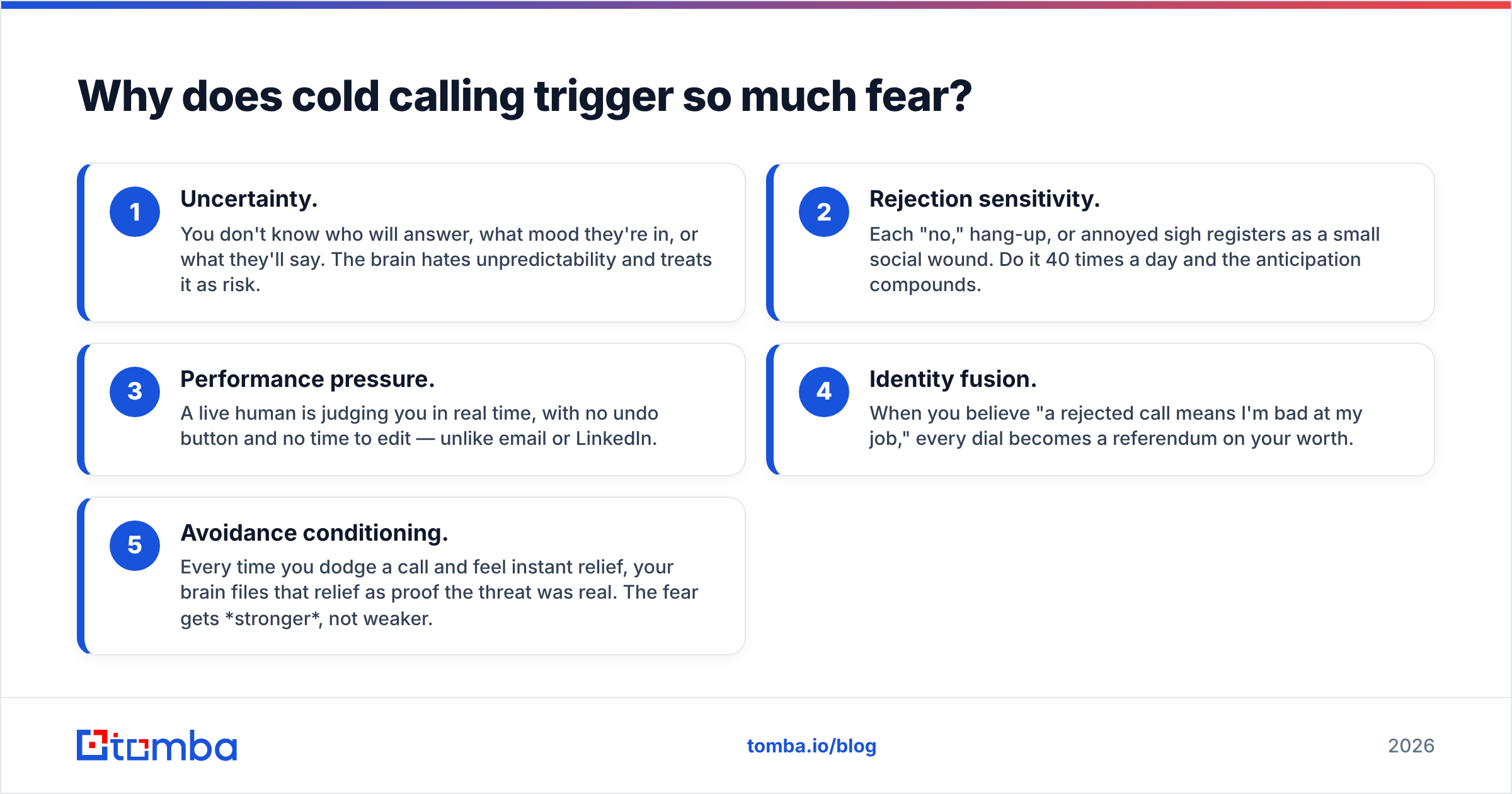
- Uncertainty. You don't know who will answer, what mood they're in, or what they'll say. The brain hates unpredictability and treats it as risk.
- Rejection sensitivity. Each "no," hang-up, or annoyed sigh registers as a small social wound. Do it 40 times a day and the anticipation compounds.
- Performance pressure. A live human is judging you in real time, with no undo button and no time to edit — unlike email or LinkedIn.
- Identity fusion. When you believe "a rejected call means I'm bad at my job," every dial becomes a referendum on your worth.
- Avoidance conditioning. Every time you dodge a call and feel instant relief, your brain files that relief as proof the threat was real. The fear gets stronger, not weaker.
That last point is the trap. Avoidance feels like self-protection, but it's the engine that keeps cold calling anxiety alive.
Is cold calling anxiety normal, or a sign you're in the wrong job?#
It's normal — overwhelmingly so. Surveys of sales professionals routinely find that call reluctance affects a large share of reps at some point, including experienced closers. Research on sales call reluctance, pioneered by psychologists George Dudley and Shannon Goodson, identified it as a distinct and treatable pattern rather than a personality defect. You can read a broad overview of the underlying stress response on Wikipedia's fight-or-flight entry.
The reps who look "fearless" mostly aren't. They've built systems that shrink the fear to a manageable size, and they've stacked enough reps to prove to their nervous system that calls are safe. That's a skill, and skills are learnable.
How do you actually reduce cold calling anxiety?#
There's no single switch. But these nine tactics, layered together, do the heavy lifting. They fall into three buckets: prepare your inputs, retrain your brain, and manage your body.
Prepare your inputs#
1. Call a clean, well-matched list. Nothing spikes anxiety like dialing a wrong number, a disconnected line, or someone who has zero reason to care. When your list is accurate and relevant, more calls turn into conversations, and your brain updates its threat model. This is where good data does more for your nerves than any breathing exercise — pairing a verified B2B phone numbers list with role-matched prospects means you're mostly talking to people who could plausibly buy.
2. Write a flexible opener, not a rigid script. Memorize the first 10 seconds cold, then keep bullet points for the rest. A known opening removes the "how do I even start" panic without making you sound like a robot reading a card.
3. Know your one next step. Decide before you dial what a "win" looks like — usually a booked meeting or a qualified disqualification. When the destination is clear, the call has rails.
Retrain your brain#
4. Reframe the goal from closing to collecting. You're not there to close on the first call. You're there to learn whether this person has the problem you solve. A call literally cannot "fail" if the job is gathering information. This one reframe deflates most of the pressure.
5. Set volume goals, not outcome goals. "Make 30 dials" is fully in your control. "Book 3 meetings" is not. Reward yourself for the activity, and results follow without the outcome anxiety.
6. Warm up with the easy calls first. Start your block with low-stakes dials — existing contacts, warm referrals, or friendly accounts — to get your voice and confidence going before the harder ones.
Manage your body#
7. Breathe before you dial. A slow exhale (in for 4, out for 6) activates the parasympathetic nervous system and physically lowers your heart rate. Do it for 60 seconds before your first call.
8. Stand up and move. Posture changes physiology. Standing, walking, or even smiling while dialing measurably shifts your tone and lowers perceived stress.
9. Timebox and batch. Anxiety balloons when a task feels endless. A defined 45-minute power hour with a clear stop time is far easier to face than "call all day."
What's the difference between winging it and a system?#
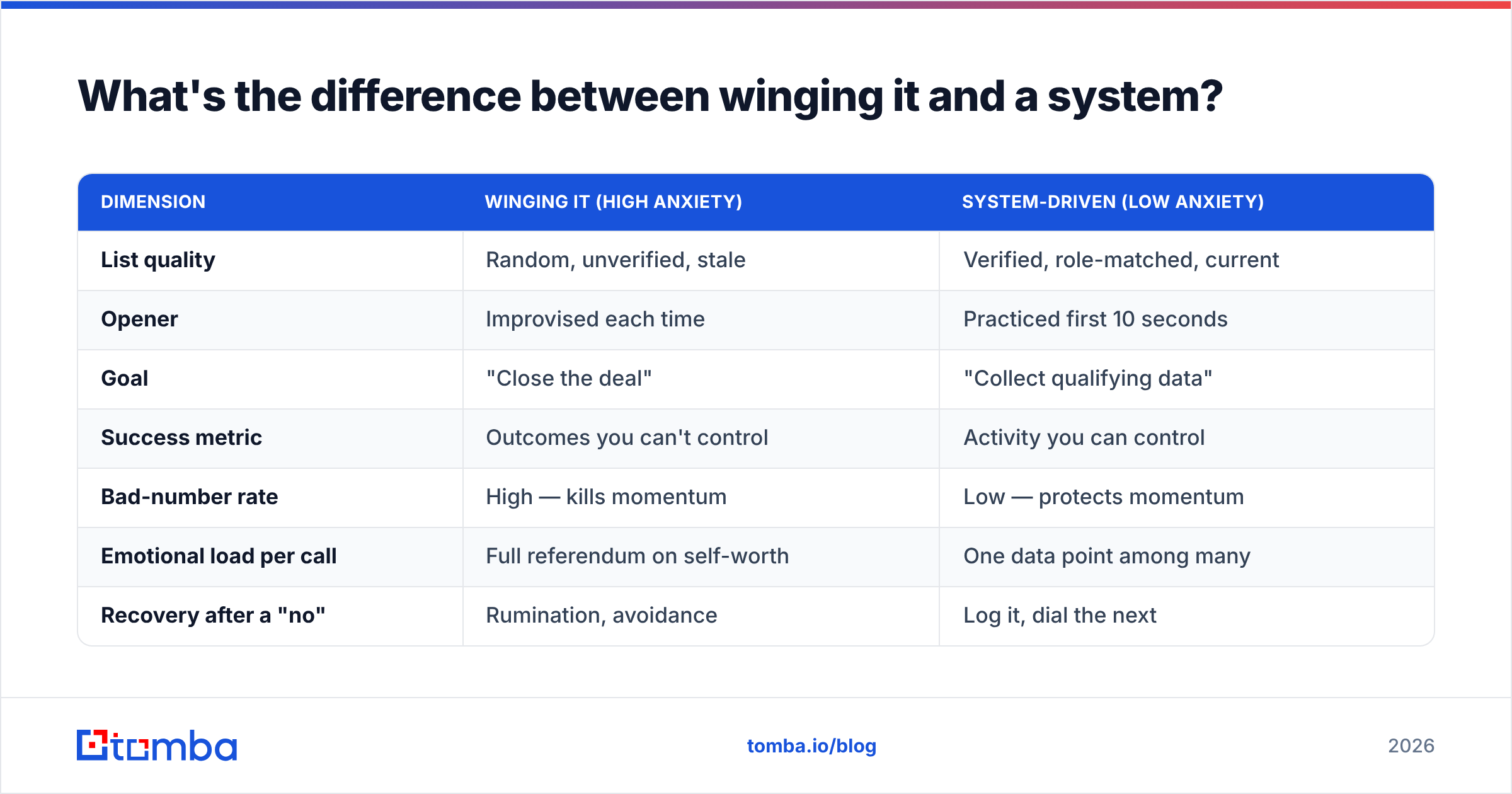
Reps who struggle most tend to treat every call as an isolated act of courage. Reps who thrive treat calling as a repeatable system with tuned inputs. Here's the contrast:
| Dimension | Winging it (high anxiety) | System-driven (low anxiety) |
|---|---|---|
| List quality | Random, unverified, stale | Verified, role-matched, current |
| Opener | Improvised each time | Practiced first 10 seconds |
| Goal | "Close the deal" | "Collect qualifying data" |
| Success metric | Outcomes you can't control | Activity you can control |
| Bad-number rate | High — kills momentum | Low — protects momentum |
| Emotional load per call | Full referendum on self-worth | One data point among many |
| Recovery after a "no" | Rumination, avoidance | Log it, dial the next |
The right-hand column isn't a personality type. It's a set of decisions and tools you can adopt this week.
How does better data lower call anxiety?#
Because the single biggest source of on-call dread is a bad conversation — and most bad conversations start with a bad contact. When you dial someone whose number is wrong, whose role doesn't fit, or who has no plausible need, you get friction, confusion, and rejection that teaches your brain to fear the phone.
Flip that. When your list is verified and enriched, you spend your dials on real, reachable, relevant people. You still hear "no," but you hear it from the right humans in the right context — which is far less bruising and far more useful. Over a few weeks, this quietly rewires your threat response.
A practical stack looks like this:
- Find the right people. Use domain search to map the decision-makers at a target account, then pull their direct lines.
- Verify before you dial. Run numbers through a phone validator so you're not burning emotional energy on dead lines.
- Enrich for context. Layer in data enrichment so you open with something relevant instead of a generic pitch.
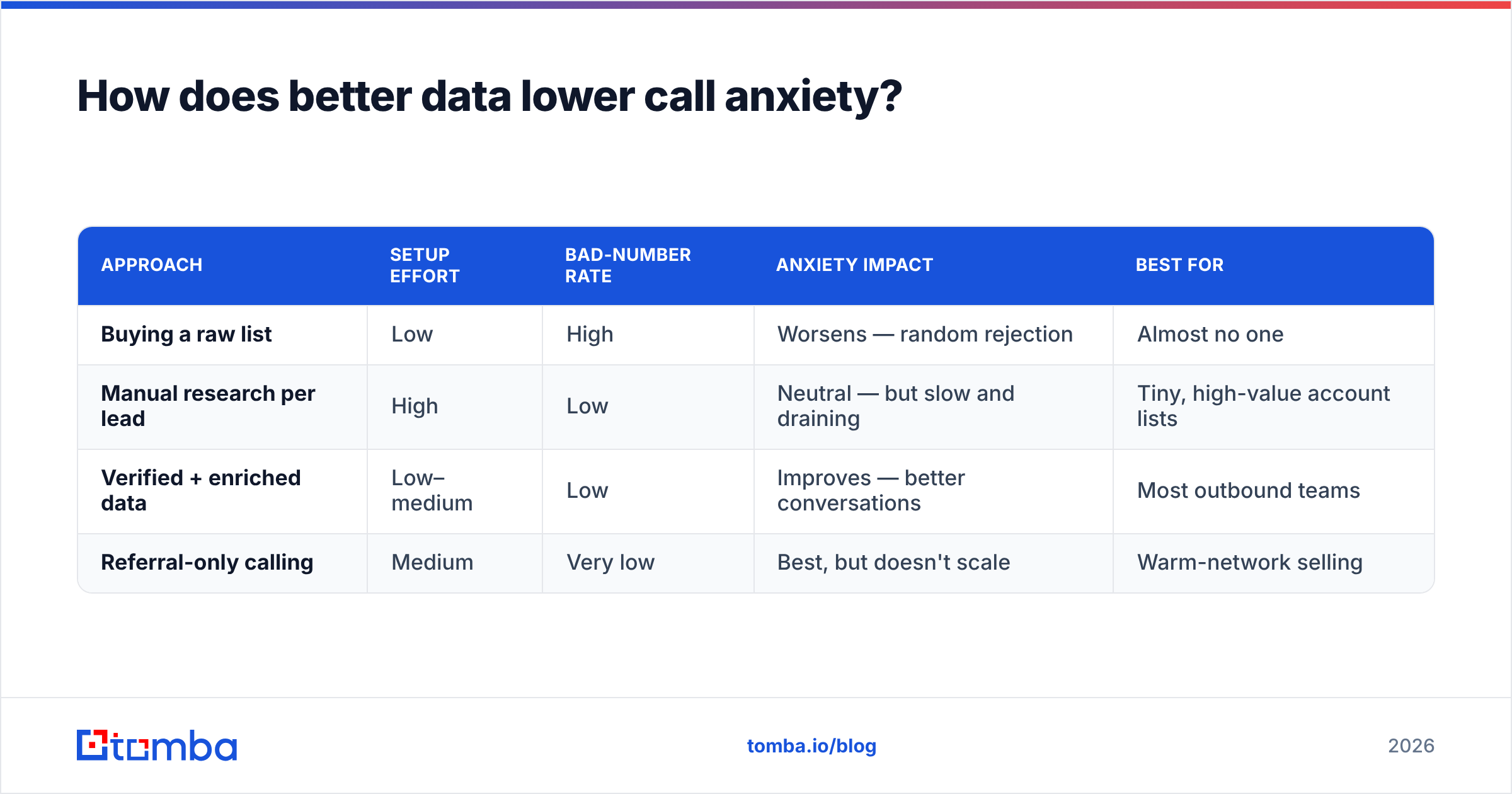
Compare a few common approaches by their impact on your nerves and your numbers:
| Approach | Setup effort | Bad-number rate | Anxiety impact | Best for |
|---|---|---|---|---|
| Buying a raw list | Low | High | Worsens — random rejection | Almost no one |
| Manual research per lead | High | Low | Neutral — but slow and draining | Tiny, high-value account lists |
| Verified + enriched data | Low–medium | Low | Improves — better conversations | Most outbound teams |
| Referral-only calling | Medium | Very low | Best, but doesn't scale | Warm-network selling |
For a fuller look at where contact data comes from and how accuracy is measured, vendor documentation like Tomba's data sources page and third-party review sites such as G2 are more reliable than any single blog claim, including this one.
What should managers do about team-wide call reluctance?#
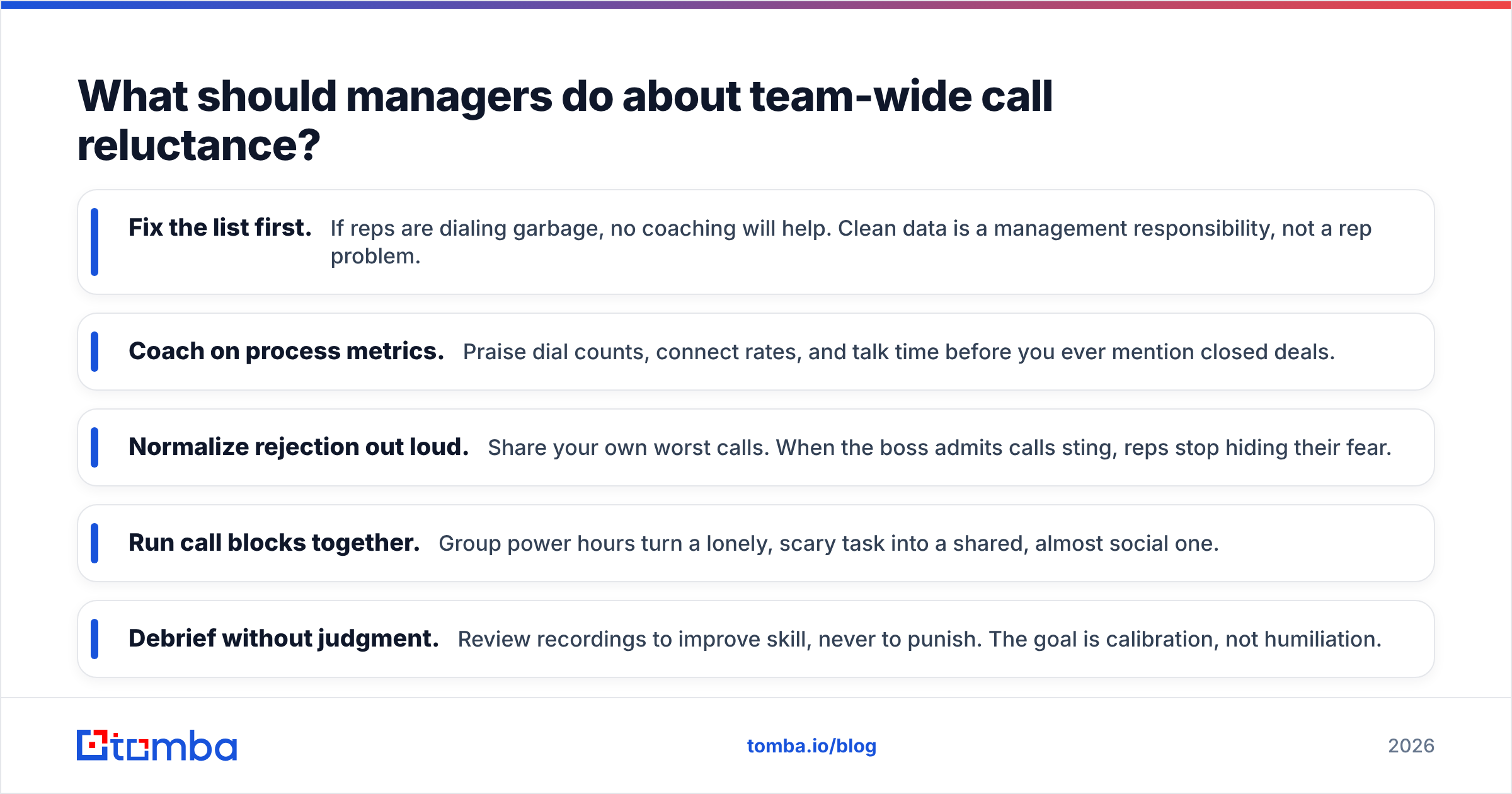
If you lead a team, the fix is structural, not motivational. Yelling "just make the calls" adds shame to fear, which deepens avoidance.
- Fix the list first. If reps are dialing garbage, no coaching will help. Clean data is a management responsibility, not a rep problem.
- Coach on process metrics. Praise dial counts, connect rates, and talk time before you ever mention closed deals.
- Normalize rejection out loud. Share your own worst calls. When the boss admits calls sting, reps stop hiding their fear.
- Run call blocks together. Group power hours turn a lonely, scary task into a shared, almost social one.
- Debrief without judgment. Review recordings to improve skill, never to punish. The goal is calibration, not humiliation.
You can pair these habits with the rest of your outbound motion — for teams building a repeatable engine, it's worth reading up on sales prospecting fundamentals and connecting your dialer to your CRM through your existing integrations so every call is logged without extra friction.
Does cold calling anxiety ever fully go away?#
Mostly, yes — but not by eliminating the feeling. Experienced reps still get a small pre-call buzz; they've just reclassified it. The racing heart that once meant "danger, avoid" gets relabeled as "I'm activated and ready." Same chemistry, different story. That reappraisal, plus enough reps to prove calls are safe, is what "getting over it" actually looks like.
The path is boring and reliable: prepare your inputs, take the reps, protect your momentum with good data, and treat each call as one data point instead of a verdict. Do that for a few weeks and the alarm quiets on its own.
The fastest lever you control today#
You can't instantly rewire your nervous system, but you can instantly upgrade who you're calling — and that's the input that shapes every dial. Fewer dead numbers, fewer irrelevant contacts, and more real conversations mean less brutal rejection and faster desensitization.
Start by building a verified, role-matched call list with Tomba's Email Finder and its companion phone tools, so every dial lands on a real person who could plausibly say yes. Check the Tomba pricing — the free tier gives you 25 searches a month to test the difference, and paid plans start at $49/mo when you're ready to scale your outbound. Better data won't make you fearless overnight, but it will stack enough good conversations to teach your brain the truth: the phone was never the threat.
Related guides#
Ready to find emails that actually work?
Join 150,000+ professionals who stopped guessing and started sending. Free credits on signup — no credit card required.
Get the Tomba newsletter
Practical outbound tactics and product updates — once every two weeks.
About the author