Cold Calling in B2B: The 2026 Playbook That Books Meetings
Cold calling isn't dead in B2B — it's just changed. Here's the data, scripts, timing, and pre-call research that separate reps who book meetings from reps who get hung up on.
Cold calling gets declared dead every year, and every year top B2B teams keep hitting quota with it. The difference in 2026 isn't whether you pick up the phone — it's how much you know before you dial, how tight your first fifteen seconds are, and whether the number you're calling is even real.
This guide is the practical version: what works, what wastes your day, and the exact process to run so your dials turn into conversations instead of voicemails.
TL;DR#
- Cold calling B2B still works — reps who research before dialing book 2-3x more meetings than reps who spray-and-pray.
- Data quality decides everything. Bad phone numbers and wrong contacts kill connect rates before your script matters.
- The first 15 seconds are the whole game: name the reason you called, earn 30 more seconds, then ask a question.
- Timing beats volume. Tuesday–Thursday, mid-morning and late afternoon, in the prospect's timezone.
- Multichannel wins. Pair calls with email and LinkedIn touches; a call after an opened email connects far more often.
Is cold calling B2B still worth it in 2026?#
Short answer: yes, for the right motion. Cold calling remains one of the fastest ways to reach a decision-maker directly, especially for mid-market and enterprise deals where a single conversation can be worth six figures.
The nuance is that raw dial volume no longer wins on its own. Buyers screen calls harder, gatekeepers are sharper, and mobile-first workforces mean the office line often rings an empty desk. What still works is targeted, researched calling — fewer dials into better-qualified accounts, backed by accurate contact data.
Think of cold calling like fishing. You can throw a net anywhere and hope, or you can find where the fish actually are, use the right bait, and cast at the right time. In 2026, the reps who "find the fish first" — through account research and verified contact data — outperform the high-volume dialers who never check their aim.
Gartner's research on B2B buying consistently shows buyers want fewer, more relevant interactions — which is an argument for precision calling, not against calling itself. You can read more on how buyers evaluate vendors in Gartner's B2B buying journey research.
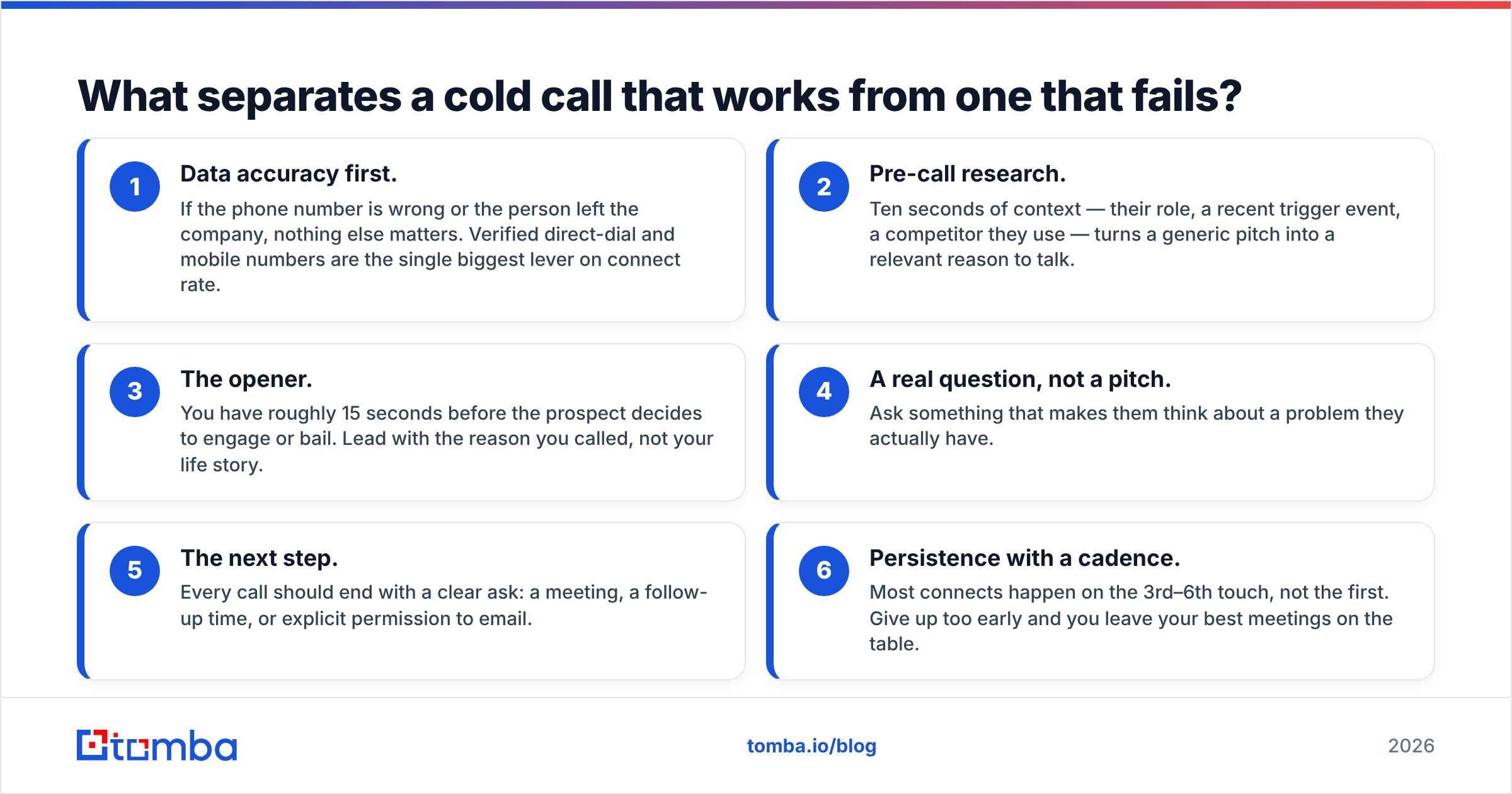
What separates a cold call that works from one that fails?#
Most failed cold calls fail before the dial. Here's the honest breakdown of where meetings are won and lost.
- Data accuracy first. If the phone number is wrong or the person left the company, nothing else matters. Verified direct-dial and mobile numbers are the single biggest lever on connect rate.
- Pre-call research. Ten seconds of context — their role, a recent trigger event, a competitor they use — turns a generic pitch into a relevant reason to talk.
- The opener. You have roughly 15 seconds before the prospect decides to engage or bail. Lead with the reason you called, not your life story.
- A real question, not a pitch. Ask something that makes them think about a problem they actually have.
- The next step. Every call should end with a clear ask: a meeting, a follow-up time, or explicit permission to email.
- Persistence with a cadence. Most connects happen on the 3rd–6th touch, not the first. Give up too early and you leave your best meetings on the table.
The reps who master these six don't sound like they're "cold calling" at all — they sound like someone with a specific, relevant reason to be on the phone.
How do you prepare before the first dial?#
Preparation is where average and elite reps split. Before a single call, you should know who you're calling, why, and that the number works.
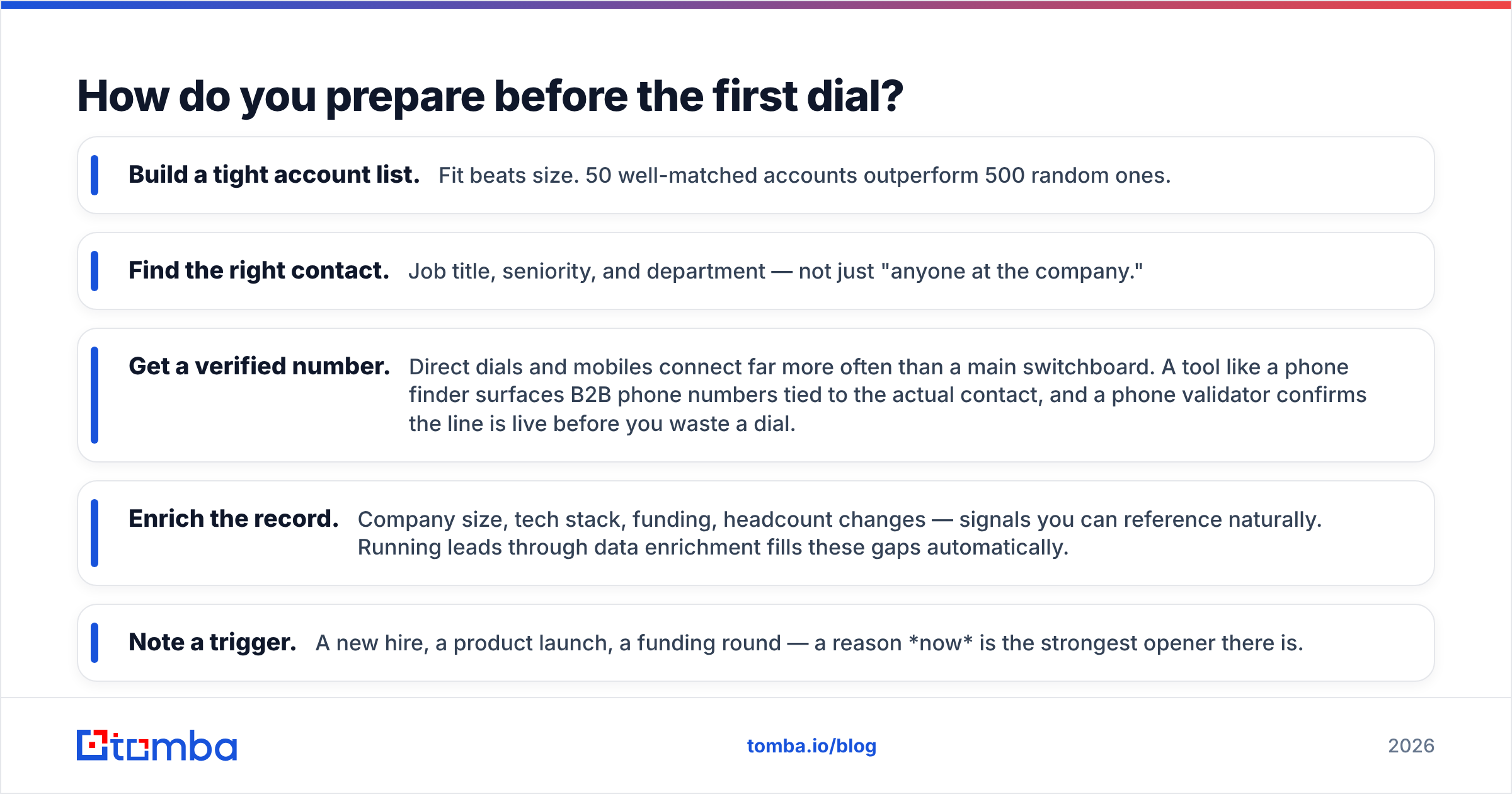
Here's the pre-call checklist that consistently lifts connect and conversion rates:
- Build a tight account list. Fit beats size. 50 well-matched accounts outperform 500 random ones.
- Find the right contact. Job title, seniority, and department — not just "anyone at the company."
- Get a verified number. Direct dials and mobiles connect far more often than a main switchboard. A tool like a phone finder surfaces B2B phone numbers tied to the actual contact, and a phone validator confirms the line is live before you waste a dial.
- Enrich the record. Company size, tech stack, funding, headcount changes — signals you can reference naturally. Running leads through data enrichment fills these gaps automatically.
- Note a trigger. A new hire, a product launch, a funding round — a reason now is the strongest opener there is.
Skipping this step is the fastest way to sound like every other cold caller. Doing it is how you sound like you did your homework — because you did.
What does a good B2B cold call script look like?#
A script isn't a word-for-word cage; it's a rail that keeps you on track under pressure. The best ones follow a simple arc: permission → reason → question → next step.
Here's a proven structure:
Opener (earn the next 30 seconds):
"Hi [Name], it's [You] from [Company]. I know I'm calling out of the blue — can I take 30 seconds to tell you why, and you can decide if it's worth continuing?"
Almost everyone says yes to a fair, low-pressure ask like that.
Reason (make it about them):
"I work with [role] at [similar companies], and the thing I keep hearing is [specific problem]. I noticed [trigger about their company], so you came to mind."
Question (open a real conversation):
"How are you handling [problem] right now?"
Next step (always close for one):
"Makes sense. Worth a 20-minute call next week to show you how [peer company] solved this? Does Thursday morning work?"
Keep it human. If they push back, don't fight — acknowledge, ask one more question, and either book the next step or exit gracefully. A clean "no" is more valuable than a dragged-out maybe.
How does cold calling compare to cold email and LinkedIn?#
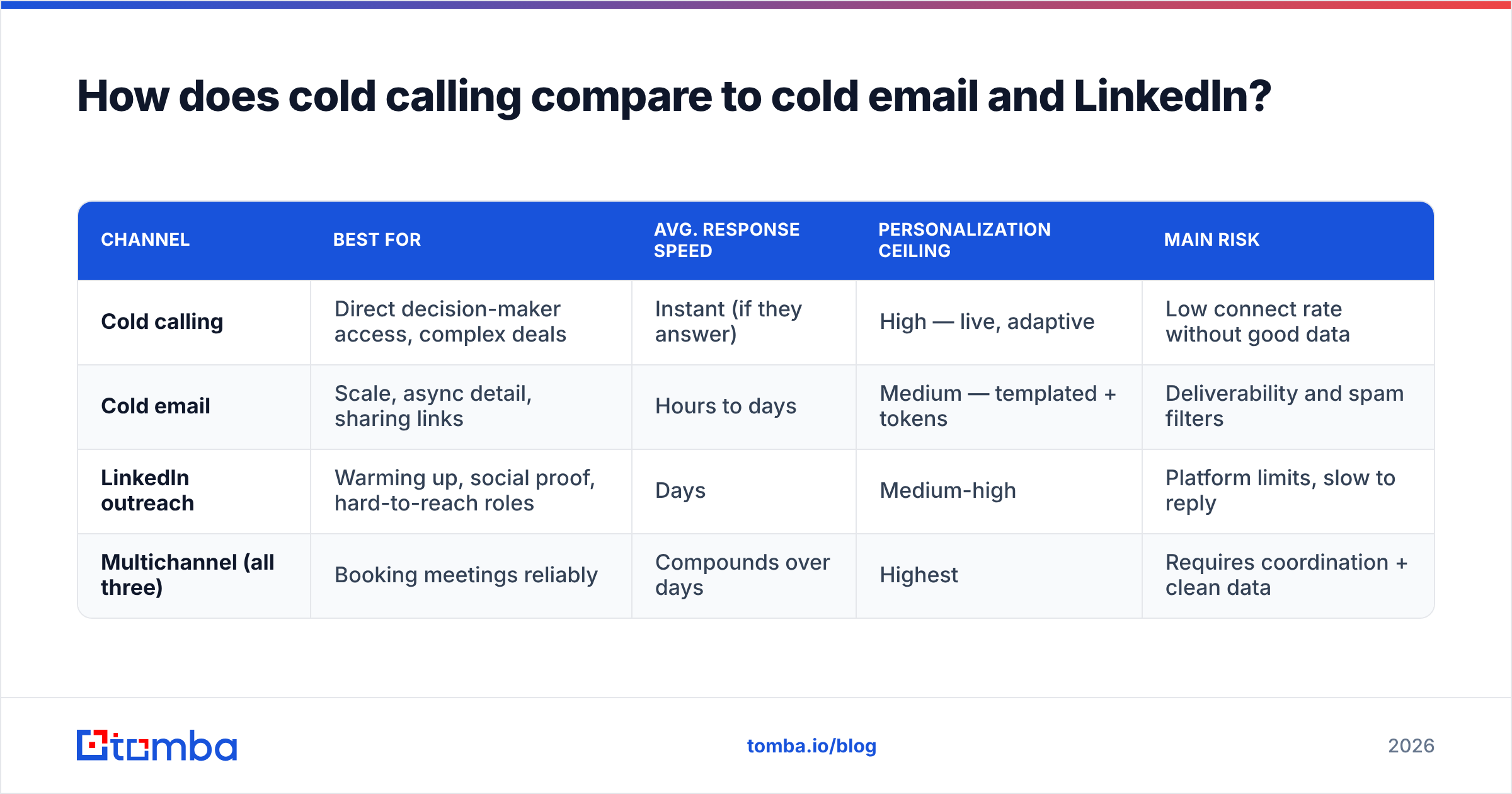
Cold calling isn't a replacement for other channels — it's a multiplier when combined with them. Each channel has different strengths, and the winning play in 2026 is to sequence them together.
| Channel | Best for | Avg. response speed | Personalization ceiling | Main risk |
|---|---|---|---|---|
| Cold calling | Direct decision-maker access, complex deals | Instant (if they answer) | High — live, adaptive | Low connect rate without good data |
| Cold email | Scale, async detail, sharing links | Hours to days | Medium — templated + tokens | Deliverability and spam filters |
| LinkedIn outreach | Warming up, social proof, hard-to-reach roles | Days | Medium-high | Platform limits, slow to reply |
| Multichannel (all three) | Booking meetings reliably | Compounds over days | Highest | Requires coordination + clean data |
The pattern that wins: send a relevant email, connect on LinkedIn, then call referencing the message. A call placed after an opened email connects noticeably more often than a truly cold dial, because you're no longer a stranger — you're "the person who emailed about [topic]."
If email is part of your motion, tightening those touches with proven cold email templates and clean lists makes the whole sequence pull harder.
When is the best time to cold call B2B prospects?#
Timing won't fix a bad list, but with a good one it meaningfully lifts connect rates. General patterns hold across most B2B teams:
- Best days: Tuesday, Wednesday, Thursday. Mondays are chaos; Fridays are check-out.
- Best windows: Mid-morning (around 10–11:30am) and late afternoon (around 4–5:30pm) in the prospect's local time. That last window catches people winding down and more willing to talk.
- Worst window: Right after lunch and the first hour of Monday morning.
- Follow the trigger. If someone just changed jobs, launched a product, or downloaded content, call within days — relevance decays fast.
Always call in the prospect's timezone, not yours. It sounds obvious, but it's one of the most common connect-rate killers for teams selling across regions. HubSpot's sales research offers more benchmarks on outreach timing and cadence in its sales statistics roundup.
What tools do you actually need for B2B cold calling?#
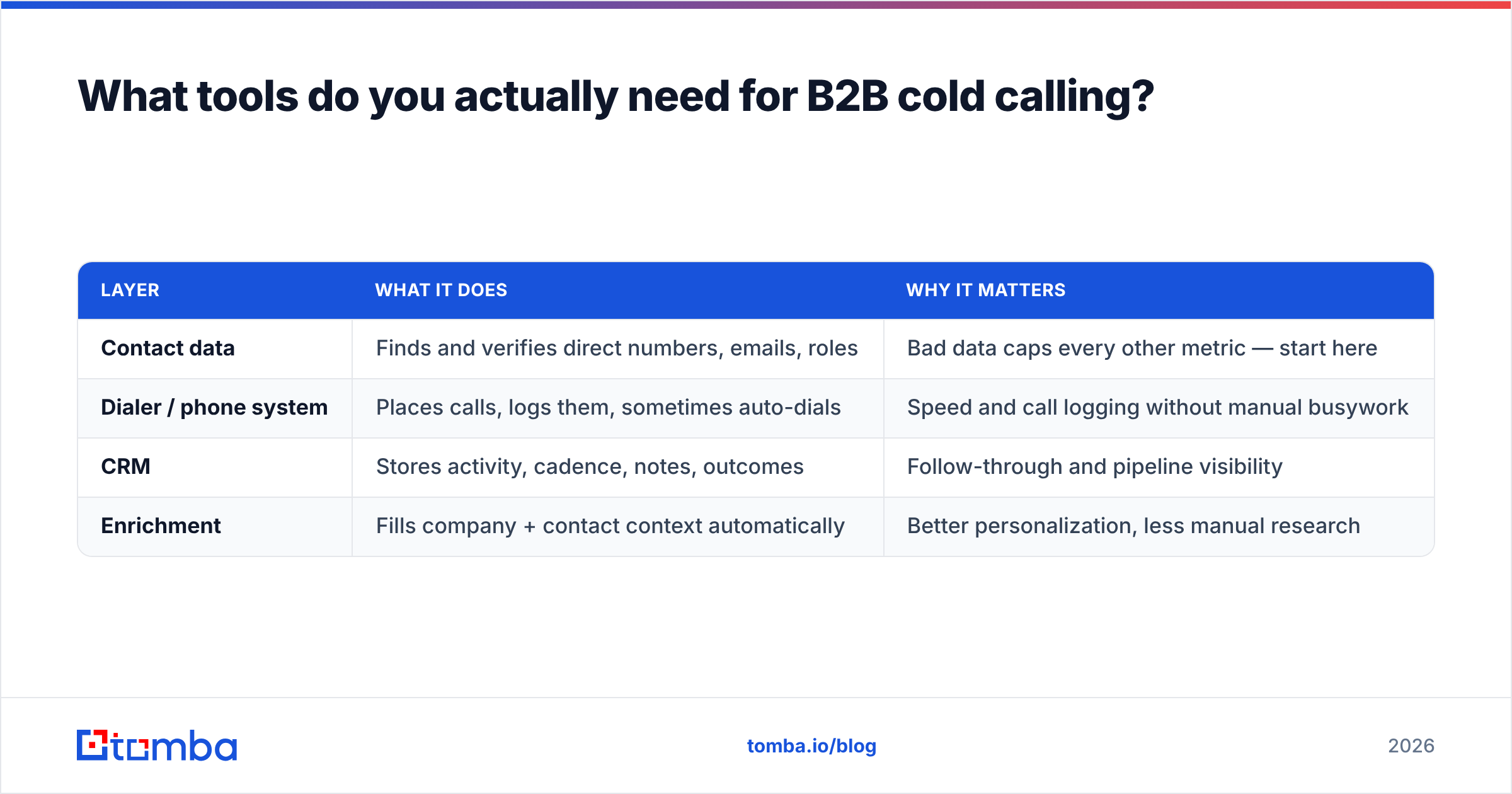
You don't need a bloated stack. You need three things working together: good data, a way to dial, and a way to track.
| Layer | What it does | Why it matters |
|---|---|---|
| Contact data | Finds and verifies direct numbers, emails, roles | Bad data caps every other metric — start here |
| Dialer / phone system | Places calls, logs them, sometimes auto-dials | Speed and call logging without manual busywork |
| CRM | Stores activity, cadence, notes, outcomes | Follow-through and pipeline visibility |
| Enrichment | Fills company + contact context automatically | Better personalization, less manual research |
The layer teams underinvest in is the first one. You can have the slickest dialer and the best CRM, but if 30% of your numbers are stale, you're paying reps to dial dead lines. Building your list from a reliable B2B database and verifying contacts up front is the cheapest performance gain available.
How do you measure and improve cold calling performance?#
Track a small set of metrics and improve them one at a time. Vanity metrics like "total dials" hide more than they reveal.
- Connect rate — % of dials that reach a live target. Low? Fix your data first.
- Conversation rate — % of connects that become real conversations. Low? Fix your opener.
- Meeting rate — % of conversations that book a next step. Low? Fix your questions and close.
- Show rate — % of booked meetings that actually happen. Low? Fix your confirmation and value framing.
Isolate the weakest number and work only on that. If connect rate is your bottleneck, no script tweak will save you — you need better numbers. If conversation rate is weak, your first 15 seconds need work. Diagnosing the right stage is how you improve fast instead of guessing.
For teams building or vetting a stack, peer reviews on sites like G2 are a useful reality check on which data and dialer tools actually deliver for cold calling specifically.
Common cold calling mistakes to avoid#
- Dialing without verifying the number. The most expensive mistake, because it wastes time you can't get back.
- Pitching in the first breath. Nobody wants a monologue from a stranger. Ask, don't tell.
- Talking past the "no." Respect it, learn from it, move on.
- Calling once and quitting. Most meetings come from persistence across a cadence.
- Reading the script like a robot. The script is a rail, not a cage. Sound like a person.
- Ignoring the CRM. If it's not logged, it didn't happen — and you'll re-dial the same dead leads.
The bottom line#
Cold calling in B2B is alive and effective in 2026 — but only for reps who treat it as precision work, not a numbers grind. Research the account, verify the contact, nail the first fifteen seconds, ask a real question, and always close for a next step. Do that consistently and the phone becomes one of the highest-ROI channels you have.
The unglamorous truth is that most of the win happens before you dial: accurate, verified contact data. If your reps are burning hours on wrong numbers and stale records, fix that first — everything downstream improves.
Start by building a clean, verified prospect list. Use Tomba's Email Finder to pull accurate professional contacts by name, company, or domain, pair it with the phone finder for verified direct dials, and enrich the rest so your reps walk into every call with a real reason to talk. Better data in means more meetings out — check the Tomba plans (free tier included) and give your callers a list worth dialing.
Related guides#
// get started
Find, verify and enrich your first contacts today
Start on the free plan with 25 searches a month, then scale when your team is ready.
Free plan · No credit card required · GDPR & CCPA
// about the author