The Cold Calling Checklist That Actually Books Meetings (2026)
A practical, step-by-step cold calling checklist for 2026 — what to prep before you dial, what to say on the call, and how top reps turn a phone number into a booked meeting.
Cold calling is not dead — sloppy cold calling is. The reps still booking meetings over the phone in 2026 are not smiling-and-dialing a raw list. They run a repeatable process every single call, and that process starts long before the phone rings.
This is that process, written down as a cold calling checklist you can print, pin, or paste into your CRM. Work through it top to bottom and you will sound more prepared, get past more gatekeepers, and turn more dials into calendar invites.
TL;DR — The cold calling checklist at a glance#
- Prep beats dials. Ten minutes of research per account beats 100 blind calls. Verify the number, know the trigger, and write one relevant line before you dial.
- The first 8 seconds decide the call. A pattern-interrupt opener plus a permission-based question keeps you off the "not interested" reflex.
- Handle objections with a script, not improvisation. The four objections you hear cover 90% of calls — prepare all four.
- Every call ends with a next step. A booked meeting, a scheduled callback, or a documented disqualification. Never "I'll try again sometime."
- Log everything. Numbers, dispositions, and objections feed your next round. Bad data is the number-one reason cold calls fail.
Why do you need a cold calling checklist at all?#
Because consistency is the entire game. A checklist is like a pilot's pre-flight routine: even experienced pilots run it every time, because the cost of skipping one step is too high to trust memory. Cold calling is the same. The reps who "wing it" have good days and terrible days. The reps who run the same sequence every call have a predictable connect rate, a predictable talk-to-meeting ratio, and a pipeline they can forecast.
A checklist also makes you coachable. When every call follows the same steps, you can see exactly where deals fall apart — the opener, the discovery, the ask — and fix that one link instead of blaming "the list."
What goes on the pre-call checklist (before you dial)?#
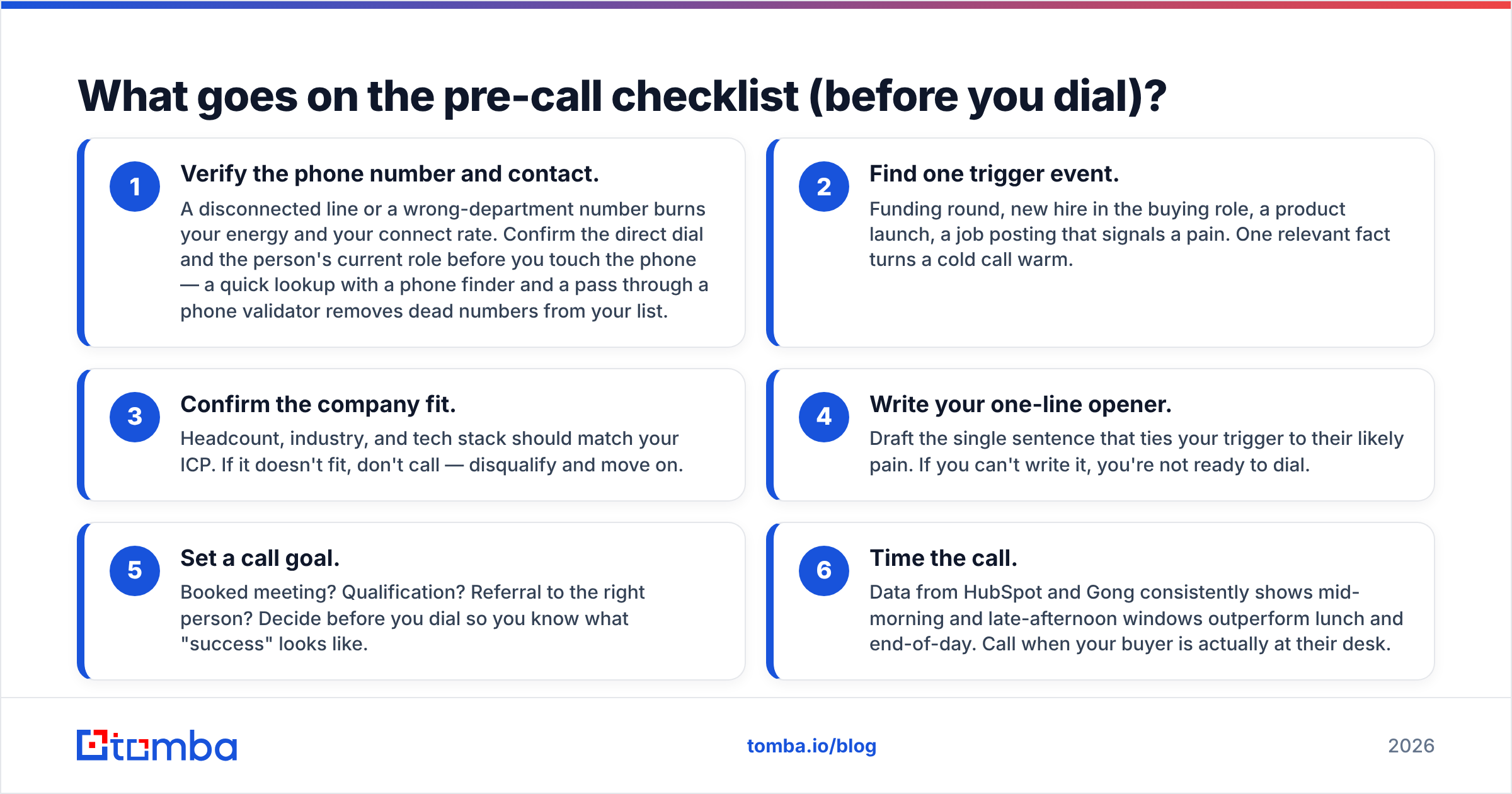
This is where most reps lose. They treat prep as optional and then wonder why every call opens with an awkward "So, um, what does your company do?" Do this instead:
- Verify the phone number and contact. A disconnected line or a wrong-department number burns your energy and your connect rate. Confirm the direct dial and the person's current role before you touch the phone — a quick lookup with a phone finder and a pass through a phone validator removes dead numbers from your list.
- Find one trigger event. Funding round, new hire in the buying role, a product launch, a job posting that signals a pain. One relevant fact turns a cold call warm.
- Confirm the company fit. Headcount, industry, and tech stack should match your ICP. If it doesn't fit, don't call — disqualify and move on.
- Write your one-line opener. Draft the single sentence that ties your trigger to their likely pain. If you can't write it, you're not ready to dial.
- Set a call goal. Booked meeting? Qualification? Referral to the right person? Decide before you dial so you know what "success" looks like.
- Time the call. Data from HubSpot and Gong consistently shows mid-morning and late-afternoon windows outperform lunch and end-of-day. Call when your buyer is actually at their desk.
Enrich the account once and reuse it across the whole sequence. Pulling firmographics and contact details through data enrichment means you're not researching from scratch on every dial — you research the account once and call the whole buying committee.
What is the ideal cold call structure?#
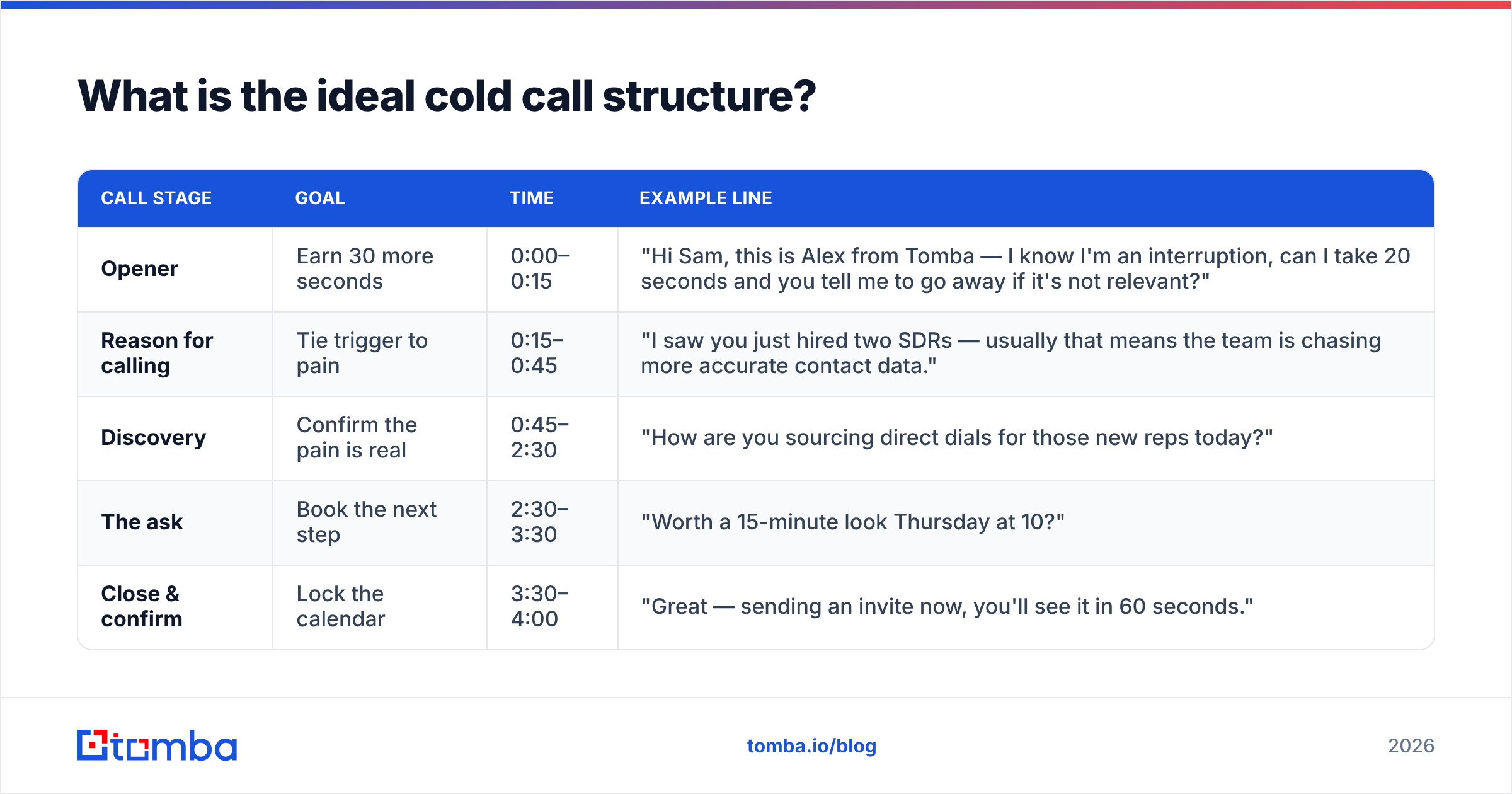
Every strong cold call has the same five beats. Memorize the skeleton, not a word-for-word script — buyers can hear a read script instantly.
| Call stage | Goal | Time | Example line |
|---|---|---|---|
| Opener | Earn 30 more seconds | 0:00–0:15 | "Hi Sam, this is Alex from Tomba — I know I'm an interruption, can I take 20 seconds and you tell me to go away if it's not relevant?" |
| Reason for calling | Tie trigger to pain | 0:15–0:45 | "I saw you just hired two SDRs — usually that means the team is chasing more accurate contact data." |
| Discovery | Confirm the pain is real | 0:45–2:30 | "How are you sourcing direct dials for those new reps today?" |
| The ask | Book the next step | 2:30–3:30 | "Worth a 15-minute look Thursday at 10?" |
| Close & confirm | Lock the calendar | 3:30–4:00 | "Great — sending an invite now, you'll see it in 60 seconds." |
Notice the ask comes early. You're not selling the product on a cold call; you're selling the meeting. Keep the goal narrow.
How do you handle the four objections you'll actually hear?#
You will hear the same four objections on nearly every call. Prepare a calm, one-breath response to each and you'll stop freezing mid-call.
- "I'm not interested." Don't argue. "Totally fair — most people say that before they know why I called. Can I give you one sentence and you decide?"
- "Send me an email." This is a soft brush-off. "Happy to. So I send something relevant instead of noise — what's the biggest gap in your outbound data right now?"
- "We already use [competitor]." Good — they have budget and a use case. "Makes sense, they're solid. Most teams we talk to keep them and add us for coverage where they come up short. What's your match rate looking like?"
- "I don't have time." Respect it. "I hear you — that's exactly why I called instead of adding to your inbox. 15 minutes Thursday or Friday?"
The pattern is the same every time: acknowledge, don't fight, redirect to a question. Improvising these in the moment is where calls die, so write them down and keep them in view.
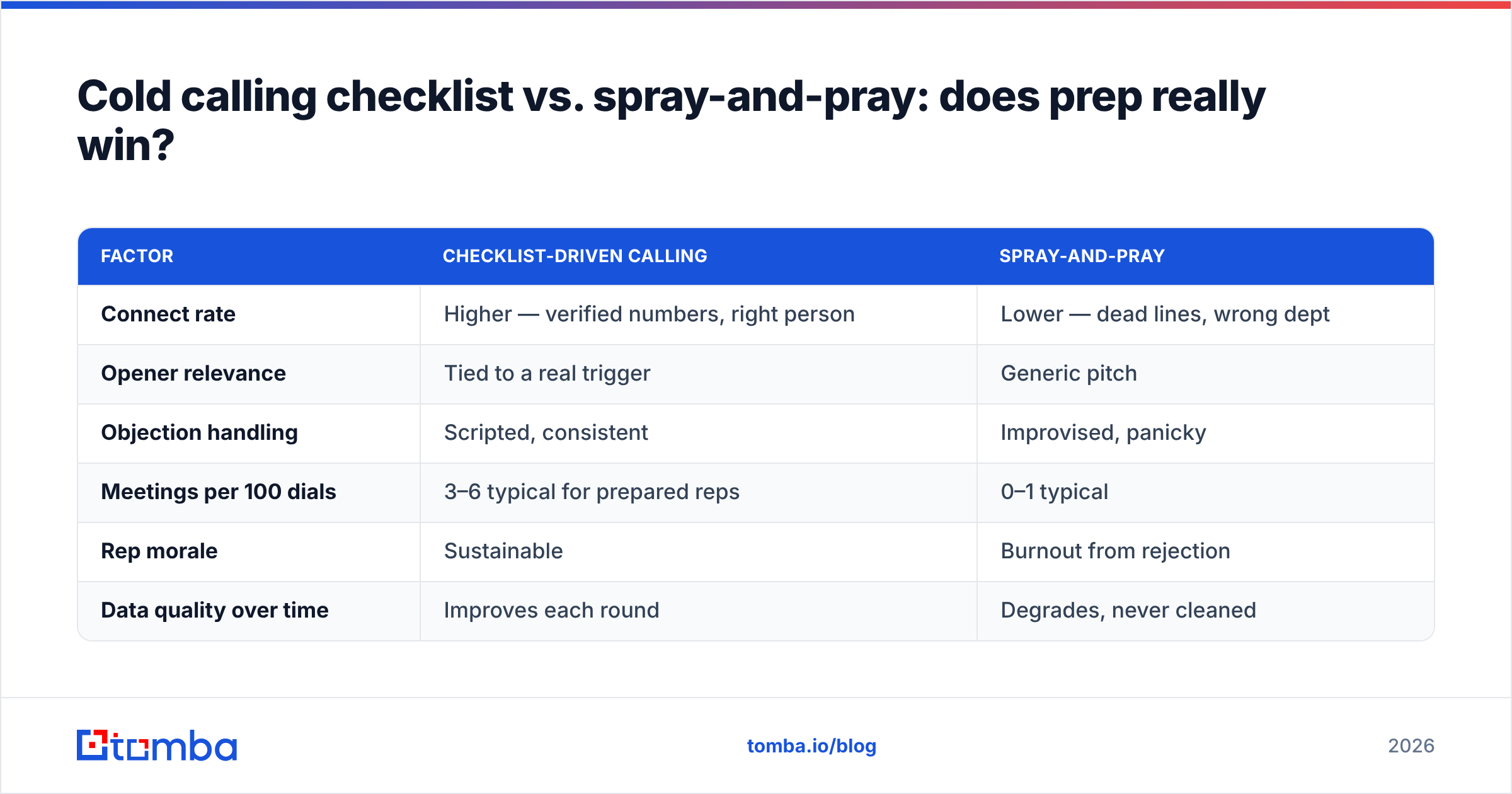
Cold calling checklist vs. spray-and-pray: does prep really win?#
Yes — and the gap is not subtle. Here's the honest comparison between running this checklist and just dialing a raw list.
| Factor | Checklist-driven calling | Spray-and-pray |
|---|---|---|
| Connect rate | Higher — verified numbers, right person | Lower — dead lines, wrong dept |
| Opener relevance | Tied to a real trigger | Generic pitch |
| Objection handling | Scripted, consistent | Improvised, panicky |
| Meetings per 100 dials | 3–6 typical for prepared reps | 0–1 typical |
| Rep morale | Sustainable | Burnout from rejection |
| Data quality over time | Improves each round | Degrades, never cleaned |
The prepared approach costs more minutes up front and returns them many times over in booked meetings. If you want a benchmark for what "good" looks like, Gong's public research on cold calls breaks down opener and talk-ratio data worth reading before you build your own script.
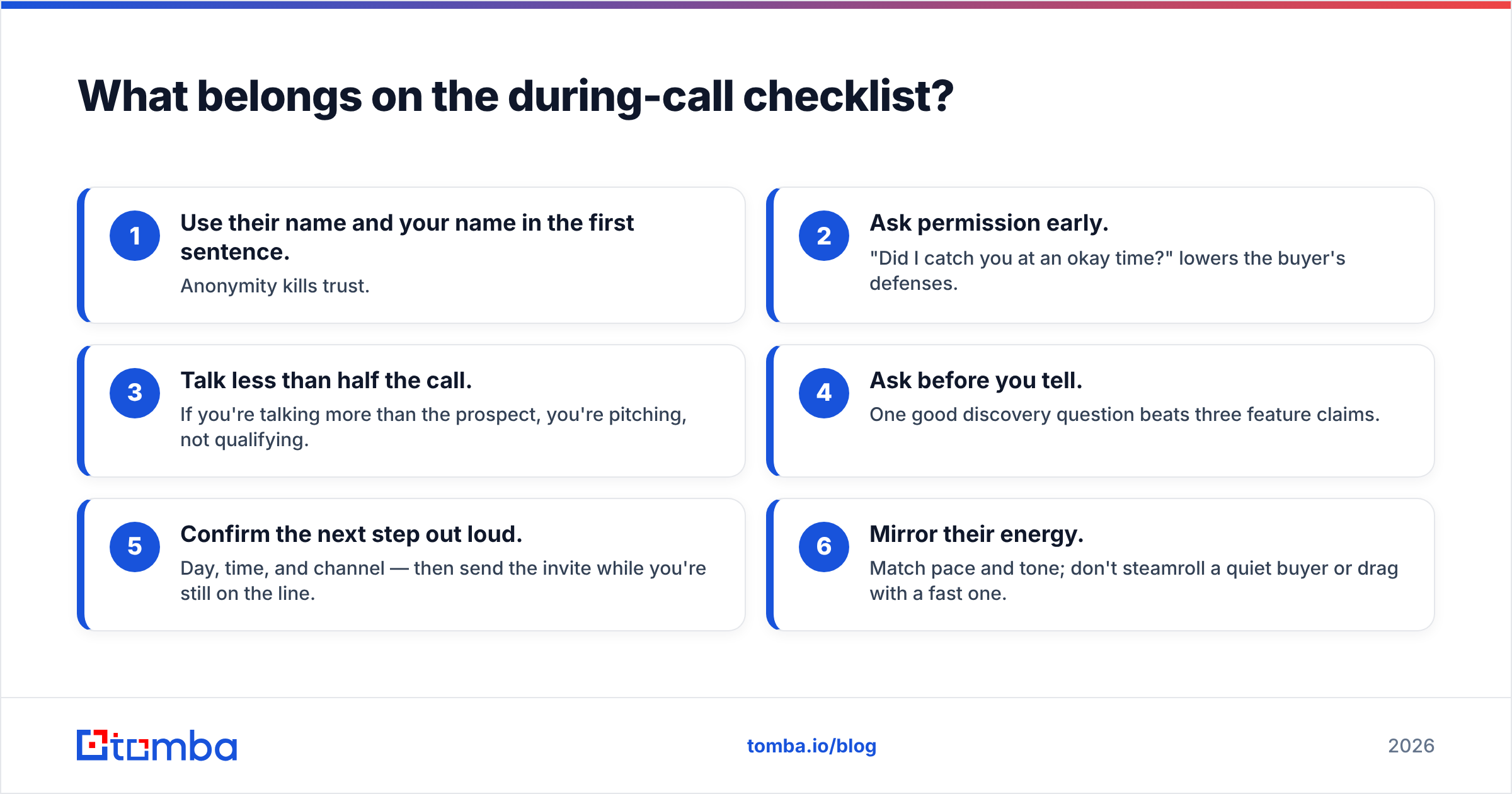
What belongs on the during-call checklist?#
Keep these visible while you talk. They're the guardrails that stop good calls from wandering:
- Use their name and your name in the first sentence. Anonymity kills trust.
- Ask permission early. "Did I catch you at an okay time?" lowers the buyer's defenses.
- Talk less than half the call. If you're talking more than the prospect, you're pitching, not qualifying.
- Ask before you tell. One good discovery question beats three feature claims.
- Confirm the next step out loud. Day, time, and channel — then send the invite while you're still on the line.
- Mirror their energy. Match pace and tone; don't steamroll a quiet buyer or drag with a fast one.
What is the post-call checklist most reps skip?#
The call isn't over when you hang up. This is the part that compounds — the difference between a rep who improves every week and one who's stuck at the same connect rate all year.
- Log the disposition immediately. Connected, voicemail, gatekeeper, wrong number, booked. Do it before the next dial while it's fresh.
- Update the contact record. Correct the title, add the direct dial, note the buying role. Clean data is the input to your next campaign — contact enrichment can auto-fill the gaps you find.
- Send the promised follow-up in under 5 minutes. The recap email or the calendar invite goes out now, not tonight.
- Note the objection you heard. Track which objection came up so you can refine your responses and, over time, your targeting.
- Schedule the next touch. If it wasn't a meeting, it's a callback or a sequenced email. Never let a live contact go cold with no next action.
Follow-up is where most pipeline leaks. Improving your response rate on the post-call email often does more for your numbers than any change to the opener.
How do you build the list that feeds the checklist?#
A checklist can't fix a bad list. Garbage numbers and wrong titles will sink even a perfect script. Before you run any of the above, your list needs three things:
- Right accounts — matched to your ICP by size, industry, and signal.
- Right people — the actual decision-maker or champion, with a current title.
- Right numbers — direct dials that connect, not switchboards.
Sourcing that manually is slow. Pulling verified contact data programmatically — through the Tomba API or a bulk export — lets you spend your prep time on research and triggers instead of hunting for phone numbers. If you also run email sequences alongside calls (you should — multi-channel outbound outperforms single-channel), tools like HubSpot's sales dialer or Salesforce can log calls and emails against the same record so nothing falls through.
Frequently asked questions#
How many cold calls should I make a day? Volume matters less than most managers think. A prepared rep making 40–60 well-researched dials will outbook a rep making 150 blind ones. Prioritize connect rate and relevance over raw dial count.
Is a script or a checklist better? A checklist. A rigid word-for-word script sounds robotic and breaks the moment the buyer goes off-path. A checklist keeps you on-structure while letting you sound human.
What's the single biggest reason cold calls fail? Bad data. Wrong numbers, wrong titles, and no trigger event kill more calls than any weakness in your pitch. Fix the list first.
Should I leave a voicemail? Yes, but keep it under 15 seconds and reference the trigger, not the product. Voicemail plus a follow-up email lifts your callback rate meaningfully over a hang-up.
Put the checklist to work#
A cold calling checklist only pays off when the list underneath it is clean. Start there. Use the Tomba Email Finder to build accurate, verified contact lists — real people, current roles, working direct dials and emails — so every dial on your checklist lands on someone worth calling. Pair it with the phone finder to complete the record, and your prep step drops from ten minutes of hunting to thirty seconds of confirming.
Check Tomba pricing to see which plan fits your call volume — the free tier lets you test the data quality before you commit. Get the list right, run the checklist every call, and watch your dials turn into booked meetings.
Related guides#
// get started
Find, verify and enrich your first contacts today
Start on the free plan with 25 searches a month, then scale when your team is ready.
Free plan · No credit card required · GDPR & CCPA
// about the author