Cold Calling Coaching in 2026: A Complete Playbook for Sales Teams
Cold calling coaching only works when it's specific, frequent, and measured. Here's the framework, the scorecards, and the drills that actually lift connect and conversion rates.
Cold calling coaching is the highest-leverage activity a sales manager owns, and most teams do it by accident. A rep bombs a call, the manager says "be more confident next time," and everyone moves on. That is not coaching. That is commentary.
Real cold calling coaching is a repeatable system: you record calls, score them against a rubric, isolate one behavior at a time, and drill it until it becomes automatic. This guide gives you the framework, the scorecards, and the drills you can run this week.
TL;DR#
- Coaching is a system, not a pep talk. Record, score, isolate one skill, drill, re-measure. Vague feedback ("sound more excited") changes nothing.
- Frequency beats intensity. Fifteen minutes of focused coaching three times a week outperforms a two-hour monthly review.
- Score calls against a rubric so feedback is objective and reps can self-assess. Opener, discovery, objection handling, and next-step control are the four pillars.
- Bad data kills good coaching. If half your list has wrong numbers, you are coaching reps on a broken funnel. Fix the B2B phone numbers first.
- Drills build muscle memory. Role-play the first 10 seconds and the top three objections until reps stop thinking about them.
What is cold calling coaching, really?#
Think of cold calling coaching like coaching a free-throw shooter. You do not tell a player to "make more shots." You film their form, spot that their elbow drifts out, drill that single correction, and re-film. The number on the scoreboard is a lagging indicator; the elbow is the thing you actually coach.
Cold calling works the same way. "Book more meetings" is the scoreboard. The coachable behaviors are the opener, the pace, the pause after a question, the way a rep handles "I'm not interested." Technically, cold calling coaching is the structured process of observing a rep's calls, diagnosing specific behaviors, correcting one at a time, and verifying improvement with data.
The difference between coaching and managing: a manager reviews outcomes, a coach changes behaviors. You need both, but only one of them raises a rep's ceiling.
Why do most cold calling coaching programs fail?#
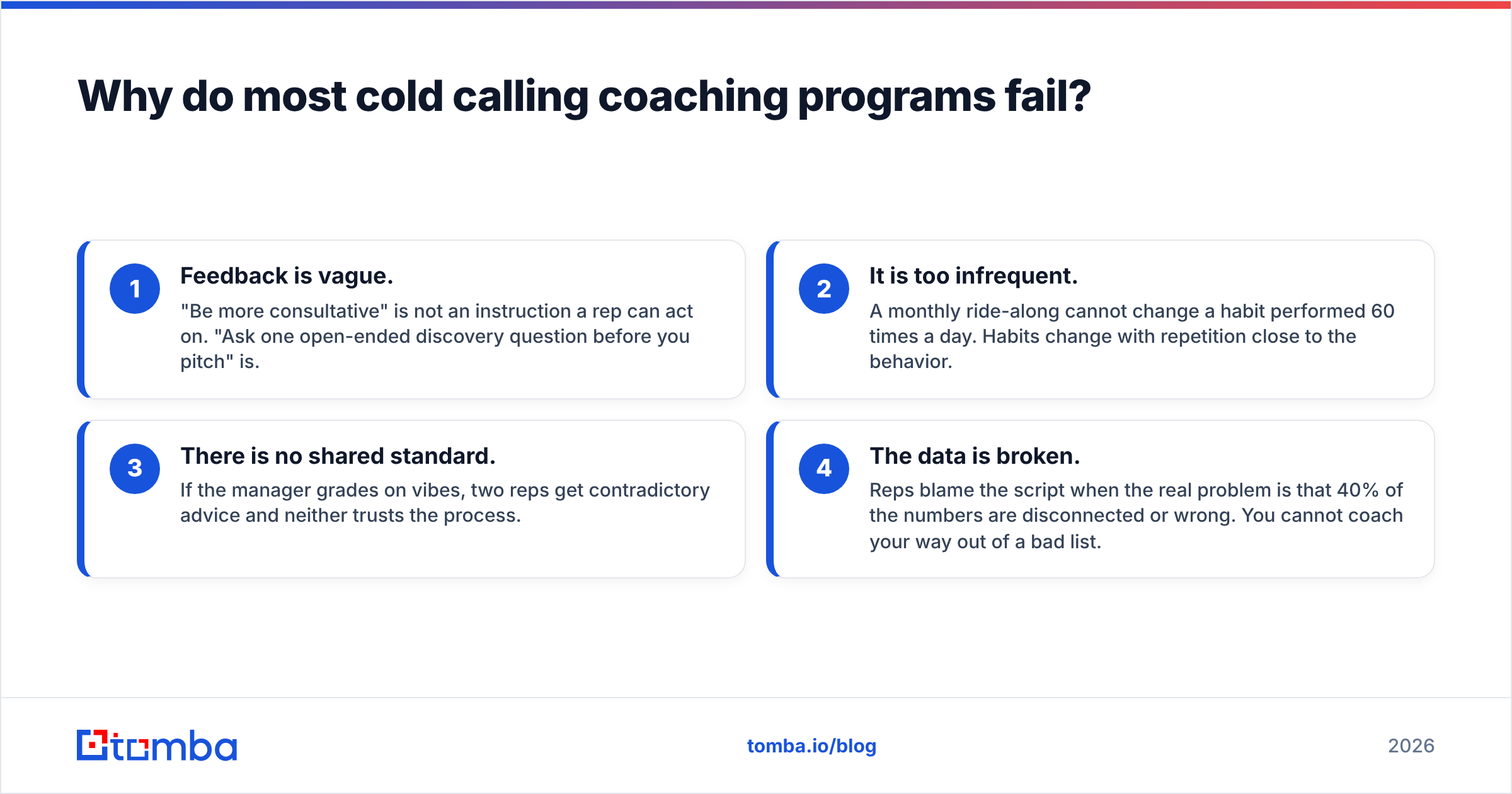
They fail for four predictable reasons, and every one of them is fixable.
- Feedback is vague. "Be more consultative" is not an instruction a rep can act on. "Ask one open-ended discovery question before you pitch" is.
- It is too infrequent. A monthly ride-along cannot change a habit performed 60 times a day. Habits change with repetition close to the behavior.
- There is no shared standard. If the manager grades on vibes, two reps get contradictory advice and neither trusts the process.
- The data is broken. Reps blame the script when the real problem is that 40% of the numbers are disconnected or wrong. You cannot coach your way out of a bad list.
That last point is the silent killer. According to broad industry benchmarks compiled by Gong's research on sales conversations, the biggest swings in cold-call success come from talk-track behaviors — but those behaviors only matter if reps are reaching live humans in the first place. Clean, verified contact data is the precondition for any coaching to show up in the numbers.
What does a cold calling coaching framework look like?#
Use a five-step loop. Run it weekly per rep.
- Record every call (with compliant consent). You cannot coach what you did not hear.
- Sample and score three to five calls against a fixed rubric. Do not review all of them — review a representative sample.
- Isolate one behavior. Pick the single highest-impact gap. One. Not five.
- Drill it in a role-play before the next call block, so the correction is fresh.
- Re-measure next week. Did the scored behavior improve? Did the connect-to-meeting rate move?
The discipline is in step 3. Managers love to dump a laundry list of fixes. Reps can absorb one change per cycle. Stack corrections and you get zero.
What should a cold call scorecard measure?#
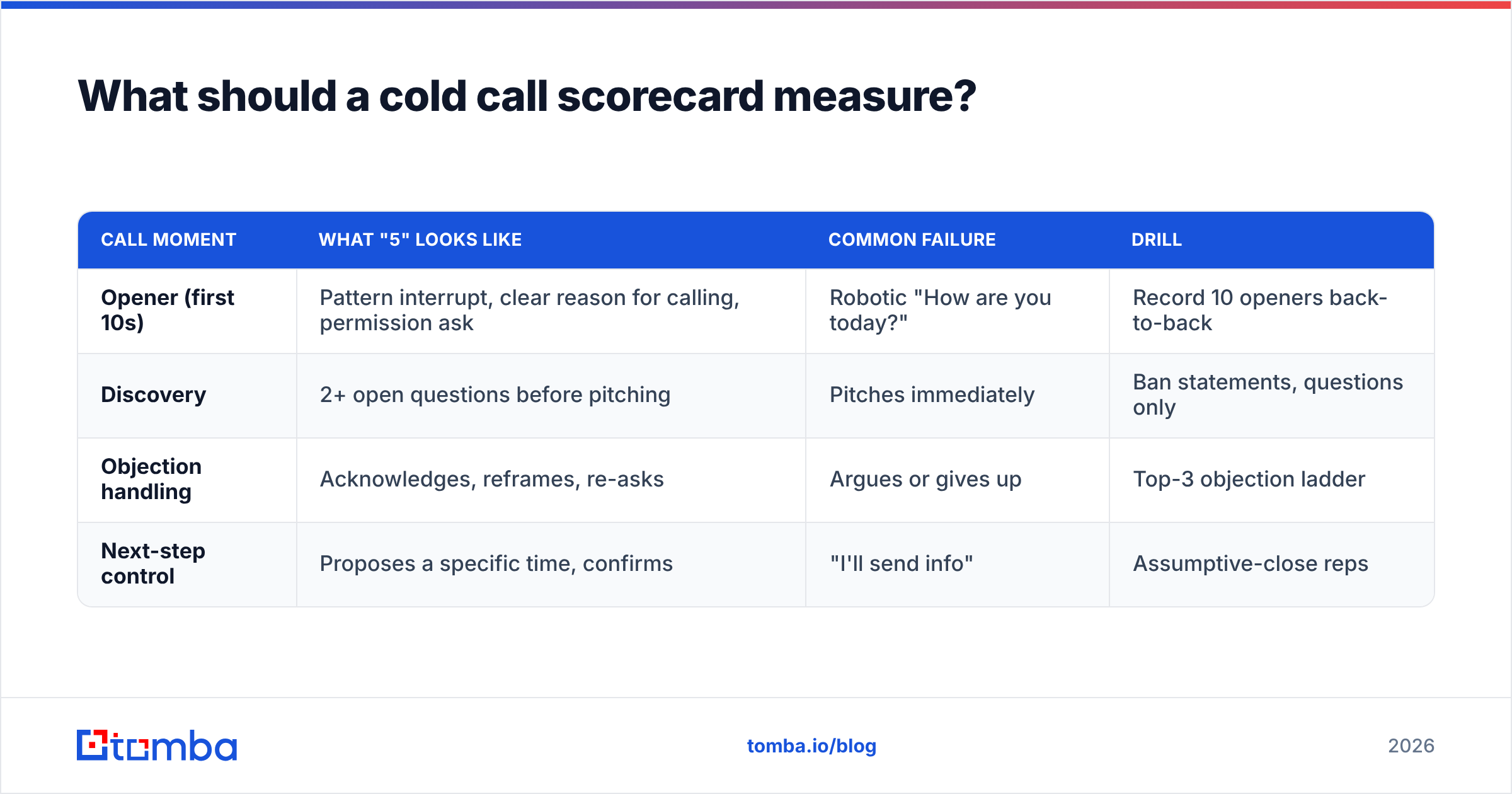
A scorecard turns opinion into data. Keep it to the four moments that decide a cold call, and grade each 1–5.
| Call moment | What "5" looks like | Common failure | Drill |
|---|---|---|---|
| Opener (first 10s) | Pattern interrupt, clear reason for calling, permission ask | Robotic "How are you today?" | Record 10 openers back-to-back |
| Discovery | 2+ open questions before pitching | Pitches immediately | Ban statements, questions only |
| Objection handling | Acknowledges, reframes, re-asks | Argues or gives up | Top-3 objection ladder |
| Next-step control | Proposes a specific time, confirms | "I'll send info" | Assumptive-close reps |
Give the rubric to your reps. When reps can self-score, coaching stops being something done to them and becomes something they run themselves. That shift is where compounding improvement comes from.
How often should you coach cold calls?#
Short answer: little and often. The research on skill acquisition and the day-to-day reality of sales floors both point the same way — spaced, frequent repetition beats rare, marathon sessions.
A workable cadence for a manager with six to eight reps:
- Daily (5 min): one live-listen or one scored call, one specific note.
- Weekly (20 min, 1:1): review the week's scores, pick the single focus behavior, drill it.
- Monthly (45 min): zoom out to trends — is the whole team weak on discovery? Build a group session.
The math is simple. A rep making 50 dials a day gets 250 reps a week at the behavior you are coaching. Coach once a month and you are trying to change a habit that has been reinforced 1,000 times since you last talked. Coach three times a week and you are steering while the clay is still wet.
Which cold calling coaching methods work best?#
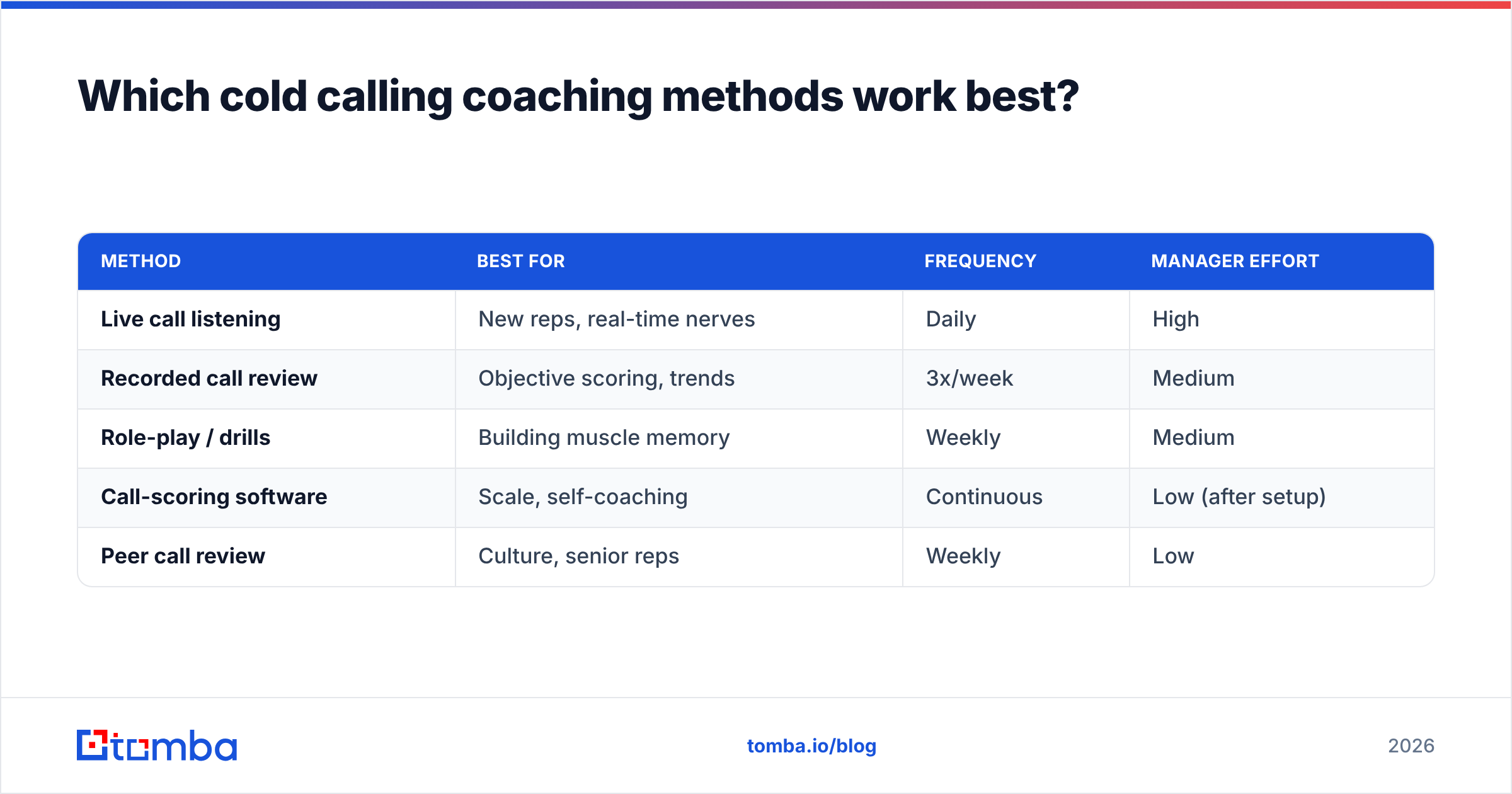
Different methods fit different problems. Here is how the common approaches compare.
| Method | Best for | Frequency | Manager effort |
|---|---|---|---|
| Live call listening | New reps, real-time nerves | Daily | High |
| Recorded call review | Objective scoring, trends | 3x/week | Medium |
| Role-play / drills | Building muscle memory | Weekly | Medium |
| Call-scoring software | Scale, self-coaching | Continuous | Low (after setup) |
| Peer call review | Culture, senior reps | Weekly | Low |
Most strong programs blend three: recorded review for objectivity, drills for repetition, and peer review to spread it across the team without bottlenecking on the manager. You will find deeper tactical breakdowns of these in resources like HubSpot's sales blog and vendor comparisons on G2.
How do you run a cold call drill that actually helps?#
The best drill is boring and repetitive on purpose. Two examples you can run in ten minutes:
The 10-second opener drill. Have the rep deliver their opener 10 times in a row, no pausing, you playing the prospect. By rep five they stop reciting and start sounding human. This is the single fastest way to fix a stiff opener, because the goal is not to write a better script — it is to make the existing one automatic.
The objection ladder. List your top three objections ("no budget," "not interested," "send me an email"). The rep must acknowledge, reframe, and re-ask a question for each — three times each, escalating your resistance. Reps who freeze on objections in the wild have simply never practiced them anywhere except live, with a real prospect and real stakes.
Drills work because they move the thinking off the call. A rep who has to think about the objection response will sound uncertain. A rep who has drilled it 30 times just says it.
How does data quality affect cold calling coaching?#
You can run a flawless coaching program on top of a broken list and see zero improvement. This is the most under-discussed problem in sales coaching.
If a rep's connect rate is 4%, is that a talk-track problem or a data problem? You cannot know until you separate the two. Before you coach a rep on "getting more conversations," confirm the mechanics:
- Are the numbers correct? Run the list through a phone validator so you are not coaching reps on disconnected lines.
- Are you reaching direct dials? Switchboards tank connect rates. Enrich your list with direct B2B phone numbers so reps talk to the actual buyer.
- Is the timing sane? Track calls by hour and day; late morning and late afternoon usually beat post-lunch and early morning.
- Is the response rate trending with coaching, or flat? Flat-despite-coaching usually means a data or targeting problem, not a skill problem.
Once the data floor is solid, coaching lifts show up cleanly in the metrics. Until then, you are flying blind and reps lose faith in the process. Good tooling and clean data sources are not a nice-to-have here — they are what makes coaching measurable at all.
What metrics prove your coaching is working?#
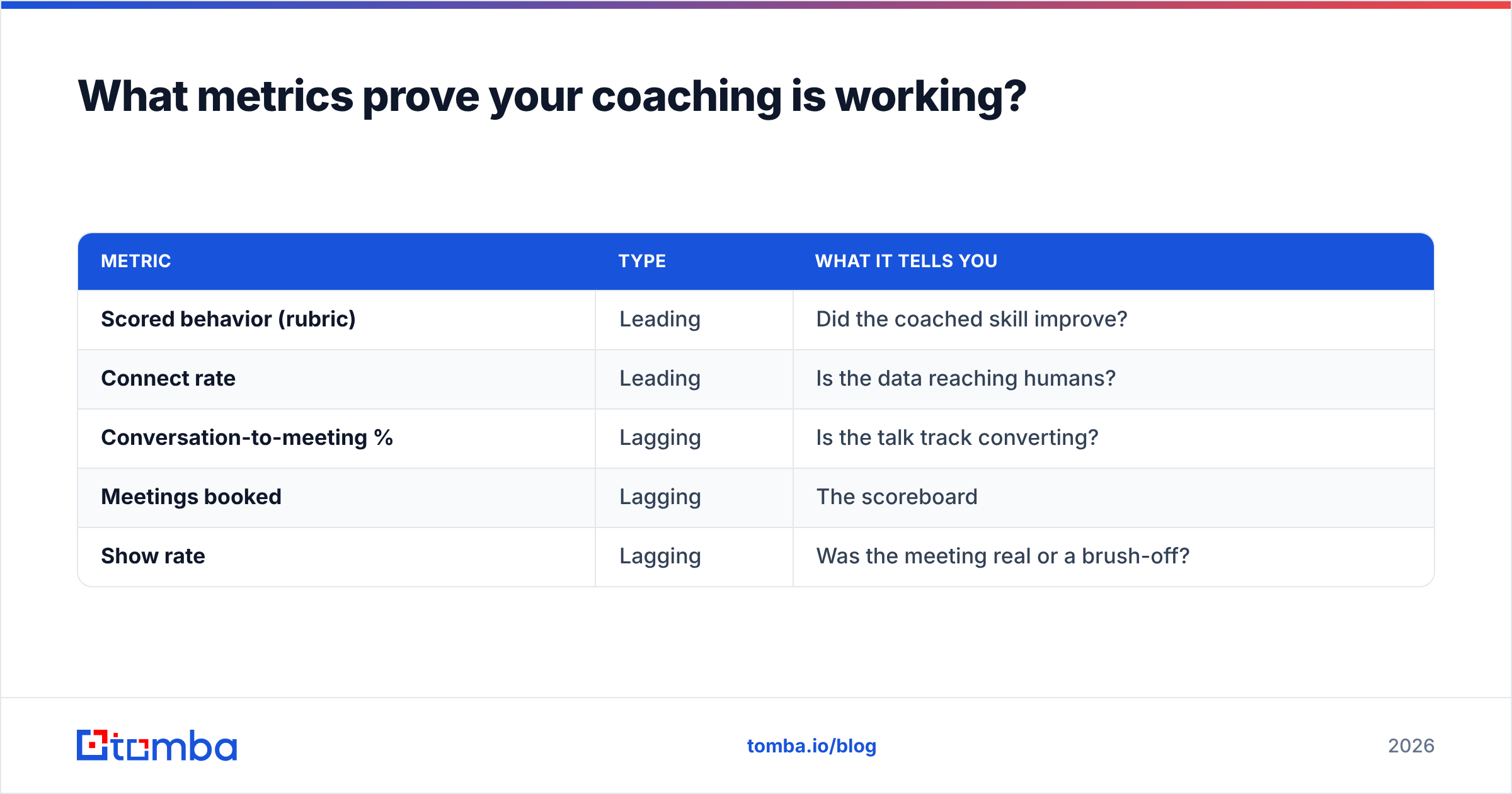
Track leading and lagging indicators together, and always pair them.
| Metric | Type | What it tells you |
|---|---|---|
| Scored behavior (rubric) | Leading | Did the coached skill improve? |
| Connect rate | Leading | Is the data reaching humans? |
| Conversation-to-meeting % | Lagging | Is the talk track converting? |
| Meetings booked | Lagging | The scoreboard |
| Show rate | Lagging | Was the meeting real or a brush-off? |
The trap is watching only "meetings booked." That number is noisy — it swings with list quality, seasonality, and luck. The rubric score is the cleanest signal that your coaching changed a behavior. When the rubric score climbs and the meeting rate follows two weeks later, you have proof your coaching caused the lift.
How do you scale coaching beyond one manager?#
A single manager can deeply coach maybe six reps. Past that, you scale in three ways:
- Self-scoring. Reps grade their own calls against the rubric weekly and bring the toughest one to the 1:1. This doubles your coverage instantly.
- Peer review pods. Pair reps to review one call each per week. Teaching a behavior is the fastest way to internalize it.
- Software-assisted scoring. Conversation-intelligence tools auto-transcribe and flag moments, so you review the 10% of calls that need you instead of listening to everything.
Whichever you pick, keep the rubric constant. The moment two coaches grade differently, trust collapses. Standardize the standard, then distribute the coaching.
Start with the data, then coach the reps#
Cold calling coaching compounds — but only on top of a clean funnel. If your reps are dialing dead numbers and gatekeepers, no amount of opener drills will move the scoreboard, and you will burn coaching credibility chasing a data problem with a skills fix.
Fix the floor first. Enrich your call lists with accurate, verified direct dials using Tomba's Phone Finder, and pair it with the Tomba Email Finder so every rep opens each block with contacts who actually pick up. Check the current Tomba pricing — the free tier lets you validate a sample list before you commit. Get the data right, run the five-step coaching loop, and your rubric scores and booked meetings will finally move together.
Related guides#
// get started
Find, verify and enrich your first contacts today
Start on the free plan with 25 searches a month, then scale when your team is ready.
Free plan · No credit card required · GDPR & CCPA
// about the author