How to Build Cold Calling Confidence in 2026 (Field-Tested)
Cold calling confidence isn't a personality trait you're born with — it's a system. Here's the field-tested routine, scripts, and prep that quiet the nerves before you dial.
Cold calling confidence looks like talent from the outside. It isn't. The reps who sound calm on the phone built a system that removes the reasons to be nervous before they ever dial. You can copy that system.
TL;DR#
- Confidence is downstream of preparation. A clean list, a tight opener, and a plan for the first objection kill most call anxiety before the phone rings.
- Call reluctance is a habit, not a flaw. You beat it with volume, warm-up reps, and reframing rejection as data — not a verdict on you.
- Bad data destroys confidence faster than any objection. Half your nerves come from dialing wrong numbers and guessing who you're calling.
- Scripts are training wheels, not cages. Learn the beats, then talk like a human.
- Track leading activity, not just outcomes. Dials and conversations are in your control; a "yes" is not.
Why do you lose confidence on cold calls?#
You lose confidence because you're improvising under pressure with incomplete information. Every unknown — Is this the right person? Is this number even live? What do I say after "hello"? — is a small spike of stress, and stress stacks. By the tenth dial you're not nervous about rejection, you're exhausted from guessing.
Think of it like driving in a city you've never visited without GPS. You're not a bad driver. You just can't relax because every intersection is a decision you're not equipped to make. Cold calling feels the same when your list is messy and your opener is vague. Fix the map, and the driving gets easy.
The research backs this up. In HubSpot's sales statistics, the reps who consistently book meetings aren't the loudest — they're the most prepared. Preparation is the lever, and most of it happens before you touch the phone.

What actually causes call reluctance?#
Call reluctance — the quiet avoidance that has you "researching" one more account instead of dialing — usually comes from three sources:
- Fear of the unknown response. You don't know what they'll say, so your brain fills the gap with worst-case scenarios.
- Fear of rejection as identity. A "no" feels like a judgment of you, not of the timing or the fit.
- Fear of wasting the prospect's time. If you don't believe your reason for calling is valuable, hesitation leaks into your voice.
Notice that none of these are cured by "just be more confident." They're cured by structure. When you know your opener cold, have a verified contact in front of you, and have decided in advance that rejection is feedback, all three fears shrink.
How do you build cold calling confidence before you dial?#
Build it in the fifteen minutes before your calling block. This is the highest-leverage window in your day.
1. Warm up your voice and your reps. Athletes don't sprint cold. Make your first two calls low-stakes — an existing customer, a partner, a friendly gatekeeper — so you hit your first tough prospect already in rhythm.
2. Verify who you're calling. Nothing tanks confidence like realizing mid-call that you have the wrong name, the wrong title, or a dead number. Run your list through a phone validator so you're not burning nerve on disconnected lines, and confirm the contact is who you think they are.
3. Rehearse the first 10 seconds. You only need to over-prepare the opener and the first objection. Everything after that is conversation. Say your opener out loud five times until it stops sounding like a script.
4. Set an activity goal, not an outcome goal. "Make 40 dials" is in your control. "Book 3 meetings" is not. Confidence comes from hitting targets you own.
5. Lower the stakes of any single call. If you're making 40 calls, no single one matters. This is a numbers game with a memory reset button between dials.
Does your data affect your confidence?#
Yes — more than any script or pep talk. Your confidence is only as steady as the list in front of you. Dialing a spray-and-pray list of scraped, unverified numbers means every third call is a wrong number, a disconnected line, or a person who left the company two years ago. That's a confidence tax you pay all day.
Clean, verified contact data flips the equation. When you trust that the name, title, and number are right, you stop bracing for the awkward "actually, who are you looking for?" and start focusing on the conversation.
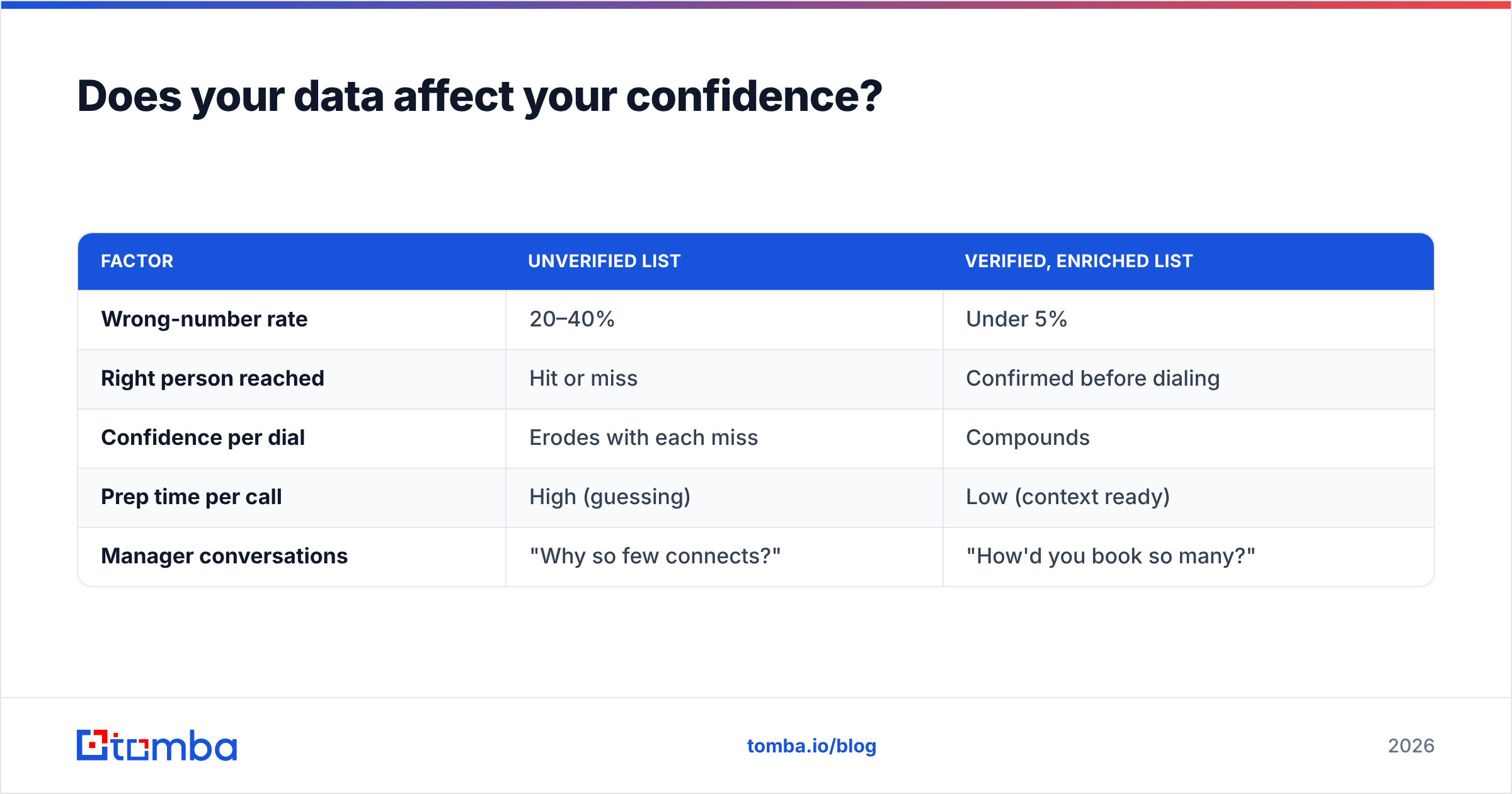
Here's how the two approaches compare in practice:
| Factor | Unverified list | Verified, enriched list |
|---|---|---|
| Wrong-number rate | 20–40% | Under 5% |
| Right person reached | Hit or miss | Confirmed before dialing |
| Confidence per dial | Erodes with each miss | Compounds |
| Prep time per call | High (guessing) | Low (context ready) |
| Manager conversations | "Why so few connects?" | "How'd you book so many?" |
If you're pulling contacts at scale, a B2B phone finder that returns direct dials alongside verified emails means you walk into every block with a list you trust instead of one you fear.
What's a cold call script that keeps you confident?#
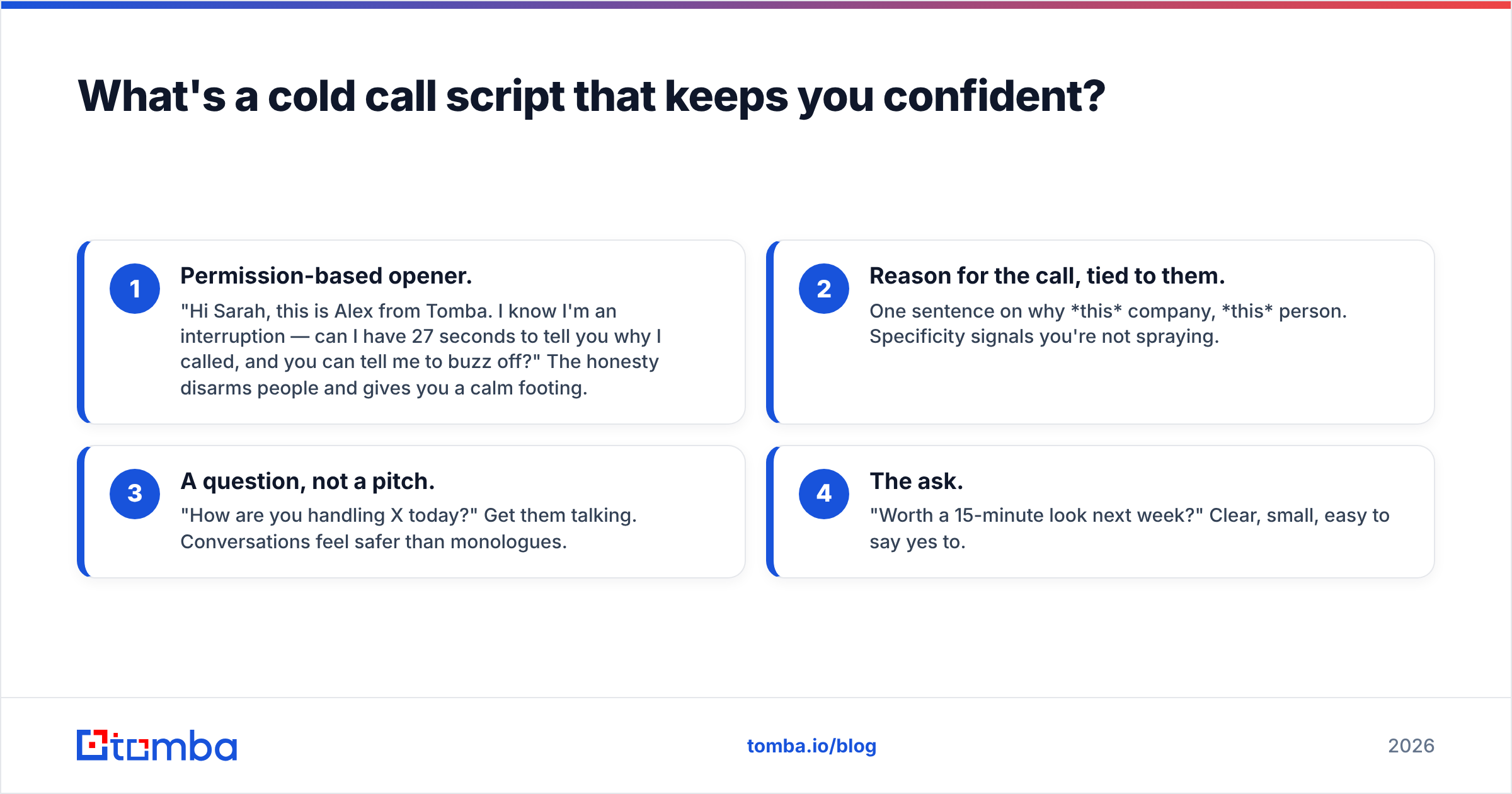
A good script gives you rails without turning you into a robot. Learn the beats, internalize them, then improvise inside the structure. Here's a proven frame:
- Permission-based opener. "Hi Sarah, this is Alex from Tomba. I know I'm an interruption — can I have 27 seconds to tell you why I called, and you can tell me to buzz off?" The honesty disarms people and gives you a calm footing.
- Reason for the call, tied to them. One sentence on why this company, this person. Specificity signals you're not spraying.
- A question, not a pitch. "How are you handling X today?" Get them talking. Conversations feel safer than monologues.
- The ask. "Worth a 15-minute look next week?" Clear, small, easy to say yes to.
Notice the script does the heavy lifting so your nervous system doesn't have to. When the first fifteen seconds are automatic, your brain is free to actually listen. For messaging you can reuse across channels, an AI cold email writer can help you draft the follow-up you promise on the call — so the call itself has a clear next step.
How do you handle rejection without losing your nerve?#
Reframe rejection as routing, not judgment. A "no" is the prospect sorting themselves out of your pipeline, which is a gift — it saves you both time. The reps who last in this job internalize that a call going badly says nothing about their worth and almost everything about timing, budget, and fit they can't see.
A few tactical reframes that work:
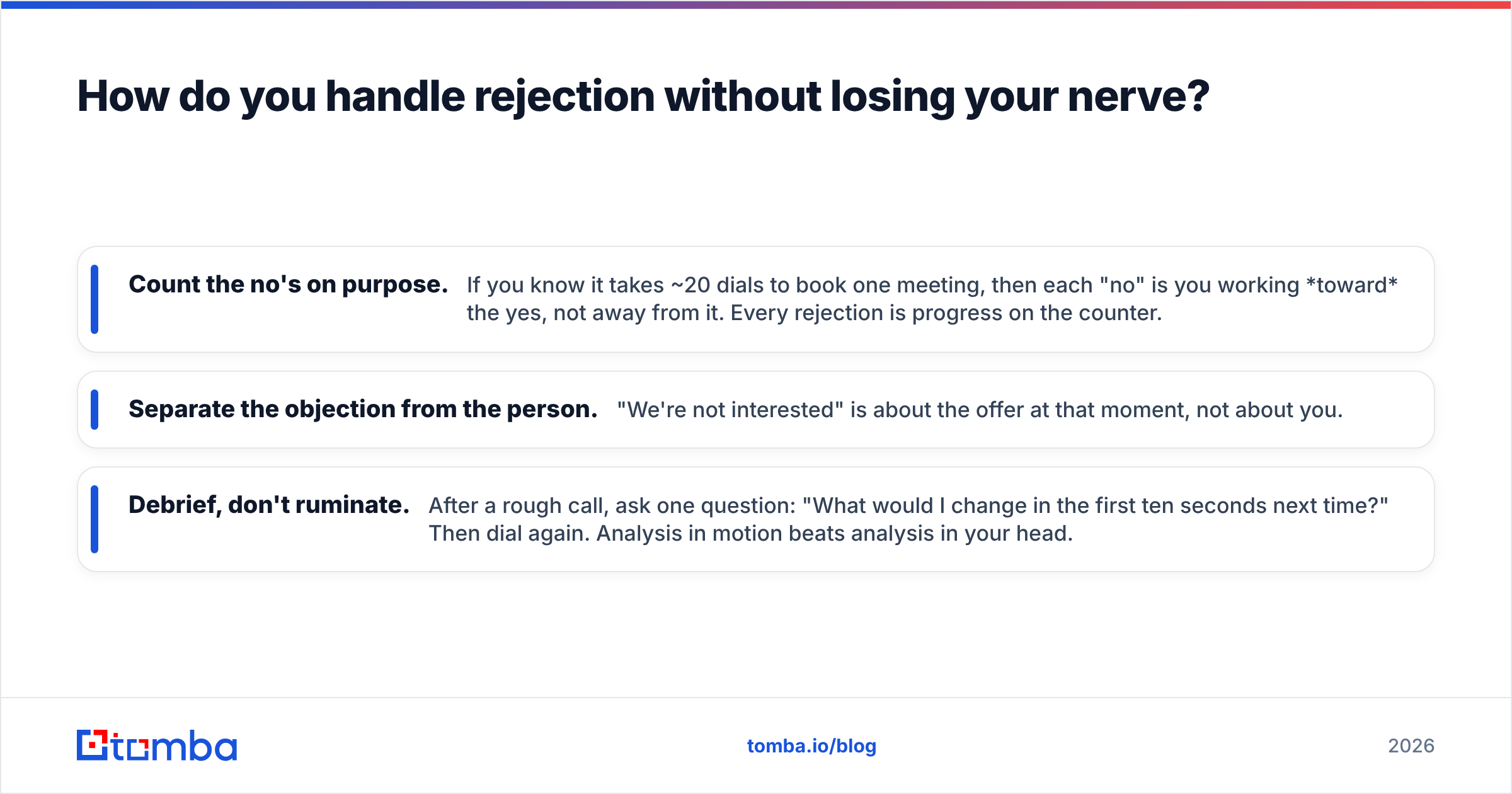
- Count the no's on purpose. If you know it takes ~20 dials to book one meeting, then each "no" is you working toward the yes, not away from it. Every rejection is progress on the counter.
- Separate the objection from the person. "We're not interested" is about the offer at that moment, not about you.
- Debrief, don't ruminate. After a rough call, ask one question: "What would I change in the first ten seconds next time?" Then dial again. Analysis in motion beats analysis in your head.
Sales-intelligence tools that record and analyze calls, like Gong, exist precisely because reviewing real conversations — instead of replaying them anxiously from memory — is how good reps get calm. You don't need enterprise software to start; a simple after-call note works.
What daily habits build lasting confidence?#
Confidence is a muscle. These habits keep it strong:
- Dial in blocks, not scattered. Batching calls builds momentum. Ten calls back-to-back beats ten calls spread across a distracted day.
- Stand up and smile. It sounds like a cliché because it works — your posture and face change your voice. Prospects hear the difference.
- Track your connect rate weekly. Watching the number climb is proof you're improving, and proof beats pep talks. Keep an eye on your response rate across channels so calls aren't your only signal.
- Celebrate the dial, not just the deal. Reward yourself for the activity you control. The outcomes follow the activity.
- Keep your list clean continuously. Data decays — people change jobs, numbers get reassigned. A monthly refresh of your contacts keeps the confidence tax low.
Confidence checklist before every calling block#
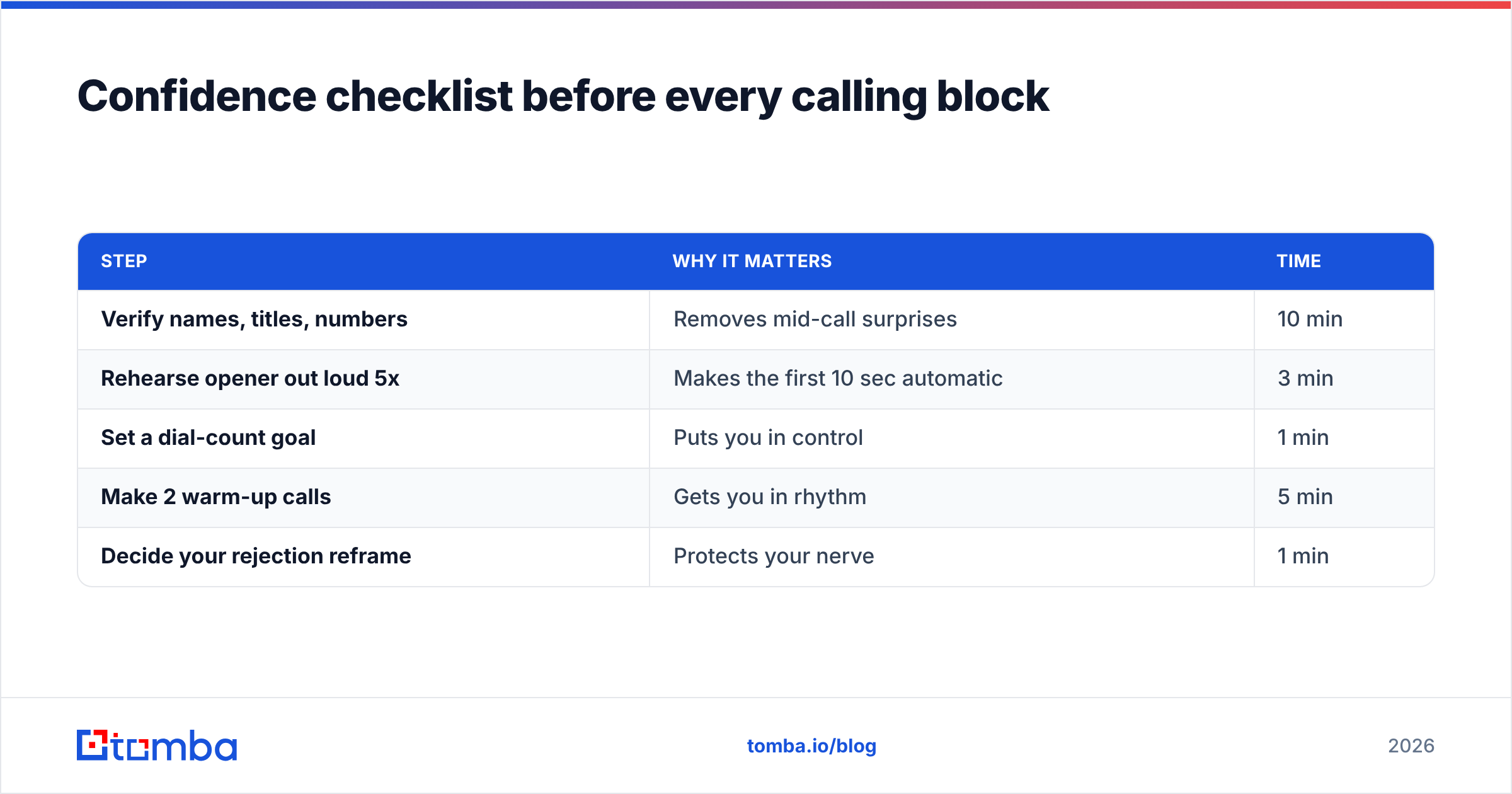
| Step | Why it matters | Time |
|---|---|---|
| Verify names, titles, numbers | Removes mid-call surprises | 10 min |
| Rehearse opener out loud 5x | Makes the first 10 sec automatic | 3 min |
| Set a dial-count goal | Puts you in control | 1 min |
| Make 2 warm-up calls | Gets you in rhythm | 5 min |
| Decide your rejection reframe | Protects your nerve | 1 min |
Run this for a week and you'll feel the shift. The nerves don't vanish — they just stop running the show, because you've removed the reasons they had to.
Is cold calling confidence really just preparation?#
Mostly, yes — with one addition: reps. Preparation lowers the barrier; volume builds the calm. No amount of prep replaces the nervous-system adaptation that comes from making the call, surviving the "no," and dialing again. The good news is that preparation makes the reps far less painful, so you'll actually make more of them. Prepared reps compound. Unprepared reps burn people out.
If there's a single unlock, it's this: the calmer you are about who you're calling and why, the more attention you have left for the human on the other end. And attention — real listening — is what actually books meetings.
Get a list you can dial with confidence#
The fastest way to sound confident on the phone is to stop guessing about who you're calling. Start with verified contacts. Tomba's Email Finder and its companion phone finder give you accurate names, titles, and direct contact details — so every dial starts from certainty instead of a shaky scraped list. Pair it with a warm-up routine and a tight opener, and you'll spend your energy on the conversation, not on bracing for the wrong number.
You can start free with 25 searches a month, and if you're scaling a calling team, the Tomba pricing plans start at $49/mo for the volume most SDRs need. Clean data won't make the calls for you — but it will make you a lot harder to rattle. Go build the list, then go dial.
Related guides#
Ready to find emails that actually work?
Join 150,000+ professionals who stopped guessing and started sending. Free credits on signup — no credit card required.
Get the Tomba newsletter
Practical outbound tactics and product updates — once every two weeks.
About the author