Cold Calling for Digital Marketing Agencies: The 2026 Playbook
Is cold calling still worth it for digital marketing agencies in 2026? Here's the honest data, the scripts that book meetings, and how to blend calls with email.
Cold calling gets written off every year, and every year agencies that do it well keep booking meetings their competitors never get. If you sell SEO, paid media, web design, or content services, the phone is still one of the fastest paths from "never heard of you" to "let's talk." The problem is not the channel. The problem is that most agencies dial the wrong numbers, wing the opener, and quit after two attempts.
This guide fixes that. Here is what actually works for cold calling in digital marketing in 2026, backed by numbers, scripts, and a workflow you can copy.
TL;DR#
- Cold calling still converts for digital marketing services, but only when the list is accurate and calls are paired with email and LinkedIn touches.
- Data quality is the whole game. Bad phone numbers and outdated contacts kill connect rates before the script ever matters.
- A tight, permission-based opener beats a scripted pitch. Ask for 27 seconds, lead with a relevant observation, and earn the next sentence.
- Multichannel sequences win. Calls plus targeted email plus one LinkedIn touch routinely 2-3x meeting rates versus calling alone.
- Track connect rate, conversation rate, and meetings booked — not dials. Volume without data hygiene just burns your list.
Is cold calling still effective for digital marketing in 2026?#
Yes, when it is done as one layer of a multichannel motion rather than a standalone spray-and-pray. Buyers of marketing services are flooded with cold email and LinkedIn DMs, so a well-timed, well-researched call actually stands out now more than it did five years ago.
The catch is that raw dial volume no longer works on its own. According to widely cited outbound benchmarks, connect rates for cold calls hover in the low single digits to low teens depending on data quality and title. That range is entirely determined by two things: are you calling the right person, and is the number correct? Get both right and a rep can hold several real conversations per hour. Get them wrong and you will burn an afternoon leaving voicemails.
Digital marketing is actually a strong fit for calling because your prospect's pain is publicly visible. You can see a slow website, a thin blog, a broken meta description, or a competitor outranking them before you ever pick up the phone. That research turns a generic pitch into a specific, credible reason to call.
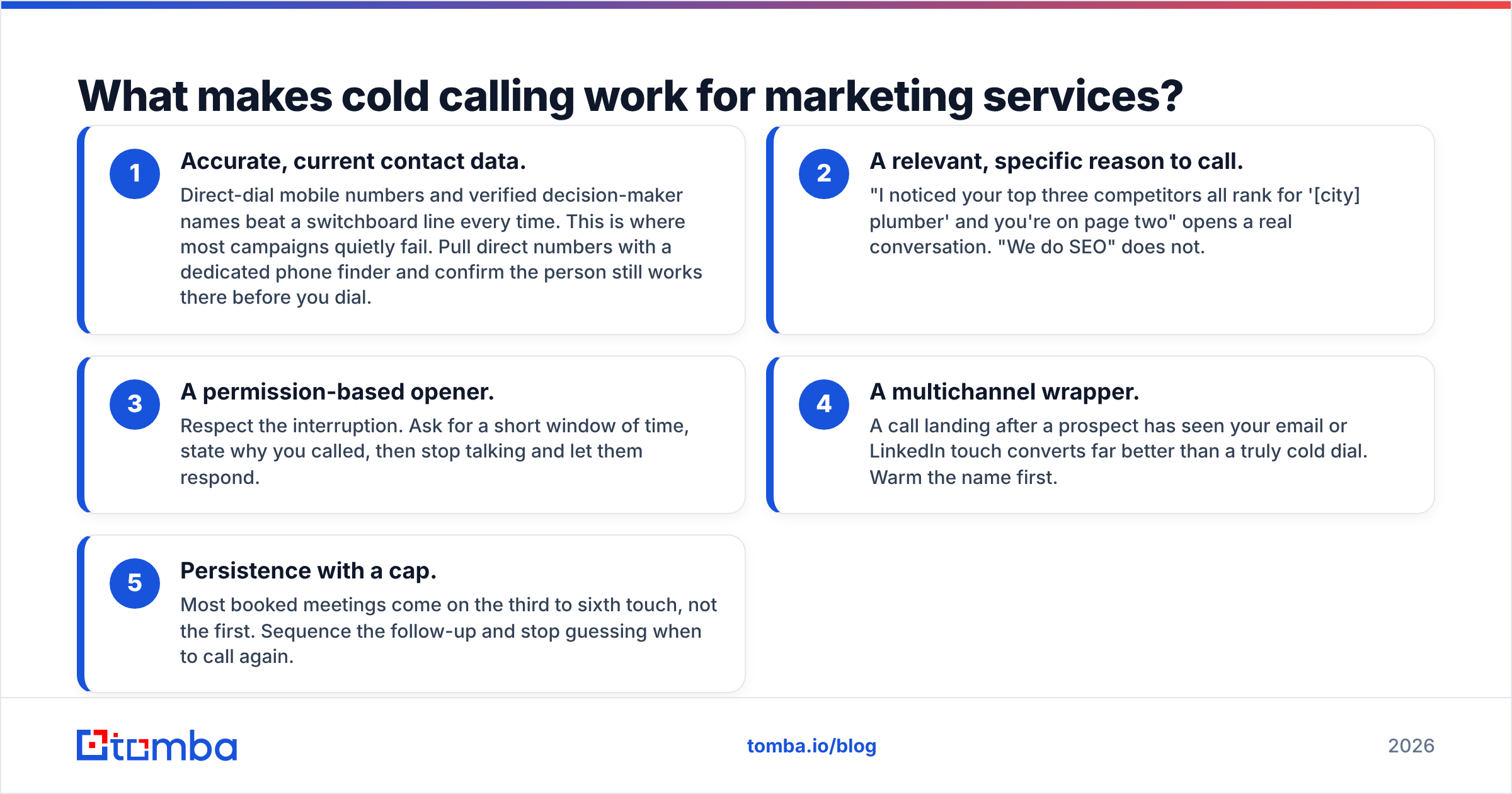
What makes cold calling work for marketing services?#
Four ingredients separate agencies that book meetings from agencies that get hung up on. Nail these before you scale dials.
- Accurate, current contact data. Direct-dial mobile numbers and verified decision-maker names beat a switchboard line every time. This is where most campaigns quietly fail. Pull direct numbers with a dedicated phone finder and confirm the person still works there before you dial.
- A relevant, specific reason to call. "I noticed your top three competitors all rank for '[city] plumber' and you're on page two" opens a real conversation. "We do SEO" does not.
- A permission-based opener. Respect the interruption. Ask for a short window of time, state why you called, then stop talking and let them respond.
- A multichannel wrapper. A call landing after a prospect has seen your email or LinkedIn touch converts far better than a truly cold dial. Warm the name first.
- Persistence with a cap. Most booked meetings come on the third to sixth touch, not the first. Sequence the follow-up and stop guessing when to call again.
Miss the first ingredient and nothing else matters. You can have the best script in the industry and still fail if 40% of your numbers are dead. That is why data hygiene, not charisma, is the real lever.
Cold calling vs cold email vs LinkedIn: which channel wins?#
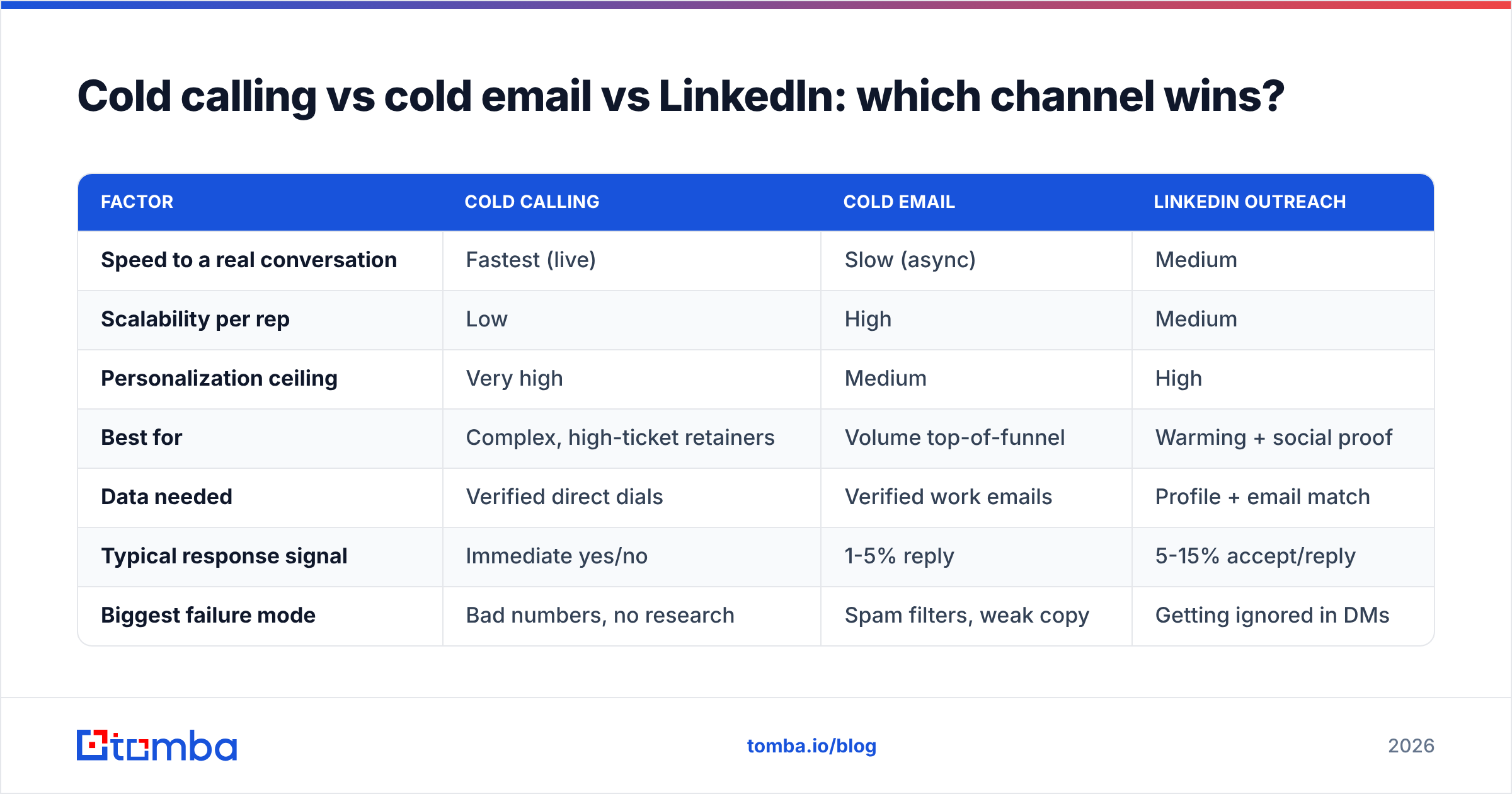
None of them win alone. The agencies pulling the highest meeting rates run all three in a coordinated sequence, using each channel for what it does best. Here is how they compare for selling digital marketing services.
| Factor | Cold calling | Cold email | LinkedIn outreach |
|---|---|---|---|
| Speed to a real conversation | Fastest (live) | Slow (async) | Medium |
| Scalability per rep | Low | High | Medium |
| Personalization ceiling | Very high | Medium | High |
| Best for | Complex, high-ticket retainers | Volume top-of-funnel | Warming + social proof |
| Data needed | Verified direct dials | Verified work emails | Profile + email match |
| Typical response signal | Immediate yes/no | 1-5% reply | 5-15% accept/reply |
| Biggest failure mode | Bad numbers, no research | Spam filters, weak copy | Getting ignored in DMs |
The practical takeaway: use email and LinkedIn to build name recognition and warm the account, then call to close the gap to a booked meeting. If you want to sharpen the email leg of that motion, our guide to email deliverability covers the reputation basics that keep your warm-up messages landing in the inbox.
How do you build a cold calling list that connects?#
Start with the account, find the right person, get a verified direct number, then enrich. Skipping any step drops your connect rate.
Here is the workflow that consistently produces callable lists for agencies:
- Define the account profile. Company size, industry, and a visible marketing gap you can fix. For a local SEO agency that might be "home services businesses within 50 miles ranking below page one."
- Find the decision maker. For marketing services this is usually a founder, marketing director, or head of growth — not a junior coordinator.
- Get the direct number. Switchboards waste dials. Use a phone validator to confirm the line is live and mobile where possible.
- Confirm the email for the multichannel wrapper. You need a verified address to run the email touches around the call. Pull it with an email finder and clean the list with an email verifier so bounces don't wreck your sender reputation.
- Enrich with a hook. Add one specific, callable data point per contact — a competitor outranking them, a recent funding round, a new location, a page-speed problem.
The difference between a list built this way and a scraped spreadsheet is enormous. One connects; the other trains your reps to hate the phone. If you're running this at volume, a bulk email finder and enrichment step lets you prep hundreds of accounts without hand-searching each one.
What should a digital marketing cold call script sound like?#
Short, specific, and permission-based. The goal of the call is not to sell the retainer — it is to earn a discovery meeting. Here is a framework that works for selling marketing services.
The opener (earn 30 seconds): "Hi [Name], it's [You] from [Agency]. I know I'm calling out of the blue — can I take 27 seconds to tell you why, and you can tell me to buzz off if it's not relevant?"
The reason (be specific): "I was looking at [Company] and noticed your top two competitors, [X] and [Y], both rank on page one for '[keyword]' while you're on page three. That gap is probably costing you [rough estimate] of leads a month."
The question (make it easy): "I'm not going to pitch you on this call. I just wanted to ask — is organic search something your team is actively working on right now, or has it been on the back burner?"
The close (one small ask): "Makes sense. Would it be worth 15 minutes next week to show you exactly where the gap is and what it'd take to close it? No obligation."
Notice what this script does not do: it does not list services, it does not talk about how long the agency has been in business, and it does not ask "how are you today?" Every sentence either earns permission or delivers something relevant to the prospect.
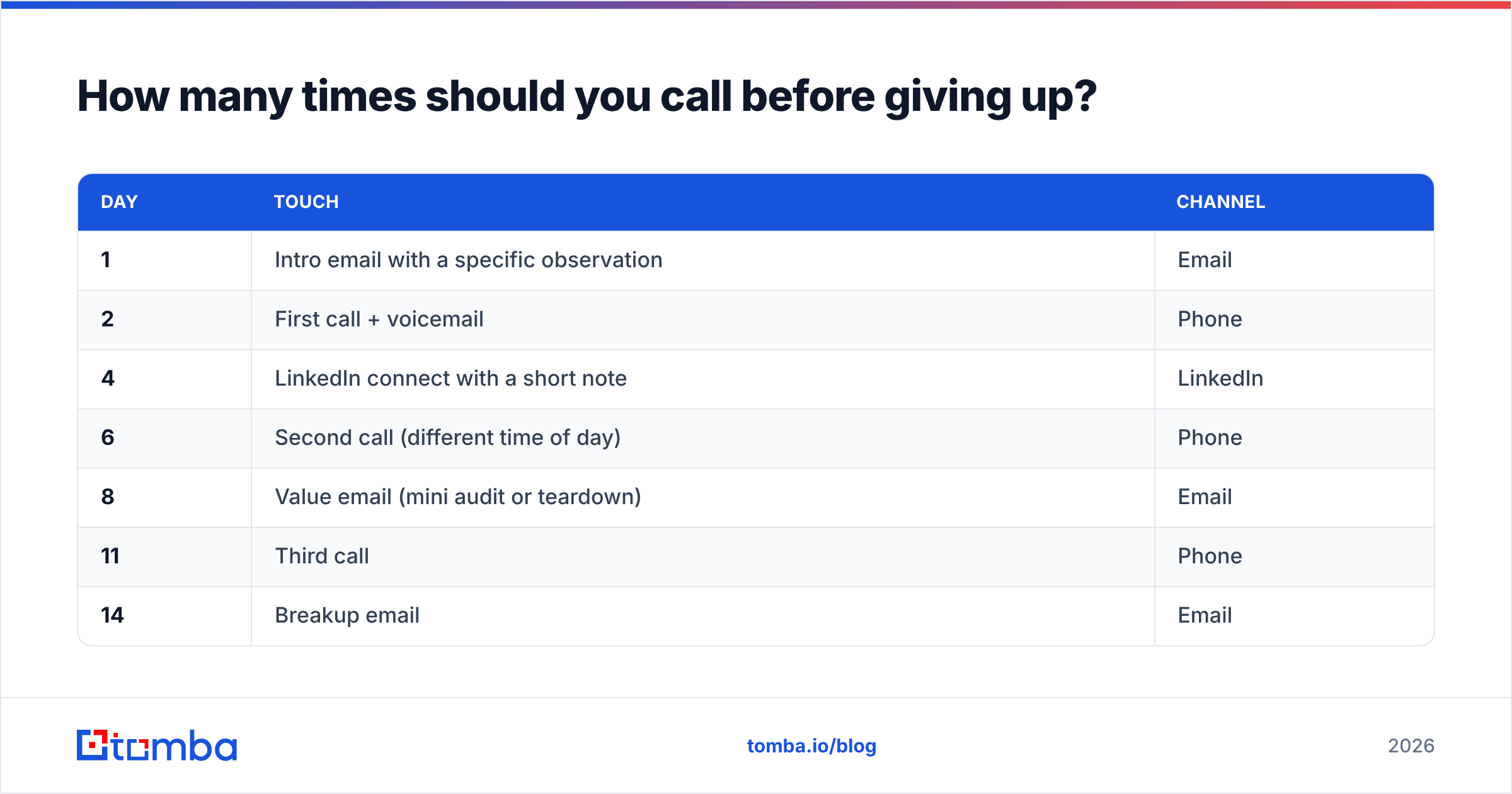
How many times should you call before giving up?#
Six to eight touches across channels, not calls alone. A single dial is barely an attempt. Most agencies quit after one or two voicemails, which is exactly why the persistent ones win the account.
A realistic cadence for selling marketing services looks like this:
| Day | Touch | Channel |
|---|---|---|
| 1 | Intro email with a specific observation | |
| 2 | First call + voicemail | Phone |
| 4 | LinkedIn connect with a short note | |
| 6 | Second call (different time of day) | Phone |
| 8 | Value email (mini audit or teardown) | |
| 11 | Third call | Phone |
| 14 | Breakup email |
Vary the time of day on calls — the person who never answers at 10 a.m. often picks up at 4:45 p.m. And always leave a voicemail that references your email so the touches reinforce each other. Coordinating this by hand gets messy fast, which is why most teams run it through a CRM or sequencing tool with the verified data already loaded. If you're pairing calls with LinkedIn outreach, keep the messaging consistent across all three channels so the prospect hears one coherent story.
What metrics actually matter for cold calling?#
Track conversations and meetings, not dials. Dial count is a vanity metric that rewards activity over outcomes and hides the data problems killing your campaign.
Here are the numbers worth watching:
- Connect rate — live conversations divided by dials. If this is under 5%, your data is the problem, not your reps. Fix the list before touching the script.
- Conversation-to-meeting rate — meetings booked divided by live conversations. This measures your opener and reason-to-call. Under 10% means the script needs work.
- Meetings booked per rep per day — the number that actually predicts revenue.
- Show rate — booked meetings that actually happen. Low show rates usually mean weak qualification on the call.
- Cost per meeting — total rep hours and tooling divided by meetings. This tells you whether calling beats your other channels for this segment.
When connect rate is low, the fix is almost always upstream: better data enrichment and cleaner phone data. Reps can only convert conversations they actually have.
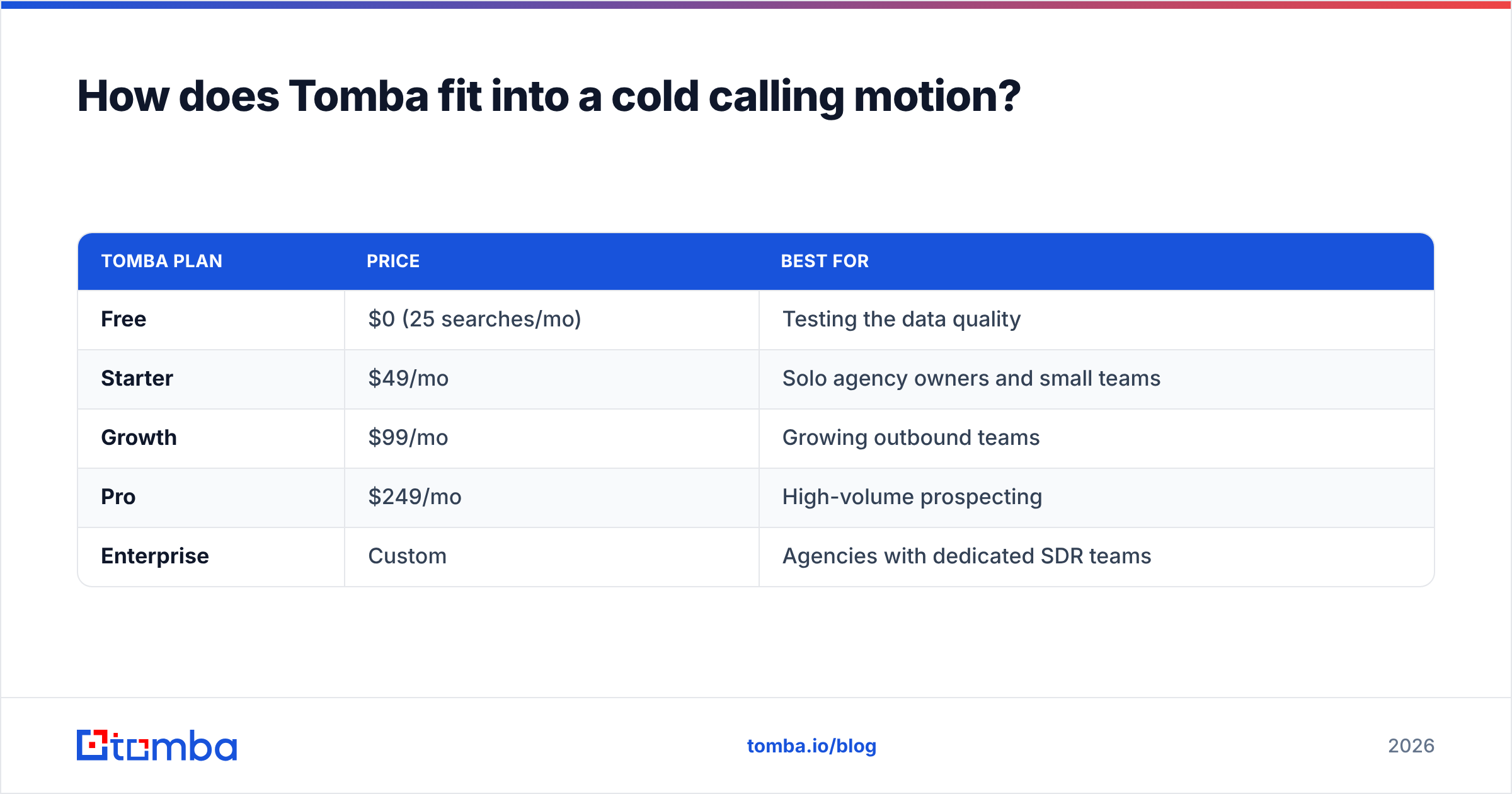
How does Tomba fit into a cold calling motion?#
Tomba supplies the layer that makes calling work: accurate contact data. Before a rep ever dials, you need the right person, a verified direct number, and a confirmed email to wrap the call in a sequence. That is exactly what Tomba is built for.
| Tomba plan | Price | Best for |
|---|---|---|
| Free | $0 (25 searches/mo) | Testing the data quality |
| Starter | $49/mo | Solo agency owners and small teams |
| Growth | $99/mo | Growing outbound teams |
| Pro | $249/mo | High-volume prospecting |
| Enterprise | Custom | Agencies with dedicated SDR teams |
A typical agency workflow: use domain search to map the decision makers at a target account, pull their direct numbers with the phone finder, verify the emails, and push everything into your CRM or sequencer. See full Tomba pricing for team seats and API access if you're automating the whole pull.
For an independent, third-party view of email and data tools before you commit, G2 and Capterra both carry verified user reviews across the category. And if you want the broader sales-strategy context around where calling fits in modern outbound, HubSpot's sales blog is a solid, vendor-neutral starting point.
The bottom line on cold calling for digital marketing#
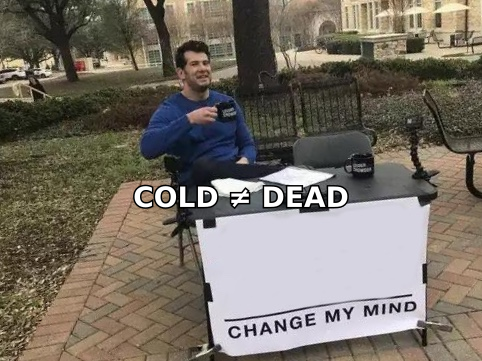
Cold calling is not dead — lazy cold calling is. The agencies still winning on the phone in 2026 are the ones that treat data as the foundation, call with a specific and relevant reason, wrap every dial in an email-and-LinkedIn sequence, and measure conversations instead of dials. Get the list right and everything downstream gets easier.
Start there. Before your next calling block, build a list of verified decision makers with confirmed direct numbers and emails using the Tomba Email Finder and phone tools. Feed your reps accurate data, give them a specific reason to call, and let the conversations do the rest. The phone still works — you just have to dial the right numbers.
Related guides#
Ready to find emails that actually work?
Join 150,000+ professionals who stopped guessing and started sending. Free credits on signup — no credit card required.
Get the Tomba newsletter
Practical outbound tactics and product updates — once every two weeks.
About the author