Cold Calling Follow Up Email: Templates, Timing, and Examples
A cold call rarely closes on the first touch. Learn how to write a cold calling follow up email that gets replies, with timing rules, a cadence table, and 7 copy-paste templates.
The call ended with "sure, send me something." Then nothing. If that pattern feels familiar, the problem usually isn't your pitch — it's the cold calling follow up email that never got written, or got written badly. The follow-up is where cold calls actually convert, and most reps treat it as an afterthought.
This guide breaks down when to send, what to write, and how to build a repeatable cadence, with seven templates you can paste and adapt today.
TL;DR#
- Send within 24 hours of the call, while your name and voice are still fresh. Waiting a week resets you to a stranger.
- One email is not a follow-up — it's a coin flip. Plan a 4–6 touch sequence spread over two to three weeks.
- Reference the call specifically. "Great chatting about your Q3 hiring crunch" beats "following up on our conversation" every time.
- Keep it under 90 words, one clear ask, one link or attachment max.
- Get the email right before you send it. A bounced follow-up wastes the whole call — verify the address first.
Why does the follow up email matter more than the call?#
Because the call is where you earn attention, and the email is where you convert it into a next step. Think of the cold call as a first handshake at a conference: pleasant, forgettable within an hour. The follow-up email is the note you hand them before they walk away — it's what they actually keep.
Data backs this up. According to HubSpot's sales research, the majority of sales require multiple follow-up touches after the initial contact, yet a large share of reps stop after one attempt. The gap between "called once" and "followed up five times" is where quota lives.
A cold calling follow up email also does something the call can't: it gives the prospect an artifact. Buyers forward emails to their boss. They don't forward the memory of a phone call. Your written follow-up becomes the internal document that moves the deal along without you in the room.
When should you send a cold calling follow up email?#
Within 24 hours for the first touch — no exceptions. After that, spacing matters more than speed. Here's the timing logic:
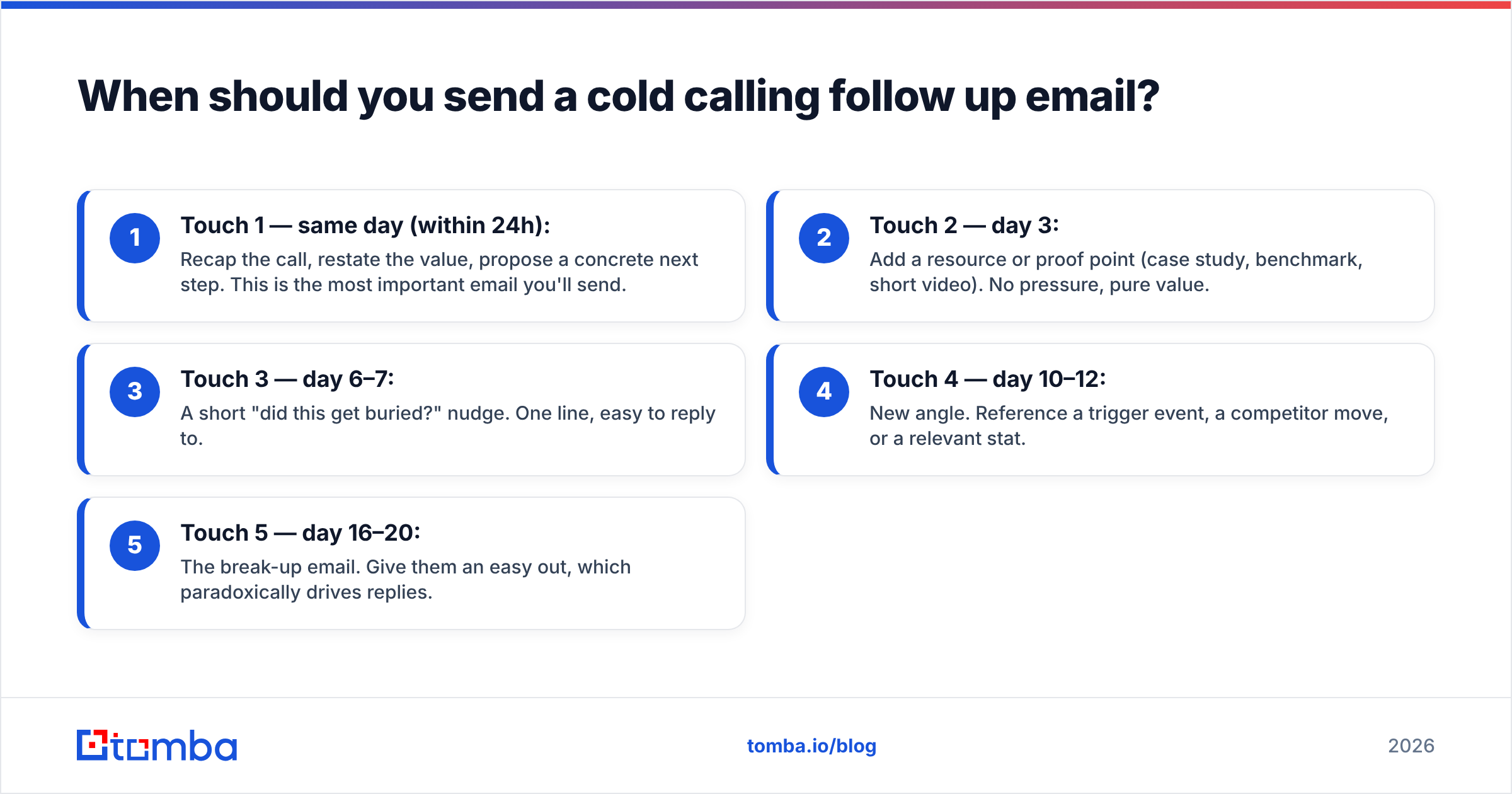
- Touch 1 — same day (within 24h): Recap the call, restate the value, propose a concrete next step. This is the most important email you'll send.
- Touch 2 — day 3: Add a resource or proof point (case study, benchmark, short video). No pressure, pure value.
- Touch 3 — day 6–7: A short "did this get buried?" nudge. One line, easy to reply to.
- Touch 4 — day 10–12: New angle. Reference a trigger event, a competitor move, or a relevant stat.
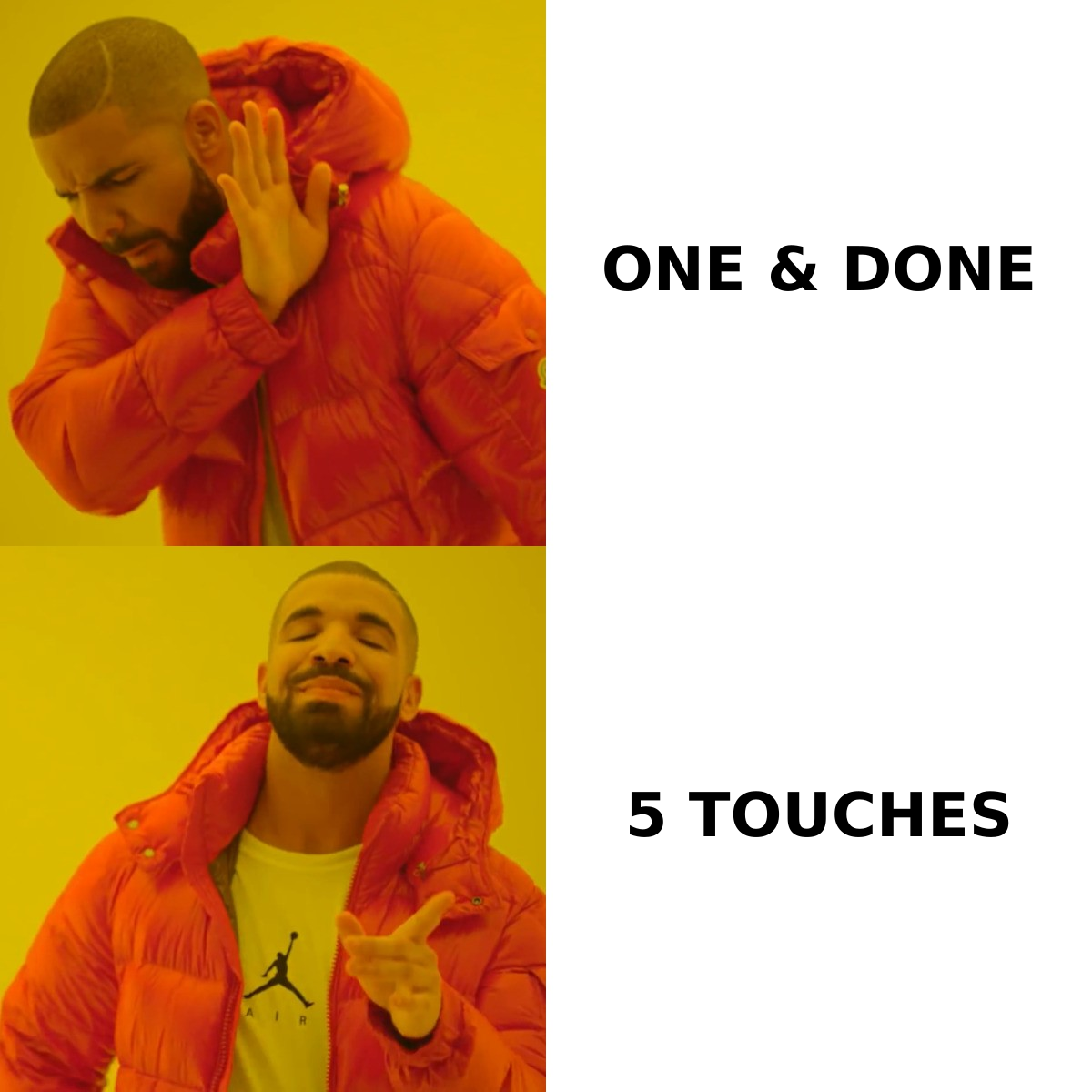
- Touch 5 — day 16–20: The break-up email. Give them an easy out, which paradoxically drives replies.
The mistake most reps make is clustering all their energy on day one, then vanishing. The prospect who ignored touch one often replies to touch four, simply because timing finally aligned with their calendar. Persistence isn't annoying when every email carries something useful.
What makes a cold call follow up email actually get replies?#
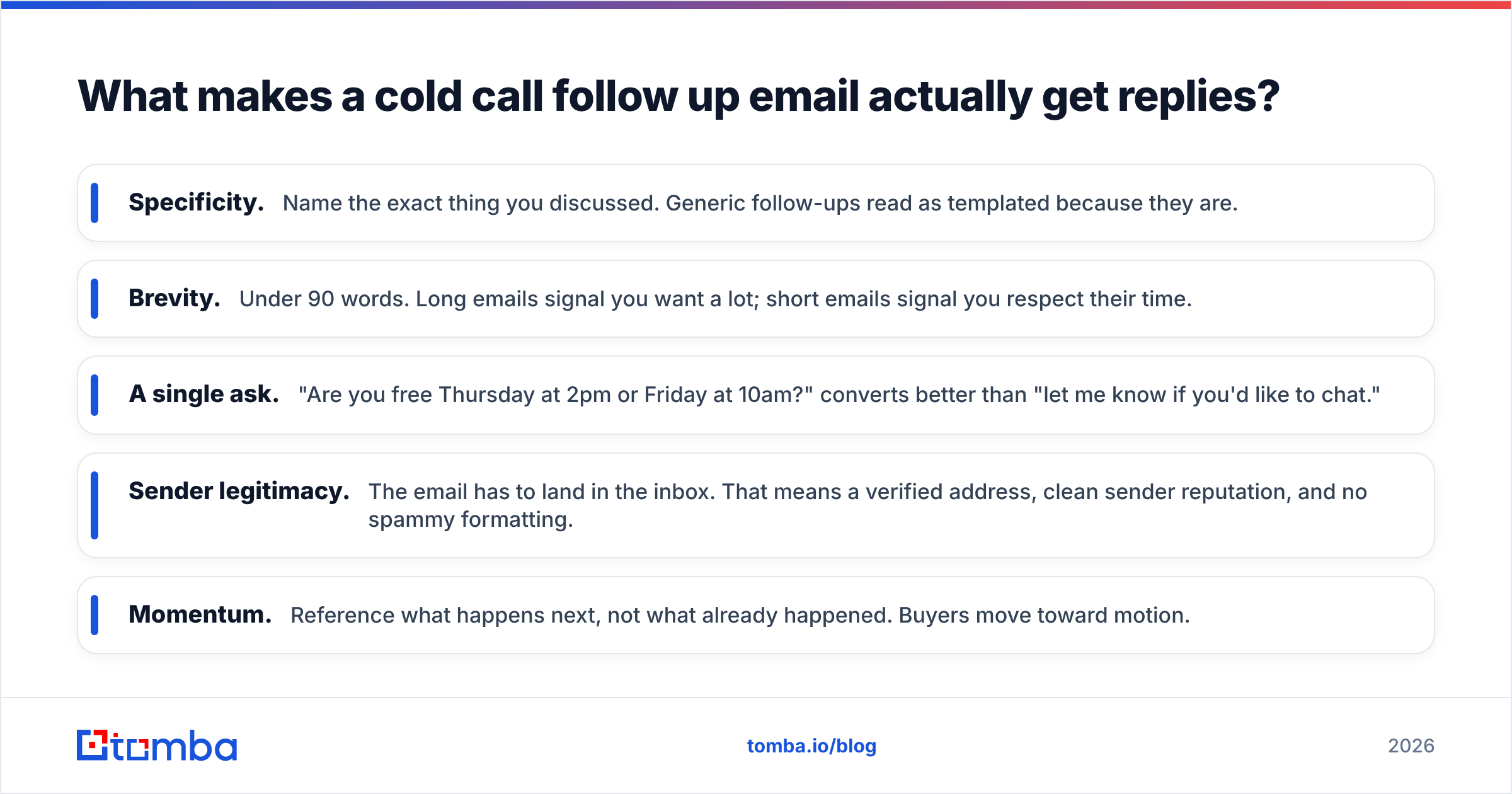
Five things, and none of them are clever subject lines alone:
- Specificity. Name the exact thing you discussed. Generic follow-ups read as templated because they are.
- Brevity. Under 90 words. Long emails signal you want a lot; short emails signal you respect their time.
- A single ask. "Are you free Thursday at 2pm or Friday at 10am?" converts better than "let me know if you'd like to chat."
- Sender legitimacy. The email has to land in the inbox. That means a verified address, clean sender reputation, and no spammy formatting.
- Momentum. Reference what happens next, not what already happened. Buyers move toward motion.
Before you write a word, make sure the address is real. Reps often guess a format after a call — jane@company.com vs j.doe@company.com — and half of those guesses bounce. Run the address through an email verifier so your carefully written follow-up doesn't die at the mail server. If you only captured a name and company on the call, a quick domain search fills in the verified email pattern in seconds.
Cold call follow up email vs. cold email vs. voicemail follow-up#
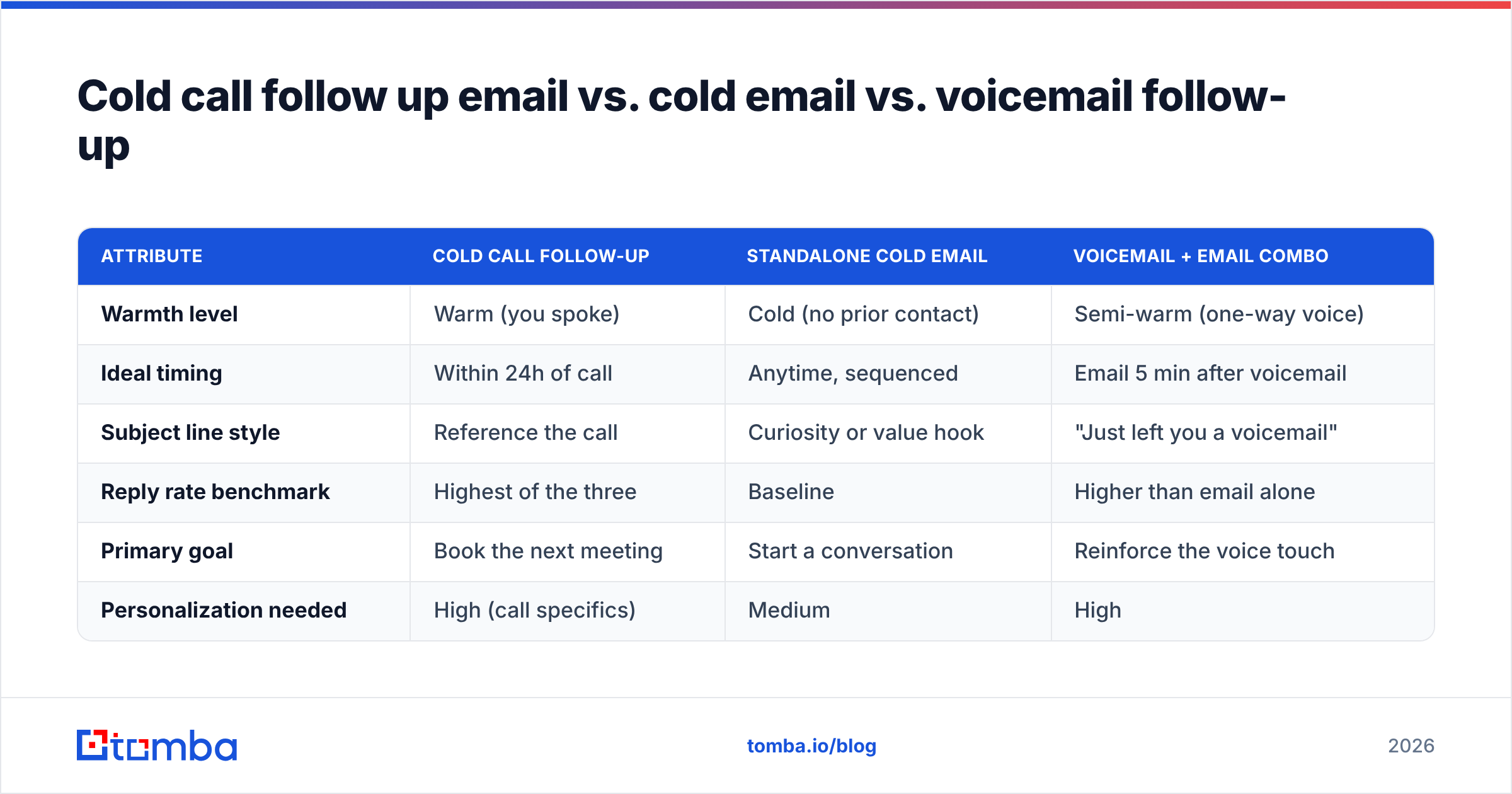
These three touches look similar but do different jobs. Matching the format to the situation is half the battle.
| Attribute | Cold Call Follow-Up | Standalone Cold Email | Voicemail + Email Combo |
|---|---|---|---|
| Warmth level | Warm (you spoke) | Cold (no prior contact) | Semi-warm (one-way voice) |
| Ideal timing | Within 24h of call | Anytime, sequenced | Email 5 min after voicemail |
| Subject line style | Reference the call | Curiosity or value hook | "Just left you a voicemail" |
| Reply rate benchmark | Highest of the three | Baseline | Higher than email alone |
| Primary goal | Book the next meeting | Start a conversation | Reinforce the voice touch |
| Personalization needed | High (call specifics) | Medium | High |
The takeaway: a cold calling follow up email should never read like a generic cold email. You have context the cold emailer doesn't. Waste it and you throw away your biggest advantage — the fact that this person already heard your voice and, however briefly, engaged.
7 cold calling follow up email templates#
Copy these, swap the brackets, and cut anything that doesn't sound like you. Each is built for a specific moment in the sequence.
1. The same-day recap (Touch 1)#
Subject: Great chatting about [specific topic]
Hi [Name],
Thanks for the few minutes today — the part about [specific pain they mentioned] stood out. As promised, here's [one resource].
Based on what you shared, I think we could help you [concrete outcome]. Worth a 20-minute call to map it out? I'm open Thursday 2pm or Friday 10am.
[Your name]
2. The proof-point add-on (Touch 2)#
Subject: The [competitor/peer] example I mentioned
Hi [Name],
Quick follow-up — here's how [similar company] solved [pain]. They went from [before] to [after] in [timeframe].
Happy to walk you through how it maps to your setup. Does early next week work?
3. The gentle nudge (Touch 3)#
Subject: Did this get buried?
Hi [Name], totally understand inboxes are brutal. Should I follow up next week, or is now a better time to grab 15 minutes?
4. The new-angle re-engage (Touch 4)#
Subject: Saw [trigger event] — thought of our call
Hi [Name],
Noticed [company news / hire / funding]. That usually makes [pain] more urgent. When we spoke, you mentioned [related point] — this seems like the moment to revisit it.
5. The value-only touch#
Subject: No ask — just this
Hi [Name], no pitch today. This [article/tool/benchmark] on [topic] is genuinely useful for what you're building. Enjoy.
6. The break-up email (Touch 5)#
Subject: Should I close your file?
Hi [Name],
I don't want to clutter your inbox, so this is my last note for now. If [outcome] is still a priority, I'm here. If not, no hard feelings — just reply "not now" and I'll circle back next quarter.
7. The referral pivot#
Subject: Wrong person? Point me right
Hi [Name], if [topic] isn't on your plate, who owns it on your team? Happy to take this off your inbox and reach out to them directly.
How do you write the subject line?#
The subject line decides whether the rest exists. For a cold calling follow up email, lean on the shared context — it's your unfair advantage over every other unread message in the inbox.
- Reference the call: "Great chatting about [topic]"
- Ask a genuine question: "Did this get buried?"
- Signal brevity: "Quick one after our call"
- Create a soft loop: "Should I close your file?"
Avoid anything that smells like mass mail — no "Exclusive offer inside," no ALL CAPS, no emoji storms. If you want to pressure-test options, a subject line generator gives you variants to A/B, but the reference-the-call approach almost always wins for post-call follow-ups because it's impossible to fake at scale.
Keep subject lines under about 45 characters so they don't truncate on mobile, where most first opens happen. And match the subject to the body — a curiosity-gap subject followed by a boring recap trains people to stop opening you.
How many follow-up emails is too many?#
The honest answer: fewer than you fear, more than you're probably sending. Five to seven touches over two to three weeks is a healthy range for a warm cold-call follow-up. Beyond that, you hit diminishing returns and start damaging your sender reputation if replies stay flat.
The real limiter isn't a magic number — it's whether each email earns its place. A sequence of five value-carrying touches feels helpful. A sequence of three "just checking in" emails feels like nagging. Every message should give the prospect a reason to reply that they didn't have yesterday.
Watch your metrics, too. If your response rate craters after touch four across a whole segment, that's the market telling you the message or the fit is off — not a signal to send touch five louder.
What tools make the follow-up process repeatable?#
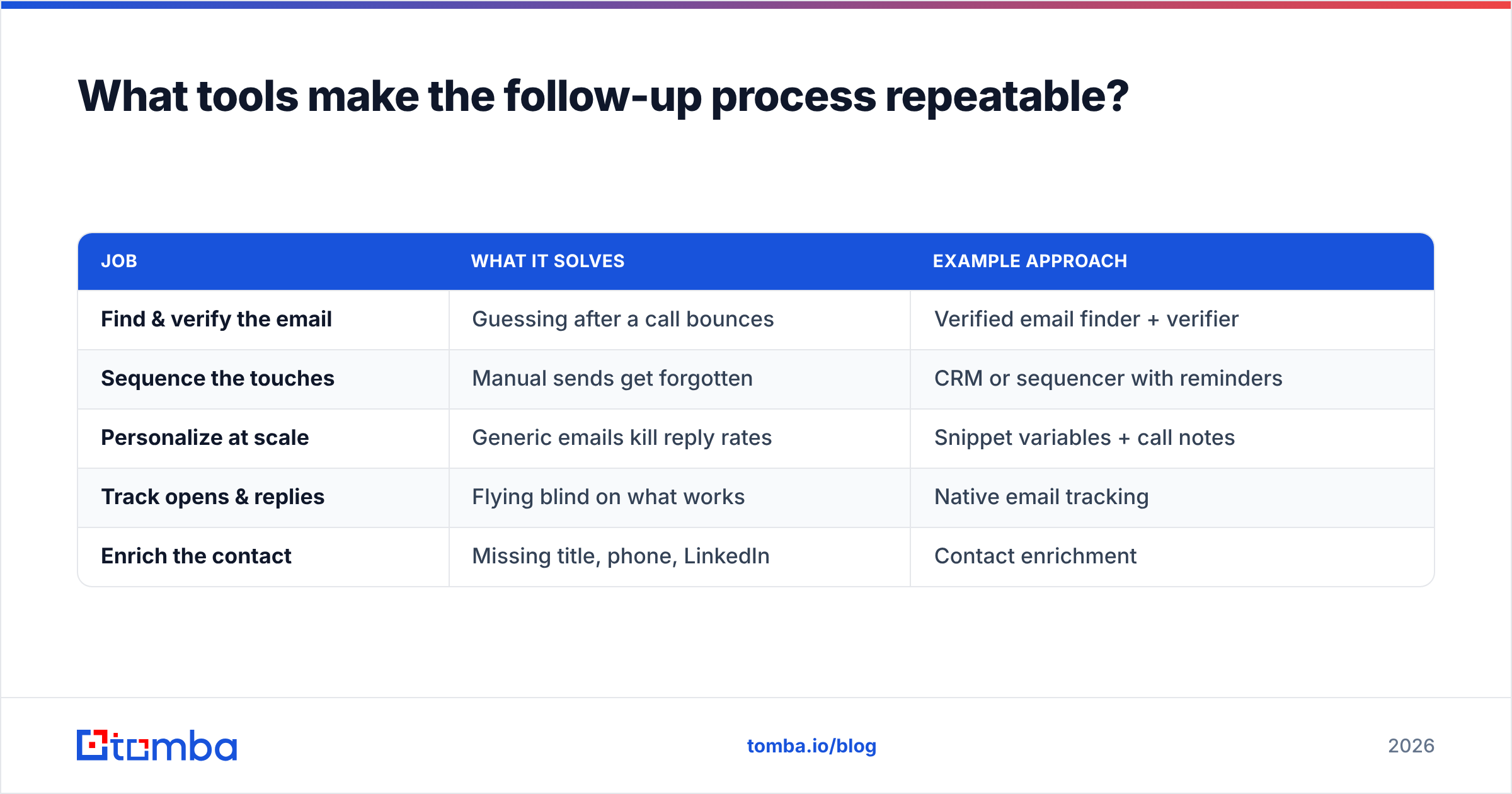
Doing this for one prospect is easy. Doing it across a full pipeline is where reps drown. A few categories of tooling keep it sane:
| Job | What it solves | Example approach |
|---|---|---|
| Find & verify the email | Guessing after a call bounces | Verified email finder + verifier |
| Sequence the touches | Manual sends get forgotten | CRM or sequencer with reminders |
| Personalize at scale | Generic emails kill reply rates | Snippet variables + call notes |
| Track opens & replies | Flying blind on what works | Native email tracking |
| Enrich the contact | Missing title, phone, LinkedIn | Contact enrichment |
The first row is the one reps skip and regret. You can automate a beautiful five-touch cadence, but if the address is wrong, the whole sequence lands nowhere. Start every follow-up by confirming the contact with a reliable email finder, then let your CRM handle the reminders. Tools like Salesforce and HubSpot sequence the sends; a data layer makes sure the sends are deliverable in the first place.
If your motion is phone-heavy, pairing the email cadence with accurate direct dials from a phone finder lets you multithread — a call, then an email, then a LinkedIn touch — which consistently outperforms any single channel run alone.
Common mistakes that kill your follow-up#
- Waiting too long. Day-four first touches read as "I forgot about you."
- Being vague. "Following up on our call" tells them nothing worth opening for.
- Multiple asks. One CTA per email. Choice creates friction.
- No break-up. The final "should I close your file?" email routinely outperforms every other touch. Skipping it leaves replies on the table.
- Ignoring deliverability. A perfect email in the spam folder is a perfect email nobody reads. Verify addresses and keep formatting clean.
Rank these by frequency and vagueness wins. Reps write follow-ups that could apply to any of fifty prospects because it's faster. It's also why those emails get ignored. Spend the extra sixty seconds naming the specific thing you discussed — it's the single highest-leverage edit you can make.
The bottom line#
A cold call is a door you knocked on. The follow-up email is you actually walking through it. Send fast, reference the call, keep it short, run a real cadence, and above all make sure the address is verified so your work reaches a human inbox instead of a bounce log.
Great follow-ups start with great data. Before your next round of calls, confirm every contact with the Tomba Email Finder — find and verify professional emails by name, company, or domain so every follow-up you write actually lands. Check the Tomba pricing to start on the free tier and scale as your pipeline grows. The pitch is only as good as the inbox it reaches.
Related guides#
// get started
Find, verify and enrich your first contacts today
Start on the free plan with 25 searches a month, then scale when your team is ready.
Free plan · No credit card required · GDPR & CCPA
// about the author