Cold Calling for Dummies: The No-Fluff 2026 Beginner's Guide
New to the phones? This plain-English cold calling for dummies guide walks you through lists, scripts, objection handling, and the metrics that actually book meetings in 2026.
TL;DR
- Cold calling still works in 2026, but only when your list is accurate, your opener is short, and you call with a reason the prospect cares about.
- The three pillars for beginners: a clean contact list, a flexible script (not a robot recitation), and a simple objection framework.
- Dial quality beats dial quantity. 40 calls to verified, well-researched contacts outperform 200 spray-and-pray dials.
- Track connect rate, conversation rate, and meetings booked — not just "calls made."
- Feed your dialer with verified direct numbers and emails so you spend time talking, not chasing bad data.
Cold calling gets a bad reputation, and most of that reputation is earned by people who do it badly. If you are new to it, the good news is simple: the bar is low, and a few fundamentals put you ahead of the majority who wing it. This is the plain-English, cold calling for dummies walkthrough — no jargon, no "crush your quota" hype, just the moving parts and how to assemble them.
What is cold calling, really?#
Cold calling is reaching out by phone to someone who hasn't asked to hear from you, with the goal of starting a conversation — usually to book a meeting, not to close a deal on the spot.
Think of it like knocking on a stranger's door to ask for two minutes of their time. You wouldn't kick the door in and start yelling about your product. You'd introduce yourself, give a reason you're there, and read whether they're willing to talk. Cold calling is the phone version of that, and the same manners apply.
Here's the mindset shift most beginners need: the call's job is not to sell. Its job is to earn the next step. When you stop trying to close a $40,000 deal in 90 seconds, the pressure drops and your delivery gets better.

Does cold calling still work in 2026?#
Yes — but the version that works looks nothing like the 1990s boiler room. Buyers screen unknown numbers, spam filters flag suspicious traffic, and attention spans are shorter than ever. What survives is relevant calling: right person, right reason, right moment.
The single biggest predictor of success for a beginner isn't charisma. It's data quality. If half your numbers are wrong or route to the wrong person, no script saves you. That's why serious teams pair their dialer with accurate contact data and a phone finder so reps dial real direct lines instead of dead switchboards.
What do you need before your first call?#
Three things, in order of importance. Skip the first and the rest are wasted.
- A clean, targeted list. 50 well-chosen contacts beat 500 random ones. Define your ideal customer (industry, company size, role) before you dial anything.
- Verified contact details. Wrong numbers and role changes are the top time-wasters. Verify before you dial — a quick email verifier pass and a phone validation step keep your list honest.
- A one-sentence reason to call. Why this person, why now? "I saw you're hiring five SDRs" is a reason. "I wanted to introduce our platform" is not.
Everything else — the perfect headset, the fancy dialer, the closing tricks — is secondary to those three.
What does a good cold call script look like?#
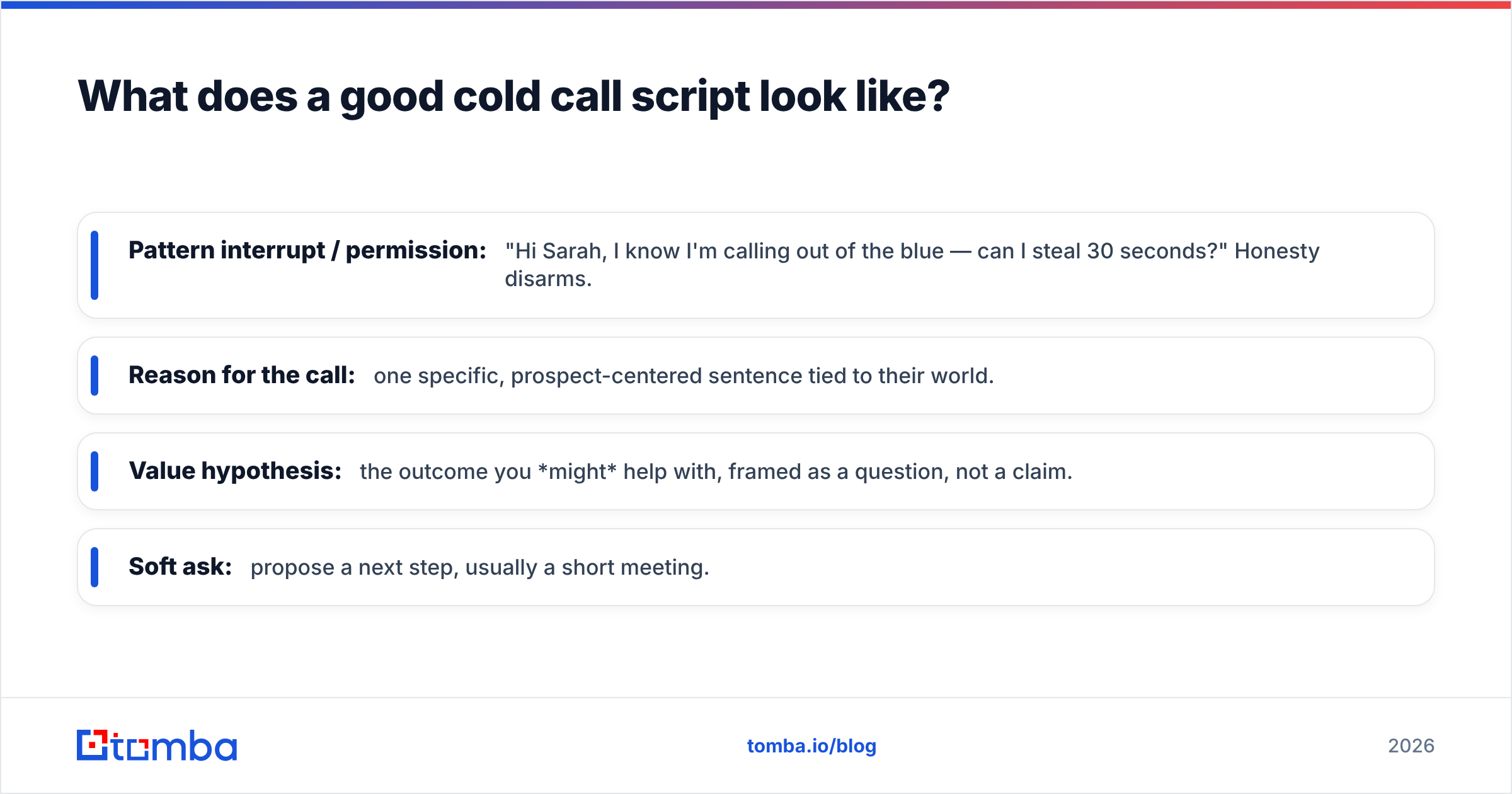
A script is a map, not a cage. You follow the route but adjust for traffic. Every effective opener has four beats:
- Pattern interrupt / permission: "Hi Sarah, I know I'm calling out of the blue — can I steal 30 seconds?" Honesty disarms.
- Reason for the call: one specific, prospect-centered sentence tied to their world.
- Value hypothesis: the outcome you might help with, framed as a question, not a claim.
- Soft ask: propose a next step, usually a short meeting.
Here's a bare-bones template you can adapt:
"Hi [Name], it's [You] from [Company]. I'll be quick — I know you didn't expect this call. I'm reaching out because [specific trigger]. We help teams like yours [outcome]. Worth a 15-minute look next week, or is this totally off-base?"
That last "or is this totally off-base?" is deliberate. It gives the prospect an easy out, which paradoxically makes them more likely to keep talking. For more openers and full frameworks, HubSpot maintains a widely used library of cold call scripts worth studying.
How do you handle objections without freezing?#
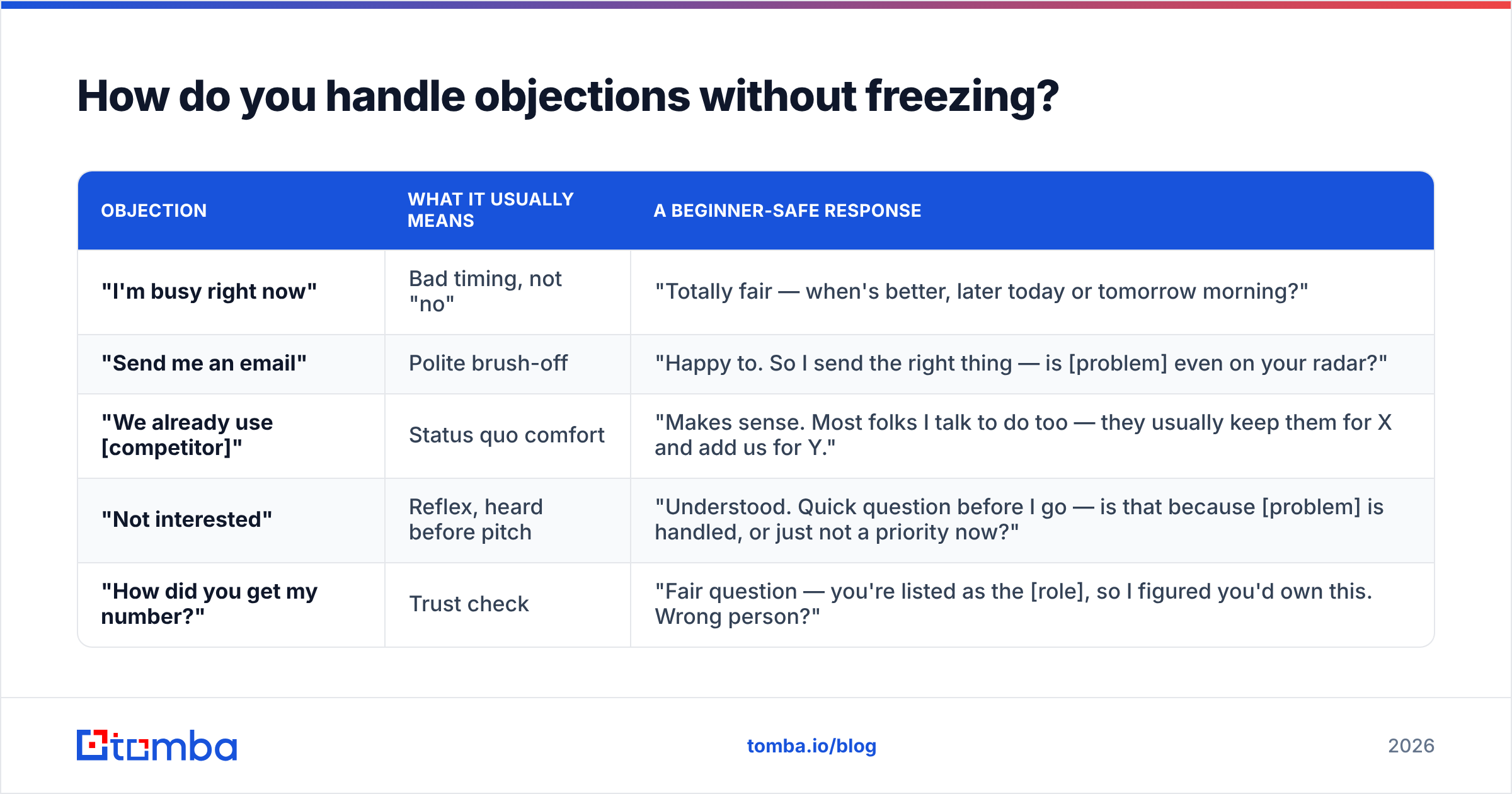
Objections aren't rejection — they're information. Most fall into a handful of buckets, and you can prepare for each. The trick is to acknowledge first, then respond, never argue.
| Objection | What it usually means | A beginner-safe response |
|---|---|---|
| "I'm busy right now" | Bad timing, not "no" | "Totally fair — when's better, later today or tomorrow morning?" |
| "Send me an email" | Polite brush-off | "Happy to. So I send the right thing — is [problem] even on your radar?" |
| "We already use [competitor]" | Status quo comfort | "Makes sense. Most folks I talk to do too — they usually keep them for X and add us for Y." |
| "Not interested" | Reflex, heard before pitch | "Understood. Quick question before I go — is that because [problem] is handled, or just not a priority now?" |
| "How did you get my number?" | Trust check | "Fair question — you're listed as the [role], so I figured you'd own this. Wrong person?" |
The pattern is the same every time: agree, ask, advance. You're not overpowering anyone; you're keeping the conversation alive for one more exchange.
How many calls should a beginner make?#
Enough to get reps, not so many that quality collapses. For someone starting out, 40–60 quality dials a day is a realistic target while you're still learning. The goal early on is conversations, not call volume for its own sake.
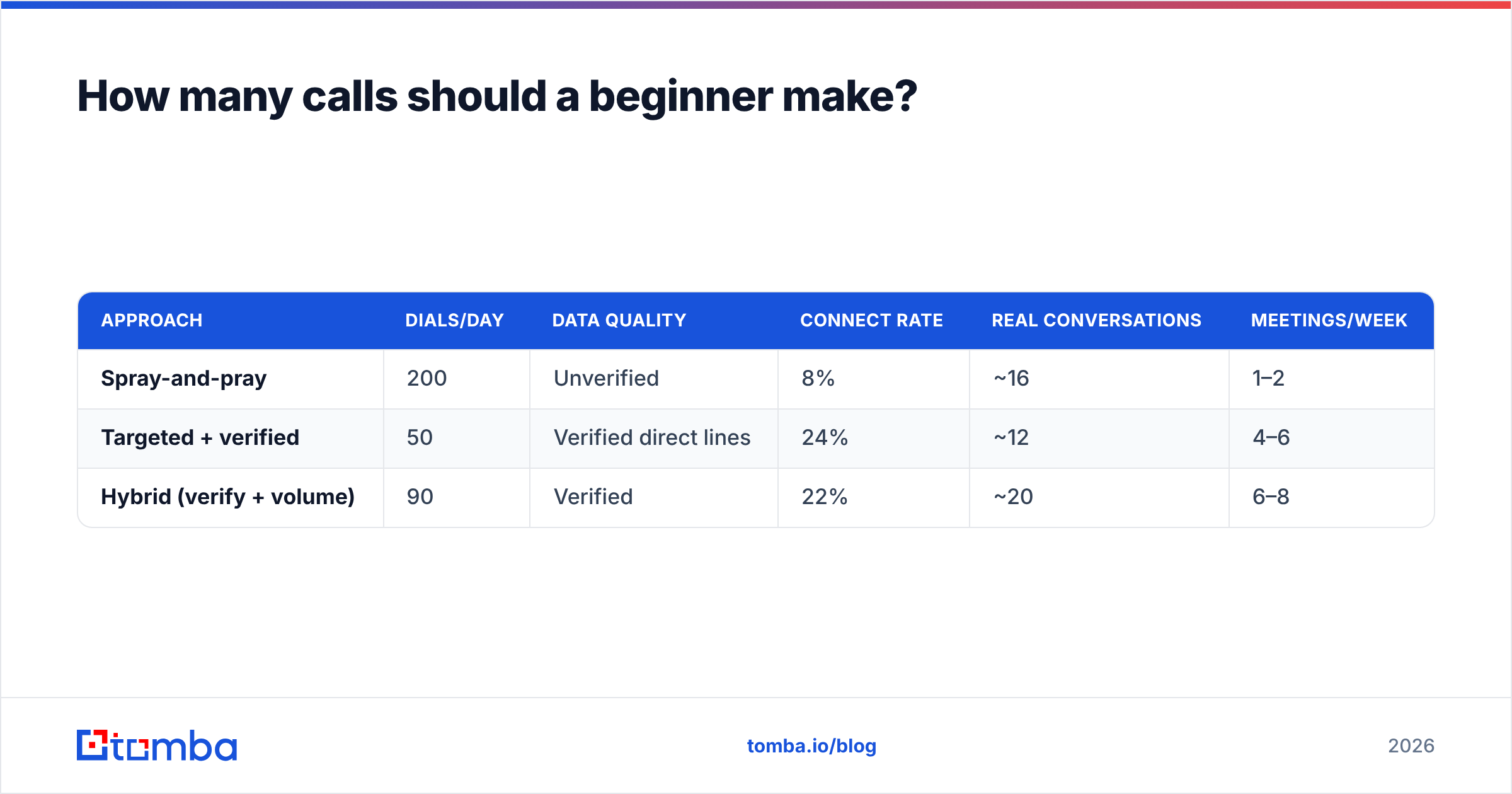
Quality vs. quantity isn't really a debate once you do the math. Look at how the two approaches compare:
| Approach | Dials/day | Data quality | Connect rate | Real conversations | Meetings/week |
|---|---|---|---|---|---|
| Spray-and-pray | 200 | Unverified | 8% | ~16 | 1–2 |
| Targeted + verified | 50 | Verified direct lines | 24% | ~12 | 4–6 |
| Hybrid (verify + volume) | 90 | Verified | 22% | ~20 | 6–8 |
Fewer, better dials win because every wrong number, gatekeeper loop, and "who is this?" burns time and morale. Clean data is the multiplier. If you're building lists at scale, a bulk email finder plus number verification keeps the top of your funnel from rotting.
What metrics actually matter?#
"Calls made" is a vanity number. Track the chain that leads to revenue instead:
- Connect rate — of the numbers you dialed, how many reached a live human? Low here = a data problem, not a skill problem.
- Conversation rate — of connects, how many turned into a real back-and-forth? This measures your opener.
- Meeting rate — of conversations, how many booked a next step? This measures your ask.
- Show rate — of meetings booked, how many actually happened? This measures your qualification.
When one number is weak, you know exactly what to fix. A poor connect rate means better data or better call times. A poor meeting rate means a stronger ask. This is how you improve deliberately instead of just "calling more."
How does cold calling fit with email and LinkedIn?#
Phone alone is a blunt instrument. The strongest beginners run the phone inside a light multichannel rhythm: a call, a short follow-up email, a LinkedIn touch, another call — spaced over a week or two. Each channel reminds the prospect of the others.
This is where accurate data pays off twice. The same verified record gives you the direct line and the email, so your touches actually land. Pull contacts once with an email finder, enrich them, and sequence across channels instead of guessing. If you want the mechanics of the email side, review the fundamentals of email deliverability so your follow-ups don't die in spam.
Cold calling tools: what does a beginner actually need?#
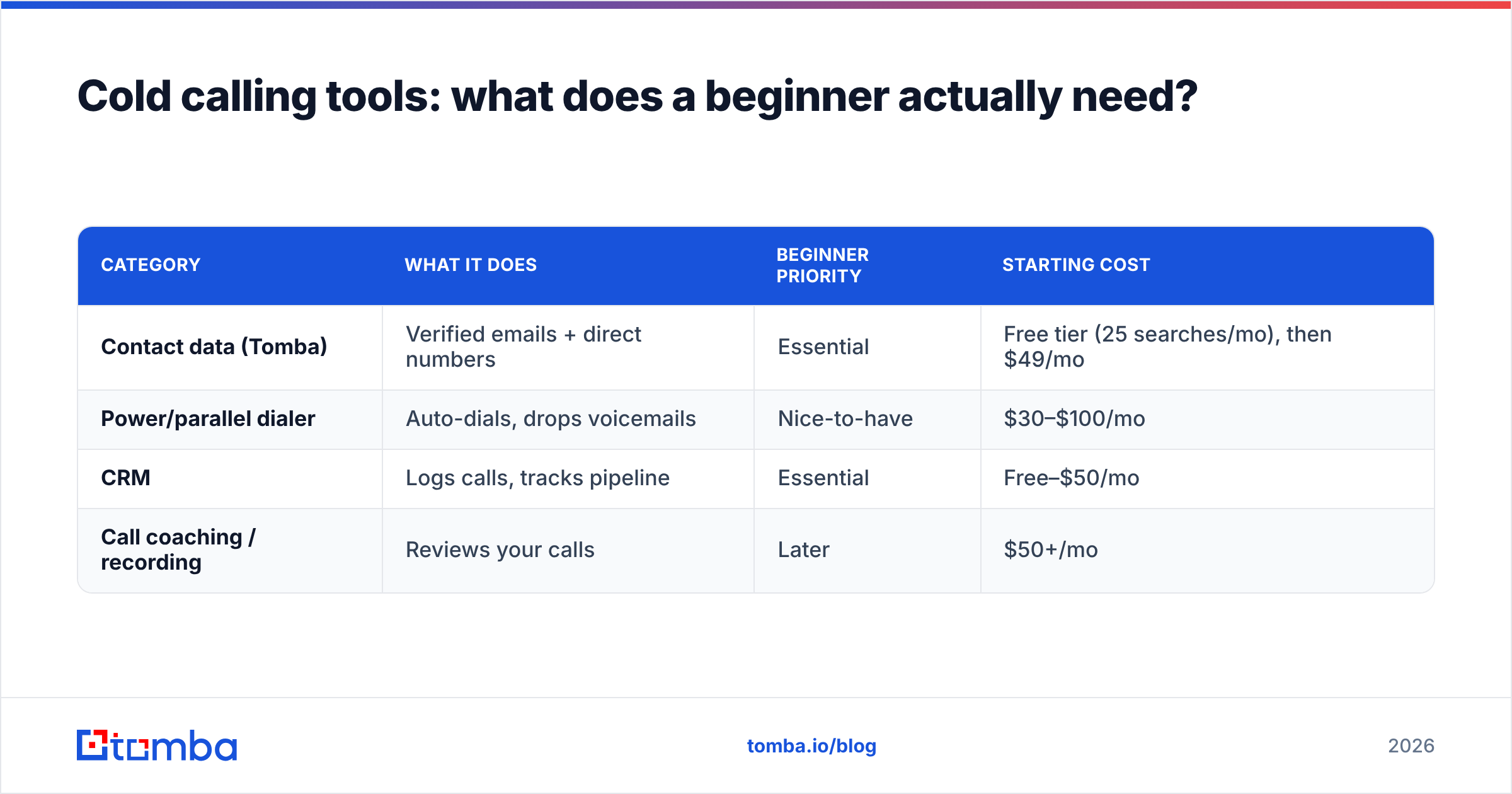
You don't need a bloated tech stack. You need clean data, a way to dial, and a place to log outcomes. Here's an honest starter comparison of the categories — and roughly what they cost.
| Category | What it does | Beginner priority | Starting cost |
|---|---|---|---|
| Contact data (Tomba) | Verified emails + direct numbers | Essential | Free tier (25 searches/mo), then $49/mo |
| Power/parallel dialer | Auto-dials, drops voicemails | Nice-to-have | $30–$100/mo |
| CRM | Logs calls, tracks pipeline | Essential | Free–$50/mo |
| Call coaching / recording | Reviews your calls | Later | $50+/mo |
Start with the two essentials — data and a CRM — and add the rest when volume justifies it. You can see full Tomba pricing if you want to compare tiers, and third-party reviews on G2 are useful for sanity-checking any vendor's claims before you pay. For direct dials specifically, a phone validator pass before a calling block saves you from wasting your best hours on dead numbers.
What are the most common beginner mistakes?#
- Reading the script like a hostage. Practice until the words are yours. Prospects can hear a recital.
- Talking too much. Ask a question, then shut up. Silence does the selling.
- Pitching before permission. Earn the 30 seconds first.
- Dialing garbage data. The number-one time sink. Verify first, always.
- Giving up after voicemail #1. Most connects happen on later attempts. Persistence, not pestering.
- Ignoring the numbers. If you don't track connect and meeting rates, you're improving blind.
Fix these six and you'll clear the bar most reps never reach.
The bottom line#
Cold calling for dummies comes down to this: dial the right people, with a real reason, using accurate data, and measure what happens so you can get better each week. The mechanics are learnable in a month. The discipline of clean lists and honest metrics is what separates the reps who book meetings from the ones who burn out.
Everything starts with the list. If your contacts are wrong, no amount of scripting or grit fixes it — you're just dialing faster into a wall. Build your calling list on verified, accurate contact data with the Tomba Email Finder and its companion phone finder, start on the free tier, and spend your dials on conversations instead of chasing dead numbers. Get the data right, and the rest of cold calling gets a whole lot easier.
Related guides#
Ready to find emails that actually work?
Join 150,000+ professionals who stopped guessing and started sending. Free credits on signup — no credit card required.
Get the Tomba newsletter
Practical outbound tactics and product updates — once every two weeks.
About the author