Cold Calling for Introverts: The 2026 Playbook for Quiet Closers
Think you need to be loud to sell on the phone? You don't. Here's a calm, script-light system for cold calling as an introvert — and why quiet reps often win.
If the phrase "cold calling" makes your stomach drop, you are the exact person this post is for. The loud, back-slapping "always be closing" stereotype has scared a lot of thoughtful, capable people away from the phone. That stereotype is also wrong. Some of the best closers are quiet, prepared, and allergic to small talk — and they win precisely because of it.
TL;DR
- Introverts are often better at cold calling because they prepare more, listen harder, and ask better questions — the phone rewards depth, not volume.
- The fear isn't the call; it's the unscripted call. A repeatable framework and a pre-built list remove the two things introverts hate most: improvising and rejection roulette.
- Batch your calls, warm up with research, and lean on a tight opener you don't have to invent every time.
- Quality data beats brute force. Fewer, better-targeted calls to verified contacts convert higher and hurt less.
- You do not need to become a "phone person." You need a system that lets you sound like the calm expert you already are.
Why is cold calling so hard for introverts?#
The short answer: cold calling forces the three things introverts find most draining, all at once — improvising in real time, performing for a stranger, and absorbing rejection with no recovery buffer.
Think of it like being asked to do stand-up comedy with no set written. Extroverts often get energy from the unpredictability. Introverts get depleted by it. It's not a character flaw or a lack of ability — it's a mismatch between an unstructured task and a brain that does its best work with preparation and depth.
Here's the reframe that changes everything: the discomfort isn't coming from talking to people. It's coming from unpredictability. Remove the unpredictability — with research, a framework, and a clean list — and what's left is a focused conversation with one person about a problem you understand well. That's introvert home turf.
Are introverts actually worse at cold calling?#
No — and the data leans the other way. The traits that make someone "quiet" are the same traits that move deals forward on the phone.
- Listening over talking. Analysis of sales calls by conversation-intelligence platforms consistently shows top performers talk less and listen more. The ideal talk-to-listen ratio skews toward the prospect. Introverts default to this naturally.
- Preparation over improvisation. Introverts tend to over-prepare. On a cold call, "over-prepared" just means "credible in the first ten seconds."
- Thoughtful questions over pitches. Great discovery is a series of well-placed questions, then silence. Introverts are comfortable with silence; extroverts often rush to fill it.
- Depth over breadth. One genuinely relevant conversation beats twenty spray-and-pray dials. Introverts are wired for the former.
According to research summarized by HubSpot's sales blog, personalization and relevance are the biggest levers on connect-to-conversation rates. That's a preparation game, not a personality game — and preparation is where introverts quietly dominate.
What does an introvert-friendly cold calling system look like?#
The goal is to replace "wing it" energy with a repeatable process. Build the system once, then run the play. Here's the framework.
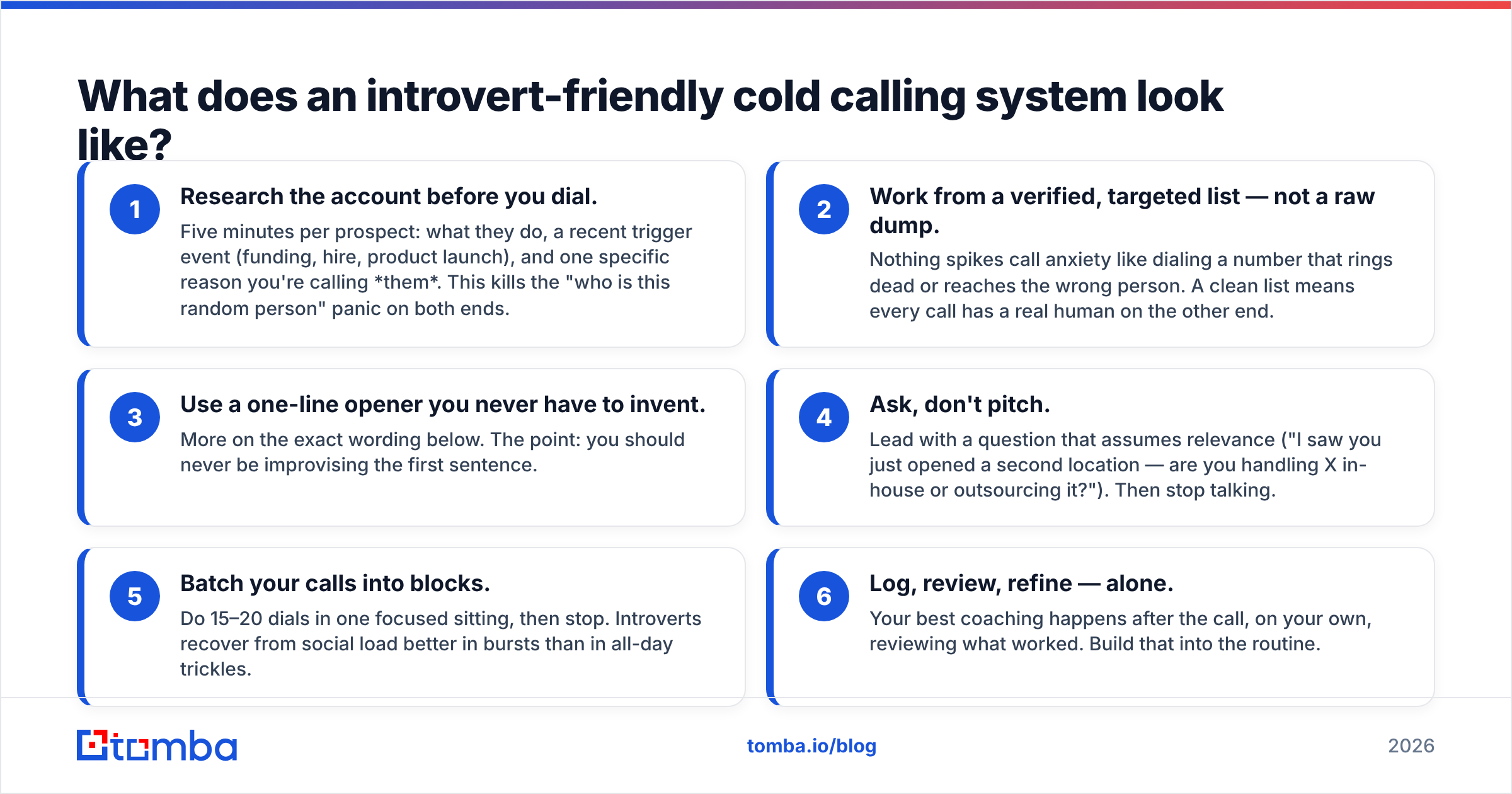
- Research the account before you dial. Five minutes per prospect: what they do, a recent trigger event (funding, hire, product launch), and one specific reason you're calling them. This kills the "who is this random person" panic on both ends.
- Work from a verified, targeted list — not a raw dump. Nothing spikes call anxiety like dialing a number that rings dead or reaches the wrong person. A clean list means every call has a real human on the other end.
- Use a one-line opener you never have to invent. More on the exact wording below. The point: you should never be improvising the first sentence.
- Ask, don't pitch. Lead with a question that assumes relevance ("I saw you just opened a second location — are you handling X in-house or outsourcing it?"). Then stop talking.
- Batch your calls into blocks. Do 15–20 dials in one focused sitting, then stop. Introverts recover from social load better in bursts than in all-day trickles.
- Log, review, refine — alone. Your best coaching happens after the call, on your own, reviewing what worked. Build that into the routine.
This is the same logic behind good outbound sales strategy generally: reduce randomness, increase relevance, and let the process carry the emotional weight so you don't have to.
How do I write a cold call script that doesn't feel fake?#
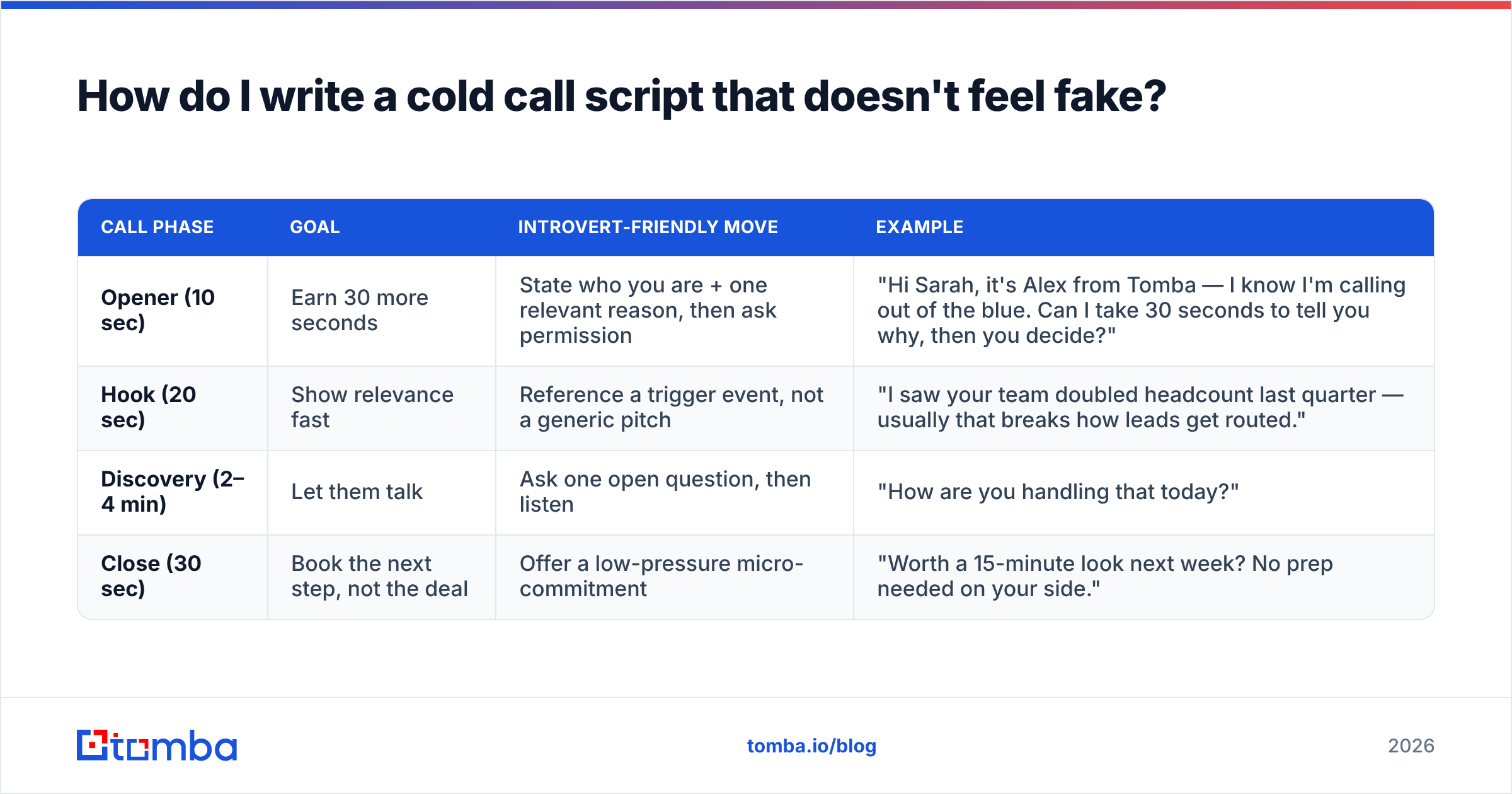
Write a framework, not a word-for-word script. A rigid script makes introverts sound robotic and panics them the moment a prospect goes off-track. A framework gives you rails without a cage.
Use this four-part structure:
| Call phase | Goal | Introvert-friendly move | Example |
|---|---|---|---|
| Opener (10 sec) | Earn 30 more seconds | State who you are + one relevant reason, then ask permission | "Hi Sarah, it's Alex from Tomba — I know I'm calling out of the blue. Can I take 30 seconds to tell you why, then you decide?" |
| Hook (20 sec) | Show relevance fast | Reference a trigger event, not a generic pitch | "I saw your team doubled headcount last quarter — usually that breaks how leads get routed." |
| Discovery (2–4 min) | Let them talk | Ask one open question, then listen | "How are you handling that today?" |
| Close (30 sec) | Book the next step, not the deal | Offer a low-pressure micro-commitment | "Worth a 15-minute look next week? No prep needed on your side." |
Notice how little you have to say. The structure does the heavy lifting. You're steering, not performing. If you want a starting point, tested cold email templates translate cleanly into call openers — the relevance principles are identical.
The permission-based opener ("Can I take 30 seconds?") is especially powerful for introverts. It replaces the dreaded hard pitch with a small, honest ask, and prospects respect it. It also gives you an exit ramp, which lowers anxiety before you even dial.
How can I cold call without burning out?#
Protect your energy like a budget, because for introverts it literally is one. The reps who last aren't the ones who grind hardest — they're the ones who structure the day so the phone doesn't drain the tank by 11 a.m.
- Batch, don't scatter. Two focused 45-minute call blocks beat six hours of ambient dialing.
- Warm up cold. Do your account research immediately before a block. Walking in prepared cuts the anxiety spike dramatically.
- Script the scary parts, improvise the rest. You only need the opener and objection responses memorized. Everything else is a conversation.
- Recover on purpose. Schedule a quiet task after each block. Back-to-back calls with no buffer is how introverts burn out.
- Measure conversations, not just dials. A dials-only metric rewards volume and punishes the depth you're good at. Track meetings booked per 100 dials instead.

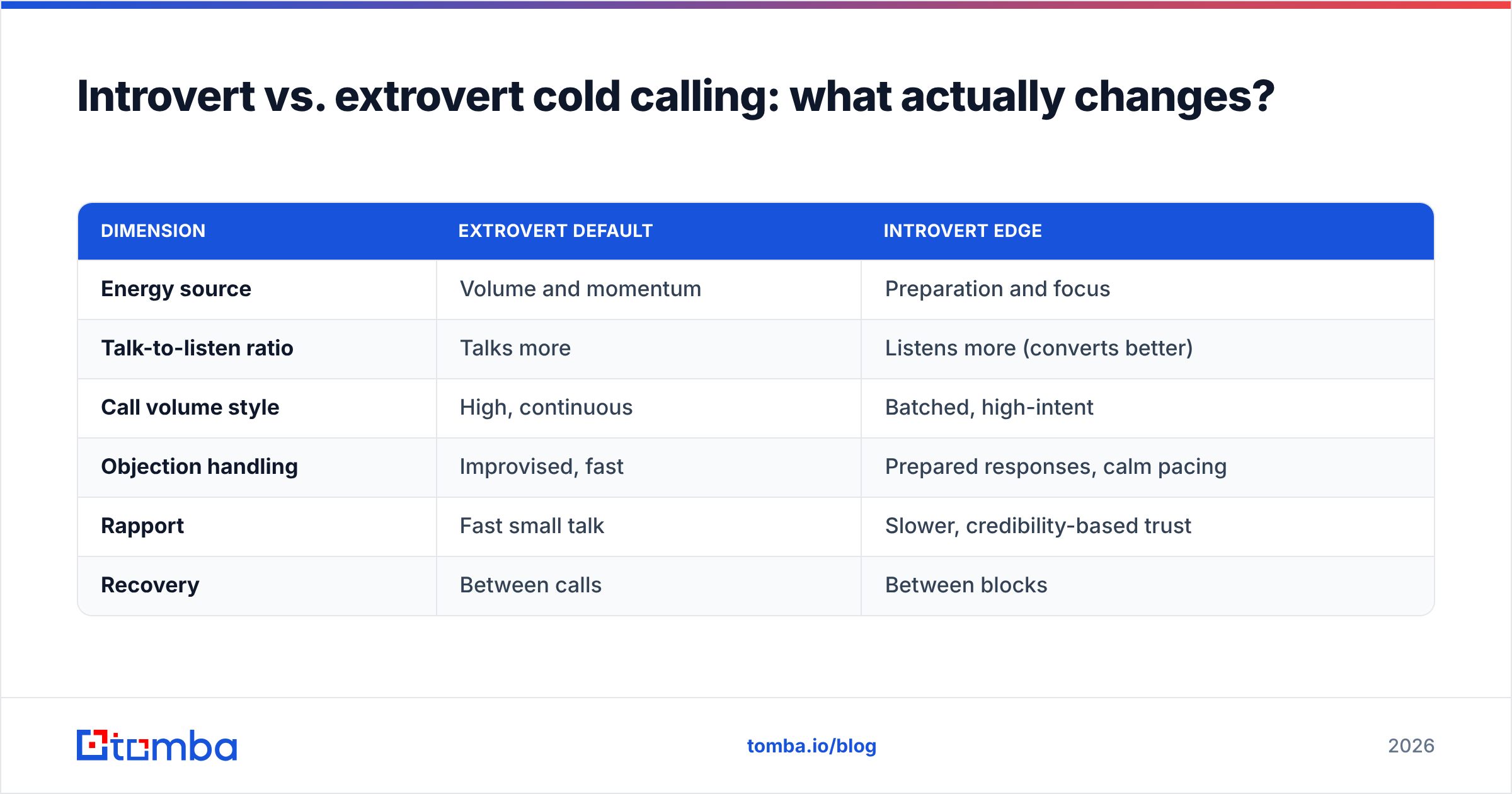
Introvert vs. extrovert cold calling: what actually changes?#
Both can succeed — but the path looks different. Trying to sell like an extrovert is the fastest way for an introvert to burn out and quit. Play your own game.
| Dimension | Extrovert default | Introvert edge |
|---|---|---|
| Energy source | Volume and momentum | Preparation and focus |
| Talk-to-listen ratio | Talks more | Listens more (converts better) |
| Call volume style | High, continuous | Batched, high-intent |
| Objection handling | Improvised, fast | Prepared responses, calm pacing |
| Rapport | Fast small talk | Slower, credibility-based trust |
| Recovery | Between calls | Between blocks |
The takeaway: don't out-extrovert the extroverts. Out-prepare them. A quiet rep with a verified list, a trigger-based opener, and genuine listening will out-convert a loud rep working a bad list every time.
Does the quality of my list matter more than my personality?#
Yes — arguably more than any other single factor. You can have a flawless framework and a calm voice, and still have a miserable day if 40% of your numbers are dead, wrong, or belong to someone who left the company two years ago.
For introverts specifically, bad data is a double tax: you waste effort and you absorb needless rejection that has nothing to do with your ability. Every "wrong number" chips at the confidence you need for the next real conversation.
This is where good tooling quietly changes the emotional math:
- Build lists from accurate, verified contacts so every dial reaches a real, relevant person. A phone finder surfaces direct-dial B2B numbers instead of generic switchboards, and a phone validator filters out dead lines before you ever pick up the handset.
- Pair calls with email so you can send a relevant follow-up the moment a prospect says "email me." Reliable contact data and a fast email finder mean your "just following up" note actually lands.
- Enrich each contact with role and company context so your opener is specific, not generic — the difference between a hang-up and a conversation.
According to independent reviews on G2, data accuracy is the single most cited factor separating tools people keep from tools they abandon. For a cold caller, accuracy isn't a nice-to-have — it's your rejection insurance.
Fewer, better calls to verified contacts is the whole introvert cheat code: it plays to your strength (depth) and shields your weakness (rejection tolerance).
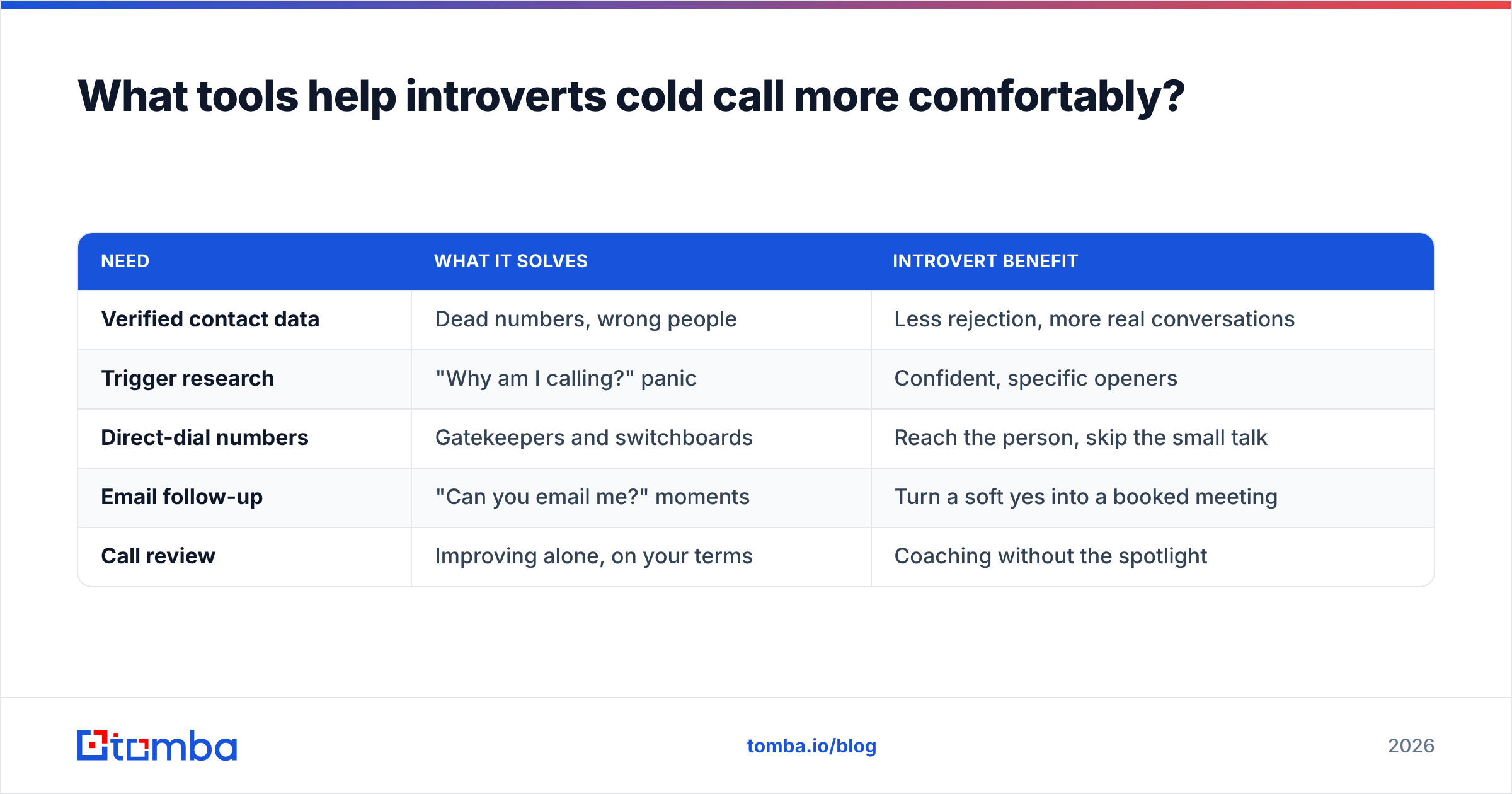
What tools help introverts cold call more comfortably?#
The right stack removes the parts you dread and amplifies the parts you're good at. You don't need a dozen apps — you need clean data, a way to research fast, and a light process layer.
| Need | What it solves | Introvert benefit |
|---|---|---|
| Verified contact data | Dead numbers, wrong people | Less rejection, more real conversations |
| Trigger research | "Why am I calling?" panic | Confident, specific openers |
| Direct-dial numbers | Gatekeepers and switchboards | Reach the person, skip the small talk |
| Email follow-up | "Can you email me?" moments | Turn a soft yes into a booked meeting |
| Call review | Improving alone, on your terms | Coaching without the spotlight |
Conversation-intelligence tools like Gong let you review your own calls privately and learn from patterns — ideal for reps who'd rather self-coach than role-play in front of a team. Combine that with a source of accurate contacts, and the phone stops feeling like a slot machine and starts feeling like a series of solvable puzzles.
How do I get over the fear enough to start?#
Start smaller than feels reasonable, and let evidence — not pep talks — build your confidence. Fear shrinks when the task is defined and the data is good. It grows when you're improvising into the unknown.
- Make your first block tiny. Five calls to your best-fit, verified prospects. That's it. Prove to yourself the sky doesn't fall.
- Aim for the conversation, not the close. Your only goal early on is to have a human exchange. Meetings follow.
- Expect and pre-write objections. "Not interested," "send me an email," "we already use someone." Have a calm one-liner for each. Preparedness is the antidote to dread.
- Reframe every no. A fast no from a wrong-fit prospect is a gift — it protects your energy for the right ones. Good targeting means more of your nos are quick and painless.
- Track your own trend. Watch your meetings-per-100-dials climb over two weeks. Introverts trust data more than hype — so let the data do the convincing.
The reps who quit are usually the ones who tried to power through with a bad list and no framework, taking every rejection personally. The reps who thrive built a calm system, protected their energy, and let preparation carry the weight. You can absolutely be the second kind.
Start with a list worth calling#
Cold calling for introverts isn't about faking extroversion — it's about engineering the conditions where your natural strengths (research, listening, patience) win. The framework matters. The energy management matters. But it all sits on top of one foundation: who you're calling.
Give yourself the unfair advantage of accurate, verified contacts so every dial reaches a real, relevant person and every follow-up lands. Use Tomba's Email Finder to build clean, targeted lists — complete with the emails, direct numbers, and company context that turn a cold, anxious dial into a warm, informed conversation. Check the Tomba pricing plans (a free tier gets you 25 searches a month to start), build your first list of best-fit prospects, and make five calls. Quiet closers win with better data — start there.
Related guides#
Ready to find emails that actually work?
Join 150,000+ professionals who stopped guessing and started sending. Free credits on signup — no credit card required.
Get the Tomba newsletter
Practical outbound tactics and product updates — once every two weeks.
About the author