Cold Calling for Outbound Sales: The 2026 Playbook That Works
Cold calling isn't dead — it's just harder to do badly and get away with it. Here's how to build a cold calling motion that books meetings in 2026, from data and cadences to scripts and objection handling.
Cold Calling for Outbound Sales: The 2026 Playbook That Works
Cold calling for outbound sales is not dead. What's dead is the spray-and-pray version — 200 random dials a day into a list you bought three years ago, reading a script that opens with "Did I catch you at a bad time?" The reps who still hit quota on the phone in 2026 treat calling as a precision tool: good data, tight targeting, a reason to call, and a cadence that mixes the phone with email and LinkedIn.
This guide breaks down exactly how that works — what to expect from connect rates, how to build a list that's actually callable, the anatomy of a cold call that converts, and where calling fits inside a modern outbound sequence.
TL;DR#
- Cold calling still works, but only when it sits on top of accurate, phone-verified data and a clear target profile. Bad numbers kill more campaigns than bad scripts.
- Expect 1–3% of dials to become meetings in most B2B segments — the winners get there by improving connect rate, not just dialing more.
- The best openers earn permission and give a reason to call. "Did I catch you at a bad time?" is not a strategy.
- Calling belongs in a multi-channel cadence, not alone. Pair each call with an email and a LinkedIn touch for 2–3x the reply rate.
- Data is the multiplier. A verified mobile number and a real job title beats any clever line. Start with a clean list from a tool like the Tomba phone finder.
Is cold calling for outbound sales still worth it in 2026?#
Short answer: yes, for most B2B teams selling deals above roughly $5,000 in annual contract value. The phone is still the fastest way to have a real, two-way conversation with a stranger — and a live conversation compresses a sales cycle in ways that a cold email thread can't.
Think of cold calling like knocking on a neighbor's door versus mailing them a flyer. The flyer (email) scales infinitely and costs nothing, but most of it lands in the recycling. The knock (call) interrupts, which is exactly why it works when you have something worth interrupting for. You get an answer — yes, no, or "call me next quarter" — in ninety seconds instead of a two-week email chase.
That said, the economics have shifted. Mobile carriers flag spam-likely numbers, buyers screen unknown callers, and connect rates on landlines have collapsed. The response is not to abandon the channel — it's to raise the quality bar on everything upstream of the dial.
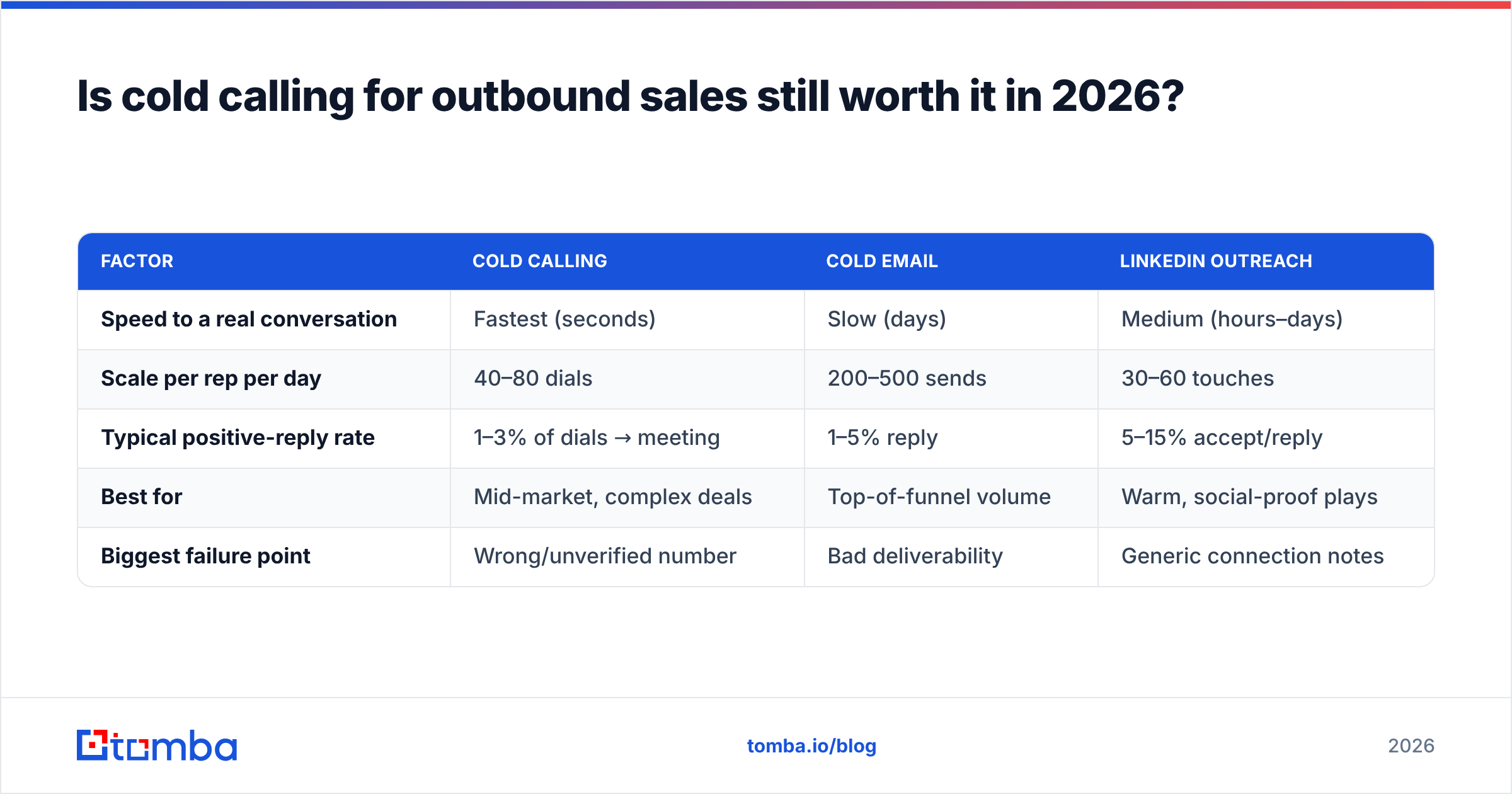
| Factor | Cold calling | Cold email | LinkedIn outreach |
|---|---|---|---|
| Speed to a real conversation | Fastest (seconds) | Slow (days) | Medium (hours–days) |
| Scale per rep per day | 40–80 dials | 200–500 sends | 30–60 touches |
| Typical positive-reply rate | 1–3% of dials → meeting | 1–5% reply | 5–15% accept/reply |
| Best for | Mid-market, complex deals | Top-of-funnel volume | Warm, social-proof plays |
| Biggest failure point | Wrong/unverified number | Bad deliverability | Generic connection notes |
The takeaway: no single channel wins. Cold calling for outbound sales is strongest as the tip of the spear inside a coordinated cadence, and its ceiling is set almost entirely by data quality.
What makes a cold call actually connect?#
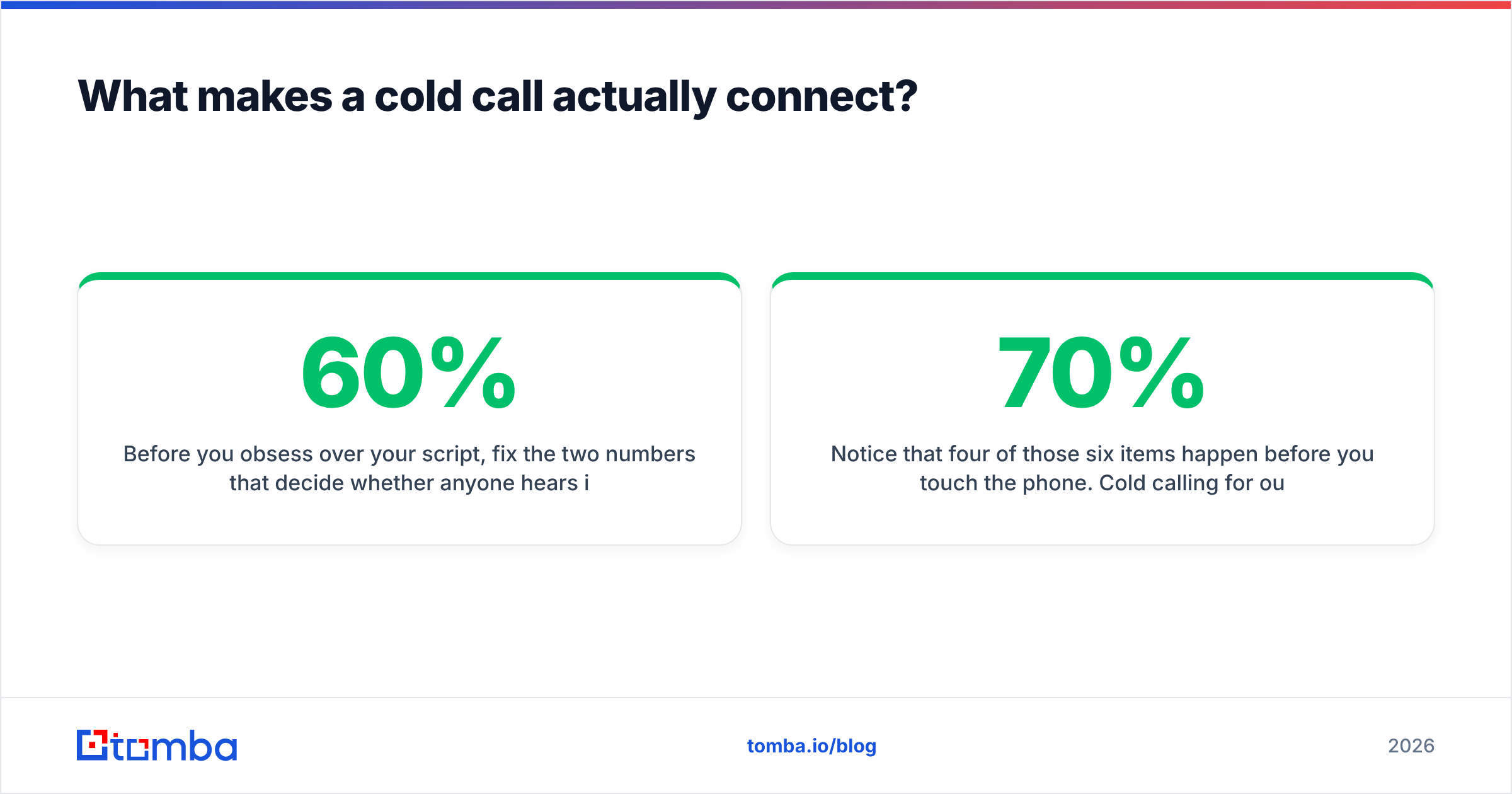
Before you obsess over your script, fix the two numbers that decide whether anyone hears it: connect rate and contact accuracy. You can have the best pitch in the building, but if 60% of your numbers are wrong or route to a dead desk phone, you're optimizing the wrong thing.
Here's the order of operations that separates teams who book meetings from teams who burn a dialer:
- Target account fit. Define the industry, headcount, and trigger (funding, hiring, tech stack) that make an account worth a call. A tighter list dialed carefully beats a huge list dialed blindly.
- The right person. Get to the actual decision-maker or a credible champion. A verified title matters as much as a verified number.
- A reachable number. Direct dials and mobiles convert far better than switchboards. This is where a dedicated phone finder and a phone validator earn their keep — you want live, dialable numbers, not a spreadsheet of main lines.
- A reason to call now. Reference a trigger event. "I saw you just opened a second office in Austin" beats "I wanted to introduce our platform."
- A repeatable cadence. One dial is noise. Six to eight touches across phone, email, and LinkedIn over two to three weeks is a campaign.
- A short, permission-based opener. More on the script below — but the goal is to earn the next thirty seconds, not to pitch in the first breath.
Notice that four of those six items happen before you touch the phone. Cold calling for outbound sales is 70% preparation, 30% talk track. Reps who invert that ratio wonder why the channel "doesn't work."
What does a cold call script that converts look like?#
A good script is a skeleton, not a cage. It gives you a reliable structure so you can listen instead of scrambling for what to say next. Here's a framework that holds up across most B2B segments.
1. The pattern-interrupt opener (10 seconds). Use their name, your name, your company, and an honest ask for a few seconds. Buyers respect directness.
"Hi Sarah, this is Alex from Tomba. I know I'm an interruption — can I take twenty seconds to tell you why I called, and you can decide if it's worth continuing?"
Almost everyone says yes to that. You've earned permission instead of stealing time.
2. The reason-for-the-call (20 seconds). Tie the call to a trigger and a specific outcome you drive for people like them.
"I'm reaching out because you're scaling the SDR team — I saw the three open roles. Teams at that stage usually lose hours a week to bad contact data, and we help fix connect rates. Is that a priority right now?"
3. The discovery pivot. Ask one sharp question and then be quiet. The rep who talks least on a cold call usually wins.
4. The single ask. Don't try to close the deal — close the next step. "Worth a 15-minute look next Tuesday?" A calendar slot is the only goal.
5. The graceful exit. If it's a no, get a reason or a referral, thank them, and move on. Every no protects your time for the next yes.
How do you handle the objections you'll hear every day?#
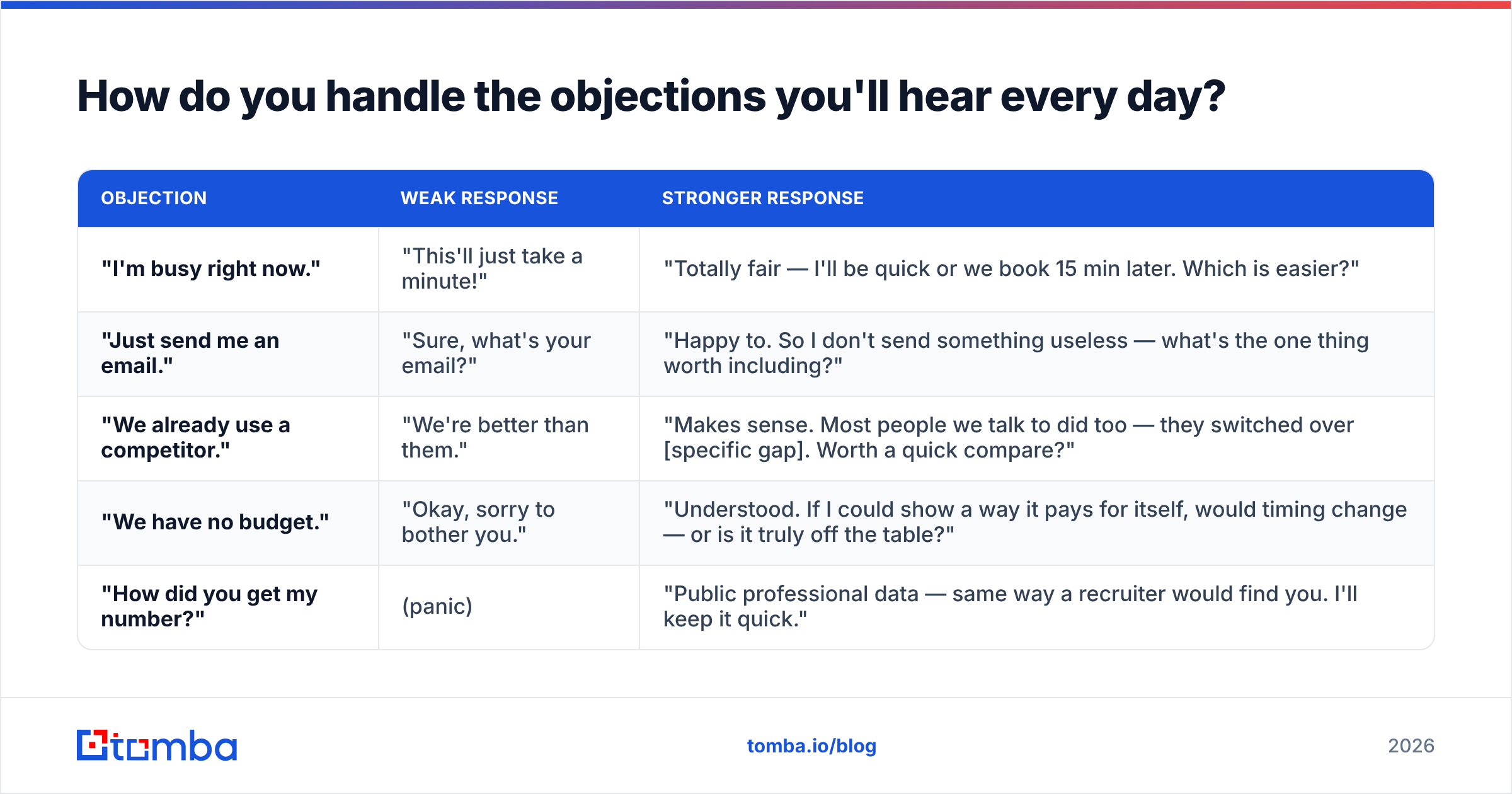
You'll hear the same four or five objections thousands of times. Scripting your responses isn't robotic — it's the difference between a confident answer and an awkward pause that ends the call.
| Objection | Weak response | Stronger response |
|---|---|---|
| "I'm busy right now." | "This'll just take a minute!" | "Totally fair — I'll be quick or we book 15 min later. Which is easier?" |
| "Just send me an email." | "Sure, what's your email?" | "Happy to. So I don't send something useless — what's the one thing worth including?" |
| "We already use a competitor." | "We're better than them." | "Makes sense. Most people we talk to did too — they switched over [specific gap]. Worth a quick compare?" |
| "We have no budget." | "Okay, sorry to bother you." | "Understood. If I could show a way it pays for itself, would timing change — or is it truly off the table?" |
| "How did you get my number?" | (panic) | "Public professional data — same way a recruiter would find you. I'll keep it quick." |
The "send me an email" objection is the most common polite brush-off, and it's also your best chance to earn a real next step. When you do send that follow-up, make it land — a tight, relevant note beats a brochure. If email copy is your weak spot, borrow from proven cold email templates and personalize from there.
Where does calling fit in a multi-channel outbound cadence?#
Cold calling for outbound sales performs best when it's woven into a sequence, not run as a standalone activity. A call reinforces an email; an email gives a caller a reference point; a LinkedIn view warms the name before the phone rings. Buyers who see you in three places assume you're everywhere — that familiarity lifts every channel's response rate.
Here's a proven two-week cadence you can adapt:
- Day 1: LinkedIn profile view + connection request (no pitch).
- Day 2: Cold call #1 + voicemail if no answer.
- Day 3: Personalized email referencing the same trigger.
- Day 5: Cold call #2 at a different time of day.
- Day 7: LinkedIn message or comment on their post.
- Day 9: Cold call #3 + "breakup" voicemail.
- Day 11: Value email (case study, relevant resource).
- Day 14: Final call + polite breakup email.
Two operational notes. First, vary your call times — someone who never answers at 9 a.m. may pick up at 4:45 p.m. Second, the whole cadence collapses if the underlying record is wrong. If the email bounces and the number is dead, you've spent two weeks touching a ghost. Run your list through an email verifier and validate phone numbers before the sequence starts, not after it fails.
For a deeper look at building the sequences themselves, Salesforce's guide to sales cadences is a solid, vendor-neutral primer, and HubSpot's cold calling research is worth a read for benchmark stats on timing and connect rates.
How do you build a callable list that doesn't waste your day?#
This is the part most guides skip, and it's the part that decides everything. A rep making 60 dials a day into a 90%-accurate list of direct mobiles will crush a rep making 120 dials into a 50%-accurate list of switchboards. Same effort, double the conversations.
A callable list needs three things per contact: the right person, a verified professional email (your cadence backbone), and a direct, validated phone number. Here's how to assemble that at scale without buying a stale database:
- Find the people by company. Use domain search to pull the decision-makers at your target accounts, complete with roles and email patterns.
- Get the direct numbers. Layer in a phone finder to attach mobile and direct-dial numbers instead of main lines.
- Verify before you dial or send. Clean the list so you're not burning time on disconnected numbers or bounced emails.
- Enrich for context. Pull in seniority, company size, and other firmographics with data enrichment so your openers can reference something real.
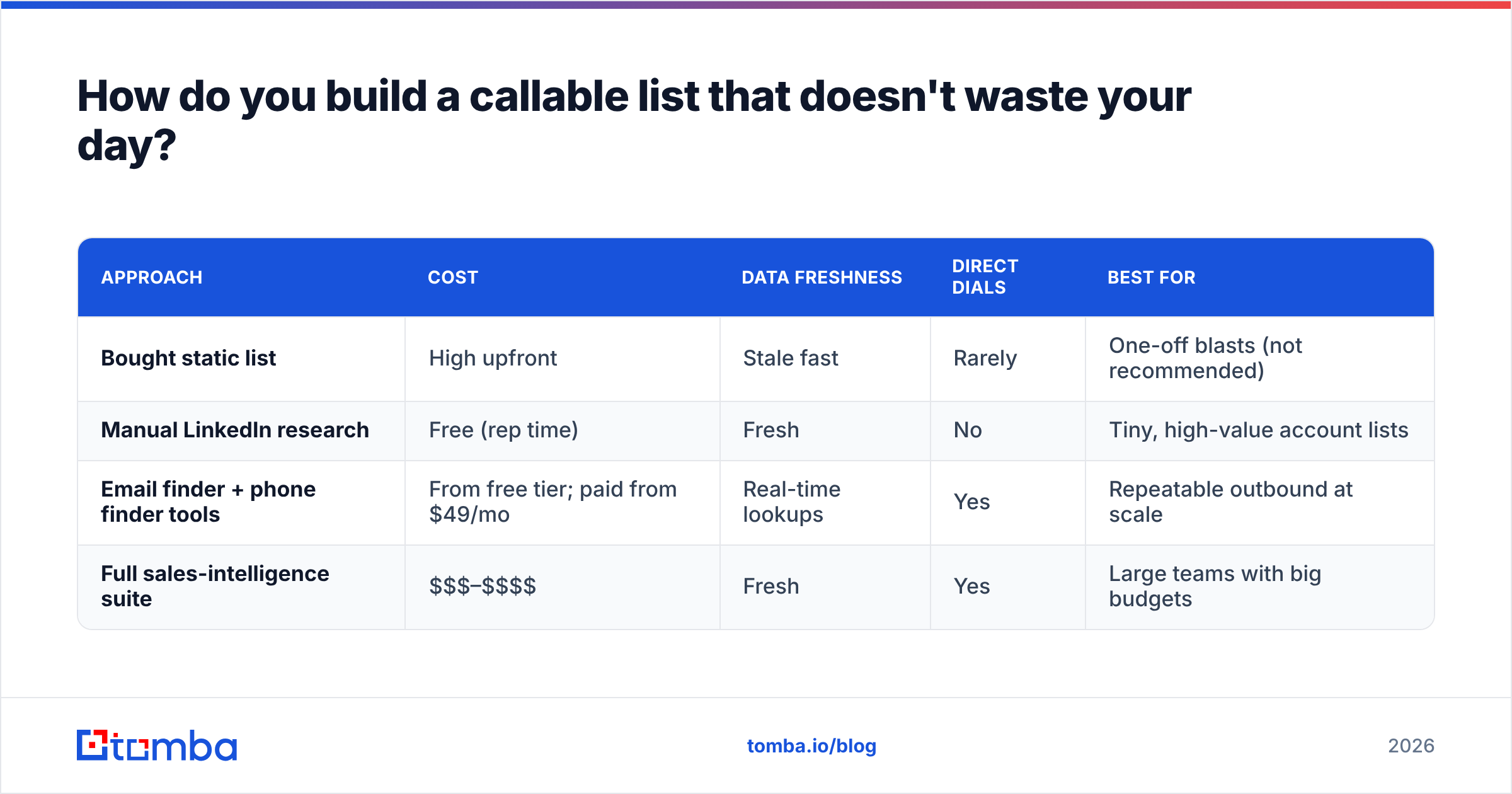
Compare a few approaches to sourcing that data:
| Approach | Cost | Data freshness | Direct dials | Best for |
|---|---|---|---|---|
| Bought static list | High upfront | Stale fast | Rarely | One-off blasts (not recommended) |
| Manual LinkedIn research | Free (rep time) | Fresh | No | Tiny, high-value account lists |
| Email finder + phone finder tools | From free tier; paid from $49/mo | Real-time lookups | Yes | Repeatable outbound at scale |
| Full sales-intelligence suite | $$$–$$$$ | Fresh | Yes | Large teams with big budgets |
Tomba sits in that third row. The Tomba pricing starts with a free tier of 25 searches a month, with the Starter plan at $49/mo, Growth at $99/mo, and Pro at $249/mo — so you can validate the motion before you scale spend. If you're comparing broader databases, peers like BookYourData offer strong ready-made B2B lists; the right choice depends on whether you want to build lists dynamically or buy them pre-packaged. Reading real user reviews on G2 before committing is always worth the ten minutes.
What metrics tell you cold calling is working?#
Don't judge cold calling for outbound sales on gut feel. Track a small set of numbers weekly so you can see which lever to pull:
- Connect rate (conversations ÷ dials): Below ~8–10%? Your data or your call times are the problem, not your script.
- Conversation-to-meeting rate: Below ~15%? Your opener, targeting, or offer needs work.
- Meetings per 100 dials: Your north star. Getting from 1 to 3 usually comes from better data, not more dials.
- Show rate: Meetings booked mean nothing if they don't show. Confirm via email the day before.
When connect rate is your bottleneck — and it usually is — the fix lives upstream in list quality, not in your talk track. That's the recurring theme of modern outbound: the phone still works, but only for the reps who earned the right to dial by doing the data work first.
Start with a list worth calling#
The reps who still win on the phone in 2026 aren't better talkers — they're better prepared. They call the right people, at the right accounts, on numbers that actually ring, with a reason worth interrupting for. Everything downstream of that is coaching and reps.
If you want to stop guessing and start dialing a list that connects, build it on verified contact data. Use the Tomba Email Finder to pull the decision-makers at your target accounts, attach direct numbers with the phone finder, and verify everything before your first dial. Start on the free tier, prove the motion on 25 searches, and scale from there. Good data doesn't guarantee a yes — but it guarantees you're spending your day talking to real prospects instead of dead lines.
Related guides#
// get started
Find, verify and enrich your first contacts today
Start on the free plan with 25 searches a month, then scale when your team is ready.
Free plan · No credit card required · GDPR & CCPA
// about the author