Cold Calling for Sales Reps: The 2026 Field Playbook
Cold calling isn't dead — it's just unforgiving of bad data and worse scripts. Here's a rep-level playbook for 2026: dialing math, openers, objection handling, and the phone data that actually connects.
Cold calling gets declared dead every year, and every year quota-carrying reps keep booking pipeline with it. The tactic didn't change — the tolerance for sloppiness did. In 2026, a rep who dials a clean, targeted list with a sharp opener still outperforms one who blasts 300 stale numbers and calls it "activity."
This is a working playbook for reps, not a motivational pep talk. It covers the math, the scripts, the objections, and — the part most guides skip — the data hygiene that decides whether your phone even reaches a human.
TL;DR#
- Cold calling still works in 2026, but only when your list is targeted and your phone data is verified — bad numbers quietly kill 30–40% of dial attempts before you say a word.
- Connect rates live and die on data quality. Verified direct dials beat scraped switchboard numbers by a wide margin.
- A repeatable structure beats improvisation: pattern-interrupt opener, permission to continue, one-sentence value hook, one qualifying question, clear ask.
- Objections are predictable. Script the top five ("not interested," "send me an email," "we already use X," "no budget," "call me next quarter") and you handle 80% of pushback on autopilot.
- Cold calling is one channel, not the whole strategy. Pair it with email and LinkedIn touches in a single cadence for compounding results.
Is cold calling for sales reps still worth it in 2026?#
Yes — with caveats. The phone remains one of the few channels where you get a real-time, two-way conversation with a buyer, which email and LinkedIn can't match. Decision-makers still answer, especially direct dials and mobile numbers. What's changed is the cost of doing it badly: gatekeeping tech, spam-labeling on carrier networks, and buyers with zero patience for a rep who clearly didn't do their homework.
The reps who win treat cold calling as a precision tool. They call a short list of well-researched accounts with accurate numbers, not a spray-and-pray dump from a five-year-old CSV. According to HubSpot's sales research, a meaningful share of buyers still want to hear from reps by phone at specific stages of their journey — the trick is calling the right person at the right moment with something worth their 30 seconds.

What decides whether cold calling works: the dialing math#
Before scripts, understand the funnel. Cold calling is a numbers game layered on top of a quality game. Improving any single stage multiplies everything downstream.
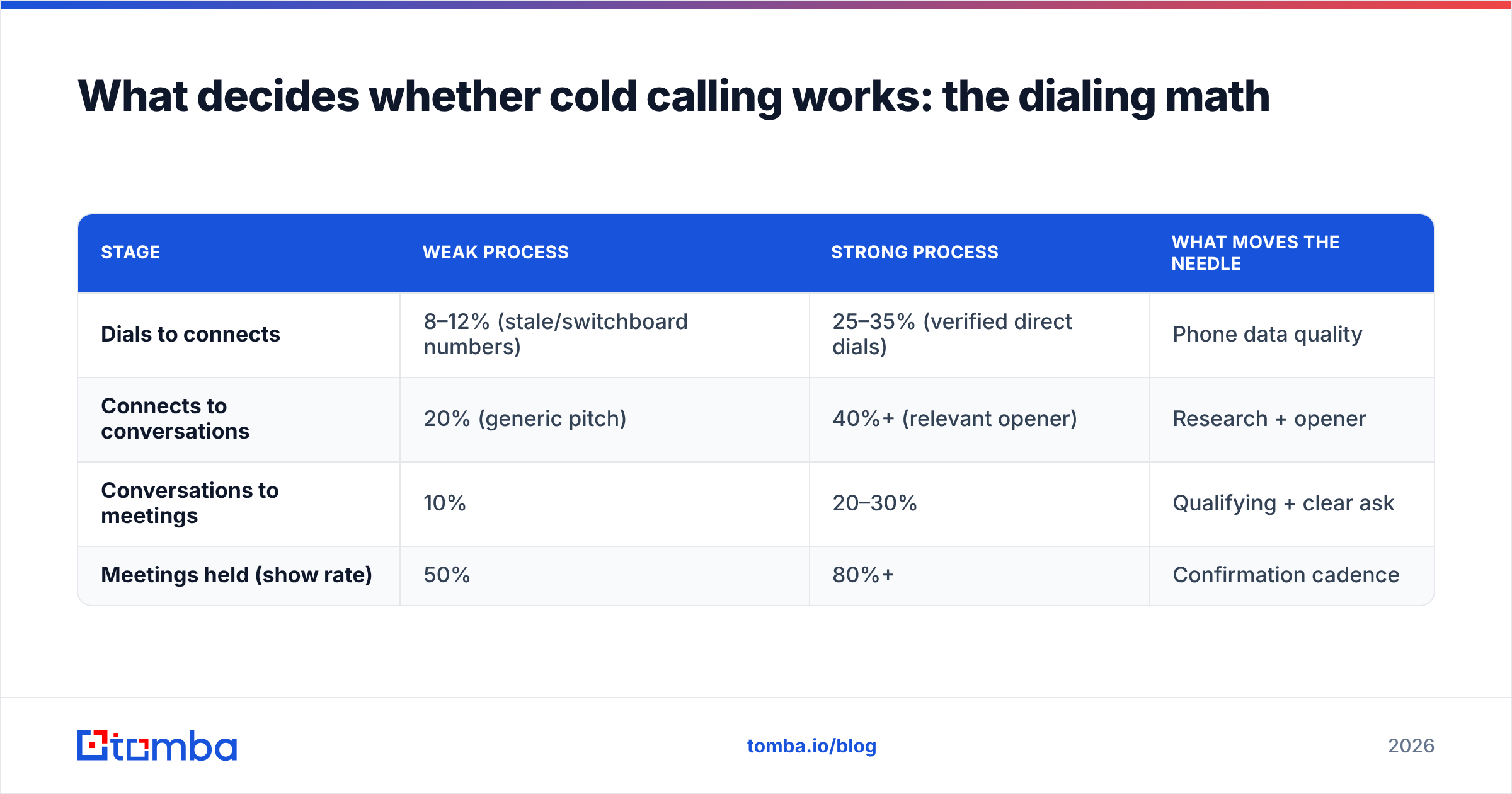
| Stage | Weak process | Strong process | What moves the needle |
|---|---|---|---|
| Dials to connects | 8–12% (stale/switchboard numbers) | 25–35% (verified direct dials) | Phone data quality |
| Connects to conversations | 20% (generic pitch) | 40%+ (relevant opener) | Research + opener |
| Conversations to meetings | 10% | 20–30% | Qualifying + clear ask |
| Meetings held (show rate) | 50% | 80%+ | Confirmation cadence |
Run the arithmetic. With a weak process, 200 dials might yield roughly 2 meetings held. With a strong process on the same 200 dials, you can land 8–12. Same effort, 4–5x the output — and almost none of that gap comes from talking louder. It comes from who you call and whether the number is real.
This is why data hygiene isn't a back-office chore. A number that rings a disconnected line, a wrong department, or a long-gone employee costs you the same time as a good dial and returns nothing.
How do you build a cold-call list that actually connects?#
Start with fit, then get contactable. A perfect-fit account you can't reach is worthless, and a reachable contact who's a bad fit wastes your pitch.
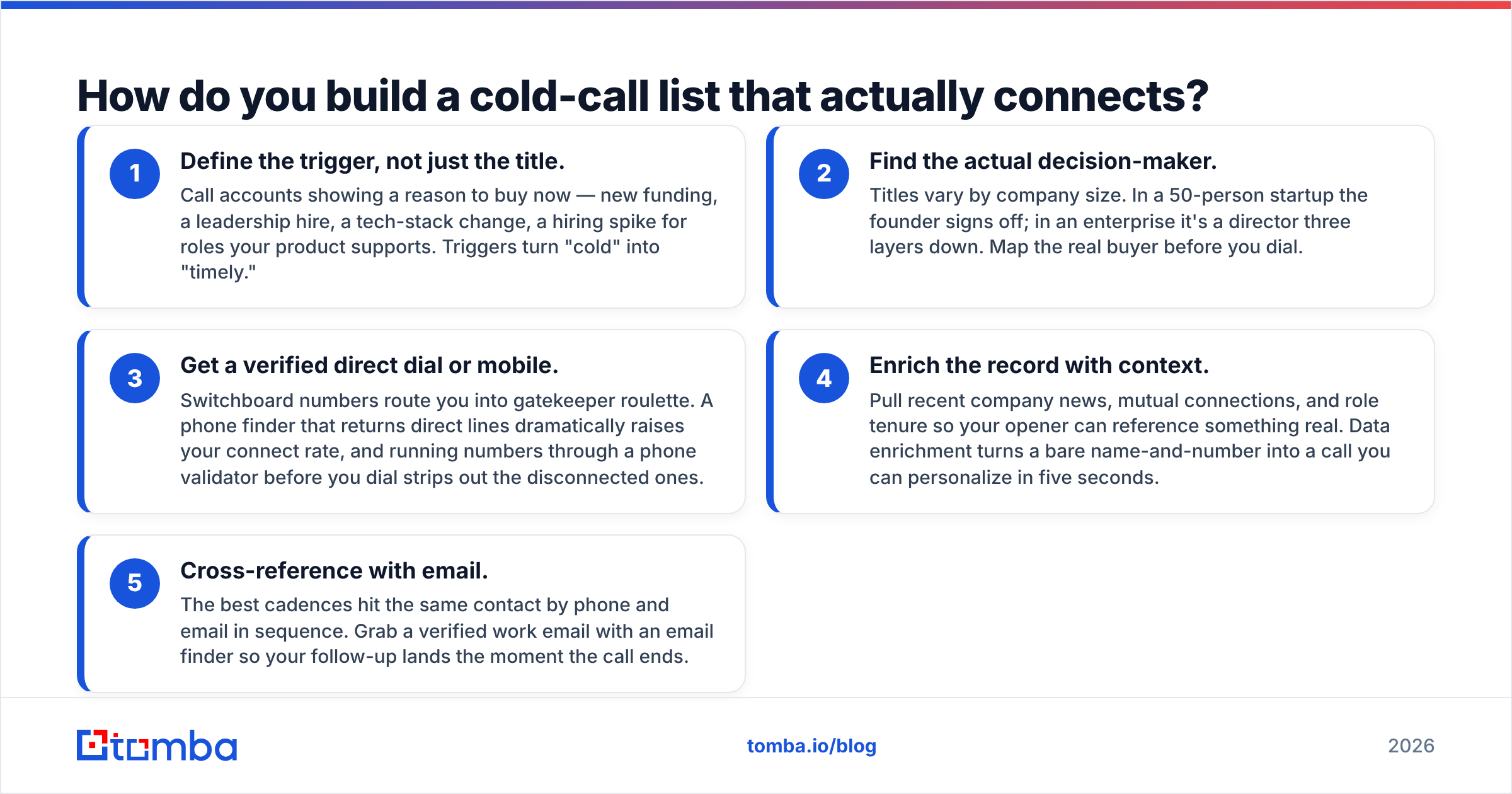
- Define the trigger, not just the title. Call accounts showing a reason to buy now — new funding, a leadership hire, a tech-stack change, a hiring spike for roles your product supports. Triggers turn "cold" into "timely."
- Find the actual decision-maker. Titles vary by company size. In a 50-person startup the founder signs off; in an enterprise it's a director three layers down. Map the real buyer before you dial.
- Get a verified direct dial or mobile. Switchboard numbers route you into gatekeeper roulette. A phone finder that returns direct lines dramatically raises your connect rate, and running numbers through a phone validator before you dial strips out the disconnected ones.
- Enrich the record with context. Pull recent company news, mutual connections, and role tenure so your opener can reference something real. Data enrichment turns a bare name-and-number into a call you can personalize in five seconds.
- Cross-reference with email. The best cadences hit the same contact by phone and email in sequence. Grab a verified work email with an email finder so your follow-up lands the moment the call ends.
Keep the daily list tight — 40 to 60 well-built records beats 300 garbage rows. You'll dial more of the good ones and burn less time on dead numbers.
What's the anatomy of a cold call that books meetings?#
Structure beats charisma. The best callers aren't smooth talkers; they run a repeatable frame that respects the prospect's time and gets to the point fast.
1. The pattern interrupt (first 5 seconds). Skip "How are you today?" — it signals a pitch. Try: "Hi [Name], this is [You] with [Company]. I know I'm an interruption — can I take 30 seconds to tell you why I called, and you can decide if it's worth continuing?" This disarms the reflex to hang up by naming the elephant and handing them control.
2. The permission and hook (next 15 seconds). Once they say "go ahead," deliver one specific, outcome-focused sentence: "We help [role] at [company type] cut [specific problem] — for example, [peer company] went from [before] to [after]. I wanted to see if that's even relevant to you."
3. The qualifying question (next 20 seconds). Don't pitch features — ask one question that reveals fit: "How are you handling [problem] today?" Their answer tells you whether to push for a meeting or politely exit.
4. The clear ask. Never end vague. "Sounds like it's worth a deeper look — do you have 20 minutes Thursday at 2, or is Friday morning better?" Offer two specific times, not "sometime next week."
5. Confirm and bridge to email. Lock the calendar invite while you're on the line, then send a one-line recap email immediately. Reps who confirm in writing see far higher show rates.
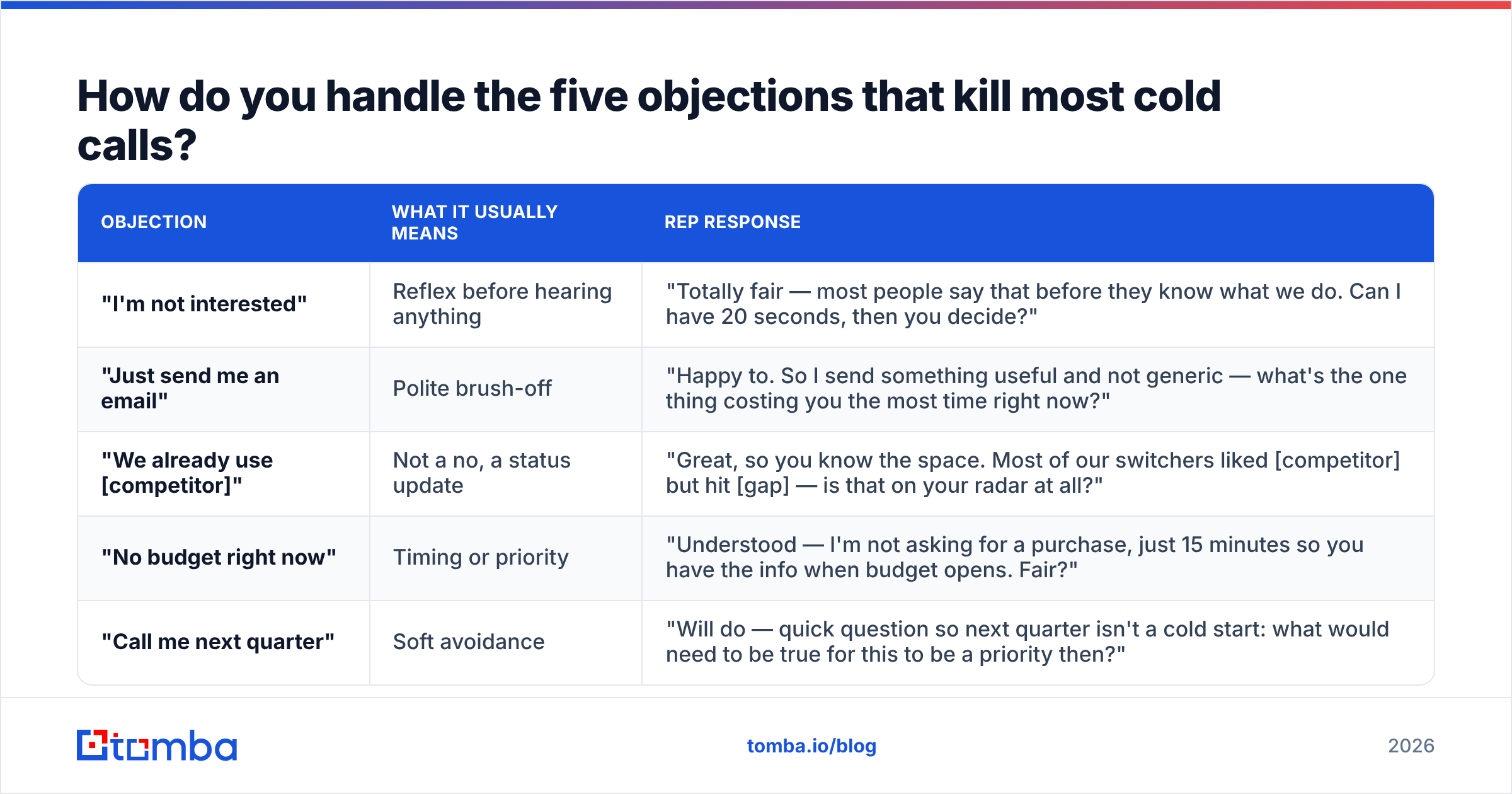
How do you handle the five objections that kill most cold calls?#
Objections aren't rejection — they're reflexes. Nearly every one you'll hear falls into five buckets, and scripting your first response keeps you calm and in control.
| Objection | What it usually means | Rep response |
|---|---|---|
| "I'm not interested" | Reflex before hearing anything | "Totally fair — most people say that before they know what we do. Can I have 20 seconds, then you decide?" |
| "Just send me an email" | Polite brush-off | "Happy to. So I send something useful and not generic — what's the one thing costing you the most time right now?" |
| "We already use [competitor]" | Not a no, a status update | "Great, so you know the space. Most of our switchers liked [competitor] but hit [gap] — is that on your radar at all?" |
| "No budget right now" | Timing or priority | "Understood — I'm not asking for a purchase, just 15 minutes so you have the info when budget opens. Fair?" |
| "Call me next quarter" | Soft avoidance | "Will do — quick question so next quarter isn't a cold start: what would need to be true for this to be a priority then?" |
The goal isn't to "overcome" every objection by force. It's to earn 20 more seconds or a next step. If they're genuinely not a fit, disqualify fast and move to your next dial — protecting your time is a skill too.
How many dials does it take, and how do you stay consistent?#
Consistency beats intensity. A rep who makes 50 focused dials every single day will out-book one who does 200 in a burst and then avoids the phone for a week.
Practical benchmarks for a full-time SDR/BDR seat in 2026:
- 50–80 quality dials per day on a verified list (not 200 low-effort ones).
- Block calling into 60–90 minute sprints — context-switching between the phone and email tanks your rhythm and confidence.
- Call when buyers answer. Early morning and late afternoon local time tend to beat midday. Track your own connect-by-hour data and double down on what works.
- Log everything in your CRM. If it's not tracked, you can't improve it. Understanding your own funnel is basic revenue operations hygiene, and it's what turns gut feel into a repeatable process.
Track leading indicators (dials, connects, conversations) weekly, not just booked meetings. Meetings are a lagging metric — by the time they dip, the problem started upstream two weeks ago.
How does cold calling fit into a multi-channel cadence?#
Cold calling alone is harder than it needs to be. Buyers respond to familiarity, so the phone works best as one instrument in a sequenced cadence that also uses email and LinkedIn. A prospect who's seen your name in their inbox and heard your voicemail is far warmer on dial three than dial one.
A simple, proven 10-touch, two-week cadence:
- Day 1: Call + voicemail, then a short intro email referencing the same value hook.
- Day 3: LinkedIn connection request with a personalized note (no pitch).
- Day 5: Second call at a different time of day.
- Day 7: Value email — a case study or relevant insight, no ask.
- Day 9: Third call + breakup voicemail.
- Day 12: Breakup email that leaves the door open.
The phone and email reinforce each other only if both reach real inboxes and real numbers. That's the through-line of this whole playbook: your creativity is capped by your data. Run contacts through an email verifier so your emails land, and validate numbers so your calls connect. Vendors like G2 and analysts at Gartner consistently tie outbound performance back to data accuracy — the tooling has improved, but the fundamentals didn't change.
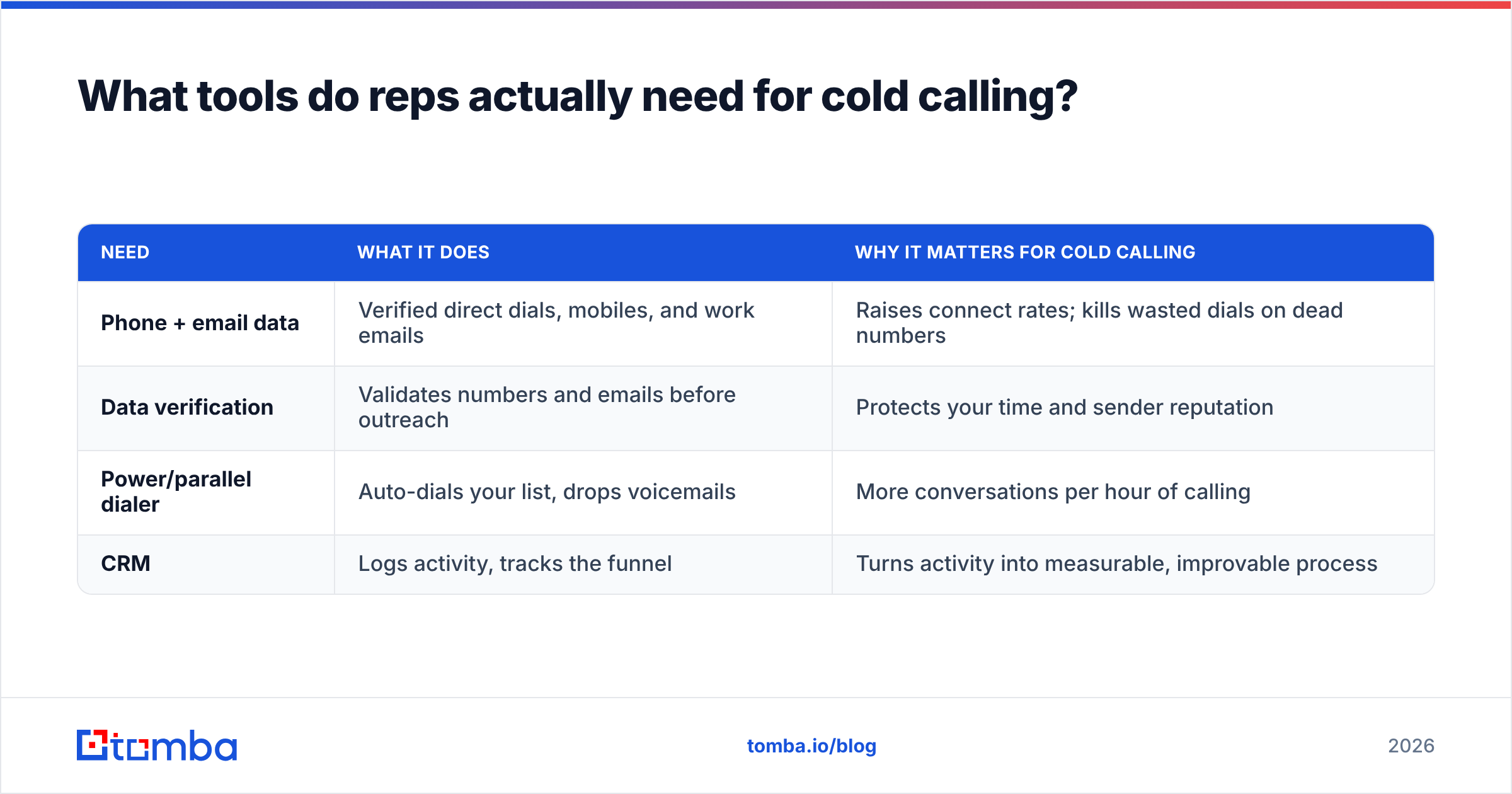
What tools do reps actually need for cold calling?#
You don't need a bloated stack. You need three things that work: accurate contact data, a way to dial efficiently, and a CRM to track it. Everything else is optional.
| Need | What it does | Why it matters for cold calling |
|---|---|---|
| Phone + email data | Verified direct dials, mobiles, and work emails | Raises connect rates; kills wasted dials on dead numbers |
| Data verification | Validates numbers and emails before outreach | Protects your time and sender reputation |
| Power/parallel dialer | Auto-dials your list, drops voicemails | More conversations per hour of calling |
| CRM | Logs activity, tracks the funnel | Turns activity into measurable, improvable process |
Notice the top two rows are both about data. That's deliberate. The dialer and CRM only pay off when they're pointed at contacts who are real, reachable, and a fit. Cheap-but-wrong data is the most expensive line item on any sales team, because it burns the one resource you can't buy back: rep hours.
The bottom line for reps#
Cold calling for sales reps in 2026 is still one of the highest-leverage skills in outbound — but the margin for lazy execution is gone. Build a tight, well-researched list. Verify the numbers before you dial. Run a repeatable opener and script your objection responses. Wrap it all in a multi-channel cadence so the phone isn't carrying the whole load. Do that, and the "cold calling is dead" crowd will keep wondering how you hit quota.
Start where the biggest leak is: your data. If half your dials hit dead numbers or the wrong person, no script will save you. Build your call lists on verified, connectable contacts with Tomba's Email Finder and phone tools — find the real decision-maker, get a direct line and a valid work email, and spend your calling hours talking to humans instead of dial tones. Check the Tomba pricing tiers to match the plan to your dialing volume, starting free with 25 searches a month.
Related guides#
Ready to find emails that actually work?
Join 150,000+ professionals who stopped guessing and started sending. Free credits on signup — no credit card required.
Get the Tomba newsletter
Practical outbound tactics and product updates — once every two weeks.
About the author