Cold Calling Guidelines: A 2026 Playbook That Actually Works
Cold calling still books meetings in 2026 — if you follow the right rules. Here are the data-backed cold calling guidelines top reps use to open, handle objections, and stay compliant.
Cold calling is not dead — bad cold calling is. The reps still booking meetings in 2026 are not smiling-and-dialing random lists. They follow a tight set of rules around who they call, when they call, what they say in the first ten seconds, and how they log the result. This guide turns those rules into a repeatable playbook.
TL;DR#
- Data beats dialing volume. A verified, well-targeted list of 40 numbers outperforms a stale list of 400. Fix the data before you touch the phone.
- The first 10 seconds decide the call. Use a permission-based opener, state why you're calling, and earn the next 30 seconds.
- Objections are signals, not walls. Have a rehearsed, one-sentence response for the five objections you hear every day.
- Timing and cadence are measurable. Mid-morning and late-afternoon on Tuesday–Thursday still win; pair every call with an email and a LinkedIn touch.
- Compliance is non-negotiable. Know TCPA, honor Do-Not-Call lists, and keep records. One lawsuit costs more than a year of pipeline.
What are cold calling guidelines, and why do they matter?#
Cold calling guidelines are the standard rules a rep follows on every outbound call — from list quality and call timing to opener structure, objection handling, and legal compliance. Think of them like a pilot's pre-flight checklist: the pilot has flown a thousand times, but they still run the list because the cost of skipping a step is catastrophic. Your cost is a burned prospect, a wasted hour, or a compliance fine.
They matter because cold calling is still one of the highest-intent channels in B2B. A live conversation surfaces objections, budget, and timing that no email thread will. But the channel is unforgiving: a wrong number, a bad opener, or a tone-deaf pitch ends the relationship in seconds. Guidelines keep every rep operating at the level of your best rep, not your average one.
The single biggest lever is upstream of the call itself: the accuracy of your contact data. If a third of your list is disconnected numbers and gatekeeper mainlines, no script saves you.
What should you do before you ever pick up the phone?#
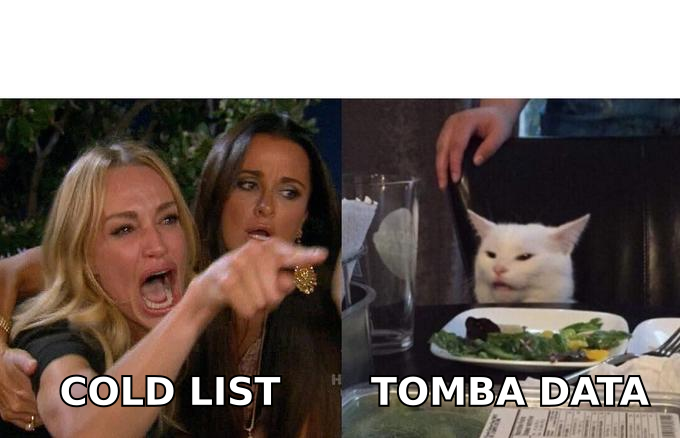
Preparation is where average and elite reps separate. Before a single dial, run this pre-call sequence.
- Verify the number and the person. Confirm the direct line and that the contact still works there. Roles change constantly; calling a title that moved on six months ago wastes the slot. A phone finder that returns direct-dial B2B numbers — and a phone validator to confirm the line is live — removes most of this waste.
- Know one specific trigger. A funding round, a new hire, a product launch, a job posting. One relevant reason to call beats ten generic ones.
- Set a single call objective. Usually that objective is book the next step, not close the deal. Trying to sell in one call kills more deals than it makes.
- Prepare for the top objection. For each account, guess the most likely brush-off and have your one-liner ready.
- Have the follow-up channel loaded. The email and LinkedIn message should be drafted before you dial, so the follow-up goes out within five minutes of hanging up.
- Log everything. Disposition, notes, next action, and timestamp go into the CRM immediately — not at end of day when you've forgotten the nuance.
If your list itself is thin, build it from a domain search to map the company's contacts, then enrich each record so you're dialing a real human with a real title, not a guess.
How do you open a cold call so they don't hang up?#
Lead with permission and a reason, then earn the next 30 seconds. The worst opener is "How are you today?" — it signals a script and invites a reflexive "not interested."
A structure that works:
- Pattern interrupt + name: "Hi Sarah, this is Alex from Tomba — I know I'm an interruption."
- Permission micro-ask: "Can I take 30 seconds to tell you why I called, and you can decide if it's worth continuing?"
- Specific reason: "I saw you just opened two SDR roles, which usually means the team is scaling outbound."
- Soft question: "Is finding accurate contact data a bottleneck when you scale, or have you got that solved?"
That last question hands control to the prospect and starts a conversation instead of a monologue. The permission ask sounds counterintuitive — you're inviting a "no" — but it dramatically lowers defensiveness because you've treated them like an adult with a choice.
Keep your talk-to-listen ratio near 40/60. If you're talking more than the prospect, you're pitching, not qualifying. For a deeper look at the metrics behind good conversations, your response rate across channels tells you whether your messaging resonates before you scale the dials.
What are the most common objections, and how do you handle them?#
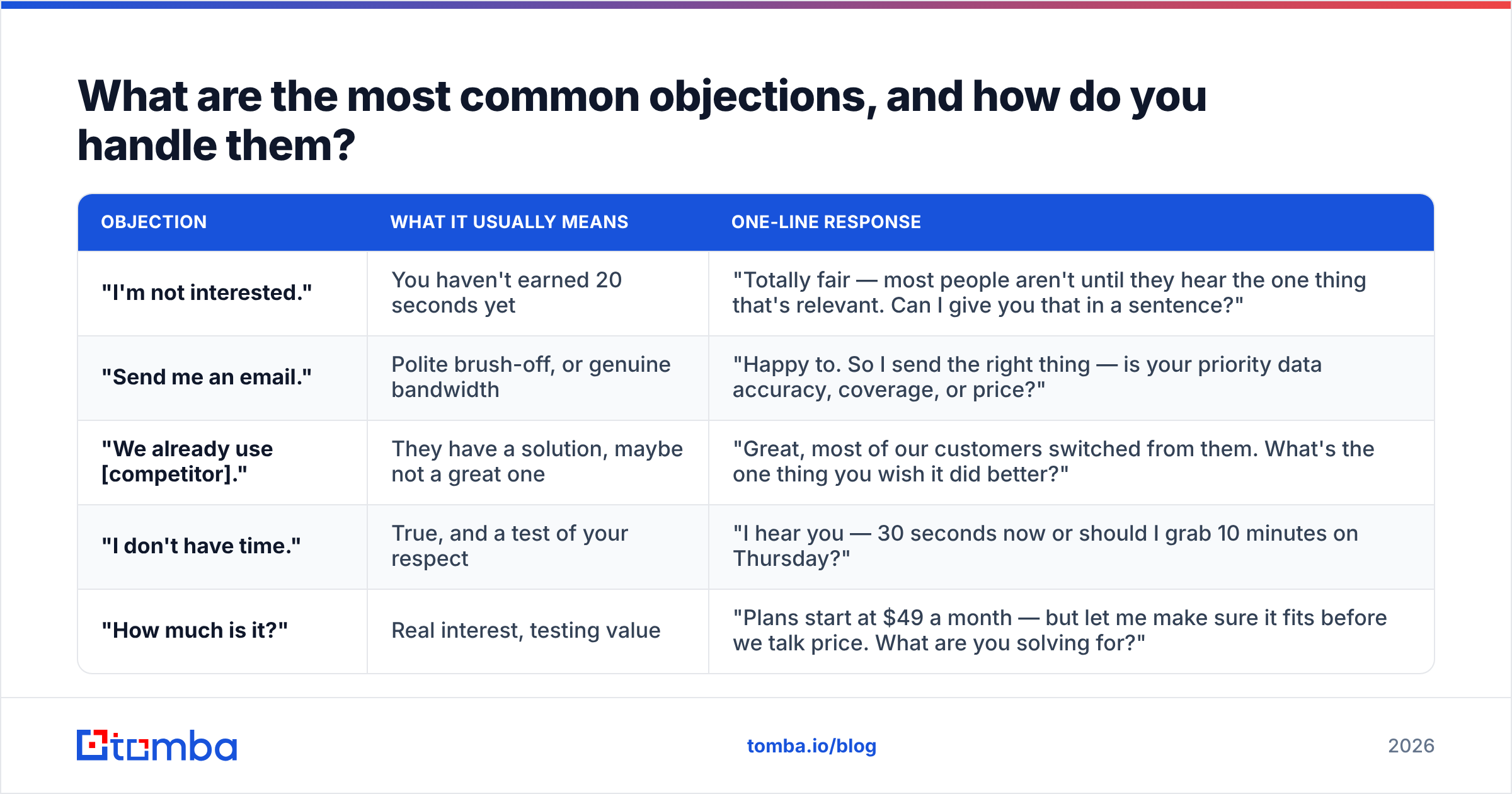
Objections are the job, not an interruption to it. The trick is that 80% of what you hear falls into five buckets. Rehearse one clean response for each and you'll never freeze.
| Objection | What it usually means | One-line response |
|---|---|---|
| "I'm not interested." | You haven't earned 20 seconds yet | "Totally fair — most people aren't until they hear the one thing that's relevant. Can I give you that in a sentence?" |
| "Send me an email." | Polite brush-off, or genuine bandwidth | "Happy to. So I send the right thing — is your priority data accuracy, coverage, or price?" |
| "We already use [competitor]." | They have a solution, maybe not a great one | "Great, most of our customers switched from them. What's the one thing you wish it did better?" |
| "I don't have time." | True, and a test of your respect | "I hear you — 30 seconds now or should I grab 10 minutes on Thursday?" |
| "How much is it?" | Real interest, testing value | "Plans start at $49 a month — but let me make sure it fits before we talk price. What are you solving for?" |
Notice each response ends by handing a question back. You're steering the conversation, not defending. Never argue with an objection; acknowledge it, then redirect. And never fake urgency — experienced buyers smell it instantly.
When is the best time to cold call in 2026?#
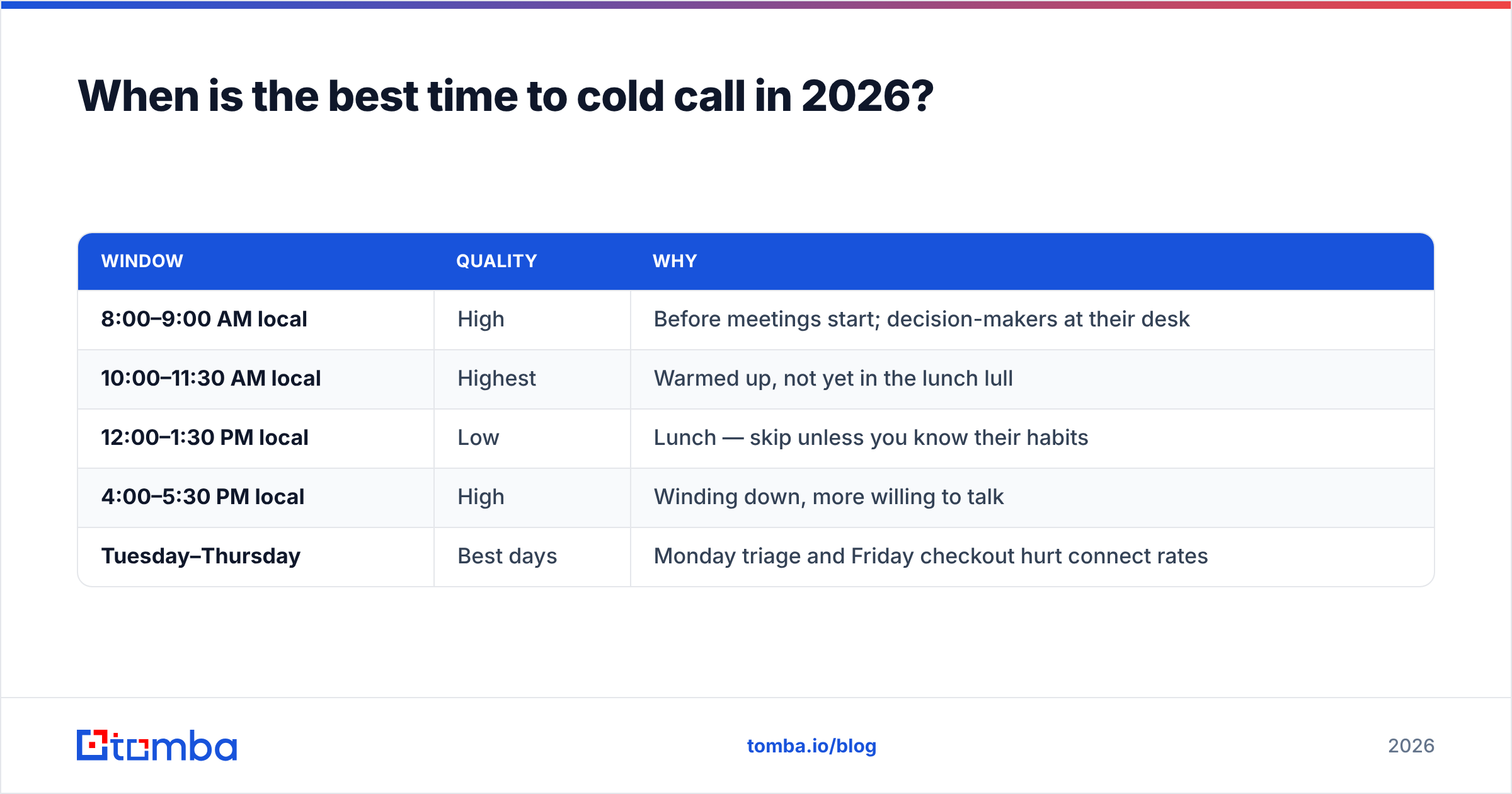
Timing is one of the few cold-calling variables you can measure and optimize. The long-standing patterns still hold up in 2026 data from sales-intelligence vendors:
| Window | Quality | Why |
|---|---|---|
| 8:00–9:00 AM local | High | Before meetings start; decision-makers at their desk |
| 10:00–11:30 AM local | Highest | Warmed up, not yet in the lunch lull |
| 12:00–1:30 PM local | Low | Lunch — skip unless you know their habits |
| 4:00–5:30 PM local | High | Winding down, more willing to talk |
| Tuesday–Thursday | Best days | Monday triage and Friday checkout hurt connect rates |
These are starting points, not laws. Your own connect-rate data by hour and day should override any benchmark within a few weeks. The real win is consistency: block dial time, protect it, and call in focused sprints of 60–90 minutes rather than scattering calls across the day.
Time zones matter more than the clock. Segment your list by region so you're always calling into a prime local window, not your own.
How does cold calling fit into a modern outbound cadence?#
The phone is one instrument in the outbound orchestra, not the whole band. A call that follows a relevant email and a LinkedIn view connects far better than a cold-cold dial. Multi-threading also protects you: if the buyer ignores one channel, another catches them.
A simple, effective 10-day cadence:
- Day 1: LinkedIn view + connection request (no pitch)
- Day 2: Call #1 + voicemail + follow-up email
- Day 4: Value email (case study, relevant insight)
- Day 6: Call #2 at a different time of day
- Day 8: LinkedIn message referencing the earlier touches
- Day 10: Call #3 + "breakup" email
Every touch reinforces the others. For the email side, warm your domain and keep your sender reputation clean so the messages that support your calls actually land in the inbox. If your emails hit spam, your cadence loses half its horsepower and the phone carries a load it shouldn't.
Feed the whole cadence from one enriched record per prospect — direct dial, verified email, and LinkedIn URL together — so you're not stitching three tools per contact.
What compliance rules must you follow?#
Compliance is not optional, and ignorance is not a defense. The rules vary by region, but a few apply almost everywhere in B2B outbound:
- TCPA (US): Governs automated dialing and prerecorded messages. Manual B2B calls to business lines have more latitude, but auto-dialers to cell phones are a minefield. Know the difference. Read the FTC's own guidance on telemarketing rules at ftc.gov before you scale.
- Do-Not-Call lists: Scrub against national and internal DNC lists. Honor opt-outs immediately and permanently.
- GDPR / ePrivacy (EU/UK): You need a lawful basis to process personal data and to call. Legitimate interest can apply to B2B, but document it and honor objections.
- Record-keeping: Log consent, opt-outs, and call outcomes. If you can't prove you followed the rules, you didn't.
- Identify yourself: State who you are and who you represent early. Spoofing or hiding your identity is both illegal in many places and a trust-killer.
When in doubt, involve legal. Reputable industry bodies like G2 and analyst firms publish vendor compliance features — use them to vet the tools in your stack, not just the pitch.
How do you know if your cold calling is working?#
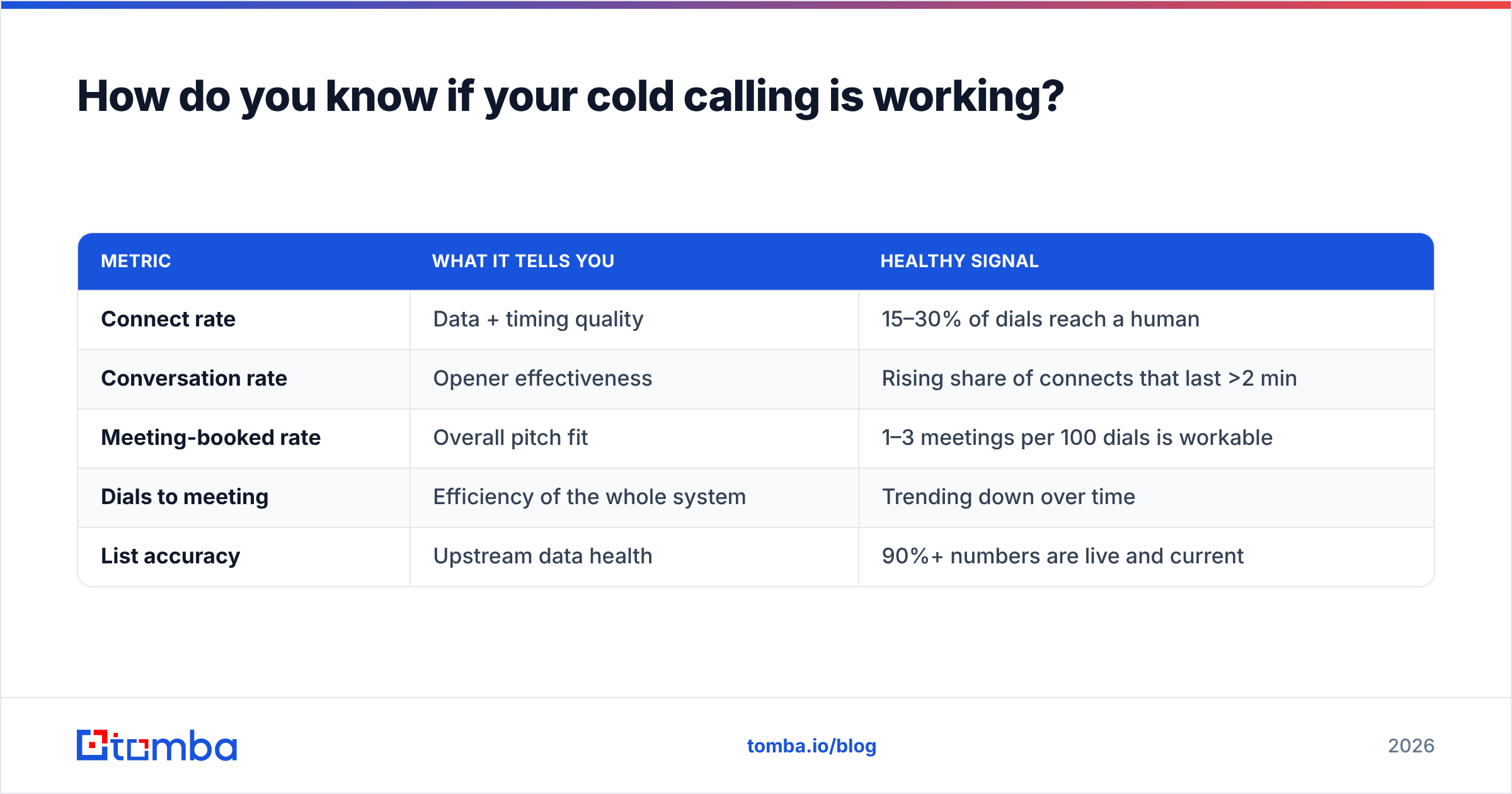
Measure inputs and outputs, not just gut feel. Track these at minimum:
| Metric | What it tells you | Healthy signal |
|---|---|---|
| Connect rate | Data + timing quality | 15–30% of dials reach a human |
| Conversation rate | Opener effectiveness | Rising share of connects that last >2 min |
| Meeting-booked rate | Overall pitch fit | 1–3 meetings per 100 dials is workable |
| Dials to meeting | Efficiency of the whole system | Trending down over time |
| List accuracy | Upstream data health | 90%+ numbers are live and current |
If connect rate is low, the problem is almost always data or timing — not your script. That's why the highest-leverage fix is usually list hygiene, not another roleplay session. Compare your numbers against your own baseline month over month; external benchmarks are directional at best because industries and personas differ wildly.
The bottom line#
Cold calling in 2026 rewards discipline over volume. Verify your list, call into prime local windows, open with permission and a specific reason, handle the five objections without flinching, wrap every dial into a multi-channel cadence, and stay inside the compliance lines. Do those things and the phone remains one of the most direct routes to a booked meeting in B2B.
Everything downstream depends on one thing: dialing the right person at the right number. That starts with clean, current contact data — accurate direct dials, verified emails, and up-to-date roles. Tomba's email finder, phone finder, and enrichment tools give your reps a list worth calling, with a free tier to start and plans from $49/month as you scale. Fix the data first, and every guideline in this playbook works harder. Start finding accurate contacts with Tomba and turn your dial time into pipeline.
Related guides#
// get started
Find, verify and enrich your first contacts today
Start on the free plan with 25 searches a month, then scale when your team is ready.
Free plan · No credit card required · GDPR & CCPA
// about the author