Cold Calling Lead Generation: The 2026 Playbook That Works
Is cold calling dead in 2026? Not even close. Here's a data-backed playbook for turning dials into qualified pipeline — scripts, cadences, and the data layer most teams skip.
TL;DR
- Cold calling lead generation is the practice of proactively phoning prospects who haven't engaged yet, with the goal of booking a qualified meeting — not closing on the first dial.
- It still works in 2026, but only when connect rates are protected by accurate, verified phone data and a tight, permission-based opener.
- The average cold call connect rate sits near 5–8%; teams that clean their contact data and multithread beat that by 2–3x.
- A repeatable system beats charisma: right list, right number, right time, right first line, right follow-up.
- The biggest lever isn't the script — it's the data. Bad numbers kill more pipeline than bad talk tracks.
What is cold calling lead generation?#
Cold calling lead generation is using outbound phone calls to start conversations with prospects who have not raised their hand. Think of it like knocking on doors in a neighborhood you researched first: you're not hoping someone random answers, you're calling the houses most likely to need what you sell, at a time they're likely home.
The goal is almost never a same-call sale in B2B. It's a booked meeting — a discovery call, a demo, or a warm handoff. That reframing matters because it changes how you measure success. You're not judged on "did they buy," you're judged on "did I earn the next 15 minutes."
Three ingredients separate cold calling from cold dialing:
- A researched list. You know why each account is a fit before the phone rings.
- A verified number. The person you want actually picks up, not a dead extension.
- A reason to call now. A trigger event, a role change, a competitor switch, funding news.
Miss any one of those and you're just interrupting strangers. Hit all three and cold calling becomes one of the highest-intent channels you have — nothing else lets you handle an objection in real time.
Is cold calling still worth it in 2026?#
Yes — with a caveat. Cold calling still works, but the margin for sloppy execution is gone. Buyers screen unknown numbers aggressively, and spam-labeling has made "just dial more" a losing strategy. The teams winning today treat calls as one coordinated touch inside a multichannel sequence, not a standalone activity.
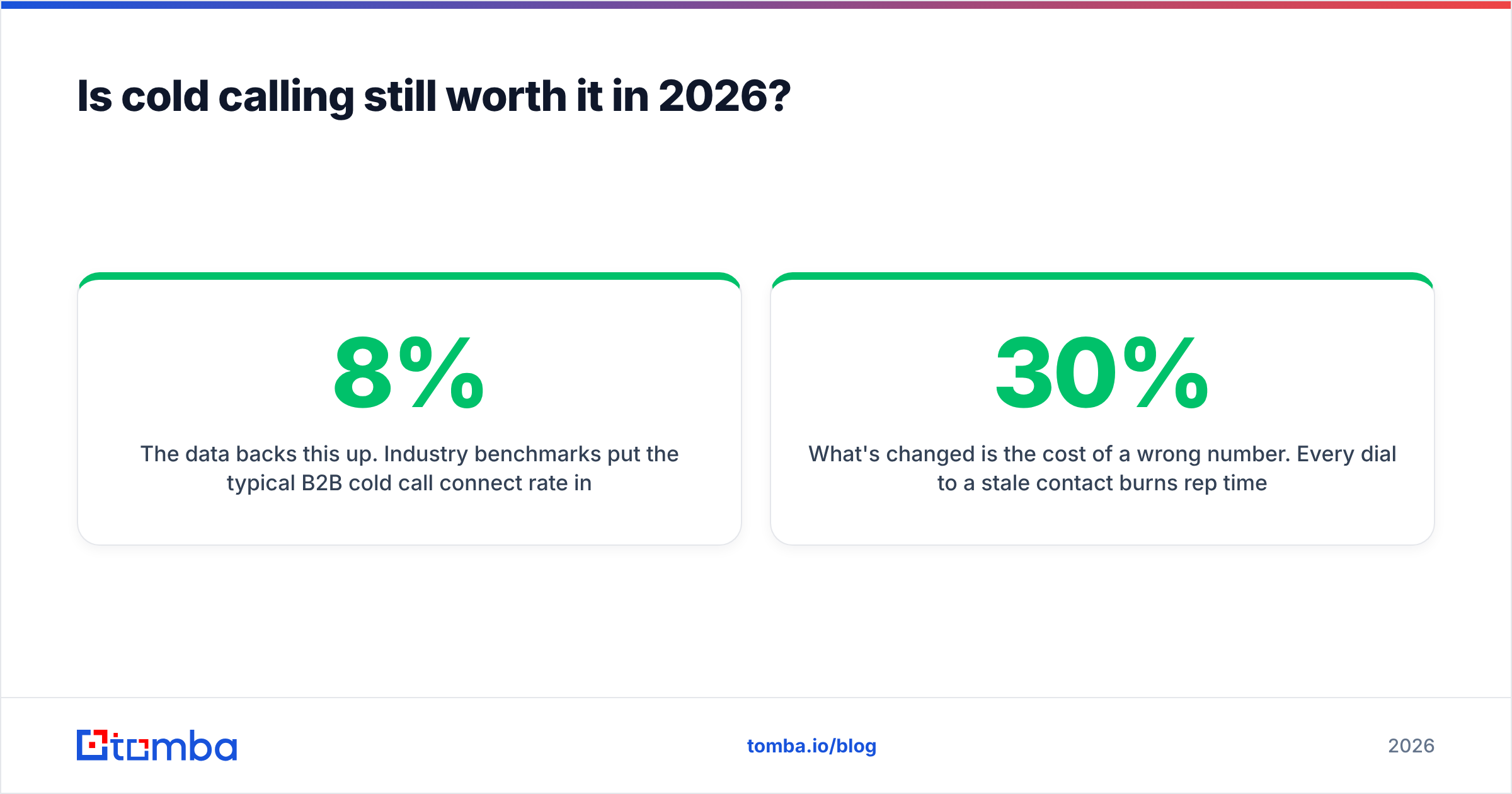
The data backs this up. Industry benchmarks put the typical B2B cold call connect rate in the 5–8% range, and it takes an average of roughly six to eight touchpoints to reach a decision-maker. According to HubSpot's sales research, a large share of buyers still want a phone conversation at some point in the process — the phone hasn't died, the lazy phone call has.

What's changed is the cost of a wrong number. Every dial to a stale contact burns rep time, dents your caller ID reputation, and produces zero pipeline. That's why the smartest 2026 playbooks start upstream — at the data layer — before anyone touches a headset. If your list is 30% inaccurate, you've capped your best rep at 70% of their potential before they say a word.
How does cold calling compare to other outbound channels?#
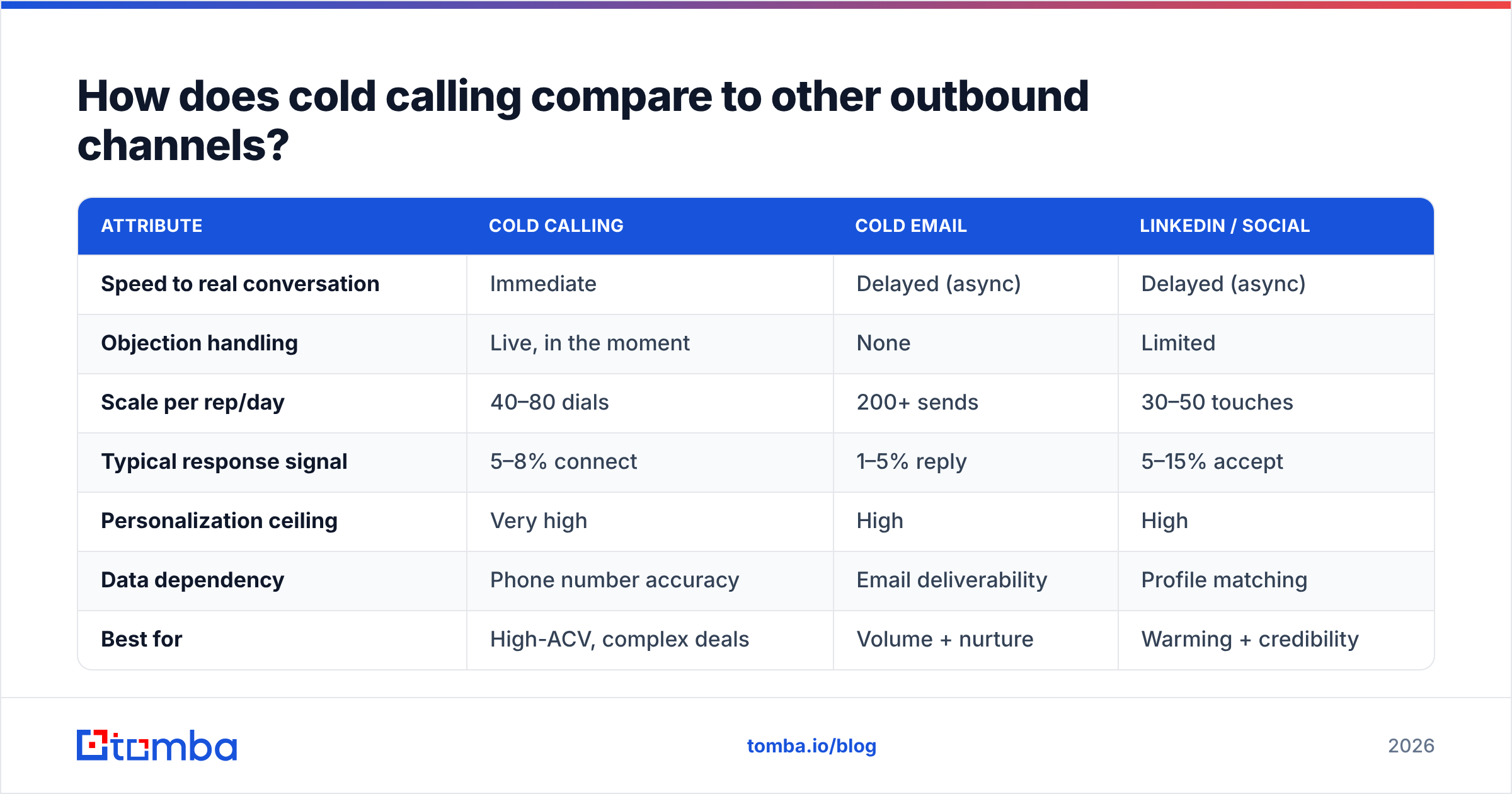
Cold calling isn't in competition with email or social — it's strongest as part of a blended cadence. Each channel has a job. Here's how the three primary outbound motions stack up.
| Attribute | Cold Calling | Cold Email | LinkedIn / Social |
|---|---|---|---|
| Speed to real conversation | Immediate | Delayed (async) | Delayed (async) |
| Objection handling | Live, in the moment | None | Limited |
| Scale per rep/day | 40–80 dials | 200+ sends | 30–50 touches |
| Typical response signal | 5–8% connect | 1–5% reply | 5–15% accept |
| Personalization ceiling | Very high | High | High |
| Data dependency | Phone number accuracy | Email deliverability | Profile matching |
| Best for | High-ACV, complex deals | Volume + nurture | Warming + credibility |
The takeaway: don't pick one. Use email and social to warm the account, then call. A prospect who saw your name in their inbox and on LinkedIn last week answers a "cold" call as a semi-warm one. The channels compound.
This is also why your data enrichment layer matters across all three at once — the same contact record feeds the dialer, the sequence, and the social touch. Clean data isn't a cold-calling tactic, it's an outbound foundation.
What does a high-converting cold call framework look like?#
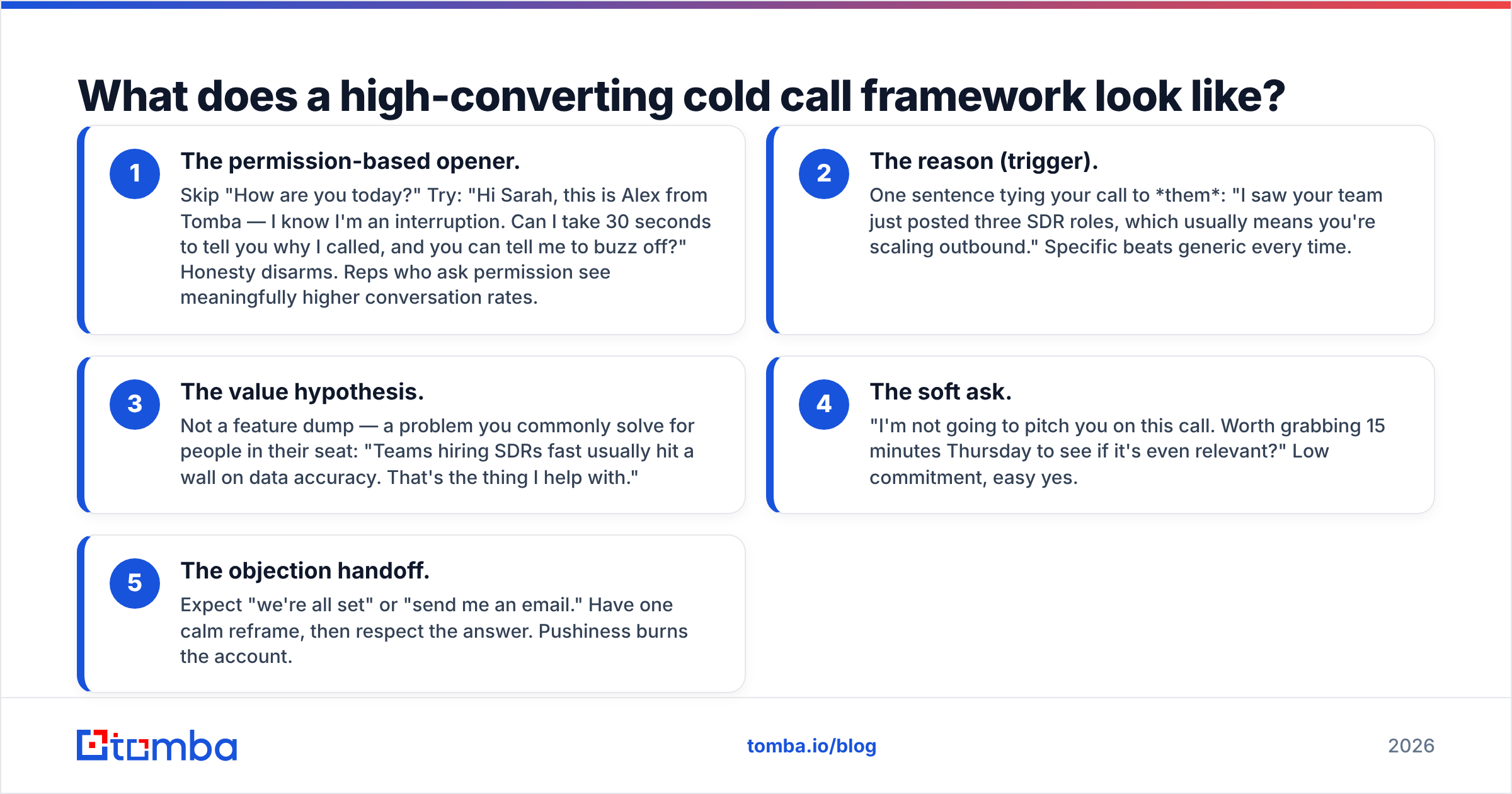
A good cold call has five parts, and none of them are "wing it." Structure frees you to listen instead of scrambling for your next line.
- The permission-based opener. Skip "How are you today?" Try: "Hi Sarah, this is Alex from Tomba — I know I'm an interruption. Can I take 30 seconds to tell you why I called, and you can tell me to buzz off?" Honesty disarms. Reps who ask permission see meaningfully higher conversation rates.
- The reason (trigger). One sentence tying your call to them: "I saw your team just posted three SDR roles, which usually means you're scaling outbound." Specific beats generic every time.
- The value hypothesis. Not a feature dump — a problem you commonly solve for people in their seat: "Teams hiring SDRs fast usually hit a wall on data accuracy. That's the thing I help with."
- The soft ask. "I'm not going to pitch you on this call. Worth grabbing 15 minutes Thursday to see if it's even relevant?" Low commitment, easy yes.
- The objection handoff. Expect "we're all set" or "send me an email." Have one calm reframe, then respect the answer. Pushiness burns the account.

Notice what's not here: no rambling intro, no 90-second monologue, no closing on the first call. The entire job of the call is to earn the next step. Treat the meeting as the win and your whole tone relaxes — which, paradoxically, is what makes people say yes.
Why does data accuracy make or break cold calling lead generation?#
Because you can't handle an objection from someone who never picks up. Data accuracy is the single biggest multiplier in cold calling lead generation, and it's the part most teams under-invest in.
Run the math. Say a rep makes 60 dials a day:
- With a 30% bad-number list: 18 dials are wasted before anyone answers. Real reachable dials drop to 42, connects to maybe 3.
- With a verified list: all 60 dials hit live numbers, connects climb to 5–6, and the rep spends their energy talking instead of redialing.
That's not a small edge — it's the difference between a rep hitting quota and grinding out excuses. This is where a purpose-built phone finder and a phone validator earn their keep: one surfaces the direct dial, the other confirms it's live before your rep wastes a slot on it. Verifying numbers upfront also protects your caller ID from getting spam-flagged, which quietly tanks connect rates over time.
The same discipline applies to the email side of your cadence. If your warm-up emails bounce, your "warm" call is cold again. Pairing an email verifier with your dialing list keeps the whole sequence intact. Garbage in, no pipeline out — the fanciest script can't rescue a list that's lying to you.
How do you build a cold calling cadence that books meetings?#
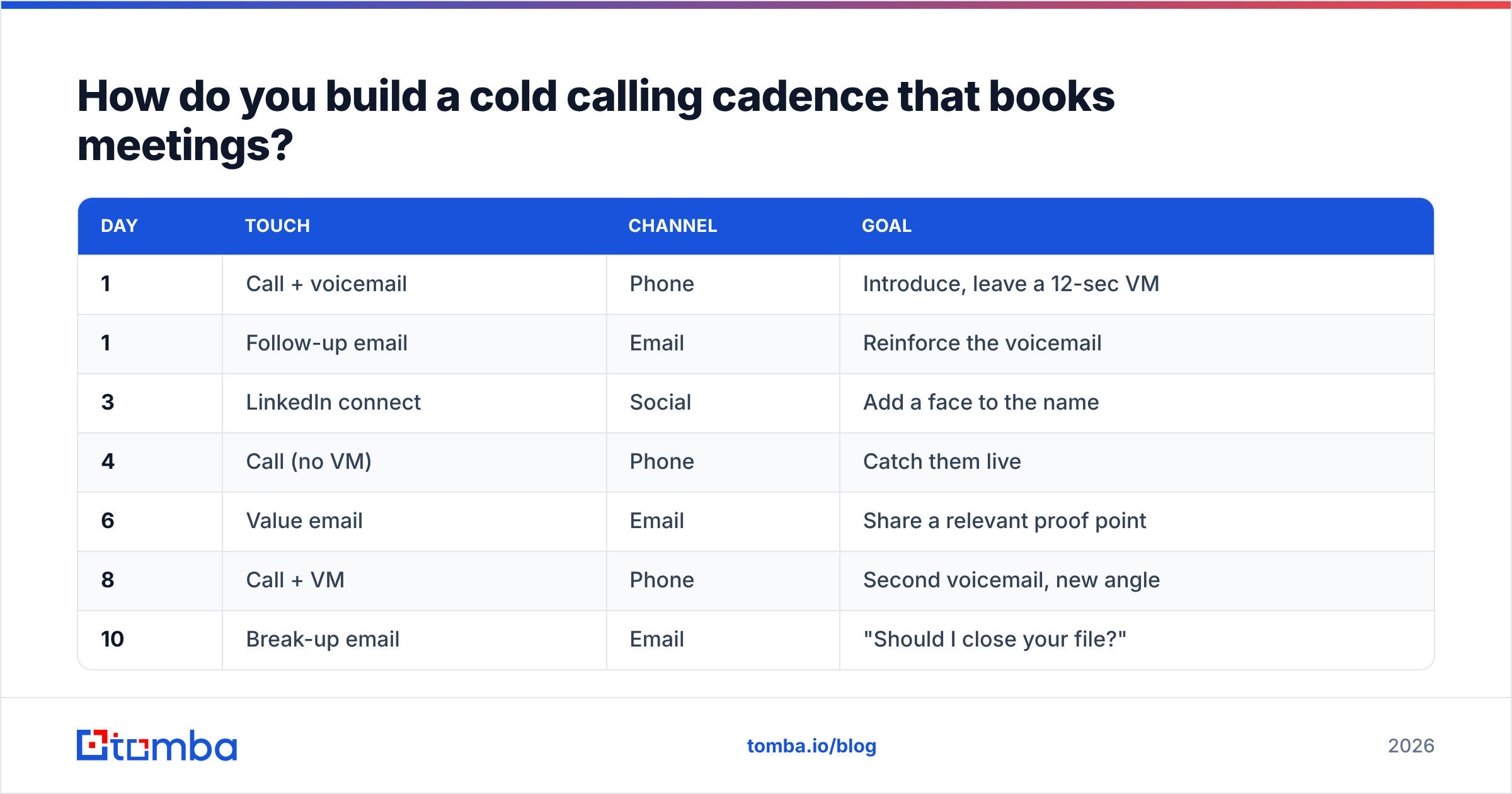
A cadence is a scripted sequence of touches across days and channels. The point is persistence without pestering. Most decision-makers aren't reached on attempt one — they're reached on attempt five or six, which is exactly where most reps quit.
Here's a proven 10-business-day structure you can adapt:
| Day | Touch | Channel | Goal |
|---|---|---|---|
| 1 | Call + voicemail | Phone | Introduce, leave a 12-sec VM |
| 1 | Follow-up email | Reinforce the voicemail | |
| 3 | LinkedIn connect | Social | Add a face to the name |
| 4 | Call (no VM) | Phone | Catch them live |
| 6 | Value email | Share a relevant proof point | |
| 8 | Call + VM | Phone | Second voicemail, new angle |
| 10 | Break-up email | "Should I close your file?" |
Two rules keep this working. First, change the angle, not just the channel — repeating the same message louder doesn't help. Second, log everything in your CRM so no prospect gets double-touched or dropped. If you're wiring this up, Tomba's HubSpot integration pushes verified contacts straight into your sequences so the data and the cadence stay in sync.
The break-up email is underrated. "Sounds like the timing isn't right — okay if I close your file?" reliably resurrects a chunk of quiet prospects, because loss aversion kicks in when you offer to walk away.
What are the most common cold calling mistakes?#
Most failed cold calling programs die from a handful of repeatable errors, not from the channel being "dead." Watch for these:
- Dialing an unverified list. Covered above, but it's #1 for a reason. Fix the data first.
- Pitching instead of qualifying. The call is a conversation, not a commercial. Ask, then listen.
- Giving up at attempt two. If it takes six touches and you stop at two, you've quit at 33% of the job.
- No trigger, no relevance. "Just checking in" is not a reason to call. Find the event.
- Ignoring the follow-up. A great call with no logged next step and no confirmation email leaks pipeline.
- Talking over objections. The prospect's "no" often contains the exact information you need to earn a "later."
Fixing even two of these usually moves the needle more than a brand-new script. Cold calling rewards operators, not performers.
Cold calling tools and stack: what do you actually need?#
You need less than the market wants to sell you. A lean, effective cold calling stack has four layers:
- A data source for accurate names, direct dials, and enrichment — the foundation everything sits on.
- A dialer (power or parallel) to remove manual dialing friction.
- A CRM to log touches and manage the cadence.
- A sequencer to orchestrate the email and social touches around your calls.
You can compare dialers and sequencers on a marketplace like G2 to match your budget and team size. But whatever you pick for layers 2–4, layer 1 is where results are won or lost. If you want to see how contact data is sourced and validated, Tomba documents its data sources openly — worth reading before you trust any provider with your rep hours.
For teams that just need clean, verified direct dials to feed an existing dialer, that's the fastest ROI: better inputs, same process, immediately higher connects. You don't need to rip out your stack — you need to stop feeding it bad numbers.
Frequently asked questions#
Is cold calling legal for B2B in 2026? In most regions, B2B cold calling is legal but regulated — you must respect do-not-call registries and local consent rules. Check your jurisdiction and keep suppression lists current.
What's a good cold call connect rate? 5–8% is typical. With verified direct dials and good timing (early morning and late afternoon convert best), strong teams push into double digits.
How many dials should a rep make per day? Quality-focused teams run 40–80 dials daily. Beyond that, personalization and data quality usually suffer, so more dials stop meaning more meetings.
Do I need a script? Yes — as a framework, not a monologue. A script keeps your opener and objection handling sharp while leaving room to actually listen and react.
The bottom line#
Cold calling lead generation works in 2026 for the same reason it always has: it's the only outbound channel where you handle objections live and book a meeting in real time. What's changed is that sloppy execution no longer survives. The winning formula is a researched list, a verified number, a trigger-based opener, a multichannel cadence, and relentless follow-up.
Get the data layer right and everything downstream improves — higher connects, less wasted rep time, more meetings from the same effort. Start there. Use Tomba's Email Finder and phone finder to build a verified, enriched contact list your reps can actually dial, and check Tomba pricing — the free tier gives you 25 searches a month to test the accuracy before you commit. Feed your dialer clean data, run the playbook, and let the phone do what email and social can't.
Related guides#
Ready to find emails that actually work?
Join 150,000+ professionals who stopped guessing and started sending. Free credits on signup — no credit card required.
Get the Tomba newsletter
Practical outbound tactics and product updates — once every two weeks.
About the author