How to Build a Cold Calling List That Actually Connects
A cold calling list is only as good as its phone numbers. Here's how to build one that connects, who to prioritize, and the tools that keep it clean in 2026.
Your dial rate is not a phone problem. It's a list problem. Reps who "can't get anyone on the phone" are usually working a spreadsheet full of stale direct dials, wrong departments, and numbers that ring into voicemail forever. Fix the list and the connect rate fixes itself.
This guide walks through what a cold calling list actually is, how to source one that connects, how to prioritize the rows so your best hours go to your best prospects, and how to keep the whole thing from rotting.
TL;DR#
- A cold calling list is a prioritized set of contacts with verified phone numbers, matched to your ideal customer profile — not just a name-and-number dump.
- Bad data, not bad scripts, kills most cold calling. Disconnected numbers, wrong titles, and shared switchboards waste the majority of dial time.
- Direct dials and mobiles beat main lines by a wide margin on connect rate — prioritize records that carry them.
- Enrich, verify, then prioritize. Layer firmographic and intent signals so reps call the accounts most likely to answer and buy.
- Refresh monthly. B2B phone and job data decays fast; a list built in January is noticeably worse by April.
What is a cold calling list?#
A cold calling list is a structured set of prospect records — name, title, company, and a valid phone number — that a sales rep works through to start conversations with people who haven't opted in yet. Think of it like a fishing map, not a bucket of bait: the value isn't the sheer number of names, it's knowing where the fish are and having a line that actually reaches them.
The difference between a list and a pile of contacts comes down to three things:
- Fit — every record matches your ideal customer profile (industry, company size, region, role).
- Reachability — each row has a phone number that connects to a real, current person, ideally a direct dial or mobile rather than a corporate switchboard.
- Priority — the list is ordered so reps spend their best calling hours on the accounts most likely to answer and convert.
Strip any one of those out and you don't have a cold calling list — you have busywork.

Why do most cold calling lists fail?#
Most lists fail because the data underneath them is wrong, and no script survives a wrong number. The industry rule of thumb is that B2B contact data decays at roughly 30% per year — people change jobs, companies restructure, and direct dials get reassigned. A list you bought or scraped six months ago has already lost a meaningful chunk of its accuracy.
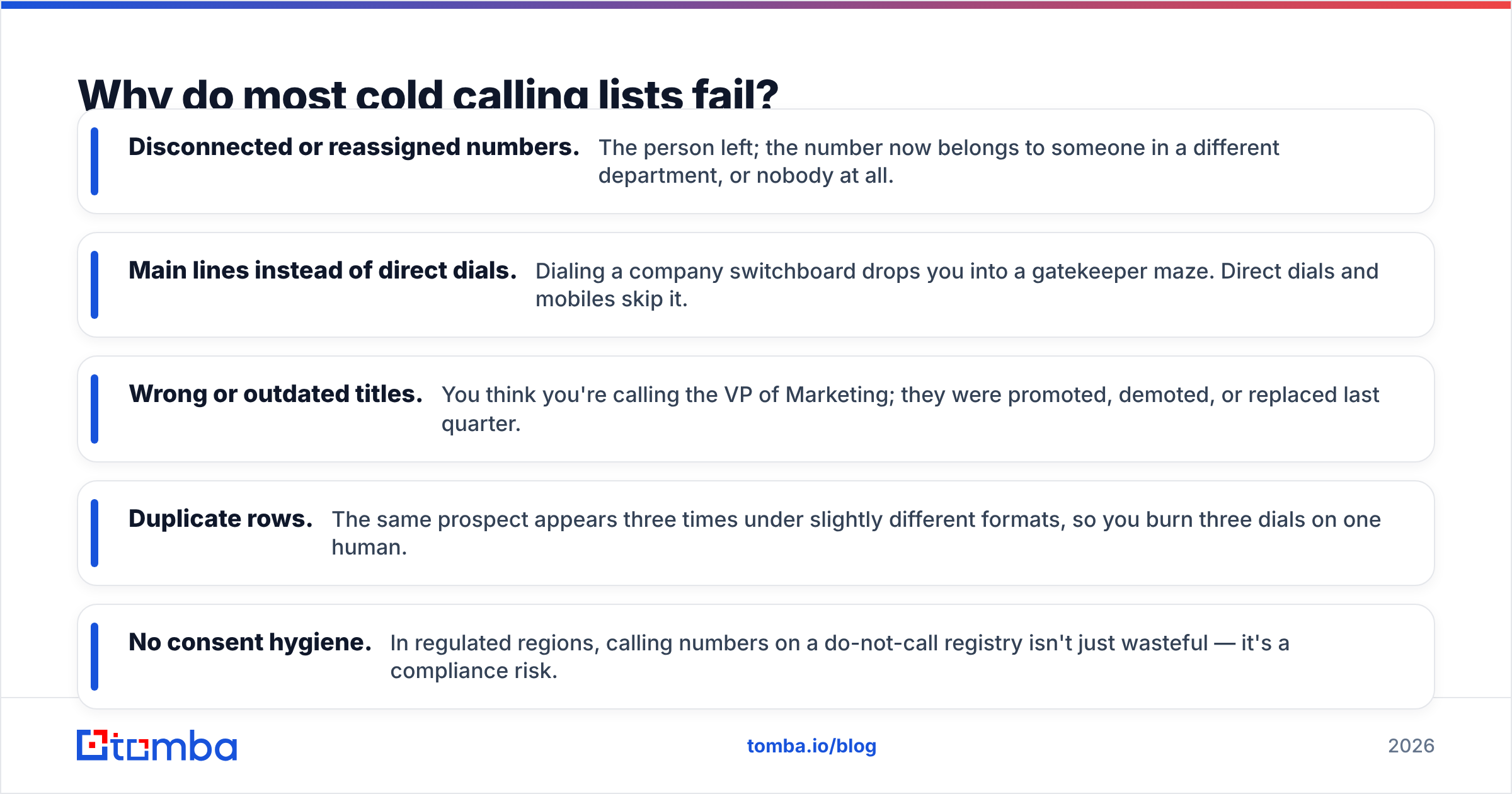
Here's where cold calling lists rot:
- Disconnected or reassigned numbers. The person left; the number now belongs to someone in a different department, or nobody at all.
- Main lines instead of direct dials. Dialing a company switchboard drops you into a gatekeeper maze. Direct dials and mobiles skip it.
- Wrong or outdated titles. You think you're calling the VP of Marketing; they were promoted, demoted, or replaced last quarter.
- Duplicate rows. The same prospect appears three times under slightly different formats, so you burn three dials on one human.
- No consent hygiene. In regulated regions, calling numbers on a do-not-call registry isn't just wasteful — it's a compliance risk.
The fix isn't to dial harder. It's to source better data and verify it before your reps ever touch the phone. If you want the conceptual grounding on why data quality drives outbound performance, the Gartner sales research library is a solid neutral reference.
How do you build a cold calling list step by step?#
Building a cold calling list is a five-step sequence: define the profile, source the contacts, enrich the records, verify the numbers, then prioritize. Skipping steps three and four is exactly why so many lists underperform.
Step 1 — Define your ideal customer profile#
Before you pull a single number, write down who you're calling and why. At minimum: target industries, company size band, geography, and the specific job titles that own the problem you solve. A tight ICP means a shorter list — and a short list of the right people always beats a long list of the wrong ones.
Step 2 — Source the raw contacts#
You have a few realistic sourcing paths, covered in the comparison table below. Whatever the source, capture company domain alongside the name — the domain is the key that unlocks accurate enrichment later.
Step 3 — Enrich the records#
Enrichment fills the gaps: direct dial, mobile, LinkedIn, seniority, department, company revenue, tech stack, and recent triggers like funding or hiring. This is where a good data enrichment workflow turns a thin name-and-company row into a callable, prioritizable record. Enrichment is also what lets you segment — you can't prioritize what you haven't described.
Step 4 — Verify the phone numbers#
Run every number through validation before the list reaches a rep. A phone validator confirms the line is active and correctly formatted, flags disconnected numbers, and identifies line type (mobile vs. landline vs. VoIP). Every dead number you catch here is a dial your rep doesn't waste.
Step 5 — Prioritize and segment#
Finally, order the list. Put direct dials and mobiles at the top. Layer in intent or trigger signals so accounts showing buying behavior jump the queue. Break the master list into small daily call blocks — reps work a focused segment far better than an endless scroll.
Where should you source a cold calling list?#
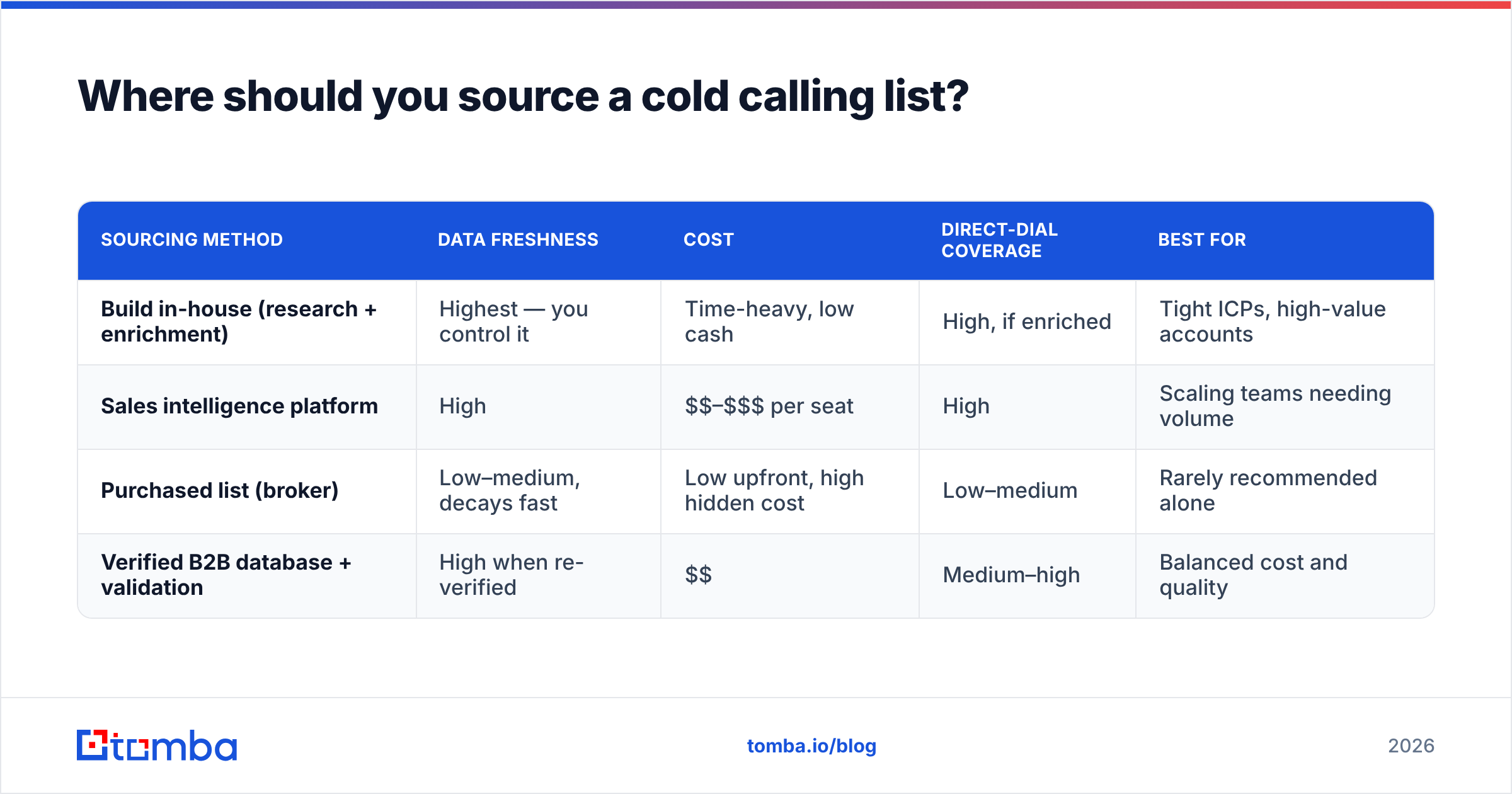
You can build, buy, or blend. Each path trades off freshness, cost, and control differently.
| Sourcing method | Data freshness | Cost | Direct-dial coverage | Best for |
|---|---|---|---|---|
| Build in-house (research + enrichment) | Highest — you control it | Time-heavy, low cash | High, if enriched | Tight ICPs, high-value accounts |
| Sales intelligence platform | High | $$–$$$ per seat | High | Scaling teams needing volume |
| Purchased list (broker) | Low–medium, decays fast | Low upfront, high hidden cost | Low–medium | Rarely recommended alone |
| Verified B2B database + validation | High when re-verified | $$ | Medium–high | Balanced cost and quality |
A quick note on buying: purchased broker lists are cheap for a reason. They're often shared across dozens of buyers, rarely re-verified, and heavy on main lines. Reputable data vendors like BookYourData address this by selling verified, pay-as-you-go records rather than stale bulk files — a genuinely better model than a scraped CSV, and worth a look if buying is your route. Whichever source you pick, treat verification as non-negotiable: even good data needs a re-check before it hits the dialer.
For teams that want to assemble lists from a company domain outward, pairing a B2B database with real-time validation gives you the freshness of self-serve with the coverage of a platform.
What data fields make a cold calling list connect?#
A record that connects carries more than a name and a number. The fields below are the difference between a 3% and a 15% connect rate.
- Direct dial or mobile number — the single highest-leverage field. Main lines route you to gatekeepers; direct lines route you to buyers.
- Verified line status — active/disconnected flag and line type, so you skip dead numbers automatically.
- Current job title and seniority — confirms you're reaching the decision-maker, not someone who left the role.
- Company firmographics — size, industry, revenue, so you can tailor the opener and qualify fast.
- Time zone — obvious, constantly ignored. Calling a West Coast prospect at 8 a.m. their time tanks your pickup rate.
- Trigger signals — recent funding, new hires, product launches, or leadership changes that give you a reason to call now.
If you're wondering why the "surprised" reaction above is so common: teams routinely build a list once, work it for months, and act shocked when connect rates collapse. The numbers didn't fail — they aged out.
How do you prioritize a cold calling list for the highest connect rate?#
Prioritize by reachability first, then by fit and timing. In practice, that means scoring each record on three axes and sorting:
- Reachability score — Does the row have a verified direct dial or mobile? Records with a confirmed mobile go to the top; main-line-only records go to the bottom or get held back for enrichment.
- Fit score — How closely does the account match your ICP? Weight by revenue band, industry, and title seniority.
- Timing score — Are there active trigger signals? A prospect whose company just raised a round or posted a relevant job opening is worth calling before a cold-but-quiet account.
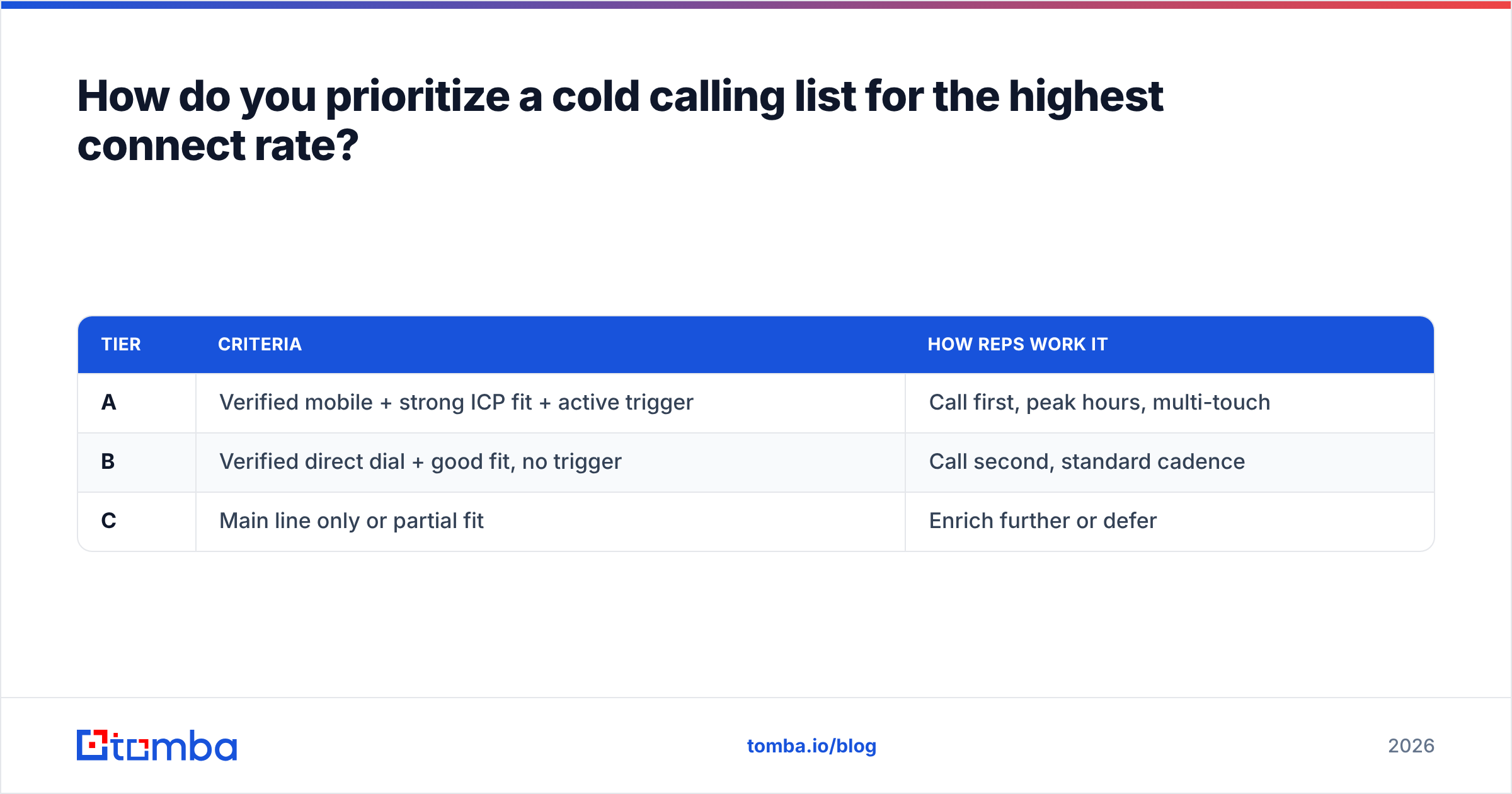
Combine the three into a single priority tier (A/B/C is enough) and have reps work A-tier during peak calling windows — typically mid-morning and late afternoon in the prospect's local time. Save list cleanup, research, and B/C dials for the off-peak hours. This is the same logic behind good lead scoring: finite rep time should chase the highest-probability conversations first.
A concrete example of tiering:
| Tier | Criteria | How reps work it |
|---|---|---|
| A | Verified mobile + strong ICP fit + active trigger | Call first, peak hours, multi-touch |
| B | Verified direct dial + good fit, no trigger | Call second, standard cadence |
| C | Main line only or partial fit | Enrich further or defer |
What tools keep a cold calling list clean?#
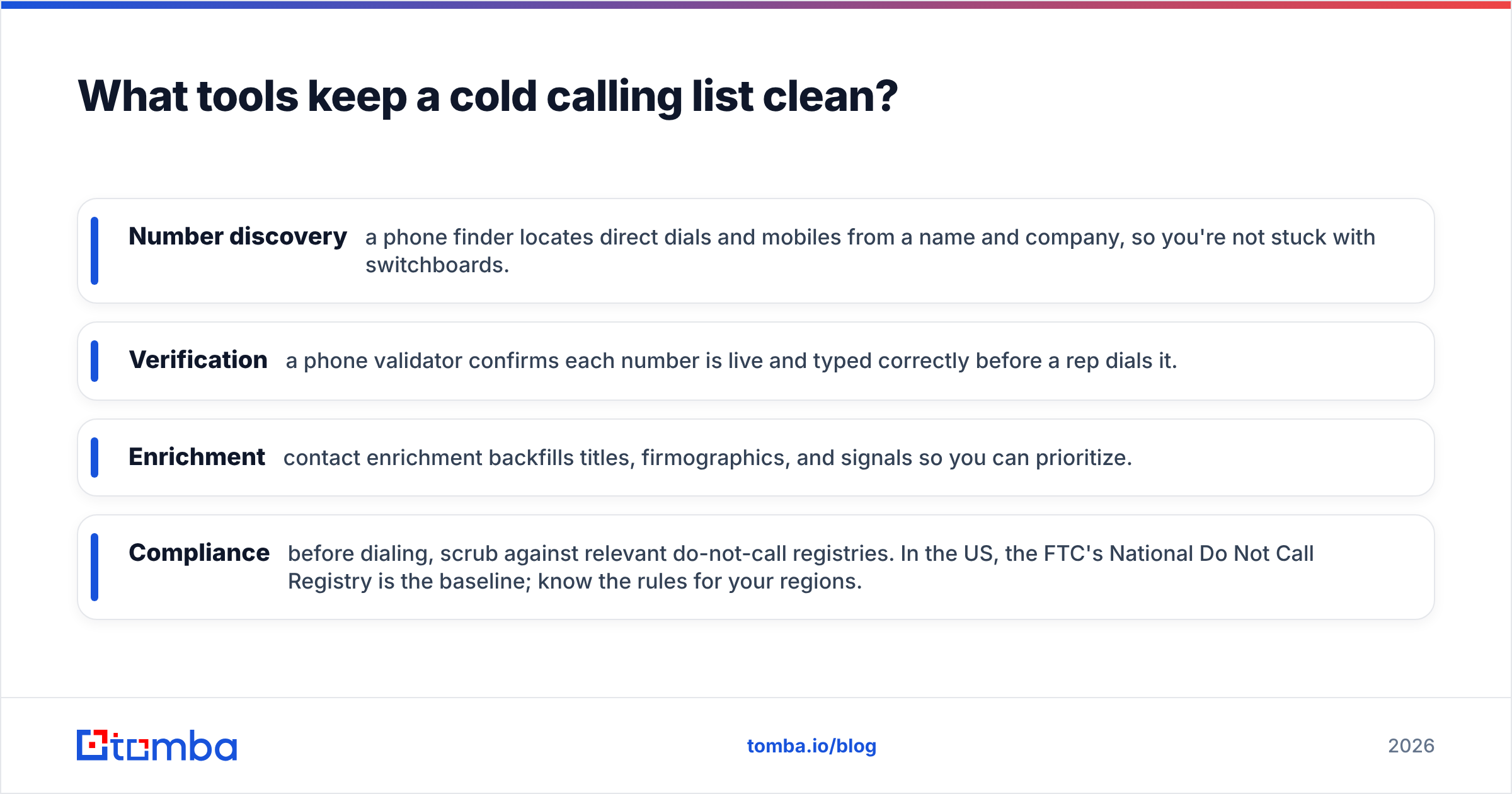
The tooling splits into three jobs: finding numbers, verifying them, and enriching the surrounding record. You can stitch these together or use a platform that covers all three.
- Number discovery — a phone finder locates direct dials and mobiles from a name and company, so you're not stuck with switchboards.
- Verification — a phone validator confirms each number is live and typed correctly before a rep dials it.
- Enrichment — contact enrichment backfills titles, firmographics, and signals so you can prioritize.
- Compliance — before dialing, scrub against relevant do-not-call registries. In the US, the FTC's National Do Not Call Registry is the baseline; know the rules for your regions.
The workflow that keeps lists healthy is boring and repeatable: pull new records, enrich, validate, tier, dial, and re-verify the survivors on a monthly cycle. Automating the validate-and-enrich steps — through an API or a spreadsheet add-in — is what makes monthly refreshes actually happen instead of falling off the roadmap.
How often should you refresh your cold calling list?#
Refresh at least monthly, and re-verify any list older than 90 days before working it again. Given ~30% annual data decay, a quarterly rebuild is the floor for teams that call at volume; monthly is better. The mechanics:
- Weekly: add fresh records from new inbound, events, and research.
- Monthly: re-run verification across the active list, drop disconnected numbers, and update changed titles.
- Quarterly: rebuild low-performing segments from scratch and re-score priority tiers.
Set this on a calendar and, ideally, wire the verification step into an automated job so it runs whether or not anyone remembers. A list that's re-verified on a schedule stays a productive asset; one that isn't quietly becomes a graveyard of dead lines your reps blame on their scripts.
Build a cold calling list that connects with Tomba#
A great cold call starts long before the dial — it starts with a clean, prioritized, verified list. Tomba gives you the pieces to build one: use the Tomba Email Finder and phone finder to source direct contacts from a company domain, run every number through the phone validator, and layer on data enrichment to prioritize the accounts most likely to answer.
You can start free with 25 searches a month, and paid plans begin at $49/mo (Starter) with Growth at $99/mo — see the full Tomba pricing for team volumes. Stop blaming your script for a data problem. Build the list your reps actually want to dial, and watch the connect rate follow.
Related guides#
Ready to find emails that actually work?
Join 150,000+ professionals who stopped guessing and started sending. Free credits on signup — no credit card required.
Get the Tomba newsletter
Practical outbound tactics and product updates — once every two weeks.
About the author