How to Build Cold Calling Lists That Actually Convert in 2026
Most cold calling lists fail before the first dial—wrong numbers, dead contacts, no fit. Here's how to source, verify, and prioritize a B2B call list that actually connects and books meetings.
Cold calling still works in 2026 — but only when the list underneath it is good. Dialing a spreadsheet full of disconnected numbers and mismatched job titles isn't prospecting; it's expensive noise. This guide walks through what a cold calling list actually is, how to build one that connects, and how to keep it clean so your reps spend time talking to buyers instead of voicemail robots.
TL;DR#
- A cold calling list is a targeted set of contacts — name, company, role, and a verified phone number — filtered to match your ideal customer profile, not a random data dump.
- Bad data is the silent killer. Roughly a third of B2B contact data decays every year, so an unverified list bought six months ago is already half-dead.
- Buying and building both work — but the winning move is a hybrid: source raw contacts fast, then verify and enrich them before anyone picks up the phone.
- Prioritize, don't just collect. Segment by fit, intent, and reachability so reps call the 20% of the list that produces 80% of the meetings first.
- Compliance is non-negotiable. Scrub against Do-Not-Call registries and keep records of consent and sourcing to stay on the right side of regulators.
What is a cold calling list?#
A cold calling list is a structured set of prospects you intend to call who haven't spoken with you before. Think of it like a guest list for a dinner party: the goal isn't to invite everyone in the city, it's to invite the specific people who'd actually want to be there — and to have their correct address so they don't get lost on the way.
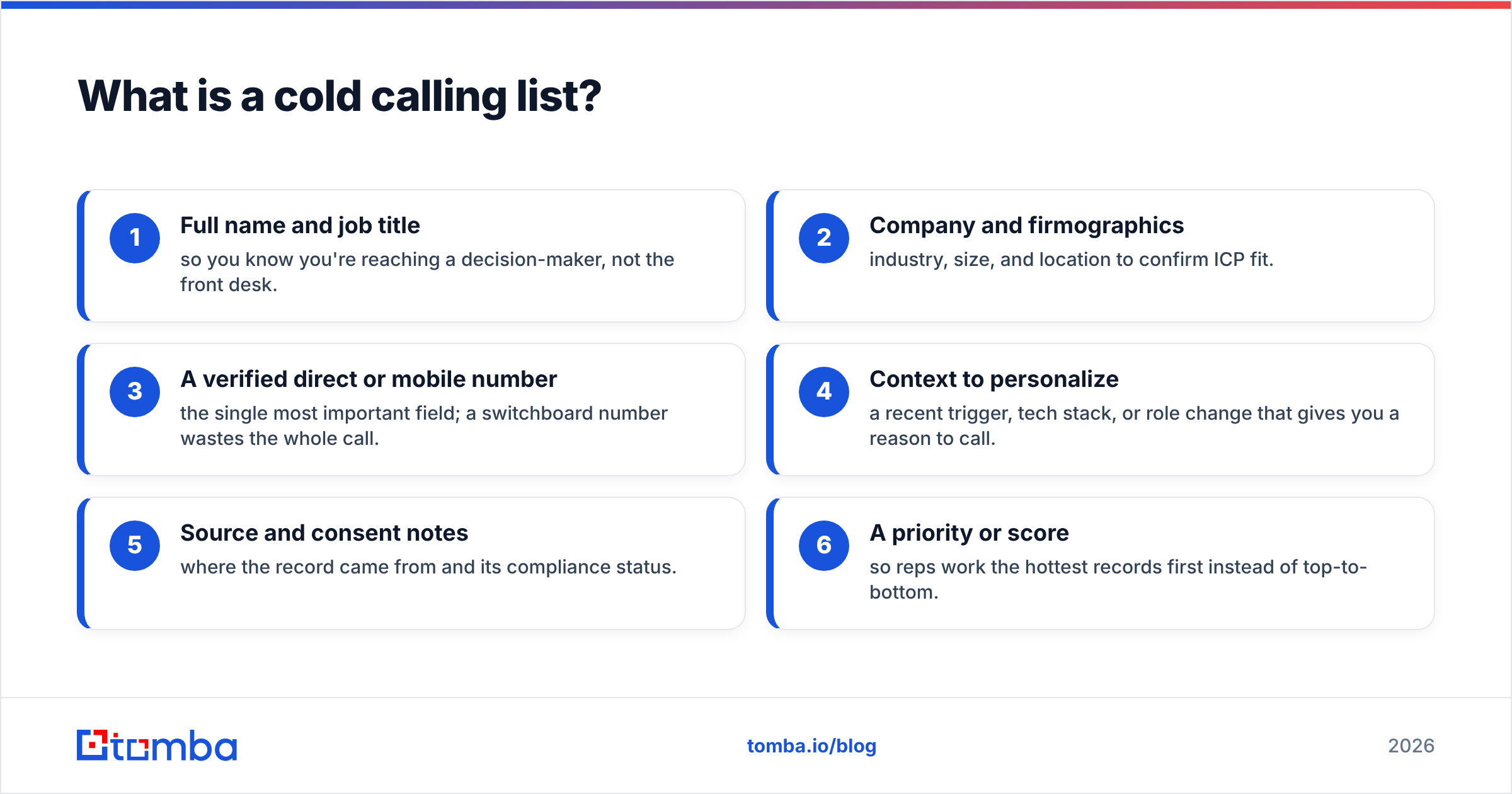
At minimum, a usable cold calling list has:
- Full name and job title — so you know you're reaching a decision-maker, not the front desk.
- Company and firmographics — industry, size, and location to confirm ICP fit.
- A verified direct or mobile number — the single most important field; a switchboard number wastes the whole call.
- Context to personalize — a recent trigger, tech stack, or role change that gives you a reason to call.
- Source and consent notes — where the record came from and its compliance status.
- A priority or score — so reps work the hottest records first instead of top-to-bottom.
The difference between a list that books meetings and one that burns reps out isn't the number of rows. It's how many of those rows are reachable and relevant.
Should you buy or build your cold calling list?#
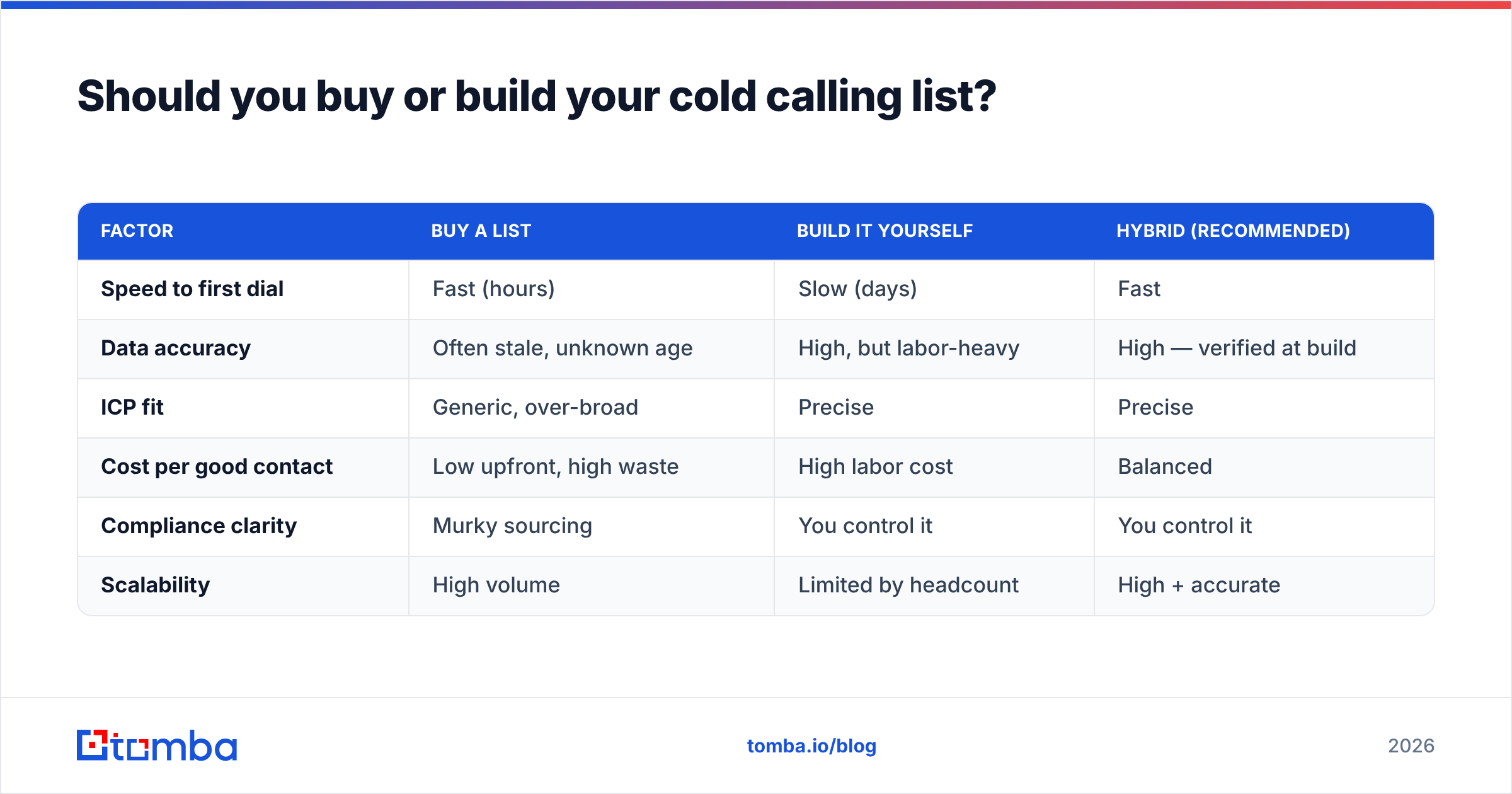
Short answer: build the targeting, but don't manually hunt every number by hand — use tools to accelerate sourcing, then verify everything. Here's how the two pure approaches compare.
| Factor | Buy a list | Build it yourself | Hybrid (recommended) |
|---|---|---|---|
| Speed to first dial | Fast (hours) | Slow (days) | Fast |
| Data accuracy | Often stale, unknown age | High, but labor-heavy | High — verified at build |
| ICP fit | Generic, over-broad | Precise | Precise |
| Cost per good contact | Low upfront, high waste | High labor cost | Balanced |
| Compliance clarity | Murky sourcing | You control it | You control it |
| Scalability | High volume | Limited by headcount | High + accurate |
Bought lists get a bad reputation for a reason: you're often paying for records someone else already burned through, with no visibility into how old the numbers are. But building every record manually doesn't scale past a handful of reps. The practical answer for most teams is the third column — pull contacts programmatically from reliable sources, then run every phone number through verification and enrichment before it reaches a dialer.
That's where a tool like a phone finder earns its keep: you feed it a company or a person, it returns direct B2B phone numbers, and you skip the switchboard-roulette entirely. Pair it with a phone validator so you're not dialing numbers that were disconnected two quarters ago.
Where do you get cold calling data?#
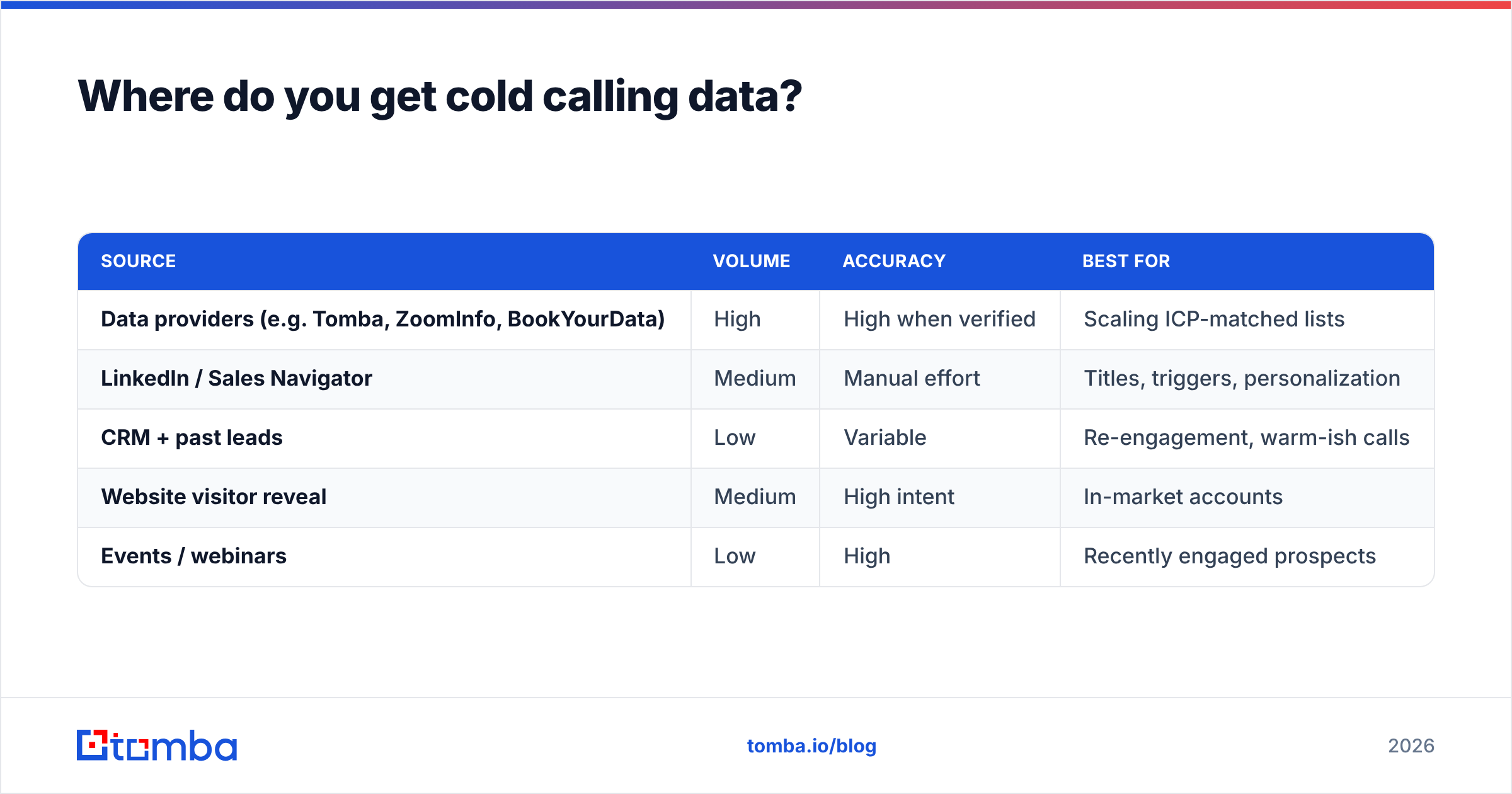
Not all sources are equal. Some give you volume, some give you accuracy, and the good ones give you both plus a paper trail. Here's how the main options stack up.
| Source | Volume | Accuracy | Best for |
|---|---|---|---|
| Data providers (e.g. Tomba, ZoomInfo, BookYourData) | High | High when verified | Scaling ICP-matched lists |
| LinkedIn / Sales Navigator | Medium | Manual effort | Titles, triggers, personalization |
| CRM + past leads | Low | Variable | Re-engagement, warm-ish calls |
| Website visitor reveal | Medium | High intent | In-market accounts |
| Events / webinars | Low | High | Recently engaged prospects |
Providers like BookYourData and other B2B databases are a solid starting point when you need coverage across a segment quickly. LinkedIn is unbeatable for confirming a person's current role and finding a personalization hook, but it doesn't hand you a phone number — you'll pair it with enrichment. And your own CRM is criminally underused: lost deals and old MQLs are often the highest-converting "cold" calls you can make, because they already know who you are.
For teams working account lists, layering data enrichment on top of a thin source list is what turns "a name and a company" into "a mobile number, a title, and a reason to call." You can also tap a maintained B2B database to fill gaps rather than scraping from scratch.
If you want the fundamentals of how professional databases assemble and refresh records, G2's data provider category is a useful neutral reference for comparing vendors on freshness and coverage.
Why does list quality matter more than list size?#
Because you can't out-dial bad data. If your reps have to make 200 dials to reach 20 humans, you've turned a people problem into a math problem — and the math loses.
B2B contact data decays fast. People change jobs, companies restructure, direct lines get reassigned. Industry estimates consistently put annual B2B data decay around 25–30%, which means a list sitting untouched for a year is roughly a coin flip on any given number. HubSpot's research on database decay is a good primer on why "set it and forget it" list-building quietly kills pipeline.
The knock-on effects of a dirty list are worse than wasted minutes:
- Rep morale tanks. Nothing burns out an SDR faster than 40 dead numbers in a row.
- Connect rates crater, which distorts every downstream metric you're trying to coach on.
- Your dialing reputation suffers — high volumes of dead-number dials can get your numbers flagged as spam by carriers.
Cleaning the list before you dial fixes all three at once. A quick pass through a phone validator to drop disconnected lines, plus an email verifier if you're running multichannel, means every dial has a real chance of connecting.
How do you build a high-converting cold calling list step by step?#
Here's a repeatable process that works whether you're building 50 contacts or 5,000.
- Define the ICP tightly. Industry, company size, region, and the exact titles who own the problem you solve. A narrow, correct list beats a wide, vague one every time.
- Source raw contacts. Pull from a data provider or your CRM to get names and companies that match. Don't worry about phone numbers yet.
- Enrich each record. Append direct/mobile numbers, titles, and firmographics. This is where a phone finder and enrichment turn a thin list into a callable one.
- Verify everything. Run numbers through validation and drop the dead ones. Aim to remove bounces before they hit a rep's queue, not after.
- Segment and score. Group by fit and intent, then rank. Recent job-changers, website visitors, and past opportunities go to the top.
- Add a personalization hook per contact. One line — a funding round, a hire, a tech-stack signal — that gives the rep a non-generic opener.
- Load, dial, and feed results back. Log outcomes in the CRM so tomorrow's list is smarter than today's.
Steps 3 and 4 are where most teams cut corners — and it's exactly the corner that determines whether the whole effort pays off.
What makes a cold calling list compliant in 2026?#
Compliance isn't optional garnish; it's the difference between a sustainable channel and a fine. The rules vary by region, but the fundamentals are consistent.
- Scrub against Do-Not-Call registries. In the US, cross-check numbers against the National Do Not Call Registry and honor internal opt-outs. Many countries maintain equivalents.
- Know your consent basis. B2B calling has more latitude than B2C in many jurisdictions, but "legitimate interest" still requires you to document why you hold and use the data.
- Keep a sourcing trail. Record where each contact came from and when. If a regulator or prospect asks, "how did you get my number," you need an answer.
- Time and frequency limits. Respect calling-hour windows and don't hammer the same number repeatedly.
- Honor opt-outs instantly. One request to stop, and that record is suppressed everywhere — not just in the rep's notebook.
Baking compliance into the list-building step — rather than praying nobody complains — keeps the channel alive long-term. Tools that document data sources make the paper-trail requirement far less painful.
Which tools help you build and clean cold calling lists?#
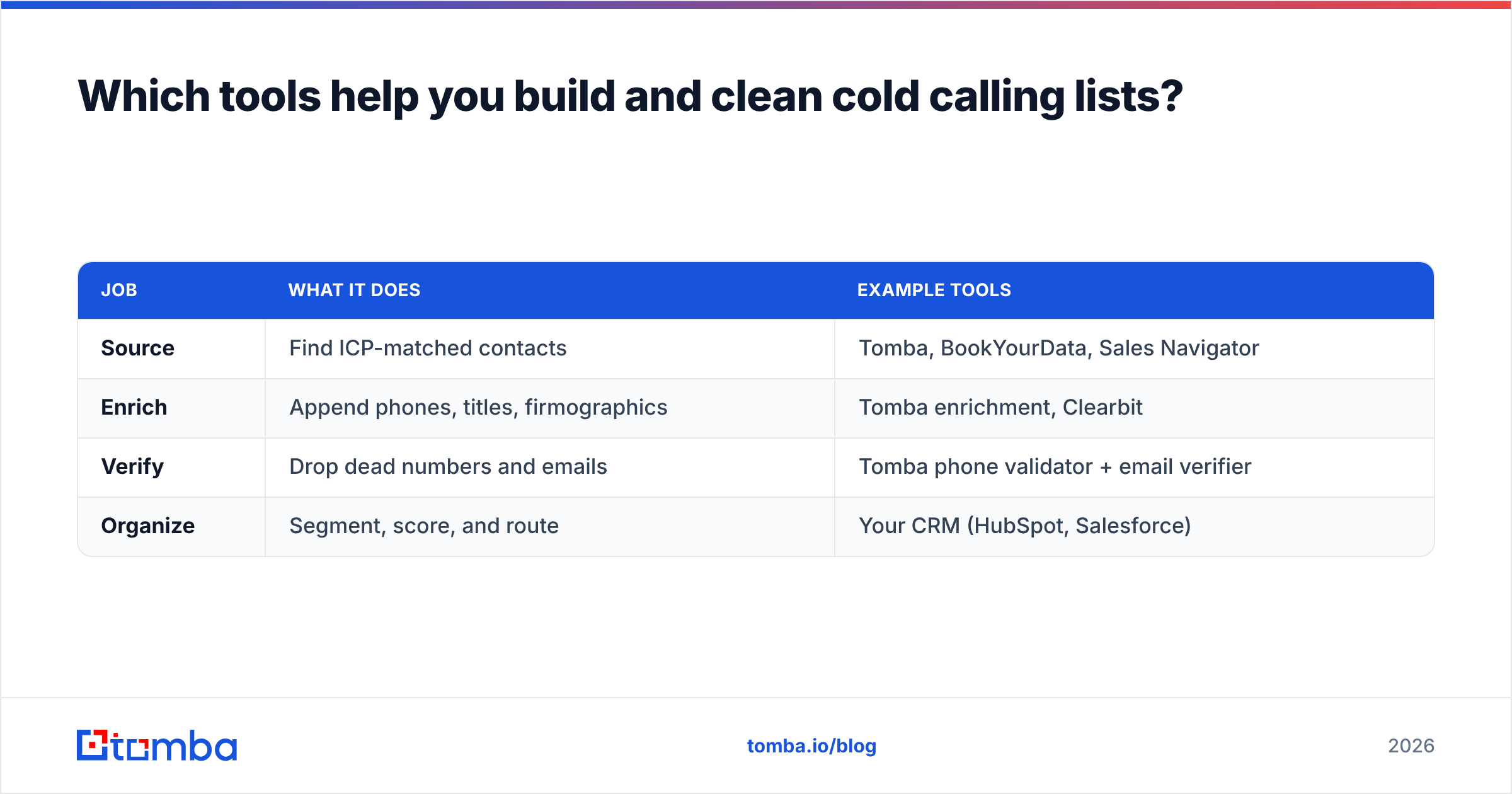
You don't need a 12-tool stack. You need coverage across three jobs: source, enrich, and verify. Here's a lean stack that covers all three.
| Job | What it does | Example tools |
|---|---|---|
| Source | Find ICP-matched contacts | Tomba, BookYourData, Sales Navigator |
| Enrich | Append phones, titles, firmographics | Tomba enrichment, Clearbit |
| Verify | Drop dead numbers and emails | Tomba phone validator + email verifier |
| Organize | Segment, score, and route | Your CRM (HubSpot, Salesforce) |
The point isn't to buy every box. It's to make sure no record reaches a rep without passing through enrichment and verification first. If your data provider and your CRM connect cleanly — check the integrations your stack supports — you can automate most of this so the list stays fresh on its own. Salesforce's own data management guidance is a good reference for keeping CRM records from rotting once they're in.
How often should you refresh your cold calling list?#
Treat your list like fresh produce, not canned goods. Given ~2–3% monthly decay, a working list should be re-verified at least every 90 days, and hot segments more often than that. Practical cadence:
- Weekly: re-score and re-prioritize based on new intent signals and CRM activity.
- Monthly: append new contacts and personalization hooks.
- Quarterly: full re-verification pass on every phone number and email.
- Continuously: suppress opt-outs and bounces the moment they happen.
The teams that win at cold calling aren't the ones with the biggest list. They're the ones whose list is always current, so every dial has a real human on the other end who actually fits.
Build a call list that connects#
A cold calling list is only as good as the numbers inside it — and numbers go stale fast. If you want reps talking to real, in-fit buyers instead of dead lines, start by sourcing and verifying with Tomba's Phone Finder: pull direct B2B numbers, enrich them with titles and firmographics, and validate before the first dial. Pair it with a free tier to test coverage on your own ICP, then scale up as connect rates climb. Check the current Tomba pricing — plans start at $49/mo after the free tier — and give your team a list worth dialing.
Related guides#
// get started
Find, verify and enrich your first contacts today
Start on the free plan with 25 searches a month, then scale when your team is ready.
Free plan · No credit card required · GDPR & CCPA
// about the author