Cold Calling Methods That Actually Book Meetings in 2026
Scripts, timing, and frameworks matter — but the cold calling methods that book meetings all start with one thing reps ignore. Here's what works in 2026.
Cold calling isn't dead — but the version that worked in 2015 is. Reps who still dial a giant untargeted list and read a stiff script are getting hung up on, while a smaller group books meetings at 3-5x the rate. The difference isn't charisma. It's method.
This guide breaks down the cold calling methods that actually move pipeline in 2026: the frameworks, the timing, the openers, and the one unglamorous step most reps skip that quietly sinks the other four.
TL;DR#
- Method beats volume. A structured approach (research → timing → opener → framework → next step) outperforms high-dial-count spray-and-pray every time.
- The permission-based opener ("Did I catch you at a bad time?") consistently outperforms the classic "How are you today?" hook.
- Timing is a lever, not luck. Wednesday and Thursday, late morning and late afternoon, still test as the strongest windows.
- Frameworks like SPIN and the "3x3" research rule give the call structure without making you sound like a robot.
- Bad phone data kills good methods. If the number is wrong or disconnected, script quality is irrelevant — clean, verified contact data is the foundation everything else sits on.
Does cold calling still work in 2026?#
Yes — but only when it's targeted. The data that gets thrown around ("cold calling is dead," "1% connect rates") describes untargeted, unresearched dialing. When you narrow the list, verify the numbers, and lead with relevance, connect and conversion rates jump.
HubSpot's sales research has repeatedly shown that buyers still take calls when the outreach is relevant and well-timed — the problem is that most reps optimize for dials-per-hour instead of quality-per-dial. Gong's conversation analytics back this up: the calls that convert share structural patterns, not lucky breaks.
So the question isn't "does cold calling work?" It's "which cold calling methods work?" Let's get into them.
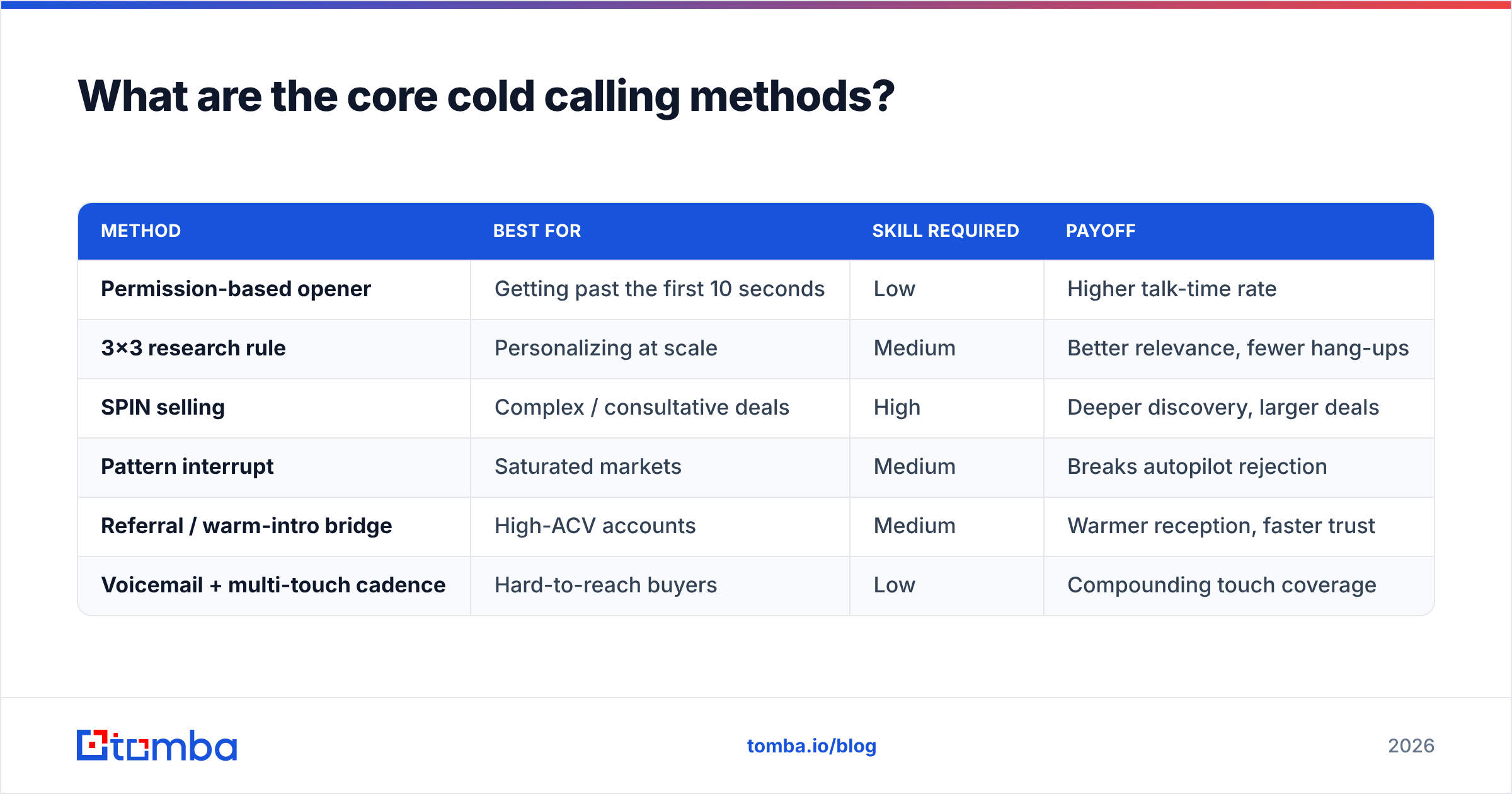
What are the core cold calling methods?#
There's no single "right" method — there's a stack of techniques that layer together. Here's how the main ones compare on effort, skill required, and where they shine.
| Method | Best for | Skill required | Payoff |
|---|---|---|---|
| Permission-based opener | Getting past the first 10 seconds | Low | Higher talk-time rate |
| 3x3 research rule | Personalizing at scale | Medium | Better relevance, fewer hang-ups |
| SPIN selling | Complex / consultative deals | High | Deeper discovery, larger deals |
| Pattern interrupt | Saturated markets | Medium | Breaks autopilot rejection |
| Referral / warm-intro bridge | High-ACV accounts | Medium | Warmer reception, faster trust |
| Voicemail + multi-touch cadence | Hard-to-reach buyers | Low | Compounding touch coverage |
You don't pick one. You combine a research method, an opener, and a discovery framework into a repeatable motion. Below are the ones worth building your motion around.
1. The permission-based opener#
Instead of the tired "How are you doing today?", top reps ask a disarming honesty question: "Hi Sarah, this is Alex from Acme — I know I'm calling out of the blue. Do you have 27 seconds before you tell me to get lost?"
It works because it acknowledges the interruption, gives the prospect control, and the oddly specific number ("27 seconds") triggers curiosity. Prospects who say "sure, go ahead" have opted in — and opted-in listeners convert far better than trapped ones.
2. The 3x3 research rule#
Before you dial, spend three minutes finding three relevant facts about the prospect or their company: a recent funding round, a job change, a product launch, a LinkedIn post. You open the call by referencing one of them. This is the single fastest way to stop sounding like a telemarketer.
The catch is that three minutes of research per prospect doesn't scale unless your data is already assembled. This is where data enrichment earns its keep — pulling title, company, and recent signals into one view so your three minutes go to insight, not hunting.
3. SPIN selling#
SPIN (Situation, Problem, Implication, Need-payoff) is a questioning framework built for consultative calls. You move the prospect from their current situation, to the problem, to the implications of leaving it unsolved, to the value of fixing it — using questions, not pitches. It's more demanding than a script but it's the backbone of most enterprise cold calling methods because it makes the buyer articulate the pain.
4. The pattern interrupt#
In saturated markets, buyers reject on autopilot. A pattern interrupt breaks the script they expect. Calling and saying "I'll be honest, this is a cold call — you can hang up, but will you give me 30 seconds first?" disrupts the reflex "no" long enough to earn a real conversation. Use sparingly; it's a scalpel, not a hammer.
What's the best cold calling framework to structure a call?#
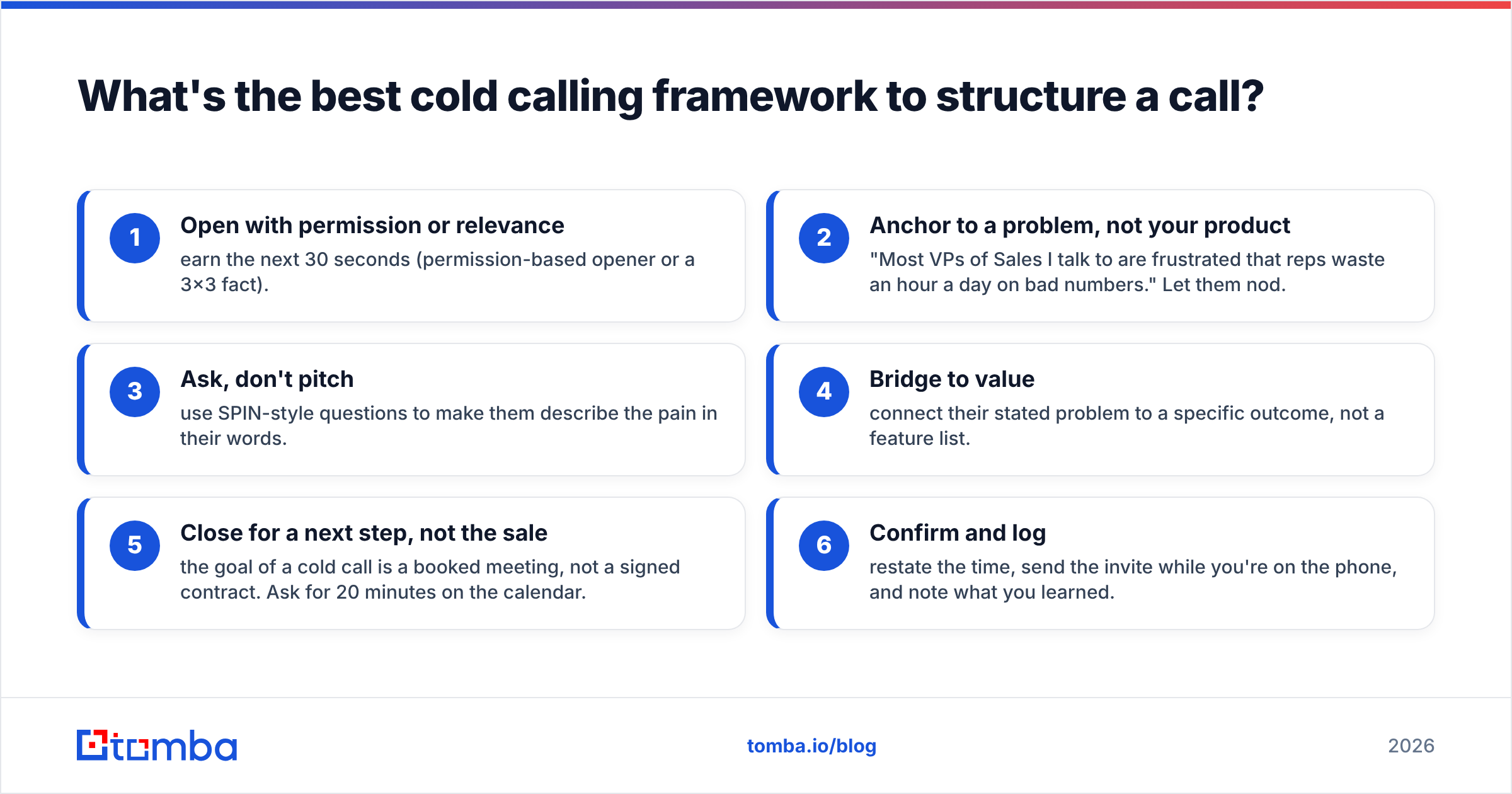
Think of a cold call like a house's closing routine after service — there's a predictable sequence that keeps things from falling apart. The strongest structure across most cold calling methods looks like this:
- Open with permission or relevance — earn the next 30 seconds (permission-based opener or a 3x3 fact).
- Anchor to a problem, not your product — "Most VPs of Sales I talk to are frustrated that reps waste an hour a day on bad numbers." Let them nod.
- Ask, don't pitch — use SPIN-style questions to make them describe the pain in their words.
- Bridge to value — connect their stated problem to a specific outcome, not a feature list.
- Close for a next step, not the sale — the goal of a cold call is a booked meeting, not a signed contract. Ask for 20 minutes on the calendar.
- Confirm and log — restate the time, send the invite while you're on the phone, and note what you learned.
That last step matters more than reps admit. A booked meeting that never gets confirmed in writing has a way of evaporating.
When is the best time to cold call?#
Timing is one of the few free levers you have. While every market differs, the patterns that hold up across most studies:
- Best days: Wednesday and Thursday. Monday buyers are triaging their week; Friday they're checking out.
- Best windows: roughly 10-11am and 4-5pm in the prospect's local time zone — before lunch and near end-of-day, when they're between deep-work blocks.
- Worst window: right after lunch (1-2pm), when calls go to voicemail.
- Speed to lead: if someone just filled out a form or triggered a buying signal, call within five minutes. That's not really "cold" anymore — and it converts dramatically better.
Time zones are the hidden trap here. Calling a West Coast prospect at what feels like late morning to an East Coast rep means you're dialing at 7am their time. Segment your list by region before you dial.
Why do most cold calling methods fail? (The data problem)#
Here's the part nobody wants to hear: the best opener in the world is worthless if the phone rings to a disconnected line, a wrong department, or a person who left the company eight months ago.
Study after study on wasted rep time points to the same culprit — stale, unverified contact data. Reps burn a third of their calling hours on numbers that were never going to connect. No script fixes that. No framework fixes that. Only clean data does.
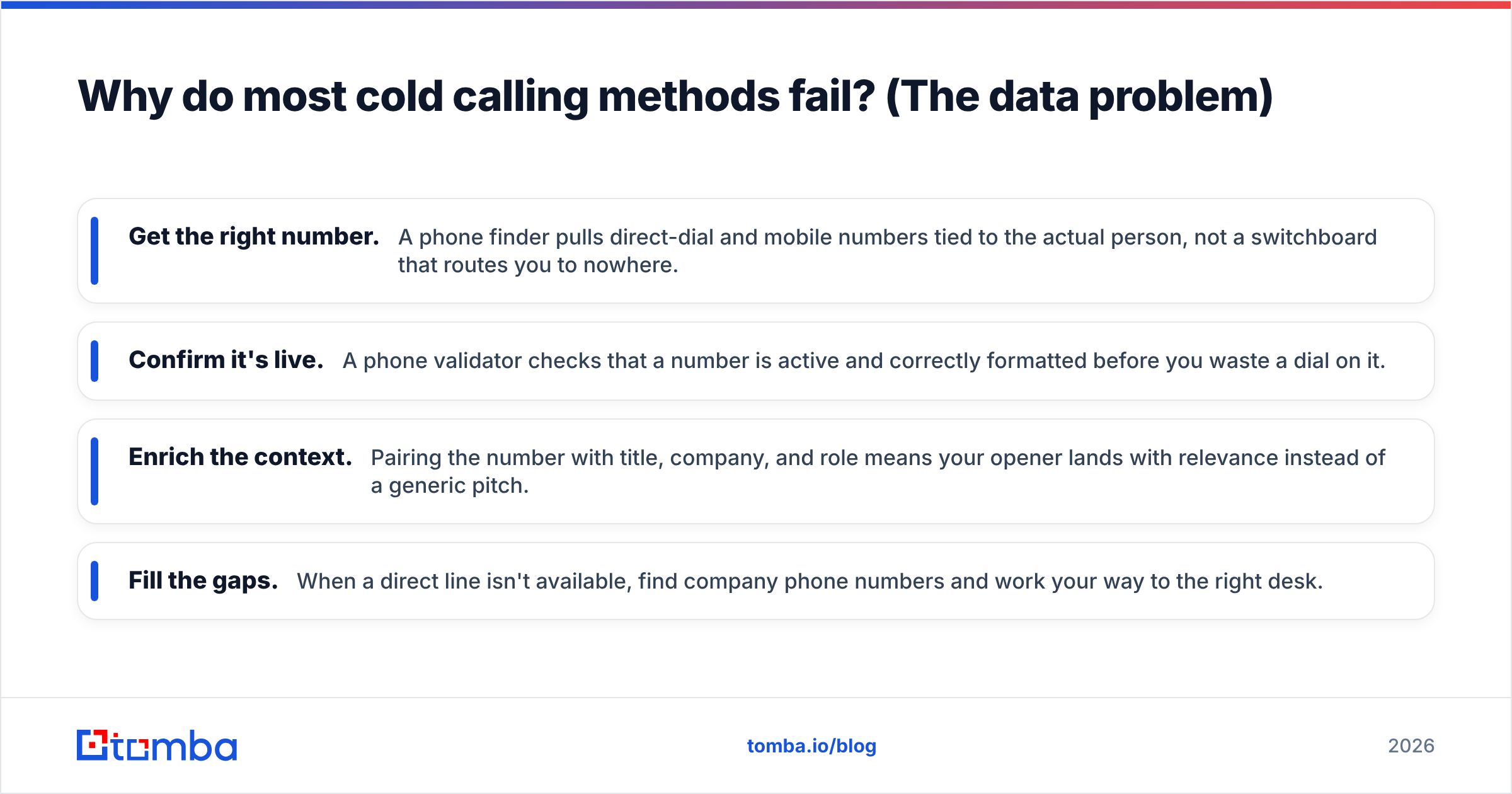
This is why the highest-performing teams treat data hygiene as step zero of their cold calling method:
- Get the right number. A phone finder pulls direct-dial and mobile numbers tied to the actual person, not a switchboard that routes you to nowhere.
- Confirm it's live. A phone validator checks that a number is active and correctly formatted before you waste a dial on it.
- Enrich the context. Pairing the number with title, company, and role means your opener lands with relevance instead of a generic pitch.
- Fill the gaps. When a direct line isn't available, find company phone numbers and work your way to the right desk.
Reps who skip this step blame their scripts. Reps who nail it spend their energy on conversations that can actually convert. If you're comparing vendors on data coverage, buyers on sites like G2 consistently rank verified, up-to-date phone data as the number-one factor separating a productive dialing day from a wasted one.
How do you combine cold calling with other channels?#
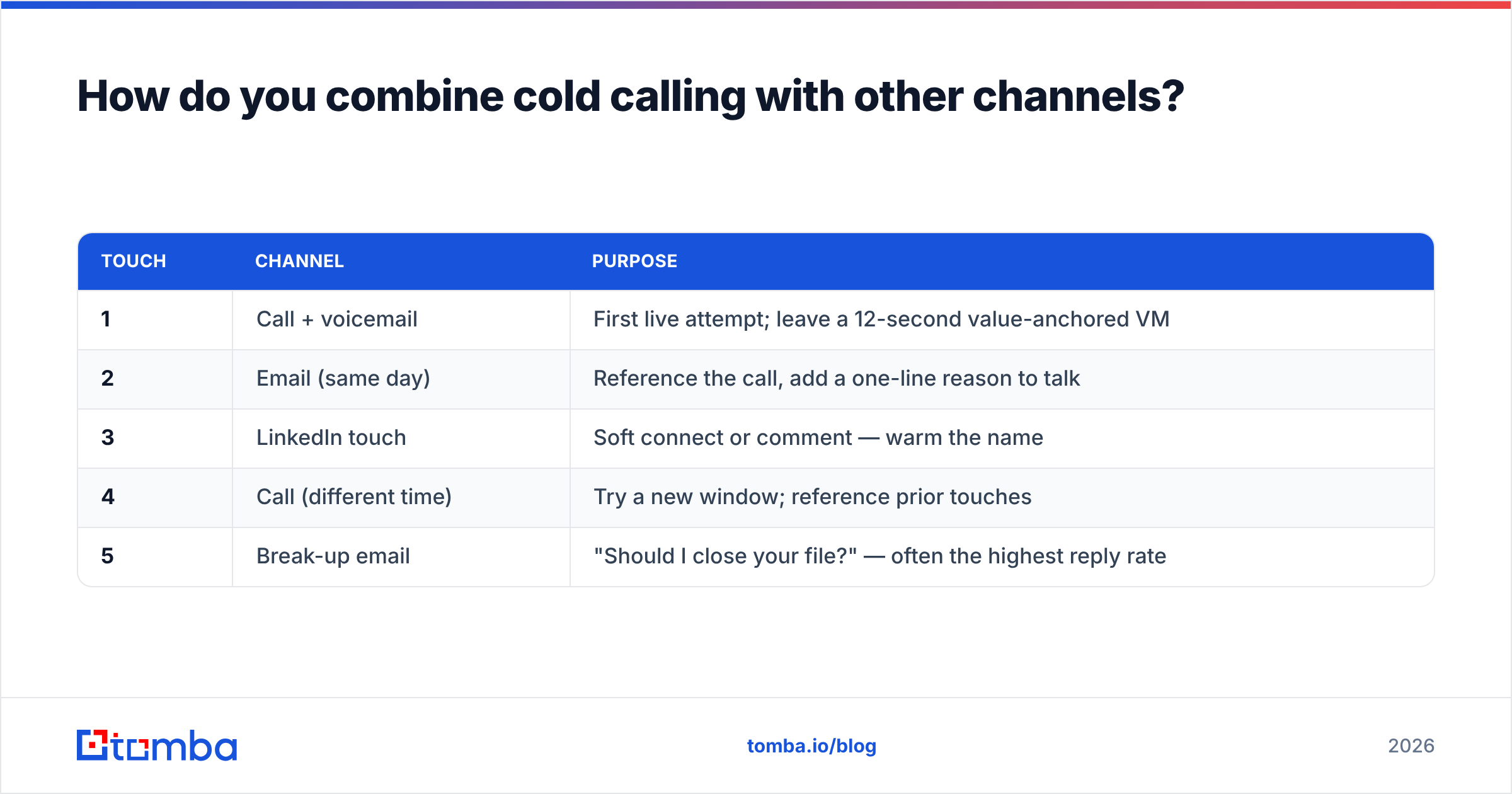
Cold calling alone is weaker than cold calling as part of a multi-touch cadence. The methods stack:
| Touch | Channel | Purpose |
|---|---|---|
| 1 | Call + voicemail | First live attempt; leave a 12-second value-anchored VM |
| 2 | Email (same day) | Reference the call, add a one-line reason to talk |
| 3 | LinkedIn touch | Soft connect or comment — warm the name |
| 4 | Call (different time) | Try a new window; reference prior touches |
| 5 | Break-up email | "Should I close your file?" — often the highest reply rate |
The phone is the sharpest tool in that sequence, but it lands harder when the prospect has already seen your name. Coordinating calls with LinkedIn outreach and email turns a cold call into a "warm-ish" one — the same disarming effect as a referral, at scale.
What does a good cold call script look like?#
A script isn't a cage — it's a set of rails. Keep it flexible. Here's a compact template that folds several methods together:
Opener (permission): "Hi [Name], it's [You] from [Company]. I know this is out of the blue — can I take 30 seconds and you can decide if it's worth continuing?"
Relevance (3x3): "I saw [specific fact — funding, hire, launch]. Usually when that happens, [role] ends up dealing with [problem]."
Discovery (SPIN): "How are you handling [problem] right now? … What does that cost you when it slips?"
Bridge: "That's exactly the gap we close for teams like [peer]. Worth a proper look?"
Close: "Let's grab 20 minutes Thursday. I'll send an invite now — does 10am work?"
Notice there's no monologue. Every step hands the conversation back to the prospect. The reps who sound the most natural are usually the ones following the tightest structure — the rails free them to listen.
Cold calling methods checklist#
Before your next block of dials, run this list:
- Verified numbers loaded — every contact has a validated direct line or mobile.
- List segmented by time zone — you're calling into the right local window.
- Three facts per prospect — 3x3 research done or enriched in advance.
- Opener chosen — permission-based or pattern interrupt, ready to go.
- Framework in mind — SPIN questions drafted for this persona's likely pain.
- Next-step goal set — you're closing for a meeting, not a sale.
- Multi-touch cadence queued — email and LinkedIn touches scheduled around the call.
The bottom line#
The cold calling methods that work in 2026 aren't secret openers or magic scripts. They're a disciplined stack: verified data first, then research, timing, a permission-based open, a questioning framework, and a clear next step. Miss the foundation — the data — and nothing built on top of it holds.
Start where the leverage is highest. Before you refine a single word of your script, make sure every number you dial is real, current, and attached to the right person. Tomba's phone finder and phone validator give you verified direct-dial and mobile numbers so your reps spend their day in conversations, not on dead lines. You can start on the free tier (25 searches a month) and scale from Starter at $49/mo once the pipeline proves itself. Fix the data, and every other cold calling method finally gets a chance to work.
Related guides#
Ready to find emails that actually work?
Join 150,000+ professionals who stopped guessing and started sending. Free credits on signup — no credit card required.
Get the Tomba newsletter
Practical outbound tactics and product updates — once every two weeks.
About the author