Cold Calling Mindset: How Top Reps Beat Call Reluctance
The gap between reps who hit quota on the phone and reps who freeze isn't a script — it's mindset. Here's how the best build one that survives 50 rejections a day.
TL;DR
- A strong cold calling mindset is a trainable system, not a personality trait — the best reps engineer confidence with routines, reframes, and metrics, not raw nerve.
- Call reluctance is almost always a fear-of-rejection problem, not a skill problem. Fix the story you tell yourself before you fix your script.
- Measure activity you control (dials, conversations, meaningful connects), not outcomes you don't (yes/no) — this single shift removes most of the emotional volatility.
- Rejection is a numbers game with a known ratio. Once you know your ratio, every "no" literally pays you.
- Good data does more for your mindset than any pep talk: dialing accurate, verified contacts means fewer dead ends and more real conversations per hour.
Why does cold calling feel so hard?#
Cold calling feels hard because your brain treats a stranger's rejection like a physical threat. That's the honest answer. When you dial a number and someone snaps "not interested" and hangs up, the same neural circuitry that once kept you alive on the savanna fires off a small alarm. Do that forty times before lunch and you get what the industry politely calls "call reluctance" — the very real, very common tendency to find literally anything else to do besides pick up the phone.
Here's the reframe that changes everything: the discomfort is not evidence that you're bad at this. It's evidence that you're human and the stakes feel real. The reps who succeed on the phone didn't remove the fear. They built a cold calling mindset that lets them act while the fear is present. Think of it like cold-water swimming. The water is always cold. Veterans don't feel warmth the beginners can't — they've just learned that the shock passes in ninety seconds and stopped negotiating with it.
That's the whole game. Not fearlessness. A repeatable relationship with discomfort.

What actually is a "cold calling mindset"?#
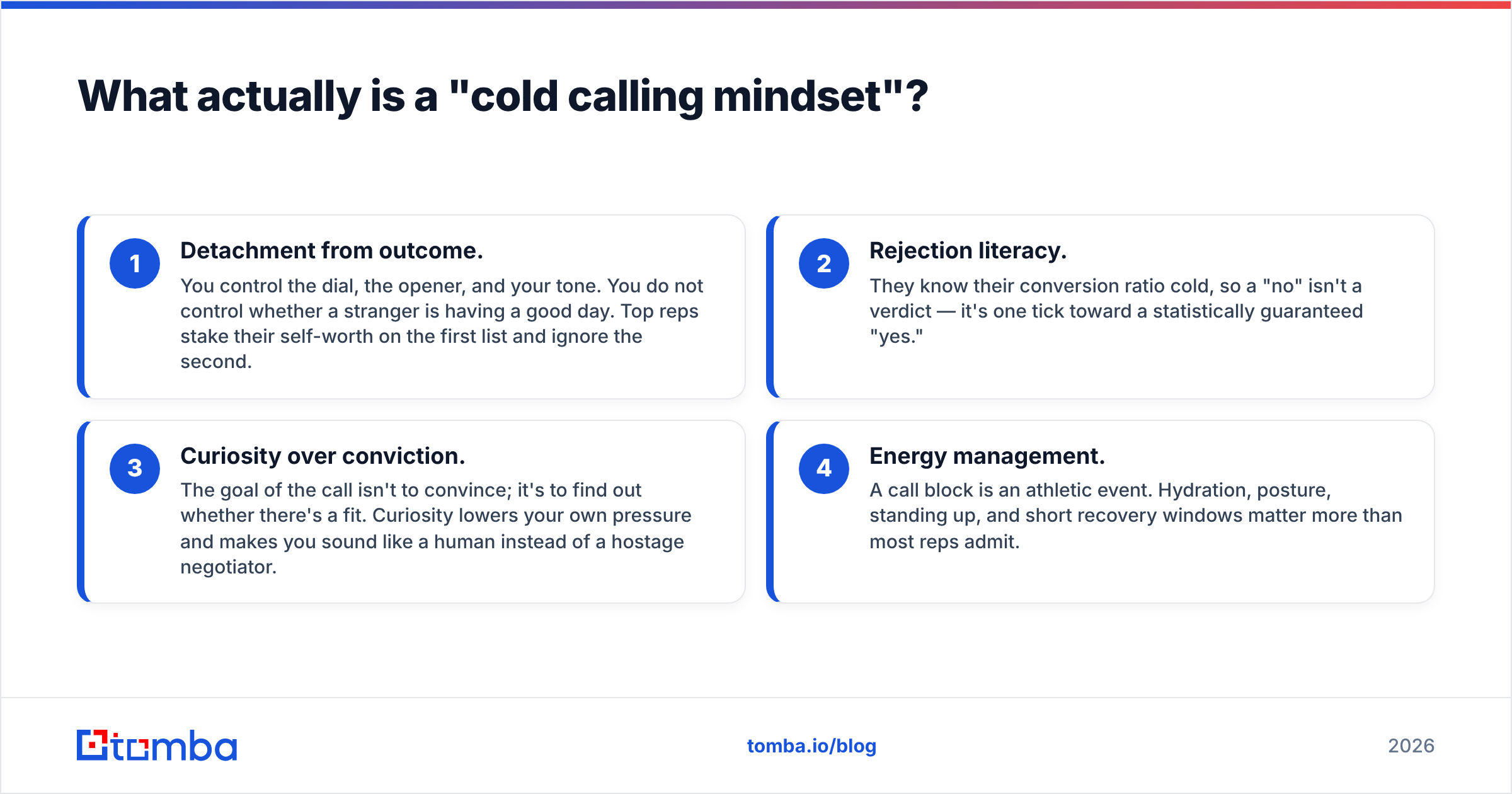
A cold calling mindset is the set of beliefs, routines, and reference points that let you keep dialing at a consistent quality regardless of how the last call went. It has four moving parts, and the good news is every one of them is trainable.
- Detachment from outcome. You control the dial, the opener, and your tone. You do not control whether a stranger is having a good day. Top reps stake their self-worth on the first list and ignore the second.
- Rejection literacy. They know their conversion ratio cold, so a "no" isn't a verdict — it's one tick toward a statistically guaranteed "yes."
- Curiosity over conviction. The goal of the call isn't to convince; it's to find out whether there's a fit. Curiosity lowers your own pressure and makes you sound like a human instead of a hostage negotiator.
- Energy management. A call block is an athletic event. Hydration, posture, standing up, and short recovery windows matter more than most reps admit.
Notice what's missing from that list: talent, extroversion, and a golden voice. Plenty of quiet, anxious people out-dial the naturally charismatic because mindset beats disposition over a full quarter. If you want the psychological grounding on why beliefs drive behavior here, the concept overlaps heavily with what sales researchers call response rate discipline — you optimize the inputs, and the outputs follow.
How do you reframe rejection so it stops hurting?#
You reframe rejection by converting it from a personal judgment into a unit of currency. This is the single highest-leverage move in building a cold calling mindset, so it's worth slowing down on.
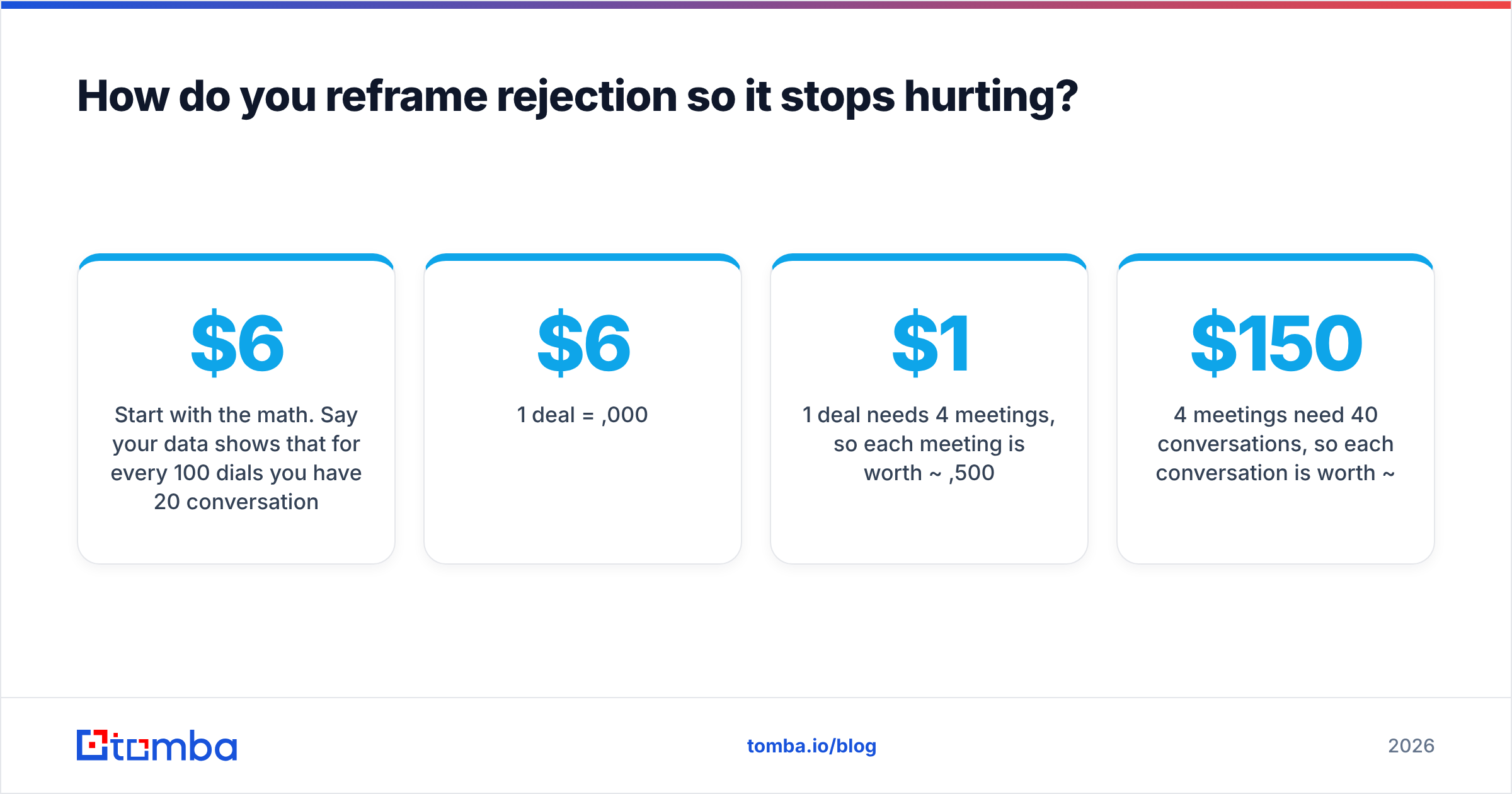
Start with the math. Say your data shows that for every 100 dials you have 20 conversations, and for every 20 conversations you book 2 meetings, and for every 4 meetings you close 1 deal worth $6,000 in commission. Work backward:
- 1 deal = $6,000
- 1 deal needs 4 meetings, so each meeting is worth ~$1,500
- 4 meetings need 40 conversations, so each conversation is worth ~$150
- 40 conversations need 200 dials, so each dial is worth ~$30 — whether the person says yes or no.
Read that last line again. The "no" pays you $30 just as much as the "yes" does, because both move you through the ratio. Once you internalize this, hanging up on a rejection stops feeling like failure and starts feeling like earning. Every top phone rep I've watched has some version of this number taped to their monitor.
The mistake beginners make is grading themselves on the wrong metric. They measure "how many people said yes today," which is mostly noise and outside their control, so their mood whipsaws all day. Instead, grade yourself on dials, connects, and conversations — the inputs you fully own. Do that, and a brutal day of twelve rejections becomes a good day, because you hit your activity target and the ratio does the rest.
Which metrics should you actually track?#
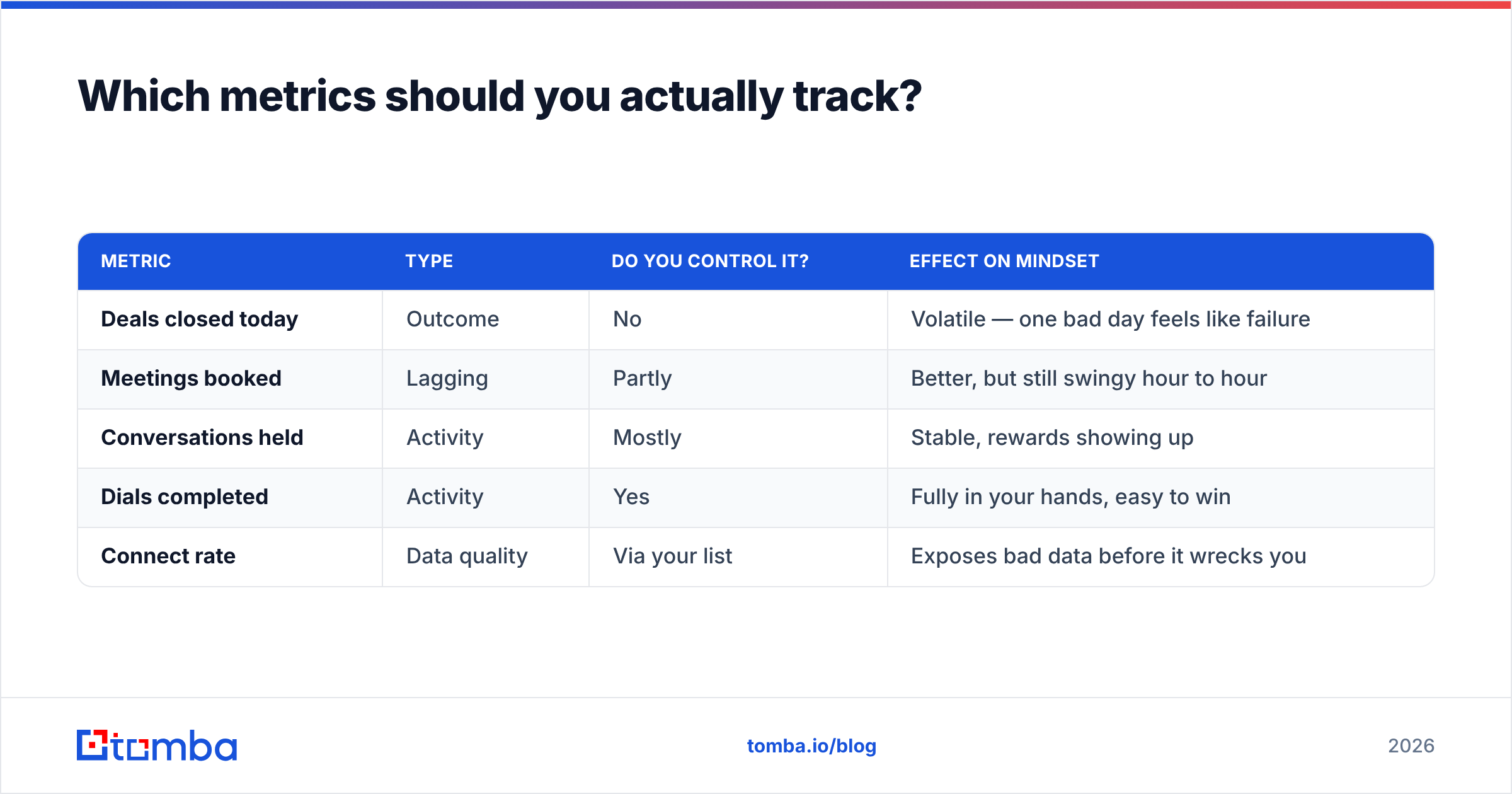
Track the inputs you control, not the outcomes you don't. Here's how the two philosophies compare, and why the left column quietly destroys morale while the right column protects it.
| Metric | Type | Do you control it? | Effect on mindset |
|---|---|---|---|
| Deals closed today | Outcome | No | Volatile — one bad day feels like failure |
| Meetings booked | Lagging | Partly | Better, but still swingy hour to hour |
| Conversations held | Activity | Mostly | Stable, rewards showing up |
| Dials completed | Activity | Yes | Fully in your hands, easy to win |
| Connect rate | Data quality | Via your list | Exposes bad data before it wrecks you |
The bottom two rows are your mindset armor. If you set a daily goal of, say, 60 dials and 8 real conversations, you can "win" every single day regardless of whether anyone buys — and winning daily is what keeps you dialing on Thursday afternoon when motivation is gone. Outcome-only reps have no such floor, so they burn out.
There's a data-quality wrinkle hiding in that table, and it matters more than most managers realize. Your connect rate is largely a function of list quality. If a third of your numbers are wrong or your emails bounce, you'll spend a third of your energy dialing ghosts — and nothing corrodes a cold calling mindset faster than a morning of disconnected lines. This is exactly why the strongest phone teams obsess over verified contact data before they ever pick up the phone. Feeding your dialer clean, current B2B phone numbers means more of your effort turns into actual conversations, which means the ratio works in your favor and your confidence compounds instead of leaking away.
What daily routines build call confidence?#
Confidence on the phone is manufactured before the call block starts, not summoned mid-dial. The best reps run a pre-call routine as deliberate as an athlete's warm-up. Here's a framework you can steal.
Before the block (10 minutes):
- Warm up your voice literally. Read your opener out loud three times, exaggerating energy. Cold vocal cords sound timid and your first three dials suffer for it.
- Review the ratio. Glance at your dial-to-deal math so your subconscious knows a "no" is progress, not pain.
- Set an activity target, not an outcome target. "60 dials" beats "book 3 meetings." One you control; the other you pray for.
- Stand up. Posture changes vocal projection and perceived confidence on the other end. Many reps dial standing for exactly this reason.
During the block:
- Batch your dials. Momentum is real. Ten calls in a row keeps you in a rhythm; one call, then email, then Slack, then a call kills it.
- Time-box it. 50-minute sprints with a hard 10-minute recovery. Cold calling is anaerobic; you can't sprint for four straight hours.
- Detach after each call in under five seconds. Log it, breathe, dial again. Rumination is the enemy.
After the block:
- Review conversations, not rejections. Pull one call that went well and one that went sideways, and ask what you'd change. That's coaching. Replaying humiliations is not.
If you want to see how activity targets plug into a broader outbound engine, our breakdown of LinkedIn outreach cadence pairs neatly with a phone-first routine — the multichannel reps almost always win.

Is a script a crutch or a confidence tool?#
A script is a confidence tool — right up until you read it like a hostage note, at which point it becomes a liability. The distinction is whether the script frees your attention or consumes it.
Think of a script like sheet music. A beginner pianist stares at every note and sounds robotic. A pro glances at the page and improvises around it because the structure is internalized. Your opener, your two or three qualifying questions, and your objection responses should be memorized frameworks, not word-for-word paragraphs you cling to. When the structure lives in your head, your conscious attention is free to actually listen — and listening is where deals are won.
The reps with the strongest cold calling mindset use the script as a safety net, not a script. It removes the "what do I say next?" panic that spikes anxiety, which lets them stay curious and present. Curiosity is the tell of a confident caller: they're genuinely trying to find out if there's a fit, not white-knuckling toward a close.
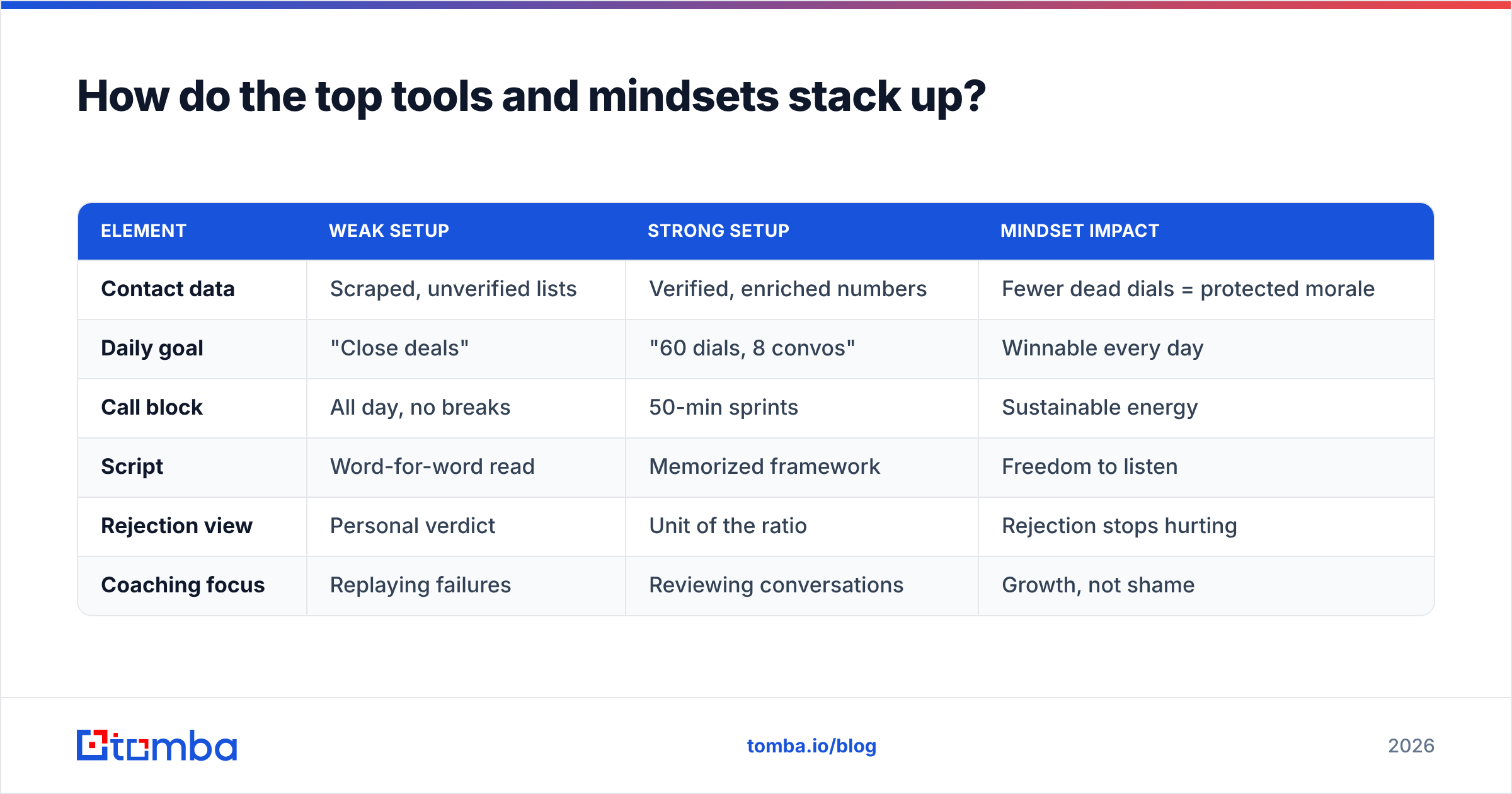
How do the top tools and mindsets stack up?#
Mindset doesn't operate in a vacuum — your environment either reinforces good habits or sabotages them. Here's how the elements of a phone operation compare when you look at them through a mindset lens.
| Element | Weak setup | Strong setup | Mindset impact |
|---|---|---|---|
| Contact data | Scraped, unverified lists | Verified, enriched numbers | Fewer dead dials = protected morale |
| Daily goal | "Close deals" | "60 dials, 8 convos" | Winnable every day |
| Call block | All day, no breaks | 50-min sprints | Sustainable energy |
| Script | Word-for-word read | Memorized framework | Freedom to listen |
| Rejection view | Personal verdict | Unit of the ratio | Rejection stops hurting |
| Coaching focus | Replaying failures | Reviewing conversations | Growth, not shame |
The pattern is obvious once it's laid out: every "strong setup" choice removes a source of emotional volatility, and volatility is what erodes a cold calling mindset over a quarter. Data quality sits at the top of that list for a reason. Sales research from firms like Gartner and community benchmarks on G2 consistently show that rep productivity tracks with data accuracy — you can't out-hustle a list that's 30% wrong.
How long does it take to build this mindset?#
Expect meaningful change in about two to three weeks of consistent dialing, and durable transformation in a quarter. The timeline surprises people because we're conditioned to think confidence is either innate or takes years. It isn't and it doesn't.
The mechanism is exposure. Every call block is a small dose of the thing you fear, and your nervous system habituates faster than you'd guess. Week one is genuinely uncomfortable. By week two, the pre-call dread shrinks. By week three, you notice you're dialing without the negotiation-with-yourself that used to eat ten minutes before every block. That's not because the calls got easier — it's because your relationship to them changed. The fear didn't leave; your tolerance grew around it.
The single biggest accelerator is volume of real conversations, not just dials into the void. This loops back to data one final time: a rep making 60 dials against a clean list will have far more actual conversations — and therefore far more habituation reps — than a rep making 60 dials against a junk list. Clean data literally compresses your learning curve. If your team is scaling outbound, building the habit on top of a reliable B2B database is the difference between building a mindset in three weeks and grinding for three months.
The bottom line#
A cold calling mindset is not courage you're born with — it's a system you build. Detach from outcomes, learn your ratio until rejection becomes currency, measure the activity you control, run a real warm-up routine, and treat your script as a framework that frees you to listen. Do those five things on top of clean data and the phone stops being the scariest tool in your stack and becomes the fastest one.
The data piece is the part reps underrate most. Every dead number, wrong extension, and disconnected line is a tiny withdrawal from your confidence account — and those withdrawals add up to call reluctance. Give yourself the unfair advantage of verified, current contacts so more of your effort turns into conversations that actually move the ratio. Start free with the Tomba Email Finder and pair it with the phone finder to feed your dialer contacts that pick up. Compare Tomba pricing — the free tier gives you 25 searches to test it, and plans start at $49/mo when you're ready to scale. Build the mindset. Feed it good data. Then go dial.
Related guides#
Ready to find emails that actually work?
Join 150,000+ professionals who stopped guessing and started sending. Free credits on signup — no credit card required.
Get the Tomba newsletter
Practical outbound tactics and product updates — once every two weeks.
About the author