Cold Calling Mistakes That Quietly Kill Your Connect Rate
Most cold calls fail before the prospect says a word. Here are the cold calling mistakes that tank your connect rate in 2026 — and the fixes that actually move pipeline.
Cold calling still works in 2026 — but most reps sabotage it before the first ring. The problem is rarely the channel. It's a stack of small, fixable cold calling mistakes that compound into a dead pipeline.
TL;DR#
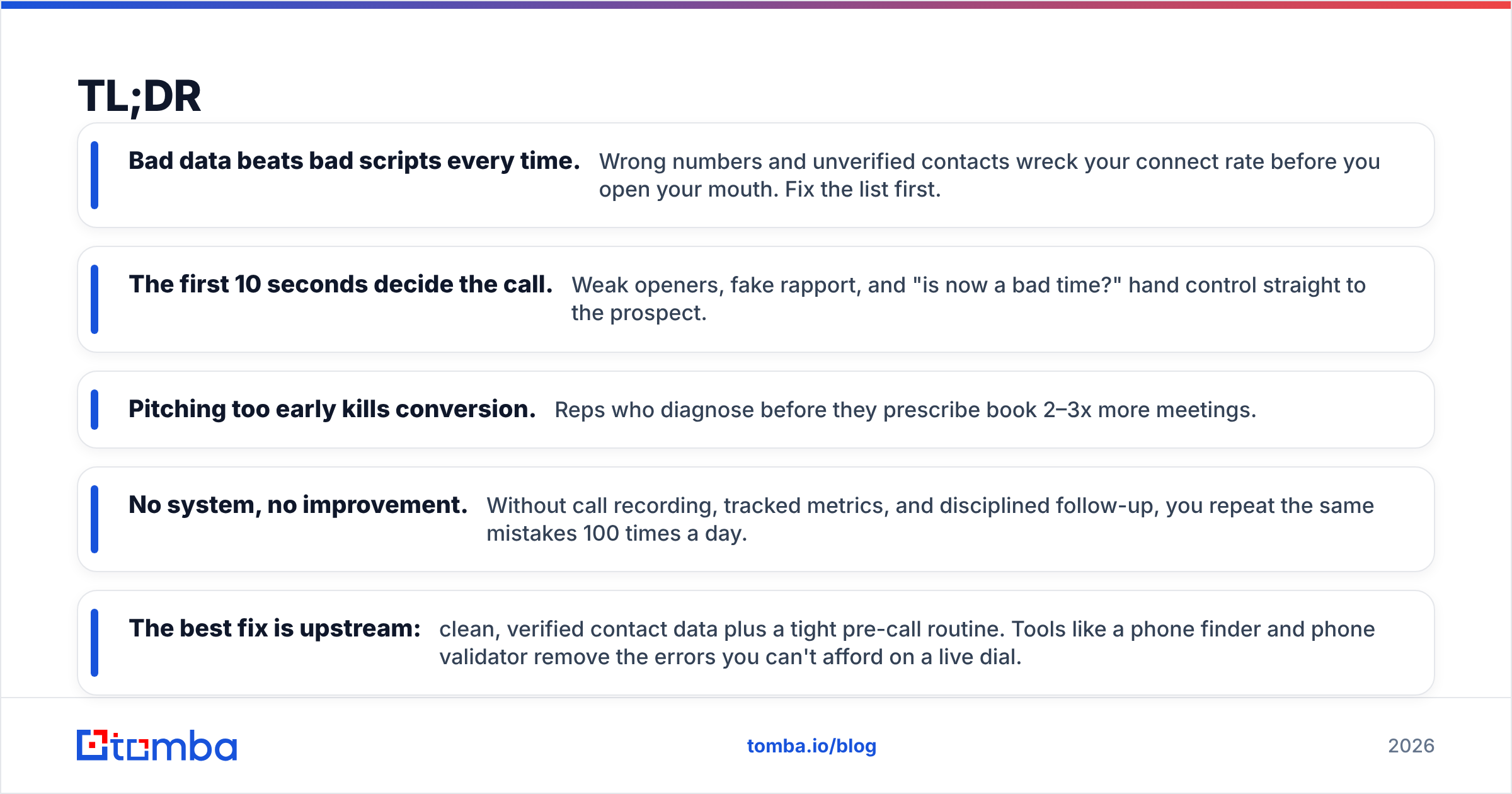
- Bad data beats bad scripts every time. Wrong numbers and unverified contacts wreck your connect rate before you open your mouth. Fix the list first.
- The first 10 seconds decide the call. Weak openers, fake rapport, and "is now a bad time?" hand control straight to the prospect.
- Pitching too early kills conversion. Reps who diagnose before they prescribe book 2–3x more meetings.
- No system, no improvement. Without call recording, tracked metrics, and disciplined follow-up, you repeat the same mistakes 100 times a day.
- The best fix is upstream: clean, verified contact data plus a tight pre-call routine. Tools like a phone finder and phone validator remove the errors you can't afford on a live dial.
Why do most cold calls fail before you even speak?#
The uncomfortable truth: your call is often lost at the data layer, not the conversation layer. If 30% of your numbers are wrong, disconnected, or belong to someone who left the company two years ago, no script on earth saves you.
Think of it like a delivery driver with a stack of bad addresses. The driver can be charming, fast, and well-dressed — but if half the houses don't exist, the route fails. Cold calling is the same. Reputable benchmarks from sales orgs tracked on G2 consistently show connect rates collapsing when list hygiene is ignored.

Before you obsess over openers, audit your inputs. The most expensive cold calling mistakes happen in the spreadsheet, not on the phone.
What are the most common cold calling mistakes in 2026?#
Here are the twelve that quietly drain pipeline, grouped by where they happen.
Before the call
- Dialing unverified numbers. Every wrong number is wasted time and a dent in your momentum. Validate before you dial.
- Zero research. Calling with no idea what the company does or why they'd care. Ten seconds of context changes the whole tone.
- No clear goal for the call. "Just checking in" is not a goal. Booking a 20-minute discovery slot is.
- Calling at dead hours. Early morning and late afternoon consistently beat the post-lunch lull for connects.
During the call
- Weak, apologetic openers. "Sorry to bother you" tells the brain you're a low-priority interruption.
- Asking "is now a bad time?" You just handed them a scripted exit.
- Pitching before diagnosing. Talking features before you understand the problem.
- Talking more than listening. Top reps keep talk-to-listen ratios closer to 45:55, not 80:20.
- Ignoring buying signals. The prospect leans in and you keep reciting your deck.
After the call
- No next step locked. Ending on "I'll send some info" with no date on the calendar.
- Giving up after one attempt. Most meetings come from the 3rd–6th touch, not the first.
- Never reviewing recordings. Making the same mistake 200 times because nobody listened back.
Which cold calling mistakes cost you the most money?#
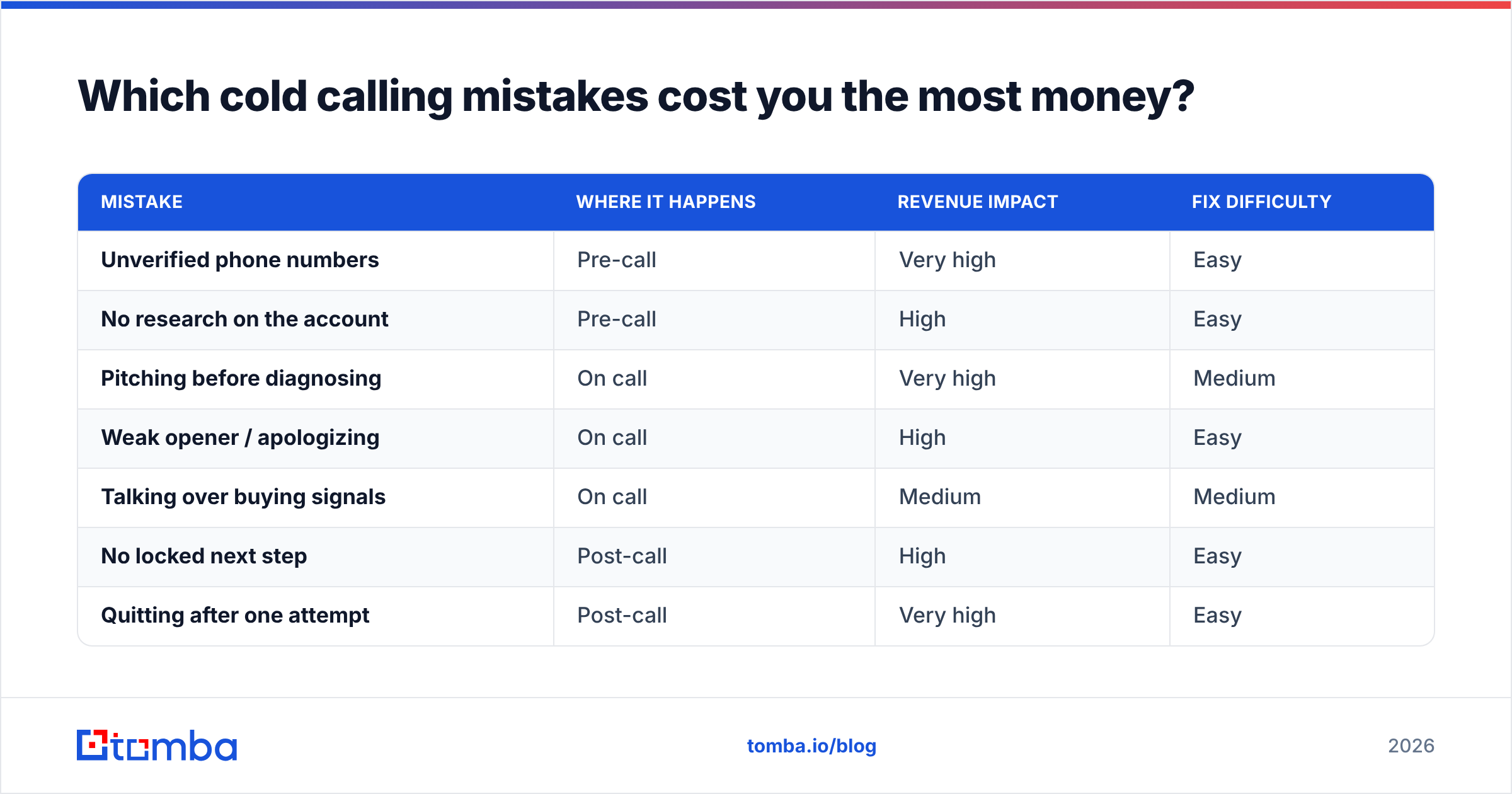
Not all mistakes are equal. Some cost you a single call; others cost you the whole quarter. This table ranks them by impact and how hard they are to fix.
| Mistake | Where it happens | Revenue impact | Fix difficulty |
|---|---|---|---|
| Unverified phone numbers | Pre-call | Very high | Easy |
| No research on the account | Pre-call | High | Easy |
| Pitching before diagnosing | On call | Very high | Medium |
| Weak opener / apologizing | On call | High | Easy |
| Talking over buying signals | On call | Medium | Medium |
| No locked next step | Post-call | High | Easy |
| Quitting after one attempt | Post-call | Very high | Easy |
| Never reviewing calls | System | High | Medium |
Notice the pattern: the highest-impact mistakes are often the easiest to fix. Bad data and no follow-up are both cheap to solve and brutally expensive to ignore. That's where you start.
How does bad data ruin your connect rate?#
Bad data ruins your connect rate three ways: you dial dead numbers, you reach the wrong person, and you burn the rep's confidence one failed call at a time.
A rep making 60 dials a day with a 30% bad-data rate wastes 18 dials daily — roughly 90 a week, or nearly 4,700 a year. That's not a rounding error; that's weeks of paid selling time spent listening to disconnection tones.
The fix is boring and effective: verify contacts before they hit the dialer. Use a phone validator to strip disconnected and invalid numbers, and pull direct dials with a dedicated find phone numbers tool instead of scraping switchboards. If you also run email sequences alongside calls, keep those addresses clean with an email verifier so your multichannel touches don't bounce.
Clean data doesn't just raise connect rates — it protects the one thing quotas depend on: reps who still believe the phone works.
Why is your opener killing the call?#
Your opener is killing the call because it signals "interruption" instead of "relevance." The brain sorts unknown callers into two buckets in about three seconds: threat/waste, or worth-a-moment. Apologizing, mumbling your company name, or launching into a pitch drops you into the first bucket instantly.
Compare two openers for the same call:
- Weak: "Hi, uh, sorry to bother you — is now a bad time? I'm calling from Acme, we do sales software…"
- Strong: "Hi Sam, this is Alex from Acme. I know I'm an interruption — can I take 30 seconds to tell you why I called, then you decide if it's worth continuing?"
The second one is honest, gives the prospect control without offering a free exit, and earns 30 seconds. That "permission-based" pattern is a staple in HubSpot's cold calling guidance for a reason: it respects the prospect while keeping you in the driver's seat.
Your opener has one job — to buy the next 30 seconds. Anything that gives them a reason to hang up is a mistake.
Are you pitching too early?#
Almost certainly yes. Pitching too early is the most common on-call mistake because it feels productive — you're "getting your value prop out there." In reality you're prescribing before you've diagnosed.
Picture a doctor who hands you a prescription the moment you sit down, before asking a single question. You wouldn't trust it. Prospects react the same way to a rep who leads with features.
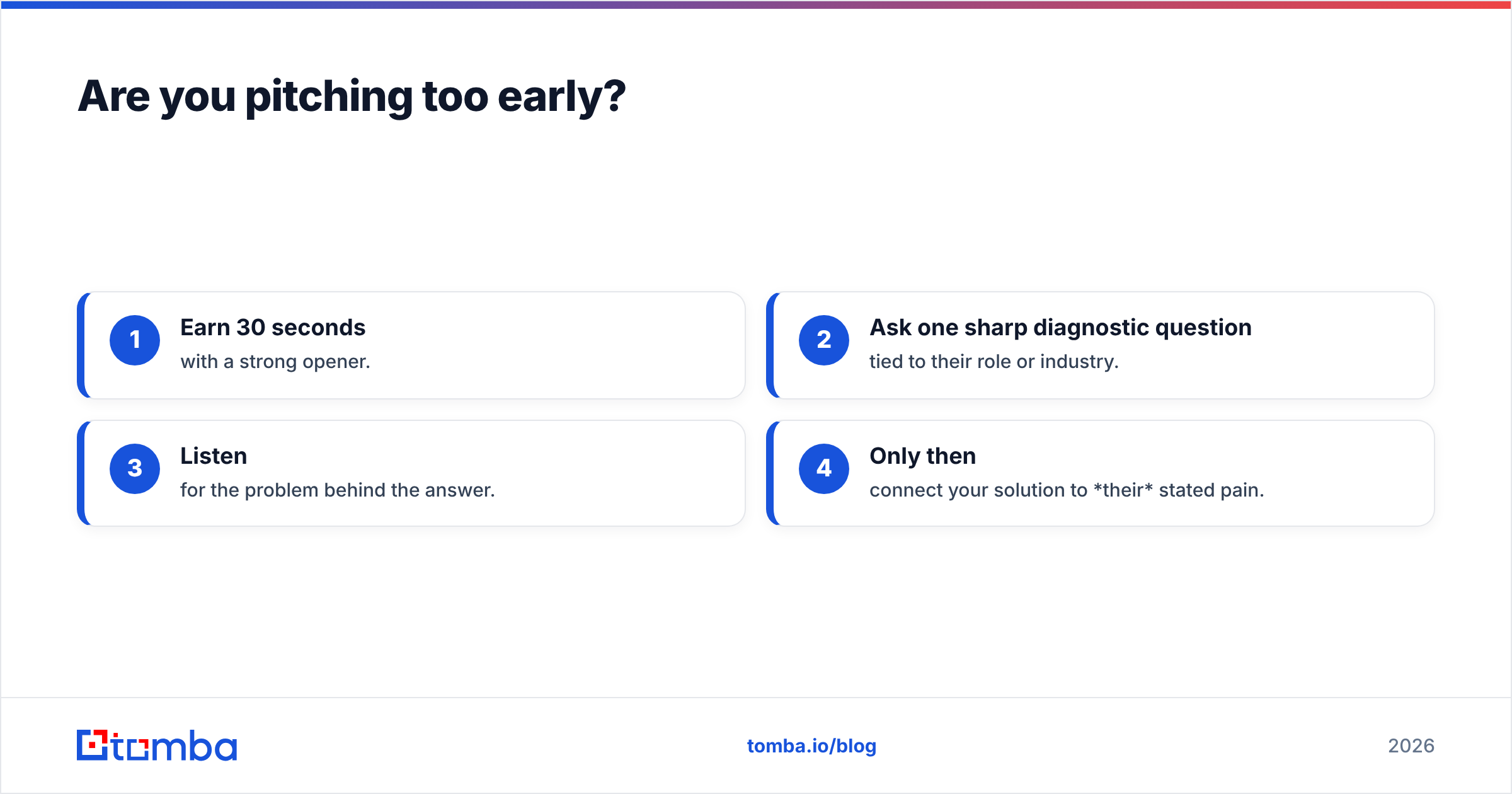
The fix is a simple sequence:
- Earn 30 seconds with a strong opener.
- Ask one sharp diagnostic question tied to their role or industry.
- Listen for the problem behind the answer.
- Only then connect your solution to their stated pain.
This is also where research pays off. When you already know the account — its tech stack, recent hiring, funding — your diagnostic questions land as informed, not generic. Enriching your list ahead of time with contact enrichment gives reps that context before they dial, so step 2 isn't a guess.
What's the biggest follow-up mistake reps make?#
The biggest follow-up mistake is quitting too early. Data compiled across outbound teams — including studies referenced by Salesforce — repeatedly shows most booked meetings come after several touches, yet a large share of reps stop after the first attempt.
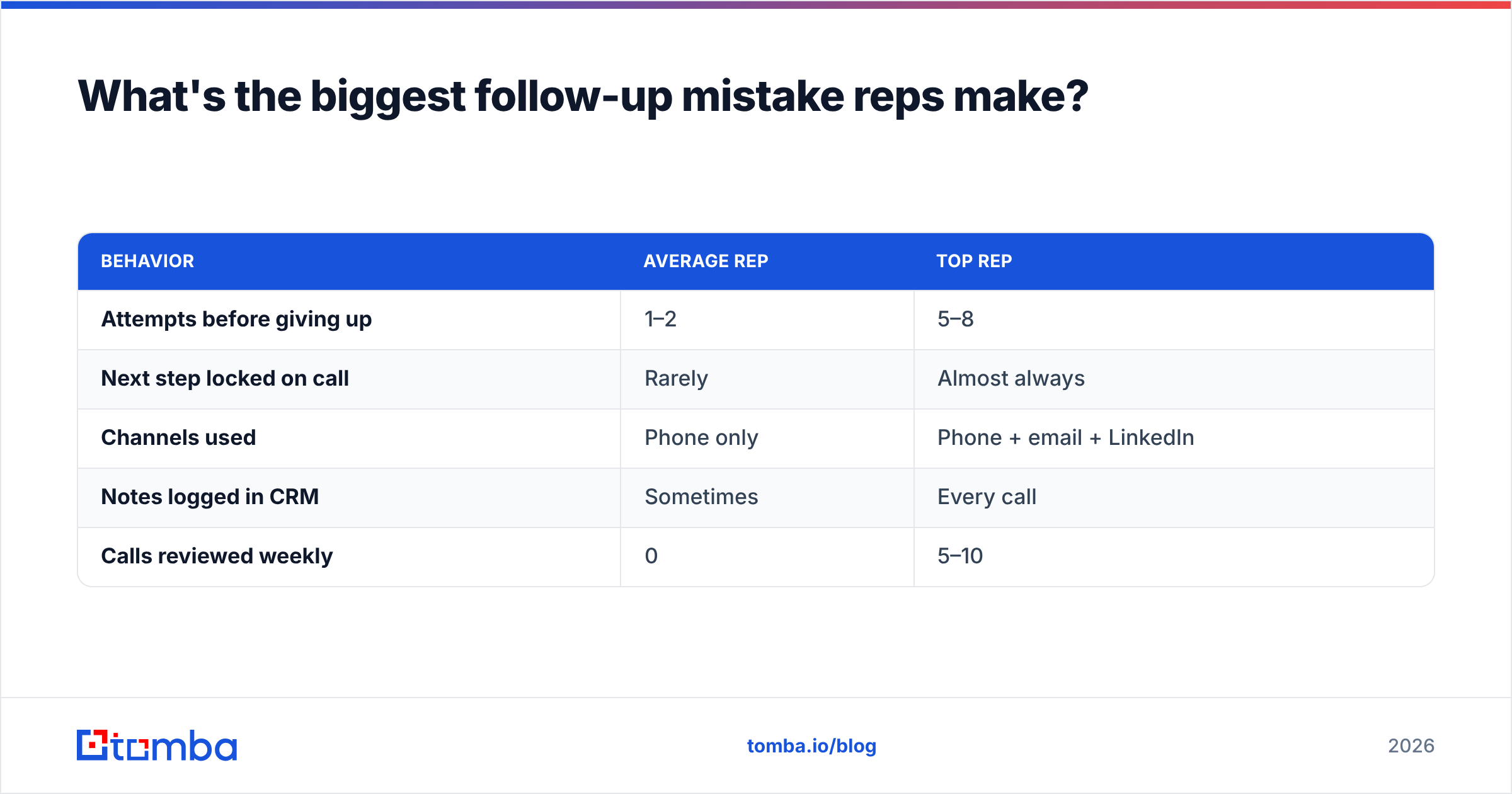
Here's what disciplined follow-up looks like versus the default:
| Behavior | Average rep | Top rep |
|---|---|---|
| Attempts before giving up | 1–2 | 5–8 |
| Next step locked on call | Rarely | Almost always |
| Channels used | Phone only | Phone + email + LinkedIn |
| Notes logged in CRM | Sometimes | Every call |
| Calls reviewed weekly | 0 | 5–10 |
The gap isn't talent. It's process. Top reps treat every call as one node in a sequence, not a one-shot lottery ticket. They lock a next step before hanging up, they vary channels, and they log everything so the next touch has context.
If you run phone alongside email and social, keep the whole sequence coordinated — a single source of truth for contact details beats three disconnected tools. That's where a unified B2B database and clean records matter more than any single clever line.
How do you actually fix these cold calling mistakes?#
You fix them by working upstream to downstream: data, then preparation, then delivery, then review. Trying to fix delivery first — better lines, more confidence — while your list is dirty is like polishing a car with four flat tires.
Step 1 — Clean the data. Validate numbers, verify emails, remove duplicates. This single step recovers more selling hours than any script tweak.
Step 2 — Prep a two-minute pre-call routine. For each account, know: what they do, one likely pain, and one specific reason you're calling them. Two minutes, not twenty.
Step 3 — Standardize a permission-based opener. Same structure every time so you can measure what works.
Step 4 — Diagnose before you pitch. One question, then listen. Let the prospect's answer shape the rest.
Step 5 — Lock a next step on every call. A date and time on the calendar, not "I'll follow up."
Step 6 — Review five calls a week. Record, listen back, pick one thing to change. Improvement compounds.
None of this is glamorous. That's the point — cold calling isn't won by charisma, it's won by removing errors the same way every day.
Cold calling mistakes: quick reference checklist#
Use this before your next call block:
- Numbers validated? No disconnected or wrong lines in the queue.
- List enriched? You know each account's basics before dialing.
- Opener ready? Permission-based, no apology, no "bad time?"
- First question chosen? One diagnostic question per persona.
- Next-step goal set? You know exactly what "yes" looks like.
- Follow-up planned? Attempts 2–6 scheduled, across channels.
- Recording on? So you can review and improve this week.
If every box is checked, you've eliminated the mistakes that sink 80% of cold calls. What's left is a conversation you can actually win.
Start with the data layer#
The fastest way to cut your cold calling mistakes isn't a new script — it's better inputs. Reps who dial verified, enriched contacts spend their energy on conversations that can convert, not on disconnection tones and gatekeepers who never had budget.
Tomba's phone finder surfaces direct-dial B2B numbers, and the phone validator strips out the dead lines before they ever reach your dialer — so your connect rate reflects your talent, not your bad list. Pair them with the Tomba Email Finder for coordinated phone-plus-email sequences, and check Tomba pricing — the Free tier gives you 25 searches a month to test the difference on your own list before you commit. Fix the data, and the rest of the call gets a lot easier.
Related guides#
// get started
Find, verify and enrich your first contacts today
Start on the free plan with 25 searches a month, then scale when your team is ready.
Free plan · No credit card required · GDPR & CCPA
// about the author