Cold Calling Motivation: 15 Proven Ways to Stay Motivated
The tenth rejection of the day is where most reps quit. Here's how top callers rebuild cold calling motivation on demand, beat call reluctance, and keep the dials coming.
Cold calling motivation is not a personality trait. It is a system you build so that the fortieth dial of the day feels the same as the first. Reps who "just love the phone" are rare; reps who engineer a repeatable routine are everywhere on the leaderboard.
This guide breaks down why motivation collapses on the phones, and 15 concrete tactics to rebuild it fast — before the next block, not after a bad quarter.
TL;DR#
- Motivation follows action, not the reverse. You dial your way into confidence; you don't wait to feel confident before dialing.
- Rejection math is your friend. When you know your dials-to-meeting ratio, every "no" is measurable progress toward a "yes."
- Environment beats willpower. Better lists, clean phone data, and a tight pre-call ritual protect motivation more than any hype video.
- Small, visible wins compound. Track leading activity (dials, conversations) instead of only lagging results (closed deals).
- The best fuel is accurate data. Nothing kills momentum like a block of wrong numbers — start with verified contacts.
Why does cold calling motivation disappear so fast?#
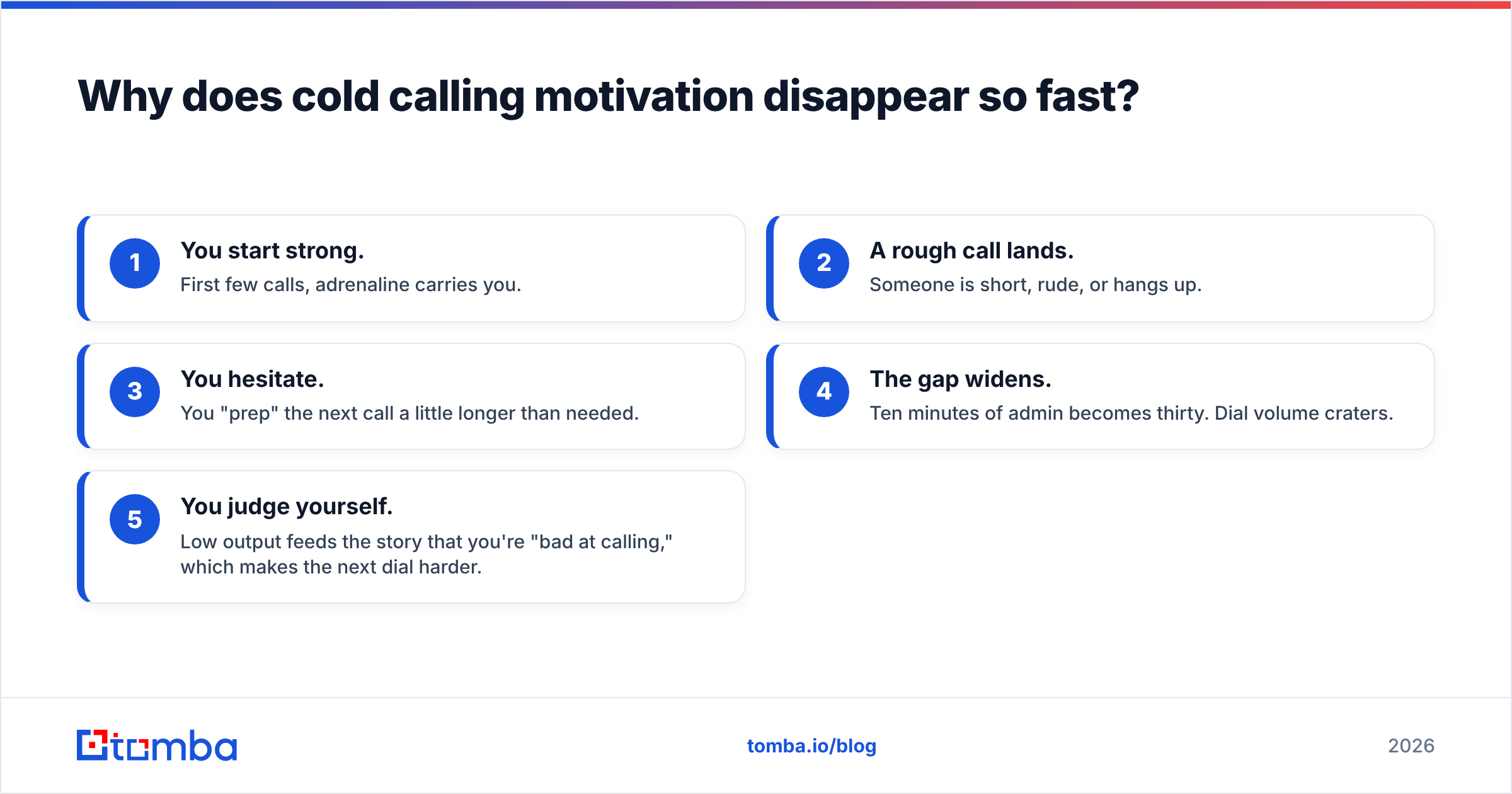
Cold calling is one of the only jobs where you get rejected 20 to 40 times before lunch. Your brain treats each "no" like a small threat, and the cumulative sting is real. Psychologists call the avoidance response that follows call reluctance — the quiet stalling, list-tidying, and "research" that happens instead of dialing.
The pattern usually looks like this:
- You start strong. First few calls, adrenaline carries you.
- A rough call lands. Someone is short, rude, or hangs up.
- You hesitate. You "prep" the next call a little longer than needed.
- The gap widens. Ten minutes of admin becomes thirty. Dial volume craters.
- You judge yourself. Low output feeds the story that you're "bad at calling," which makes the next dial harder.
The trap is that motivation is treated as the cause of activity, when it's actually the result of it. Break the loop at step three and the whole spiral changes.

Is cold calling even worth it in 2026?#
Short answer: yes, when the data is good. The phone still books meetings that email and LinkedIn can't, because a live conversation surfaces objections instantly. According to HubSpot sales research, a large share of buyers still take calls from vendors they don't know when the timing and relevance are right.
But "worth it" is conditional. A cold call to a wrong number, a disconnected line, or the wrong decision-maker is worse than no call at all — it burns your energy for zero pipeline. That's why motivation and data quality are the same conversation. The tactics below assume you're calling real, verified people.
What are the 15 best ways to rebuild cold calling motivation?#
Here are the tactics that actually move the needle, grouped by when to use them.
Before the block: set up to win#
1. Warm up with a two-minute ritual. A short, identical routine — water, headset, first script line read aloud — signals your brain that dialing starts now. Consistency matters more than the specific steps.
2. Call your easiest list first. Open with re-engagement or inbound-adjacent contacts. Early conversations build a "yes" rhythm before you hit true cold accounts.
3. Set an activity goal, not an outcome goal. "Make 50 dials" is fully in your control. "Book 3 meetings" is not. Control the input and the output follows.
4. Batch your dials. Block 60–90 uninterrupted minutes. Task-switching between email and calls is where reluctance sneaks back in.
5. Start with verified numbers. Ten dead lines in a row will break anyone. Pull clean contacts using a phone finder and confirm them with a phone validator so every dial reaches a real person.
During the block: keep momentum#
6. Detach from the single call. You're not trying to win this call. You're running a volume game where the average is what pays. One bad call is noise, not signal.
7. Track a tally in front of you. A visible counter of dials and conversations gives you constant small wins, independent of whether anyone buys today.
8. Reframe every "no" as data. Each rejection updates your ratio. If it takes 25 dials to book a meeting, dial number 13 literally moves you halfway there.
9. Stand up and change your voice. Energy is physical. Standing, smiling, and pacing measurably change how you sound — and how you feel between calls.
10. Use a "reset" line for bad calls. After a harsh hangup, a scripted phrase ("Next one's better") plus a ten-second breath stops the spiral before it starts.
After the block: protect the long game#
11. Review conversations, not just outcomes. Note one thing that worked and one to fix. Improvement is its own motivator.
12. Celebrate leading indicators. Hit your dial target? That's a win worth marking, even on a zero-meeting day.
13. Trade calls with a peer. Listening to a teammate's calls normalizes rejection fast — everyone gets hung up on.
14. Protect your recovery. Sleep, movement, and a hard stop keep the tank full. Burnout is the real enemy of consistency.
15. Fix the list, not just the mindset. If motivation keeps dying mid-block, audit your data before blaming your grit. Bad lists are a data problem wearing a motivation mask.

How does mindset compare to systems for staying motivated?#
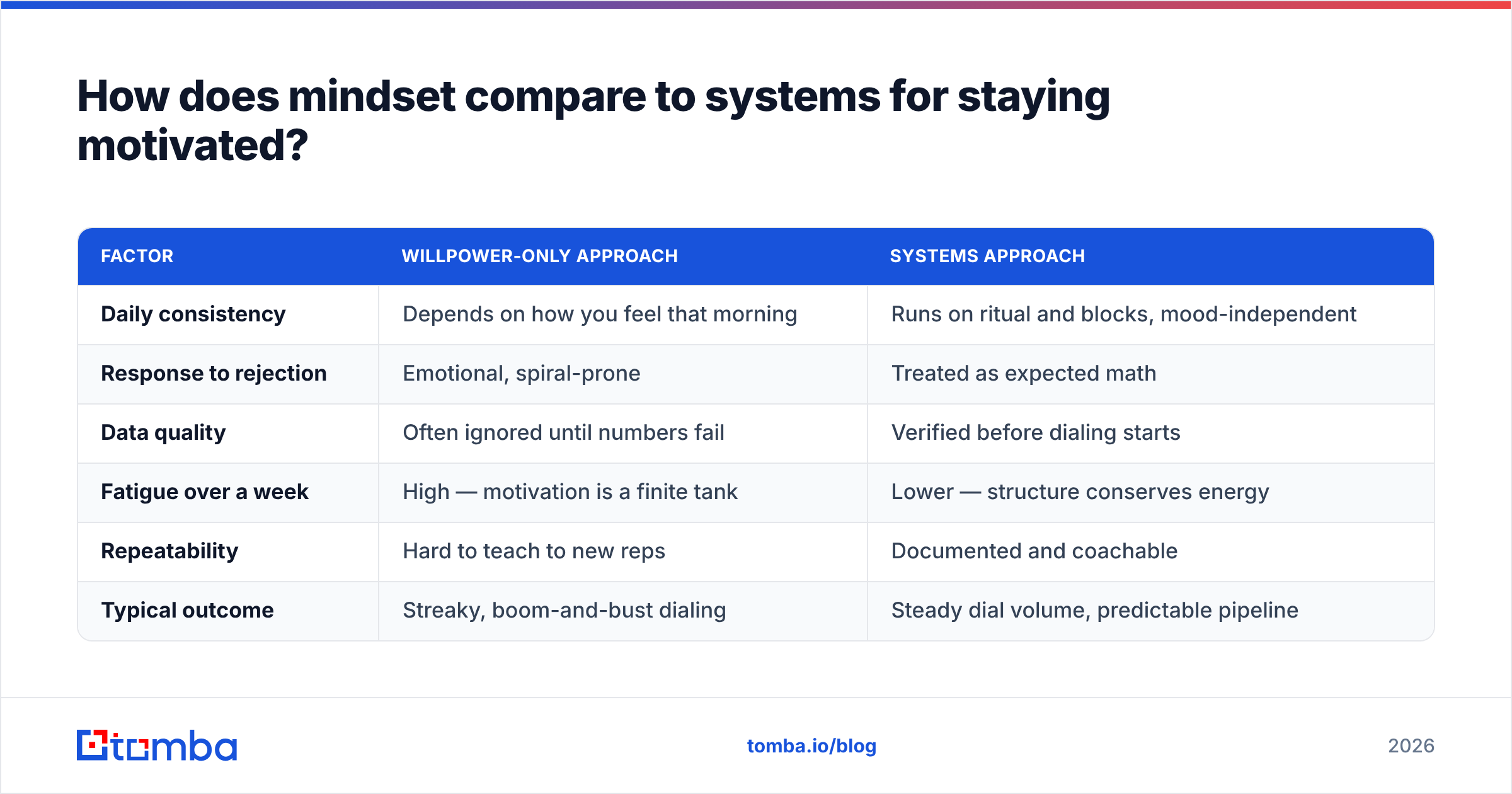
Most advice leans entirely on mindset — hype, affirmations, "just push through." Systems thinking says your environment does the heavy lifting. Here's how the two approaches stack up on the phones.
| Factor | Willpower-only approach | Systems approach |
|---|---|---|
| Daily consistency | Depends on how you feel that morning | Runs on ritual and blocks, mood-independent |
| Response to rejection | Emotional, spiral-prone | Treated as expected math |
| Data quality | Often ignored until numbers fail | Verified before dialing starts |
| Fatigue over a week | High — motivation is a finite tank | Lower — structure conserves energy |
| Repeatability | Hard to teach to new reps | Documented and coachable |
| Typical outcome | Streaky, boom-and-bust dialing | Steady dial volume, predictable pipeline |
The takeaway: mindset gets you through a single tough call, but systems get you through a tough month. Build both, and lead with the system.
What tools and metrics actually keep you dialing?#
Motivation lives or dies on your numbers, so track the ones you control. The core metric is your dials-to-conversation-to-meeting ratio — once you know it, rejection stops feeling personal and starts feeling like progress. Pair that with a healthy response rate target so you can see momentum building across channels, not just on the phone.
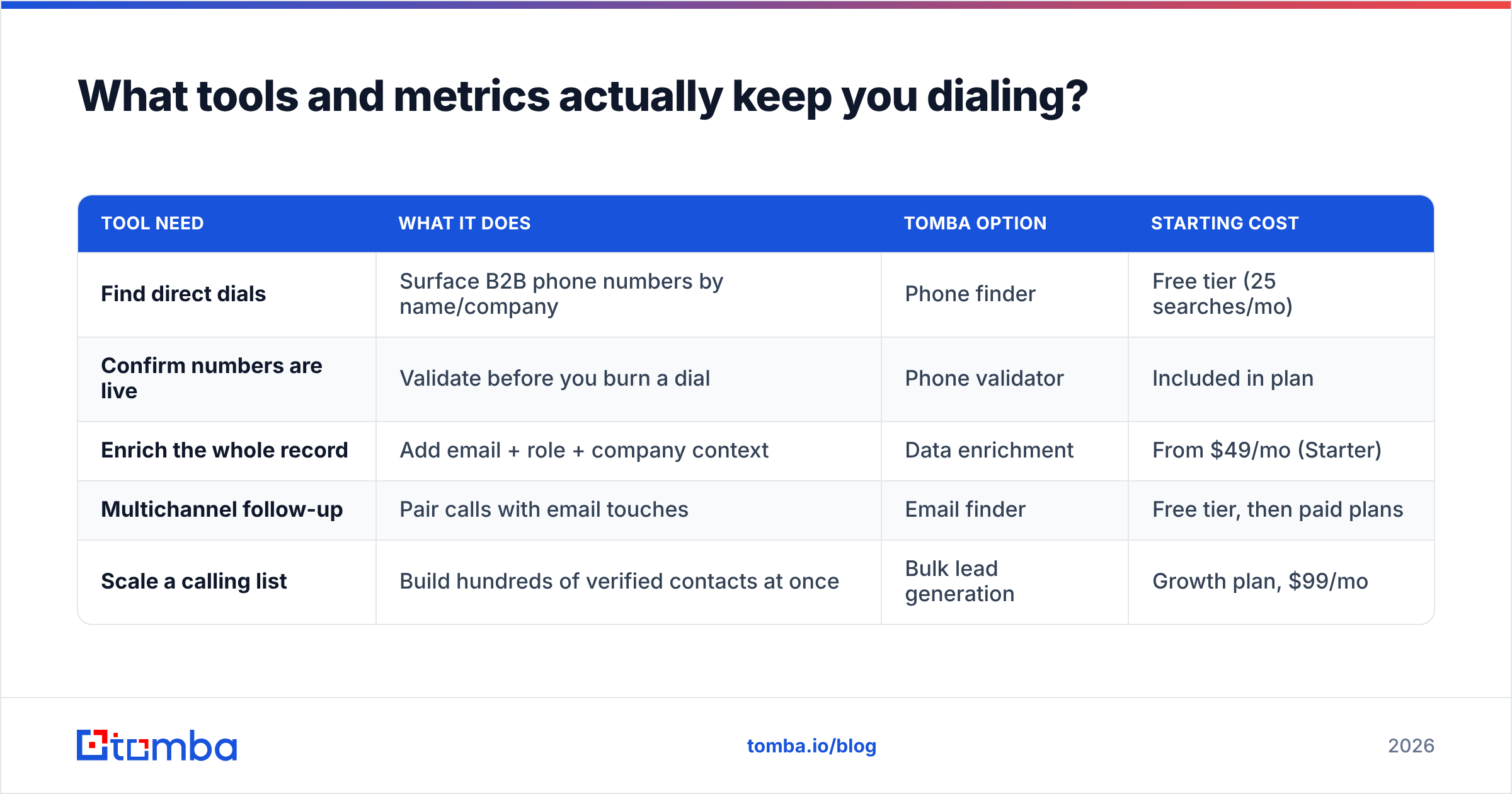
On the tooling side, the highest-leverage fix is upstream: the quality of your contact list. A tight, verified list keeps you in conversations instead of voicemail purgatory. Here's a quick comparison of what to keep on hand and what it costs.
| Tool need | What it does | Tomba option | Starting cost |
|---|---|---|---|
| Find direct dials | Surface B2B phone numbers by name/company | Phone finder | Free tier (25 searches/mo) |
| Confirm numbers are live | Validate before you burn a dial | Phone validator | Included in plan |
| Enrich the whole record | Add email + role + company context | Data enrichment | From $49/mo (Starter) |
| Multichannel follow-up | Pair calls with email touches | Email finder | Free tier, then paid plans |
| Scale a calling list | Build hundreds of verified contacts at once | Bulk lead generation | Growth plan, $99/mo |
You can compare vendors on independent review sites like G2 before you commit, but the principle holds regardless of tool: motivation is cheaper to protect than to rebuild. Every dead number you remove from your list is one less reason to stall. See full Tomba pricing if you're mapping this to a team budget.
How do you keep motivation up across a whole team?#
Individual grit doesn't scale — team structure does. If you manage callers, the same principles apply at a larger altitude:
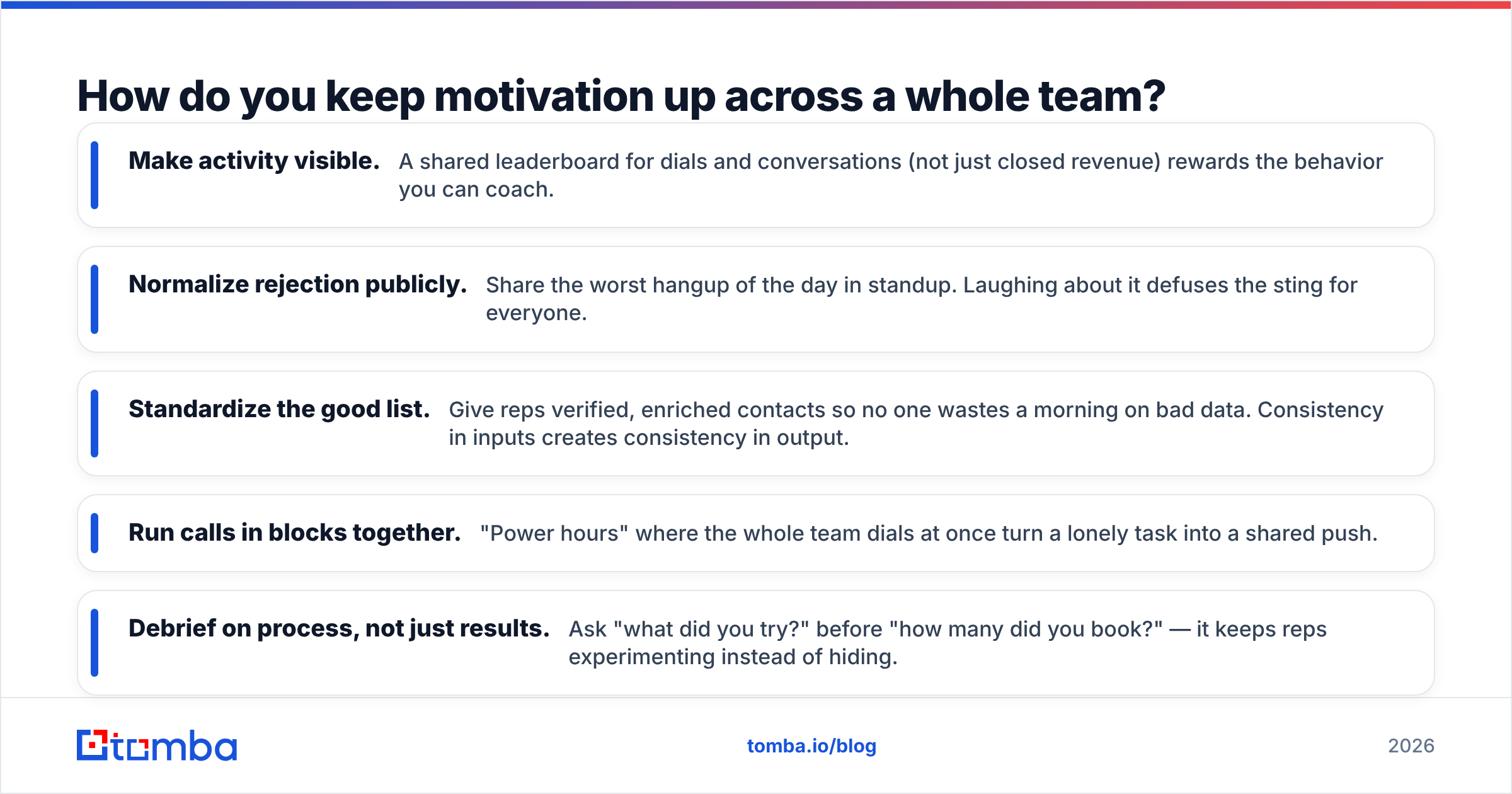
- Make activity visible. A shared leaderboard for dials and conversations (not just closed revenue) rewards the behavior you can coach.
- Normalize rejection publicly. Share the worst hangup of the day in standup. Laughing about it defuses the sting for everyone.
- Standardize the good list. Give reps verified, enriched contacts so no one wastes a morning on bad data. Consistency in inputs creates consistency in output.
- Run calls in blocks together. "Power hours" where the whole team dials at once turn a lonely task into a shared push.
- Debrief on process, not just results. Ask "what did you try?" before "how many did you book?" — it keeps reps experimenting instead of hiding.
A team that treats motivation as a designed system, not a daily coin flip, stops depending on a few naturally-outgoing stars and starts producing predictable pipeline from everyone.
Frequently asked questions#
How many cold calls should I make per day? It depends on your market and average call length, but most SDRs target 40–80 dials daily. Set the number based on your own dials-to-meeting ratio, then protect it as a non-negotiable input.
What do I do when I completely lose motivation mid-block? Stop dialing for two minutes, stand up, and switch to your easiest list. Get one live conversation, however small, to reset the rhythm — then return to cold accounts. Don't end the block on a rejection.
Is call reluctance normal? Completely. Nearly every rep experiences it. The difference between top performers and everyone else is that they've built rituals and systems that shrink the hesitation gap instead of relying on feeling brave.
Does better data really change motivation? Yes, measurably. Reaching a real person on most dials keeps you in conversations, and conversations — not connects to dead lines — are what rebuild confidence and momentum.
Keep the momentum: start with contacts worth calling#
Motivation is a system, and the first block of that system is your list. You can do every ritual perfectly, but if half your numbers are wrong, the phones will drain you no matter how positive you feel. Fix the input first.
Start free with the Tomba Email Finder to build a clean, verified list of the right decision-makers — then layer in phone data so every dial reaches a real human. Twenty-five searches a month cost nothing, and paid plans start at $49/mo when you're ready to scale. Give your motivation something it can't sabotage: a list of real people who are worth the call. Pick up the phone, make one more dial, and let the math do the rest.
Related guides#
// get started
Find, verify and enrich your first contacts today
Start on the free plan with 25 searches a month, then scale when your team is ready.
Free plan · No credit card required · GDPR & CCPA
// about the author