The Cold Calling Objection Framework: Handle Any Pushback
Most reps freeze the second a prospect pushes back. A repeatable cold calling objection framework fixes that—here's the four-step method, word-for-word rebuttals, and the data that keeps you dialing the right people.
Cold calls don't die on the opener. They die on the first objection—"I'm not interested," "send me an email," "we already use someone." If you don't have a repeatable way to handle that moment, every call becomes a coin flip. This guide gives you one.
TL;DR#
- A cold calling objection framework is a repeatable 4-step response pattern—Acknowledge, Isolate, Reframe, Ask—that works on any objection instead of memorizing 50 one-off comebacks.
- Most objections in the first 20 seconds are reflexes, not real reasons. Treat them as noise until you earn the real reason.
- The framework beats scripting because it scales: one structure covers "not interested," "no budget," "send an email," and "call me next quarter."
- Objection handling only works when you're calling the right person at the right number—bad data kills more calls than bad rebuttals.
- Track rebuttals like a funnel. Measure which objection kills the most calls, then fix that one line.
Why do most cold call rebuttals fail?#
Because they're memorized as isolated scripts. A rep learns "here's what to say when they mention price," "here's what to say when they say they're busy," and tries to pattern-match in real time. Under pressure, the recall breaks and the rep either freezes or argues.
Arguing is the real killer. When a prospect says "not interested" and you respond with "but wait, let me tell you why you should be," you've turned a conversation into a debate. People don't buy from someone they're debating. According to HubSpot's sales research, the reps with the highest connect-to-meeting rates aren't the ones who talk the most—they're the ones who ask the most relevant questions after a "no."
A framework fixes this by giving you one structure to run every time. You stop thinking "which script is this?" and start thinking "which step am I on?" That mental shift is the entire game.

What is the cold calling objection framework?#
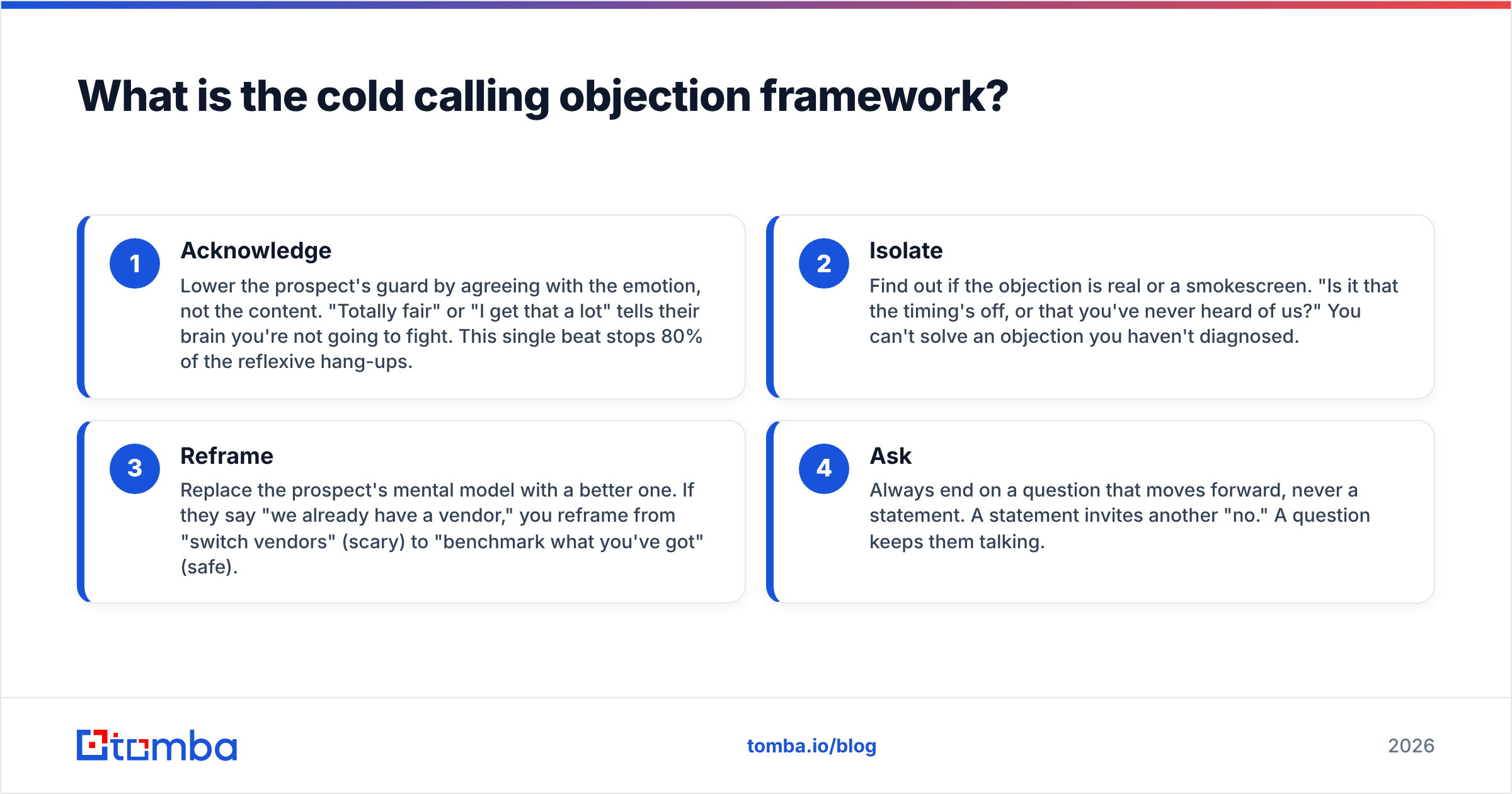
It's a four-step loop you run on every objection, regardless of content. The steps are Acknowledge, Isolate, Reframe, Ask. Here's what each one does:
- Acknowledge — Lower the prospect's guard by agreeing with the emotion, not the content. "Totally fair" or "I get that a lot" tells their brain you're not going to fight. This single beat stops 80% of the reflexive hang-ups.
- Isolate — Find out if the objection is real or a smokescreen. "Is it that the timing's off, or that you've never heard of us?" You can't solve an objection you haven't diagnosed.
- Reframe — Replace the prospect's mental model with a better one. If they say "we already have a vendor," you reframe from "switch vendors" (scary) to "benchmark what you've got" (safe).
- Ask — Always end on a question that moves forward, never a statement. A statement invites another "no." A question keeps them talking.
The magic is that these four steps are objection-agnostic. "No budget," "no time," "no interest," "send me info"—all of them route through the same loop. You're not memorizing 50 rebuttals. You're memorizing one pattern and filling in the blanks live.
How does the framework handle specific objections?#
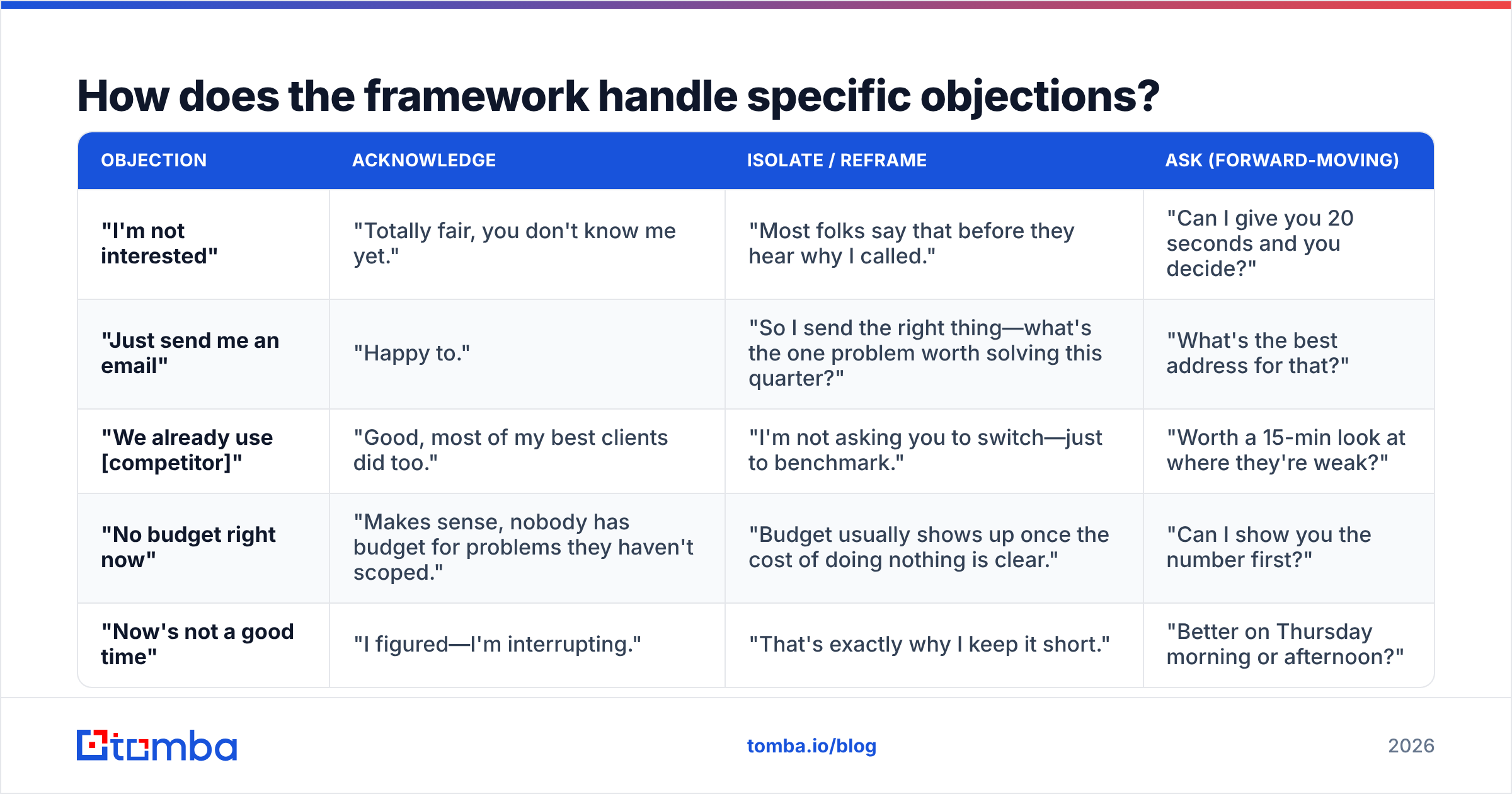
Here's the loop applied to the objections you hear every single day. Treat these as templates, not word-for-word scripts—your voice has to sound like yours.
| Objection | Acknowledge | Isolate / Reframe | Ask (forward-moving) |
|---|---|---|---|
| "I'm not interested" | "Totally fair, you don't know me yet." | "Most folks say that before they hear why I called." | "Can I give you 20 seconds and you decide?" |
| "Just send me an email" | "Happy to." | "So I send the right thing—what's the one problem worth solving this quarter?" | "What's the best address for that?" |
| "We already use [competitor]" | "Good, most of my best clients did too." | "I'm not asking you to switch—just to benchmark." | "Worth a 15-min look at where they're weak?" |
| "No budget right now" | "Makes sense, nobody has budget for problems they haven't scoped." | "Budget usually shows up once the cost of doing nothing is clear." | "Can I show you the number first?" |
| "Now's not a good time" | "I figured—I'm interrupting." | "That's exactly why I keep it short." | "Better on Thursday morning or afternoon?" |
Notice that every row ends with a question, and none of them argue. You're never telling the prospect they're wrong. You're acknowledging, redirecting, and handing the next move back to them.
For a deeper library of openers and rebuttal lines you can adapt, our cold email templates work as talk tracks too—the psychology of a pattern interrupt is identical whether it's typed or spoken.
Is a framework better than a memorized script?#
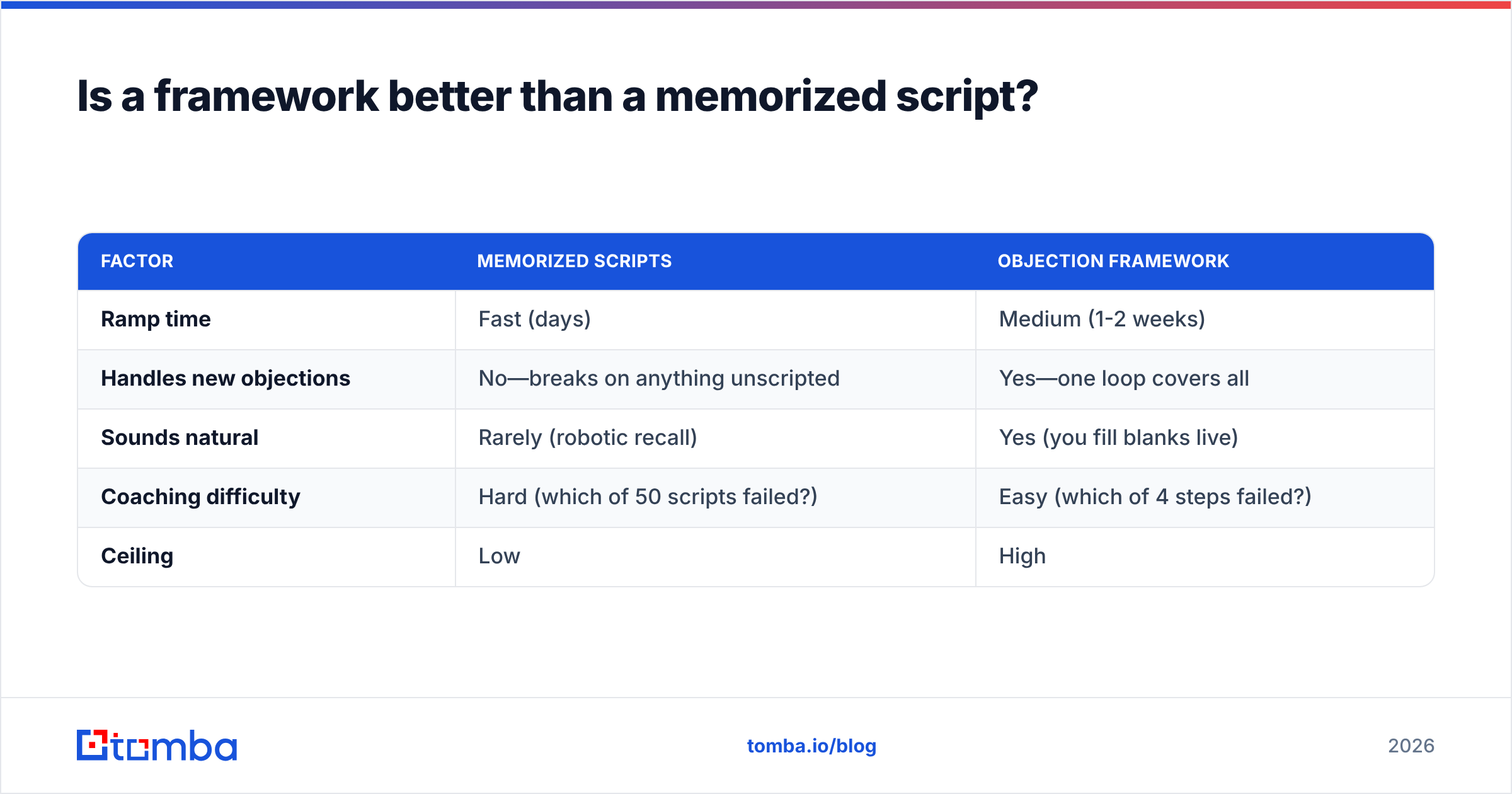
Yes, for anything past your first month on the phones. Here's the honest comparison:
| Factor | Memorized scripts | Objection framework |
|---|---|---|
| Ramp time | Fast (days) | Medium (1-2 weeks) |
| Handles new objections | No—breaks on anything unscripted | Yes—one loop covers all |
| Sounds natural | Rarely (robotic recall) | Yes (you fill blanks live) |
| Coaching difficulty | Hard (which of 50 scripts failed?) | Easy (which of 4 steps failed?) |
| Ceiling | Low | High |
Scripts win on day one. Frameworks win by day thirty. The reason is coaching: when a rep loses a call using a framework, you can pinpoint the exact step that broke—"you skipped Isolate and jumped to Reframe, so you solved the wrong objection." That's a fixable, specific lesson. With 50 scripts, all you can say is "try harder next time," which coaches nothing.
Sales-leadership research from Gong's labs consistently shows that the highest-performing reps handle objections with questions and reframes, not counters—which is exactly what a structured loop trains you to do by default.
What breaks the framework? (Hint: it's not your rebuttals)#
Bad data. The best objection framework in the world can't save a call to the wrong person at a disconnected number. If you're spending your "no" on someone who was never the buyer, you're not handling objections—you're wasting dials.
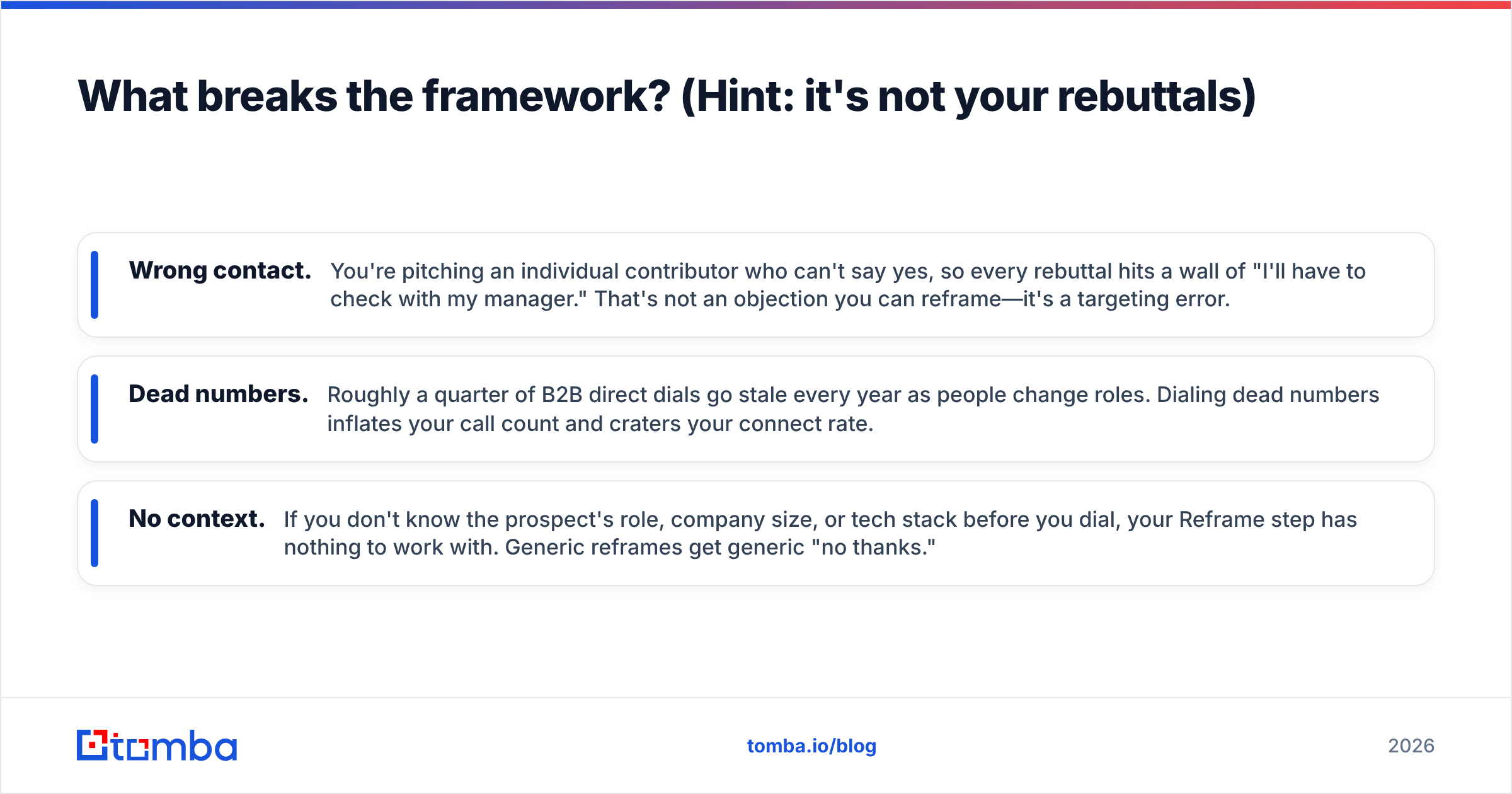
Three data problems quietly destroy call performance:
- Wrong contact. You're pitching an individual contributor who can't say yes, so every rebuttal hits a wall of "I'll have to check with my manager." That's not an objection you can reframe—it's a targeting error.
- Dead numbers. Roughly a quarter of B2B direct dials go stale every year as people change roles. Dialing dead numbers inflates your call count and craters your connect rate.
- No context. If you don't know the prospect's role, company size, or tech stack before you dial, your Reframe step has nothing to work with. Generic reframes get generic "no thanks."
This is where your pre-call work matters more than your talk track. Pulling accurate B2B phone numbers and validating them before you dial means every "no" you collect is a real signal—not a data artifact. And running a quick data enrichment pass so you know the role and company before the call gives your Reframe something concrete to grab onto.

How do you practice objection handling without burning real leads?#
Drill it off the phones first. Live prospects are too expensive to use as a practice field.
- Objection bingo. Write your top 8 objections on cards. A teammate reads one at random; you run the four-step loop out loud. No prep, no lookup. This trains recall under mild pressure.
- Record and review. Record your real calls (where legal) and re-listen only to the 10 seconds after each objection. Ask: did I acknowledge, or did I argue? Ninety percent of reps discover they argue far more than they think.
- The "no" quota. Set a daily target for collecting no's, not yes's. It sounds backward, but it removes the fear that makes reps rush the Acknowledge step. When a "no" is the goal, you slow down and actually run the loop.
- One-line fixes. Don't overhaul your whole approach at once. Pick the single objection that kills the most calls this week and rewrite only that rebuttal. Measure, then move to the next.
Track your response rate and connect-to-meeting ratio before and after each fix. If a rewritten rebuttal doesn't move the number in two weeks, it's not working—kill it and try another. Objection handling is a testable, measurable skill, not a personality trait.
What does a full call flow look like?#
Here's the framework in motion on a typical call, start to finish:
You: "Hi Sarah, it's Alex from Tomba—I know I'm an interruption, can I have 30 seconds to tell you why I called and you can hang up if it's junk?"
Sarah: "I'm really not interested."
You (Acknowledge): "Totally fair, you have no idea who I am yet."
You (Isolate): "Quick question though—is it that you've got prospecting handled, or that you've just never heard of us?"
Sarah: "We've got a tool for it already."
You (Reframe): "Perfect, most of my best clients did too. I'm not calling to rip out what works—I'm calling because teams usually find their list data decays faster than they realize, and that quietly eats connect rates."
You (Ask): "If I could show you your own bounce rate in 15 minutes, would that be worth a Thursday slot?"
Every objection routes through the same loop. Sarah never got argued with, never got a hard pitch, and got handed a low-risk next step. That's the whole framework—repeated until it's muscle memory.
Where should you start?#
Start with your data, then your loop. A perfect rebuttal delivered to the wrong number is still a wasted dial, and no amount of charisma fixes a list that's calling people who left the company a year ago.
Get your targeting right first: use Tomba's Phone Finder to pull accurate, current B2B direct dials, run them through the phone validator so you're not burning attempts on dead numbers, and enrich each contact with role and company context so your Reframe step has real material to work with. Plans start free (25 searches/mo) and scale to $49/mo—see the full Tomba pricing for team volumes. Fix the data, run the loop, and watch "not interested" turn into "Thursday works." You can compare tools on G2 if you want a second opinion, but the principle holds anywhere: right person, right number, four-step loop.
Related guides#
// get started
Find, verify and enrich your first contacts today
Start on the free plan with 25 searches a month, then scale when your team is ready.
Free plan · No credit card required · GDPR & CCPA
// about the author