Cold Calling Objections and Rebuttals: The 2026 Field Guide
The objections that end most cold calls are predictable — which means they're beatable. Here's a rebuttal framework, word-for-word scripts, and the mistakes that get reps hung up on.
Most cold calls don't die because the product is wrong. They die in the first 20 seconds, on an objection you've heard a hundred times — and fumbled a hundred times. This guide fixes that.
TL;DR#
- The top cold calling objections are predictable. "Not interested," "send me an email," "we already use someone," and "I'm busy" cover roughly 80% of what you'll hear. Predictable means scriptable.
- A rebuttal is a bridge, not a rebuttal. The goal is never to "win" the objection — it's to earn 30 more seconds. Acknowledge, reframe, ask a question.
- Tone beats wording. The same script lands or dies on pace, warmth, and confidence. Read the scripts below out loud until they stop sounding like scripts.
- Bad data creates fake objections. Half of "wrong person" and "he doesn't work here" objections are a data problem, not a talk-track problem. Clean numbers and verified contacts remove them before the call.
- Track objections like a pipeline metric. Log which objection killed each call. The pattern tells you what to fix next.
Why do cold calling objections happen at all?#
Think of a cold call like knocking on a stranger's door at dinner time. The reflex to say "no thanks" fires before the person even processes who you are. That reflex — the brush-off — is not a real objection. It's a defense mechanism.
This distinction matters more than any single script. There are two categories of pushback:
- Reflexive brush-offs — "Not interested," "I'm busy," "Just send info." These arrive before the prospect has heard your value. They're automatic.
- Real objections — "We're locked into a contract until Q3," "Your competitor is cheaper," "We tried this and it failed." These come after engagement and contain actual information.
You handle them completely differently. Brush-offs need a pattern interrupt and a reason to keep listening. Real objections need discovery and proof. Treat a reflexive "not interested" like a real objection and you'll launch into a feature dump nobody asked for — which gets you hung up on.
What is a rebuttal framework, and why do you need one?#
A rebuttal framework is a repeatable three-step structure you run on any objection so you never have to improvise under pressure. Improvising is where reps sound defensive, robotic, or pushy.
The framework most top callers converge on is Acknowledge → Reframe → Ask:
- Acknowledge. Show you heard them. This lowers the wall. "Totally fair," "I get that a lot," "Makes sense."
- Reframe. Offer a new angle that makes continuing worth their while — without arguing. You're not saying they're wrong; you're widening the frame.
- Ask. End on a question that hands them the mic and buys you time. Statements invite hang-ups; questions invite answers.
Here's the same objection handled without and with the framework:
Prospect: "We already use a provider for this."
Weak reply: "Oh okay, but we're actually much better because we have more features and better pricing and..." (argues, feature-dumps, gets cut off)
Framework reply: "That's great, most companies I call already have something in place (acknowledge). The reason I still reached out is that teams often keep their current tool and use us for the 20% of cases it misses (reframe). Out of curiosity — where does your current setup tend to fall short? (ask)"
The second version keeps the prospect talking. That's the only job of the first 60 seconds.
What are the most common cold calling objections and rebuttals?#
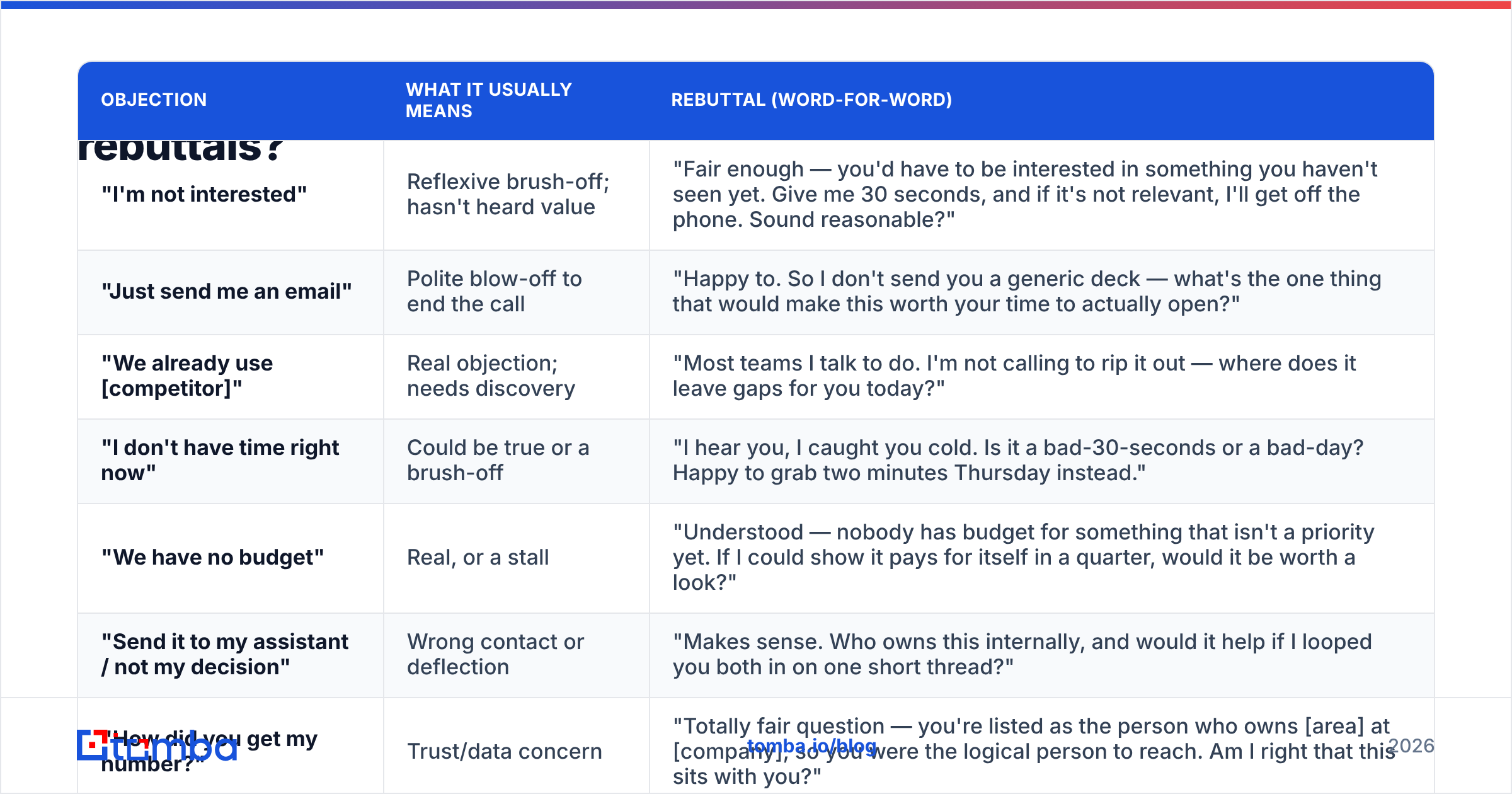
Below are the objections you'll hear most, with a rebuttal built on the Acknowledge → Reframe → Ask structure. Steal the wording, then rewrite it in your own voice — a script you can't say naturally is worse than no script.
| Objection | What it usually means | Rebuttal (word-for-word) |
|---|---|---|
| "I'm not interested" | Reflexive brush-off; hasn't heard value | "Fair enough — you'd have to be interested in something you haven't seen yet. Give me 30 seconds, and if it's not relevant, I'll get off the phone. Sound reasonable?" |
| "Just send me an email" | Polite blow-off to end the call | "Happy to. So I don't send you a generic deck — what's the one thing that would make this worth your time to actually open?" |
| "We already use [competitor]" | Real objection; needs discovery | "Most teams I talk to do. I'm not calling to rip it out — where does it leave gaps for you today?" |
| "I don't have time right now" | Could be true or a brush-off | "I hear you, I caught you cold. Is it a bad-30-seconds or a bad-day? Happy to grab two minutes Thursday instead." |
| "We have no budget" | Real, or a stall | "Understood — nobody has budget for something that isn't a priority yet. If I could show it pays for itself in a quarter, would it be worth a look?" |
| "Send it to my assistant / not my decision" | Wrong contact or deflection | "Makes sense. Who owns this internally, and would it help if I looped you both in on one short thread?" |
| "How did you get my number?" | Trust/data concern | "Totally fair question — you're listed as the person who owns [area] at [company], so you were the logical person to reach. Am I right that this sits with you?" |
Notice none of these argue. Each one acknowledges the prospect, reframes, and returns a question. That rhythm is the whole game.
How do you handle the "send me an email" objection specifically?#
Treat "send me an email" as a qualifier, not a dismissal. Nine times out of ten it's a soft exit. Your job is to find out whether there's real interest hiding behind it before you agree.
The move: agree instantly, then attach a condition that requires them to engage.
"Absolutely, I'll send something over. Quick thing though — I don't want to be another ignored email in your inbox. What specifically should I include so it's actually useful to you?"
If they give you a specific answer ("pricing for a 40-person team"), you've converted a brush-off into a discovery point and a reason to follow up. If they stall ("just whatever you've got"), you know the interest isn't there yet, and you can push gently for a reason or move on.
Whatever you promise to send, make sure it actually lands. A rebuttal that ends with an email to a dead or wrong address is a wasted call. Verifying the address before you hang up — or pulling it live during the call — keeps the follow-up alive. A quick check with an email verifier means the message you fought to earn doesn't bounce.
Do objections come from your script or your data?#
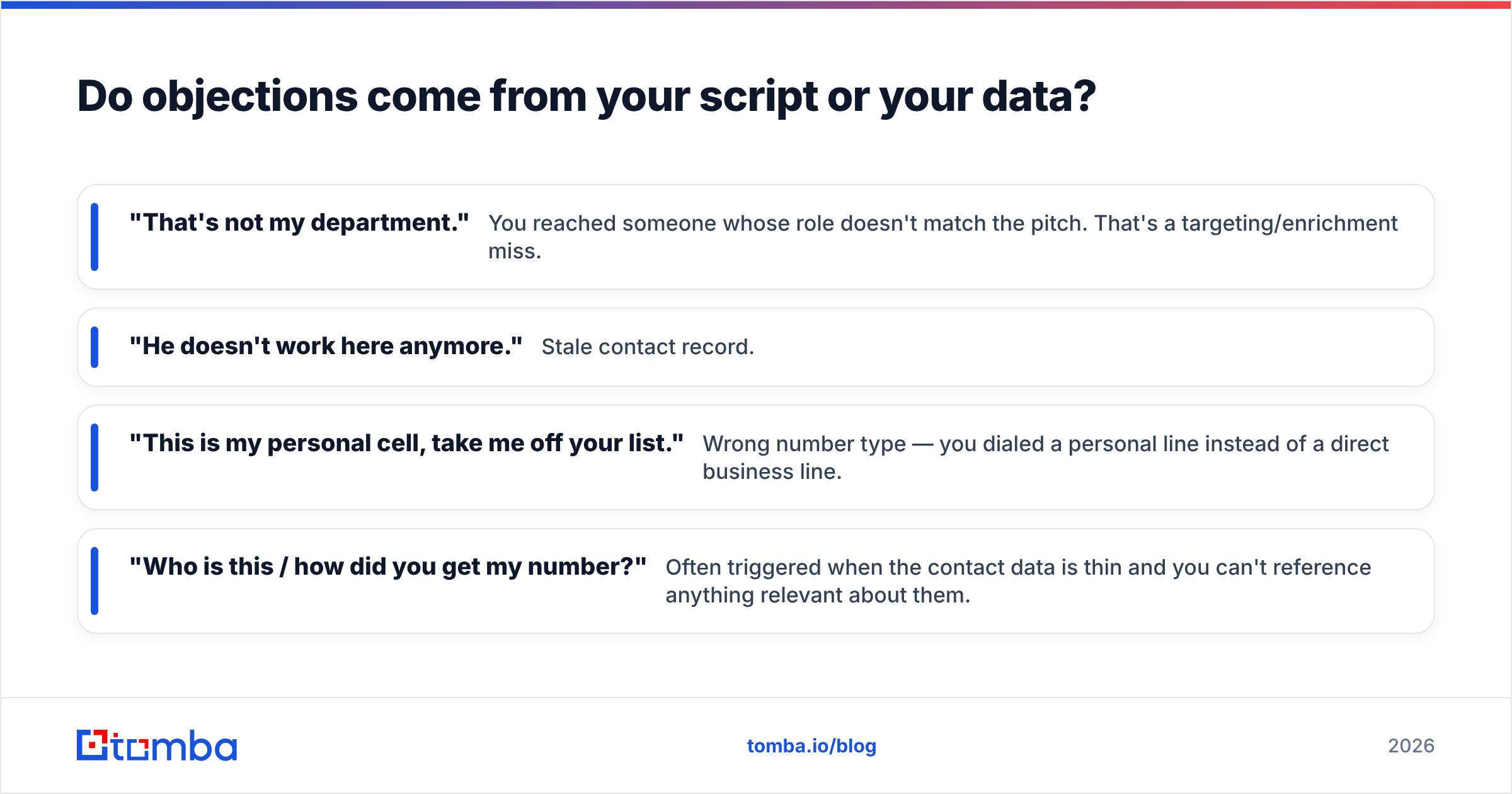
A large share of "objections" aren't objections at all — they're symptoms of dialing the wrong person with the wrong information. No talk-track fixes a bad list.
Consider the objections that are really data failures in disguise:
- "That's not my department." You reached someone whose role doesn't match the pitch. That's a targeting/enrichment miss.
- "He doesn't work here anymore." Stale contact record.
- "This is my personal cell, take me off your list." Wrong number type — you dialed a personal line instead of a direct business line.
- "Who is this / how did you get my number?" Often triggered when the contact data is thin and you can't reference anything relevant about them.
You can't rebut your way out of these. You fix them upstream by dialing verified, role-accurate contacts. Pulling accurate direct-dial numbers with a phone finder and validating them through a phone validator removes a whole class of "objections" before the phone even rings. According to HubSpot's sales research, reps spend a punishing amount of time on non-connects — much of that is bad data, not bad prospects.
Clean data doesn't just cut fake objections. It also gives you the reference points ("I saw you just opened a second office in Austin") that stop the real ones before they start.
How should tone and delivery change your rebuttals?#
The same words can sound like a trusted advisor or a desperate telemarketer. Delivery is 70% of a rebuttal. Research on winning sales conversations from Gong's analysis of call data consistently shows that pacing, talk-to-listen ratio, and confident tone separate top performers from the rest — not clever wording.
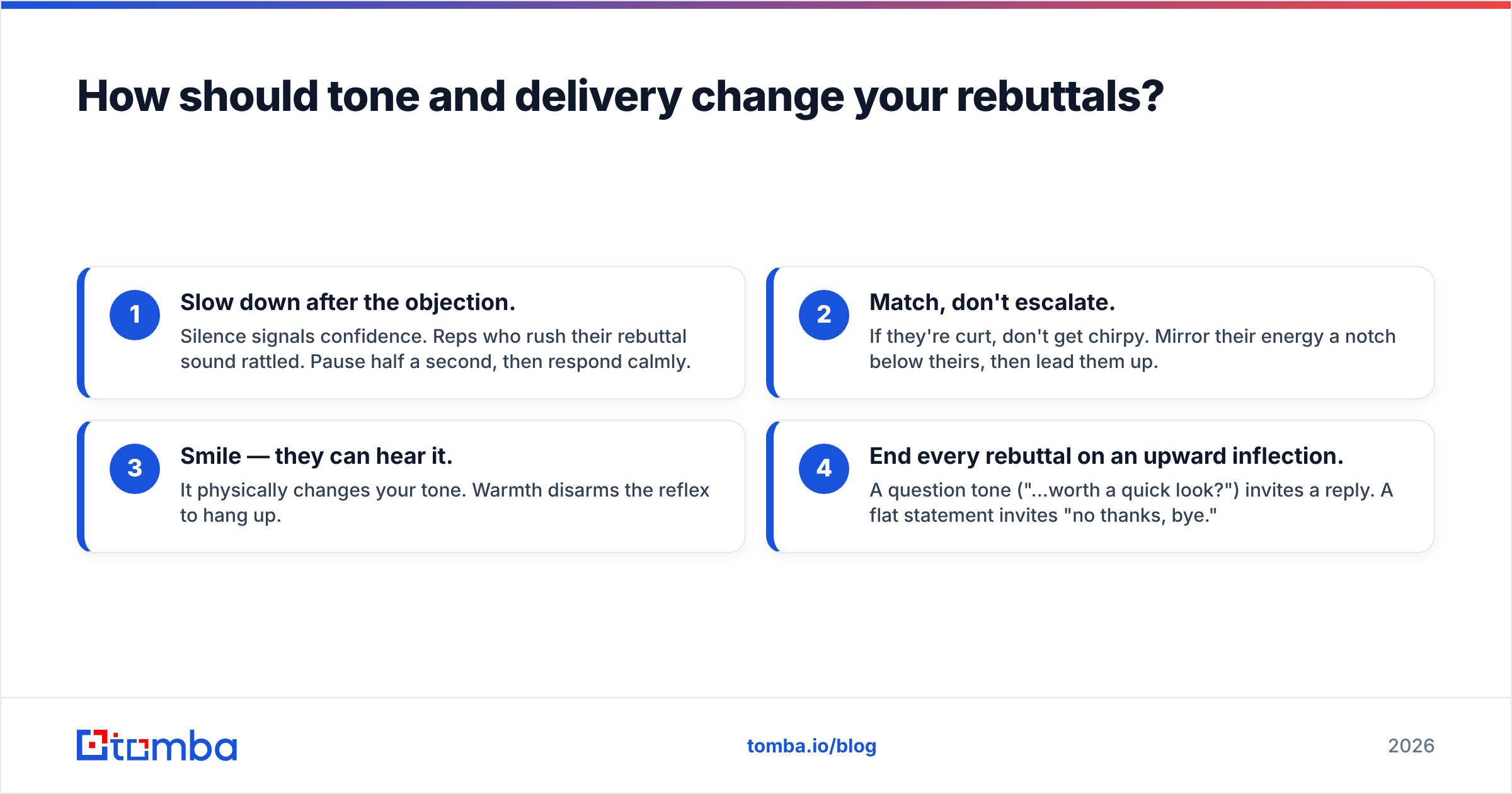
Four delivery rules that make any rebuttal land better:
- Slow down after the objection. Silence signals confidence. Reps who rush their rebuttal sound rattled. Pause half a second, then respond calmly.
- Match, don't escalate. If they're curt, don't get chirpy. Mirror their energy a notch below theirs, then lead them up.
- Smile — they can hear it. It physically changes your tone. Warmth disarms the reflex to hang up.
- End every rebuttal on an upward inflection. A question tone ("...worth a quick look?") invites a reply. A flat statement invites "no thanks, bye."
Record your own calls and listen back. You'll hear the exact moment your voice tightens — that's the moment the prospect decided to end the call.
What mistakes turn a good rebuttal into a hang-up?#
Even with the right script, these habits sink calls. Avoid them:
- Arguing. The instant a prospect feels debated, they disengage. You can win the point and lose the call.
- Talking past the close. When a prospect softens ("hm, okay, maybe"), stop selling and book the meeting. Reps oversell right past the yes.
- Feature-dumping on a brush-off. "Not interested" is not a request for your feature list. Reframe and ask instead.
- Using more than one rebuttal per objection. Rebut once. If they hold firm, respect it and pivot to a softer ask (a follow-up time, a referral). Rebutting three times is harassment.
- No plan for the second objection. They'll stack them: "not interested" → "no budget" → "send an email." Have a bridge for the second and third, not just the first.
A simple guardrail: one rebuttal, one reframe, one ask. If you're still getting resistance after that, you're no longer selling — you're annoying.
How do you get better at objections over time?#
Objection handling is a skill you build with data, not vibes. Track it like any other pipeline metric.
Keep a running log of every call with three columns: the objection you heard, the rebuttal you used, and the outcome. After 50 calls, patterns jump out — maybe "send me an email" is killing 30% of your calls and your current rebuttal isn't working. Now you know exactly what to rewrite and drill.
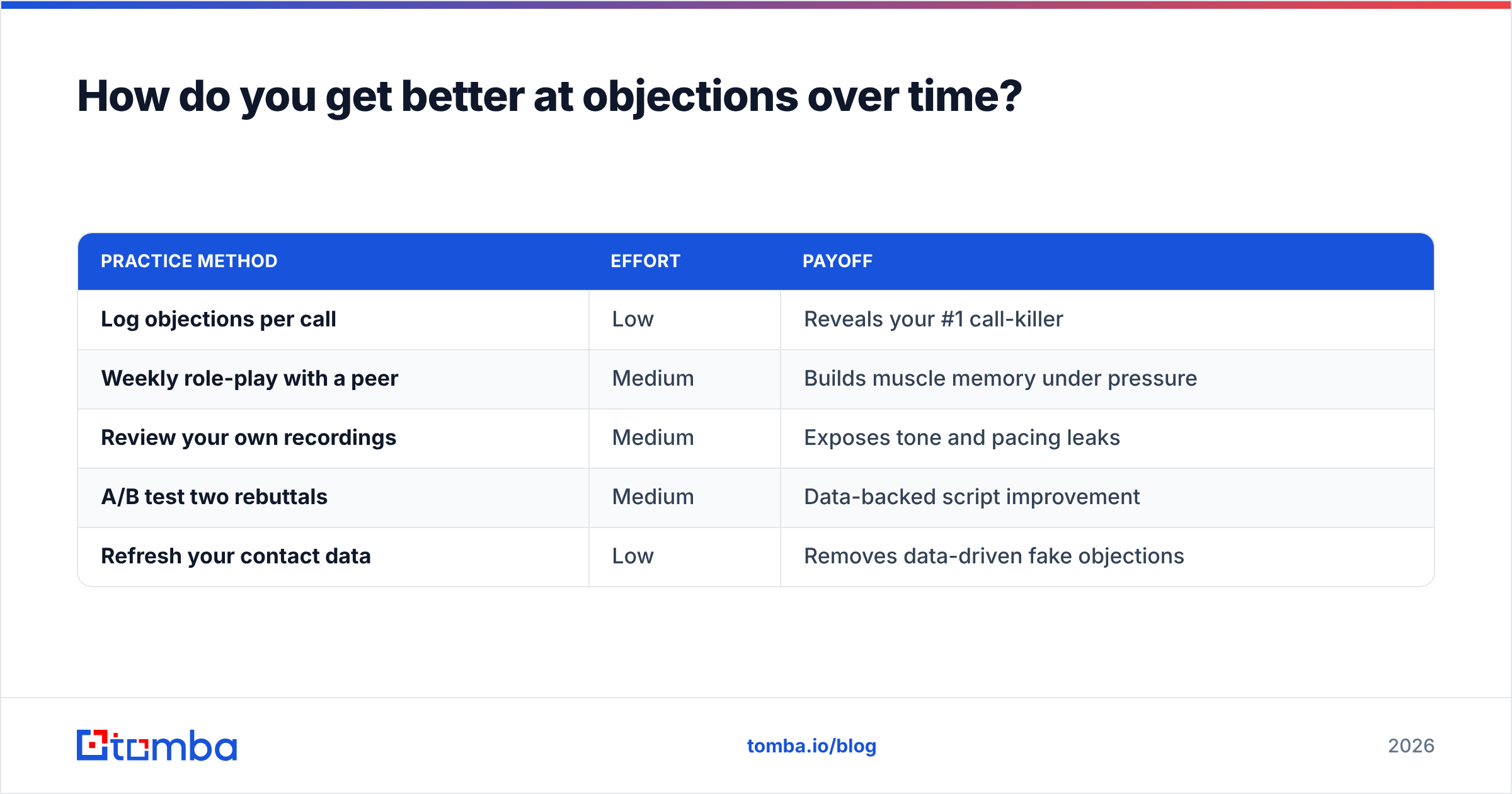
| Practice method | Effort | Payoff |
|---|---|---|
| Log objections per call | Low | Reveals your #1 call-killer |
| Weekly role-play with a peer | Medium | Builds muscle memory under pressure |
| Review your own recordings | Medium | Exposes tone and pacing leaks |
| A/B test two rebuttals | Medium | Data-backed script improvement |
| Refresh your contact data | Low | Removes data-driven fake objections |
Pair this with clean prospecting inputs. When your list is accurate and enriched, you spend your practice reps on real objections that improve your close rate — instead of burning calls on wrong numbers. Tools like G2's cold calling software category and a solid data enrichment workflow keep the top of your funnel clean so your talk-track gets a fair test.
The bottom line#
Cold calling objections feel like rejection, but they're really just a short list of predictable moments — and predictable moments can be prepared for. Build the Acknowledge → Reframe → Ask reflex, drill the seven scripts above until they sound like you, fix the delivery leaks in your own recordings, and clean the data that manufactures half your objections in the first place.
Do that and "not interested" stops being the end of the call. It becomes the start of one.
Start upstream. The best rebuttal is the one you never need because you reached the right person with the right context. Use the Tomba Email Finder to pull verified, role-accurate contacts before you dial — so every conversation begins with accurate data, a relevant hook, and a follow-up that actually reaches the inbox. Check the Tomba pricing plans, including a free tier of 25 searches a month, and give your reps a cleaner list to work from this quarter.
Related guides#
Ready to find emails that actually work?
Join 150,000+ professionals who stopped guessing and started sending. Free credits on signup — no credit card required.
Get the Tomba newsletter
Practical outbound tactics and product updates — once every two weeks.
About the author