The Cold Calling Pitch That Actually Books Meetings in 2026
A cold calling pitch fails or wins in the first 15 seconds. Here is the exact structure, opener, and objection handling that turns dials into booked meetings in 2026.
Cold calling is not dead. Bad cold calling is dead. The difference between a rep who books three meetings a day and one who gets hung up on 40 times in a row almost always comes down to the pitch — the first fifteen seconds, the structure that follows, and how you handle the "not interested" that lands before you finish your name.
This guide breaks down the exact cold calling pitch framework that works in 2026, with scripts you can steal, an objection playbook, and the data hygiene that stops you from burning dials on wrong numbers.
TL;DR#
- Your first 15 seconds decide everything. Lead with a permission-based opener, not a monologue about your company.
- Use a repeatable 5-part structure: opener → reason for the call → value hypothesis → soft ask → objection handling.
- Objections are signals, not walls. Pre-script responses to the four you hear most: "not interested," "send me an email," "no budget," "call me later."
- Dial quality beats dial quantity. A verified direct-dial list outperforms 3x the volume on bad numbers.
- Measure connect rate and conversation-to-meeting rate, not just call count, or you optimize the wrong thing.
What Makes a Cold Calling Pitch Work in 2026?#
The best cold calling pitch respects the prospect's time and earns the next fifteen seconds before spending them. Buyers screen calls harder than ever, so the old "How are you today?" filler opener signals "salesperson" instantly and triggers the reflexive brush-off.
A modern pitch does three things fast: it tells the prospect who you are, why you are calling them specifically, and what is in it for them — then it hands the conversation back with a question. Think of it like knocking on a neighbor's door. You do not launch into a ten-minute speech on the porch; you say why you are there and let them decide whether to open the door wider.
The structural difference between winners and losers is not charisma. It is preparation: a known-good phone number, a researched trigger, and a script rehearsed until it sounds unscripted.
What Is the Best Cold Call Opener?#
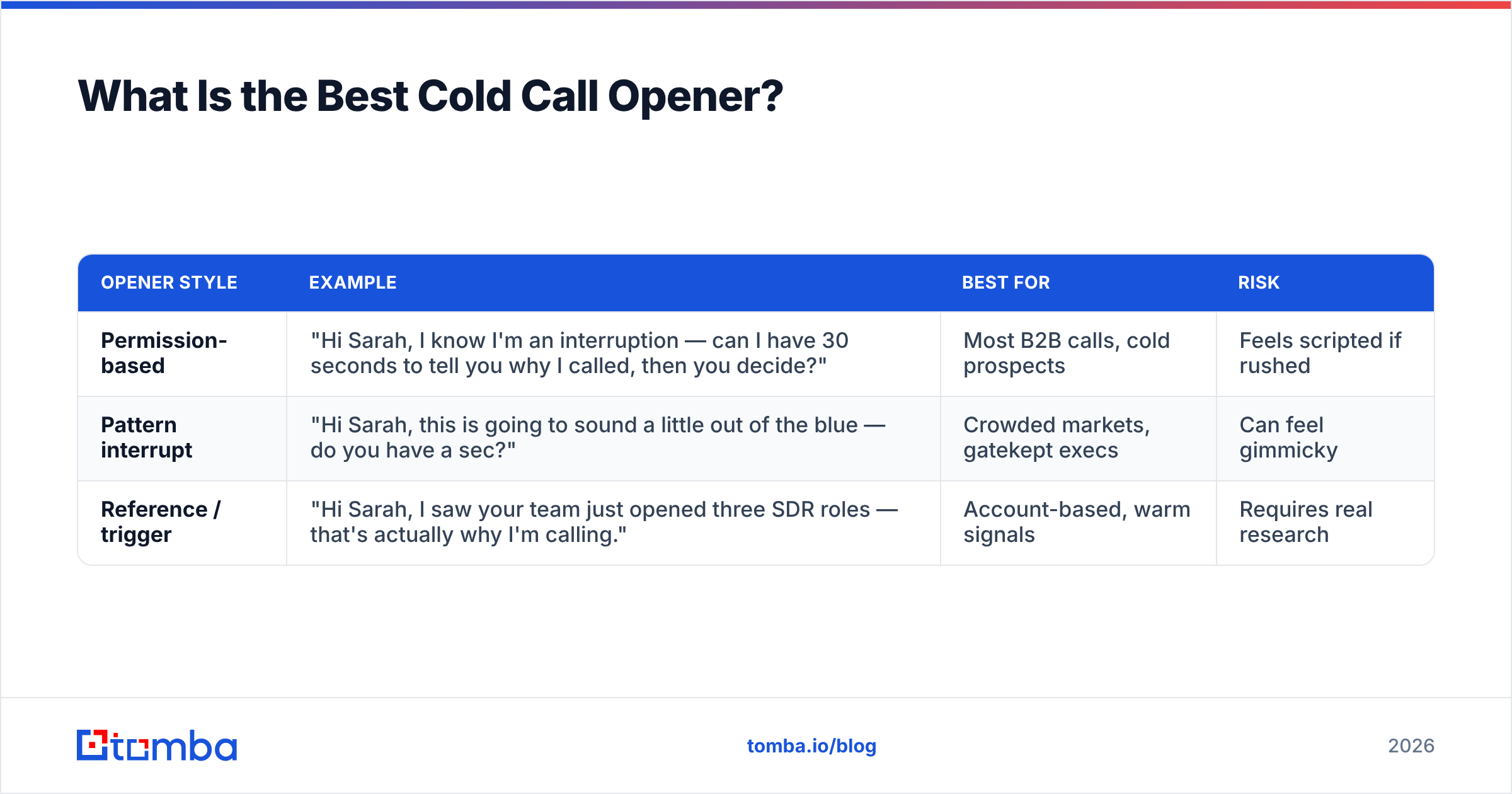
The opener is the highest-leverage sentence you will say all day. You have three broad choices, and each performs differently depending on your market.
| Opener style | Example | Best for | Risk |
|---|---|---|---|
| Permission-based | "Hi Sarah, I know I'm an interruption — can I have 30 seconds to tell you why I called, then you decide?" | Most B2B calls, cold prospects | Feels scripted if rushed |
| Pattern interrupt | "Hi Sarah, this is going to sound a little out of the blue — do you have a sec?" | Crowded markets, gatekept execs | Can feel gimmicky |
| Reference / trigger | "Hi Sarah, I saw your team just opened three SDR roles — that's actually why I'm calling." | Account-based, warm signals | Requires real research |
The permission-based opener wins most often because it does something disarming: it acknowledges you are interrupting and then transfers control to the prospect. People say yes to 30 seconds far more readily than they say yes to a meeting. Once they grant the 30 seconds, they psychologically commit to hearing you out.
Whatever you choose, say your first name and their first name, slow down, and drop the fake enthusiasm. Research from Gong's call analysis has repeatedly shown that successful cold calls open with a clear reason for the call rather than rapport-forcing small talk.
What Is the Structure of a Winning Cold Calling Pitch?#
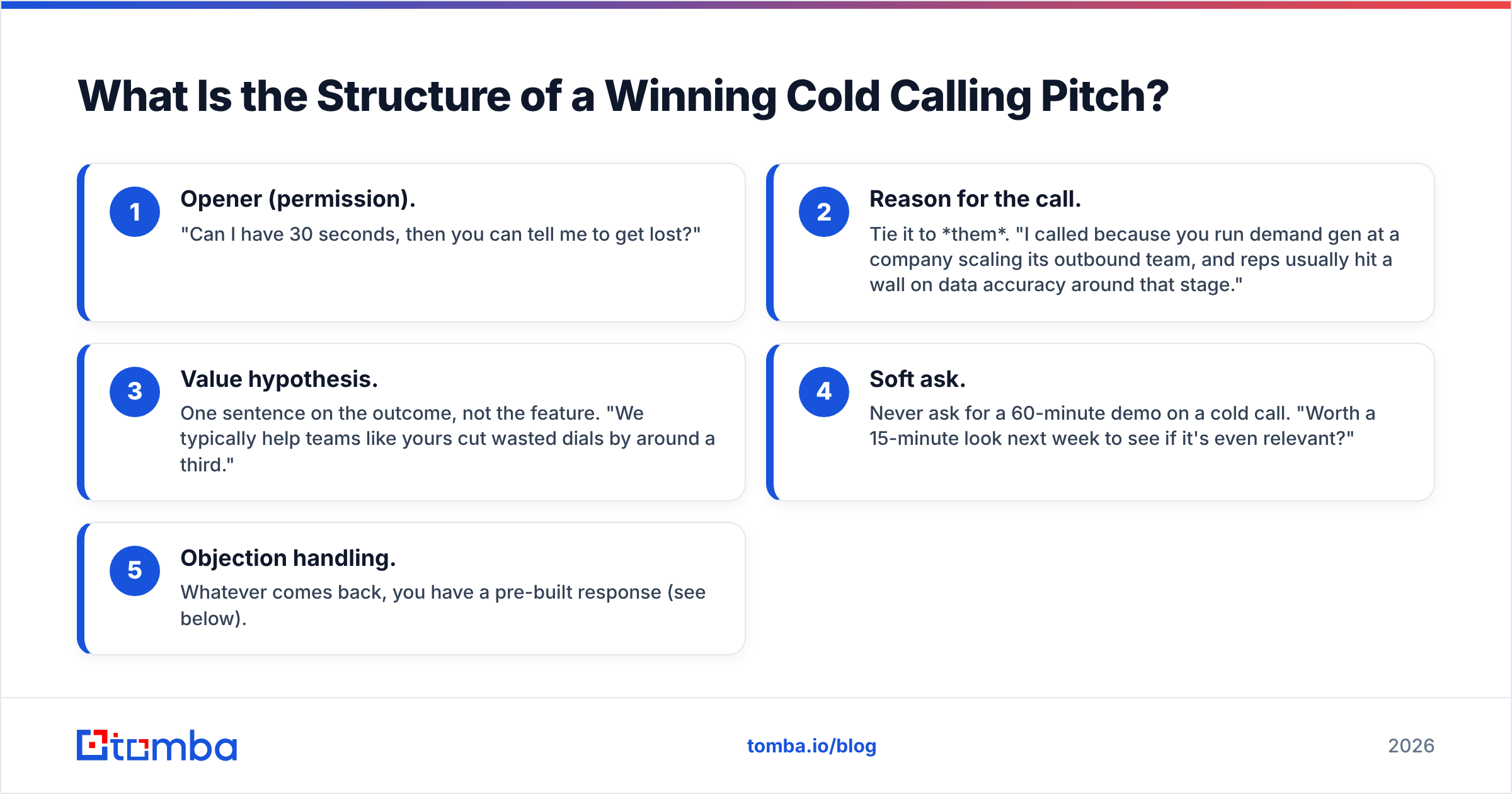
Here is the five-part skeleton. Memorize the shape, not the words — reading a script verbatim is why most reps sound like robots.
- Opener (permission). "Can I have 30 seconds, then you can tell me to get lost?"
- Reason for the call. Tie it to them. "I called because you run demand gen at a company scaling its outbound team, and reps usually hit a wall on data accuracy around that stage."
- Value hypothesis. One sentence on the outcome, not the feature. "We typically help teams like yours cut wasted dials by around a third."
- Soft ask. Never ask for a 60-minute demo on a cold call. "Worth a 15-minute look next week to see if it's even relevant?"
- Objection handling. Whatever comes back, you have a pre-built response (see below).
Notice the pitch is short. You are not closing a deal on the phone — you are earning a calendar slot. Every extra sentence is another chance for the prospect to bail.
Here is a full example you can adapt:
"Hi Sarah, this is Alex from Tomba. I know I caught you out of the blue — can I grab 30 seconds and then you tell me if it's worth continuing?
(pause, wait for yes)
Thanks. I called because your team just posted a few SDR roles, and when outbound teams scale fast, they usually start wasting a big chunk of dials on bad or outdated numbers. We help fix that at the data layer so reps actually reach live prospects.
I'm not going to pitch you the whole thing on a cold call — worth 15 minutes next Tuesday to see if it fits how your team works?"
That is under 45 seconds. It respects the interruption, names a real trigger, states an outcome, and asks for something small.
How Do You Handle Objections on a Cold Call?#
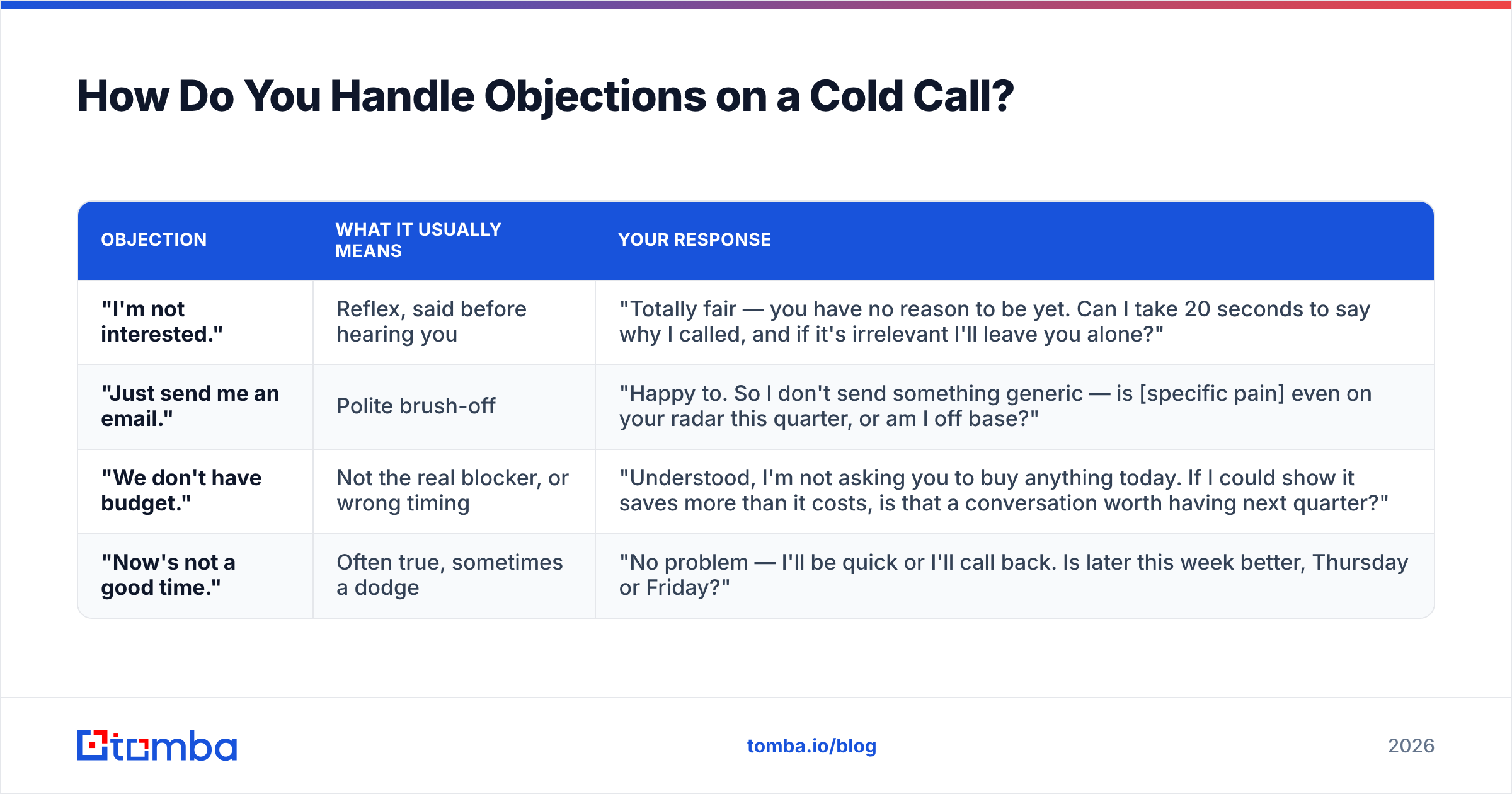
Most reps treat objections as rejection. They are actually the prospect telling you where the resistance is — which is information you can work with. The trick is that you never improvise these in the moment. You script them once and rehearse until they are automatic.
| Objection | What it usually means | Your response |
|---|---|---|
| "I'm not interested." | Reflex, said before hearing you | "Totally fair — you have no reason to be yet. Can I take 20 seconds to say why I called, and if it's irrelevant I'll leave you alone?" |
| "Just send me an email." | Polite brush-off | "Happy to. So I don't send something generic — is [specific pain] even on your radar this quarter, or am I off base?" |
| "We don't have budget." | Not the real blocker, or wrong timing | "Understood, I'm not asking you to buy anything today. If I could show it saves more than it costs, is that a conversation worth having next quarter?" |
| "Now's not a good time." | Often true, sometimes a dodge | "No problem — I'll be quick or I'll call back. Is later this week better, Thursday or Friday?" |
The pattern across all four: acknowledge, then ask a question that keeps the conversation alive without being pushy. You are looping the prospect back into dialogue instead of accepting the exit. For deeper scripts on the specific wording that improves your response rate, keep a living objection doc that every rep contributes to.
One rule: never argue. The moment you push back hard, you confirm the "annoying salesperson" stereotype and the call is over.
Why Does Your Data Decide Whether the Pitch Even Lands?#
The best cold calling pitch in the world fails if you dial a number that rings a dead line, a switchboard, or the wrong person entirely. Reps routinely lose 20 to 40 percent of their dialing time to bad contact data — wrong numbers, disconnected lines, and gatekeeper mazes that never had a shot.
This is the unglamorous half of cold calling that nobody puts in a highlight reel. Before your pitch matters, you need:
- A verified direct-dial or mobile number, not a generic company switchboard.
- The right title and seniority, so you are pitching a decision-maker, not an intern.
- A recent data source, because people change jobs constantly and stale lists mean stale numbers.
- A matched email, so your "just send me an email" objection handling actually reaches an inbox that exists.
This is where prospecting tooling earns its keep. A phone finder that returns verified B2B numbers, paired with an email finder to cover the follow-up channel, means every dial has a real chance of connecting. You can also run numbers through a phone validator before a big calling block so you are not burning your morning on disconnected lines.
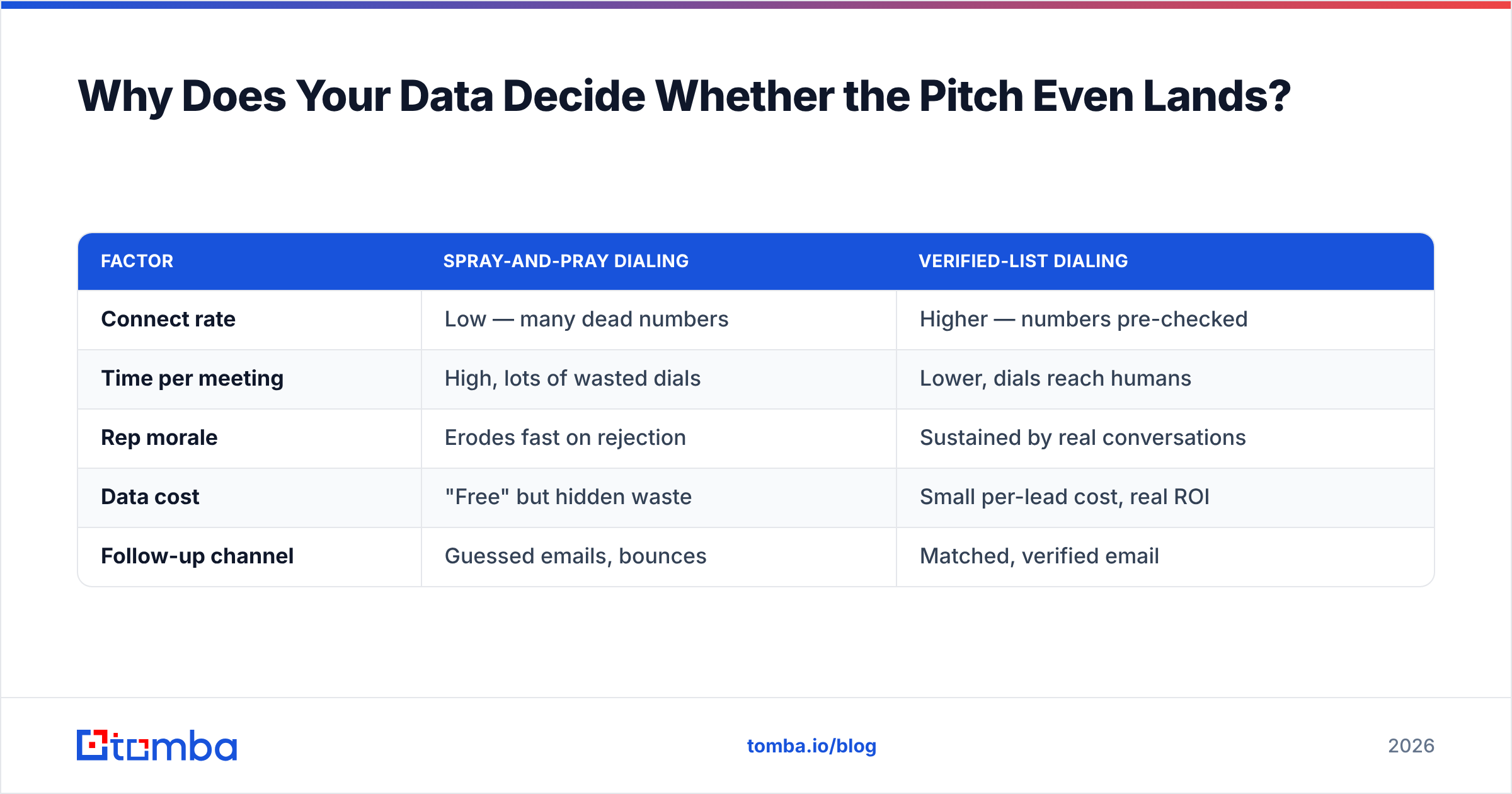
Compare the two approaches honestly:
| Factor | Spray-and-pray dialing | Verified-list dialing |
|---|---|---|
| Connect rate | Low — many dead numbers | Higher — numbers pre-checked |
| Time per meeting | High, lots of wasted dials | Lower, dials reach humans |
| Rep morale | Erodes fast on rejection | Sustained by real conversations |
| Data cost | "Free" but hidden waste | Small per-lead cost, real ROI |
| Follow-up channel | Guessed emails, bounces | Matched, verified email |
Volume still matters — cold calling is a numbers game at its core — but volume on a clean list compounds, while volume on a dirty list just wears your reps down.
How Do You Practice and Improve Your Cold Calling Pitch?#
A pitch is a skill, not a document. The reps who improve fastest treat every call as a rep in the gym.
- Record and review. Listen back to your first 15 seconds. Are you rushing? Filler words? Fake enthusiasm?
- Track the right metrics. Connect rate tells you about data and timing. Conversation-to-meeting rate tells you about the pitch itself. Watch both.
- Warm up daily. Your first three calls each morning are your worst. Do them on lower-priority accounts.
- A/B test one variable. Change the opener for a week, hold everything else constant, and measure. Then change the value hypothesis. Small controlled tests beat wholesale rewrites.
- Feed the CRM. Log objections and outcomes so the whole team learns which responses convert. Tie it back into your broader sales automation workflow so callbacks and follow-up emails fire automatically.
Set a realistic bar. Even strong reps book meetings on a small fraction of connected calls. If you connect with 30 decision-makers and book two or three quality meetings, that is a healthy day — provided those connects were with the right people, which loops straight back to data quality.
What Are the Most Common Cold Calling Pitch Mistakes?#
Avoid these and you are ahead of most of the field:
- Talking too long before the ask. If your opener runs past 20 seconds without a pause, you have lost them.
- Pitching features instead of outcomes. Nobody buys "AI-powered enrichment." They buy "stop wasting dials."
- Asking for too much. A cold call earns a 15-minute conversation, not a signed contract.
- Sounding scripted. Rehearse until the words feel yours, then let your natural voice through.
- Skipping research. A generic pitch to a researched account still beats a researched pitch to the wrong person — but do both.
- Dialing a bad list. The single most common silent killer. Fix your data first.
Cross-check tool options on independent review sites like G2 before committing budget to any calling or data stack — and pressure-test claims against real user reviews, not vendor decks.
Turn Your Pitch Into Booked Meetings#
Your cold calling pitch is only as good as the number you dial and the person on the other end. Nail the permission-based opener, follow the five-part structure, script your four objections, and rehearse until it sounds human — but do it against a verified list, or you are practicing a great pitch on dead lines.
Start by fixing the data layer. Use the Tomba Email Finder to build accurate contact lists and match every prospect to a real, reachable inbox for your follow-up, then layer in verified phone numbers so every dial has a shot at a live conversation. See Tomba pricing — there is a free tier with 25 searches a month to test it against your current list before you commit. Better data in, more meetings out.
Related guides#
// get started
Find, verify and enrich your first contacts today
Start on the free plan with 25 searches a month, then scale when your team is ready.
Free plan · No credit card required · GDPR & CCPA
// about the author