How to Cold Call Potential Clients in 2026: Scripts and Steps
Cold calling isn't dead, it's just done badly. Here's a 2026 playbook for calling potential clients: research, openers, scripts, objection handling, and the data that makes your dials actually connect and convert.
Cold calling potential clients gets a bad reputation, mostly from people doing it wrong: no research, a robotic pitch, and a phone list scraped from who-knows-where. Done right, it is still one of the fastest ways to put a qualified conversation on your calendar this week instead of next quarter. This guide breaks down exactly how to do it right in 2026.
TL;DR#
- Cold calling still works when the number is correct, the person is a fit, and your opener earns the next 30 seconds.
- Bad data kills more calls than bad scripts. Roughly 30–40% of B2B phone lists are stale within a year, so verify before you dial.
- Use a 4-part call structure: pattern-interrupt opener, permission, value hypothesis, single clear ask.
- Objections are signals, not walls. "I'm busy" and "send me an email" have scripted, respectful counters.
- Pair calls with email and LinkedIn. Multi-touch sequences book far more meetings than phone alone.
Is cold calling potential clients still worth it in 2026?#
Yes, but only as part of a multi-channel motion. The myth that "cold calling is dead" usually comes from reps who dial bad numbers, wing the opener, and give up after two rings. When you fix those three things, the phone becomes a competitive advantage precisely because so many teams have abandoned it for email-only outreach.
Here is the honest case for and against, so you can decide where it fits your process.
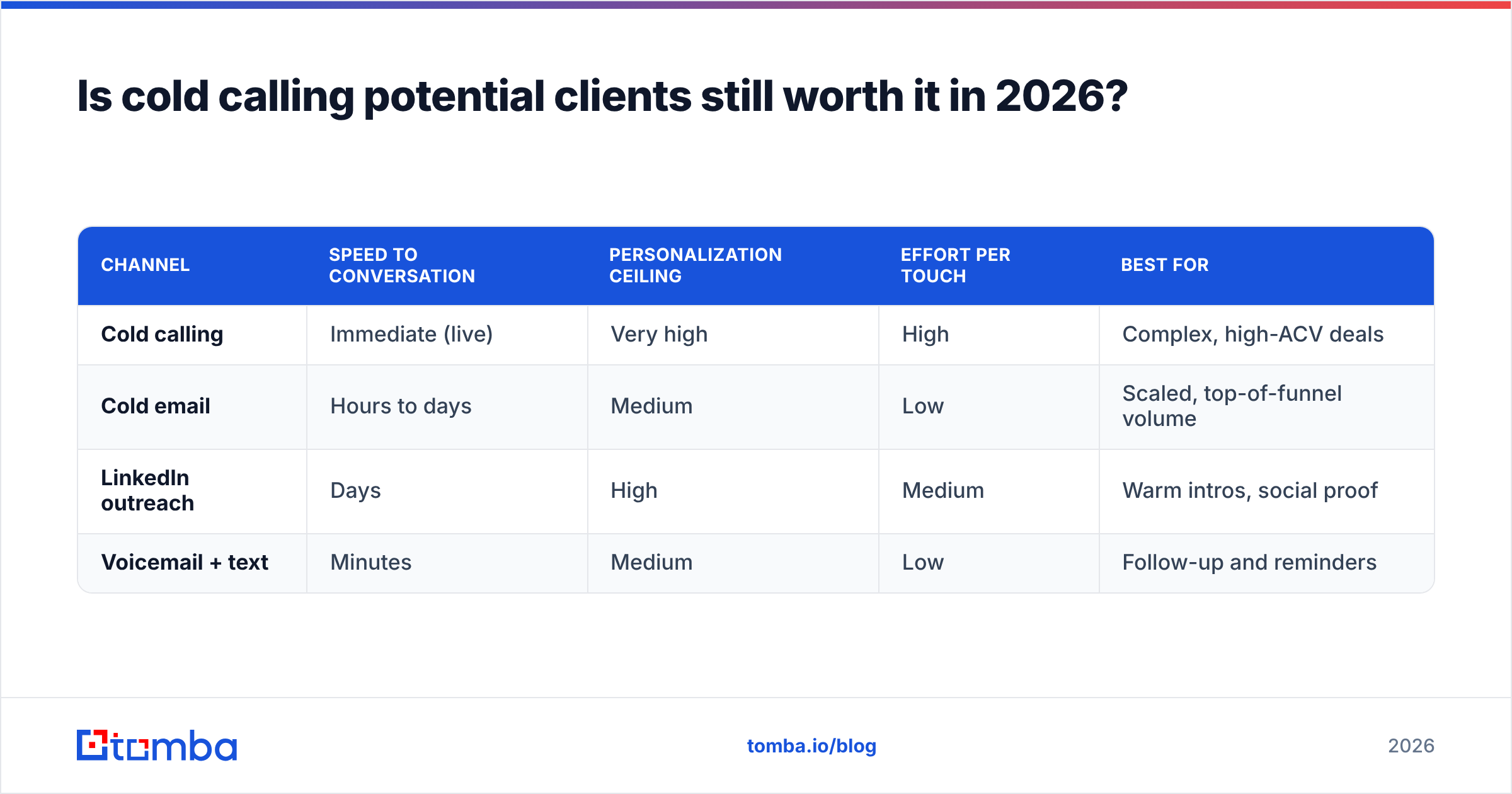
| Channel | Speed to conversation | Personalization ceiling | Effort per touch | Best for |
|---|---|---|---|---|
| Cold calling | Immediate (live) | Very high | High | Complex, high-ACV deals |
| Cold email | Hours to days | Medium | Low | Scaled, top-of-funnel volume |
| LinkedIn outreach | Days | High | Medium | Warm intros, social proof |
| Voicemail + text | Minutes | Medium | Low | Follow-up and reminders |
The takeaway: calling wins on speed and depth of conversation, and loses on scale. So reserve it for accounts where a real dialogue moves the deal, and let email carry the volume. If you want the full comparison of outbound motions, our guide to LinkedIn outreach pairs well with what follows.
Why does bad data ruin most cold calls?#
Because you cannot pitch someone you never reach. The single biggest reason cold calling "doesn't work" for a team is that the underlying contact data is wrong. Disconnected numbers, main switchboards instead of direct lines, and job-changers who left 8 months ago all burn dials before a word is spoken.
Consider what a poor list actually costs you. According to HubSpot's sales research, it already takes an average of multiple dial attempts to connect with a single prospect. Now multiply that by a list where a third of the numbers are dead. Your connect rate collapses, and reps start blaming the script.
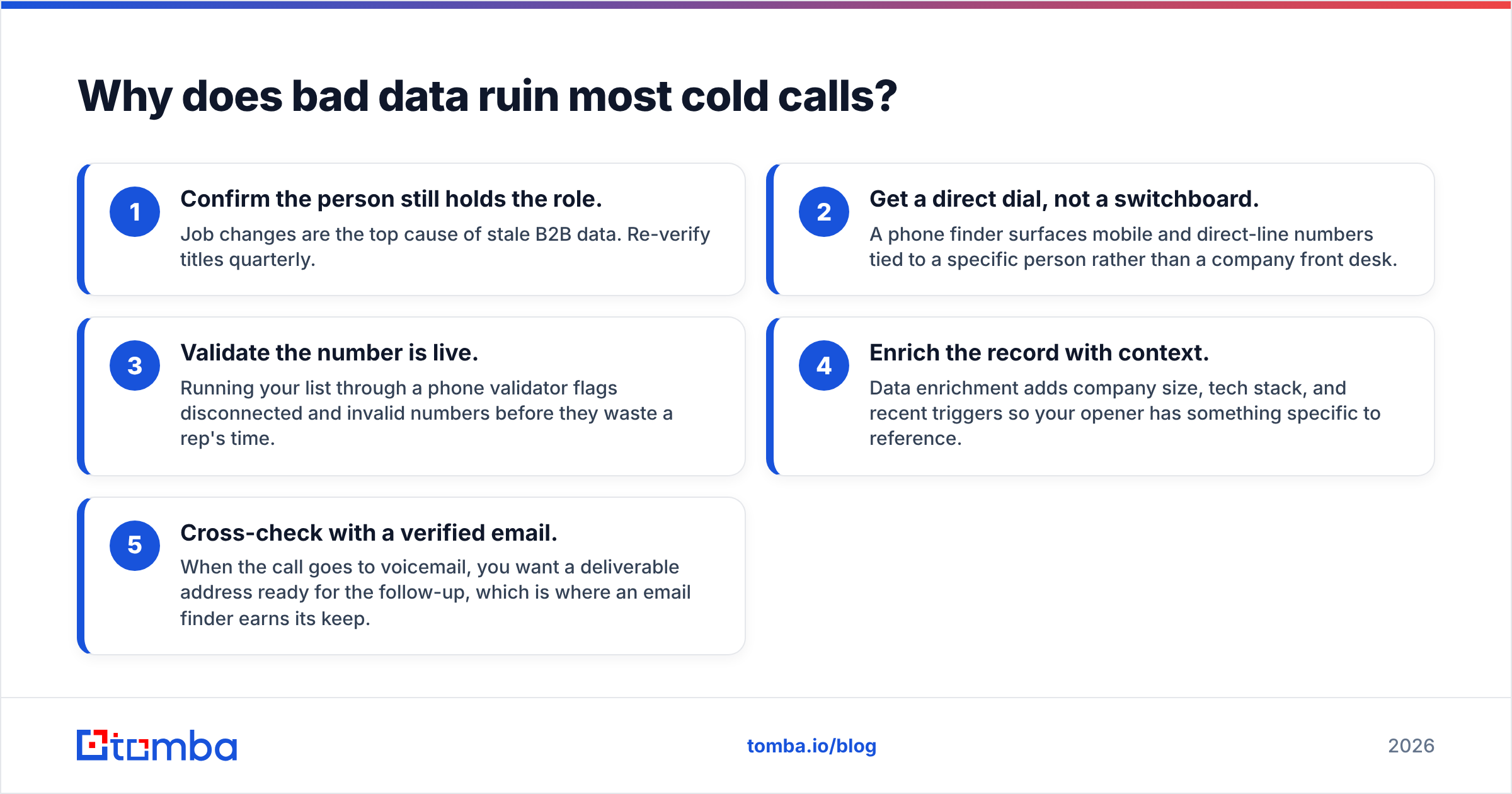
Before you dial, run this data checklist:
- Confirm the person still holds the role. Job changes are the top cause of stale B2B data. Re-verify titles quarterly.
- Get a direct dial, not a switchboard. A phone finder surfaces mobile and direct-line numbers tied to a specific person rather than a company front desk.
- Validate the number is live. Running your list through a phone validator flags disconnected and invalid numbers before they waste a rep's time.
- Enrich the record with context. Data enrichment adds company size, tech stack, and recent triggers so your opener has something specific to reference.
- Cross-check with a verified email. When the call goes to voicemail, you want a deliverable address ready for the follow-up, which is where an email finder earns its keep.
Skip this and your best script still fails. Fix it and an average script starts booking meetings.
What is the anatomy of a great cold call?#
A great cold call has four parts, and each one earns the right to the next. Think of it like getting through a locked building: the opener is the front door, permission is the security check, the value hypothesis is your reason for being there, and the ask is the meeting room you actually want to reach.
1. The pattern-interrupt opener#
Do not open with "How are you today?" Everyone knows what comes next and their guard goes up. Instead, be honest and human:
"Hi Sarah, this is Alex from Tomba. I know I'm an interruption. Can I take 30 seconds to tell you why I called, and then you can decide if it's worth continuing?"
This does two things: it acknowledges reality (lowering resistance) and it asks a small yes that most people grant.
2. Permission#
Once you have the 30 seconds, respect them. Permission-based openers consistently outperform launching straight into a monologue because the prospect feels in control rather than trapped.
3. The value hypothesis#
This is where research pays off. Reference something specific and tie it to an outcome:
"I noticed you're hiring three SDRs this quarter. Teams scaling outbound that fast usually hit a wall on data accuracy, and reps end up dialing dead numbers. That's the problem we solve."
Notice it is about their situation, not your feature list.
4. One clear ask#
End with a single, low-friction ask. Not "does that sound interesting?" (weak) but a concrete next step:
"Worth a 15-minute call Thursday to see if it's relevant?"
One ask, one calendar slot, done.
What cold calling scripts actually work?#
The best script is a flexible frame, not a word-for-word recital. Prospects can hear reading. Below is a reusable frame you can adapt to any industry.
The "problem-first" frame:
- Opener: "Hi [Name], it's [You] from [Company]. I'll be quick and honest, this is a cold call, but a relevant one. Got 30 seconds?"
- Reason: "I called because [specific trigger about their company]."
- Hypothesis: "Companies in your spot usually struggle with [problem]. Is that on your radar at all?"
- Ask: "If it is, I'd love 15 minutes Thursday to show you how [peer company] fixed it. Fair?"
The "referral" frame (when you have a name):
- "Hi [Name], [Colleague] mentioned you own [area]. I'm reaching out because [reason]. Do you have a moment?"
Keep a one-page cheat sheet with these frames and your top five objections. Everything else should sound like you, because it is you.
How do you handle the most common objections?#
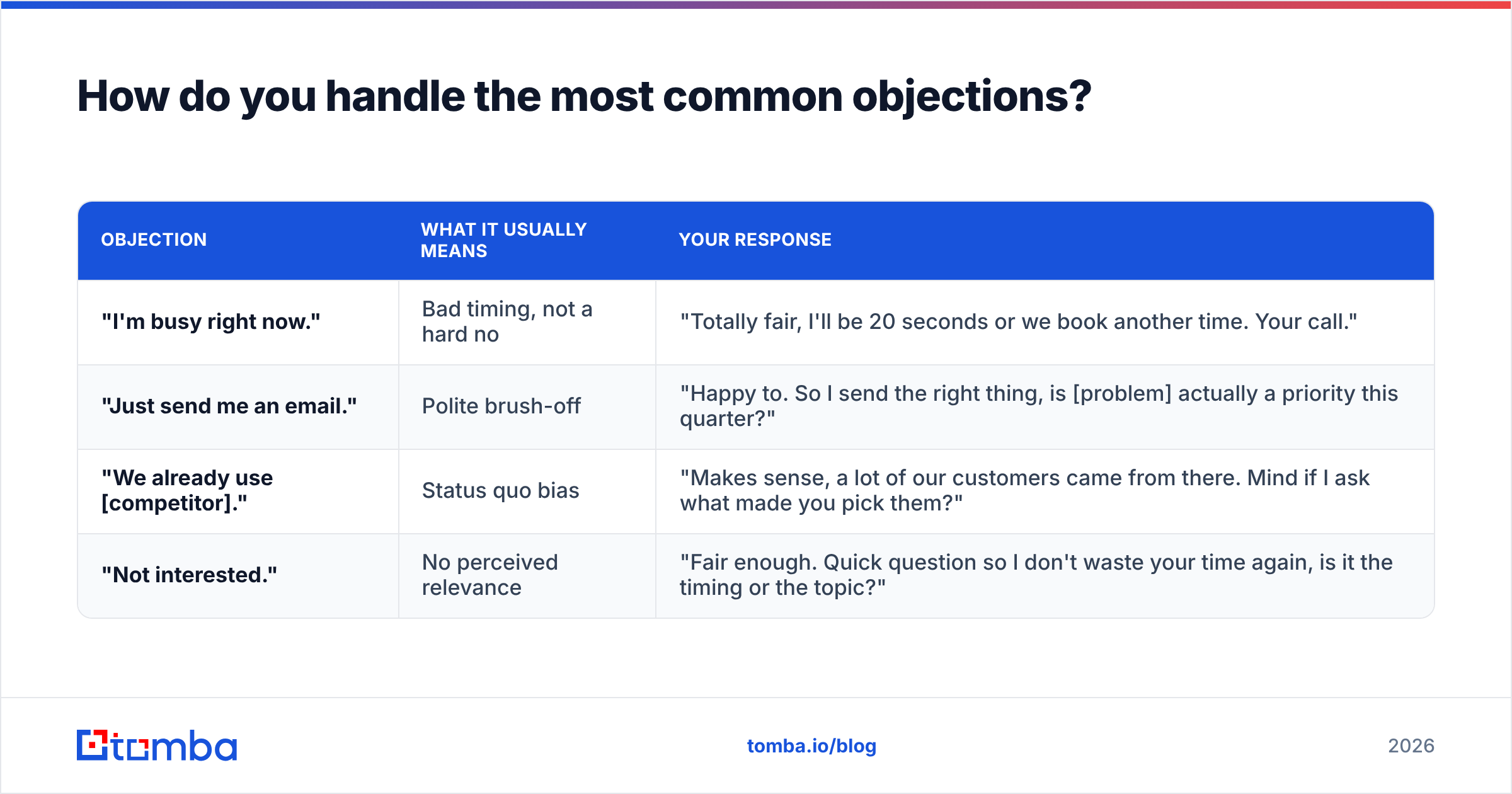
You handle objections by agreeing first, then redirecting. Arguing loses. Below are the four you will hear most and a respectful response for each.
| Objection | What it usually means | Your response |
|---|---|---|
| "I'm busy right now." | Bad timing, not a hard no | "Totally fair, I'll be 20 seconds or we book another time. Your call." |
| "Just send me an email." | Polite brush-off | "Happy to. So I send the right thing, is [problem] actually a priority this quarter?" |
| "We already use [competitor]." | Status quo bias | "Makes sense, a lot of our customers came from there. Mind if I ask what made you pick them?" |
| "Not interested." | No perceived relevance | "Fair enough. Quick question so I don't waste your time again, is it the timing or the topic?" |
The pattern is consistent: acknowledge, ask one honest question, and let the prospect re-engage on their own terms. According to sales conversation research summarized on G2, calls that treat objections as questions rather than rejections convert meaningfully better than calls that push.
When is the best time to cold call?#
The best windows are mid-morning and late afternoon, mid-week. Prospects are settled but not yet buried, and Monday chaos and Friday wind-down are both behind or ahead of them. Analysis compiled by teams at Salesforce and others consistently points to Tuesday through Thursday as the strongest days.
That said, "best time" is a starting hypothesis, not a law. Track your own connect rates by hour and day for two weeks, then double down on your team's real pattern. Your market may behave differently than the aggregate.
A simple cadence that respects the prospect and your pipeline:
- Touch 1: Call + voicemail
- Touch 2 (next day): Email referencing the voicemail
- Touch 3 (day 3): LinkedIn connection with context
- Touch 4 (day 5): Second call at a different time of day
- Touch 5 (day 8): Break-up email
Rotate the time of day across attempts so you are not always calling into the same dead zone.
How do you scale cold calling without losing quality?#
You scale by fixing the inputs, not by dialing faster. More bad dials just means more rejection. The teams that scale cleanly do three things.
Build a verified list first. Feed reps direct dials and validated numbers instead of a scraped spreadsheet. A clean B2B database with confirmed contacts means every dial has a real chance of connecting.
Standardize the frame, personalize the trigger. The opener and structure stay consistent so you can coach them. Only the value hypothesis changes per account, and that comes from enrichment data.
Measure the right metric. Track conversations per hour and conversations to meetings, not raw dials. Raw dials reward activity; conversations reward effectiveness.
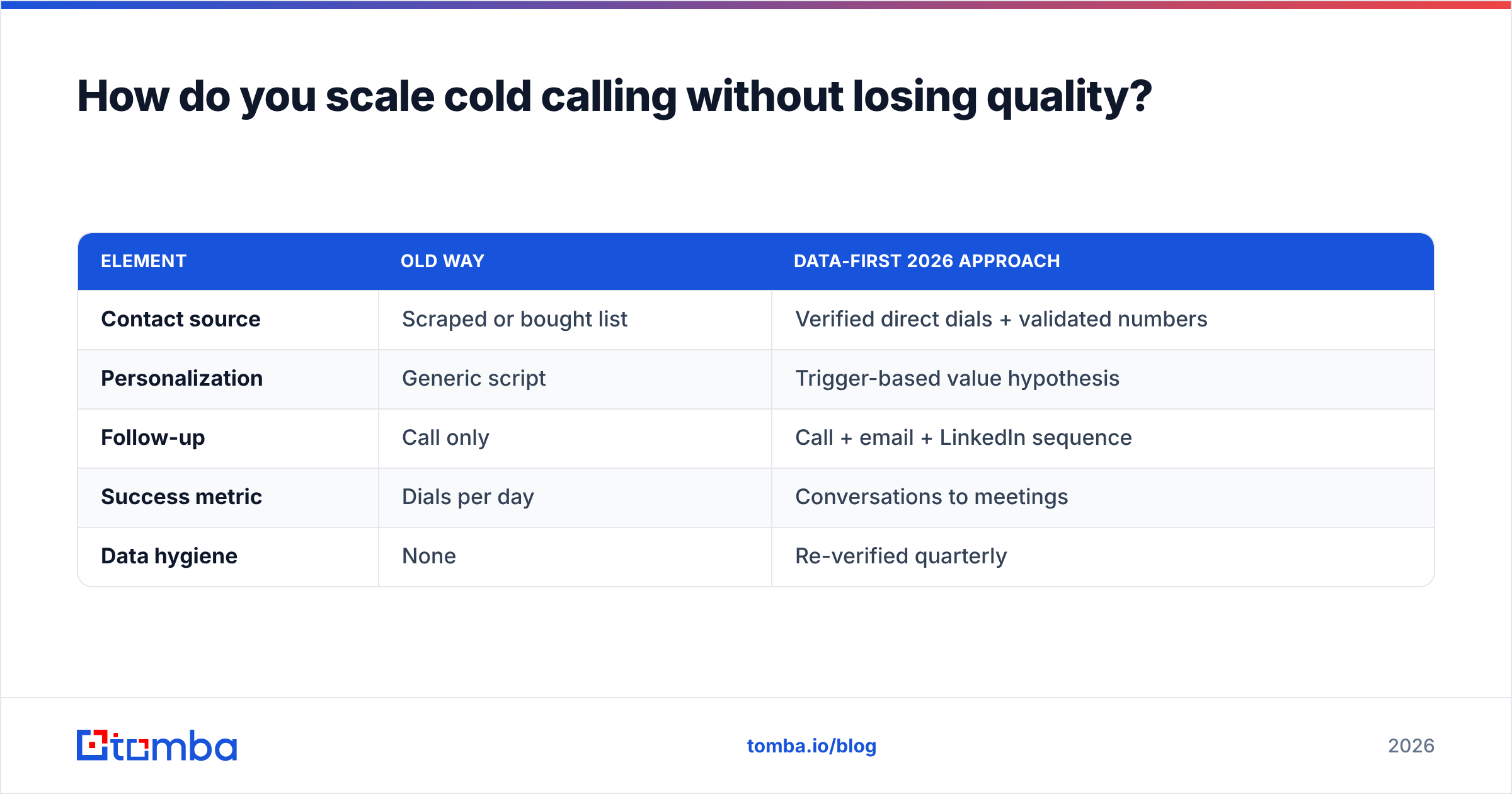
Here is how a data-first cold calling stack compares to the old way:
| Element | Old way | Data-first 2026 approach |
|---|---|---|
| Contact source | Scraped or bought list | Verified direct dials + validated numbers |
| Personalization | Generic script | Trigger-based value hypothesis |
| Follow-up | Call only | Call + email + LinkedIn sequence |
| Success metric | Dials per day | Conversations to meetings |
| Data hygiene | None | Re-verified quarterly |
The difference is not talent. It is preparation. A well-prepared average rep beats an unprepared great one on the phone every time.
What tools do you need to cold call effectively?#
At minimum, four things: a source of accurate direct dials, a validator to keep the list clean, an enrichment layer for context, and a way to reach people who do not pick up. You do not need a bloated platform, you need reliable data and a simple sequence.
Start with the data, because everything else depends on it. If your numbers are wrong, no dialer, CRM, or script will save the call. Check Tomba pricing to see where a data-first stack fits your budget; the free tier gives you 25 searches a month to test accuracy before committing, and paid plans start at $49/mo.
Cold calling potential clients: put it into practice#
Cold calling potential clients rewards preparation over volume. Get the number right, open with honesty, lead with a relevant problem, make one clear ask, and follow up across channels. That is the whole game, and most of it comes down to the quality of the data you dial.
Before your next call block, make sure every number and contact on your list is real, current, and tied to the right person. The Tomba Email Finder and its companion phone finder give you verified direct dials and deliverable emails so your reps spend their time in conversations, not in voicemail purgatory. Start free with 25 searches, clean your list, and watch your connect rate climb before you change a single word of your script.
Related guides#
// get started
Find, verify and enrich your first contacts today
Start on the free plan with 25 searches a month, then scale when your team is ready.
Free plan · No credit card required · GDPR & CCPA
// about the author