Cold Calling PPT: How to Build a Sales Deck That Books Meetings
A cold calling PPT should train reps to open, handle objections, and book meetings—not bore them. Here's the slide-by-slide structure that actually works in 2026.
Most cold calling PPT decks fail for the same reason most cold calls fail: they lead with the product, bury the point, and give the audience no reason to stay on the line. If you're building a training deck for your SDR team—or you've been handed a stale one to fix—this guide walks you through the exact slides that turn a passive slideshow into a repeatable calling system.
TL;DR#
- A cold calling PPT is a training tool, not a pitch. Its job is to teach reps a repeatable framework for opening, qualifying, handling objections, and booking the next step.
- Structure beats decoration. The best decks follow a fixed sequence: mindset, the opener, the value bridge, objection handling, the ask, and post-call logging.
- Scripts should be modular, not word-for-word. Give reps branching talk tracks they can adapt, not a monologue to read.
- The deck is only as good as your list. Even a perfect call flow dies against wrong numbers—clean contact data is the input that makes everything else work.
- Measure two things: connect rate and meetings booked per 100 dials. Every slide should trace back to moving one of them.
What is a cold calling PPT, and who actually needs one?#
A cold calling PPT is a slide deck used to train and standardize how a sales team makes outbound phone calls. Think of it as the flight manual for your SDRs: it doesn't fly the plane for them, but it makes sure every rep takes off, navigates turbulence (objections), and lands (books a meeting) the same reliable way.
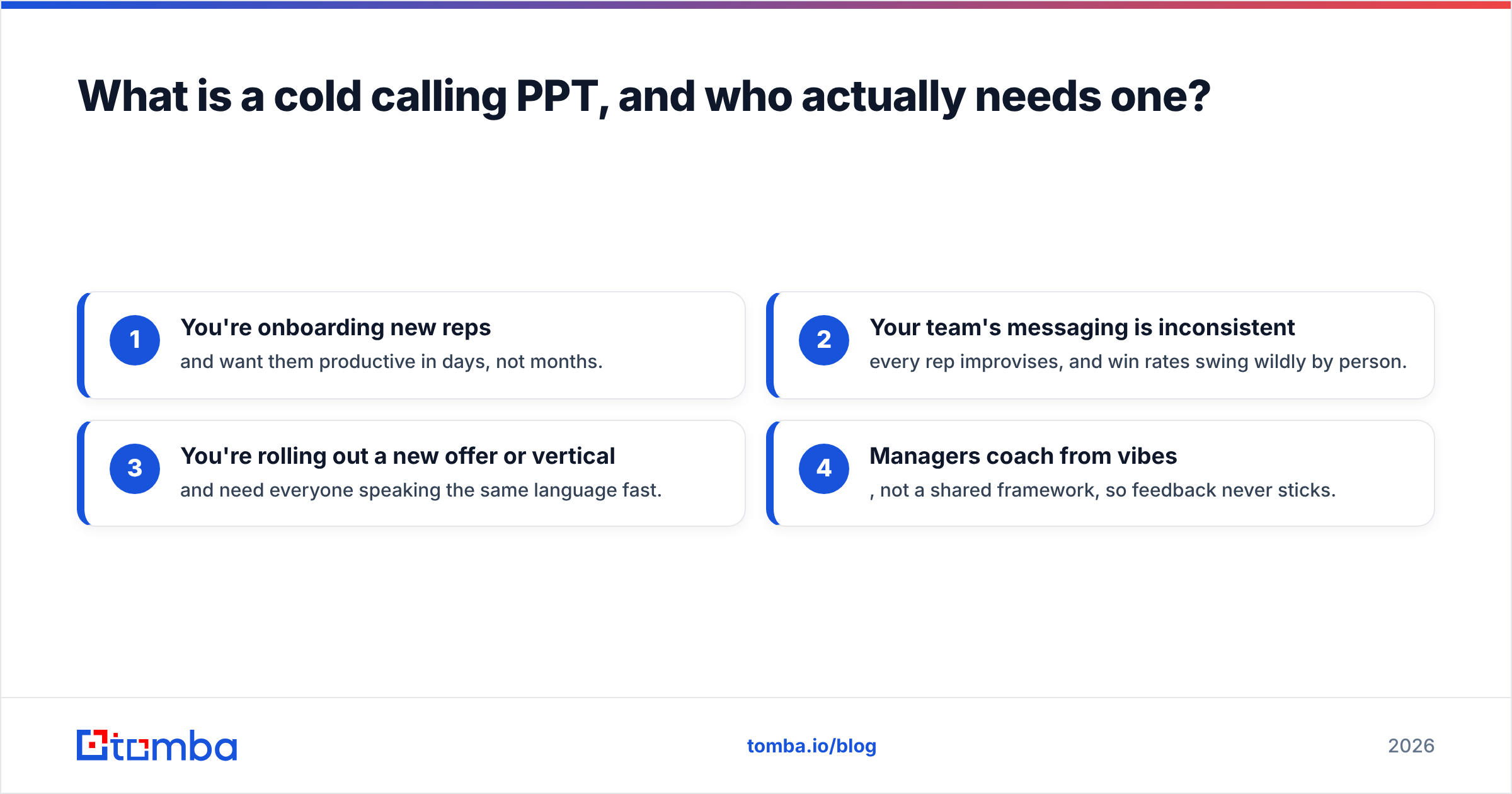
You need one if any of these are true:
- You're onboarding new reps and want them productive in days, not months.
- Your team's messaging is inconsistent—every rep improvises, and win rates swing wildly by person.
- You're rolling out a new offer or vertical and need everyone speaking the same language fast.
- Managers coach from vibes, not a shared framework, so feedback never sticks.
A deck solves the consistency problem. Instead of ten reps inventing ten openers, everyone starts from one proven structure and personalizes within guardrails. That's what makes coaching, A/B testing, and forecasting possible.
Why do most cold calling decks fail?#
Because they're built like marketing brochures instead of training tools. Here are the failure patterns worth naming before you build:
- Too much company history. Slide 3 is the founding story. No rep has ever booked a meeting by reciting a founding story.
- Word-for-word scripts. A rigid monologue makes reps sound like robots. Prospects hang up on robots.
- No objection branches. The deck assumes the call goes perfectly. Real calls veer off in the first fifteen seconds.
- Zero data hygiene. The best talk track in the world is useless against a disconnected number or the wrong contact.
- No measurement loop. If the deck doesn't tell reps what to log and why, you can't improve it.
A useful mental model: your deck has an input (the list), a process (the call flow), and an output (booked meetings). Weak decks obsess over the process and ignore the other two. According to research summarized by HubSpot, it can take multiple touch attempts to reach a single prospect—so your deck has to account for volume and accurate contact routing, not just the perfect single call.
What slides should a cold calling PPT include?#
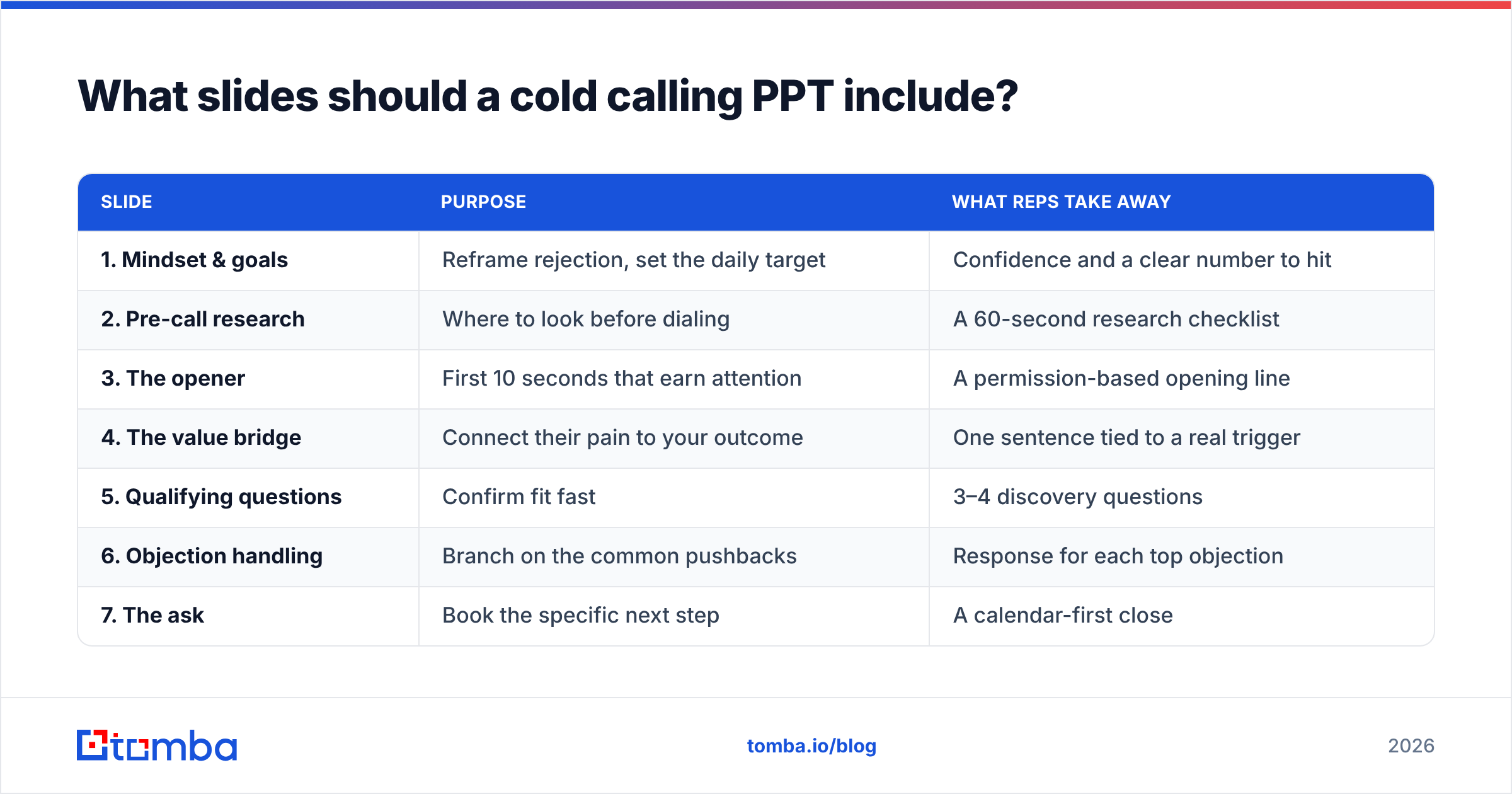
Here's the core structure. Treat it as a spine you can adapt to your motion, whether you sell software, services, or physical products.
| Slide | Purpose | What reps take away |
|---|---|---|
| 1. Mindset & goals | Reframe rejection, set the daily target | Confidence and a clear number to hit |
| 2. Pre-call research | Where to look before dialing | A 60-second research checklist |
| 3. The opener | First 10 seconds that earn attention | A permission-based opening line |
| 4. The value bridge | Connect their pain to your outcome | One sentence tied to a real trigger |
| 5. Qualifying questions | Confirm fit fast | 3–4 discovery questions |
| 6. Objection handling | Branch on the common pushbacks | Response for each top objection |
| 7. The ask | Book the specific next step | A calendar-first close |
| 8. Voicemail & follow-up | What to do on no-answer | A reusable voicemail + email combo |
| 9. Logging & metrics | Capture the data that improves the deck | Fields to update in the CRM |
Notice the deck spends nine slides on doing the job and zero on the founding story. That ratio is the point.
The four call phases every rep must master#
Within that structure, drill these four phases hard—they're where deals are won or lost:
- The opener. You have roughly ten seconds. Lead with a reason for the call that's about them, ask permission to continue, and never open with "How are you today?"
- The value bridge. Tie a specific trigger (a hire, a funding round, a tech change) to an outcome you deliver. Specific beats generic every time.
- The objection turn. "I'm busy," "send me an email," and "we already use someone" are not rejections—they're reflexes. Give reps a one-line branch for each.
- The ask. Propose a concrete time, not "some time next week." A calendar-first close removes the friction that kills momentum.
How do you write scripts that don't sound like scripts?#
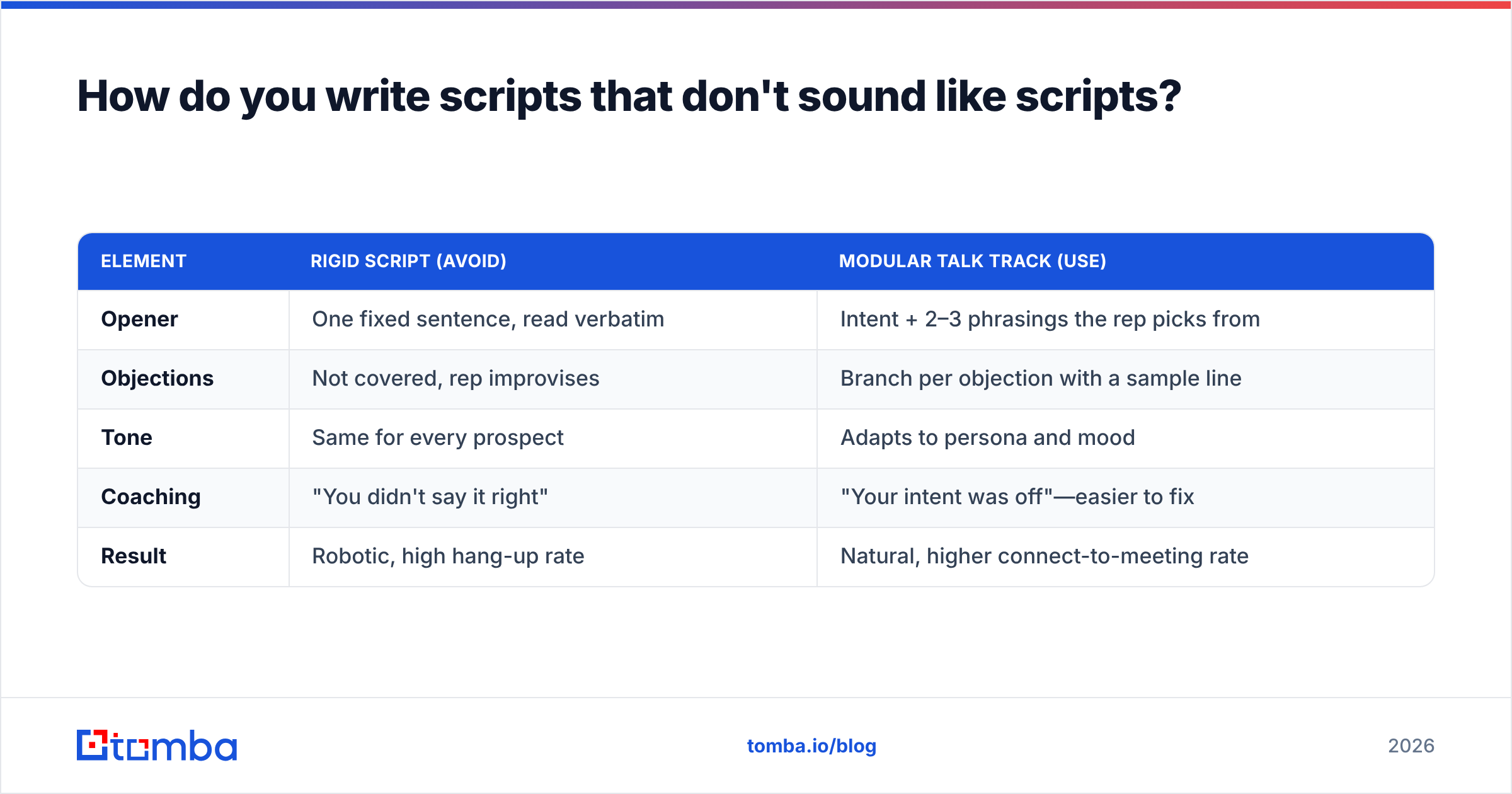
Build talk tracks, not monologues. A talk track gives reps the intent of each line and a couple of ways to say it, so they sound human while staying on-message. Compare the two approaches:
| Element | Rigid script (avoid) | Modular talk track (use) |
|---|---|---|
| Opener | One fixed sentence, read verbatim | Intent + 2–3 phrasings the rep picks from |
| Objections | Not covered, rep improvises | Branch per objection with a sample line |
| Tone | Same for every prospect | Adapts to persona and mood |
| Coaching | "You didn't say it right" | "Your intent was off"—easier to fix |
| Result | Robotic, high hang-up rate | Natural, higher connect-to-meeting rate |
For the objection slides specifically, give each pushback a three-part response: acknowledge, reframe, redirect. For "send me an email," that sounds like: "Happy to—so I send something relevant and not just noise, can I ask one quick question?" You acknowledged the request, reframed the email as a favor to them, and redirected to discovery.
If your team also runs email as a parallel channel, the same discipline applies to written outreach. You can pull ready-made structures from a library of cold email templates so the phone and inbox messaging stay aligned instead of contradicting each other.
Is a PPT even the right format in 2026?#
Yes—with a caveat. The slide deck is the right medium for teaching the framework because it forces a linear, repeatable sequence you can present, revisit, and version. But the deck should link out to living assets: a call-recording library, a shared objection doc, and your CRM dashboards.
The trend among high-performing teams is a hybrid: a tight training PPT (10–12 slides) plus recorded call reviews. Tools like Gong have made call analysis mainstream, and pairing your deck with real recordings closes the gap between "what the slide says" and "what actually happens on the phone." The deck teaches the model; the recordings prove it and expose where reps drift.
A practical rule: if a piece of information changes more than once a quarter, it doesn't belong in the deck—it belongs in a linked doc the deck points to. That keeps your PPT stable while the tactical details stay fresh.
How does data quality make or break the deck?#
Your call flow can be flawless and still fail if the number is wrong or the contact left the company six months ago. This is the input problem, and it's the most under-taught slide in almost every deck.
Before a rep dials, the list should be validated: correct company, current decision-maker, working direct line, and ideally a verified email for the follow-up. When teams skip this step, connect rates crater and reps blame the script—when the real culprit was the data.
That's where enrichment fits into the training deck. Teach reps to source and verify contacts, not just to talk. A B2B phone finder surfaces direct dials so reps aren't stuck routing through gatekeepers, and pairing each call with a verified email means the no-answer follow-up actually lands. If you want the underlying method, review how contact data enrichment turns a thin lead into a complete, callable record.
You can also build a simple data slide that reminds reps to check three things before every dial:
- Is the contact current? Titles and employers change constantly.
- Is the number a direct line or a switchboard? Direct lines convert far better.
- Do I have a verified email for the follow-up? No-answer is the norm, not the exception—so the follow-up channel matters as much as the call.
Framing data as part of the calling system—rather than a separate IT chore—is what separates decks that lift performance from decks that just look nice in a kickoff meeting.
What metrics should the final slide track?#
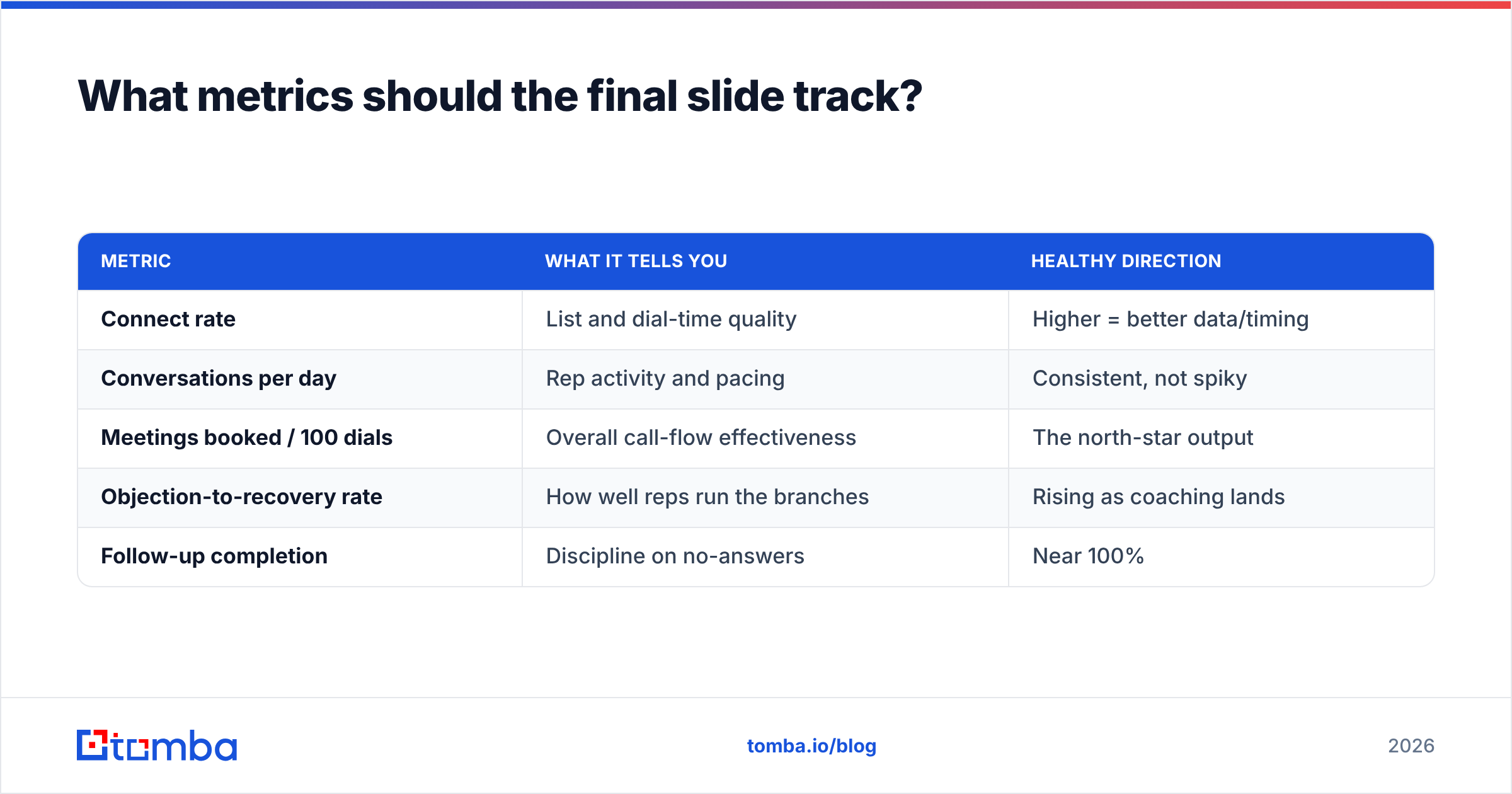
End the deck by defining success in numbers, so reps and managers share one scoreboard. Focus on a small set:
| Metric | What it tells you | Healthy direction |
|---|---|---|
| Connect rate | List and dial-time quality | Higher = better data/timing |
| Conversations per day | Rep activity and pacing | Consistent, not spiky |
| Meetings booked / 100 dials | Overall call-flow effectiveness | The north-star output |
| Objection-to-recovery rate | How well reps run the branches | Rising as coaching lands |
| Follow-up completion | Discipline on no-answers | Near 100% |
The single most important number is meetings booked per 100 dials, because it rolls up list quality, call skill, and follow-through into one figure. Improve any slide in the deck, and this number should move. For a deeper look at how outreach effectiveness is measured across channels, the concept of response rate is a useful companion metric to track alongside your dial data.
You can benchmark your own results against public sales stats aggregated on review platforms like G2, but treat external numbers as directional—your vertical, offer, and list quality will shift what "good" looks like.
How do you keep the deck alive after launch?#
A cold calling PPT is not a one-and-done artifact. Set a light maintenance rhythm:
- Monthly: Swap in one new objection branch based on what reps actually heard.
- Quarterly: Update the metrics slide with your latest benchmarks and retire any talk track that underperforms.
- Per new offer: Refresh the value bridge slide only—leave the framework intact so reps aren't relearning the whole flow.
This versioning discipline is what compounds. A deck that gets 5% better every quarter becomes a genuine competitive asset within a year, while a static deck quietly decays as your market shifts.
The bottom line#
A cold calling PPT works when it's treated as an operating system for outbound calls: a fixed framework, modular scripts, honest objection branches, and a data layer that ensures reps are calling the right people at the right numbers. Strip out the founding-story filler, teach the four call phases, and end on a metrics slide everyone shares.
But remember the input problem—no deck survives a bad list. Before your reps dial, make sure every record is current and reachable. Tomba's Email Finder helps you build and verify accurate contact lists so your calls connect and your follow-ups land, turning a good training deck into booked meetings. Start on the free tier and scale up through Tomba's pricing as your outbound motion grows.
Related guides#
Ready to find emails that actually work?
Join 150,000+ professionals who stopped guessing and started sending. Free credits on signup — no credit card required.
Get the Tomba newsletter
Practical outbound tactics and product updates — once every two weeks.
About the author