Cold Calling Practice: Drills That Actually Build Skill
Cold calling practice is the difference between reps who freeze on the phone and reps who book meetings on demand. Here are the drills, scripts, and weekly plan that build the reflex.
Cold Calling Practice: Drills That Actually Build Skill
Most reps treat their first 50 live dials of the week as "practice." That is not practice. That is prospects paying the price for skills you should have built off the clock. Real cold calling practice happens before the phone rings — in reps, in role-play, in recorded reviews — so that the live call is a performance, not a rehearsal.
This guide gives you the drills, scripts, and weekly cadence that turn cold calling from a coin flip into a repeatable skill.
TL;DR#
- Practice ≠ dialing. Live calls are the exam. Drills, role-play, and recording review are the study session — do them separately.
- Isolate one skill per rep. Openers, objection handling, tone, and discovery each need their own focused drill instead of one blurry "just make calls" block.
- Record everything. You cannot fix what you cannot hear. A phone plus a transcript beats memory every time.
- Warm data beats raw volume. Practicing perfect delivery against a list of wrong numbers still fails. Clean contact data is part of the practice.
- Ship a weekly plan. 30 minutes of structured practice a day compounds faster than a monthly "call blitz."
Why does cold calling practice matter more than call volume?#
Volume without skill just scales your bad habits. If your opener makes people hang up, dialing 200 numbers means you get hung up on 200 times faster.
Think of it like the gym. Nobody walks in and maxes out a deadlift cold — you warm up, drill form on light weight, then load the bar. Cold calling is identical. The heavy lift is the live prospect who can buy from you. Everything before that should be lighter, safer reps where mistakes cost nothing.
According to HubSpot's sales research, reps who plan and rehearse their calls consistently outperform those who "just wing it," and the gap widens over a quarter. The reason is simple: skilled reps spend the live call listening and adjusting, while unprepared reps spend it reading their own script and panicking.

The uncomfortable truth: your prospects can hear the difference between a rep who has said their opener 300 times and one saying it for the third time today. Practice removes the tremor from your voice.
What actually counts as cold calling practice?#
Practice is any activity that builds a specific calling skill without a real prospect on the line. That distinction matters. Live calls test skill; they don't efficiently build it, because you get inconsistent scenarios and no chance to stop, redo, and refine.
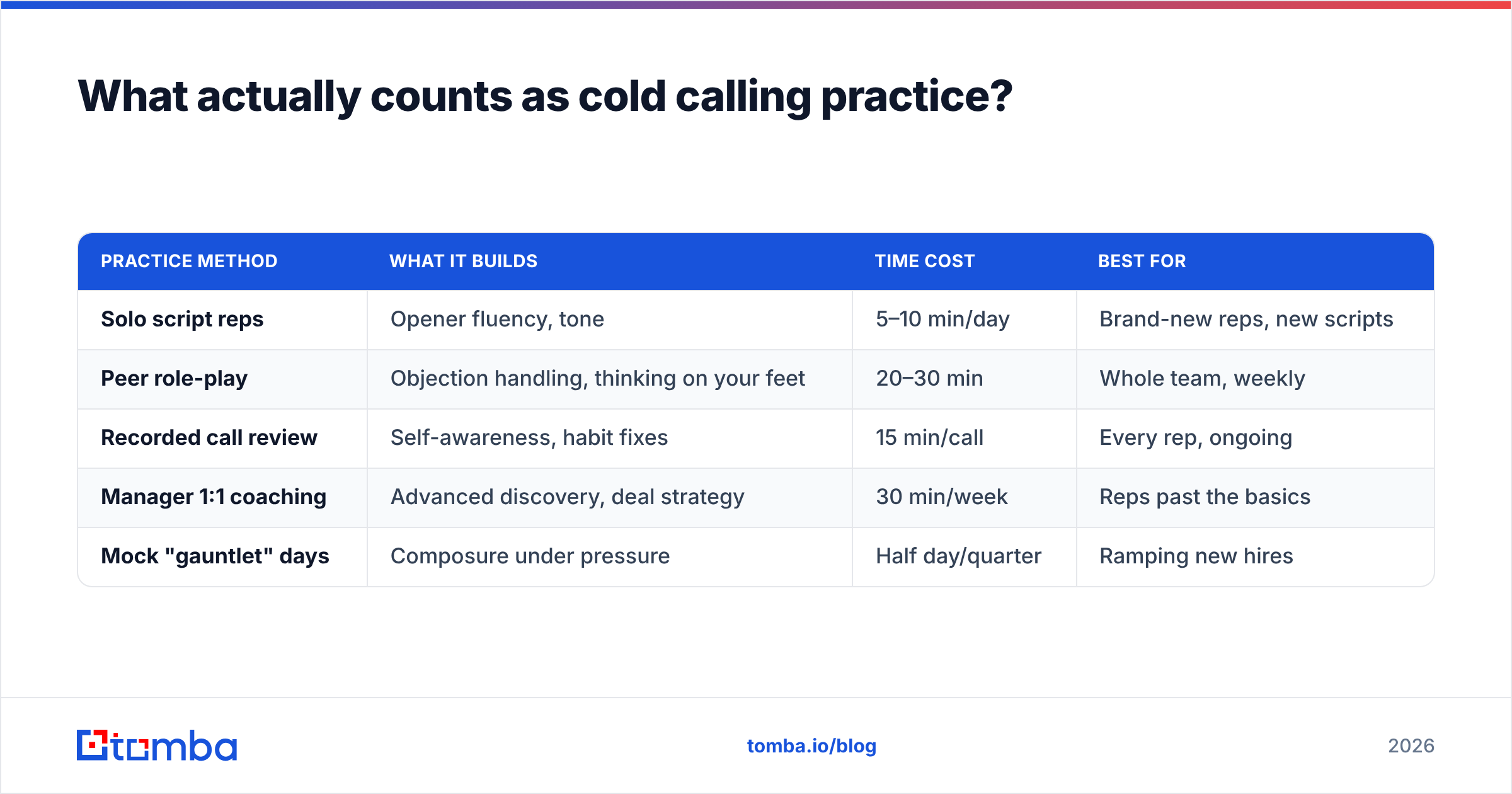
Here is how the main practice methods compare:
| Practice method | What it builds | Time cost | Best for |
|---|---|---|---|
| Solo script reps | Opener fluency, tone | 5–10 min/day | Brand-new reps, new scripts |
| Peer role-play | Objection handling, thinking on your feet | 20–30 min | Whole team, weekly |
| Recorded call review | Self-awareness, habit fixes | 15 min/call | Every rep, ongoing |
| Manager 1:1 coaching | Advanced discovery, deal strategy | 30 min/week | Reps past the basics |
| Mock "gauntlet" days | Composure under pressure | Half day/quarter | Ramping new hires |
Notice that live dialing is not on this list. Dialing is the game. The table above is the training camp. Teams that blur the two end up "practicing" on buyers and wondering why their response rate stays flat.
Which cold calling drills should you run first?#
Start with the drills that isolate one skill at a time. Trying to fix your opener, objection handling, and tone all in one call is like trying to fix your golf swing, grip, and stance in a single shot — you improve nothing.
Here are nine drills, ordered from beginner to advanced:
- The 10-opener sprint. Say your opening line out loud ten times in a row, changing one word each time until it feels natural. You are killing the robotic first-line delivery that triggers instant hang-ups.
- The objection wall. Have a peer fire your five most common objections back-to-back with no gaps. You learn to respond in under two seconds instead of freezing.
- The mute-and-mirror. Record yourself, then listen on mute reading only your body language and pacing. Most reps talk 40% too fast when nervous.
- The one-breath pitch. Deliver your value prop in a single breath. If you run out of air, it is too long. Buyers tune out at second 15.
- The cold-read discovery. A peer plays a random persona; you have to ask three good questions before pitching anything. Builds curiosity over pitching.
- The gatekeeper gauntlet. Practice getting past an assistant five times in a row. Different tactic each round.
- The tone ladder. Say the same sentence angry, bored, excited, then neutral-confident. Learn to control the instrument.
- The silence hold. After asking for the meeting, stay silent for a full ten seconds. Reps who talk into silence talk themselves out of deals.
- The recovery rep. A peer hangs up on you mid-sentence; you have to redial (in the drill) and open confidently. Kills the fear of the next call.
Run one or two of these per day. Fifteen focused minutes beats an hour of unfocused "practice calls."
How do you use role-play without it feeling fake?#
The number-one complaint about role-play is that it feels awkward and nothing like a real call. That is usually a setup problem, not a role-play problem.
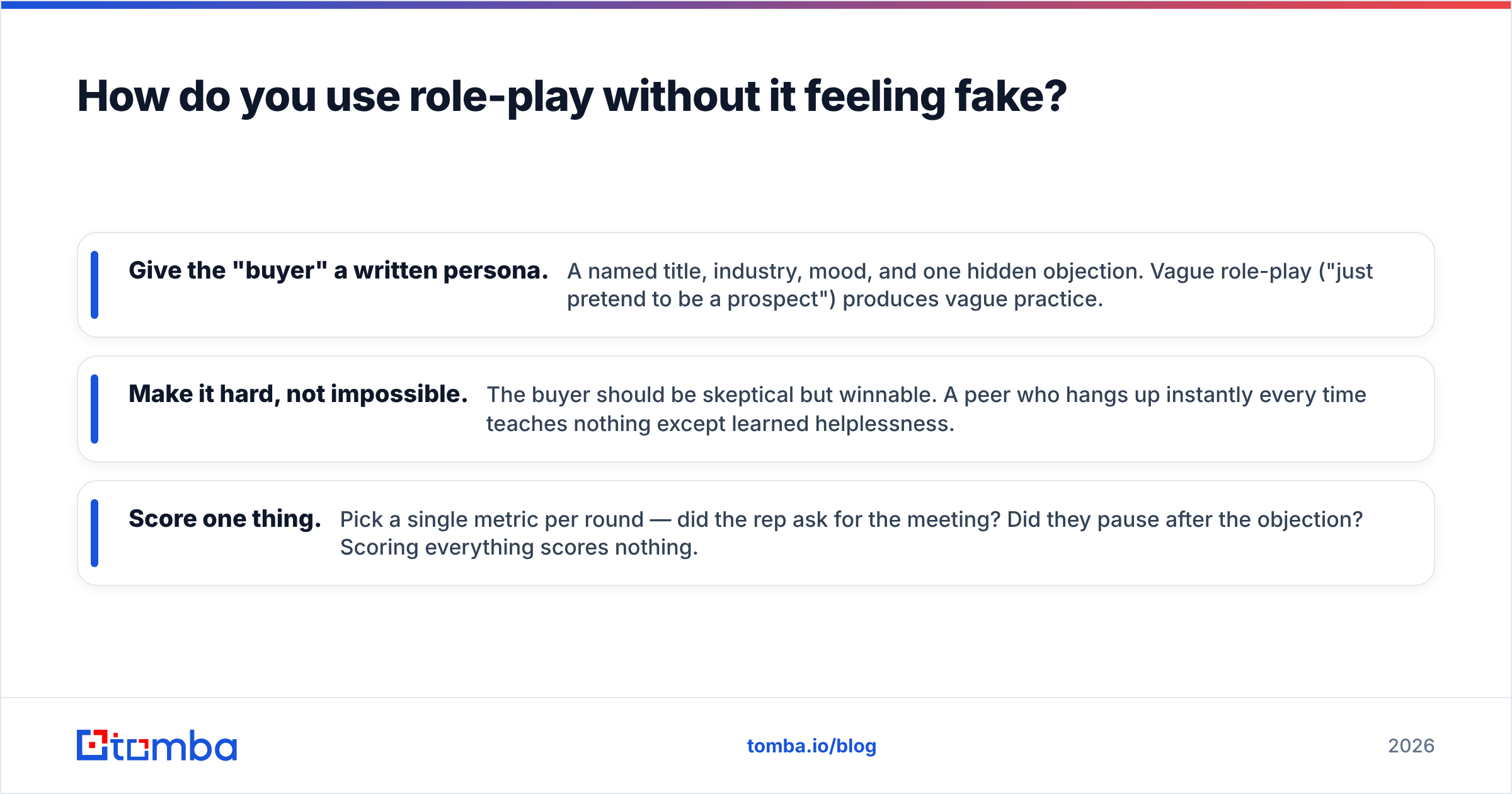
Fix it with three rules:
- Give the "buyer" a written persona. A named title, industry, mood, and one hidden objection. Vague role-play ("just pretend to be a prospect") produces vague practice.
- Make it hard, not impossible. The buyer should be skeptical but winnable. A peer who hangs up instantly every time teaches nothing except learned helplessness.
- Score one thing. Pick a single metric per round — did the rep ask for the meeting? Did they pause after the objection? Scoring everything scores nothing.
Gong's conversation research consistently shows that specific, measurable behaviors — talk-to-listen ratio, question count, monologue length — separate top performers. Role-play is where you drill those exact behaviors before they cost you a real conversation.
Rotate who plays the buyer. Reps learn a surprising amount about their own script by having to poke holes in a teammate's.
What should you record and review after practice?#
Record every practice call and a sample of live calls, then review with a checklist instead of a vibe. "That felt good" is not coaching data.
A simple review checklist:
- Did I open with a reason for the call in the first ten seconds?
- How long was my longest monologue? (Aim under 30 seconds.)
- Did I ask more questions than I answered?
- Where did the prospect's tone change — and did I notice in the moment?
- Did I ask clearly for the next step?
Reviewing recordings is where most of the real learning happens, because live calls move too fast to self-assess. You will hear filler words, rushed pacing, and missed buying signals you had no idea were there. Ten minutes of honest review per day changes a rep faster than any pep talk.
Does your call list quality affect your practice?#
Yes — more than most managers admit. You can have flawless delivery and still fail if half your list is wrong numbers, disconnected lines, or people who left the company two years ago. Bad data makes even a well-practiced rep sound lost.
This is the hidden variable in cold calling practice. When reps burn their energy on dead numbers, they get demoralized before they reach the prospects who could actually say yes. The fix is to practice against the same quality of list you will use live: real decision-makers, verified numbers, current titles.
Two things keep your practice honest:
- Accurate phone data. Pulling direct-dial B2B phone numbers means your reps rehearse against realistic contacts, not placeholder junk.
- Validated numbers. Running your list through a phone validator before a session strips out disconnected lines so drill time isn't wasted on dead ends.
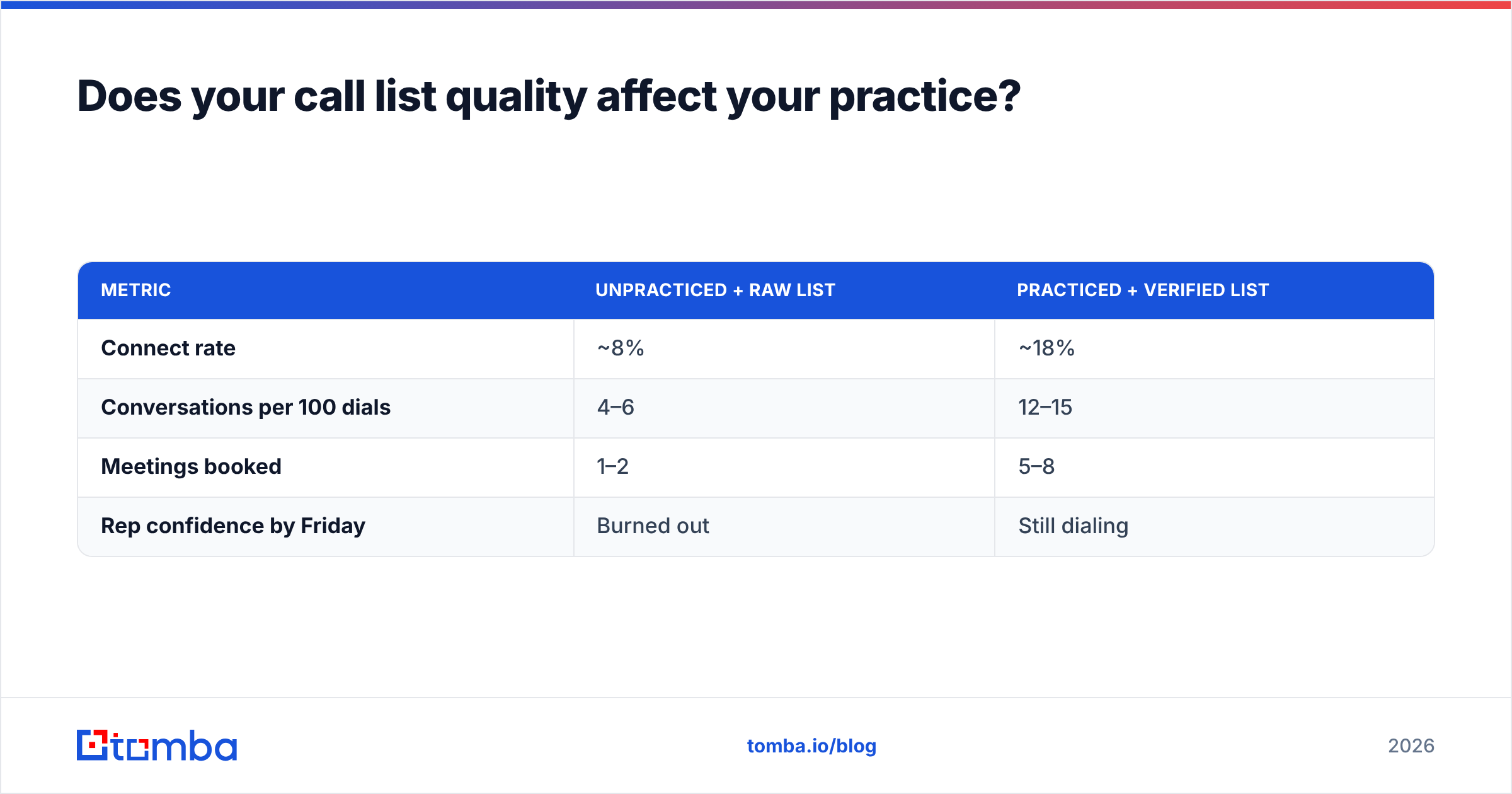
Here is how prepared versus unprepared calling stacks up over a typical week:
| Metric | Unpracticed + raw list | Practiced + verified list |
|---|---|---|
| Connect rate | ~8% | ~18% |
| Conversations per 100 dials | 4–6 | 12–15 |
| Meetings booked | 1–2 | 5–8 |
| Rep confidence by Friday | Burned out | Still dialing |
The numbers are illustrative, but the direction is not: skill and data compound together. Practicing your pitch while ignoring your list is like tuning a guitar with a broken string.
How do you build a weekly cold calling practice routine?#
Structure beats motivation. A rep who "practices when they feel like it" practices roughly never. Put it on the calendar as non-negotiable blocks.
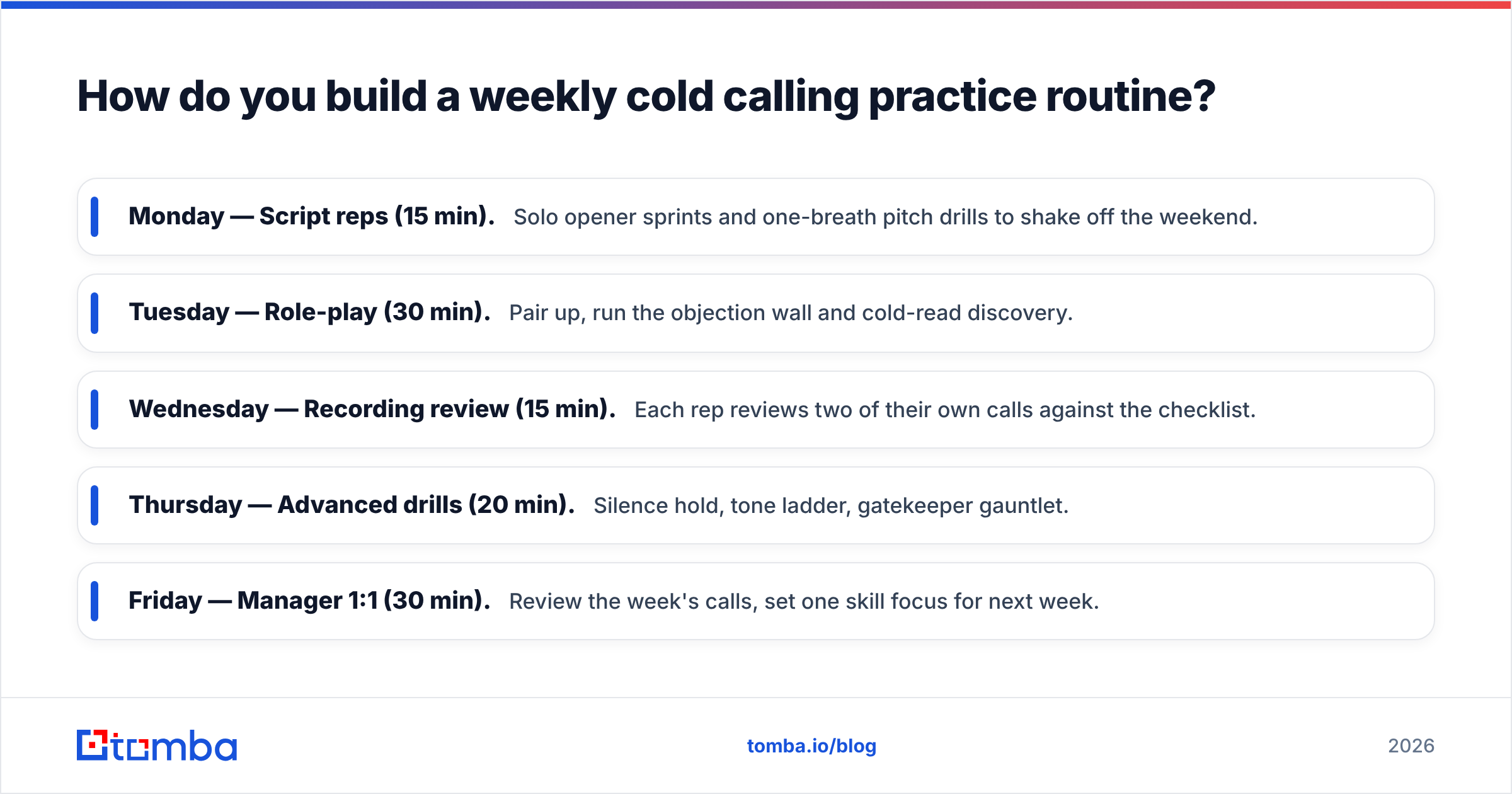
A proven weekly cadence:
- Monday — Script reps (15 min). Solo opener sprints and one-breath pitch drills to shake off the weekend.
- Tuesday — Role-play (30 min). Pair up, run the objection wall and cold-read discovery.
- Wednesday — Recording review (15 min). Each rep reviews two of their own calls against the checklist.
- Thursday — Advanced drills (20 min). Silence hold, tone ladder, gatekeeper gauntlet.
- Friday — Manager 1:1 (30 min). Review the week's calls, set one skill focus for next week.
Notice it is roughly 30 minutes a day, not a giant weekly block. Skill is built by frequency, not by cramming. A daily 15-minute drill will outrun a two-hour Friday session every quarter.
New hires should run a compressed, heavier version of this during ramp — including a quarterly "gauntlet day" where they take rapid-fire mock calls until composure becomes automatic. Sites like G2 list dedicated coaching and call-review software if you want to formalize this beyond a shared spreadsheet.
What tools make cold calling practice stick?#
You need three things: something to record calls, something to review them, and a clean list to practice against. The recording and review can start as simply as a phone and a shared doc. The list is where teams cut corners and pay for it.
If your reps are prospecting across email and phone, keeping contact data current is its own job. A B2B database with verified records means practice sessions and live sprints both run on the same trustworthy list — no more "the number's disconnected" mid-drill. And when a rep needs to fill in a missing decision-maker on the fly, a fast lookup keeps momentum instead of killing it.
The point is not to buy more tools. It is to remove the friction and bad data that make reps dread the phone in the first place.
Put your practice on a foundation of real data#
Great cold calling practice builds the skill. Great data makes sure that skill lands on the right person. The two are inseparable — a perfect pitch to a wrong number is still a wasted call.
Before your next practice sprint, build your list on contacts that are actually reachable. Tomba's Email Finder helps you pull verified professional contact details by name, company, or domain, so your reps rehearse and dial against real decision-makers instead of guesses. Pair it with verified phone data and you give your team something most sales floors never have: practice that mirrors the real thing. Check the Tomba pricing plans — including a free tier to start — and stop making your prospects pay for reps who never trained.
Practice like it's real, so that when it's real, it feels like practice.
Related guides#
// get started
Find, verify and enrich your first contacts today
Start on the free plan with 25 searches a month, then scale when your team is ready.
Free plan · No credit card required · GDPR & CCPA
// about the author