The Cold Calling Process: A Step-by-Step Guide for 2026
Cold calling still books meetings in 2026 — if you run a repeatable process instead of winging it. Here's the exact seven-stage system top reps use, with scripts, timing, and the metrics that matter.
Cold calling is not dead — bad cold calling is. The reps who still book meetings by phone in 2026 aren't smoother talkers or luckier dialers. They run a repeatable cold calling process: the same stages, in the same order, measured the same way, every single day.
This guide breaks that process into seven concrete stages you can copy today. No motivational filler, no "just be confident." Just the mechanics of turning a phone number into a booked meeting.
TL;DR#
- A cold calling process is a repeatable seven-stage system: list building → research → scripting → dialing → opening → objection handling → close and log.
- Data quality beats call volume. A clean, verified list of 40 accurate numbers outperforms 400 stale ones. Bad data is the single biggest silent killer of cold call ROI.
- The first 10 seconds decide the call. A permission-based opener beats the classic "How are you today?" by a wide margin.
- Objections are signals, not walls. The top four objections are predictable — script responses to them in advance.
- Track connect rate, conversation rate, and meetings booked — not just dials — or you're optimizing the wrong thing.
What is a cold calling process?#
A cold calling process is a documented, repeatable sequence of steps a sales rep follows to turn a cold prospect into a booked conversation over the phone. Think of it like a pilot's pre-flight checklist: the pilot isn't nervous or improvising, they're running a proven sequence so nothing critical gets skipped. Cold calling works the same way — the reps who hate it most are usually the ones with no checklist, guessing at every call.
The process matters because cold calling is a numbers game layered on top of a skill game. You can't control who picks up, but you can control the quality of your list, the sharpness of your opener, and how you respond when someone pushes back. Systematize the controllable parts and the uncontrollable parts start to average out in your favor.
Here are the seven stages of a modern cold calling process:
- Build the list — assemble accurate, targeted contact and phone data for accounts that fit your ICP.
- Research the prospect — spend 60–90 seconds finding one relevant, specific hook per contact.
- Prepare the script and openers — write a permission-based opener and a value hypothesis you can say in one breath.
- Dial in focused blocks — batch calls into power hours instead of scattering them across the day.
- Open and earn the next 30 seconds — pattern-interrupt, name the reason for the call, ask for permission.
- Handle objections — respond to the four predictable objections with pre-written, non-defensive replies.
- Close and log — book the next step, then record the outcome so your data compounds.
Why does the list matter more than the script?#
Because you can have the best script on earth and it's worthless dialed at the wrong number. Data quality is the foundation every other stage sits on, and it's where most teams quietly lose. Industry research consistently shows B2B contact data decays at roughly 25–30% per year as people change jobs, companies restructure, and direct dials get reassigned. A list you built 12 months ago is already a third wrong.
A weak list creates three compounding problems:
- Wasted dials. Every disconnected number or wrong contact is time your rep will never get back.
- Damaged morale. Nothing burns out a caller faster than 40 dead numbers in a row.
- Distorted metrics. If your connect rate is tanking because of bad data, you'll "fix" the wrong thing — rewriting a script that was never the problem.
This is where sourcing accurate contact data up front pays for itself. Pulling verified direct dials with a phone finder and confirming they're live with a phone validator means your reps spend their power hour talking to humans, not listening to disconnect tones. If you also run multichannel sequences, enriching each account with a verified email finder lets you follow every call with a same-day email while you're still top of mind.
What does each stage of the cold calling process look like?#
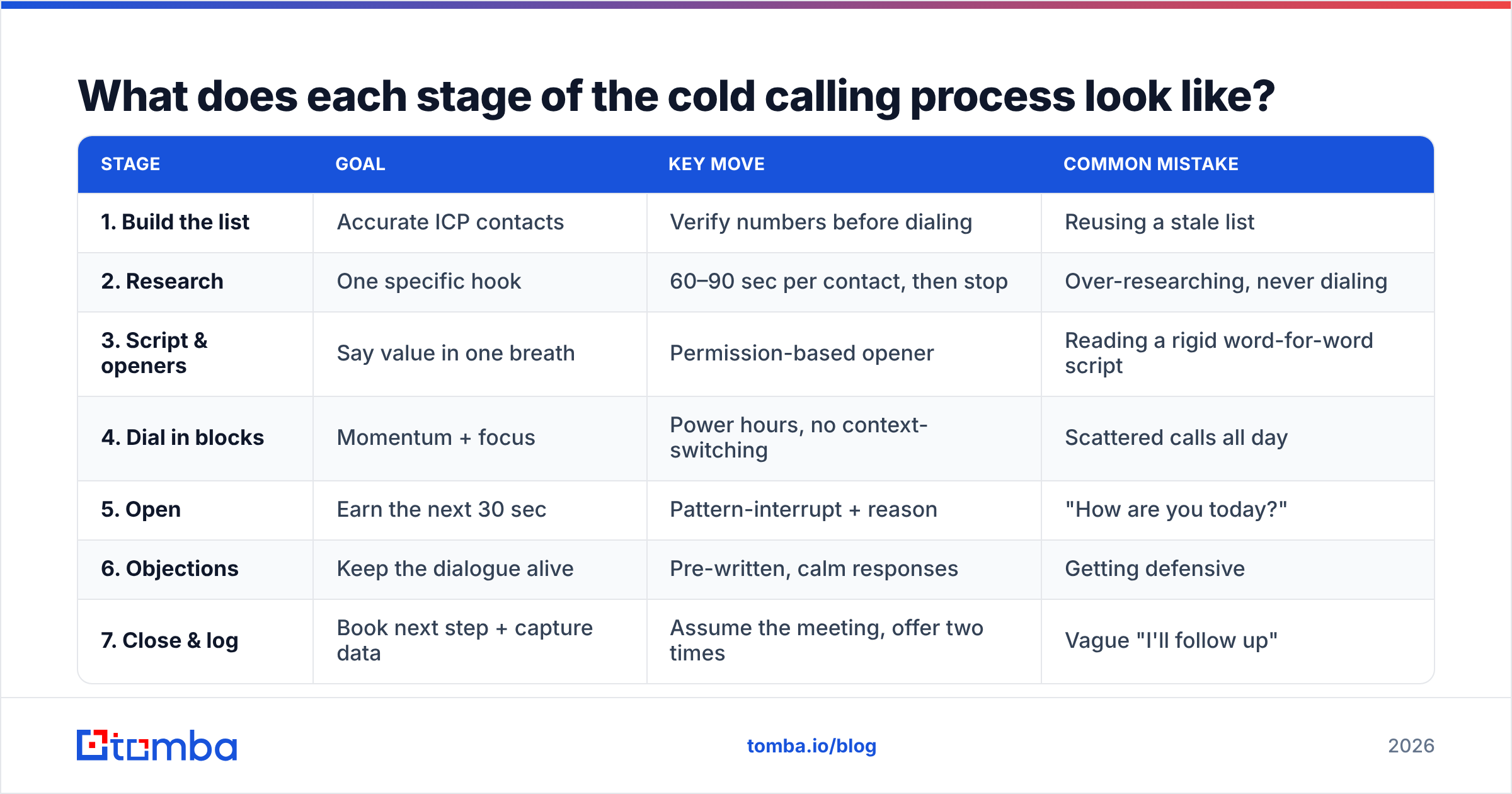
Here's how the seven stages break down in practice, with the goal and the key move for each.
| Stage | Goal | Key move | Common mistake |
|---|---|---|---|
| 1. Build the list | Accurate ICP contacts | Verify numbers before dialing | Reusing a stale list |
| 2. Research | One specific hook | 60–90 sec per contact, then stop | Over-researching, never dialing |
| 3. Script & openers | Say value in one breath | Permission-based opener | Reading a rigid word-for-word script |
| 4. Dial in blocks | Momentum + focus | Power hours, no context-switching | Scattered calls all day |
| 5. Open | Earn the next 30 sec | Pattern-interrupt + reason | "How are you today?" |
| 6. Objections | Keep the dialogue alive | Pre-written, calm responses | Getting defensive |
| 7. Close & log | Book next step + capture data | Assume the meeting, offer two times | Vague "I'll follow up" |
Stage 2: Research without over-researching#
The trap here is doing 20 minutes of LinkedIn digging per prospect and calling four people all day. Cap it. You need exactly one relevant, specific reason you're calling this person: a recent funding round, a new role, a hiring spree, a tech-stack signal. One hook, 90 seconds, then dial. Data enrichment tools can pre-load a lot of this context so your reps aren't starting from a blank page.
Stage 3: The script that doesn't sound like a script#
Great openers aren't rigid — they're a frame. HubSpot's sales research has repeatedly found that a permission-based opener — acknowledging you're an interruption and asking for 27 seconds — outperforms pretending you're old friends. Write a value hypothesis you can deliver in one breath: "We help [role] at [company type] cut [specific pain] without [common tradeoff]." If you can't say it in one breath, it's too long.
How do you handle cold call objections?#
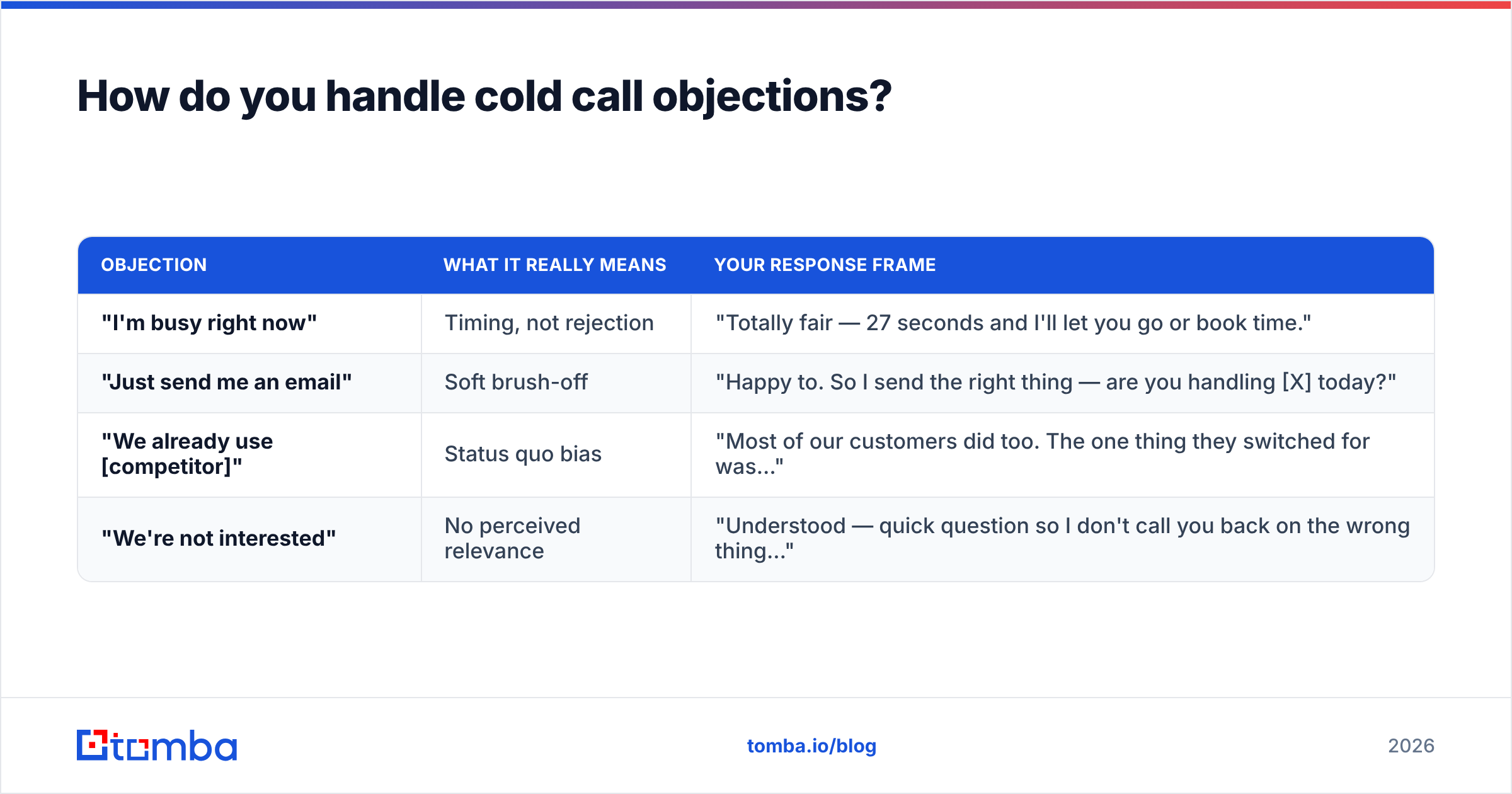
You handle objections by expecting them. The overwhelming majority of cold call pushback falls into four predictable buckets, so there's no excuse for being caught off guard.
| Objection | What it really means | Your response frame |
|---|---|---|
| "I'm busy right now" | Timing, not rejection | "Totally fair — 27 seconds and I'll let you go or book time." |
| "Just send me an email" | Soft brush-off | "Happy to. So I send the right thing — are you handling [X] today?" |
| "We already use [competitor]" | Status quo bias | "Most of our customers did too. The one thing they switched for was…" |
| "We're not interested" | No perceived relevance | "Understood — quick question so I don't call you back on the wrong thing…" |
The golden rule: never get defensive. An objection is the prospect staying on the line, which is a gift. Acknowledge, ask one question, and steer back toward relevance. If they truly aren't a fit, disqualify fast and move on — protecting your calendar is part of the process too.
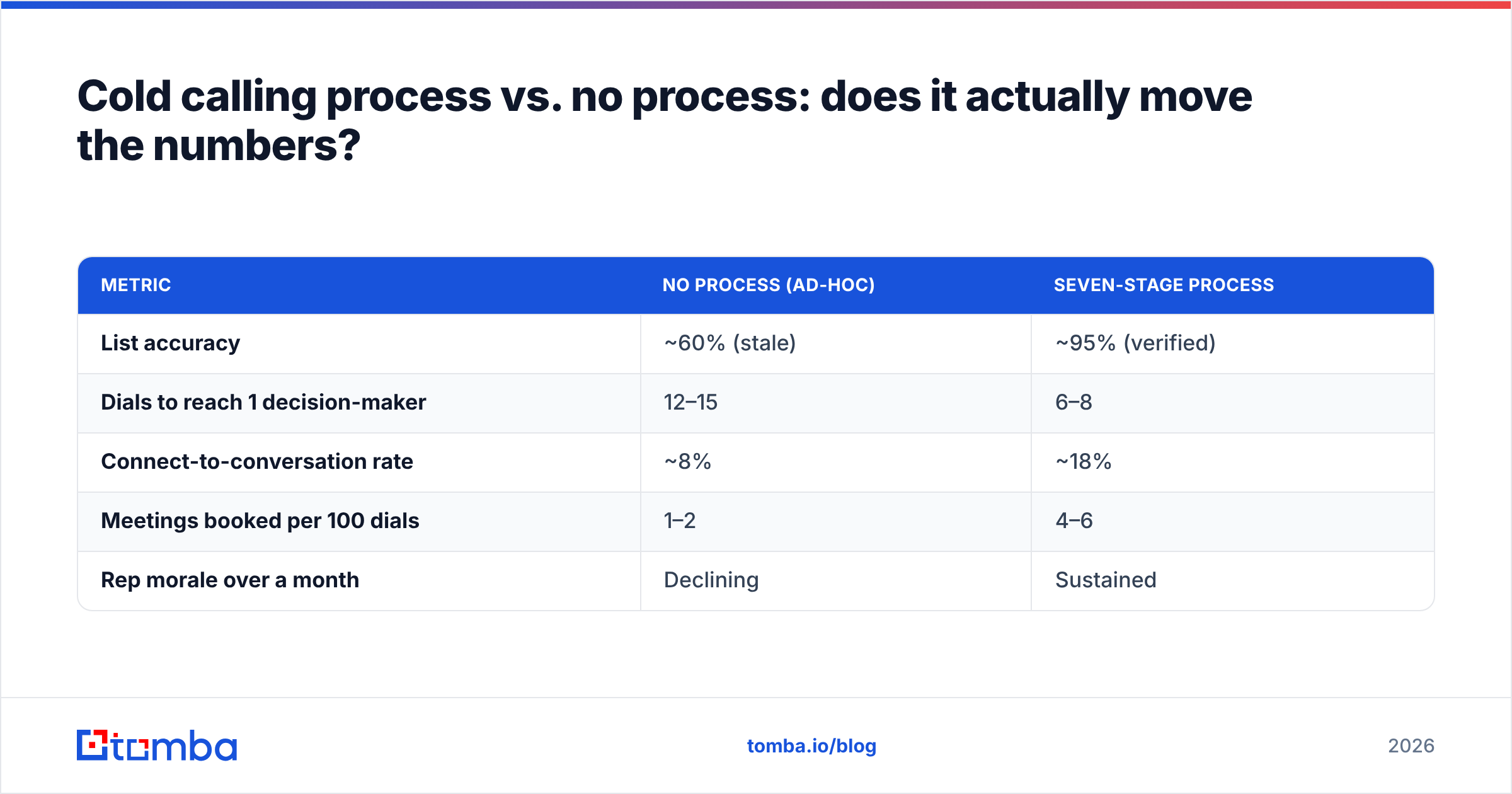
Cold calling process vs. no process: does it actually move the numbers?#
Yes, and the gap is not subtle. Here's a realistic comparison of a rep running an ad-hoc approach versus the seven-stage process, based on typical B2B benchmarks.
| Metric | No process (ad-hoc) | Seven-stage process |
|---|---|---|
| List accuracy | ~60% (stale) | ~95% (verified) |
| Dials to reach 1 decision-maker | 12–15 | 6–8 |
| Connect-to-conversation rate | ~8% | ~18% |
| Meetings booked per 100 dials | 1–2 | 4–6 |
| Rep morale over a month | Declining | Sustained |
The difference isn't talent — it's that half the ad-hoc rep's dials are wasted on bad data and weak openers before skill even enters the picture. Fix the foundation and the same rep, with the same voice, books two to three times the meetings.
What metrics should you track in your cold calling process?#
Track the metrics that tell you where the process is leaking, not just how hard people are working. Dials alone is a vanity metric — a rep can hit 100 dials on a garbage list and book nothing.
- Connect rate — connects ÷ dials. Low? Your data or your call timing is the problem, not your pitch.
- Conversation rate — meaningful conversations ÷ connects. Low? Your opener isn't earning the next 30 seconds.
- Conversion rate — meetings booked ÷ conversations. Low? Your value hypothesis or close needs work.
- Meetings booked — the number that actually feeds pipeline. This is the north star.
- Show rate — booked meetings that actually happen. A high book rate with a low show rate means you're booking soft "yeses."
Reviewing these weekly tells you exactly which stage to coach. If connect rate is fine but conversation rate is low, you don't need a better list — you need a better opening 10 seconds. Diagnose before you prescribe. Vendors like Salesforce and analysts at Gartner publish updated benchmarks worth calibrating against, and peer reviews on G2 can help you pick the dialer that fits your motion.
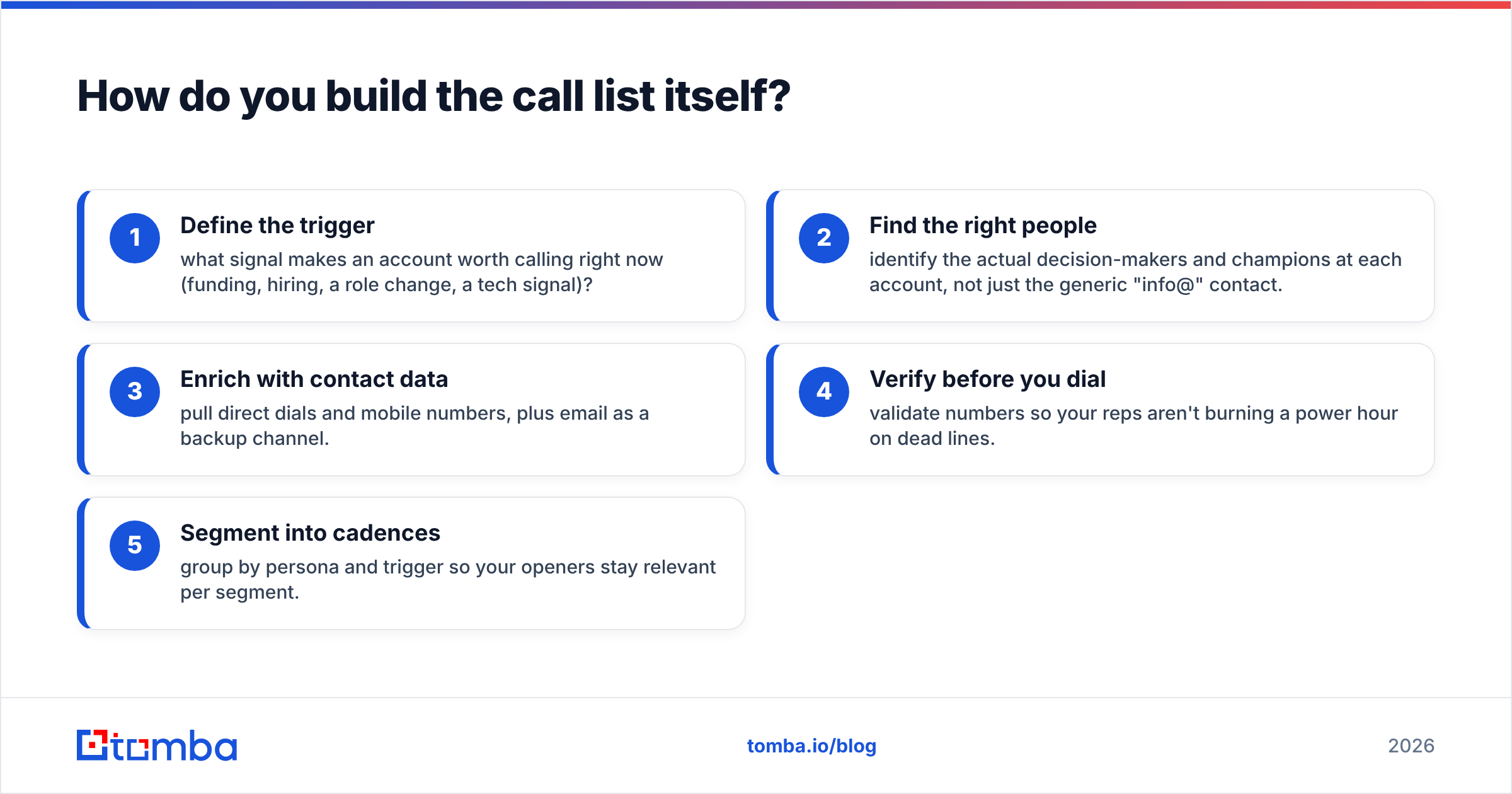
How do you build the call list itself?#
Start from your ICP and work down to verified direct dials. The sequence looks like this:
- Define the trigger — what signal makes an account worth calling right now (funding, hiring, a role change, a tech signal)?
- Find the right people — identify the actual decision-makers and champions at each account, not just the generic "info@" contact.
- Enrich with contact data — pull direct dials and mobile numbers, plus email as a backup channel.
- Verify before you dial — validate numbers so your reps aren't burning a power hour on dead lines.
- Segment into cadences — group by persona and trigger so your openers stay relevant per segment.
This is exactly the kind of repeatable, data-first workflow that separates teams who dread the phone from teams who quietly hit quota with it. Building your list from a maintained B2B database and enriching each record with data enrichment means the top of your process is solid before a single call is dialed — and everything downstream compounds from there.
Cold calling process FAQ#
How many cold calls should a rep make per day? Focus on quality blocks, not a raw number. Most high-performing reps run two to three focused "power hours" of 25–40 dials each on a clean list — far more effective than 150 scattered dials on a stale one.
What's the best time to cold call in 2026? Mid-morning (around 10–11 a.m.) and late afternoon (4–5 p.m.) in the prospect's local time zone still tend to have the highest connect rates. Test against your own segment — your data beats any generic rule.
Is cold calling still worth it compared to email? They're complementary, not competing. The strongest outbound motion pairs a verified call list with same-day follow-up emails. A call plus a personalized email beats either channel alone.
How long should a cold call script be? Your opener should be sayable in one breath (about 27 seconds). The rest of the "script" is a set of branches for the predictable objections — not a monologue to read.
Build the foundation your cold calling process depends on#
The single highest-leverage upgrade to your cold calling process isn't a new script — it's a list your reps can trust. Every wasted dial, every disconnect tone, and every "who gave you this number?" traces back to bad data.
Start there. Use Tomba's Email Finder to pull accurate, verified contact data for the accounts that fit your ICP, then layer in phone and enrichment data so every dial lands on a real decision-maker. Explore Tomba pricing — from a free tier of 25 searches a month up to Starter at $49/mo — and give your reps a foundation worth calling from. The script is coachable. The data has to be right first.
Related guides#
Ready to find emails that actually work?
Join 150,000+ professionals who stopped guessing and started sending. Free credits on signup — no credit card required.
Get the Tomba newsletter
Practical outbound tactics and product updates — once every two weeks.
About the author