Cold Calling Quality vs Quantity: What Actually Wins in 2026
More dials or better dials? We break down the cold calling quality vs quantity debate with real math, a decision framework, and where each approach wins.
Every sales floor eventually splits into two camps. One says the phone is a numbers game: dial enough people and math does the rest. The other says a handful of well-researched, well-timed calls beats a wall of noise. Both camps have quota-crushers and both have people who miss every month. So which side is right?
The honest answer: it's not a binary. Quality and quantity are two dials on the same board, and the winning setting depends on your price point, your list, and how many hours your reps actually have. This guide gives you the math and a framework to set those dials for your team — not a slogan.
TL;DR#
- Neither pure approach wins. Pipeline is a function of dials × connect rate × conversion rate. Quantity people ignore the last two terms; quality people ignore the first. You need all three.
- Quality raises your ceiling; quantity raises your floor. Low-effort volume protects you from a cold streak. Research and personalization determine how high a good streak can go.
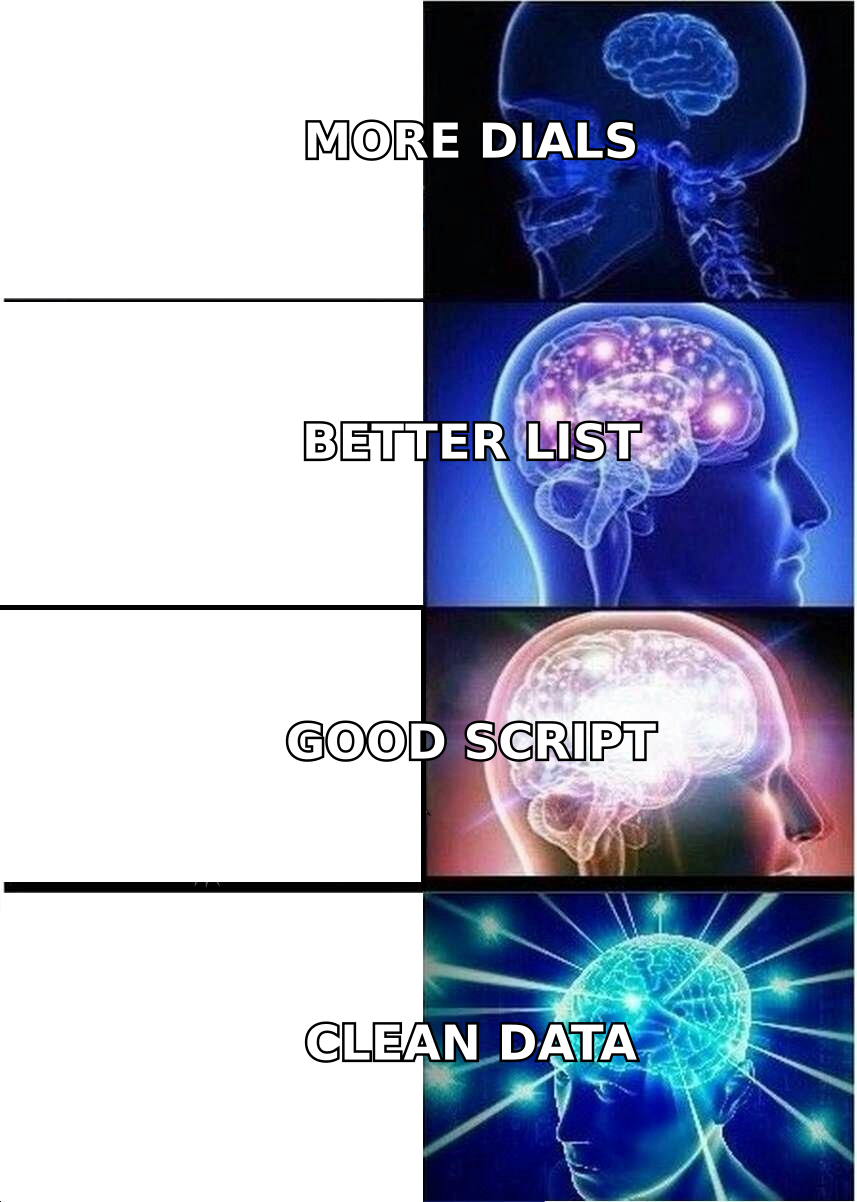
- Bad data breaks both models. If 30% of your numbers are wrong, more dials just means more wrong numbers. Clean contact data is the multiplier under everything.
- Price point decides the mix. Sub-$5k deals reward volume-tilted motion. Enterprise and multi-stakeholder deals reward research-tilted motion.
- The best reps run "efficient quality" — enough research to earn the conversation, standardized enough to hit real dial volume.
What Does "Quality vs Quantity" Actually Mean in Cold Calling?#
Quantity means maximizing activity: more dials per hour, more contacts touched per day, more shots on goal. The bet is that connect and conversion rates are roughly fixed, so output scales with input.
Quality means maximizing the value of each attempt: researching the prospect, timing the call, tailoring the opener, calling the right person at the right account. The bet is that a better attempt converts far above the baseline, so you need fewer of them.
The trap is treating these as opposing philosophies. They're inputs to the same equation:
Pipeline = Dials × Connect Rate × Conversation-to-Meeting Rate × Average Deal Value
Quantity moves the first term. Quality moves the middle two (and sometimes the fourth, by getting you into bigger accounts). A rep who wins on only one term is leaving the other on the table.

Is More Dials Really a Numbers Game?#
Yes — but only if the other numbers hold. The "it's a numbers game" mantra quietly assumes your connect rate and conversion rate stay constant as volume climbs. In practice they don't, for three reasons.
Connect rates decay with list quality. The first 50 names on your list are usually your best-fit accounts. Dial 500 and you're deep into marginal prospects who were never going to answer or buy. Volume without list discipline dilutes the average.
Rushed calls convert worse. Cramming 120 dials into a day often means no pre-call prep, generic openers, and a rep who sounds like a rep. That drags the conversion term down even as the dial term goes up.
Bad numbers waste the whole attempt. If your dialer is loaded with stale direct lines, a big share of dials never had a chance. According to HubSpot's sales research, it already takes multiple touches to reach most buyers — every wrong number resets that counter to zero.
So volume works, but it's leveraged by data. Feeding your dialer accurate B2B phone numbers is what keeps the connect-rate term from collapsing as you scale attempts.
When Does Quantity Actually Win?#
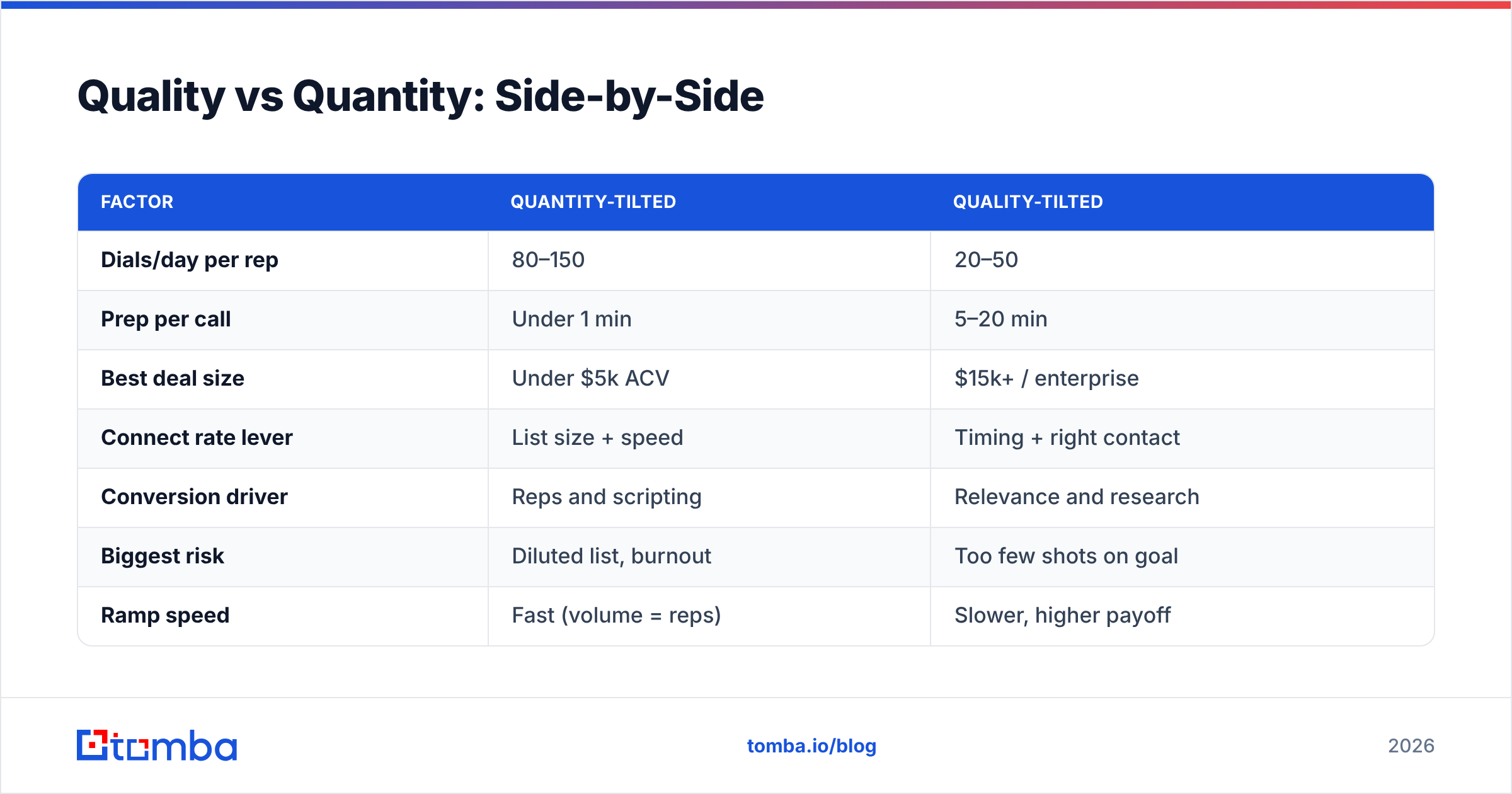
Volume-tilted calling is the right call in specific, common situations:
- Low ACV, high-volume markets. When deals are small and plentiful, the cost of researching each prospect exceeds the value it adds. Dial more, qualify fast, move on.
- Early-career reps building reps. New SDRs need pattern recognition. You can't get 200 objection reps from 20 calls. Volume is how skill compounds early.
- Broad, undifferentiated ICPs. If almost any company in a category can buy, deep research per account has low marginal value.
- Time-sensitive plays. Event follow-ups, funding-announcement blitzes, or expiring-offer campaigns reward speed over craft.
- Testing a new script or segment. You need statistical volume to know whether a message works before you invest in personalizing it.
In these cases, quantity raises your floor. On a bad week, sheer activity still produces enough connects to book something.
When Does Quality Win Instead?#
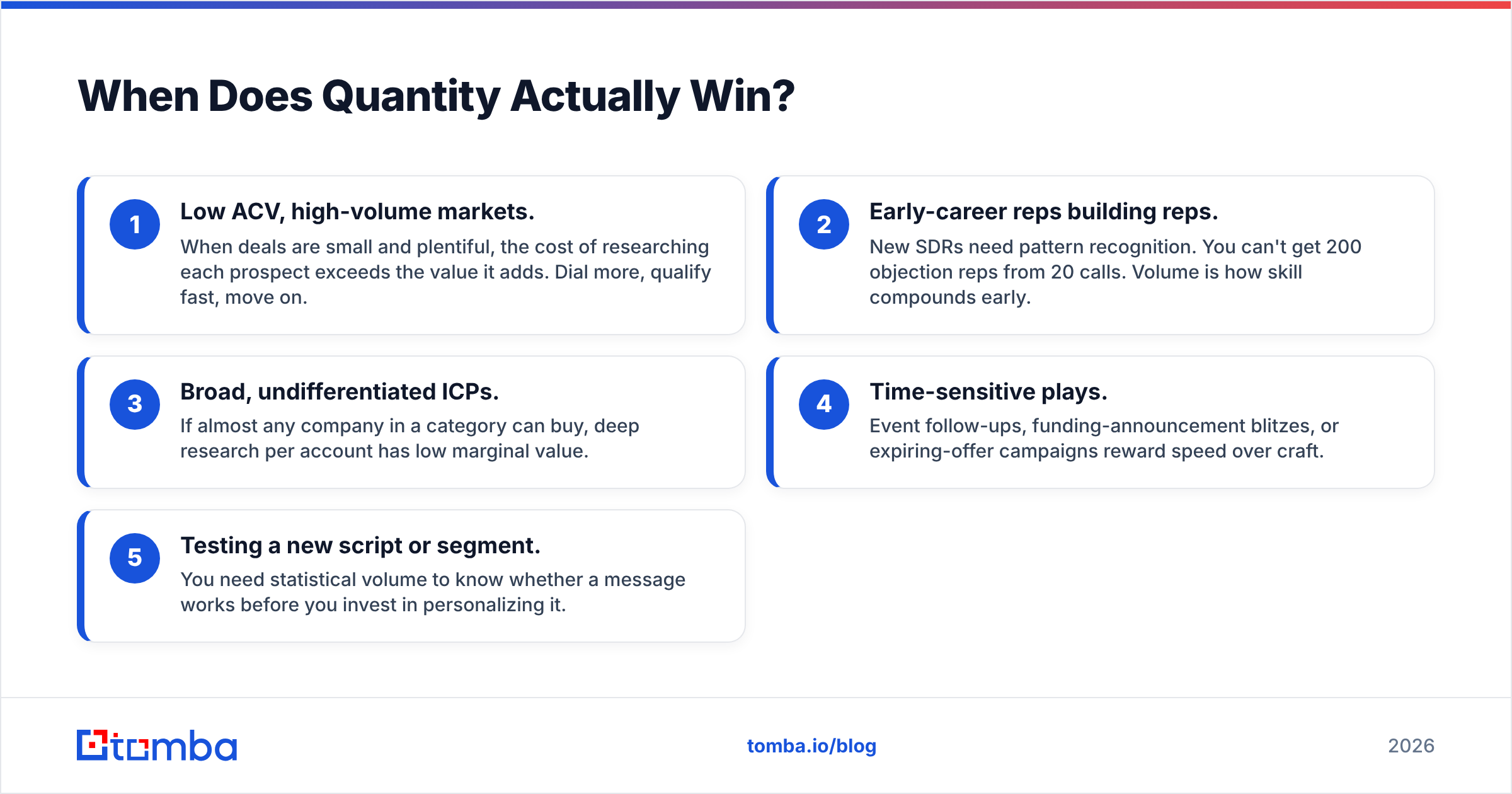
Research-tilted calling pulls ahead when the stakes per call go up:
- High ACV or enterprise deals. When one meeting is worth six figures, spending 20 minutes on research is trivially worth it.
- Multi-stakeholder buying committees. Gartner's research on B2B buying shows a typical purchase involves six to ten decision-makers. You can't brute-force that map — you have to navigate it.
- Named-account or ABM motions. When your target list is 100 specific logos, every account matters and generic outreach burns a scarce resource.
- Saturated prospects. If your ICP gets ten cold calls a week, only a genuinely relevant, well-timed call breaks through.
- Technical or senior buyers. VPs and specialists detect a spray-and-pray opener instantly and hang up.
Here quality raises your ceiling. A researched call into the right account can produce a deal that a hundred random dials never would.
Quality vs Quantity: Side-by-Side#
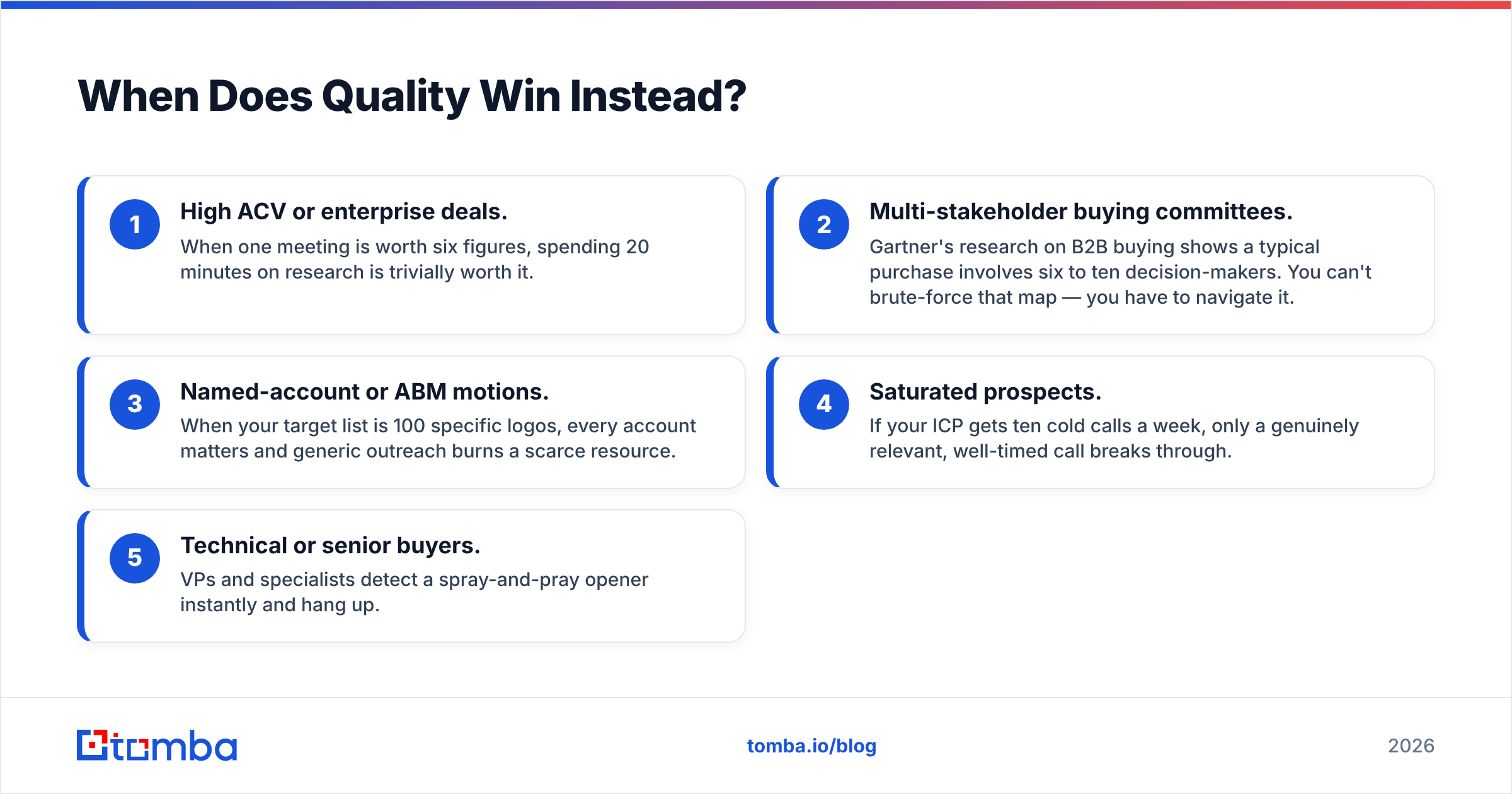
| Factor | Quantity-tilted | Quality-tilted |
|---|---|---|
| Dials/day per rep | 80–150 | 20–50 |
| Prep per call | Under 1 min | 5–20 min |
| Best deal size | Under $5k ACV | $15k+ / enterprise |
| Connect rate lever | List size + speed | Timing + right contact |
| Conversion driver | Reps and scripting | Relevance and research |
| Biggest risk | Diluted list, burnout | Too few shots on goal |
| Ramp speed | Fast (volume = reps) | Slower, higher payoff |
| Data dependency | High | Very high |
Read the table as a slider, not a switch. Most teams live somewhere in the middle and shift the pointer by segment.
What's the Hidden Variable Both Camps Ignore?#
Data accuracy. It sits underneath both terms of the equation, and it's where most cold-calling debates go wrong.
If a third of your direct dials are outdated, then:
- Your quantity camp is inflating activity with dead numbers. 150 dials with 30% bad data is really ~105 real attempts, plus wasted time on voicemails to disconnected lines.
- Your quality camp is researching the perfect pitch for a person you can't actually reach.
Fixing data is the rare lever that improves both approaches at once. Before you argue about dial targets, make sure the numbers being dialed are real. Running your list through a phone validator to strip disconnected and reassigned lines does more for connect rate than any script tweak. And enriching thin records with title, seniority, and department — via contact enrichment — is what lets a "quantity" rep make a fast call feel targeted without 20 minutes of manual digging.
This is the reconciliation the whole debate needs: clean, enriched data lets you have volume and relevance at the same time. You stop trading one for the other.
How Do You Set the Right Mix for Your Team?#
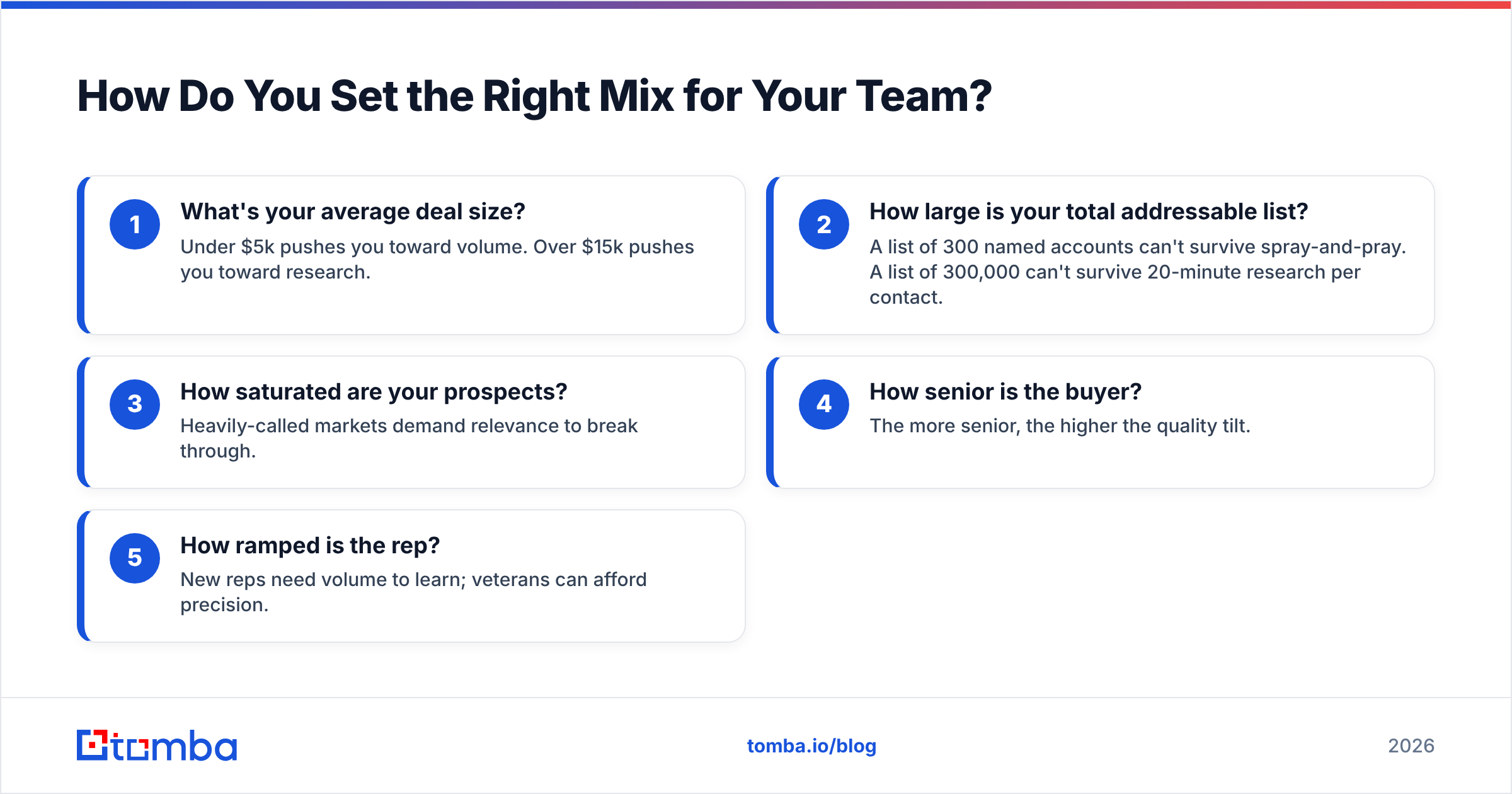
Use a short diagnostic instead of a philosophy. Answer these and your dial settings become obvious.
- What's your average deal size? Under $5k pushes you toward volume. Over $15k pushes you toward research.
- How large is your total addressable list? A list of 300 named accounts can't survive spray-and-pray. A list of 300,000 can't survive 20-minute research per contact.
- How saturated are your prospects? Heavily-called markets demand relevance to break through.
- How senior is the buyer? The more senior, the higher the quality tilt.
- How ramped is the rep? New reps need volume to learn; veterans can afford precision.
A practical default for most B2B teams: efficient quality. Standardize the research so it takes two minutes, not twenty — pull a verified direct line, a current title, a recent trigger event, and one relevant hook. That keeps dial volume respectable (say 50–80 real connects-worthy attempts a day) while every call clears the relevance bar. You're not choosing a camp; you're removing the friction that forced the choice.
Pulling that pre-call context from a single B2B database instead of five browser tabs is what makes "efficient quality" possible at scale. The bottleneck was never the rep's willingness to research — it was how long research took per contact.
What Metrics Should You Actually Track?#
Stop reporting dials as your headline number. Track the full funnel so you can see which term is dragging:
- Connect rate (connects ÷ dials) — diagnoses data and timing quality.
- Conversation rate (real conversations ÷ connects) — diagnoses opener and targeting.
- Meeting rate (meetings ÷ conversations) — diagnoses pitch and qualification.
- Meetings per hour — the real productivity metric that balances both dials.
When meetings-per-hour is your north star, the quality-vs-quantity fight dissolves. A rep who books more meetings per hour is optimized whether they got there with 120 fast dials or 40 researched ones. Peer-review sites like G2's sales engagement category are full of tools promising more dials — but the teams that win are the ones measuring outcomes per hour, not activity for its own sake.
Putting It Together: A Balanced Cold-Calling Playbook#
Here's the synthesis in one motion you can hand a rep:
- Segment first. Split your list into "volume" (broad, low-ACV) and "priority" (named, high-ACV) buckets. They get different dial cadences.
- Clean before you call. Validate numbers and enrich records so no attempt is wasted on bad data.
- Standardize the two-minute prep. Verified line, title, trigger, one hook. Every call clears the bar without killing volume.
- Set segment-specific targets. High volume on the broad bucket, lower volume with deeper prep on the priority bucket.
- Measure meetings per hour, not raw dials, and let the data reset the mix each quarter.
That's the endgame. Quantity gives you enough shots. Quality makes each shot count. Accurate data is what lets you raise both at once instead of robbing one to fund the other.
Get the Data Layer Right First#
Before you re-litigate dial targets, fix the input that undermines every argument: the contacts themselves. If your reps are calling verified, enriched, correctly-mapped decision-makers, "quality vs quantity" stops being a fight and becomes a dial you tune per segment.
Tomba's Phone Finder helps you build clean, current call lists — verified direct lines and enriched contact records — so every dial your team makes is a real attempt at the right person. Start on the free tier (25 searches a month), and check Tomba pricing when you're ready to scale from a rep to a full floor. Feed your dialer better data, and both camps finally get what they wanted.
Related guides#
Ready to find emails that actually work?
Join 150,000+ professionals who stopped guessing and started sending. Free credits on signup — no credit card required.
Get the Tomba newsletter
Practical outbound tactics and product updates — once every two weeks.
About the author