Cold Calling Questions That Book More Meetings in 2026
The right cold calling questions turn a 20-second brush-off into a real conversation. Here are 30+ discovery, qualifying, and objection-handling questions that actually open deals.
Most cold calls die in the first 15 seconds — not because the pitch is bad, but because the rep never asks a question worth answering. A good pitch tells. A good question makes the prospect think. And thinking is what keeps them on the line.
This guide gives you 30+ cold calling questions organized by where they belong in the call: openers, discovery, qualifying, objection-handling, and closing for the meeting. Steal them, adapt them to your market, and stop reading scripts at people.
TL;DR#
- Questions beat pitches. The rep who asks earns the right to talk; the rep who talks earns a hang-up.
- Sequence matters: permission-based opener → problem discovery → impact → qualifying → book the meeting.
- Open-ended questions ("what does that process look like today?") uncover pain; closed questions confirm and advance.
- Objections are questions in disguise — answer them with a question, not a defense.
- Great calls start before the dial — a verified number and accurate contact data (from a tool like Tomba's phone finder) mean you spend time talking, not chasing wrong extensions.
Why do cold calling questions matter more than the pitch?#
Think of a cold call like a first date. If you spend the whole time listing your accomplishments, you're not getting a second one. If you ask questions the other person actually wants to answer, they lean in.
Technically, questions do three jobs at once on a cold call:
- They lower resistance. A prospect braced for a pitch relaxes when you ask about them.
- They surface pain you can tie your product to — you can't sell a solution to a problem nobody has named out loud.
- They give you control. Whoever is asking the questions is steering the conversation, even when the other person is doing most of the talking.
Data backs this up. Gong's analysis of sales calls repeatedly shows that successful discovery calls have a more balanced talk-to-listen ratio and more questions asked, not fewer. The rep who interrogates gently outperforms the rep who monologues.
What are the best cold call opening questions?#
The opener has one job: earn 30 more seconds. You do that by being upfront, respectful of their time, and curious — not by launching into value props.
Try these permission-based openers:
- "Hey [Name], I know I'm an interruption — can I have 27 seconds to tell you why I called, and then you can tell me to get lost?"
- "Do you have a quick minute, or did I catch you in the middle of something?"
- "I'll be honest, this is a cold call — do you want to hang up, or give me a shot?"
- "Can I ask what prompted you to [download / attend / sign up] last week?" (for warm-ish outbound)
The "did I catch you at a bad time?" opener is polarizing — some reps swear by it, others say it hands the prospect an easy exit. Test both. What matters is that you sound like a human who respects that you're uninvited.
Which discovery questions uncover real pain?#
Discovery is the heart of the call. This is where open-ended cold calling questions do the heavy lifting. The goal is to get the prospect describing their current state in their own words so you can find the gap between where they are and where they want to be.
Use these:
- "Walk me through how your team handles [process] today."
- "What does a typical [week / campaign / quarter] look like for you right now?"
- "When you think about [area], what's working well — and what makes you want to throw your laptop?"
- "How are you measuring success there today?"
- "What made you look at solutions like this in the past — and why didn't you move forward?"
- "If you could wave a wand and fix one thing about [process], what would it be?"
Notice these questions can't be answered with "yes" or "no." That's the point. Every one of them invites a story, and stories are where pain lives.
Once you hear a problem, dig into impact:
- "How much time does that cost your team each week?"
- "What happens if this doesn't get solved by [timeframe]?"
- "Who else feels this pain when it goes wrong?"
How do you qualify a prospect over the phone?#
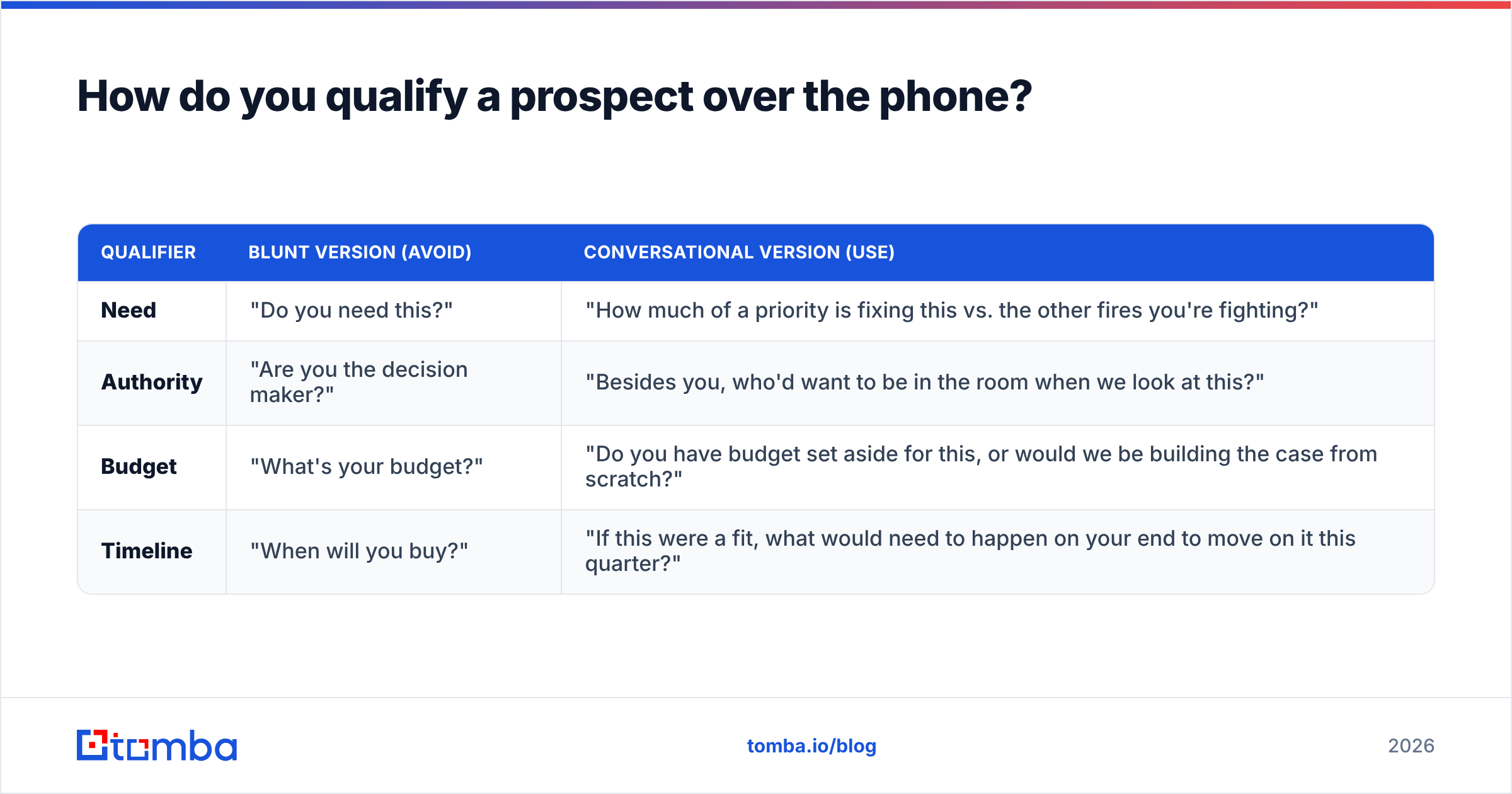
Not every conversation deserves a meeting. Qualifying questions protect your calendar and your quota. A common framework is BANT (Budget, Authority, Need, Timeline), but you don't want to sound like an airport security checkpoint. Weave qualifying into the conversation.
| Qualifier | Blunt version (avoid) | Conversational version (use) |
|---|---|---|
| Need | "Do you need this?" | "How much of a priority is fixing this vs. the other fires you're fighting?" |
| Authority | "Are you the decision maker?" | "Besides you, who'd want to be in the room when we look at this?" |
| Budget | "What's your budget?" | "Do you have budget set aside for this, or would we be building the case from scratch?" |
| Timeline | "When will you buy?" | "If this were a fit, what would need to happen on your end to move on it this quarter?" |
The right-hand column gets you the same information without triggering the defensiveness the left-hand column does. You're qualifying with the prospect, not at them.
A quick contrast of question types you'll use across the call:
- Open-ended questions — "What does that look like today?" Best for discovery; they get people talking.
- Closed questions — "Are you on HubSpot or Salesforce?" Best for confirming facts fast.
- Impact questions — "What's that costing you?" Best for building urgency around a pain you've already surfaced.
- Trade-off questions — "Is that a bigger priority than X?" Best for qualifying seriousness.
- Confirming questions — "So if I'm hearing you right…?" Best for showing you listened before you pitch.
How do you handle objections with questions?#
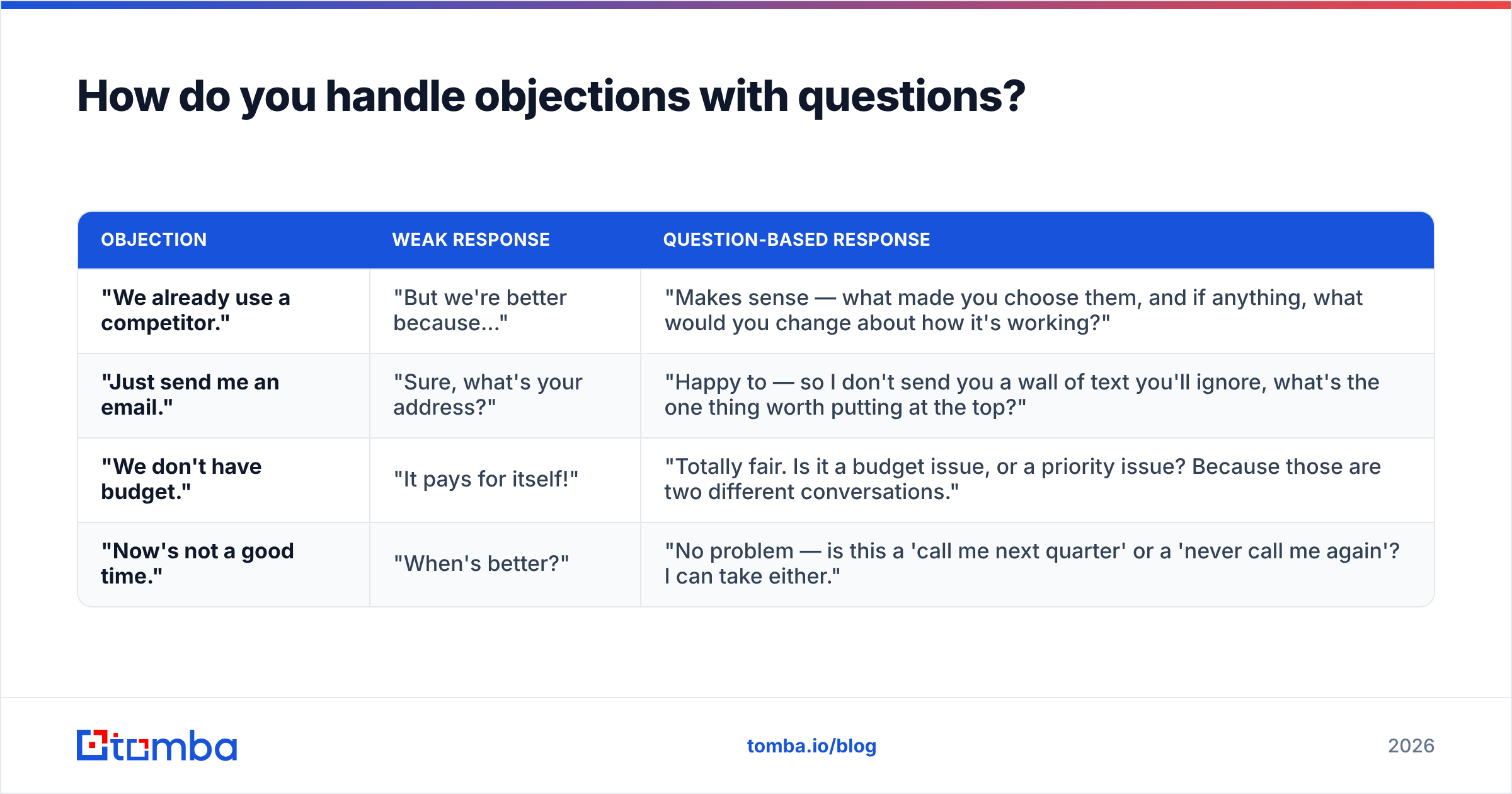
Objections aren't walls — they're doors you haven't opened yet. The instinct is to defend. The better move is to get curious and ask a question that turns the objection into more discovery.
| Objection | Weak response | Question-based response |
|---|---|---|
| "We already use a competitor." | "But we're better because…" | "Makes sense — what made you choose them, and if anything, what would you change about how it's working?" |
| "Just send me an email." | "Sure, what's your address?" | "Happy to — so I don't send you a wall of text you'll ignore, what's the one thing worth putting at the top?" |
| "We don't have budget." | "It pays for itself!" | "Totally fair. Is it a budget issue, or a priority issue? Because those are two different conversations." |
| "Now's not a good time." | "When's better?" | "No problem — is this a 'call me next quarter' or a 'never call me again'? I can take either." |
Each question-based response does two things: it acknowledges the objection (so the prospect feels heard) and it keeps the conversation alive by asking for information you can actually use.
What questions book the meeting?#
You've earned the time, found the pain, qualified the fit. Now close for the next step — not the sale. The meeting is the win on a cold call.
- "It sounds like [specific pain] is worth 20 minutes to explore — does Thursday at 10 or Friday at 2 work better?"
- "I don't want to solve this over the phone and get it half-right. Can we grab time so I can show you exactly how teams like yours handle it?"
- "Who else should be on that call to make it worth everyone's time?"
- "Before we hang up — is there any reason we wouldn't meet?"
That last one is the "negative close," and it's disarmingly effective. It surfaces hidden objections while they're still on the line instead of after they ghost you.
What's a full cold call question flow look like?#
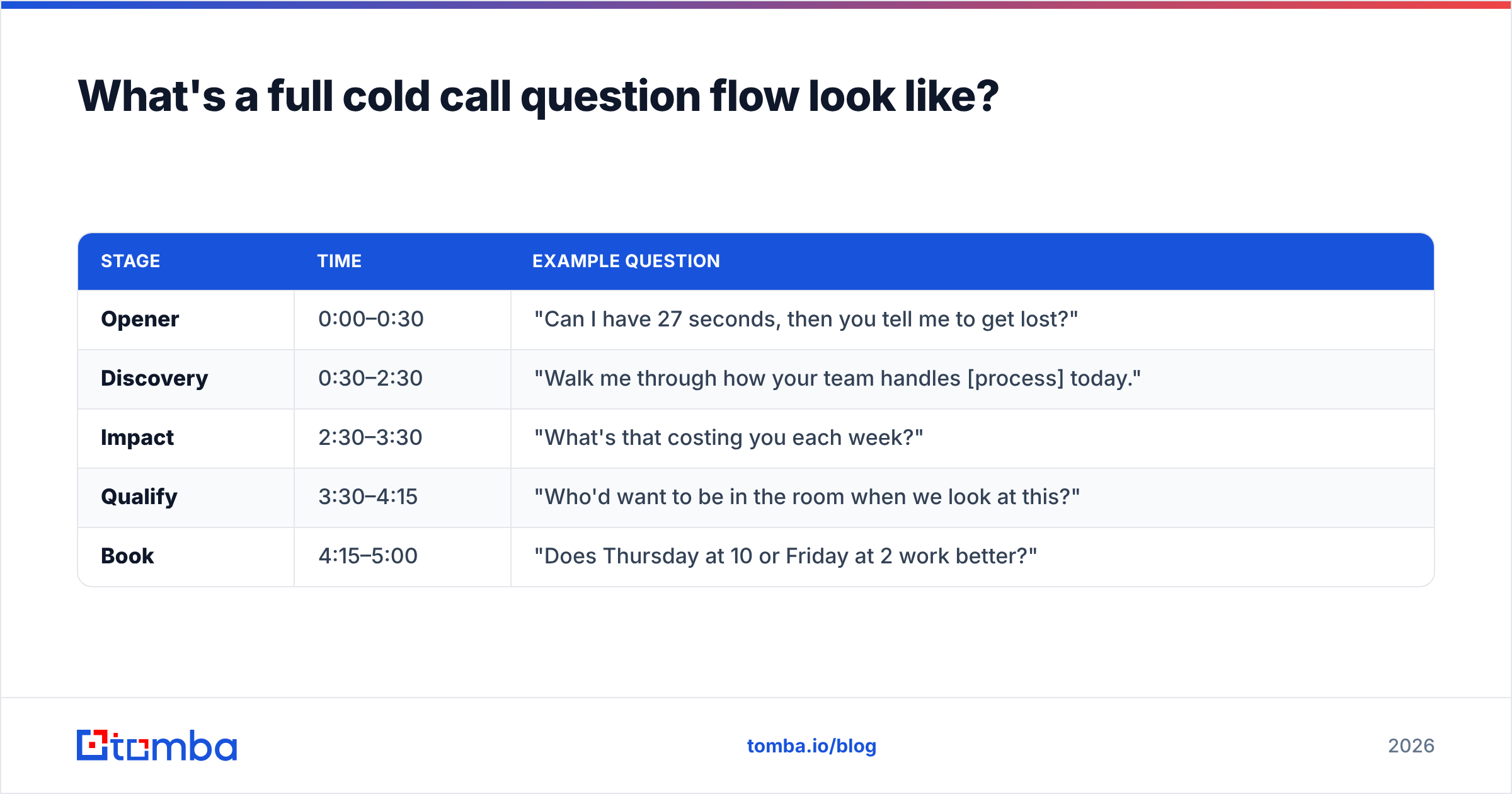
Here's how the pieces fit into a single 5-minute call:
| Stage | Time | Example question |
|---|---|---|
| Opener | 0:00–0:30 | "Can I have 27 seconds, then you tell me to get lost?" |
| Discovery | 0:30–2:30 | "Walk me through how your team handles [process] today." |
| Impact | 2:30–3:30 | "What's that costing you each week?" |
| Qualify | 3:30–4:15 | "Who'd want to be in the room when we look at this?" |
| Book | 4:15–5:00 | "Does Thursday at 10 or Friday at 2 work better?" |
Keep it flexible. Real calls jump around — a prospect might volunteer budget during discovery, or object during the close. The flow is a map, not a cage.
How does data quality change your cold calling questions?#
Here's the part nobody puts on a script card: your questions only land if you're calling the right person on a working number. There is no discovery question good enough to save a call that reaches a disconnected line or a gatekeeper who's never heard of your prospect.
That's why the best callers treat data as step zero. Before the dial, they confirm:
- The direct number is current — not a switchboard from three jobs ago.
- The role and seniority match who can actually feel the pain you're about to probe.
- Recent context (a role change, a funding round, a new tool) that turns a generic opener into a relevant one.
Pulling verified mobile and direct-dial numbers with a B2B phone number source, and enriching each record with contact enrichment so you know title, company, and stack before you call, means every question you ask is aimed at the right target. You can also run a quick phone validator pass on your list so you're not burning your morning on dead lines. Compare it against your list volume on the Tomba pricing page — the Starter plan runs $49/mo and scales up as your outbound does.
Great questions plus bad data equals a great conversation with a dial tone. Fix the data, then the questions do their job.
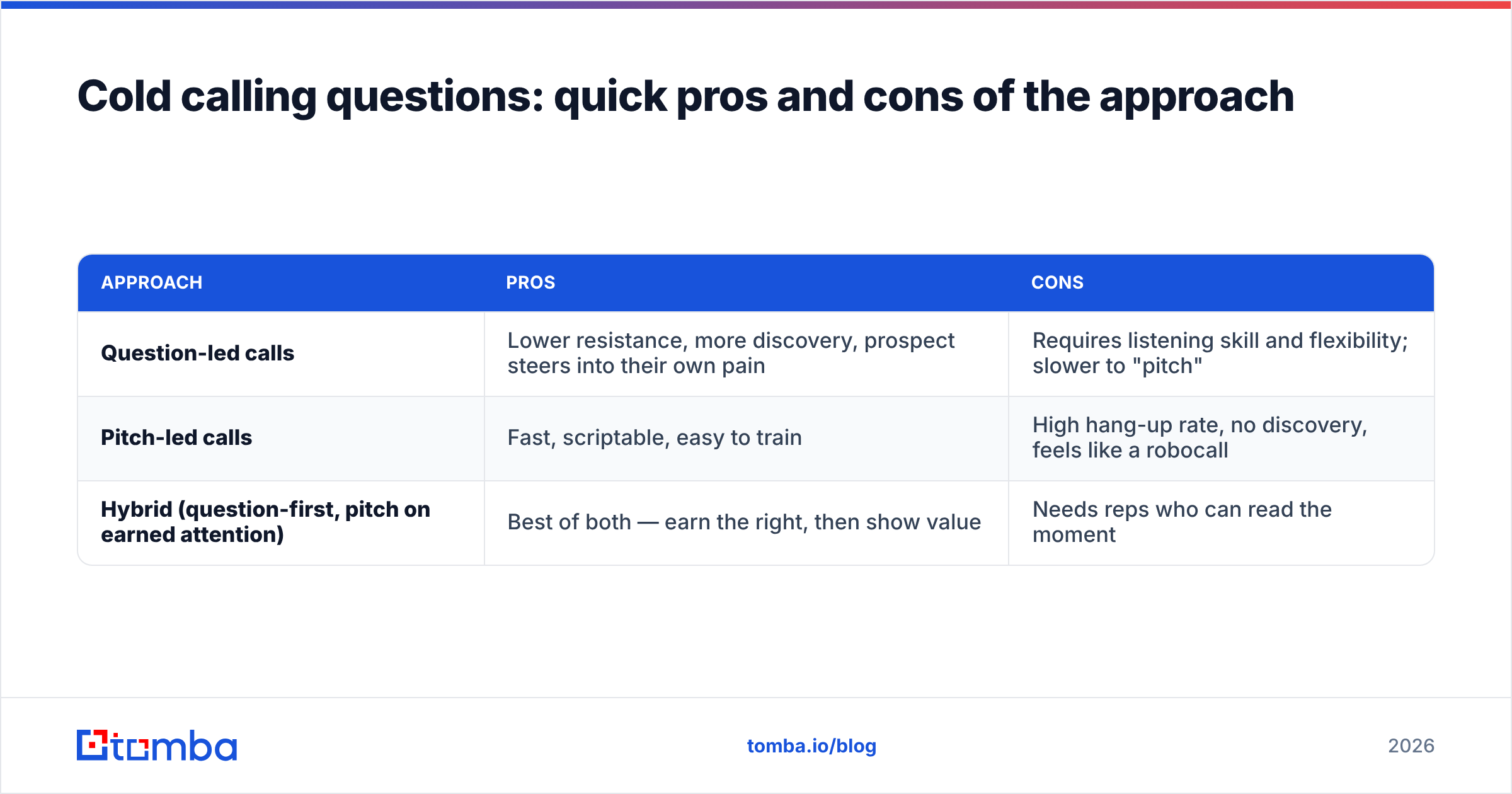
Cold calling questions: quick pros and cons of the approach#
| Approach | Pros | Cons |
|---|---|---|
| Question-led calls | Lower resistance, more discovery, prospect steers into their own pain | Requires listening skill and flexibility; slower to "pitch" |
| Pitch-led calls | Fast, scriptable, easy to train | High hang-up rate, no discovery, feels like a robocall |
| Hybrid (question-first, pitch on earned attention) | Best of both — earn the right, then show value | Needs reps who can read the moment |
The winner is almost always question-led or hybrid. Leading with a pitch is the fastest way to hear a click.
Common mistakes reps make with cold call questions#
- Stacking questions. Asking three at once confuses the prospect. Ask one, shut up, listen.
- Interrogating. A rapid-fire qualifying checklist feels like a deposition. Space it out and make it conversational.
- Not listening to the answer. If your next question ignores what they just said, they'll know you're reading a script.
- Skipping impact. Finding a problem isn't enough — you have to quantify what it costs, or there's no urgency to meet.
- Closing for the sale, not the meeting. On a cold call, the only realistic "yes" is a next step.
For more on structuring the whole conversation and improving your response rate across channels, browse the Tomba blog — but the short version is: ask, listen, quantify, advance.
Start every call with the right contact#
The best cold calling questions in the world can't rescue a call to the wrong number. Load your dialer with verified direct lines and enriched context first, then let your questions do the work. Tomba's Email Finder — alongside its phone finder, enrichment, and verification tools — gives you accurate contact data by domain, name, or company, so every dial reaches a real decision-maker who's worth asking a great question. Start free with 25 searches a month, and upgrade when your pipeline demands it.
Ask better. Close more. Dial smarter.
Related guides#
Ready to find emails that actually work?
Join 150,000+ professionals who stopped guessing and started sending. Free credits on signup — no credit card required.
Get the Tomba newsletter
Practical outbound tactics and product updates — once every two weeks.
About the author