Cold Calling Script Examples: 7 That Actually Book Meetings
Most cold calls die in the first eight seconds. These seven cold calling script examples give you proven openers, value pitches, and objection rebuttals you can adapt and dial today.
Cold calling is not dead. Bad cold calling is. The difference between a rep who books three meetings a day and one who gets hung up on forty times usually comes down to two things: the quality of the list they dial and the words they say in the first fifteen seconds. This guide fixes the second one with seven ready-to-use cold calling script examples, then shows you how to make sure those scripts land on the right person.
TL;DR#
- A script is a spine, not a cage. The best cold calling script examples give you a repeatable structure (opener, permission, value, question, close) that you adapt live.
- The first 8 seconds decide the call. Lead with a pattern-interrupt opener and ask permission before you pitch.
- Objections are predictable. Five rebuttals cover roughly 80% of what you'll hear ("not interested," "send me an email," "no budget," "we already use X," "I'm busy").
- Frameworks matter less than reps. Pick one structure below, script it, and dial it 100 times before you judge it.
- Garbage lists kill great scripts. A verified direct-dial list beats a clever opener every time — use a phone finder and validation before you touch the dialer.
What Makes a Cold Calling Script Actually Work?#
A cold calling script works when it removes friction for the prospect, not when it sounds clever to you. Think of it like a flight checklist: pilots don't read it because they're dumb, they read it because a fixed sequence prevents the one skipped step that crashes the call. Your script is that checklist.
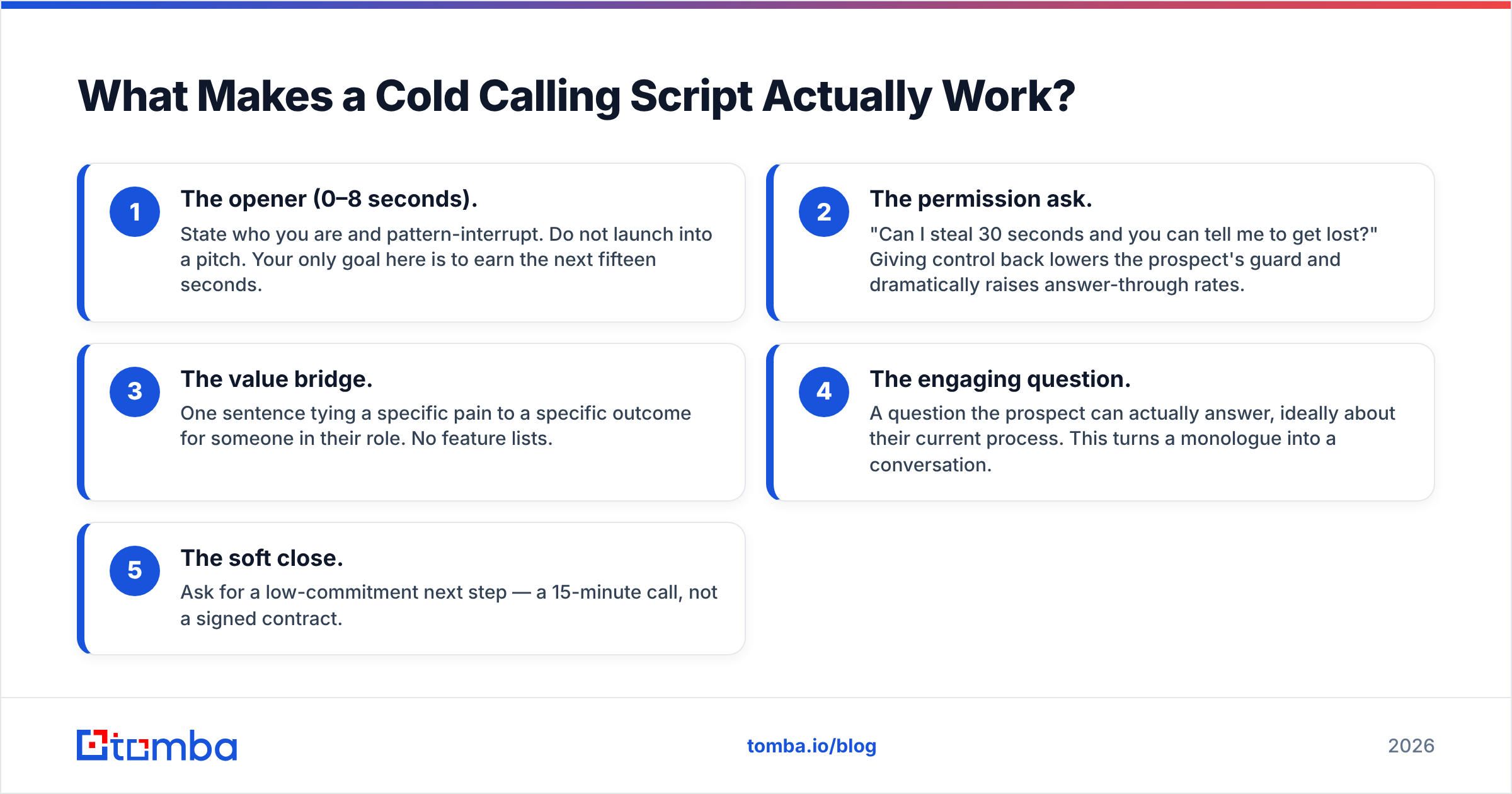
Every high-performing cold call follows the same five-part anatomy. Memorize the structure, not the exact words:
- The opener (0–8 seconds). State who you are and pattern-interrupt. Do not launch into a pitch. Your only goal here is to earn the next fifteen seconds.
- The permission ask. "Can I steal 30 seconds and you can tell me to get lost?" Giving control back lowers the prospect's guard and dramatically raises answer-through rates.
- The value bridge. One sentence tying a specific pain to a specific outcome for someone in their role. No feature lists.
- The engaging question. A question the prospect can actually answer, ideally about their current process. This turns a monologue into a conversation.
- The soft close. Ask for a low-commitment next step — a 15-minute call, not a signed contract.
Miss the permission ask and you sound like a robot reading a teleprompter. Skip the question and you're doing a presentation, not a call. Keep all five and even an average voice books meetings. According to HubSpot's sales research, it takes an average of eight touches to reach a prospect — so your script also needs to survive being one of several attempts without sounding desperate.
What Are the Best Cold Calling Script Examples for 2026?#
Below are seven cold calling script examples covering the most common B2B scenarios. Bracketed text is your fill-in. Read them out loud once, then rewrite them in your own voice.
1. The Permission-Based Opener (all-purpose)#
"Hi [Name], it's [You] from [Company]. I know I'm an interruption — can I take 30 seconds to tell you why I called, and then you decide if it's worth continuing?"
(pause for yes)
"Appreciate it. I work with [role] at companies like [peer company] who are frustrated that [specific pain]. Depending on your answer this is either relevant or a total waste — how are you handling [process] right now?"
Use this when you have nothing else. It's the safest, highest-converting structure for a genuinely cold list.
2. The Trigger-Event Script (warm signal)#
"Hi [Name], I saw [Company] just [raised a round / opened a new office / posted 12 sales roles]. Congrats. That usually means [predictable pain] is about to hit hard — is that on your radar yet, or too early?"
Relevance is the whole game here. If you can reference a real, recent trigger, your connect-to-meeting rate can double.
3. The Referral / Internal-Intro Script#
"Hi [Name], [Colleague] over in [department] mentioned you own [area] — they thought this might be worth a two-minute conversation. Did they give you a heads-up, or am I catching you cold?"
Even a soft internal reference ("your colleague in marketing") borrows enough credibility to buy you time.
4. The SaaS Demo-Booking Script#
"Hi [Name], quick one — most [job title] I talk to are stitching [Tool A] and spreadsheets together and losing hours to it. Is that roughly your setup, or have you already solved it?"
(if pain confirmed)
"That's exactly the mess we remove. Worth a 15-minute screen share Thursday so you can see if it's a fit? No pitch deck, I promise."
5. The Follow-Up-After-No-Answer Script#
"Hi [Name], [You] from [Company] again — I called Tuesday and figured a voicemail was easy to ignore, so I'm trying you live. Bad time, or do you have 60 seconds?"
Naming the previous attempt shows persistence without accusation. It also signals you're organized, which builds trust.
6. The Gatekeeper Script#
"Hi, I'm hoping you can point me in the right direction. I need to reach whoever owns [function] at [Company] — is that [Name], or someone else on the team?"
Treat the gatekeeper as a colleague, not an obstacle. Asking for help ("point me in the right direction") works far better than trying to bluff past them.
7. The Re-Engagement Script (dormant lead)#
"Hi [Name], we spoke back in [month] about [topic] and the timing wasn't right. A lot's changed on our side since then — is [original pain] still a live problem, or did you get it sorted?"
Old leads are the cheapest pipeline you own. A short, honest re-open outperforms a brand-new cold dial almost every time.
How Do You Handle the Most Common Objections?#
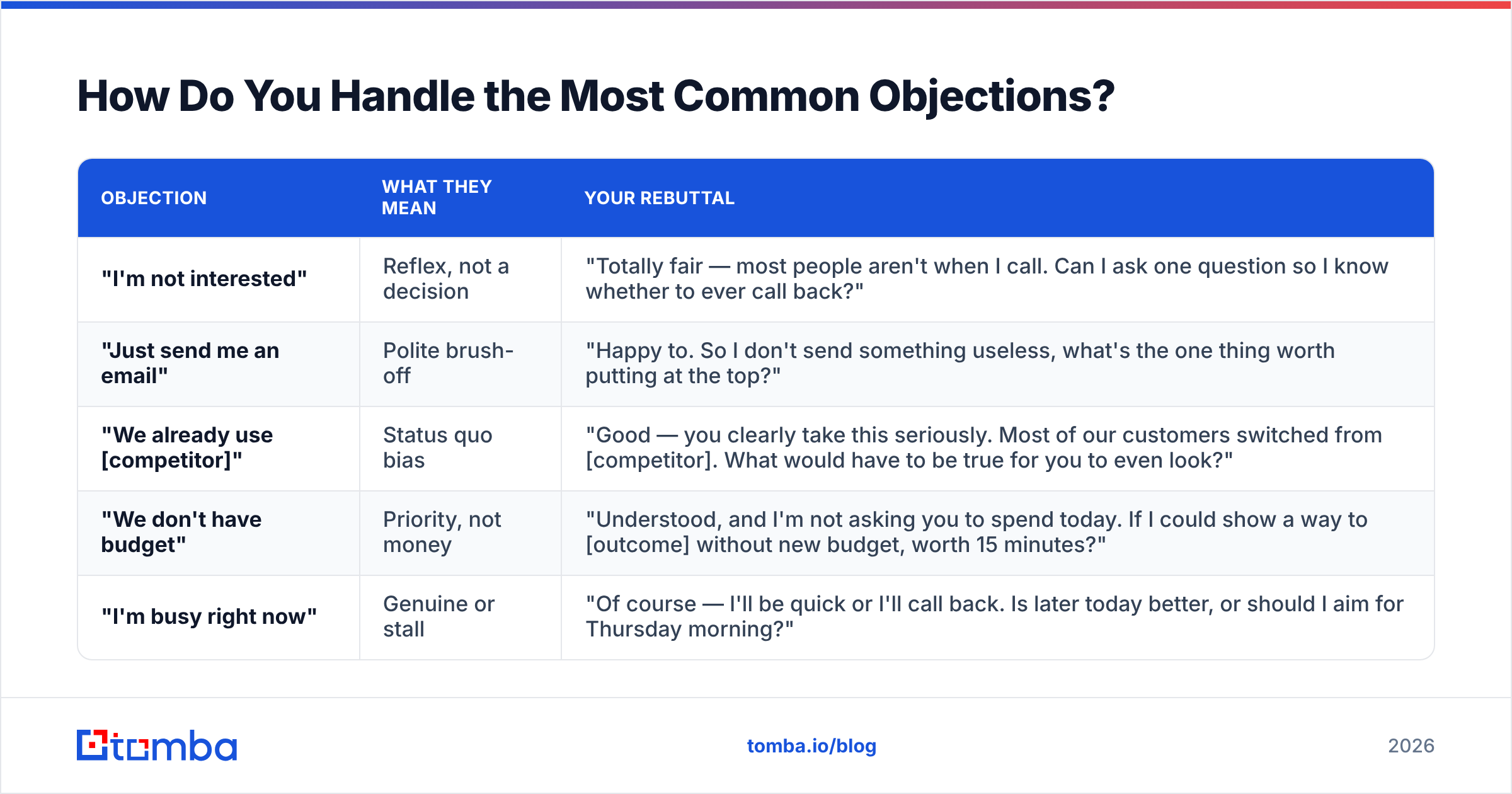
You will hear the same five objections on repeat. Script the rebuttals so you never freeze. The goal is not to "win" — it's to keep the conversation open long enough to earn a next step.
| Objection | What they mean | Your rebuttal |
|---|---|---|
| "I'm not interested" | Reflex, not a decision | "Totally fair — most people aren't when I call. Can I ask one question so I know whether to ever call back?" |
| "Just send me an email" | Polite brush-off | "Happy to. So I don't send something useless, what's the one thing worth putting at the top?" |
| "We already use [competitor]" | Status quo bias | "Good — you clearly take this seriously. Most of our customers switched from [competitor]. What would have to be true for you to even look?" |
| "We don't have budget" | Priority, not money | "Understood, and I'm not asking you to spend today. If I could show a way to [outcome] without new budget, worth 15 minutes?" |
| "I'm busy right now" | Genuine or stall | "Of course — I'll be quick or I'll call back. Is later today better, or should I aim for Thursday morning?" |
The pattern across all five: acknowledge, ask one question, offer a small next step. Never argue. As sales-conversation platform Gong's research has shown, top reps talk less and ask more questions — the call is a diagnosis, not a debate.
Which Cold Calling Script Framework Should You Use?#
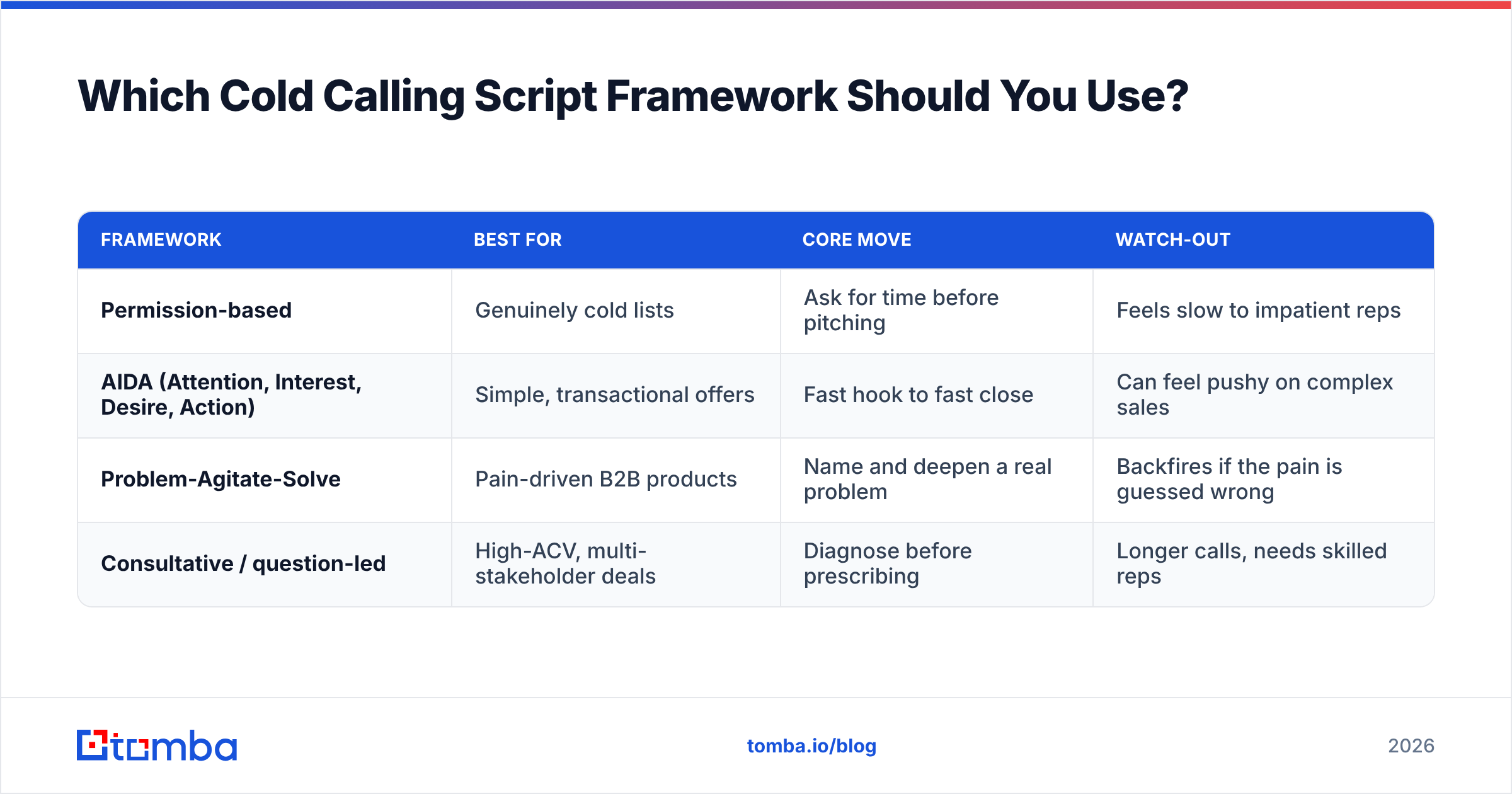
Most scripts above are built on one of four proven frameworks. Match the framework to your buyer and your product complexity rather than defaulting to whatever your team has always used.
| Framework | Best for | Core move | Watch-out |
|---|---|---|---|
| Permission-based | Genuinely cold lists | Ask for time before pitching | Feels slow to impatient reps |
| AIDA (Attention, Interest, Desire, Action) | Simple, transactional offers | Fast hook to fast close | Can feel pushy on complex sales |
| Problem-Agitate-Solve | Pain-driven B2B products | Name and deepen a real problem | Backfires if the pain is guessed wrong |
| Consultative / question-led | High-ACV, multi-stakeholder deals | Diagnose before prescribing | Longer calls, needs skilled reps |
If you sell a $49/month tool, a tight AIDA script gets to the point. If you sell a six-figure platform to a buying committee, a consultative, question-led approach protects the relationship. Pick one, script it fully, and run it at least 100 times before you decide it doesn't work. Frameworks fail from under-repetition far more often than from bad design.
How Do You Build a Call List That Doesn't Waste Your Scripts?#
Here's the uncomfortable truth: the best cold calling script examples in the world are worthless if you're dialing wrong numbers, disconnected lines, or people who left the company two years ago. Dialing a bad list is like running a great ad campaign to an empty room.
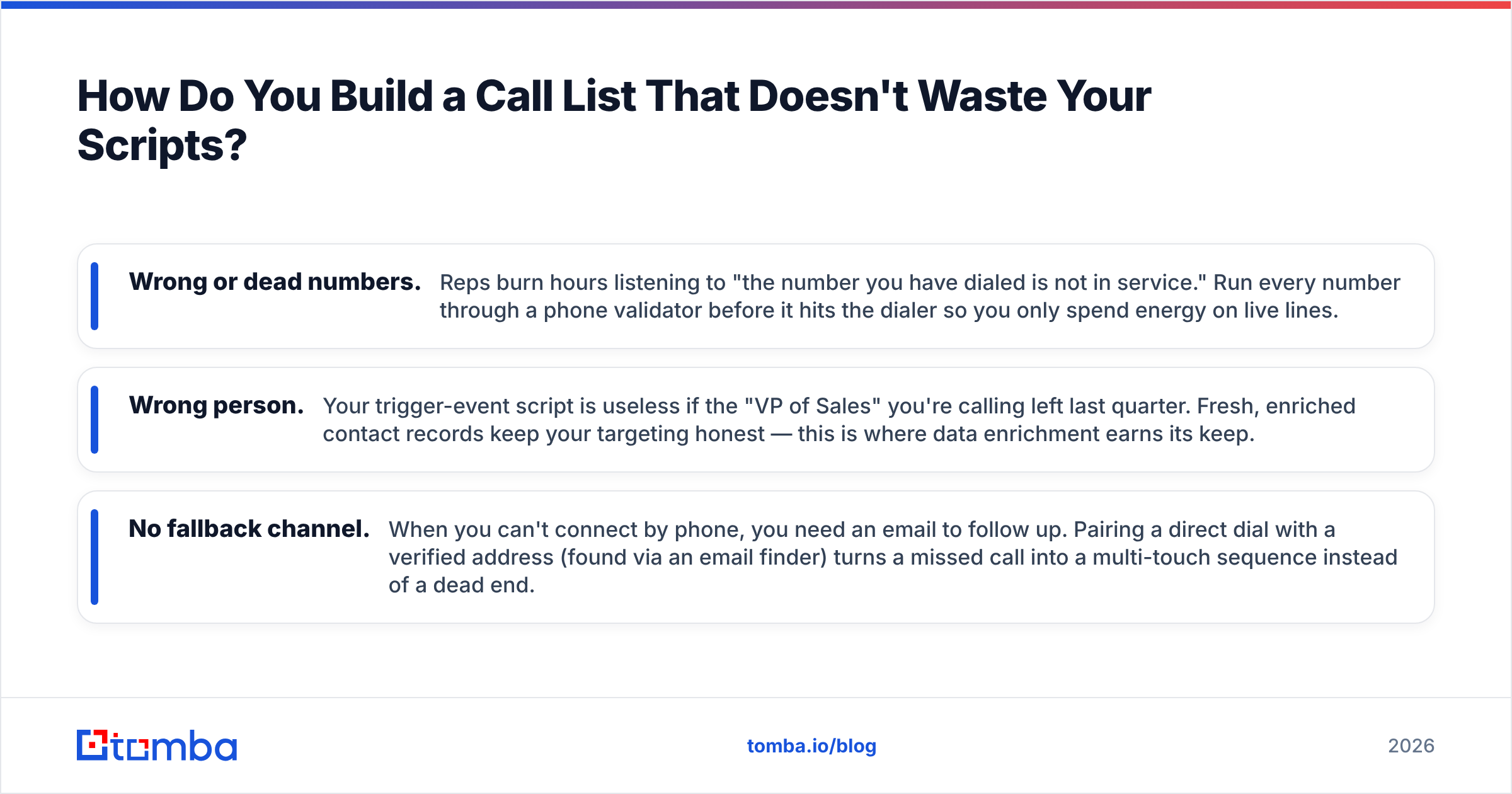
Three data problems quietly destroy cold-calling productivity:
- Wrong or dead numbers. Reps burn hours listening to "the number you have dialed is not in service." Run every number through a phone validator before it hits the dialer so you only spend energy on live lines.
- Wrong person. Your trigger-event script is useless if the "VP of Sales" you're calling left last quarter. Fresh, enriched contact records keep your targeting honest — this is where data enrichment earns its keep.
- No fallback channel. When you can't connect by phone, you need an email to follow up. Pairing a direct dial with a verified address (found via an email finder) turns a missed call into a multi-touch sequence instead of a dead end.
A practical pre-call workflow looks like this: pull target accounts from a B2B database, enrich each contact with a direct dial and email, validate the numbers, and only then load the list. Reps who do this spend their day talking to real humans instead of fighting their list — and that's what actually moves your response rate. Tools like Salesforce can house the records, but they won't verify a number is live — that's a separate step you can't skip.
How Do You Practice and Improve Your Scripts?#
A script gets better through reps and review, not through more editing in a doc. Record your calls (where legally permitted), listen back for the moment prospects tune out, and tighten that line. Track connect rate, conversation rate, and meeting-booked rate separately — a low connect rate is a data problem, a low conversation rate is an opener problem, and a low booking rate is a value-and-close problem. Diagnosing which one you have tells you exactly what to fix.
Roleplay the objections until the rebuttals are muscle memory. When you can handle "I'm not interested" without a two-second pause, your confidence carries through the phone and prospects hear it.
Frequently Asked Questions#
How long should a cold calling script be? Short enough to sound human. Your opener and permission ask should be under 15 seconds combined. The rest of the script is prompts and branches, not a paragraph you read verbatim.
Should I read the script word for word? No. Internalize the structure so you can adapt to the conversation. Reading verbatim is the fastest way to sound like a telemarketer.
What's the best time to cold call? Testing beats folklore, but late morning and late afternoon generally outperform lunch and end-of-day. Call when your specific buyer is most likely between meetings.
Do cold calling scripts still work in 2026? Yes — for teams that combine a solid script with an accurate, verified list. The scripts fail when the data underneath them is stale.
Start With a List Worth Calling#
Great scripts deserve great data. Before you dial your next batch, build a list of real decision-makers with verified direct dials and backup emails. Use the Tomba Email Finder to attach an accurate, deliverable email to every contact, then pair it with Tomba's phone finder and validation so every call reaches a live line and every miss has a follow-up channel. See the Tomba pricing plans — including a free tier of 25 searches a month — and give your seven new scripts a list that can actually convert.
Related guides#
// get started
Find, verify and enrich your first contacts today
Start on the free plan with 25 searches a month, then scale when your team is ready.
Free plan · No credit card required · GDPR & CCPA
// about the author