Cold Calling Scripts That Actually Book Meetings in 2026
Most cold calling scripts read like a robot wrote them. Here are the frameworks, openers, and objection lines that actually book meetings in 2026 — plus how to fill the dial list.
Cold Calling Scripts That Actually Book Meetings in 2026
Cold calling is not dead. Bad cold calling is dead. The rep who dials from a stale list, opens with "How are you today?", and reads a wall of text off a screen gets hung up on — and then declares the channel broken. Meanwhile, the rep next to them books three meetings before lunch using a tight, tested script and a clean dial list.
This guide gives you the second rep's playbook: the frameworks, opening lines, objection rebuttals, and voicemail structures that hold up in 2026 — plus a note on the unglamorous part nobody scripts, which is having the right number and the right person to call in the first place.
TL;DR#
- A script is a skeleton, not a cage. The best cold calling scripts define a structure (opener, reason, hook, ask) and leave room for a real conversation.
- The first 10 seconds decide the call. Lead with a permission-based or pattern-interrupt opener, never "Did I catch you at a bad time?" as a crutch.
- Objections are predictable. "Not interested," "send me an email," and "we already use X" cover ~70% of pushback — script those three cold.
- The ask is a meeting, not a sale. Your only goal on a cold call is to earn 20 minutes on the calendar.
- Garbage in, garbage out. No script survives a wrong number. Clean, verified contact data is the multiplier under everything below.
What makes a cold calling script actually work?#
The short version: a working script sounds like a person, respects the prospect's time, and is built around one clear next step. Everything else is decoration.
Think of a script like a jazz chart, not classical sheet music. The chart gives you the key, the tempo, and the changes — but you improvise the melody based on what the other player does. Reps who memorize a script word-for-word sound like they're reading a hostage note. Reps who internalize the structure sound natural because they're actually listening.
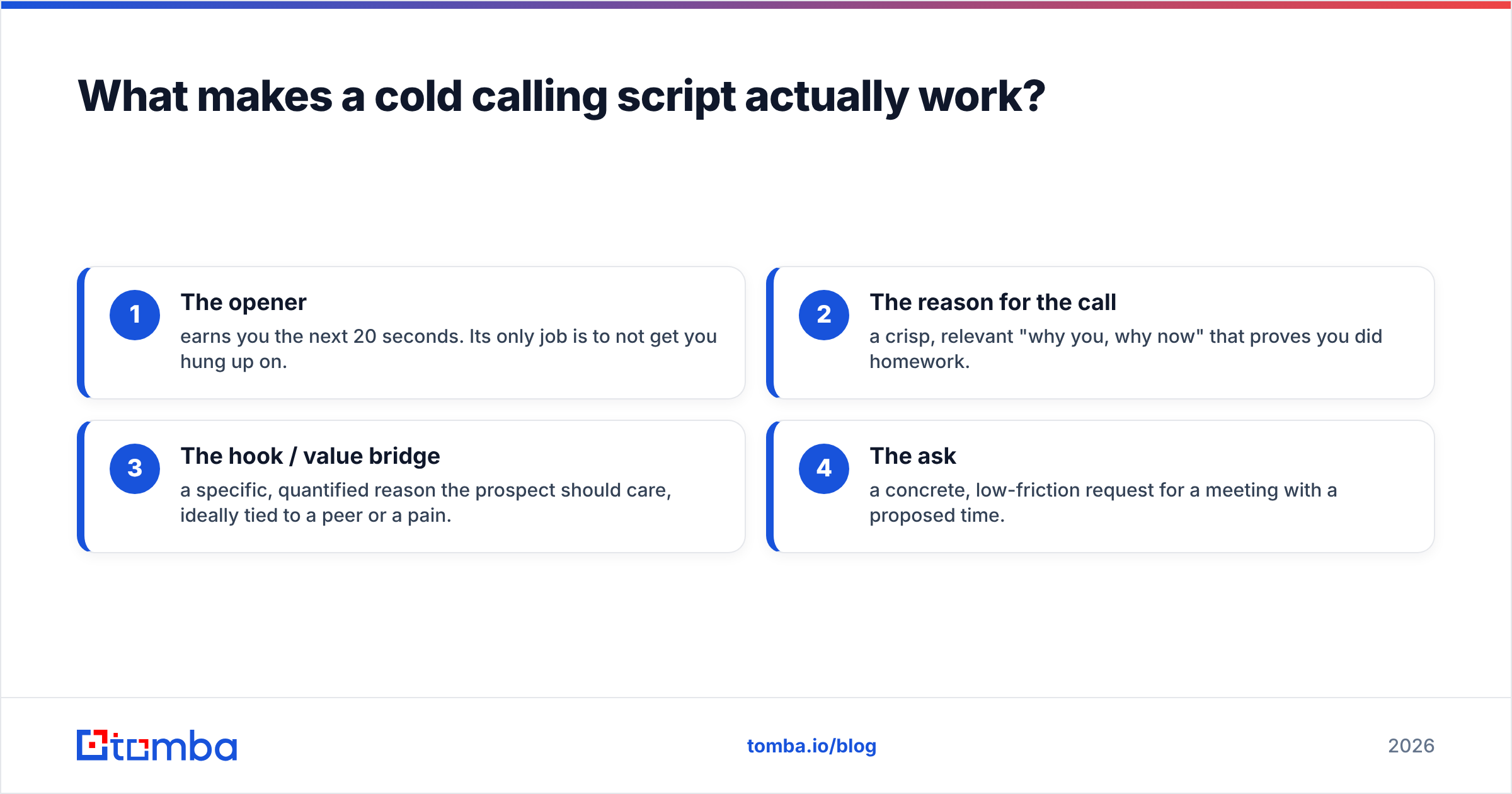
A strong cold calling script has four load-bearing parts:
- The opener — earns you the next 20 seconds. Its only job is to not get you hung up on.
- The reason for the call — a crisp, relevant "why you, why now" that proves you did homework.
- The hook / value bridge — a specific, quantified reason the prospect should care, ideally tied to a peer or a pain.
- The ask — a concrete, low-friction request for a meeting with a proposed time.
Miss any one and the call stalls. Openers without a reason feel like a bait-and-switch. Hooks without an ask leave the prospect saying "cool, thanks" and hanging up.

What are the best cold calling script frameworks?#
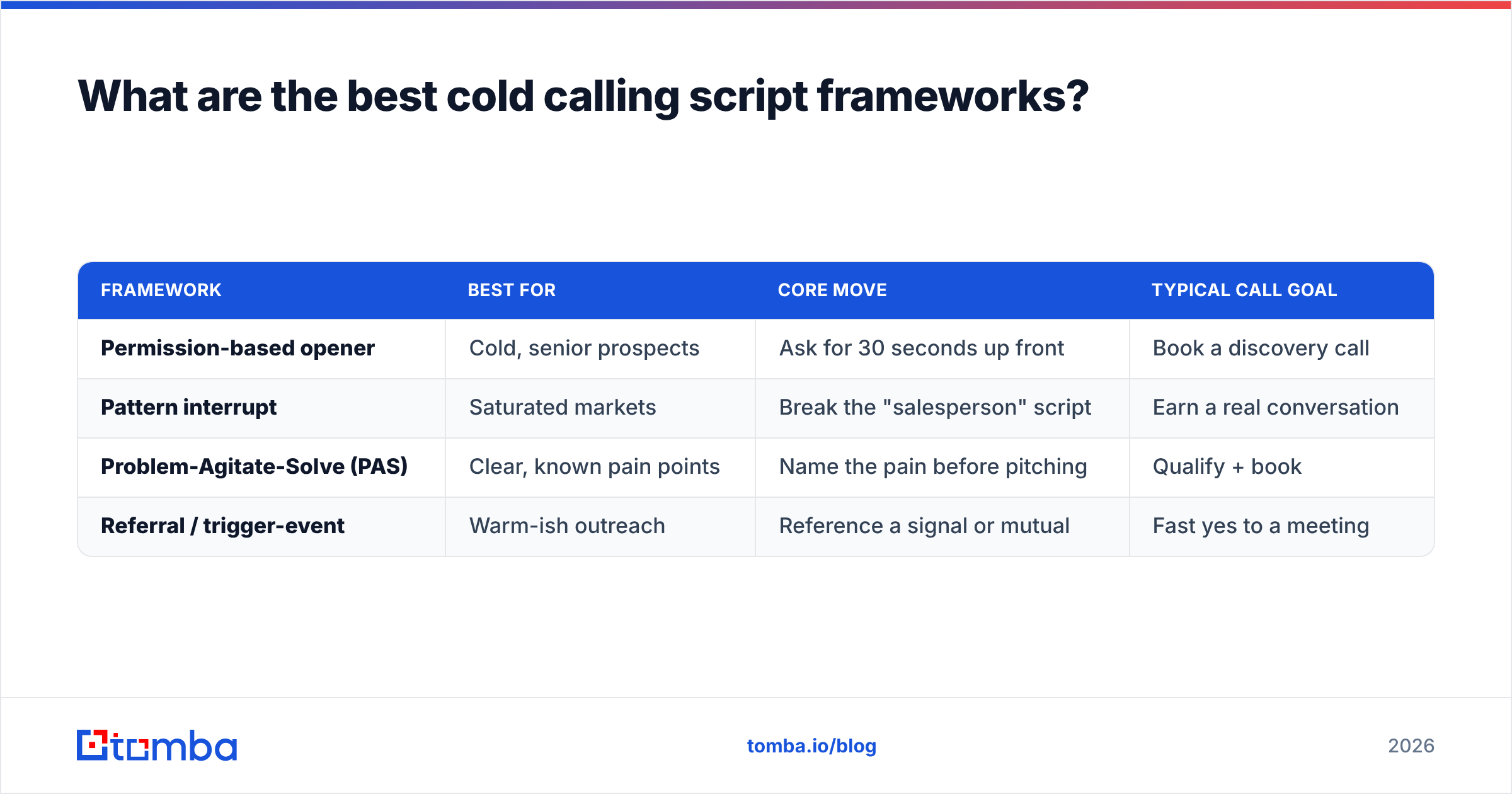
There is no single "best" script — there are frameworks that fit different call goals. Here are the four that consistently outperform, and when to reach for each.
| Framework | Best for | Core move | Typical call goal |
|---|---|---|---|
| Permission-based opener | Cold, senior prospects | Ask for 30 seconds up front | Book a discovery call |
| Pattern interrupt | Saturated markets | Break the "salesperson" script | Earn a real conversation |
| Problem-Agitate-Solve (PAS) | Clear, known pain points | Name the pain before pitching | Qualify + book |
| Referral / trigger-event | Warm-ish outreach | Reference a signal or mutual | Fast yes to a meeting |
1. The permission-based opener#
You open by asking for permission to continue. It disarms the reflexive "no" because you're handing the prospect control.
"Hi Sarah, this is Alex from Northbeam. I know I'm an interruption — can I take 30 seconds to tell you why I called, and then you can decide if it's worth continuing?"
Almost nobody says no to 30 seconds. Now you've earned the floor and set a contract: you'll be brief, and they get to judge.
2. The pattern interrupt#
Prospects hang up on scripts because they recognize the shape of a sales call in the first two seconds. A pattern interrupt breaks the shape.
"Hi Sarah — full disclosure, this is a cold call. You can hang up now, or give me 20 seconds and I'll be surprisingly relevant. Fair?"
Honesty is the interrupt. It signals you're not going to run the usual playbook, and curiosity does the rest.
3. Problem-Agitate-Solve#
When you're calling into a role with a well-known, painful problem, PAS works because you lead with their world, not your product.
"Most RevOps leads I talk to are stitching data across four tools and still can't trust the pipeline number in their board deck. When the CFO asks 'is this real?', that's a bad Tuesday. We fixed exactly that for [peer company] — worth a quick look?"
You name the pain (P), make it sting a little (A), then bridge to the solution (S) — all before asking for the meeting.
4. The trigger-event / referral open#
The warmest cold call references something specific: a funding round, a new hire, a job posting, or a mutual connection.
"Hi Sarah, congrats on the Series B — saw the announcement Tuesday. Teams usually hit a data-hygiene wall right after a raise like that, and that's the one thing I wanted to flag. Two minutes?"
Trigger events cut through because they prove the call isn't a spray-and-pray. For more on turning signals into outreach, see how strong outbound sales strategy ties triggers to sequences.
How do you open a cold call without getting hung up on?#
Lead with relevance and permission; never lead with a fake pleasantry. The opener is the single highest-leverage line in the entire script, so treat it like ad copy — every word earns its place.
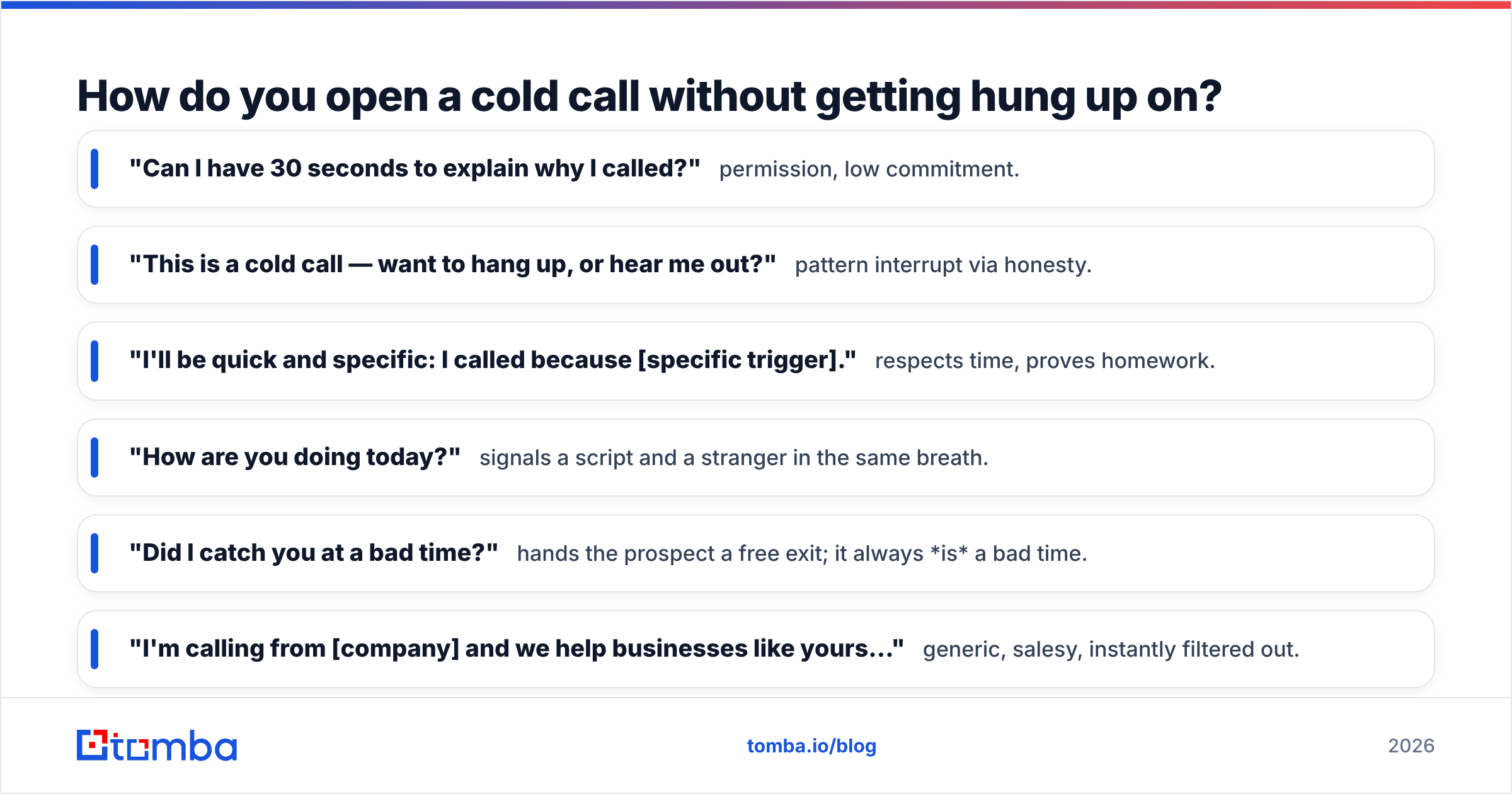
Openers that work:
- "Can I have 30 seconds to explain why I called?" — permission, low commitment.
- "This is a cold call — want to hang up, or hear me out?" — pattern interrupt via honesty.
- "I'll be quick and specific: I called because [specific trigger]." — respects time, proves homework.
Openers to retire in 2026:
- "How are you doing today?" — signals a script and a stranger in the same breath.
- "Did I catch you at a bad time?" — hands the prospect a free exit; it always is a bad time.
- "I'm calling from [company] and we help businesses like yours..." — generic, salesy, instantly filtered out.
According to research summarized by HubSpot, the opening seconds and personalization heavily influence connect-to-meeting conversion — the reps who tailor the first line win the call. Gong's conversation analytics (see gong.io) show similar patterns: successful cold calls spend more time on the prospect's situation than on the product.
What are the best objection-handling scripts?#
Most objections are not rejections — they're reflexes. Because they're predictable, you can script clean, non-defensive responses in advance. Here are the three you'll hear most and the lines that keep the call alive.
"I'm not interested."
"Totally fair — you don't know me yet, so 'not interested' is the honest answer. Most people I call say that in the first 10 seconds. Can I take one more sentence to tell you the specific reason I called, and if it's still a no, I'll let you go?"
"Just send me an email."
"Happy to. So I don't send you something generic that gets ignored, can I ask one quick question to make the email actually relevant? [Ask a qualifying question.]" — This turns a brush-off into a mini-discovery.
"We already use [competitor]."
"Makes sense — most teams I call already have something in place. I'm not calling to rip that out. The teams that took a look usually did it because [specific gap]. If that's not a pain for you, no problem — is it?"
"We don't have budget."
"Understood, and I'm not asking you to spend anything today. If I could show you a number that changes the budget conversation for next quarter, would 15 minutes be worth it?"
The pattern across all four: acknowledge, don't argue; reframe to a small next step; give the prospect an easy out. Defensiveness kills calls faster than any objection.

What should a cold call voicemail script sound like?#
Keep it under 20 seconds, create a curiosity gap, and always say you'll follow up by email. Most cold calls hit voicemail, so a tight VM script is not optional — it's half your at-bats.
"Hi Sarah, it's Alex from Northbeam — 415-555-0148. I called about [specific trigger], and I've got one idea I think is worth your time. I'll send a short email so you have the context. Again, Alex at Northbeam, 415-555-0148. Talk soon."
Rules for voicemails that get callbacks:
- Say your number twice — start and end, slowly.
- Reference one specific thing — a trigger, a peer, a metric. Vague voicemails get deleted.
- Promise an email — it stacks channels and sets up the follow-up without feeling pushy.
- Never pitch the product — the voicemail sells the email, the email sells the meeting, the meeting sells the product.
How do you build the ask so prospects say yes?#
Ask for a specific, short block of time and propose an exact slot. The single biggest mistake reps make is ending a good call with a weak, open-ended ask like "So, would you maybe want to learn more sometime?"
Compare:
- Weak: "Do you want to set something up?"
- Strong: "Let's grab 20 minutes Thursday at 10, or Friday at 2 — which is easier?"
The strong ask does three things: it's specific (20 minutes, not "a chat"), it's low-friction (a range of two times, not "when are you free?"), and it assumes the yes. You're not asking whether — you're asking which.
If they hesitate, shrink the ask, don't abandon it: "No pressure to commit to a full call — how about I send a 3-minute Loom and if it's interesting, we talk?" Always leave with a next step on the calendar or in the inbox.
Do cold calling scripts still work in 2026?#
Yes — but only when the data underneath them is clean. This is the part no script template will tell you, and it's the reason two reps reading the same script get wildly different results.
Here's the uncomfortable math. A perfect script with a 40% wrong-number list is worse than a mediocre script with a verified list. If half your dials hit disconnected numbers, gatekeepers, or the wrong person, your best openers never get heard. The channel isn't broken — the list is.
Before you obsess over your opener, make sure you have:
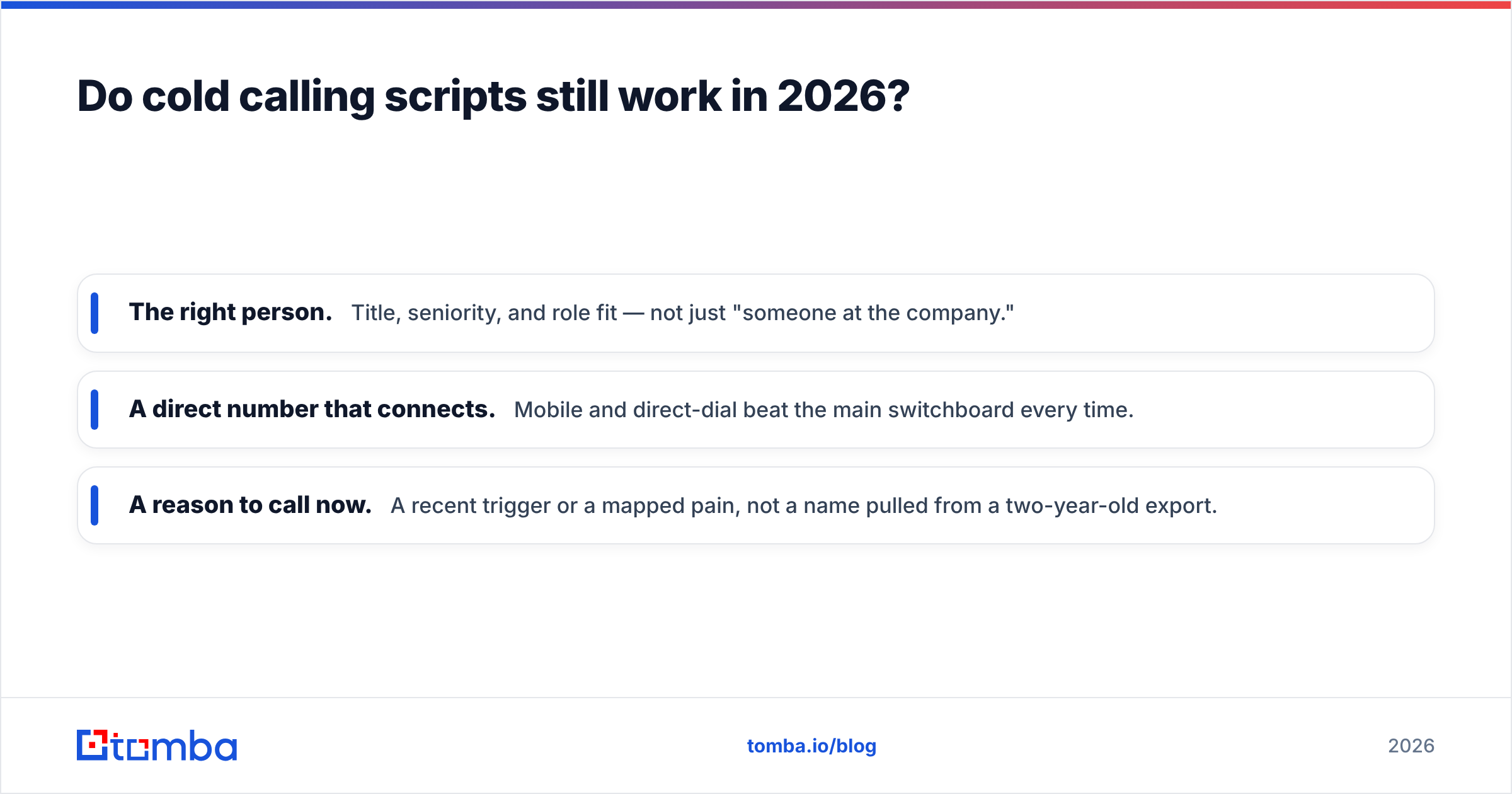
- The right person. Title, seniority, and role fit — not just "someone at the company."
- A direct number that connects. Mobile and direct-dial beat the main switchboard every time.
- A reason to call now. A recent trigger or a mapped pain, not a name pulled from a two-year-old export.
This is where prospecting data does the heavy lifting. A verified B2B database and accurate B2B phone numbers mean your scripts land on live, correct contacts instead of dead lines. Pair that with a quick email verifier pass so your promised follow-up email actually arrives — a bounced follow-up undoes a great call. Reps who feed their dialer clean, enriched contacts spend their time talking to real prospects, which is the only activity that books meetings.
You can also stack channels: use the call to earn attention, then reinforce with a personalized email using the address you found. Multi-touch beats single-channel, and both channels depend on the same thing — correct contact data.
A quick-start cold calling script you can steal#
Put it all together and here's a full script you can adapt today:
Opener (permission): "Hi Sarah, this is Alex from Northbeam. I know I'm an interruption — can I steal 30 seconds and then you decide if it's worth more?"
Reason (trigger): "I called because I saw you just hired three SDRs. Teams scaling outbound that fast usually hit a data-hygiene wall within a quarter."
Hook (peer + pain): "[Peer company] had the same setup — reps burning half their dials on bad numbers. We got their connect rate up meaningfully in six weeks."
Ask (specific): "Worth 20 minutes to see if the same fix applies? Thursday at 10 or Friday at 2?"
Objection ('send email'): "Happy to — one quick question so it's not generic: how are you sourcing numbers today?"
Read it out loud. Time it. Then make it yours — swap in your trigger, your peer proof, your metric. The structure stays; the words become your own.
The bottom line#
Great cold calling scripts don't sound like scripts. They give you a reliable structure — opener, reason, hook, ask — while leaving room to actually listen and respond. Master the four frameworks above, pre-write your top three objection rebuttals, and end every call with a specific, low-friction ask.
But remember the multiplier: even the sharpest script fails on a bad number. Feed your dialer verified, enriched contacts and your scripts finally get heard by the right people.
Start by fixing the list. Use Tomba's Email Finder and phone finder to build a clean, verified dial and follow-up list — real people, correct numbers, current roles — so every script you run lands on someone who can actually say yes. Check the Tomba pricing tiers, starting free at 25 searches a month, and give your best script the data it deserves.
Related guides#
// get started
Find, verify and enrich your first contacts today
Start on the free plan with 25 searches a month, then scale when your team is ready.
Free plan · No credit card required · GDPR & CCPA
// about the author