Cold Calling Scripts for Sales: 7 Templates That Book Meetings
Seven proven cold calling scripts for sales teams in 2026, plus the openers, objection rebuttals, and voicemail lines that actually book meetings instead of getting hung up on.
Cold calling is not dead — bad cold calling is. The reps who still book meetings by phone in 2026 aren't winging it, and they aren't reading a robotic wall of text either. They run a tested script as a flexible frame, then adapt in real time. This guide gives you seven cold calling scripts for sales, plus the openers, rebuttals, and voicemails that hold up when a prospect's finger is already hovering over the hang-up button.
TL;DR#
- A script is a frame, not a cage. The best cold calling scripts for sales give you a strong opener and branch points, then let you sound human.
- The first 10 seconds decide everything. Earn the next 30 seconds with a permission-based opener and a reason for the call.
- Objections are predictable. "Not interested," "send me an email," and "we already use X" have clean rebuttals you can rehearse.
- Dials are wasted on bad data. Wrong numbers and unverified contacts sink connect rates faster than any script flaw — verify before you dial.
- Copy the 7 scripts below, swap in your details, and A/B test openers weekly.
What makes a cold calling script actually work?#
The conclusion first: a script works when it lowers the prospect's guard fast enough to earn a real conversation. Everything else is detail.
Think of a cold call like knocking on a stranger's door. If you launch into a monologue the second it opens, the door closes. If you acknowledge you're interrupting, say why you're worth 30 seconds, and ask permission to continue, you get invited in. Great scripts are built around that social contract, not around cramming your pitch into the opening line.
The mechanics that separate a script that books meetings from one that gets you blocked:
- A pattern interrupt opener — you sound different from the 12 other reps who called today.
- A permission ask — "Can I have 27 seconds to tell you why I called?" gives the prospect control, which paradoxically keeps them on the line.
- A relevance hook — one specific reason this call matters to their company, not a generic feature dump.
- A single, low-friction ask — the goal is the next step (a 15-minute meeting), never the sale.
- Rehearsed objection branches — you never freeze, because you've practiced the three responses that come up 80% of the time.
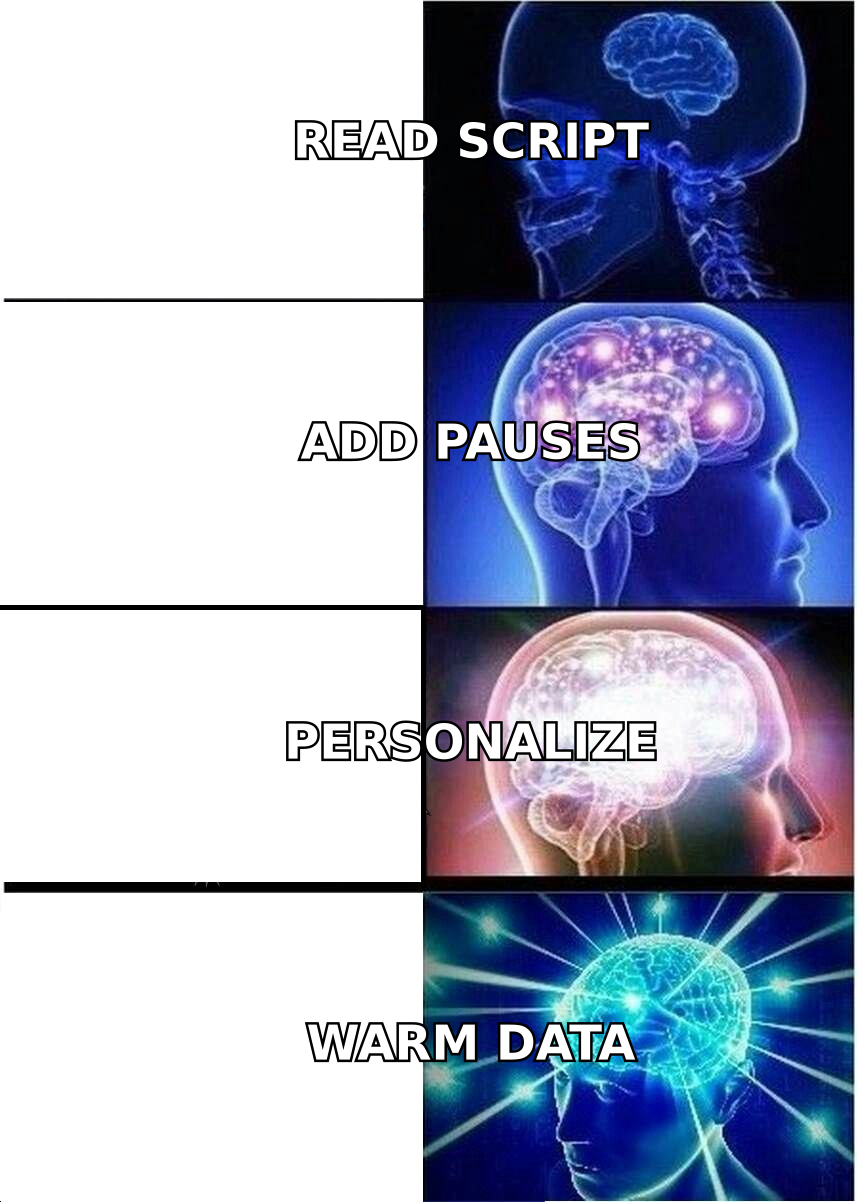
The anatomy of a high-converting cold call#
Before the templates, here's the structure every script below follows. Master the skeleton and you can write your own scripts for any vertical.
| Stage | Time | Goal | Example line |
|---|---|---|---|
| Opener | 0–10s | Interrupt the pattern, earn attention | "Hey Sarah, this is Alex — I know you weren't expecting my call." |
| Permission | 10–15s | Hand control to the prospect | "Can I take 30 seconds to explain why, then you decide?" |
| Relevance hook | 15–45s | Make it about their world | "I noticed your team is hiring three SDRs — that usually means..." |
| Discovery | 45s–3m | Ask, don't pitch | "How are you handling X today?" |
| The ask | Close | One clear next step | "Worth a 15-minute look Thursday?" |
| Objection branch | Any time | Stay in the conversation | See the rebuttal table below. |
Notice discovery is the longest stage. Reps who talk less and ask more book more meetings. The script's job is to get you to the questions, not to replace them.
The 7 cold calling scripts for sales#
1. The permission-based opener (all-purpose)#
"Hi [Name], this is [You] from [Company]. I'll be honest — this is a cold call. Do you want to hang up, or give me 30 seconds and then decide?"
Humor and honesty disarm people. This opener consistently outperforms the "How are you today?" fake-rapport opener because it respects the prospect's intelligence.
2. The trigger-event script#
"Hi [Name], I saw [Company] just [raised a round / opened a new office / launched a product]. Congrats. Teams hitting that milestone usually run into [specific problem] within a quarter — is that on your radar yet?"
Trigger events give you a legitimate reason to call now. This is where good data earns its keep: you need accurate contact info tied to a real signal.
3. The referral / name-drop script#
"Hi [Name], [Mutual contact] mentioned you're the person who owns [area]. They thought a quick chat might be worth your time — got two minutes?"
Even a soft, indirect referral raises trust. Never fabricate one; use real connections from your CRM or LinkedIn.
4. The problem-agitate script#
"Hi [Name] — quick one. Most [job title]s I talk to are frustrated that [common pain]. When that happens, [downstream cost]. Is that something your team's dealing with, or have you already nailed it?"
Ending with "or have you already nailed it?" invites an honest answer instead of a reflexive "we're fine."
5. The competitor-switch script#
"Hi [Name], I know you're using [Competitor]. I'm not calling to bash them — a lot of teams do. I'm calling because the ones who switch to us usually do it for [one specific reason]. Can I ask what made you pick [Competitor]?"
Acknowledging the incumbent lowers defensiveness and turns the call into a discovery conversation.
6. The straight-shooter script#
"Hi [Name], I'll be direct: I sell [product]. I think it could save your team [specific outcome]. If I'm wrong, tell me and I'll leave you alone. If I might be right, give me 90 seconds?"
Radical transparency cuts through gatekeeping. It works best with senior, time-poor buyers.
7. The re-engagement script (past lead)#
"Hi [Name], we spoke back in [month] about [topic] and the timing wasn't right. A few things have changed on our end since — is now a better moment, or should I check back later?"
Warm-ish leads convert far better than cold ones. Keep past conversations tagged and enriched so you know exactly what changed.
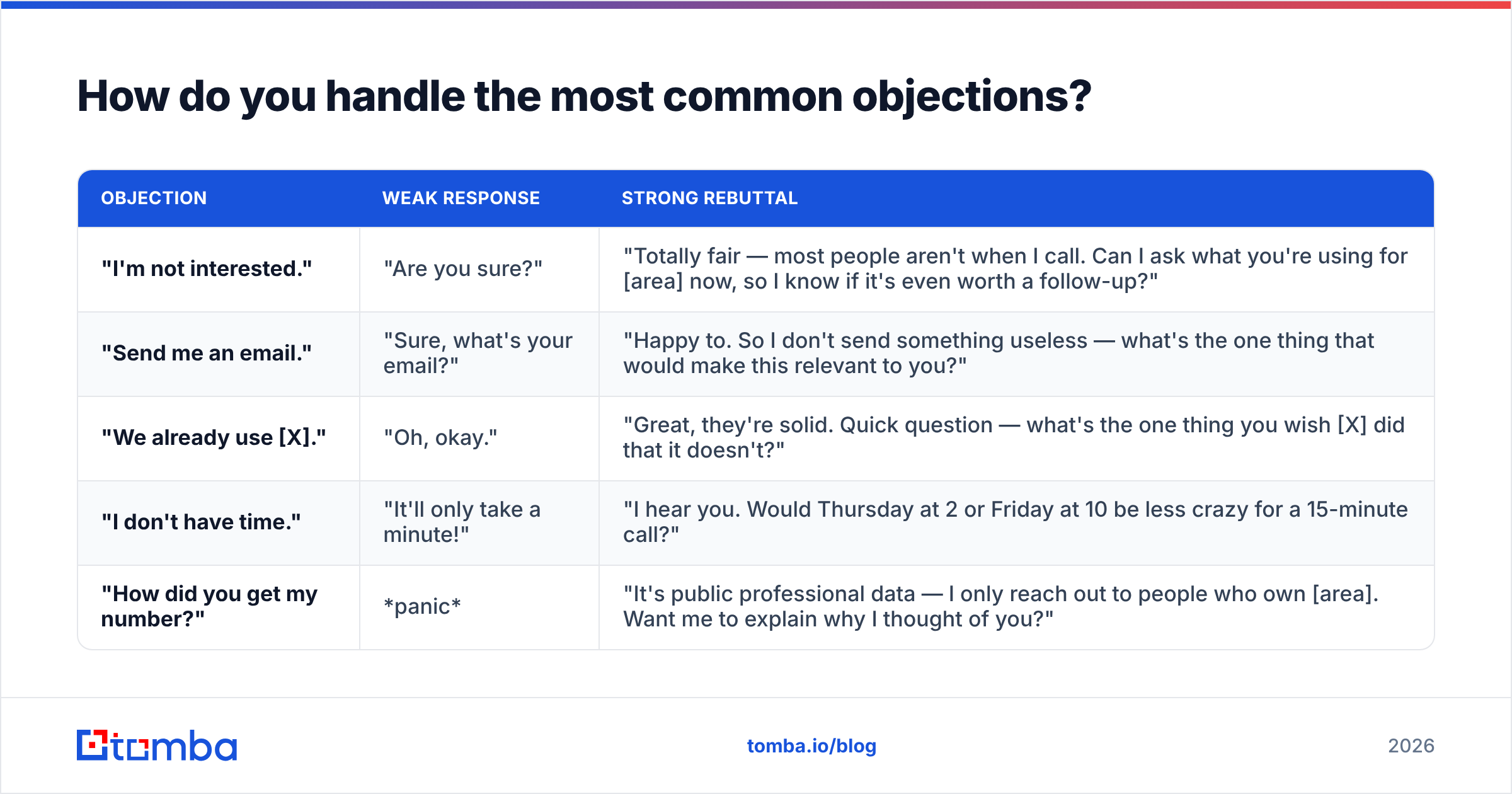
How do you handle the most common objections?#
Objections are not rejections — they're the prospect telling you what's in the way. Rehearse these until they're reflexive.
| Objection | Weak response | Strong rebuttal |
|---|---|---|
| "I'm not interested." | "Are you sure?" | "Totally fair — most people aren't when I call. Can I ask what you're using for [area] now, so I know if it's even worth a follow-up?" |
| "Send me an email." | "Sure, what's your email?" | "Happy to. So I don't send something useless — what's the one thing that would make this relevant to you?" |
| "We already use [X]." | "Oh, okay." | "Great, they're solid. Quick question — what's the one thing you wish [X] did that it doesn't?" |
| "I don't have time." | "It'll only take a minute!" | "I hear you. Would Thursday at 2 or Friday at 10 be less crazy for a 15-minute call?" |
| "How did you get my number?" | panic | "It's public professional data — I only reach out to people who own [area]. Want me to explain why I thought of you?" |
That last one matters more every year. Prospects are privacy-aware, and a confident, honest answer keeps you credible. It also underscores why your source data should be legitimate and traceable — sketchy lists produce sketchy answers.
Why your data matters more than your script#
Here's the uncomfortable truth: the best script in the world can't fix a wrong number. If half your list is disconnected lines, wrong-department contacts, or people who left the company two years ago, your connect rate craters no matter how smooth your opener is.
Two data problems quietly kill cold calling programs:
- Bad phone numbers. Reps burn hours on dead lines and voicemail loops. A phone finder that returns current, direct B2B numbers — and a phone validator to confirm the line is live before you dial — protects your most expensive resource: rep time.
- Stale or wrong contacts. Calling the wrong persona wastes the call even when you connect. Pairing calls with a verified email finder and data enrichment means you know the person's real role, seniority, and the trigger event before you say a word.
According to HubSpot's sales research, it takes an average of multiple touches to reach a prospect — so a multichannel motion (call, then email, then call) built on accurate data beats brute-force dialing every time. Reviews on G2 echo the same theme: the tools reps rate highest are the ones that keep contact data current, not the ones with the flashiest dialers.
What's the ideal cold call cadence and timing?#
Timing multiplies the value of a good script. A few field-tested patterns:
- Call windows. Late morning (10–11:30 a.m.) and late afternoon (4–5 p.m.) in the prospect's timezone tend to connect best. Avoid Monday mornings and Friday afternoons.
- Cadence. A typical sequence: Call → wait 2 days → email → call → wait 3 days → LinkedIn touch → call. Six to eight touches over two to three weeks.
- Voicemail strategy. Leave one, not five. Keep it under 20 seconds: name, company, one-line reason, and a promise to follow up by email.
- Multichannel beats single channel. A call that lands after the prospect saw your email connects far more often. Tie your dialer to your B2B database so every channel uses the same verified record.
A voicemail script that gets callbacks#
"Hi [Name], it's [You] from [Company]. I'm calling because [one specific reason tied to their company]. I'll send a short email so you have the details — but if [problem] is on your list, I'd love 15 minutes. My number is [number]. Thanks, [Name]."
Short, specific, and it sets up the email follow-up so the two channels reinforce each other.
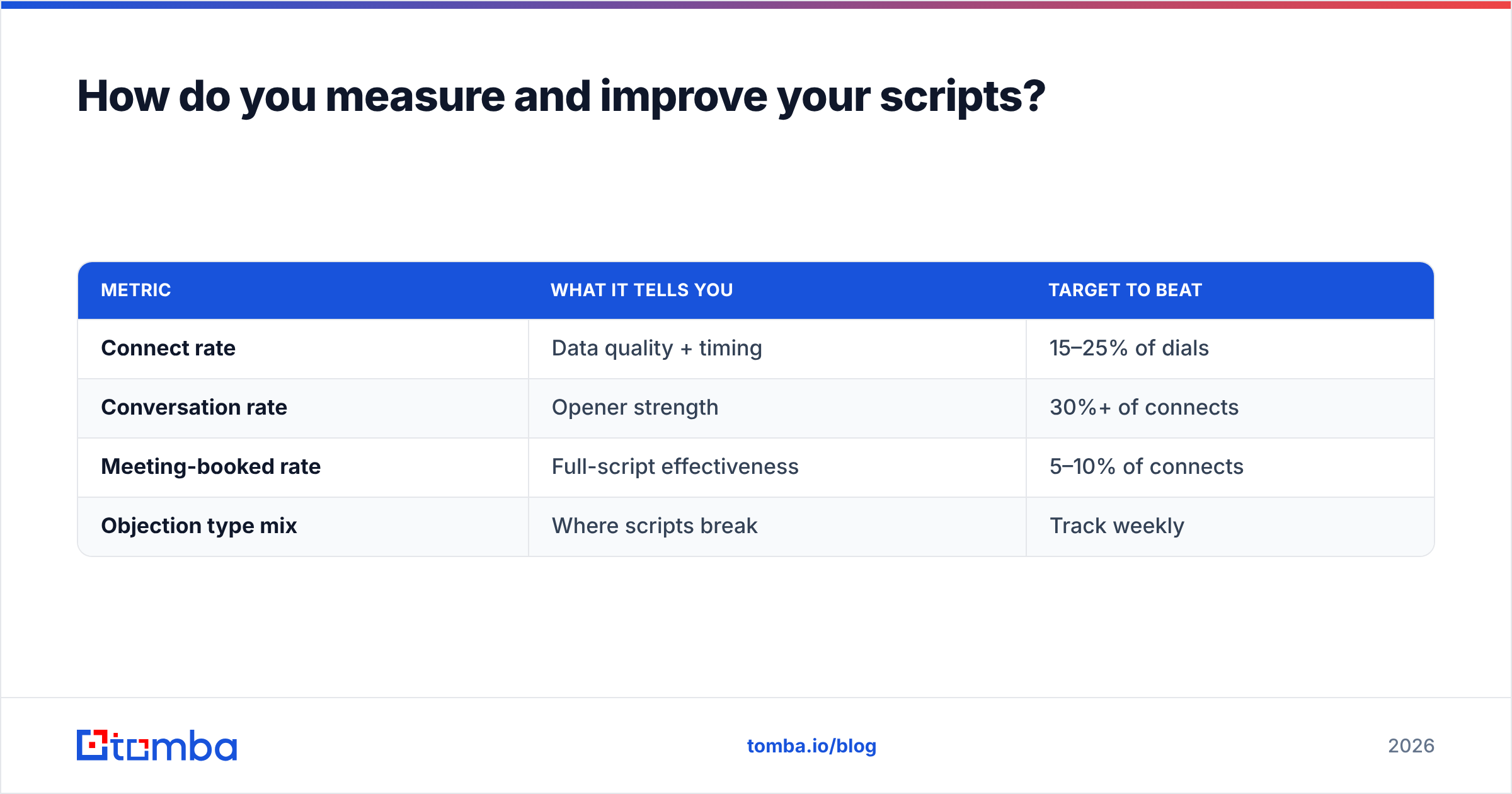
How do you measure and improve your scripts?#
You can't improve what you don't track. Log these per script and per rep:
| Metric | What it tells you | Target to beat |
|---|---|---|
| Connect rate | Data quality + timing | 15–25% of dials |
| Conversation rate | Opener strength | 30%+ of connects |
| Meeting-booked rate | Full-script effectiveness | 5–10% of connects |
| Objection type mix | Where scripts break | Track weekly |
A/B test one variable at a time. Change the opener for a week, hold everything else constant, and compare meeting-booked rates. Small opener tweaks routinely swing results more than entire pitch rewrites — the first 10 seconds really are that decisive.
Cold calling scripts: quick FAQ#
Should I read the script word-for-word? No. Use it as a frame. Internalize the opener and the branches, then talk like a person. Prospects can hear a rep reading.
How long should a cold call be? The opener earns 30 seconds; a good call runs 3–5 minutes once you're in discovery. The goal is the next meeting, not a full pitch.
How many dials to book a meeting? With verified data and a tested script, many teams book one meeting per 15–25 conversations — but connect rate depends heavily on list quality.
Is cold calling still legal and worth it in 2026? Yes, for B2B outreach to business contacts, when you use legitimately sourced data and honor do-not-call requests. Check regional rules and keep your sourcing clean.
Start dialing with data that connects#
The best cold calling scripts for sales are only half the equation. The other half is reaching the right person, at a working number, at the right moment. Feed your reps verified contacts and you turn a decent script into a booked calendar.
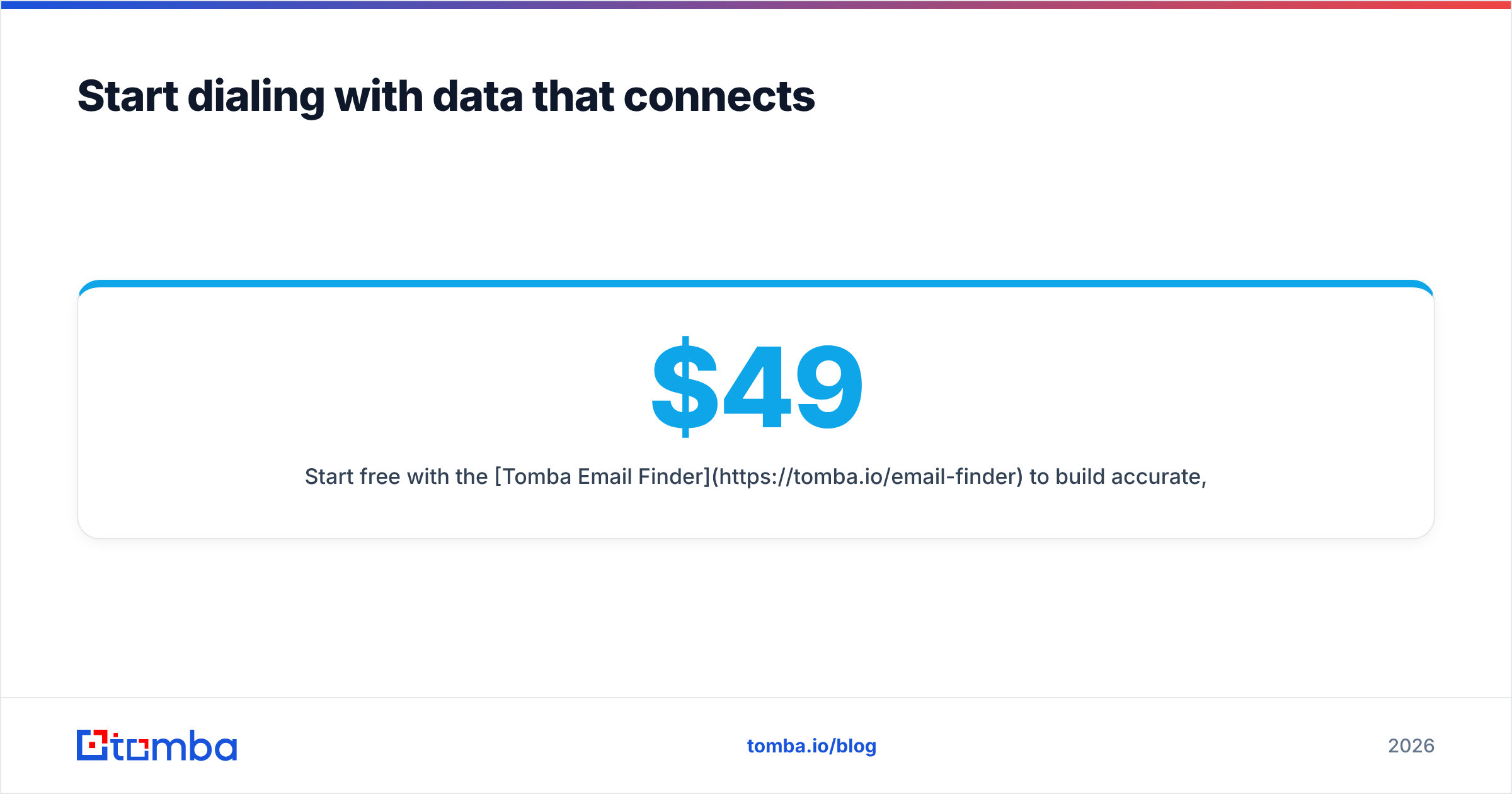
Start free with the Tomba Email Finder to build accurate, enriched contact lists — then layer in phone data so every dial has a real person on the other end. The Free tier includes 25 searches a month, and paid plans start at $49/mo (Starter), $99/mo (Growth), and $249/mo (Pro); see the full Tomba pricing for details. Write the script, verify the data, and let the meetings follow.
Related guides#
// get started
Find, verify and enrich your first contacts today
Start on the free plan with 25 searches a month, then scale when your team is ready.
Free plan · No credit card required · GDPR & CCPA
// about the author