Cold Calling Software Sales Guide: Best Tools to Buy in 2026
Power dialers, local presence, call recording, and AI coaching — here's how to pick cold calling software that actually lifts connect rates in 2026, without overpaying.
Cold calling still books meetings in 2026. But the reps hitting quota are not dialing by hand off a spreadsheet. They run software that dials for them, logs each call, surfaces the next number, and flags why the last talk stalled. The cold calling software sales teams rely on turns a slow chore into steady conversations. This guide covers what these tools do, which features matter, and how to choose without wrecking your budget.
TL;DR#
- Cold calling software automates dialing, call logging, local-presence numbers, recording, and increasingly AI coaching — so reps talk to more humans per hour.
- The single biggest lever is the dialer type: power and parallel dialers can 3–5x live conversations versus manual dialing.
- Connect rate is a data problem first. Bad phone numbers sink even the best dialer, so pair your tool with an accurate data source.
- Expect to pay $30–$150 per user per month; parallel dialers and conversation-intelligence add-ons sit at the top.
- Match the tool to your motion: SMB SDR teams need speed and CRM sync; enterprise needs compliance, analytics, and admin controls.
What is cold calling software?#
Cold calling software is a sales tool that automates the mechanical parts of outbound phone prospecting, so reps spend their time talking, not clicking. Think of it like cruise control on a road trip. You still steer and pick the route, but the software handles the tedious throttle work — looking up the number, dialing it, waiting through rings, logging the outcome, and queuing the next call.
At minimum, a modern platform bundles a dialer, call recording, CRM logging, and analytics. The better ones add local presence (matching your caller ID to the prospect's area code), voicemail drop (leave a pre-recorded message with one click), and real-time transcription with AI coaching.
The payoff is throughput. A rep dialing manually manages roughly 40–50 dials in an hour of focused calling. A rep on a power dialer can push past 100. A parallel dialer that rings multiple lines at once can more than double that again. Since connect rates on cold calls hover in the low single digits, every extra dial matters.
What features actually matter in cold calling software?#
Not every checkbox is worth paying for. Here is where to focus.
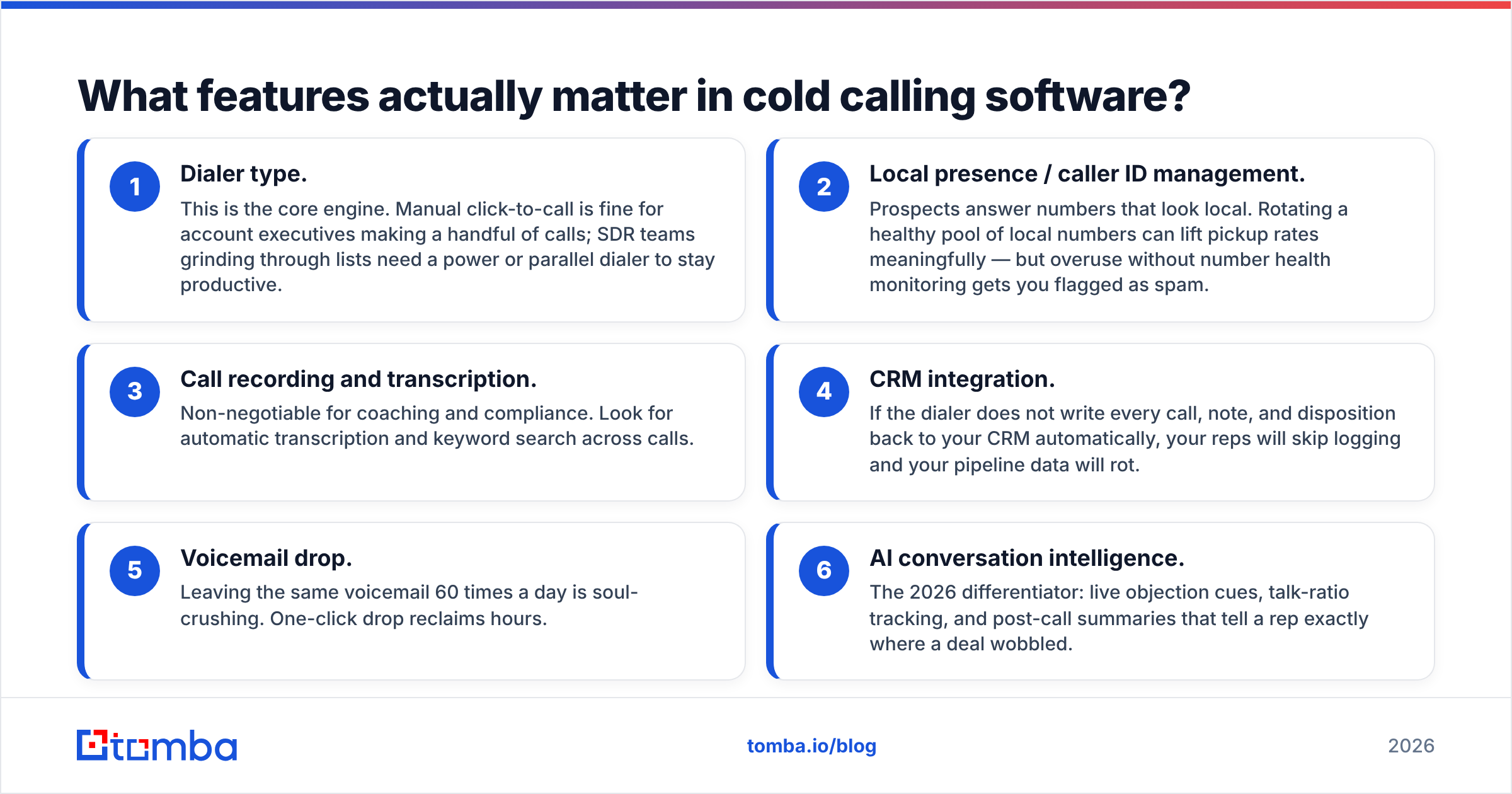
- Dialer type. This is the core engine. Manual click-to-call is fine for account executives making a handful of calls; SDR teams grinding through lists need a power or parallel dialer to stay productive.
- Local presence / caller ID management. Prospects answer numbers that look local. Rotating a healthy pool of local numbers can lift pickup rates meaningfully — but overuse without number health monitoring gets you flagged as spam.
- Call recording and transcription. Non-negotiable for coaching and compliance. Look for automatic transcription and keyword search across calls.
- CRM integration. If the dialer does not write every call, note, and disposition back to your CRM automatically, your reps will skip logging and your pipeline data will rot.
- Voicemail drop. Leaving the same voicemail 60 times a day is soul-crushing. One-click drop reclaims hours.
- AI conversation intelligence. The 2026 differentiator: live objection cues, talk-ratio tracking, and post-call summaries that tell a rep exactly where a deal wobbled.
A quick gut check before you buy: if a feature does not either increase dials, increase connects, or improve the next call, it is a nice-to-have, not a reason to upgrade tiers.
How do the main types of dialers compare?#
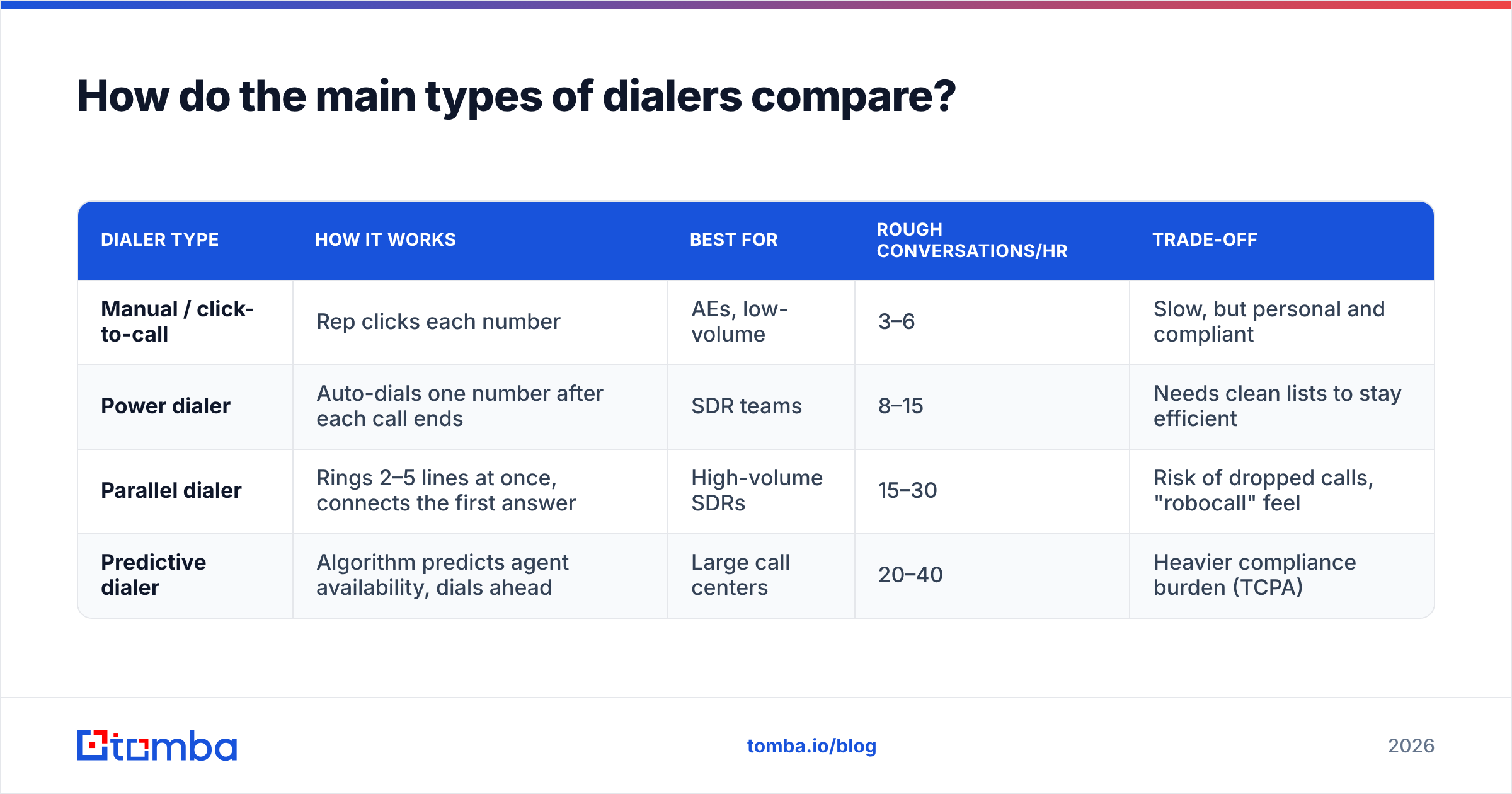
The dialer decides your ceiling on conversations per hour. Here is how the common types stack up.
| Dialer type | How it works | Best for | Rough conversations/hr | Trade-off |
|---|---|---|---|---|
| Manual / click-to-call | Rep clicks each number | AEs, low-volume | 3–6 | Slow, but personal and compliant |
| Power dialer | Auto-dials one number after each call ends | SDR teams | 8–15 | Needs clean lists to stay efficient |
| Parallel dialer | Rings 2–5 lines at once, connects the first answer | High-volume SDRs | 15–30 | Risk of dropped calls, "robocall" feel |
| Predictive dialer | Algorithm predicts agent availability, dials ahead | Large call centers | 20–40 | Heavier compliance burden (TCPA) |
For most B2B sales teams, a power dialer is the sweet spot — a real productivity jump without the compliance and connection-quality headaches that come with predictive dialing. Parallel dialers are compelling for pure SDR pods running massive lists, provided you monitor number health and drop rates.
Is cold calling software sales worth it in 2026?#
Yes. For any team making more than about 20 outbound calls per rep per day, the math is straightforward. If software lifts a rep from 45 dials an hour to 100 at the same connect rate, you have roughly doubled conversations without hiring anyone. At a fully loaded rep cost of six figures, a $75/month tool that recovers even 20% more selling time pays for itself many times over. That is the core case for cold calling software sales leaders keep coming back to.
But the honest caveat: software cannot fix a bad list. A parallel dialer screaming through disconnected numbers just burns your caller ID reputation faster. The teams that win treat the dialer and the data as one system. That is why connect rate — not dial count — is the metric to optimize, and connect rate lives and dies on phone-number accuracy.
This is where your prospecting data source becomes part of the calling stack. Pulling verified direct-dial numbers with a phone finder before a call block means your dialer spends its cycles on numbers that actually ring a human, not a dead extension.
Enriching those records with data enrichment — title, company, timezone — also lets you call at the right hour. You open with relevance instead of a cold "did I catch you at a bad time?"

How much does cold calling software cost?#
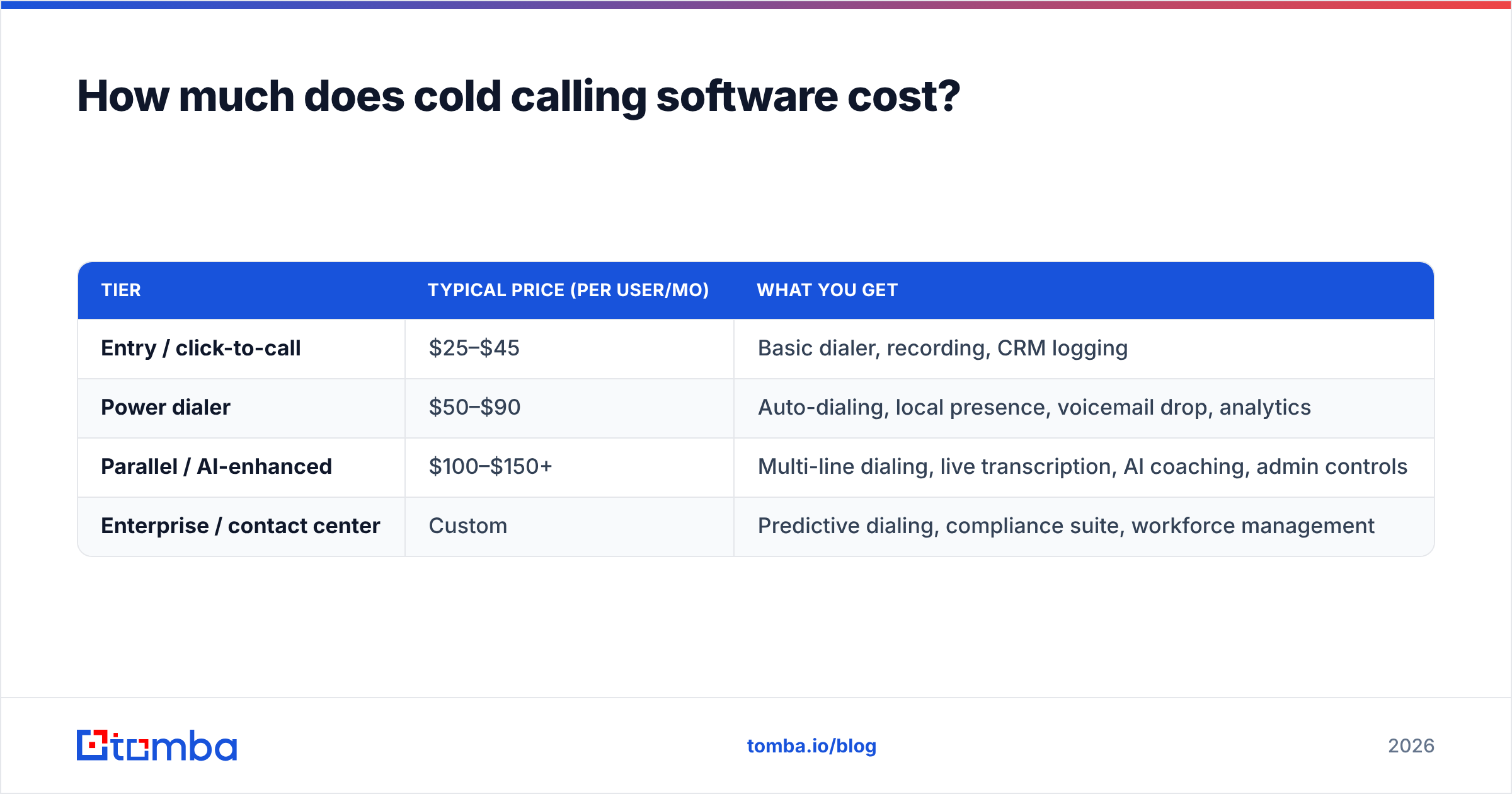
Cold calling software sales pricing generally tracks the dialer sophistication and whether AI conversation intelligence is bundled. Ballpark ranges for 2026:
| Tier | Typical price (per user/mo) | What you get |
|---|---|---|
| Entry / click-to-call | $25–$45 | Basic dialer, recording, CRM logging |
| Power dialer | $50–$90 | Auto-dialing, local presence, voicemail drop, analytics |
| Parallel / AI-enhanced | $100–$150+ | Multi-line dialing, live transcription, AI coaching, admin controls |
| Enterprise / contact center | Custom | Predictive dialing, compliance suite, workforce management |
Watch for the usual gotchas: per-minute call charges on top of the seat price, local number rental fees, annual-only billing, and AI features paywalled into the top tier. Always price the total cost for your real call volume, not the sticker seat price. Vendors publish detailed breakdowns on comparison sites like G2 — cross-check the marketing page against real reviews before committing.
How do you choose the right cold calling software?#
Work backward from your motion. Ask these five questions in order:
- What is our daily dial volume per rep? Under 20, click-to-call is enough. Over 60, you need a power or parallel dialer.
- Where does call data need to live? Whatever CRM you run — HubSpot, Salesforce, Pipedrive — the dialer must sync natively, not through brittle exports. HubSpot's own sales tools guidance is a useful benchmark for what "good" integration looks like.
- How regulated is our calling? If you dial cell phones at scale in the US, TCPA and state consent rules push you toward compliant, non-predictive setups with clear audit trails.
- Do we coach off calls? If yes, prioritize transcription quality and conversation intelligence over raw dial speed.
- How clean is our list? Be honest. If your phone data is stale, fix the data pipeline first — a fast dialer on bad numbers is just a faster way to fail.
That last point is the one teams skip and regret. Before you evaluate a single dialer, audit where your numbers come from. Sourcing direct dials and mobile numbers from an accurate provider, then validating them, is what turns dial volume into actual conversations. You can pressure-test any provider's numbers with a phone validator so your reps are not left listening to dead air.
What is the difference between a dialer and a full sales engagement platform?#
A dialer handles calls; a sales engagement platform orchestrates the whole outbound sequence — calls, emails, LinkedIn touches, and tasks — in one cadence. The line is blurring, but the distinction matters for buying.
If your team lives on the phone and email is a side channel, a focused dialer with good CRM sync is cheaper and simpler. If you run multi-touch sequences where a call is step 3 of 9, you probably want an engagement platform with a built-in dialer so reps do not tool-switch. The risk with all-in-one platforms is paying for email and social features you barely use to get the calling piece you actually need.
Either way, the phone step is only as good as the number behind it. Teams standardize on a B2B database and enrichment layer so every contact that enters a cadence already has a verified direct dial attached — no rep should be hunting for a phone number mid-sequence.
Common mistakes that kill cold calling software sales ROI#
Even with the right tool, these habits waste the investment:
- Buying speed before fixing data. Parallel dialing bad lists torches your caller ID reputation and connect rate.
- Ignoring number health. Rotate and monitor local numbers, or carriers will start flagging you as spam within weeks.
- Skipping call review. Recording every call and never listening back is paying for a coaching tool you refuse to use.
- Over-automating the open. Voicemail drop and auto-dial are great; a robotic, un-researched opener still gets hung up on.
- No disposition discipline. If reps do not tag call outcomes consistently, your analytics — and your follow-up — fall apart.
The bottom line#
Cold calling software sales comes down to one rule: fix the data, then buy the dialer. For any team dialing at real volume, a power dialer with automatic CRM logging and call recording is the practical default in 2026. Reserve parallel and predictive dialers for high-volume SDR pods that can manage number health and compliance. The fastest dialer in the world still cannot connect you to a disconnected number.
If your connect rates are stuck, start upstream. Feed your dialer verified, enriched contacts so every call reaches a real person. Tomba's Phone Finder surfaces direct-dial and mobile numbers you can validate and push straight into your calling workflow. Tomba's plans start free (25 searches/month), with paid tiers from $49/month, so you can test the data quality before you scale. Get the numbers right, and your cold calling software finally earns its seat price.
Related guides#
// get started
Find, verify and enrich your first contacts today
Start on the free plan with 25 searches a month, then scale when your team is ready.
Free plan · No credit card required · GDPR & CCPA
// about the author