Cold Calling Statistics in 2026: The Data-Backed Guide
Is cold calling dead in 2026? The data says otherwise. Here are the cold calling statistics that actually matter — conversion rates, best call times, and how top reps beat a 2% baseline.
Cold calling gets declared dead every year, and every year a segment of B2B reps keeps hitting quota with a phone and a list. The gap between those two realities is data. If you only know the scary headline stat — "it takes 8 calls to reach a prospect" — you'll quit before the math works in your favor. If you know the full picture, you'll dial smarter.
This is a plain-English breakdown of the cold calling statistics worth acting on in 2026, what they actually mean for your pipeline, and the levers that separate a 1% connect-to-meeting rate from a 10% one.
TL;DR — The Numbers That Matter#
- Cold calling still works, but the baseline is brutal: average conversion from dial to meeting sits around 1–3%, and it takes roughly 6–8 dial attempts to reach a single decision-maker.
- Timing moves the needle more than script: calling between 4–5 PM local time and on Wednesday/Thursday consistently outperforms Monday-morning dialing.
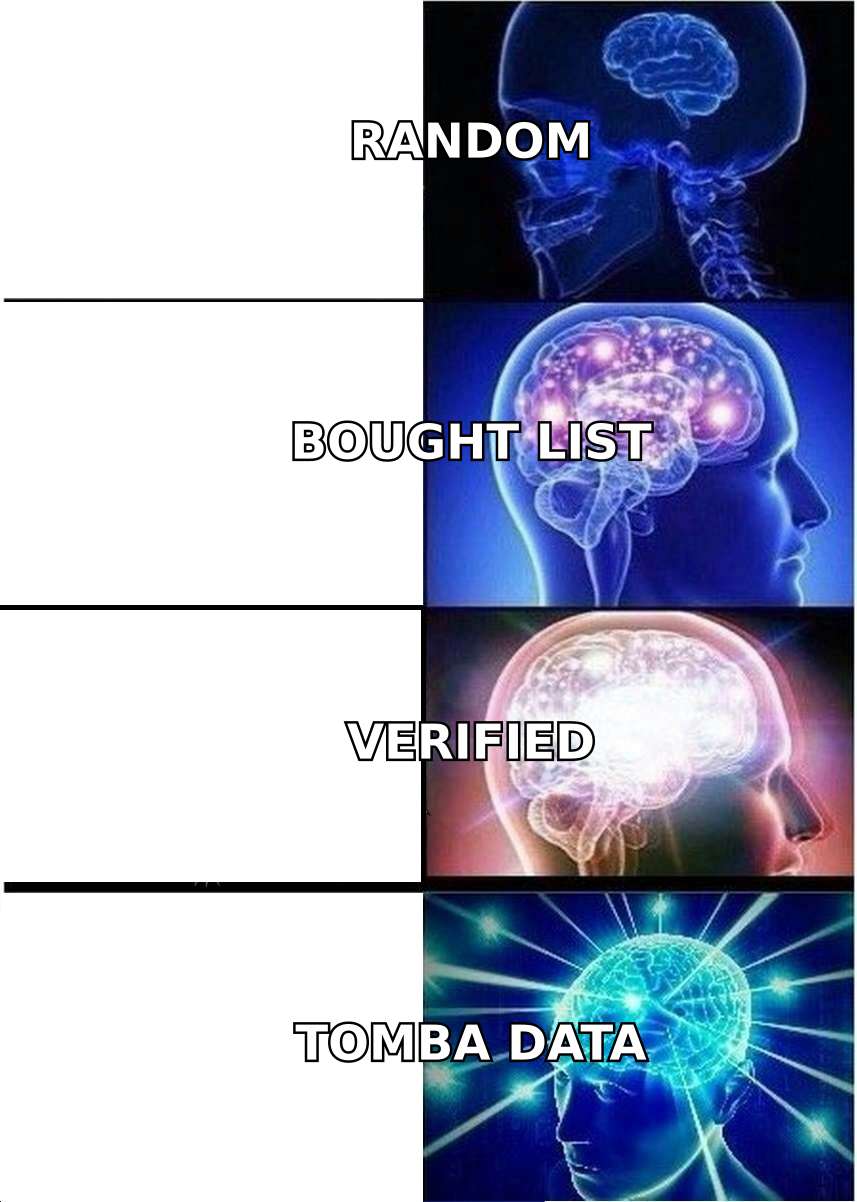
- Data quality is the hidden multiplier: reps working verified direct-dial numbers connect several times more often than reps grinding through switchboard lines and dead numbers.
- Persistence is underrated: nearly half of reps give up after one follow-up, yet most conversions happen after the 3rd–5th touch.
- Multichannel beats phone-only: pairing calls with email and LinkedIn lifts connect and reply rates well above single-channel outbound.
Is Cold Calling Dead in 2026?#
Short answer: no, but "spray and pray" cold calling is. The tactic that died is dialing random numbers off a scraped list with no context. What still works is targeted, well-timed calling into accounts you've researched, using accurate contact data.
The confusion comes from mixing two very different activities under one label. A rep hammering a purchased list of generic info@ lines and outdated switchboard numbers will post a near-zero success rate and conclude the channel is dead. A rep calling a verified direct dial for a title-matched decision-maker, right after they engaged with an email, plays a completely different game.
Think of cold calling like fishing. Casting a bare hook into a random pond all day catches nothing and "proves" fishing doesn't work. Casting the right bait where the fish actually are is a different story. The channel isn't the variable — the targeting and the data are.
What Are the Real Cold Calling Conversion Rates?#
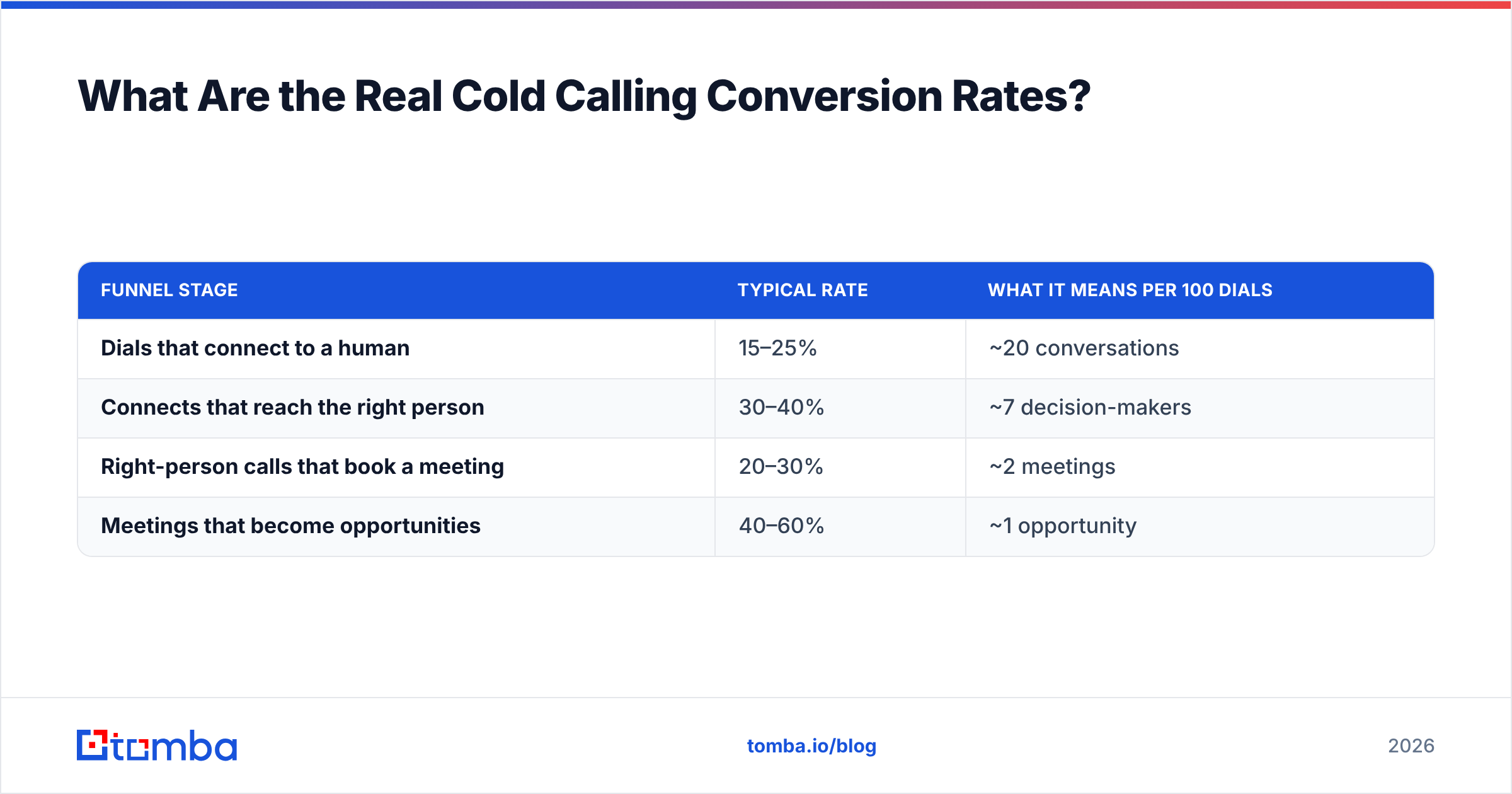
Here's where expectations need calibrating. When people hear "2% conversion" they picture 2 meetings per 100 calls, but the funnel has more stages than that — and each stage leaks.
A realistic B2B cold calling funnel looks roughly like this:
| Funnel stage | Typical rate | What it means per 100 dials |
|---|---|---|
| Dials that connect to a human | 15–25% | ~20 conversations |
| Connects that reach the right person | 30–40% | ~7 decision-makers |
| Right-person calls that book a meeting | 20–30% | ~2 meetings |
| Meetings that become opportunities | 40–60% | ~1 opportunity |
So "1–2 meetings per 100 dials" is normal — and it's not the failure it sounds like. If each opportunity is worth several thousand dollars in ACV, a rep making 50 quality dials a day is building real pipeline. The problem is that most of the leak happens at the very first stage: you can't book a meeting with a number that never connects.
That top-of-funnel leak is exactly where better data pays off. A verified phone finder that returns direct-dial mobile numbers instead of front-desk lines can double your connect rate before you change a single word of your pitch. According to HubSpot's sales research, reps consistently rank "getting through to the right person" as their biggest prospecting obstacle — and that's a data problem, not a talent problem.
When Is the Best Time to Make Cold Calls?#
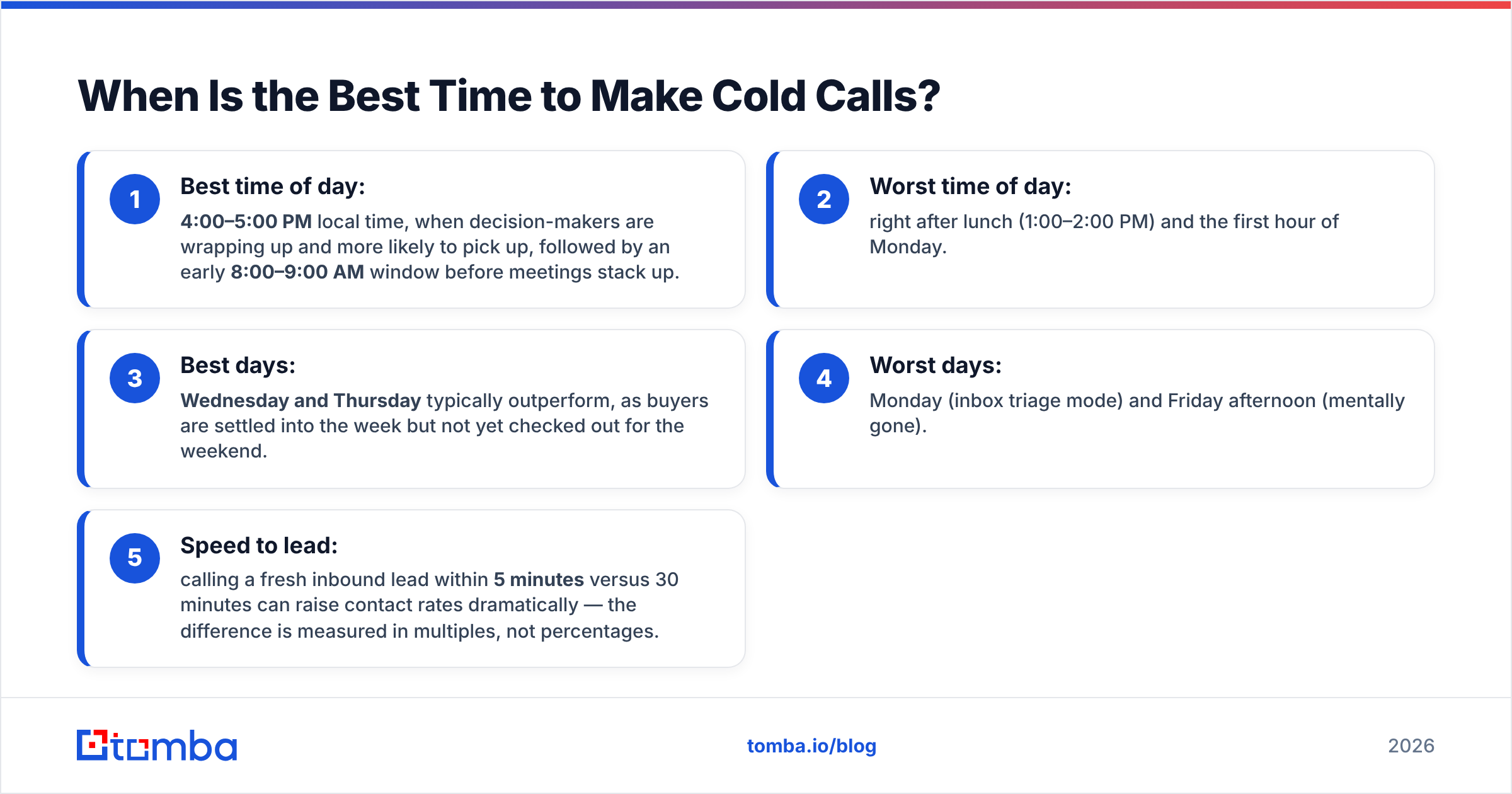
The data points to late afternoon and midweek. Multiple outbound studies converge on the same windows:
- Best time of day: 4:00–5:00 PM local time, when decision-makers are wrapping up and more likely to pick up, followed by an early 8:00–9:00 AM window before meetings stack up.
- Worst time of day: right after lunch (1:00–2:00 PM) and the first hour of Monday.
- Best days: Wednesday and Thursday typically outperform, as buyers are settled into the week but not yet checked out for the weekend.
- Worst days: Monday (inbox triage mode) and Friday afternoon (mentally gone).
- Speed to lead: calling a fresh inbound lead within 5 minutes versus 30 minutes can raise contact rates dramatically — the difference is measured in multiples, not percentages.
These are tendencies, not laws. Your buyers may run night shifts, live in three time zones, or answer best at 7 AM. The real lesson is to track your own connect rates by hour and day and let your data override the industry averages. Generic benchmarks get you started; your own numbers get you to quota.
How Many Times Should You Follow Up?#
Most reps quit right before the payoff. Survey data repeatedly shows that a large share of salespeople stop after one or two attempts, while the majority of conversions land somewhere between the third and fifth touch. That mismatch is a gift for anyone willing to be systematic.
Persistence doesn't mean calling the same dead number ten times. It means a structured cadence across channels — a call, then an email, then a LinkedIn touch, then another call — spaced over one to two weeks. Each channel covers for the others: the person who ignores your voicemail may reply to a two-line email, and vice versa.
This is also where your win rate and response rate stop being mysteries and start being math. If you understand your true response rate per touch, you can predict how many contacts you need to load into a cadence to hit a target number of meetings — and staffing, list-building, and forecasting all get easier.
Does Cold Calling Beat Cold Email?#
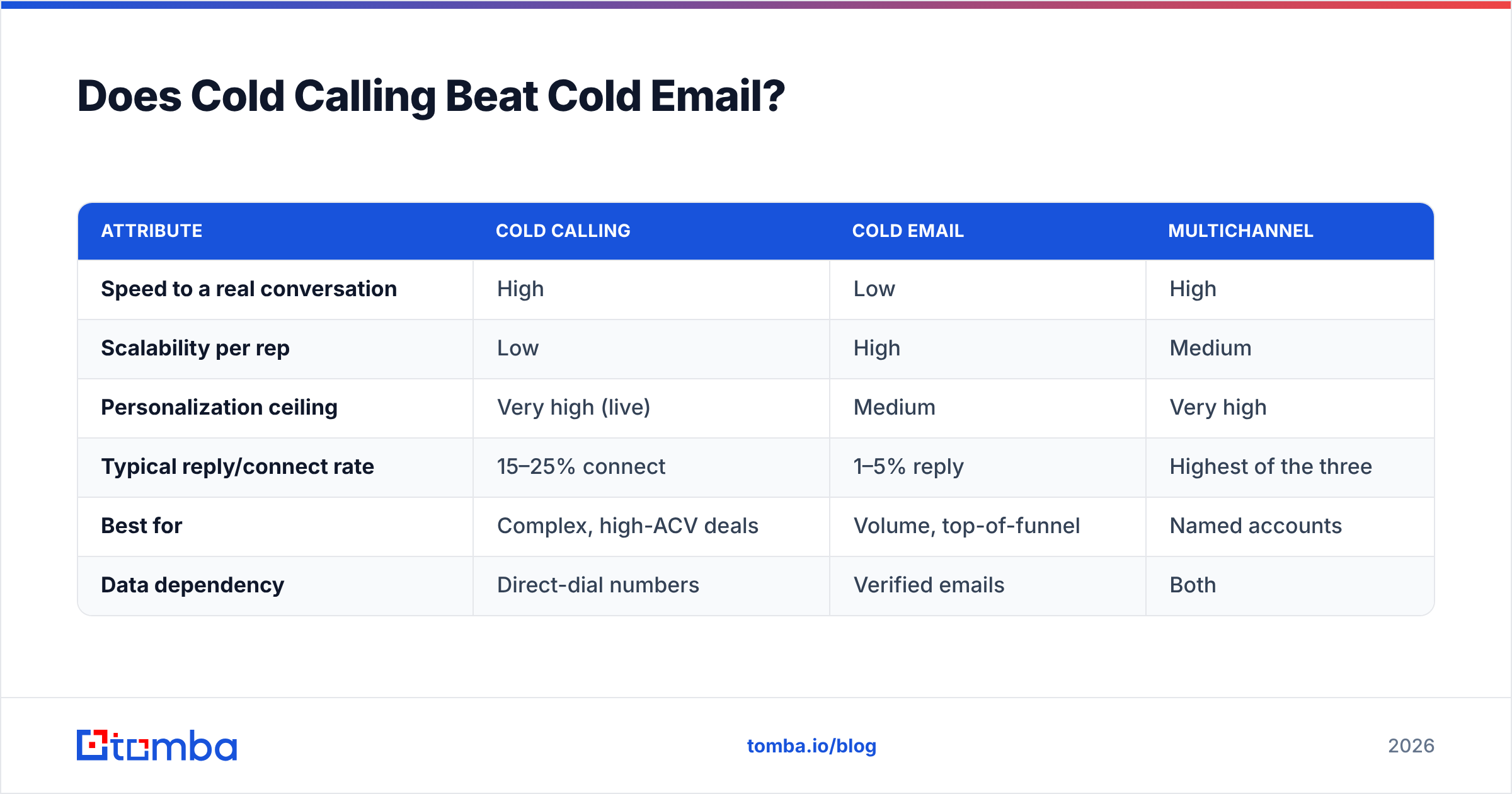
Neither wins alone — the combination wins. Framing it as calling versus emailing is the wrong question. Each channel has a distinct strength, and the best outbound teams sequence them together.
| Attribute | Cold calling | Cold email | Multichannel |
|---|---|---|---|
| Speed to a real conversation | High | Low | High |
| Scalability per rep | Low | High | Medium |
| Personalization ceiling | Very high (live) | Medium | Very high |
| Typical reply/connect rate | 15–25% connect | 1–5% reply | Highest of the three |
| Best for | Complex, high-ACV deals | Volume, top-of-funnel | Named accounts |
| Data dependency | Direct-dial numbers | Verified emails | Both |
The through-line in that table is the bottom row: both channels collapse without accurate contact data. A great script dialing a wrong number fails. A perfect email hitting a spam trap fails. That's why serious outbound motions start with clean, verified records — accurate emails from an email finder plus validated direct-dial numbers from a phone validator — before a single message goes out.
For a deeper look at how buyers actually want to be reached, Gartner's sales research is a useful, vendor-neutral reference; the recurring theme is that buyers tolerate outreach when it's relevant and well-targeted, and tune out when it isn't.
What Separates Top Cold Callers From Average Ones?#
The elite reps aren't dialing faster or talking louder. Looking across the statistics, three variables explain most of the gap:
- Data accuracy first. Top performers spend time (or spend on tools) ensuring the number they dial reaches a real, correctly-titled human. Everything downstream — script, tone, objection handling — only matters after the connect.
- Disciplined cadence. They run the same multi-touch sequence every time and don't emotionally bail after one voicemail. Consistency compounds.
- Ruthless timing. They protect their peak calling windows for live dials and batch admin work into the dead hours.
Notice that only one of those three is about talent on the phone. The other two are about process and data — which is good news, because those are the parts you can systematize and buy your way into. You can't shortcut charisma, but you can absolutely shortcut bad lists. Pulling clean, enriched contact records with a domain search or bulk enrichment step, then verifying them before your reps ever dial, removes the single biggest source of wasted calls.
How Do You Improve Your Cold Calling Numbers?#
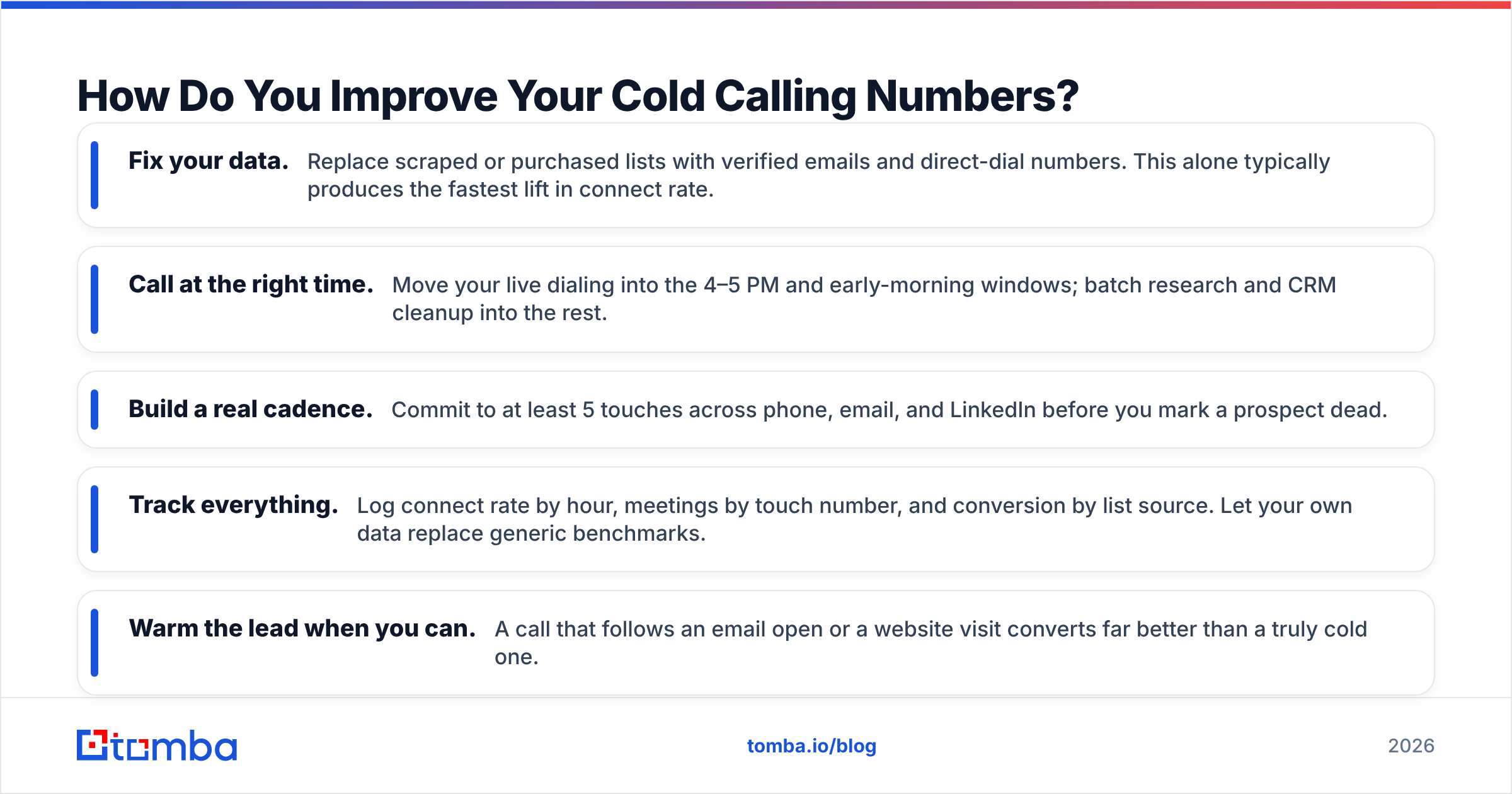
Start at the top of the funnel, because that's where the biggest leak is. In order of impact:
- Fix your data. Replace scraped or purchased lists with verified emails and direct-dial numbers. This alone typically produces the fastest lift in connect rate.
- Call at the right time. Move your live dialing into the 4–5 PM and early-morning windows; batch research and CRM cleanup into the rest.
- Build a real cadence. Commit to at least 5 touches across phone, email, and LinkedIn before you mark a prospect dead.
- Track everything. Log connect rate by hour, meetings by touch number, and conversion by list source. Let your own data replace generic benchmarks.
- Warm the lead when you can. A call that follows an email open or a website visit converts far better than a truly cold one.
Do those five things and the "2% conversion rate" you were quoted stops being a ceiling and becomes a floor.
The Bottom Line#
Cold calling in 2026 isn't dead — it's data-gated. The reps and teams posting strong numbers aren't the ones with the slickest openers; they're the ones dialing verified, correctly-targeted contacts at the right time, with the discipline to follow up. The statistics reward preparation, not volume for its own sake.
If your connect rate is the thing holding your outbound back, start where the data starts. Tomba's Email Finder and phone-finding tools give you verified, correctly-matched contact records — real people, real direct lines — so your reps spend their calling hours in conversations instead of listening to switchboard hold music. Check the Tomba pricing plans (a free tier covers 25 searches a month, with paid plans from $49/mo) and feed your next call block a list that actually connects.
Related guides#
Ready to find emails that actually work?
Join 150,000+ professionals who stopped guessing and started sending. Free credits on signup — no credit card required.
Get the Tomba newsletter
Practical outbound tactics and product updates — once every two weeks.
About the author