Cold Calling Strategies for 2026: A Rep's Field Guide
Cold calling still books meetings in 2026 — if you use the right structure, timing, and data. Here are the strategies that actually move connect and conversion rates.
Cold calling is not dead — bad cold calling is. Reps who still dial into a spreadsheet of random numbers, read a stiff script, and pitch in the first ten seconds get hung up on. Reps who research, time their dials, and lead with the buyer's problem book meetings at rates that make email jealous. This guide walks through the cold calling strategies that actually work in 2026, backed by concrete structure you can steal today.
TL;DR#
- Connect rate is a data problem first, a talent problem second. Clean, verified phone numbers beat a better script every time.
- The opener decides the call. Lead with a permission-based line and the prospect's problem, not your company name.
- Timing is a lever most reps ignore. Wednesday and Thursday, 4–5 PM local, still outperform Monday mornings.
- A tight, repeatable framework (open → hook → discovery → ask) beats improvisation and beats a rigid word-for-word script.
- Multi-channel wins. A call after a relevant email or LinkedIn touch connects far more often than a cold, first-touch dial.
Does cold calling still work in 2026?#
Yes — when it is targeted. The myth that "nobody answers the phone anymore" comes from reps blasting bad lists. Decision-makers still pick up when the number is real, the timing is sane, and the first sentence earns the next fifteen seconds.
Think of cold calling like fishing. You can have the best rod and the smoothest cast (your script and delivery), but if you are casting into an empty pool (a bad list), you catch nothing. The reps complaining that "calling is dead" are almost always fishing in the wrong pond.
The data backs this up. Industry benchmarks from HubSpot consistently show that phone outreach still drives a meaningful share of booked meetings, especially for mid-market and enterprise deals where a human conversation shortcuts a ten-email thread. The phone has not lost its power; the untargeted approach has lost its welcome.
What are the core cold calling strategies that actually move the needle?#
There are dozens of tactics floating around LinkedIn. Most are noise. These five are the load-bearing walls — get them right and everything else is trim.
- Start with clean data. Wrong numbers, disconnected lines, and gatekeeper switchboards destroy your connect rate before you say a word. Verify numbers before you dial.
- Research the prospect in 60 seconds. Recent funding, a new role, a hiring spree, a product launch — one specific detail turns a cold call into a warm one.
- Lead with their problem, not your pitch. The opener earns attention by naming a pain the prospect actually feels, then asking permission to continue.
- Run discovery, don't monologue. The best cold calls are 60% listening. Ask, shut up, and let the prospect describe their world.
- Ask for a specific next step. "Does Thursday at 2 or Friday at 10 work for a 15-minute deeper dive?" beats "Can I send you some info?"
Notice what is missing: no gimmicky tricks, no manipulation, no "pattern interrupts" that feel like magician's misdirection. Modern buyers see through that. Respect and relevance win.
How do you structure a cold call that converts?#
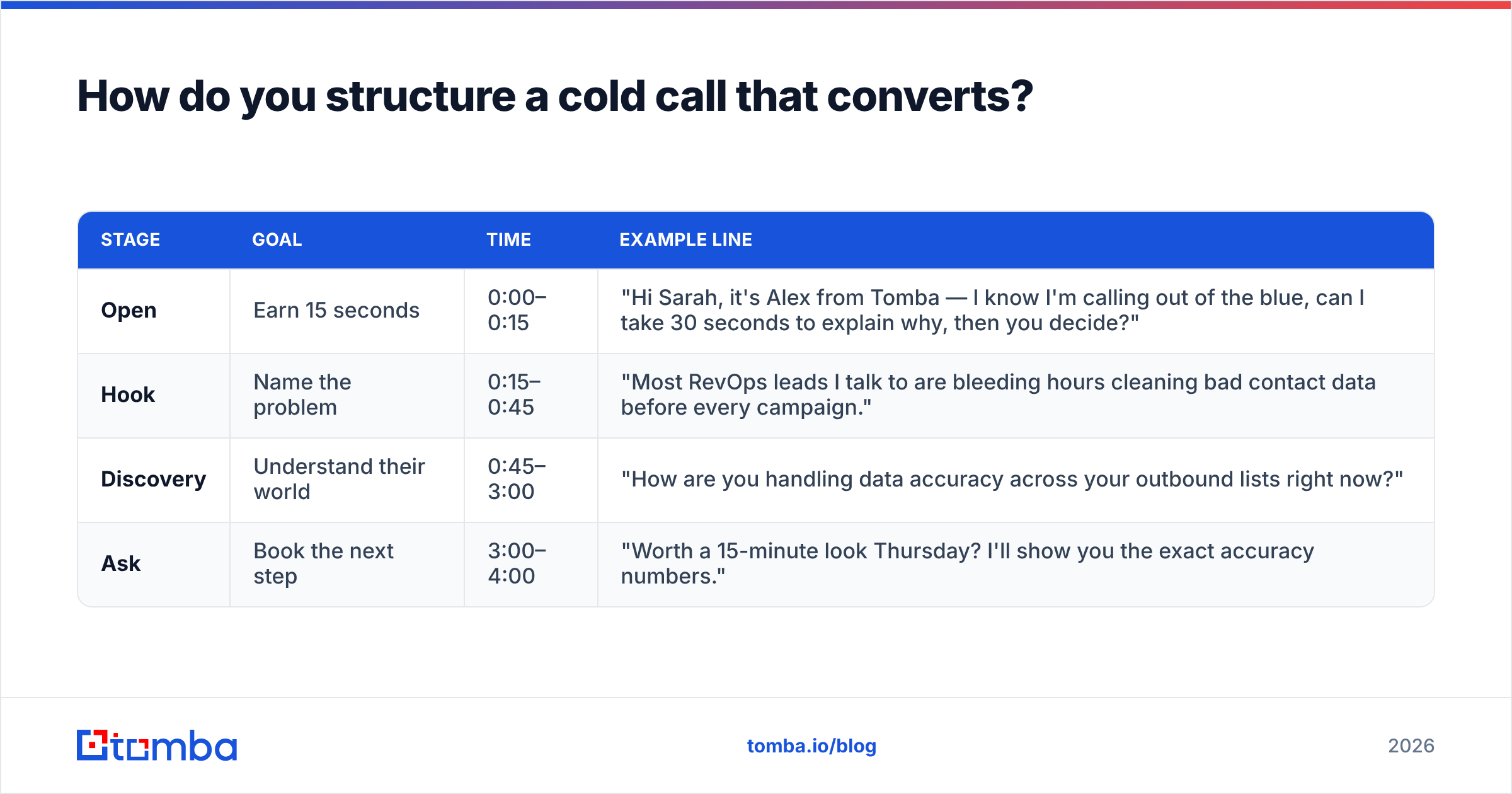
Use a framework, not a script. A framework gives you rails without making you sound like a robot reading a teleprompter. Here is a proven four-part structure.
| Stage | Goal | Time | Example line |
|---|---|---|---|
| Open | Earn 15 seconds | 0:00–0:15 | "Hi Sarah, it's Alex from Tomba — I know I'm calling out of the blue, can I take 30 seconds to explain why, then you decide?" |
| Hook | Name the problem | 0:15–0:45 | "Most RevOps leads I talk to are bleeding hours cleaning bad contact data before every campaign." |
| Discovery | Understand their world | 0:45–3:00 | "How are you handling data accuracy across your outbound lists right now?" |
| Ask | Book the next step | 3:00–4:00 | "Worth a 15-minute look Thursday? I'll show you the exact accuracy numbers." |
The "permission" open matters more than most reps realize. Asking "can I take 30 seconds" disarms the reflexive hang-up because it signals respect for the prospect's time and hands them control. Nine times out of ten, they say "sure, go ahead."
The hook is where research pays off. A generic hook ("we help companies grow") gets ignored. A specific hook that names a pain the buyer's role actually owns makes them lean in.
Why is your list the most important cold calling strategy?#
Because the best script in the world cannot fix a wrong number. Your connect rate — the percentage of dials that reach a live human — is capped entirely by list quality. Reps obsess over delivery and ignore the input, which is backwards.
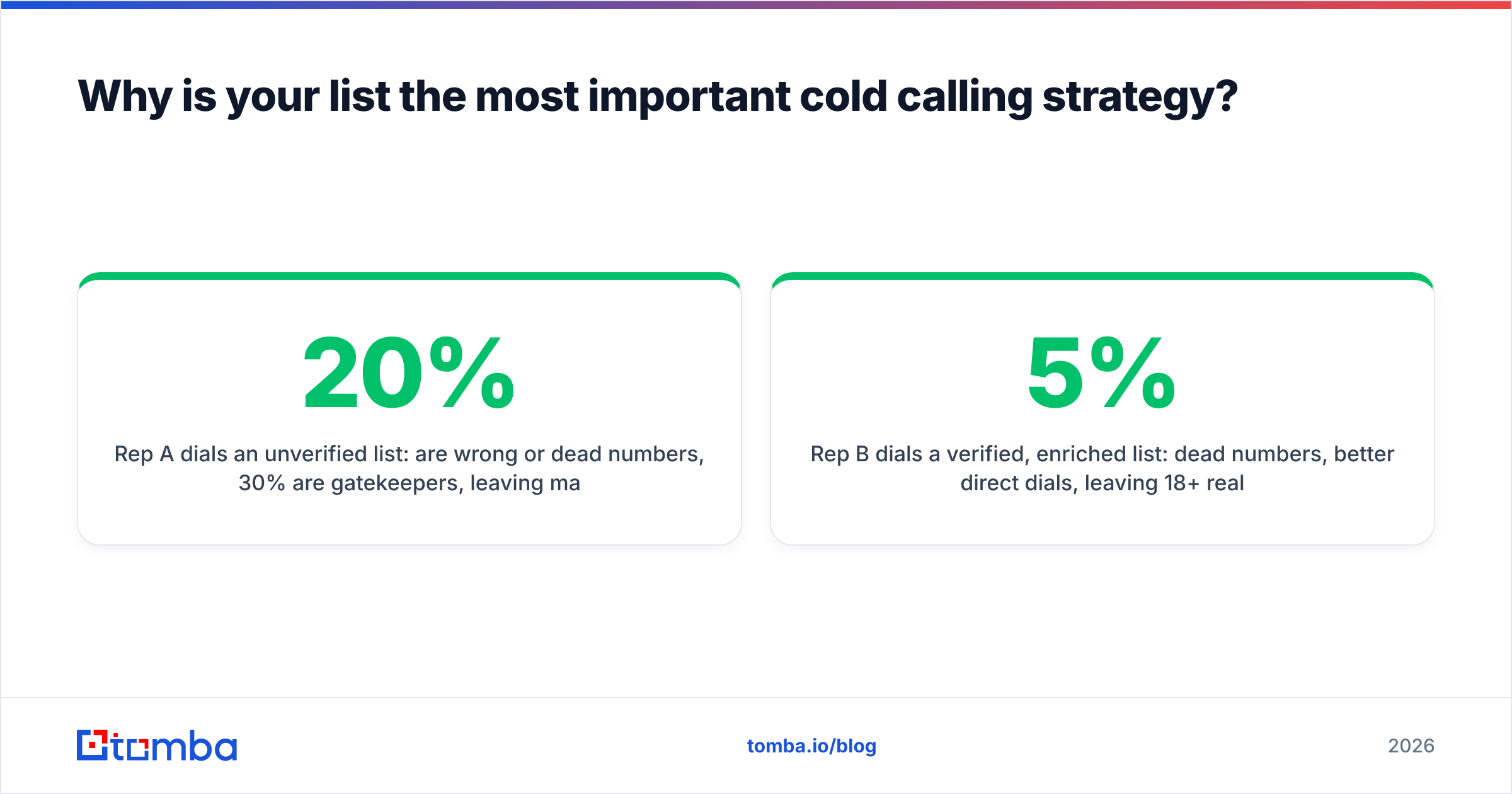
Consider two reps making 50 dials a day:
- Rep A dials an unverified list: 20% are wrong or dead numbers, 30% are gatekeepers, leaving maybe 8 real conversations.
- Rep B dials a verified, enriched list: 5% dead numbers, better direct dials, leaving 18+ real conversations.
Same effort, more than double the output. That gap is data, not talent.
This is where enrichment tooling earns its keep. Pulling accurate direct-dial numbers and confirming they are live before you call is a force multiplier. A phone finder surfaces B2B direct numbers tied to real decision-makers, and a phone validator confirms the line is active so you are not burning dials on dead ends. Pair that with data enrichment to add the role, company, and context that fuel a relevant opener.
If your outreach also runs on email — and it should, as part of a multi-channel play — verified contact points matter there too. An accurate email finder keeps your follow-up sequence landing in the right inbox instead of bouncing.
When is the best time to cold call?#
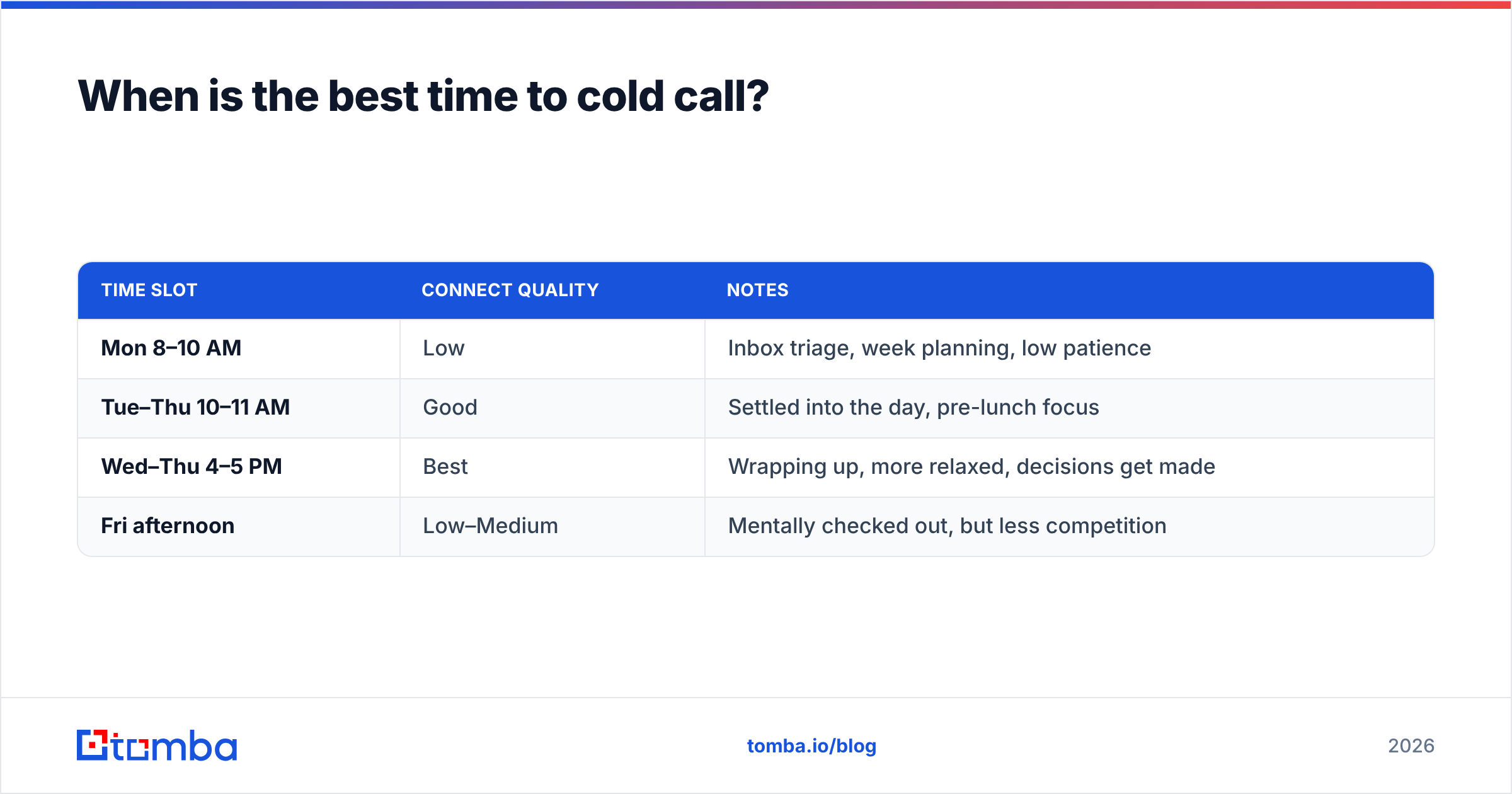
Timing is the cheapest lever you have — it costs nothing to reschedule a dial block. Decades of sales-cadence research point to a few reliable windows.
| Time slot | Connect quality | Notes |
|---|---|---|
| Mon 8–10 AM | Low | Inbox triage, week planning, low patience |
| Tue–Thu 10–11 AM | Good | Settled into the day, pre-lunch focus |
| Wed–Thu 4–5 PM | Best | Wrapping up, more relaxed, decisions get made |
| Fri afternoon | Low–Medium | Mentally checked out, but less competition |
Local time is what matters — a 4 PM call to a prospect three time zones away is a 1 PM call for them, and your data should tell you which is which. The broad pattern holds across most B2B research: mid-week, late afternoon beats Monday morning. But treat these as starting hypotheses, not gospel. Log your own connect rates by day and hour, and let your pipeline tell you the truth for your market.
How should cold calling fit into a multi-channel sequence?#
Cold calling should never stand alone. A dial that lands after the prospect has seen your name in their inbox or on LinkedIn connects far more often than a pure cold, first-touch call. Familiarity lowers the wall.
A simple, effective cadence looks like this:
- Day 1: Personalized email referencing a specific trigger (funding, hire, launch)
- Day 2: LinkedIn connection or a thoughtful comment on their post
- Day 4: First cold call — reference the email in your opener
- Day 6: Value-add email (a relevant stat, case study, or resource)
- Day 9: Second call, different angle
- Day 12: Break-up email that invites a "not now" reply
The call on Day 4 is warmer because you can open with "I sent you a note Tuesday about data accuracy — did it land?" That single reference reframes the call from intrusion to follow-up. Tools like Salesforce and modern sequencers help you orchestrate these touches without dropping a step, and syncing your dialer with your CRM keeps every attempt logged.
What are the biggest cold calling mistakes to avoid?#
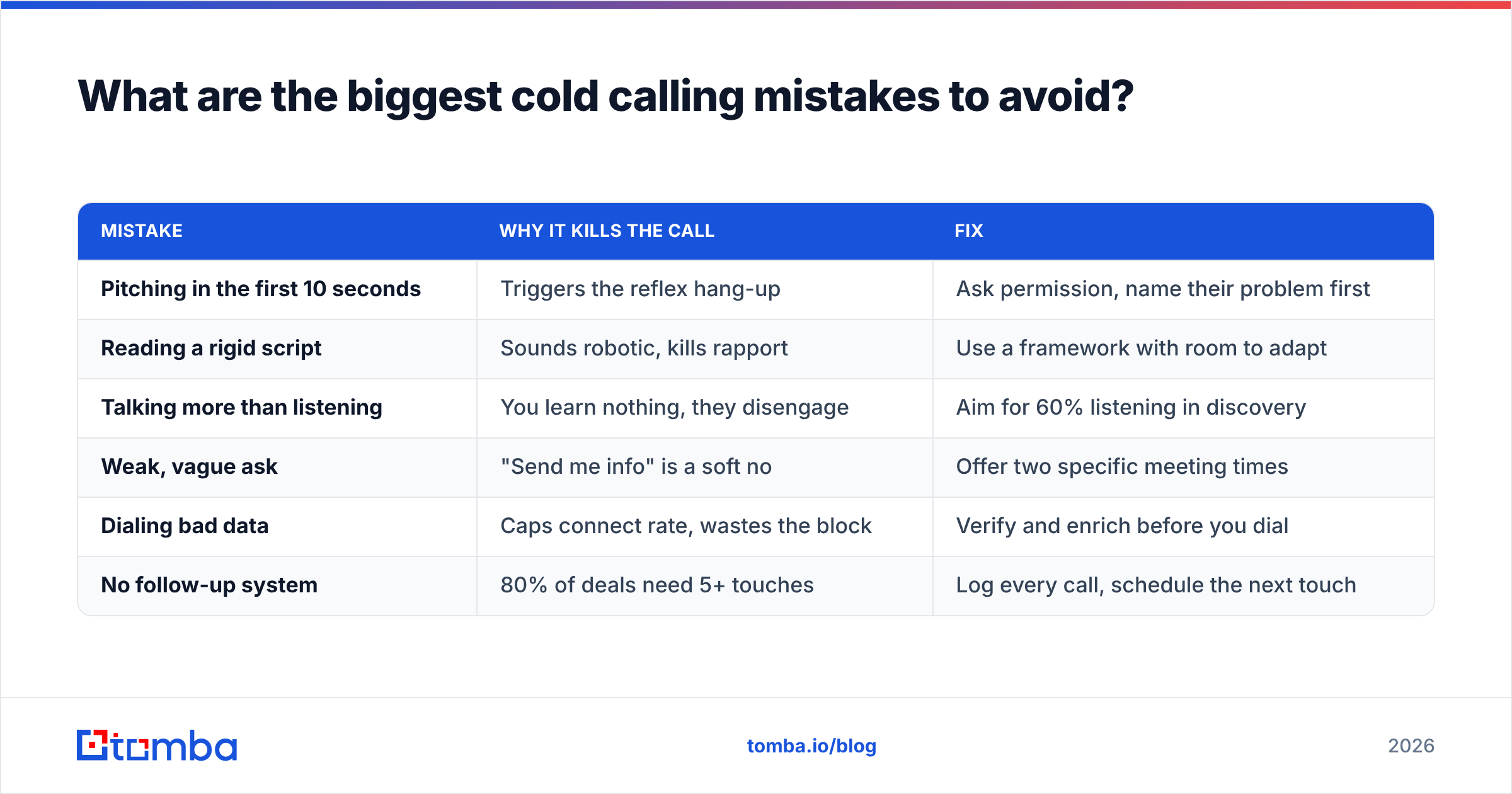
Most call failures trace back to a short list of self-inflicted wounds. Kill these and your numbers climb without any new "technique."
| Mistake | Why it kills the call | Fix |
|---|---|---|
| Pitching in the first 10 seconds | Triggers the reflex hang-up | Ask permission, name their problem first |
| Reading a rigid script | Sounds robotic, kills rapport | Use a framework with room to adapt |
| Talking more than listening | You learn nothing, they disengage | Aim for 60% listening in discovery |
| Weak, vague ask | "Send me info" is a soft no | Offer two specific meeting times |
| Dialing bad data | Caps connect rate, wastes the block | Verify and enrich before you dial |
| No follow-up system | 80% of deals need 5+ touches | Log every call, schedule the next touch |
The listening mistake is the most common and the most fixable. New reps treat a cold call like a performance — they want to deliver every line. Veterans treat it like a conversation — they ask a sharp question and let the silence do the work. Buyers who feel heard book meetings; buyers who feel pitched hang up.
How do you handle the most common objections?#
Objections are not rejections — they are requests for a reason to keep talking. Prepare for the top three and you will rarely get caught flat.
- "I'm not interested." — "Totally fair, I caught you cold. Most people I talk to weren't looking either, until they saw how much dirty data was costing them. Can I ask one quick question?"
- "Send me an email." — "Happy to. So I send something useful and not a generic deck, what's the one thing that would actually be worth your time to see?"
- "We already use someone." — "Makes sense, most teams your size do. I'm not asking you to switch — just curious how happy you are with their contact accuracy. Where does it fall short?"
Each response acknowledges the objection, avoids arguing, and pivots to a question. You are not trying to win the objection; you are trying to keep the conversation alive long enough to find a real problem.
Quick-reference: cold calling strategy checklist#
Before your next call block, run this list:
- List verified? Numbers confirmed live, roles enriched, time zones mapped.
- Research done? One specific trigger per prospect written on the sheet.
- Opener ready? Permission-based line plus a problem hook for this persona.
- Discovery questions loaded? Three open questions that surface pain.
- Ask defined? Two concrete meeting times ready to offer.
- Follow-up planned? Next touch scheduled the moment you hang up.
Miss any of these and you are leaving connect rate — and booked meetings — on the table.
Turn better data into better calls#
The single highest-leverage change most sales teams can make is not a new script or a motivational bootcamp — it is calling real numbers tied to real decision-makers. Everything downstream, from your opener to your close rate, depends on reaching a live human who actually owns the problem you solve.
Start there. Use Tomba's Phone Finder to pull accurate B2B direct dials, verify them so your dial block is not a graveyard of dead lines, and enrich each contact with the role and company context that makes your opener land. Then layer in verified email for multi-channel follow-up. Check the Tomba pricing — the free tier lets you test the data quality before you commit, and the strategies above turn that clean data into meetings on the calendar.
Good cold calling in 2026 is simple, not easy: right person, right number, right time, right opener. Nail the data and the rest is practice.
Related guides#
// get started
Find, verify and enrich your first contacts today
Start on the free plan with 25 searches a month, then scale when your team is ready.
Free plan · No credit card required · GDPR & CCPA
// about the author