Cold Calling Strategies for 2026: A No-Fluff Playbook
Cold calling still books meetings in 2026 — but only if your list, timing, and openers are right. Here are the strategies that beat spray-and-pray dialing.
Cold calling was supposed to be dead by now. It isn't. What died is the version where a rep blindly dials 300 numbers off a scraped spreadsheet and prays. In 2026, the reps hitting quota treat the phone as a precision instrument — clean data, sharp timing, and openers built for a buyer who has heard every script before.
This is a practical guide to the cold calling strategies that still produce booked meetings, and the ones that just burn your reputation and your voice.
TL;DR#
- Data beats volume. A list of 200 verified, correctly-matched direct dials outperforms 2,000 stale numbers. Bad data is why most cold calling "doesn't work."
- Timing is a lever, not luck. Mid-morning and late-afternoon local time, Tuesday–Thursday, still win — but connect rates swing more on which number you dial than when.
- Openers should earn 30 seconds, not pitch. Permission-based and pattern-interrupt openers beat "How are you today?" every time.
- Cadence is multichannel. Calls paired with email and LinkedIn touches lift answer and callback rates well above phone-only sequences.
- Track connect rate, conversation rate, and meeting rate separately. One blended "success" number hides where you're actually losing.
Does cold calling still work in 2026?#
Yes — but the bar has moved. Buyers screen unknown numbers aggressively, spam-labeling has gotten stricter, and the average B2B decision-maker fields more outreach than ever. The result: raw dial volume delivers worse returns each year, while targeted calling to the right person at the right number holds up.
The single biggest predictor of whether cold calling works for a team is the quality of the contact data behind it. If 40% of your numbers are wrong, disconnected, or point to a gatekeeper's front desk, no script saves you. That's why modern cold calling starts long before anyone picks up a phone — it starts with sourcing and verifying who you're actually calling.
What separates good cold calling strategies from bad ones?#
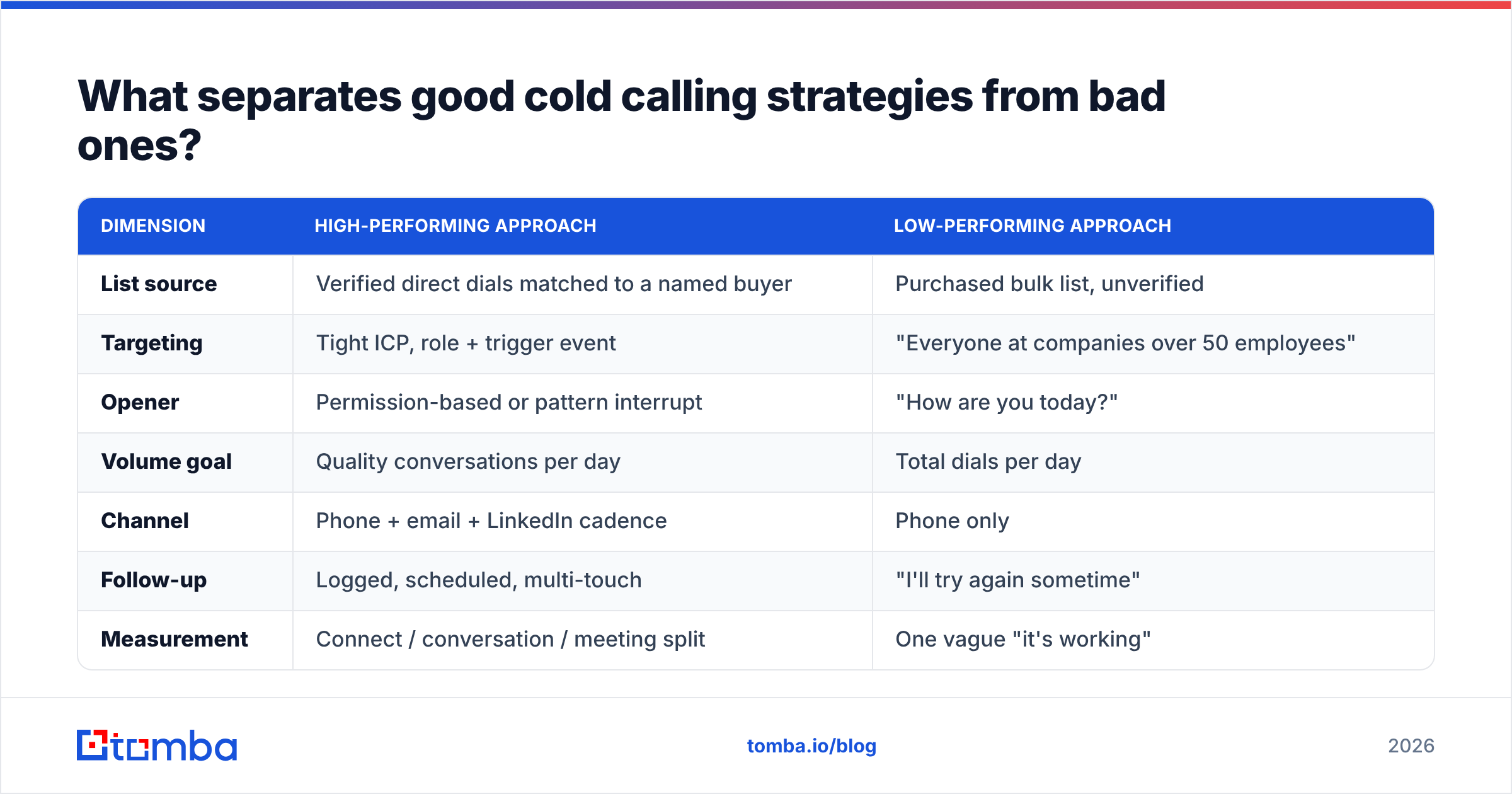
The difference is almost never charisma. It's process. Below is the honest split between the tactics that move pipeline and the ones that feel productive but don't.
| Dimension | High-performing approach | Low-performing approach |
|---|---|---|
| List source | Verified direct dials matched to a named buyer | Purchased bulk list, unverified |
| Targeting | Tight ICP, role + trigger event | "Everyone at companies over 50 employees" |
| Opener | Permission-based or pattern interrupt | "How are you today?" |
| Volume goal | Quality conversations per day | Total dials per day |
| Channel | Phone + email + LinkedIn cadence | Phone only |
| Follow-up | Logged, scheduled, multi-touch | "I'll try again sometime" |
| Measurement | Connect / conversation / meeting split | One vague "it's working" |
Notice that four of the seven rows are decided before the call happens. Cold calling is won in preparation.
How do you build a call list that actually connects?#
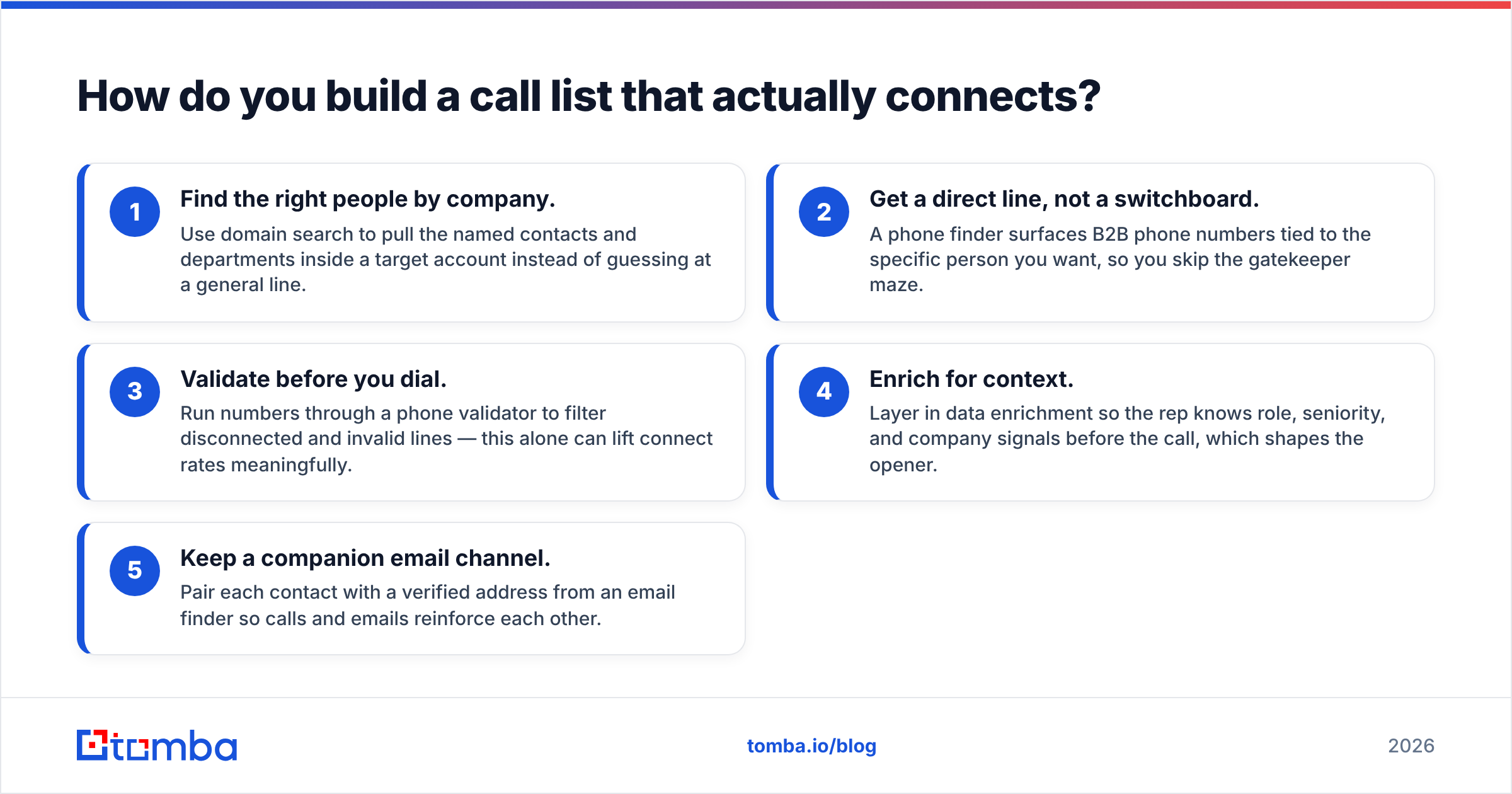
Start with the person, not the phone number. Define your ideal customer profile tightly — role, seniority, company size, and ideally a trigger event (new funding, a leadership hire, a tech-stack change). Then source and verify contact details so your reps spend time talking, not chasing dead lines.
A reliable sourcing workflow looks like this:
- Find the right people by company. Use domain search to pull the named contacts and departments inside a target account instead of guessing at a general line.
- Get a direct line, not a switchboard. A phone finder surfaces B2B phone numbers tied to the specific person you want, so you skip the gatekeeper maze.
- Validate before you dial. Run numbers through a phone validator to filter disconnected and invalid lines — this alone can lift connect rates meaningfully.
- Enrich for context. Layer in data enrichment so the rep knows role, seniority, and company signals before the call, which shapes the opener.
- Keep a companion email channel. Pair each contact with a verified address from an email finder so calls and emails reinforce each other.
The point isn't to use more tools — it's to stop wasting live-dial time on numbers that were never going to connect.
What are the best cold calling openers?#
The first 10–20 seconds decide the call. Your goal isn't to pitch — it's to earn permission to keep talking. Four openers that consistently outperform generic scripts:
- The permission-based opener. "Hey [Name], I know I'm calling out of the blue — can I take 30 seconds to tell you why, and you can decide if it's worth continuing?" This respects their control and disarms the reflexive brush-off.
- The pattern interrupt. Break the telemarketer rhythm. A slower pace, a lower-energy honest tone ("This is a cold call — I'll be quick"), or naming the awkwardness upfront resets the buyer's guard.
- The trigger-event opener. "I saw [company] just [raised a round / opened a new office / hired a VP of Sales] — that usually means [relevant problem]." Relevance buys attention that flattery never will.
- The referral or research anchor. "[Colleague] mentioned your team owns [area]" or "I was reading your [post/report]." Specificity signals you did homework, which most callers don't.
Avoid "How are you today?" — buyers pattern-match it to a sales call instantly. And never open with your full company backstory; nobody grants a stranger two uninterrupted minutes.
How many calls should a rep actually make?#
Fewer than the volume gurus claim — but with far better inputs. Chasing a raw dial count optimizes the wrong thing. Two reps can both make 60 dials: one talks to 3 people off a stale list, the other talks to 12 off a verified one. The dial count is identical; the pipeline isn't.
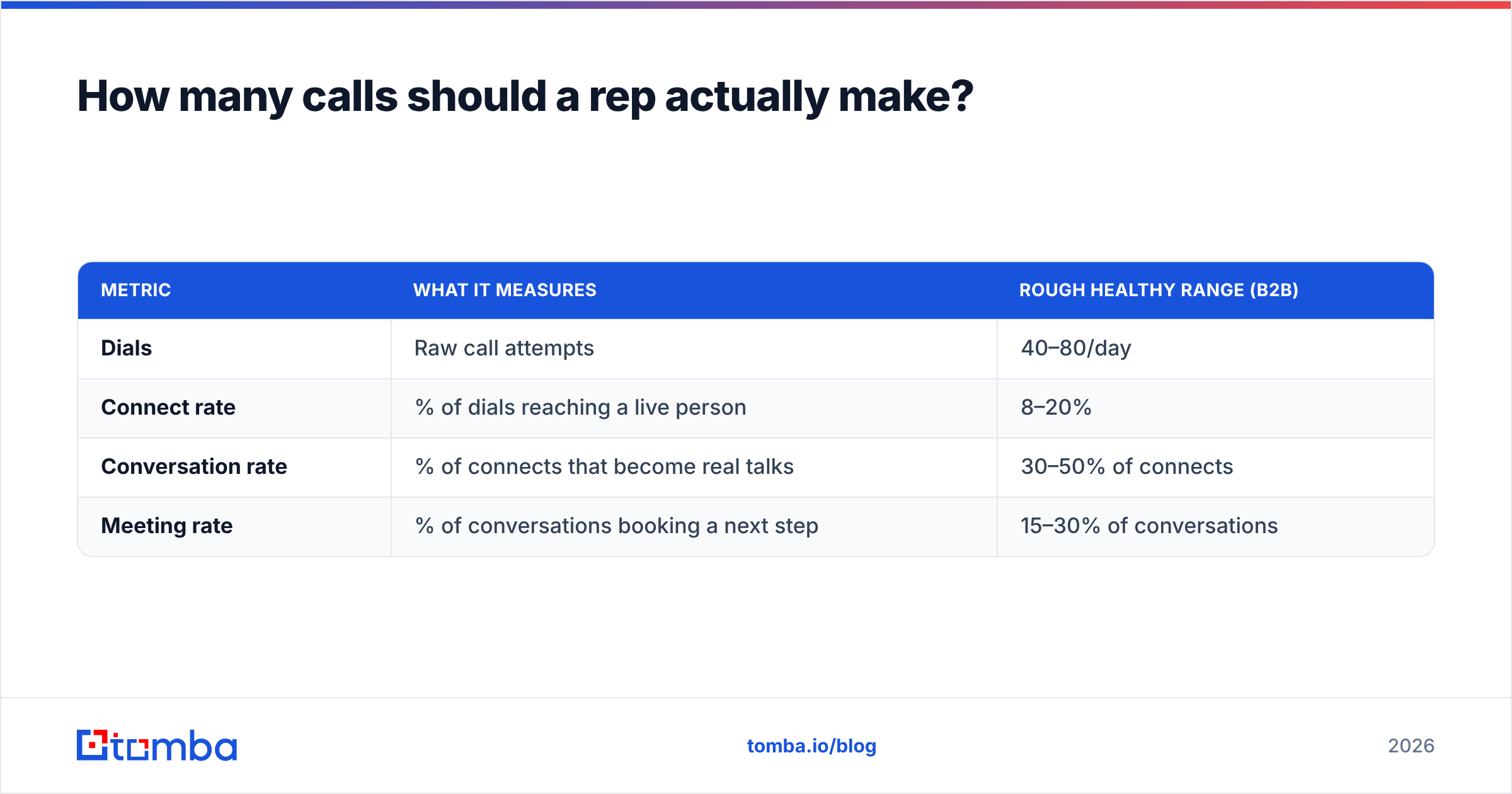
A healthier set of daily targets:
| Metric | What it measures | Rough healthy range (B2B) |
|---|---|---|
| Dials | Raw call attempts | 40–80/day |
| Connect rate | % of dials reaching a live person | 8–20% |
| Conversation rate | % of connects that become real talks | 30–50% of connects |
| Meeting rate | % of conversations booking a next step | 15–30% of conversations |
Treat these as separate dials on a mixing board. A low connect rate is a data or timing problem. A low conversation rate is an opener problem. A low meeting rate is a qualification or value problem. Blending them into one number hides exactly the diagnosis you need. For deeper benchmarking, G2's sales-tool category and vendor benchmark reports are useful reference points — just adjust for your industry.
When is the best time to cold call?#
Timing helps, but it's a smaller lever than the internet claims. General patterns still hold up across most B2B studies:
- Best days: Tuesday through Thursday.
- Best windows: roughly 9–11 a.m. and 4–6 p.m. in the prospect's local time zone — before the day fills up, or after the meeting block clears.
- Weakest window: Monday mornings and Friday afternoons.
Two caveats. First, "best time" is population-level; your specific ICP may differ, so test and log your own connect rates by hour. Second, dialing a correct direct number at a mediocre time beats dialing a wrong number at the "perfect" time every single day. Data quality dominates timing.
How should calls fit into a multichannel cadence?#
Phone-only sequences leave meetings on the table. The strongest 2026 cadences interleave calls with email and social touches so the prospect encounters your name several times across channels before — and after — you connect live.
A simple, effective 12–14 day structure:
- Day 1: Call + follow-up email if no answer.
- Day 2: LinkedIn view/connect (see LinkedIn outreach for norms).
- Day 4: Call at a different time of day.
- Day 6: Value email (case study, relevant insight).
- Day 8: Call + voicemail.
- Day 11: LinkedIn message referencing your emails.
- Day 14: Breakup email — "closing the loop."
The email and social touches raise name recognition, which lifts your answer rate on the next dial. This is why a companion channel matters: when you pair every phone contact with a verified email, a single "no answer" becomes a warm, multi-touch sequence instead of a dead end. Tools like HubSpot's cadence features or a dedicated sequencer help you keep the whole motion logged and on schedule.
How do you handle gatekeepers and objections?#
Gatekeepers are allies, not obstacles. Be transparent and courteous: "I'm hoping you can help me — I'm trying to reach [Name] about [specific, relevant topic]. Is now a bad time?" Treating the gatekeeper as a person, not a wall, gets you through more often than any trick. Having a direct number from a phone finder sidesteps much of this entirely.
Objections are usually reflexes, not verdicts. A few reliable responses:
- "I'm busy." → "Totally fair — I'll be 20 seconds, and if it's not relevant I'll let you go."
- "Send me an email." → "Happy to. So I send the right thing, is [specific problem] even on your radar this quarter?"
- "We already use [competitor]." → "Makes sense — a lot of the teams I talk to do. Most switched because of [specific gap]. Worth a quick comparison?"
- "Not interested." → "Understood. Out of curiosity, is that because timing's off, or is this genuinely not a fit?" — this separates a soft no from a hard one.
The goal of objection handling isn't to "win" — it's to reach a clear yes or a clean no, so you don't waste future touches on a dead lead.
What tools does a modern cold calling stack need?#
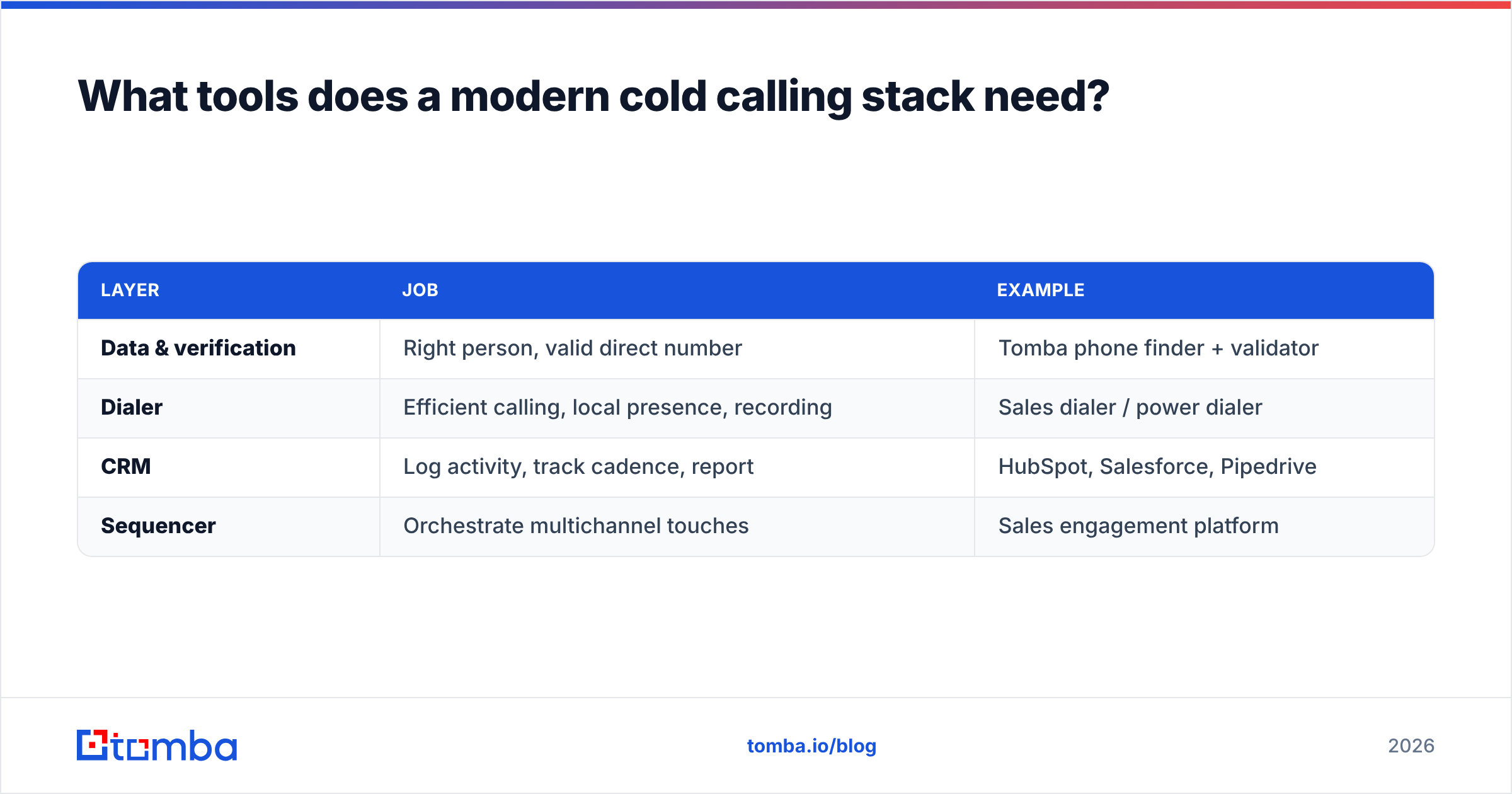
You don't need a bloated stack. You need clean data feeding a dialer feeding a CRM, with everything logged. The four essentials:
| Layer | Job | Example |
|---|---|---|
| Data & verification | Right person, valid direct number | Tomba phone finder + validator |
| Dialer | Efficient calling, local presence, recording | Sales dialer / power dialer |
| CRM | Log activity, track cadence, report | HubSpot, Salesforce, Pipedrive |
| Sequencer | Orchestrate multichannel touches | Sales engagement platform |
The layer teams most often under-invest in is the first — and it's the one that determines everything downstream. Compare data providers on match rate and verification, not just headline contact counts; you can review Tomba pricing against your volume to see where a verified-data layer fits. Whatever you choose, connect it to your CRM through native integrations so reps aren't copy-pasting numbers by hand.
Common cold calling mistakes to avoid#
- Dialing before verifying. Every disconnected number is wasted rep energy and a hit to morale.
- Reading a rigid script. Prospects hear it. Use a framework with room to react.
- Pitching in the first 15 seconds. Earn attention first.
- Phone-only outreach. No supporting email or social touch means every call starts from zero recognition.
- Ignoring the data. If you don't split connect / conversation / meeting rates, you're guessing at what to fix.
- Giving up after one attempt. Most meetings come from the 3rd–6th touch, not the 1st.
The bottom line#
Cold calling in 2026 rewards precision over volume. The reps and teams that win aren't the loudest or the most persistent for its own sake — they're the ones calling the right person, on a verified number, at a reasonable time, with an opener that earns 30 seconds and a cadence that reinforces every touch. Strip away the mythology and cold calling is just a data problem wearing a performance problem's clothes. Fix the data first.
Ready to stop dialing dead numbers? Start with the contact layer everything else depends on. Tomba's Email Finder — alongside its phone finder, validator, and enrichment tools — gives your reps verified, correctly-matched contacts so every dial has a real chance of connecting. Build a cleaner list, and watch your connect and meeting rates climb.
Related guides#
// get started
Find, verify and enrich your first contacts today
Start on the free plan with 25 searches a month, then scale when your team is ready.
Free plan · No credit card required · GDPR & CCPA
// about the author