Cold Calling Success in 2026: A Practical Playbook That Works
Cold calling still books meetings in 2026 — but only when your data, timing, and openers are dialed in. Here's the practical playbook that separates connect rates from voicemail graveyards.
Cold calling is not dead — bad cold calling is. The reps still hitting quota in 2026 are not the ones dialing the most; they are the ones dialing the right numbers, at the right time, with a reason to call. This is the difference between a 2% connect rate and a 12% one.
Below is the working playbook: what drives cold calling success now, what to stop doing, and how to build a dialing motion that compounds instead of burning your list.
TL;DR#
- Data is 50% of the outcome. Wrong numbers and stale contacts cap your connect rate before you say a word. Verify before you dial.
- The first 8 seconds decide the call. A permission-based opener beats a rehearsed pitch every time.
- Timing beats volume. Mid-morning and late afternoon in the prospect's timezone consistently outperform Monday-morning blasts.
- Multichannel wins. Calls tied to email and LinkedIn touches connect 2–3x more often than cold-dial-only.
- Track connect rate, not dial count. The metric you optimize is the behavior you get.
What does "cold calling success" actually mean in 2026?#
Cold calling success is the rate at which your dials turn into booked, qualified conversations — not the number of times you pick up the phone. That reframe matters because most underperforming teams measure activity (dials made) instead of outcome (meetings set per hour).
Think of it like fishing. You can cast a thousand times in an empty pond and feel productive, or cast twenty times where the fish actually are. Cold calling in 2026 is entirely about knowing where the fish are — and that starts with data quality, not dialing stamina.
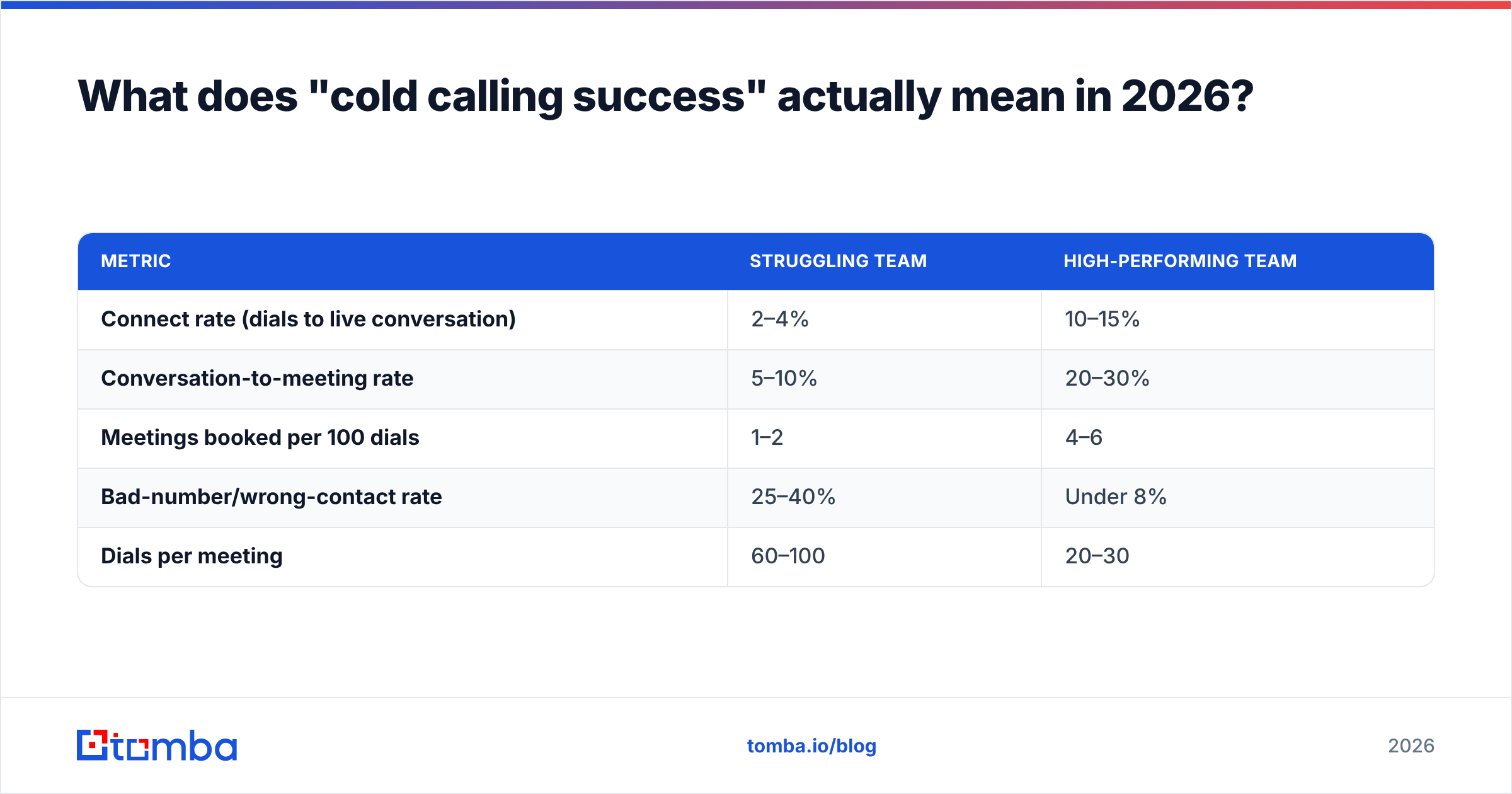
A realistic benchmark stack for a well-run outbound team looks like this:
| Metric | Struggling team | High-performing team |
|---|---|---|
| Connect rate (dials to live conversation) | 2–4% | 10–15% |
| Conversation-to-meeting rate | 5–10% | 20–30% |
| Meetings booked per 100 dials | 1–2 | 4–6 |
| Bad-number/wrong-contact rate | 25–40% | Under 8% |
| Dials per meeting | 60–100 | 20–30 |
If your bad-number rate is above 20%, no script fix will save you. You are fighting a data problem disguised as a calling problem.
Why do most cold calls fail before you even speak?#
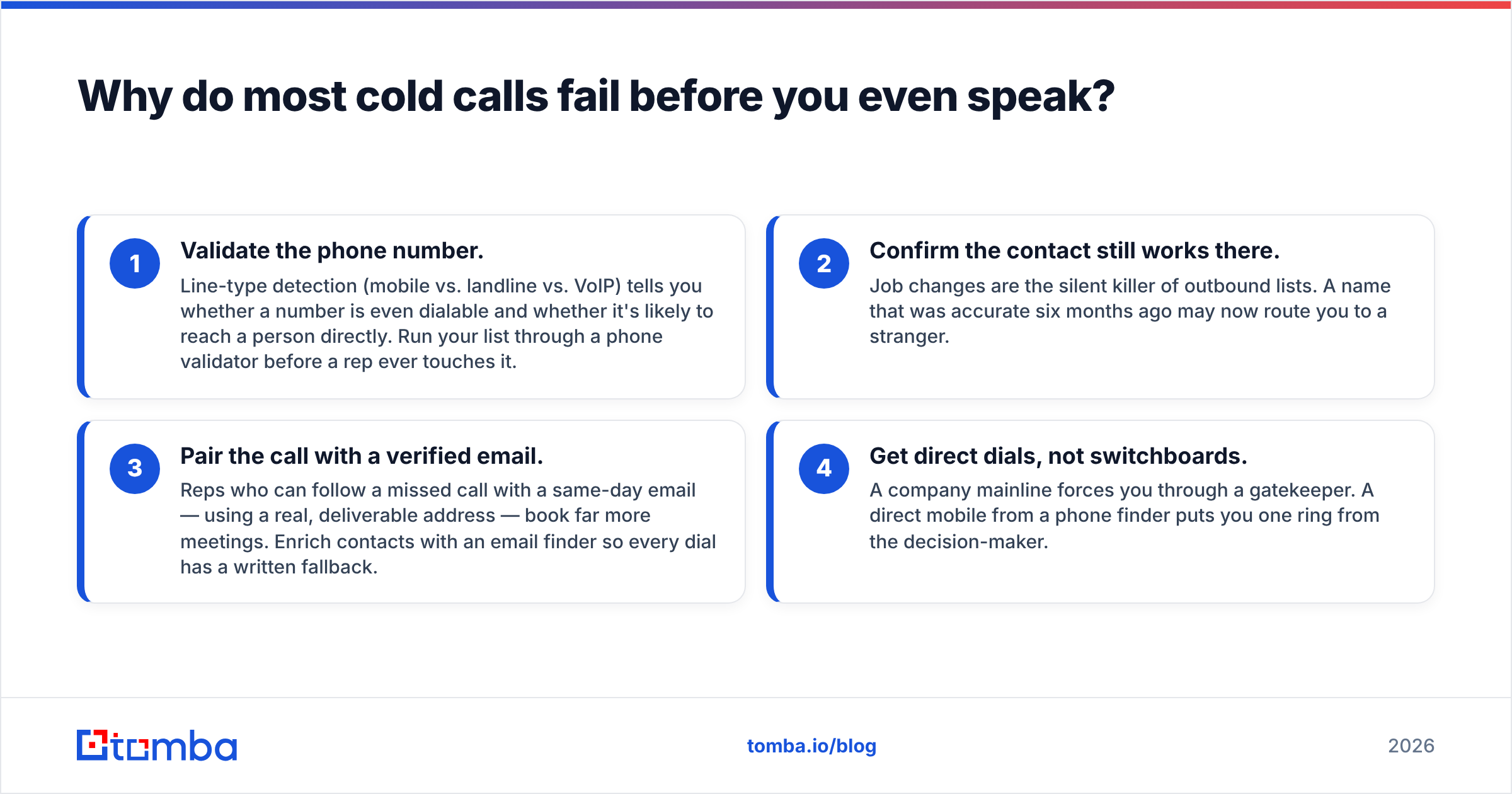
Most cold calls fail because the number is wrong, the contact left the company, or you are calling a gatekeeper's desk line that goes straight to a dead voicemail. You never get the chance to be good at talking, because you never reach a human.
This is the least glamorous and most important lever. Before you invest in call coaching, fix the inputs:
- Validate the phone number. Line-type detection (mobile vs. landline vs. VoIP) tells you whether a number is even dialable and whether it's likely to reach a person directly. Run your list through a phone validator before a rep ever touches it.
- Confirm the contact still works there. Job changes are the silent killer of outbound lists. A name that was accurate six months ago may now route you to a stranger.
- Pair the call with a verified email. Reps who can follow a missed call with a same-day email — using a real, deliverable address — book far more meetings. Enrich contacts with an email finder so every dial has a written fallback.
- Get direct dials, not switchboards. A company mainline forces you through a gatekeeper. A direct mobile from a phone finder puts you one ring from the decision-maker.
According to HubSpot's sales research, it takes an average of multiple touchpoints to connect with a prospect — and every one of those touches is wasted if the underlying contact record is wrong.
What makes a cold call opener work?#
A cold call opener works when it earns permission instead of demanding attention. The best-performing openers in 2026 share three traits: they're honest, they're short, and they hand control to the prospect.
Here's the structural difference between openers that get hung up on and openers that buy you 30 seconds:
- Pattern interrupt, not pitch: "Hi Sarah — I know I'm an interruption. Can I take 30 seconds to tell you why I called, and you can decide if it's worth continuing?" This disarms the reflexive brush-off.
- Named reason to call: Reference a trigger — a funding round, a new hire, a product launch, a job change. "I saw you just took over the RevOps function" beats "How are you today?" by a mile.
- Permission close on the opener itself: Let them say yes to listening, not to buying. Micro-commitments compound.
- No feature dump: Your goal on a cold call is the next meeting, not the sale. Talk about the problem you solve, not the 14 things your product does.
The old "Did I catch you at a bad time?" opener still works because it gives the prospect an easy exit — and paradoxically, that lowers their guard enough to keep talking.
When is the best time to cold call?#
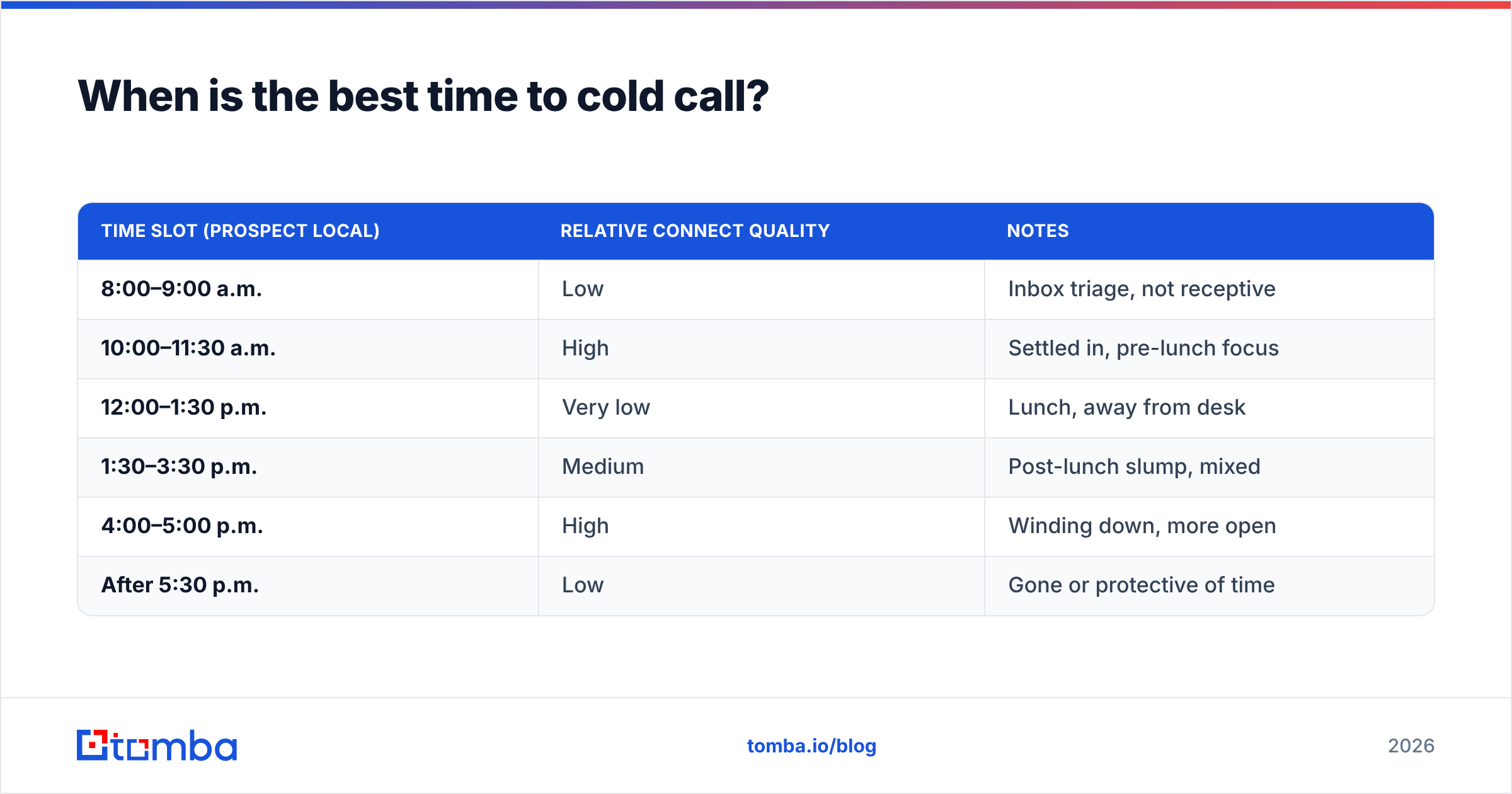
The best times to cold call are mid-to-late morning (10–11:30 a.m.) and late afternoon (4–5 p.m.) in the prospect's local timezone, on Tuesday through Thursday. Early Monday and late Friday are the graveyard shifts of outbound.
The logic is simple: people are not yet buried in their day at 10 a.m., and they're wrapping up (and more relaxed) at 4 p.m. Lunch hours and the first hour of the workday are dead zones because prospects are either away or triaging their inbox.
| Time slot (prospect local) | Relative connect quality | Notes |
|---|---|---|
| 8:00–9:00 a.m. | Low | Inbox triage, not receptive |
| 10:00–11:30 a.m. | High | Settled in, pre-lunch focus |
| 12:00–1:30 p.m. | Very low | Lunch, away from desk |
| 1:30–3:30 p.m. | Medium | Post-lunch slump, mixed |
| 4:00–5:00 p.m. | High | Winding down, more open |
| After 5:30 p.m. | Low | Gone or protective of time |
The catch: this only works if your CRM stores the correct timezone for each contact. Calling a West Coast prospect at what you think is 10 a.m. — but is actually 7 a.m. their time — turns a prime slot into a graveyard slot. Enriched, accurate location data is what makes timing strategy real instead of theoretical.
Is cold calling still worth it, or should you just email?#
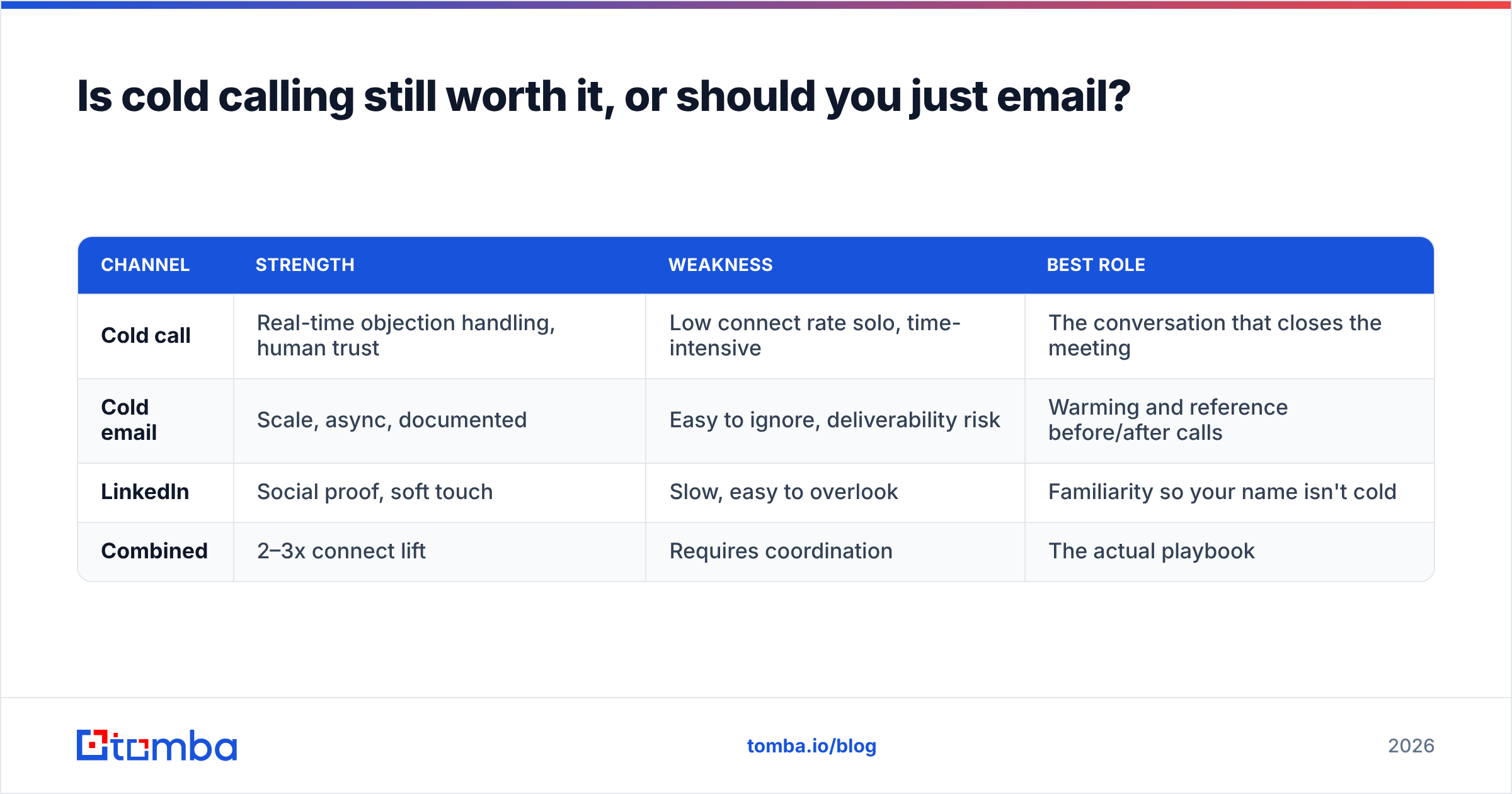
Cold calling is absolutely still worth it — but not as a standalone channel. In 2026, the winning motion is cold calling as part of a coordinated sequence, not cold calling in isolation.
Here's why the "call vs. email" debate is the wrong question:
| Channel | Strength | Weakness | Best role |
|---|---|---|---|
| Cold call | Real-time objection handling, human trust | Low connect rate solo, time-intensive | The conversation that closes the meeting |
| Cold email | Scale, async, documented | Easy to ignore, deliverability risk | Warming and reference before/after calls |
| Social proof, soft touch | Slow, easy to overlook | Familiarity so your name isn't cold | |
| Combined | 2–3x connect lift | Requires coordination | The actual playbook |
A prospect who has seen your email and your LinkedIn view is no longer truly "cold" when you call — your name registers, and that recognition is what lifts your connect and pickup rates. This is why building a clean, enriched B2B database that feeds all three channels beats running any one channel harder.
Industry analysts at Gartner have long noted that B2B buyers spend the majority of their journey researching independently — which means your job on a cold call isn't to inform, it's to be relevant enough at the right moment to earn a conversation.
How do you handle the most common objections?#
You handle objections by expecting them, not improvising. The three you'll hear on nearly every call are "I'm busy," "send me an email," and "we already have a solution." Each has a clean, tested response.
- "I'm busy right now." → "Totally fair — that's exactly why I kept this to 30 seconds. Would tomorrow at 10 or Thursday at 2 be better for a proper 10 minutes?" You acknowledge, then offer a specific alternative.
- "Just send me an email." → "Happy to. So I send something actually relevant and not spam — is [specific problem] something on your radar this quarter, or am I off base?" This turns a brush-off into qualification.
- "We already use [competitor]." → "Makes sense, a lot of teams do. Most folks I talk to who switched did it because of [specific gap]. Worth a 10-minute look, or are you fully happy?" You plant doubt without attacking.
- "How did you get my number?" → Be honest: "You're listed as the [role] at [company], so I figured you'd be the right person for this." Transparency defuses hostility.
The meta-skill is tone. Objections are reflexes, not decisions. Stay warm, stay brief, and always move toward a specific next step rather than a vague "I'll follow up."
What metrics should you track for cold calling success?#
Track connect rate, conversation-to-meeting rate, and meetings per dialing hour — in that order of importance. Dial count is a vanity metric that rewards busyness over results.
Here's the measurement hierarchy that actually improves performance:
- Connect rate — Are you reaching live humans? If this is low, it's a data problem. Fix the list.
- Conversation-to-meeting rate — When you reach someone, do you book? If this is low, it's a script/skill problem. Fix the openers and objection handling.
- Meetings per dialing hour — The true productivity metric. It bakes in both data and skill.
- Show rate — Booked meetings that actually happen. Low show rates mean weak qualification on the call.
- List decay rate — How fast your contact data goes stale. Track it so you know when to re-enrich.
Review these weekly, per rep. A rep with a great conversation rate but a terrible connect rate needs better data, not more coaching — and vice versa. Diagnosing the right problem is what makes the number move.
How do you build a cold-call-ready list?#
You build a cold-call-ready list by starting from a defined ICP, sourcing direct contact data, verifying it, and enriching every record before it reaches a rep. A list is not "done" when it has names — it's done when every row is dialable and current.
The workflow that consistently produces high connect rates:
- Define the ICP tightly. Company size, industry, role, and a trigger event. A narrower list you can personalize beats a giant generic one.
- Source direct dials and emails together. Never rely on switchboard numbers. Pull both a mobile and a verified email per contact so reps have a fallback.
- Verify at the point of use. Data decays constantly. Validate phone numbers and check email deliverability right before a campaign, not months earlier.
- Enrich with context. Job title, recent role change, company news — the raw material for your "reason to call."
- De-dupe and segment. Split by timezone and persona so timing and messaging strategies can actually be applied.
If you check Tomba's pricing, the free tier is enough to test the workflow on a small list before scaling — start there, prove the connect-rate lift, then expand. Independent reviews on G2 are a good sanity check when comparing data providers on accuracy rather than marketing claims.
The bottom line on cold calling success#
Cold calling success in 2026 is an inputs game. Reps obsess over scripts and confidence, but the single biggest predictor of your connect rate is the quality of the data you dial. Clean, verified, enriched contacts turn an average rep into a good one, and a good rep into a machine.
Get the fundamentals right in this order: accurate data → smart timing → a permission-based opener → coordinated multichannel touches → connect-rate-first metrics. Skip the data step, and everything downstream is noise.
Ready to stop dialing dead numbers? Build your next call list on verified, deliverable contact data with the Tomba Email Finder — pair it with direct-dial phone lookup and enrichment so every rep starts the day with a list that actually connects. Your quota doesn't care how many times you dialed; it cares how many people you reached.
Related guides#
// get started
Find, verify and enrich your first contacts today
Start on the free plan with 25 searches a month, then scale when your team is ready.
Free plan · No credit card required · GDPR & CCPA
// about the author