Cold Calling Tactics That Actually Book Meetings in 2026
Most cold calls fail before you say a word. Here are the cold calling tactics that book meetings in 2026 — opener scripts, timing, objection handling, and the data hygiene reps skip.
Cold calling is not dead. Bad cold calling is dead. The rep who dials 80 stale numbers, reads a robotic script, and hangs up demoralized has convinced a whole generation that the phone doesn't work. Meanwhile, the rep two desks over books three meetings before lunch using the same product and a tighter set of tactics.
This guide is about that second rep. No motivational fluff, no "just believe in yourself." Concrete cold calling tactics you can use on your next dial block, and the unglamorous groundwork — accurate numbers, clean lists, real research — that makes any script land.
TL;DR#
- The first 8 seconds decide the call. Earn the next 30 with a permission-based opener, not a pitch.
- Timing beats volume. Wednesday and Thursday, 10–11am and 4–5pm local time, still outperform random dialing.
- Objections are patterns, not surprises. Prepare five responses and you handle 90% of what you hear.
- Your list quality caps your ceiling. A great script on a wrong number connects with nobody — validate phone data before you dial.
- Multi-touch wins. Calls paired with email and LinkedIn convert far better than calls alone.
Why do most cold calls fail before you speak?#
Because the person answering has been burned a hundred times, and their brain is pattern-matching you against every telemarketer who wasted their afternoon. You have roughly eight seconds before they decide whether you're a human worth talking to or a robot to be dismissed.
Most reps lose those seconds three ways: a fake-cheerful "How are you today?" that screams script, an immediate feature dump, or an apologetic mumble that signals low confidence. All three trigger the same reflex — "not interested" — before the prospect has any idea what you're offering.
The fix is not a better pitch. It's a better opening posture: calm, direct, and respectful of their time. You're a peer making a business call, not a supplicant.
What is the best cold call opener in 2026?#
The best opener does one thing: it earns you permission to continue. The highest-converting pattern is still the honest, permission-based opener.
Try this structure:
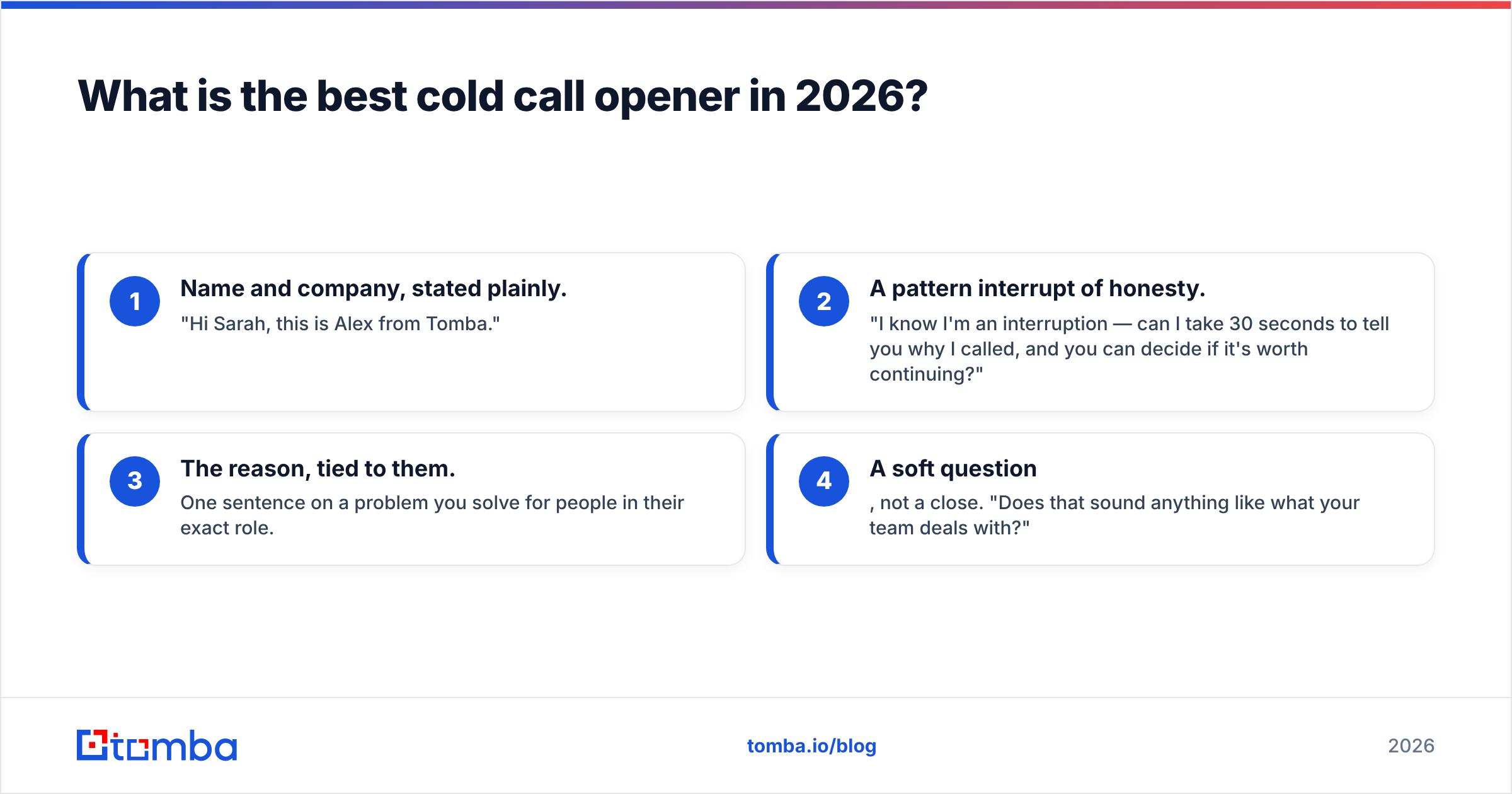
- Name and company, stated plainly. "Hi Sarah, this is Alex from Tomba."
- A pattern interrupt of honesty. "I know I'm an interruption — can I take 30 seconds to tell you why I called, and you can decide if it's worth continuing?"
- The reason, tied to them. One sentence on a problem you solve for people in their exact role.
- A soft question, not a close. "Does that sound anything like what your team deals with?"
That "can I take 30 seconds" line works because it's disarmingly transparent. You acknowledge the interruption, you cap the ask, and you hand them control. Most people say yes to 30 seconds. HubSpot's sales research has repeatedly shown that permission-based and referral-style openers outperform straight pitches — see HubSpot's cold calling data for the breakdowns.
Which cold calling tactics actually move the needle?#
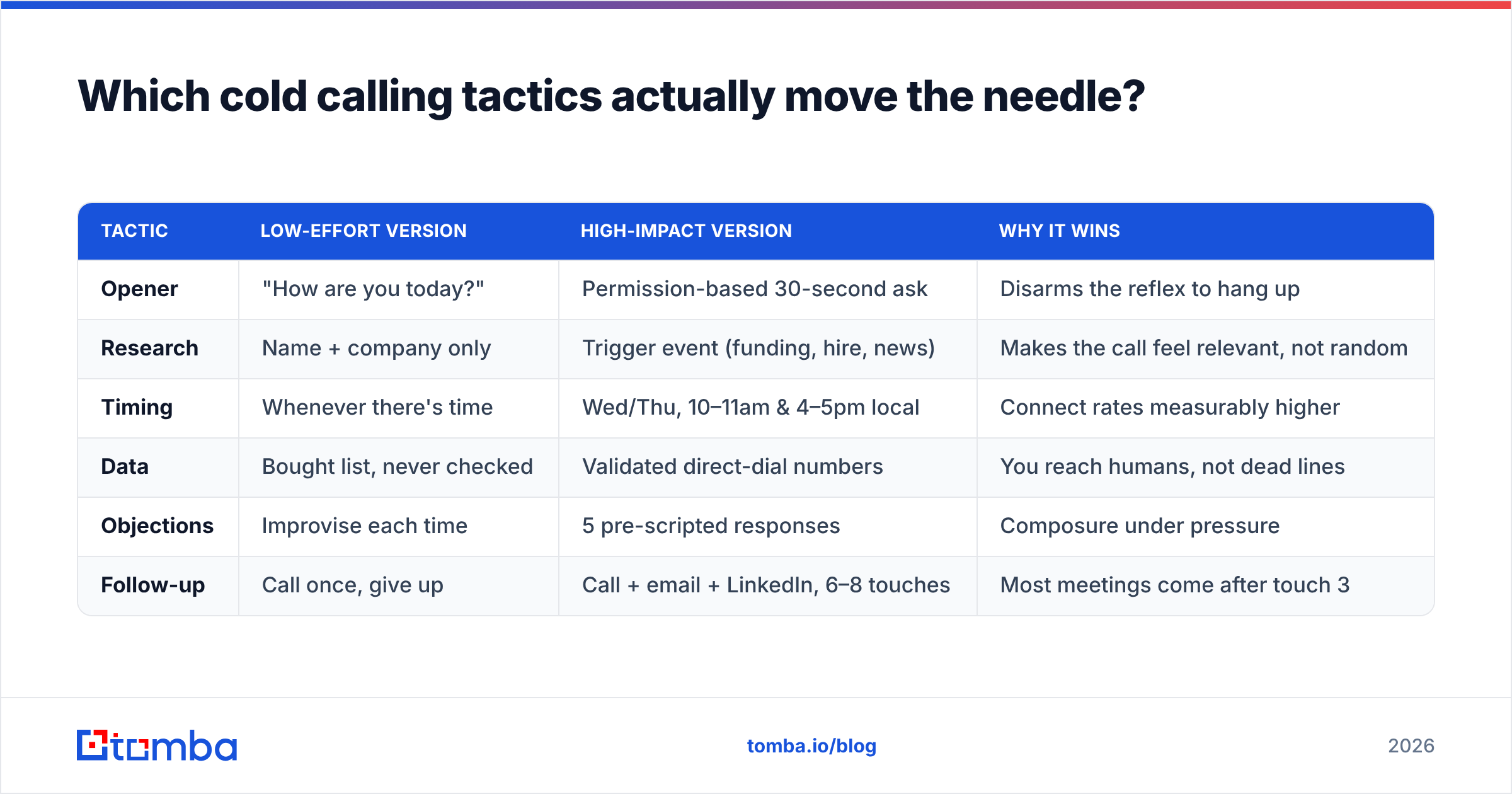
Here's a comparison of tactics reps say they use versus what actually correlates with booked meetings.
| Tactic | Low-effort version | High-impact version | Why it wins |
|---|---|---|---|
| Opener | "How are you today?" | Permission-based 30-second ask | Disarms the reflex to hang up |
| Research | Name + company only | Trigger event (funding, hire, news) | Makes the call feel relevant, not random |
| Timing | Whenever there's time | Wed/Thu, 10–11am & 4–5pm local | Connect rates measurably higher |
| Data | Bought list, never checked | Validated direct-dial numbers | You reach humans, not dead lines |
| Objections | Improvise each time | 5 pre-scripted responses | Composure under pressure |
| Follow-up | Call once, give up | Call + email + LinkedIn, 6–8 touches | Most meetings come after touch 3 |
Notice that half the "high-impact" column has nothing to do with what you say. Preparation and data do more work than charisma.
When is the best time to cold call?#
Conclusion first: mid-week, late morning and late afternoon, in the prospect's local time zone. Monday mornings people are triaging their week; Friday afternoons they've mentally checked out. Tuesday through Thursday is the sweet spot, with 10–11am and 4–5pm consistently showing the strongest connect rates across published dialer data.
But "best time" is only useful if you're calling the right number in the first place. A perfectly timed call to a disconnected line is a wasted dial. This is where most cold calling programs quietly leak: reps burn their best hours on numbers that were never going to ring the right desk.
Before a dial block, run your list through a phone validator to drop dead and reassigned numbers, and use a phone finder to fill in the direct dials your CRM is missing. Ten clean numbers beat fifty stale ones, every time.
How do you handle the most common objections?#
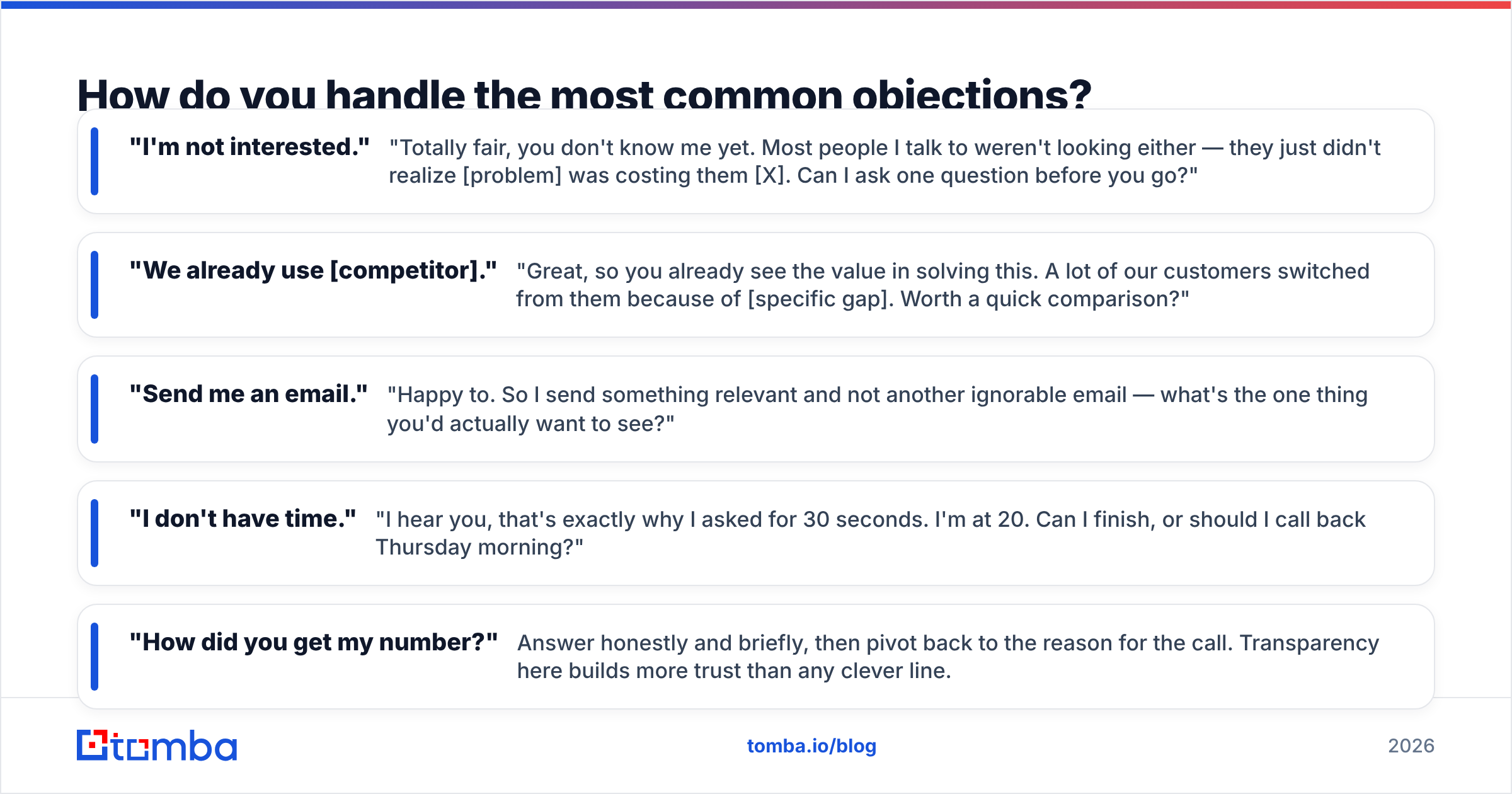
Objections are not rejection — they're reflexes. The same five come up on nearly every call, so you should never be surprised. Script your responses, practice them out loud, and deliver them without a beat of panic.
- "I'm not interested." — "Totally fair, you don't know me yet. Most people I talk to weren't looking either — they just didn't realize [problem] was costing them [X]. Can I ask one question before you go?"
- "We already use [competitor]." — "Great, so you already see the value in solving this. A lot of our customers switched from them because of [specific gap]. Worth a quick comparison?"
- "Send me an email." — "Happy to. So I send something relevant and not another ignorable email — what's the one thing you'd actually want to see?"
- "I don't have time." — "I hear you, that's exactly why I asked for 30 seconds. I'm at 20. Can I finish, or should I call back Thursday morning?"
- "How did you get my number?" — Answer honestly and briefly, then pivot back to the reason for the call. Transparency here builds more trust than any clever line.
The meta-tactic: stay warm, stay brief, and always end your response with a question that hands the conversation back. Silence after an objection is where deals die.
Does research really change cold call outcomes?#
Yes, and it's the highest-leverage 90 seconds you'll spend. A call that references a real trigger event — a recent funding round, a new VP of Sales, an expansion into a new market — stops sounding like a cold call and starts sounding like a relevant business reason to connect.
You don't need an hour per prospect. You need the right signal fast. Pull the company's recent news, confirm the contact's current role, and check that you're calling the right person before you dial. Layering in data enrichment lets you walk into the call knowing role, seniority, and company size, so your opener speaks to their world instead of a generic script.
Compare the two openings:
- Generic: "Hi, I'm calling companies in your industry about our solution..."
- Researched: "Hi Sarah — saw you just brought on a new SDR team after the Series B. I called because scaling outbound is exactly when the data problem I help with usually bites."
The second one earns the next 30 seconds. The first one earns a dial tone.
How does cold calling fit into a multi-channel sequence?#
Cold calling in isolation is a blunt instrument. Paired with email and LinkedIn, it becomes part of a rhythm that keeps you top-of-mind without being annoying. The call warms the email; the email references the call; the LinkedIn touch adds a face to the voice.
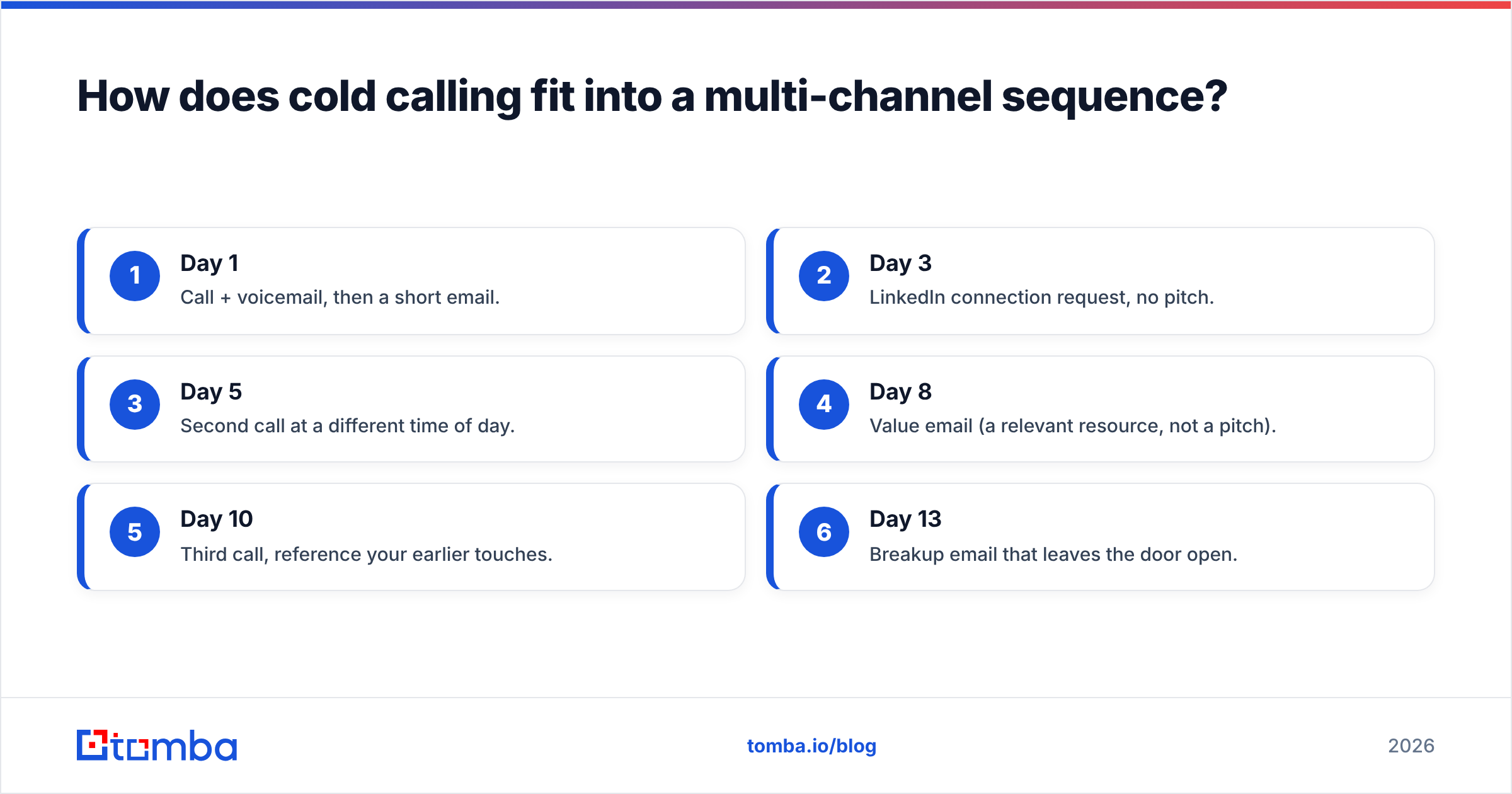
A workable 8-touch cadence over two weeks:
- Day 1 — Call + voicemail, then a short email.
- Day 3 — LinkedIn connection request, no pitch.
- Day 5 — Second call at a different time of day.
- Day 8 — Value email (a relevant resource, not a pitch).
- Day 10 — Third call, reference your earlier touches.
- Day 13 — Breakup email that leaves the door open.
Most booked meetings come on touch three or later, which is exactly where impatient reps quit. To run this at scale you need every contact reachable across channels — a verified email and a working phone. Fill the gaps with an email finder and keep the list clean with an email verifier so your sequence never stalls on a bounce or a dead line. For a deeper look at how top teams structure these plays, Gong's labs research breaks down what actually correlates with pipeline.
What tools and hygiene separate good callers from great ones?#
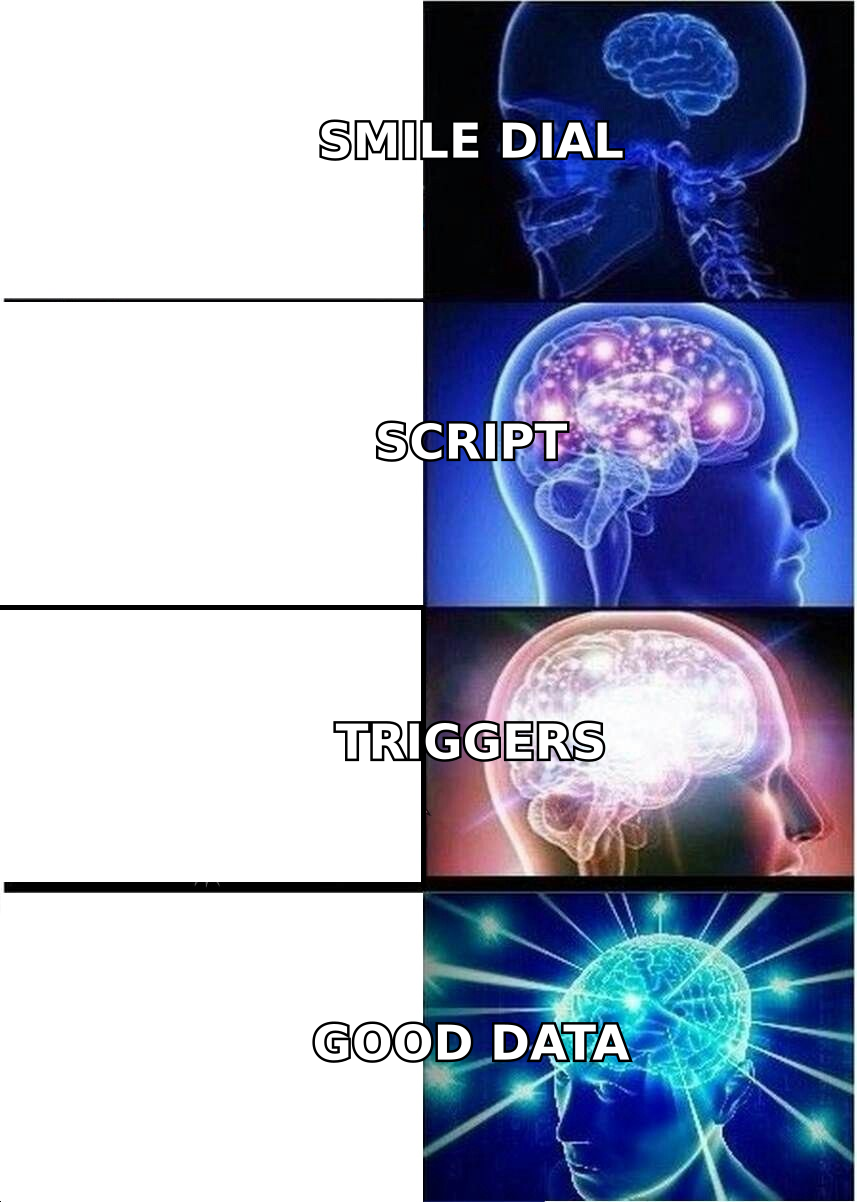
The difference between a good caller and a great one is rarely talent — it's the system around the dial. Great callers protect their calling hours, prepare their objection responses, and never dial a number they haven't validated.
The unglamorous truth: your list quality caps your entire program. You can memorize every tactic in this article, but if 30% of your numbers are wrong, you've capped your connect rate at 70% before you say a word. Data hygiene isn't the boring part you do later — it's the multiplier on everything else.
That's why the strongest cold calling motions start upstream of the phone. Build a verified list, enrich it with role and company context, validate the direct dials, and then apply the tactics above. Get the inputs right and the script almost coaches itself.
Ready to stop dialing dead numbers?#
Tactics only pay off when they reach a real human on the other end. Before your next block, build a clean list of verified contacts and direct dials so every dial has a chance. Start with the Tomba Email Finder to build accurate, enriched contact lists, pair it with the phone finder for direct dials, and check the Tomba pricing — the free tier gives you 25 searches a month to test it against your current list. Fix the data, and the tactics finally have something to work with.
Related guides#
// get started
Find, verify and enrich your first contacts today
Start on the free plan with 25 searches a month, then scale when your team is ready.
Free plan · No credit card required · GDPR & CCPA
// about the author