How to Build a Cold Calling Team That Books More Meetings in 2026
A cold calling team lives or dies on structure, data, and reps per hour. Here's how to staff, script, and measure one that actually books meetings in 2026 — not just dials numbers.
Building a cold calling team in 2026 is less about hiring loud, confident reps and more about engineering a system: clean phone data, tight roles, a repeatable script, and a dashboard that tells you where meetings are leaking out of the funnel. Get the system right and average reps hit quota. Get it wrong and even your best closer burns out chasing disconnected numbers.
TL;DR#
- A modern cold calling team is a system of four parts: accurate contact data, defined roles, a tested talk track, and a metrics loop — not just a room full of dialers.
- Reps waste 30–50% of dialing time on bad numbers. Fixing your data source is the single highest-leverage change you can make.
- The best-performing structure separates list building, dialing (SDRs), and closing (AEs) so nobody context-switches all day.
- Track connect rate, conversations per hour, and meetings booked — not raw dial count.
- Tools like a phone finder and CRM-connected dialer matter more than a bigger headcount.
What is a cold calling team?#
A cold calling team is a group of sales reps whose primary job is initiating outbound phone conversations with prospects who have not asked to be contacted — the goal being a booked meeting, a qualified opportunity, or a warm handoff, not a sale on the first call.
Think of it like a professional kitchen. The person plating the dish (your closer) is useless if nobody preps ingredients (list building) and nobody works the line under pressure (the SDRs making dials). When one person tries to do all three jobs at once, quality drops everywhere. A well-run cold calling team splits the work so each role does the thing it's best at, all day.
That division of labor is what separates a scalable outbound engine from a few individuals grinding the phones. The most common setup pairs Sales Development Reps (SDRs) who dial and qualify with Account Executives (AEs) who take the booked meetings and close them.
What roles does a high-performing cold calling team need?#
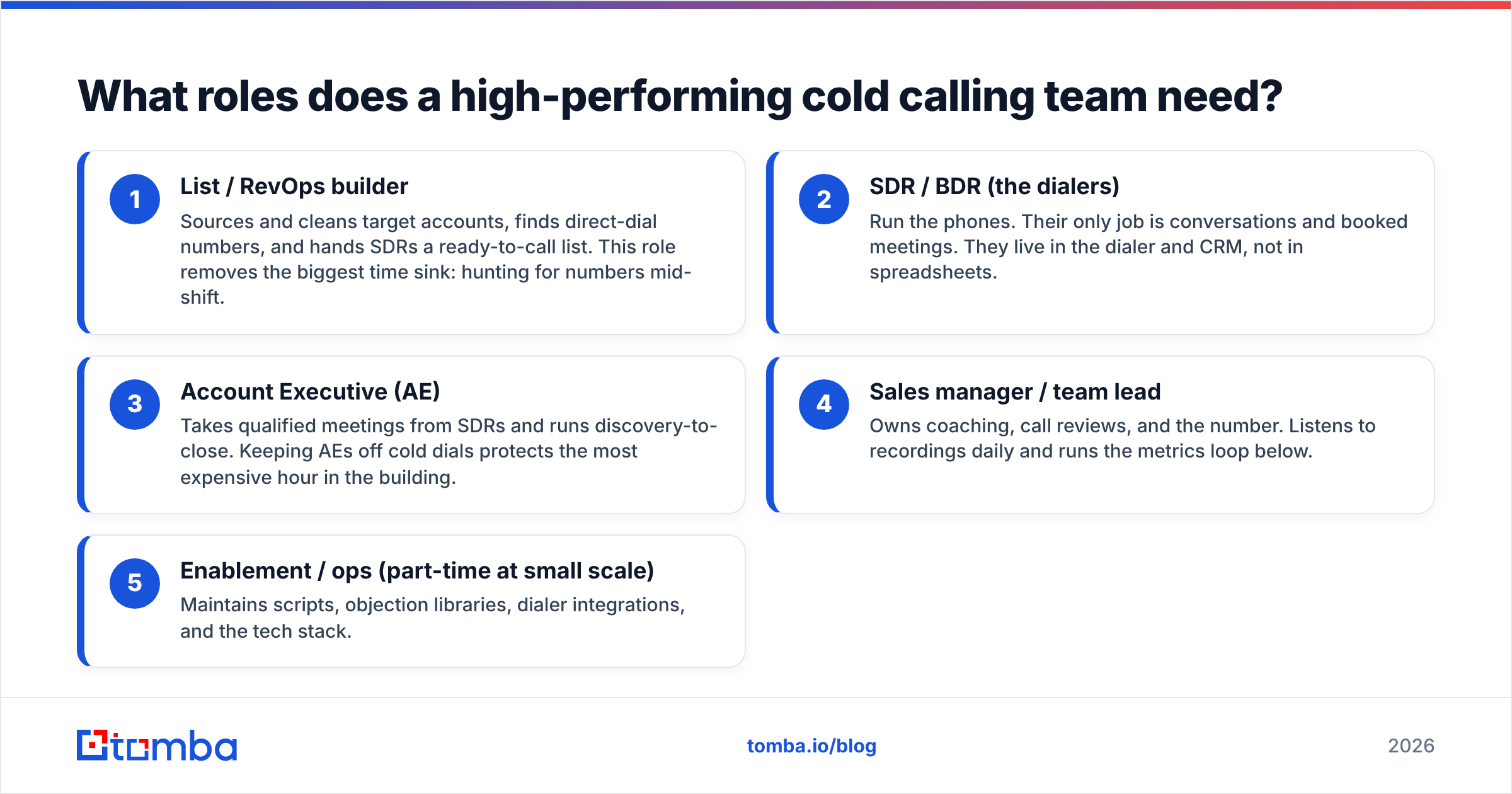
Before you script a single call, decide who does what. The structure below is what most teams booking 40+ meetings a month per rep converge on:
- List / RevOps builder — Sources and cleans target accounts, finds direct-dial numbers, and hands SDRs a ready-to-call list. This role removes the biggest time sink: hunting for numbers mid-shift.
- SDR / BDR (the dialers) — Run the phones. Their only job is conversations and booked meetings. They live in the dialer and CRM, not in spreadsheets.
- Account Executive (AE) — Takes qualified meetings from SDRs and runs discovery-to-close. Keeping AEs off cold dials protects the most expensive hour in the building.
- Sales manager / team lead — Owns coaching, call reviews, and the number. Listens to recordings daily and runs the metrics loop below.
- Enablement / ops (part-time at small scale) — Maintains scripts, objection libraries, dialer integrations, and the tech stack.
At a 5-person team you might collapse list building and management into one person. At 20+ reps, each role is dedicated. The mistake is asking your best closer to also build lists and dial cold — you pay AE money for SDR work.
How should you structure the team: SDR + AE split vs. full-cycle?#
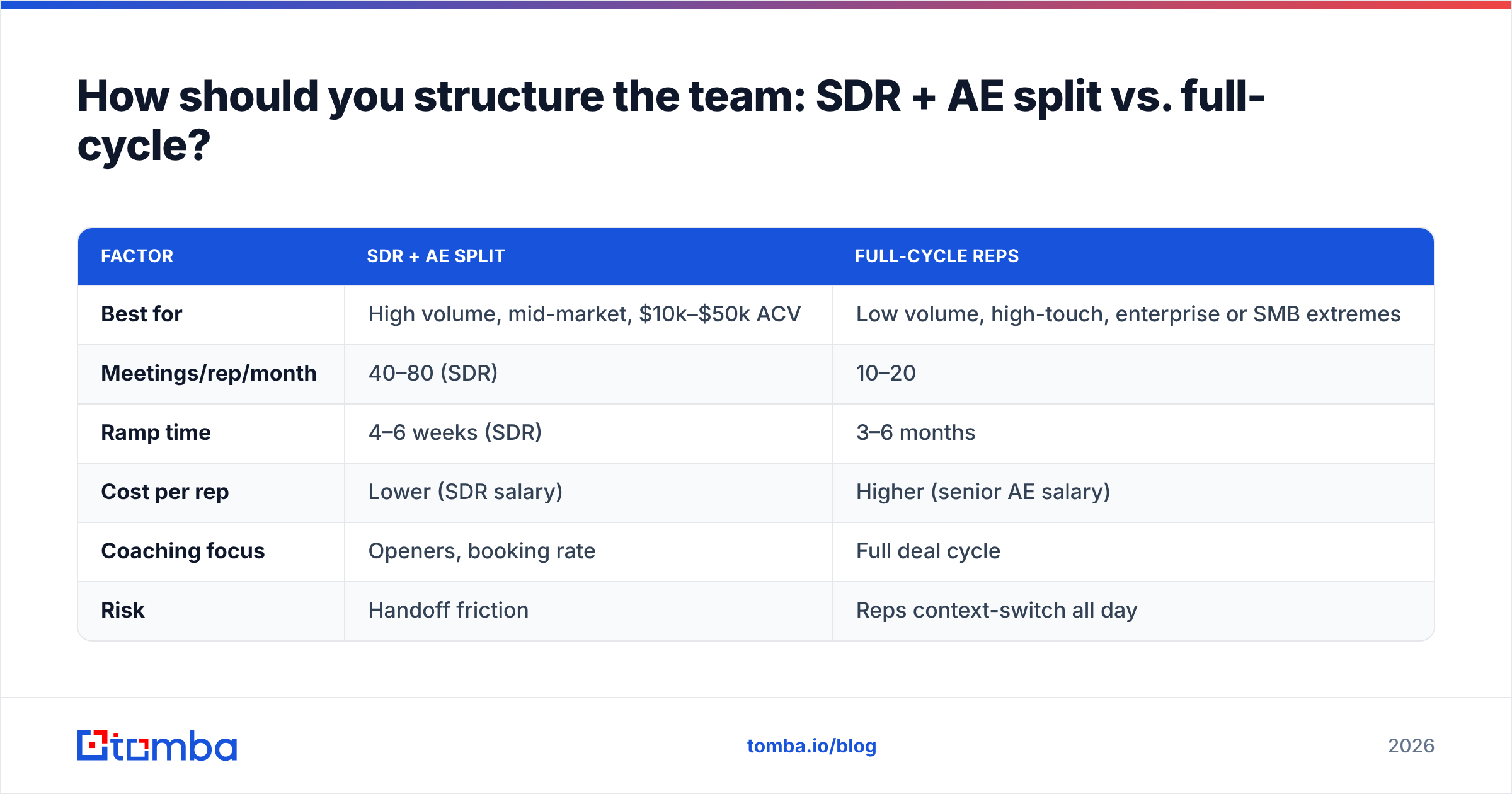
There are two dominant models, and the right one depends on deal size and volume.
| Factor | SDR + AE split | Full-cycle reps |
|---|---|---|
| Best for | High volume, mid-market, $10k–$50k ACV | Low volume, high-touch, enterprise or SMB extremes |
| Meetings/rep/month | 40–80 (SDR) | 10–20 |
| Ramp time | 4–6 weeks (SDR) | 3–6 months |
| Cost per rep | Lower (SDR salary) | Higher (senior AE salary) |
| Coaching focus | Openers, booking rate | Full deal cycle |
| Risk | Handoff friction | Reps context-switch all day |
The split model wins on pure dialing throughput because a dedicated SDR never stops to write a proposal. The full-cycle model wins when relationships are everything and a single owner from first call to signature builds trust. Most B2B teams doing serious outbound volume run the split — it's the same logic as an assembly line, and HubSpot's sales research has documented the throughput gains repeatedly.
Why does data quality matter more than headcount?#
Because a rep dialing bad numbers is a rep not talking to anyone. This is the part teams underinvest in, and it's the cheapest lever you have.
Run the math. An SDR makes ~80 dials a day. If 40% of numbers are wrong, disconnected, or main switchboards, that's 32 dials producing nothing before a conversation is even possible. Multiply across a 10-person team over a year and you've paid for hundreds of hours of dead air.
The fix isn't hiring two more reps to brute-force through bad data — it's cleaning the data:
- Get direct dials, not switchboards. A verified mobile or direct line connects; a company main line dies at a receptionist.
- Verify before you dial. A phone validator confirms a number is live and correctly formatted so reps aren't the ones discovering it's dead.
- Enrich with context. Title, company, and recent triggers turn a cold dial into a relevant one. Pair phone data with data enrichment so reps open with something that matters.
- Pull numbers by company. When you're targeting whole accounts, a phone finder sourced from a real B2B database beats scraped lists that decay monthly.
Clean data doesn't just raise connect rate — it protects morale. Nothing burns out a dialer faster than a list that doesn't answer.

What tools does a cold calling team actually need in 2026?#
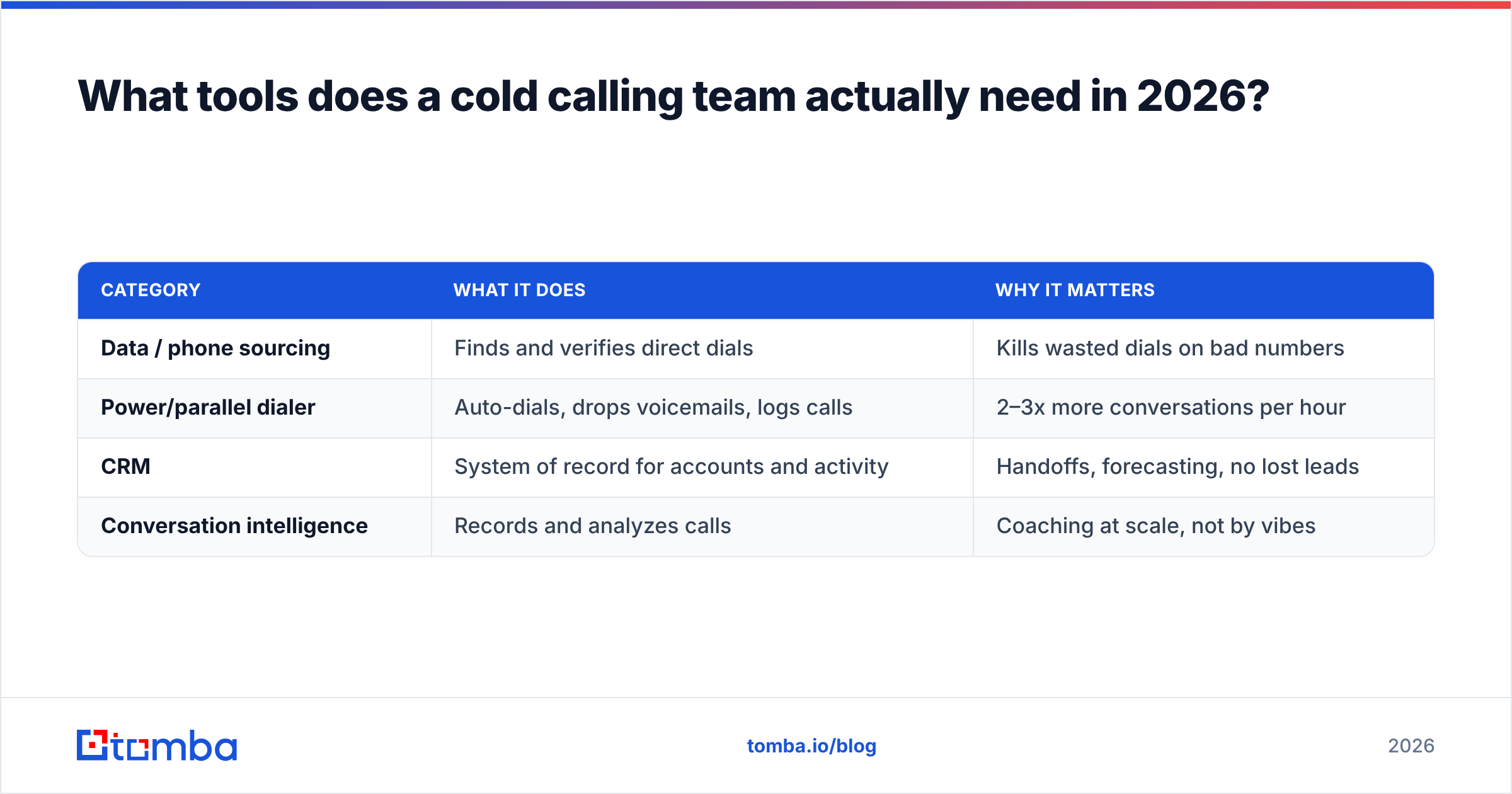
You need four categories, and buying more than one tool per category is usually waste at the start.
| Category | What it does | Why it matters |
|---|---|---|
| Data / phone sourcing | Finds and verifies direct dials | Kills wasted dials on bad numbers |
| Power/parallel dialer | Auto-dials, drops voicemails, logs calls | 2–3x more conversations per hour |
| CRM | System of record for accounts and activity | Handoffs, forecasting, no lost leads |
| Conversation intelligence | Records and analyzes calls | Coaching at scale, not by vibes |
A power dialer alone can double conversations per hour by removing manual dialing and misdials. Conversation-intelligence platforms like Gong let a manager coach from actual call moments instead of memory. And your CRM — Salesforce, HubSpot, or Pipedrive — has to be the single source of truth so a booked meeting never falls through the SDR-to-AE handoff.
One caution: tools don't fix a broken process. If your script is weak and your data is dirty, a faster dialer just helps reps reach voicemail faster. Sequence the fixes — data first, then process, then automation.
What script and cadence should the team run?#
Cold calling is a conversation, not a monologue, but structure keeps reps out of the ditch. A reliable framework:
- Opener (first 10 seconds): State who you are and the reason for the call, then ask permission. "Hi Sarah, this is Alex from Tomba — I know I'm interrupting your day, can I take 30 seconds to tell you why I called?" Honesty about the interruption disarms the reflex to hang up.
- Reason / hook (10–30 seconds): One relevant, specific observation about their world. This is where enrichment data earns its keep.
- Discovery question: Get them talking. One open question beats three pitch sentences.
- The ask: Book the meeting. Be direct and offer two concrete times.
- Objection handling: Have a written library for the five objections you hear most ("not interested," "send me an email," "no budget," "we use X," "call me next quarter").
On cadence, a single call almost never lands. Research across outbound teams consistently shows most connects happen after multiple touches, so build a multi-channel sequence: call, then a short email, then a LinkedIn touch, spread over 10–14 business days. The phone opens the conversation; the other channels keep you top of mind between attempts. Reviews on directories like G2 will tell you which dialers and sequencers actually support multi-touch cadences versus just auto-dialing.
Which metrics tell you if the team is working?#
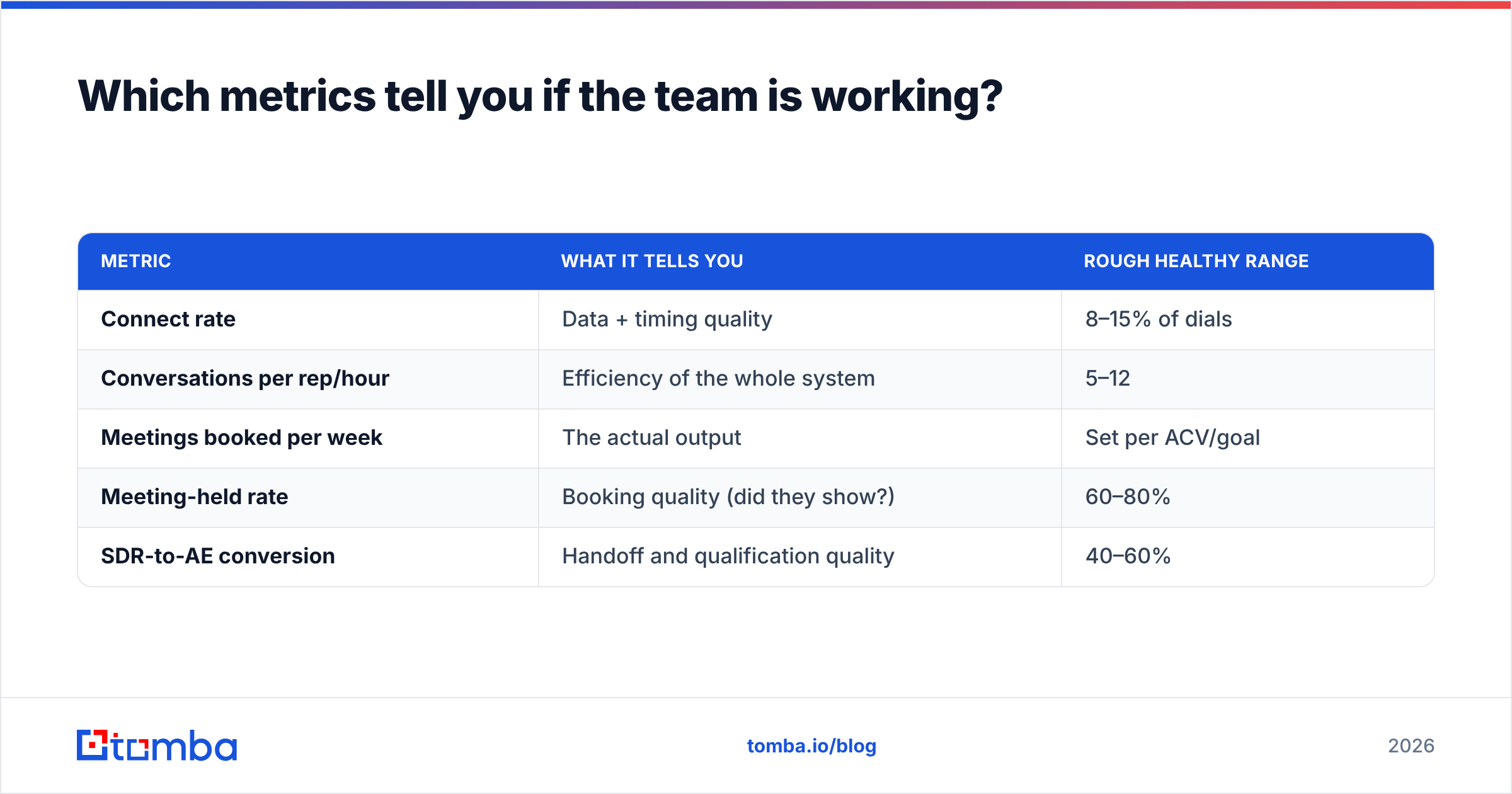
Stop celebrating dial count. Volume is an input, and rewarding it produces reps who spray-and-pray. Measure the outputs that predict revenue:
| Metric | What it tells you | Rough healthy range |
|---|---|---|
| Connect rate | Data + timing quality | 8–15% of dials |
| Conversations per rep/hour | Efficiency of the whole system | 5–12 |
| Meetings booked per week | The actual output | Set per ACV/goal |
| Meeting-held rate | Booking quality (did they show?) | 60–80% |
| SDR-to-AE conversion | Handoff and qualification quality | 40–60% |
Connect rate is your data canary. If it drops below 8%, the problem is almost always the list or the calling window, not the reps. Conversations per hour tells you whether your dialer and data are pulling their weight. And meeting-held rate exposes SDRs who book junk just to hit a number — a booked meeting that never happens is worse than no meeting, because an AE cleared time for it.
Track these weekly, review call recordings against them, and coach to the specific gap. A rep with a high connect rate but low booking rate has a talk-track problem. A rep with low connect rate has a data or timing problem. The metrics tell you where to coach — you're not guessing.
How do you ramp new reps without burning them out?#
Cold calling has brutal turnover when it's done badly, and most of that is avoidable. Protect ramp:
- Give week-one reps clean, pre-verified lists. Early wins build the resilience they'll need later. A rookie on a bad list quits in a month.
- Script the first two weeks tightly, then loosen. Structure is scaffolding, not a cage. Once the fundamentals are automatic, let personality through.
- Review calls together daily. Fifteen minutes of listening to one real call teaches more than an hour of role-play.
- Celebrate conversations, not just closes. For an SDR, a great conversation that didn't book is still a rep learning the craft.
The teams with the lowest attrition treat data and coaching as retention tools, not just performance tools. A rep who connects with real people and gets specific feedback stays. A rep dialing dead numbers in silence leaves.
Common mistakes that quietly kill cold calling teams#
- Buying headcount before fixing data. More reps on a bad list just multiplies wasted dials.
- Making AEs cold call. You're paying senior comp for entry-level activity.
- Rewarding dial volume. You get more dials and fewer meetings.
- No objection library. Every rep reinventing responses live is slow and inconsistent.
- Ignoring calling windows. Time-zone and day-of-week timing swings connect rate more than most script tweaks.
- Treating the phone as a solo channel. The phone works best inside a multi-touch cadence, not alone.
Each of these is a process fix, not a talent problem. The reps are usually fine — the system around them isn't.
Build the team on data that actually connects#
Everything above — the roles, the scripts, the metrics — assumes your reps are reaching real people. That assumption breaks the moment your list is stale, and no coaching or dialer speed can rescue a team dialing dead numbers.
That's where Tomba fits into a cold calling team's stack. Use the Tomba Email Finder to build accurate, enriched contact lists — verified emails to power your multi-touch cadence, paired with direct-dial sourcing and enrichment so every rep opens the shift with numbers and context that convert. Start free with 25 searches a month, and see Tomba pricing when you're ready to scale the whole team — Starter is $49/mo and the Growth plan at $99/mo covers most outbound teams. Fix the data first, and the rest of the system finally gets to do its job.
Related guides#
// get started
Find, verify and enrich your first contacts today
Start on the free plan with 25 searches a month, then scale when your team is ready.
Free plan · No credit card required · GDPR & CCPA
// about the author