Cold Calling Tips: 12 Techniques That Book More Meetings in 2026
Cold calling still works in 2026 — if you stop winging it. Here are 12 concrete cold calling tips covering openers, timing, objection handling, and the data that makes dials connect.
Cold calling isn't dead — bad cold calling is. Reps who still dial with a clear opener, a clean list, and a plan for the "not interested" brush-off are booking meetings while everyone else complains that "nobody picks up." This guide gives you 12 cold calling tips you can use on your next call block, plus the parts most articles skip: how to pick the right numbers to dial, when to call, and what to say in the first eight seconds.
TL;DR — The Fastest Wins#
- Nail the first 8 seconds. State who you are, why you're calling, and ask permission to continue. Skip the fake rapport.
- Call at the right time. Late morning and late afternoon in the prospect's timezone beat lunch and Monday 9 a.m.
- Dial accurate numbers. Wrong or shared numbers kill connect rates faster than any script problem — verified direct-dial data is the real unlock.
- Have a two-line answer for the top 5 objections. "Not interested" and "send me an email" are predictable; treat them as such.
- Track connect rate, conversation rate, and meetings booked — not just dials — so you know which tip actually moved the number.
Does Cold Calling Still Work in 2026?#
Yes — but the bar is higher. Buyers screen unknown numbers, gatekeepers are sharper, and a bad list burns your morning on disconnected lines. What still works is a targeted call to the right person, at a reasonable time, with a reason they care about.
The data backs this up. Gong's conversation research consistently shows that successful cold calls follow patterns you can copy: a strong opener, longer monologues at the right moments, and confident handling of pushback. And HubSpot's sales statistics report that a large share of buyers still want a phone conversation at some point in the buying process. The phone hasn't lost — lazy dialing has.

What Should You Say in the First 8 Seconds?#
Your opener decides the call. The prospect is doing something else and just got interrupted — your job is to earn the next 30 seconds, not pitch the product.
A structure that works:
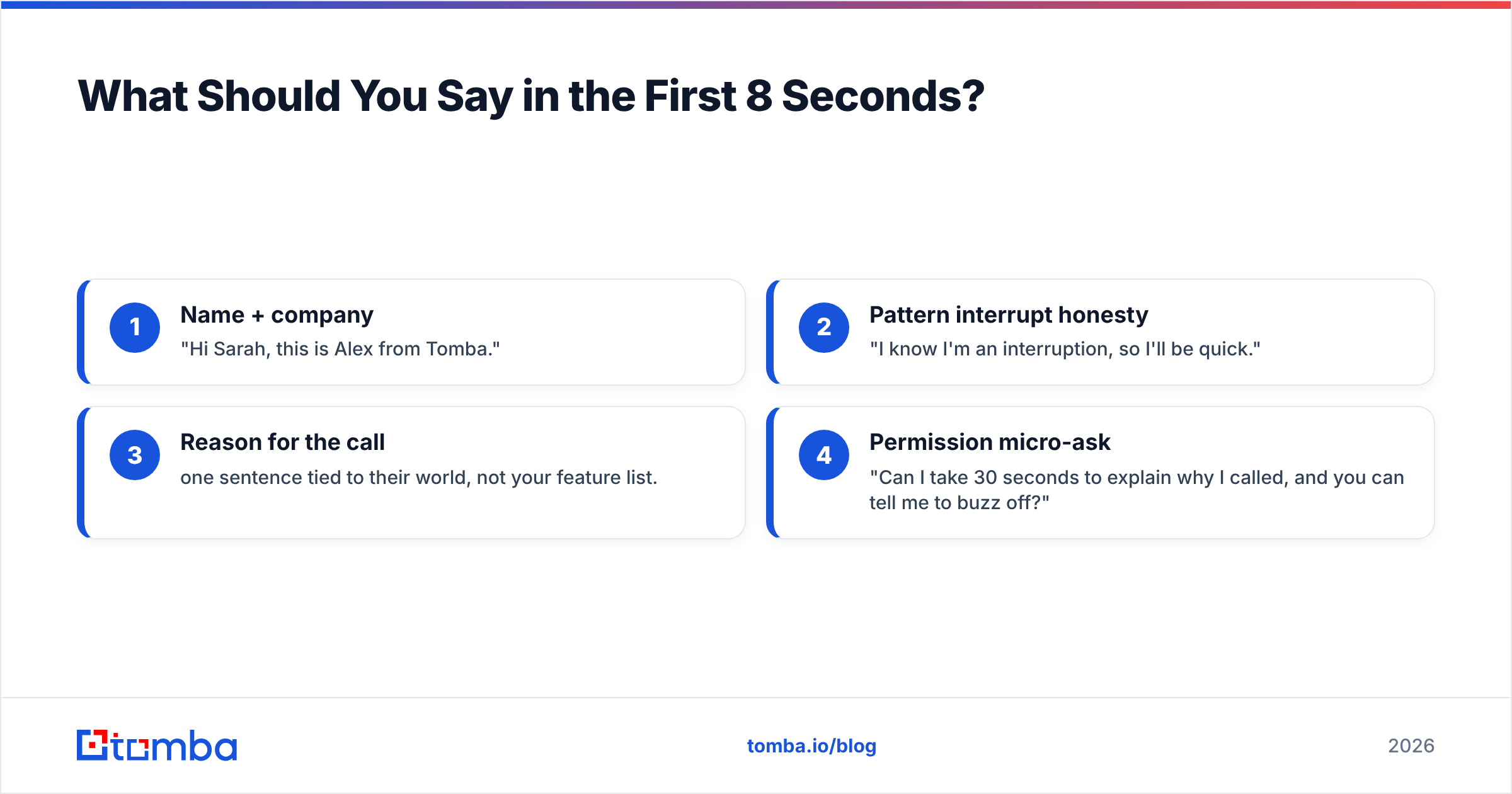
- Name + company — "Hi Sarah, this is Alex from Tomba."
- Pattern interrupt honesty — "I know I'm an interruption, so I'll be quick."
- Reason for the call — one sentence tied to their world, not your feature list.
- Permission micro-ask — "Can I take 30 seconds to explain why I called, and you can tell me to buzz off?"
That last line matters. Asking permission lowers the prospect's guard because you handed them the exit, which paradoxically makes them stay. Avoid the two worst openers: "How are you today?" (screams sales) and a 45-second monologue about your platform (screams desperation).
When Is the Best Time to Cold Call?#
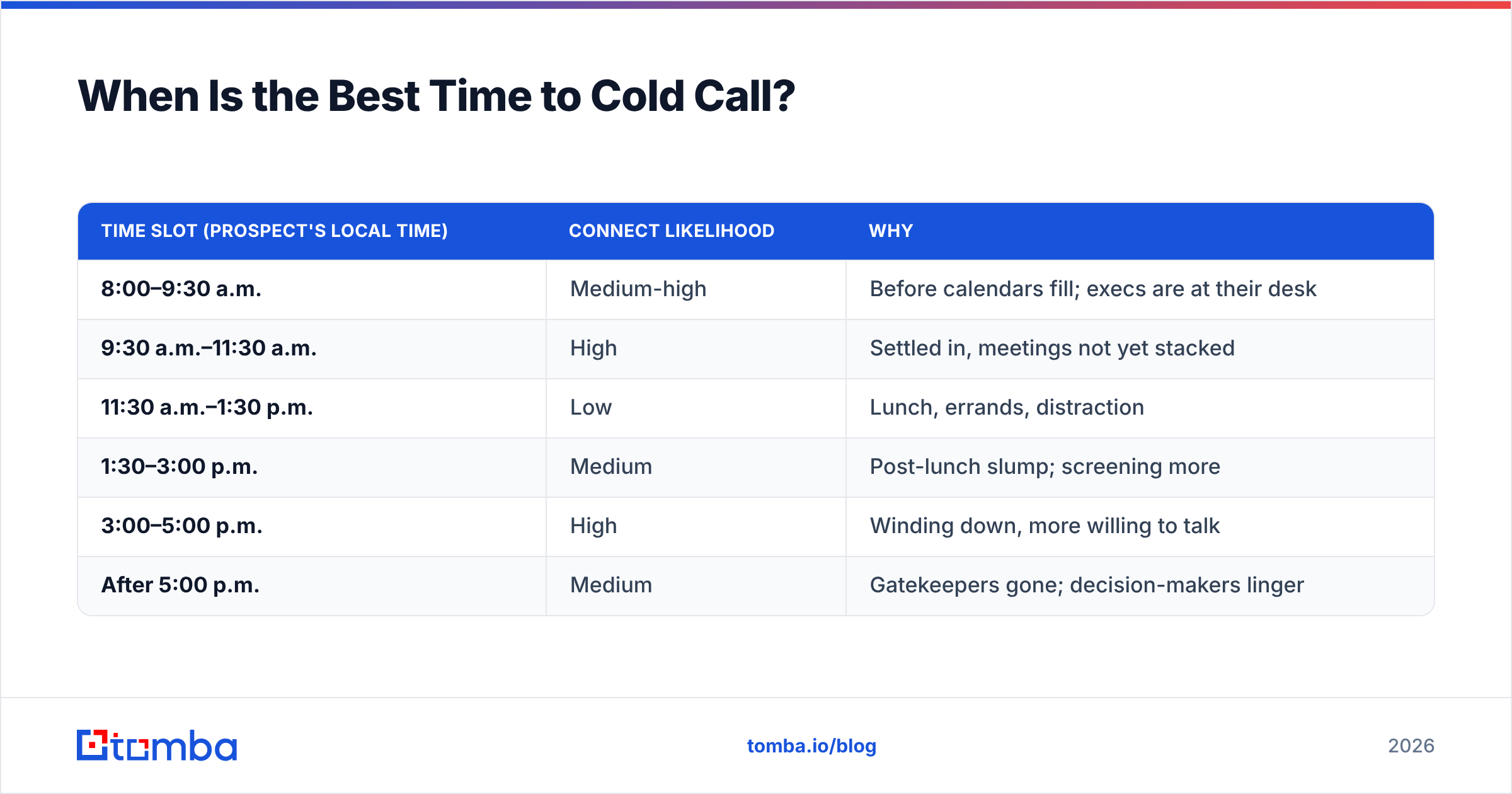
Timing changes your connect rate more than most reps expect. You're trying to catch people between tasks, not mid-meeting or mid-lunch.
| Time slot (prospect's local time) | Connect likelihood | Why |
|---|---|---|
| 8:00–9:30 a.m. | Medium-high | Before calendars fill; execs are at their desk |
| 9:30 a.m.–11:30 a.m. | High | Settled in, meetings not yet stacked |
| 11:30 a.m.–1:30 p.m. | Low | Lunch, errands, distraction |
| 1:30–3:00 p.m. | Medium | Post-lunch slump; screening more |
| 3:00–5:00 p.m. | High | Winding down, more willing to talk |
| After 5:00 p.m. | Medium | Gatekeepers gone; decision-makers linger |
Two rules on top of the table: always dial in the prospect's timezone, and spread your attempts across days. A lead you couldn't reach Tuesday at 10 a.m. might pick up Thursday at 4 p.m. One dial is not a real attempt.
Which Cold Calling Tips Actually Move the Number?#
Here are the 12 that matter, grouped by what they fix.
- Open with permission, not pleasantries. Earn the next 30 seconds; don't fake-care about their weekend.
- Lead with their problem, not your product. "Teams like yours usually struggle with X" beats "We offer Y."
- Talk in their language. Mirror the words prospects in this segment actually use — swap jargon for their jargon.
- Let silence work. After you ask a question, shut up. The pause pulls out the real answer.
- Anchor to a trigger event. New funding, a new VP, a job posting — a specific reason makes the call feel researched, not random.
- Batch your dials. Call in focused 60–90 minute blocks. Context-switching between calls and email tanks your rhythm.
- Prepare your top 5 objection responses. Predictable pushback deserves rehearsed, two-line answers (see below).
- Ask for the meeting, specifically. "Does Thursday at 2 or Friday at 10 work better?" beats "Would you be open to chatting sometime?"
- Record and review your calls. Listen back to your losses weekly. Your openers and hang-up moments are where the coaching lives.
- Warm the account first. A LinkedIn view or a relevant email before the call raises pickup and receptiveness.
- Dial verified, direct numbers. A clean list of mobile and direct-dial numbers is the single biggest connect-rate lever.
- Follow up fast. Send the promised email within five minutes while you're still fresh in their memory.
Notice how many of these depend on who and what number you dial — not just what you say. That's the part most "cold calling tips" posts ignore.
How Do You Handle the Most Common Objections?#
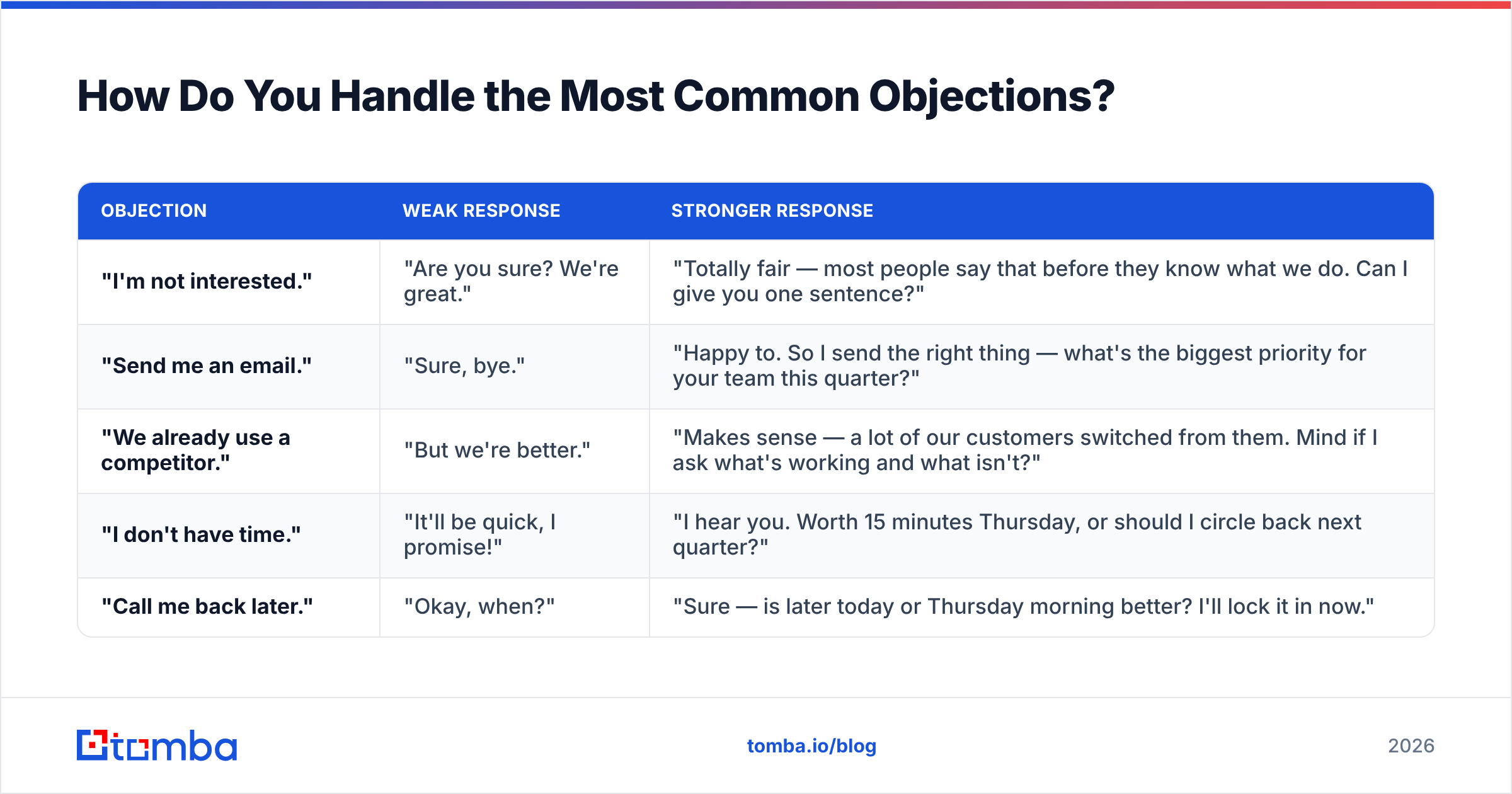
Objections aren't rejections — they're reflexes. The prospect said "not interested" before they even processed your reason. Your job is to acknowledge, reframe, and re-ask without arguing.
| Objection | Weak response | Stronger response |
|---|---|---|
| "I'm not interested." | "Are you sure? We're great." | "Totally fair — most people say that before they know what we do. Can I give you one sentence?" |
| "Send me an email." | "Sure, bye." | "Happy to. So I send the right thing — what's the biggest priority for your team this quarter?" |
| "We already use a competitor." | "But we're better." | "Makes sense — a lot of our customers switched from them. Mind if I ask what's working and what isn't?" |
| "I don't have time." | "It'll be quick, I promise!" | "I hear you. Worth 15 minutes Thursday, or should I circle back next quarter?" |
| "Call me back later." | "Okay, when?" | "Sure — is later today or Thursday morning better? I'll lock it in now." |
The pattern is the same every time: agree, ask a question, and move toward a specific next step. Never argue the objection head-on. And always give the prospect a concrete choice — two times, not an open "sometime."
Why Does Your List Matter More Than Your Script?#
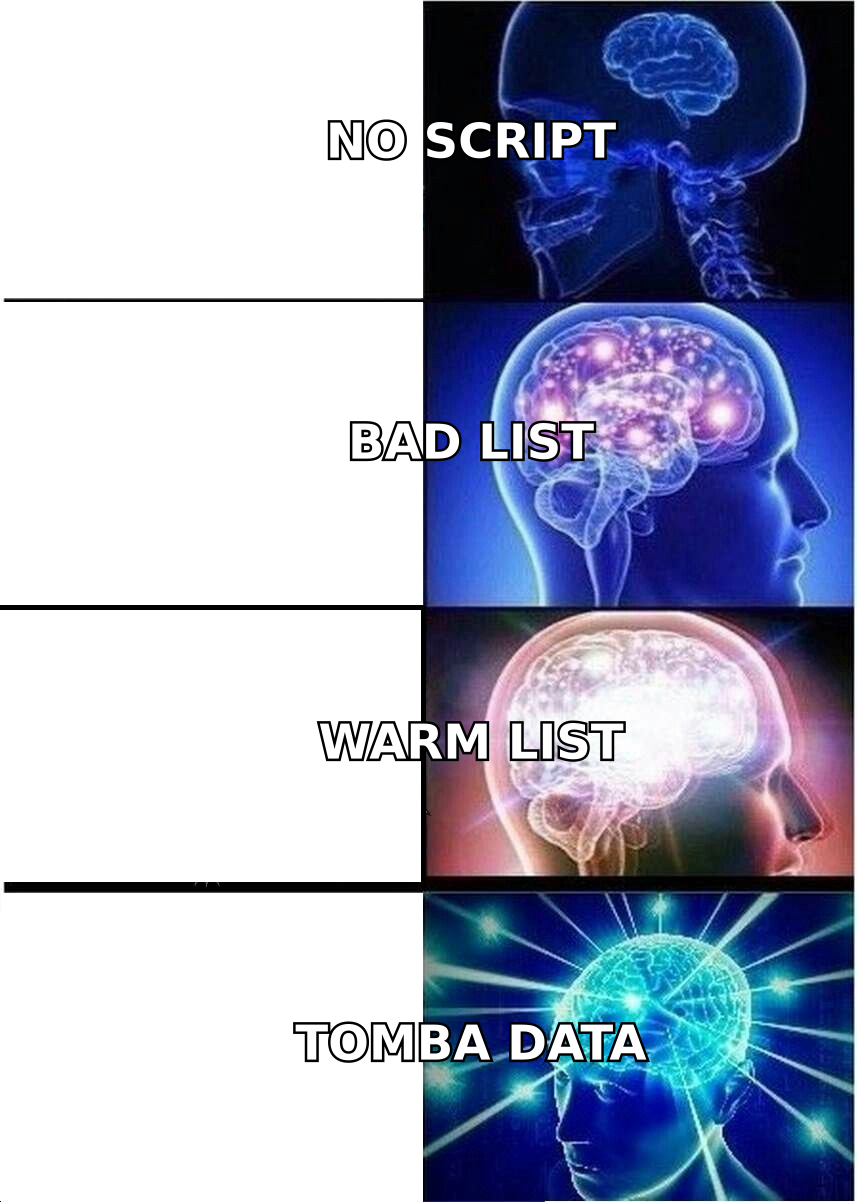
Because you can't sell to a disconnected line. The best opener in the world is wasted on a wrong number, a number that reaches a former employee, or a generic switchboard where the gatekeeper stonewalls you.
This is where data quality quietly decides your quota. If half your dials never reach a human, no script tweak will save the day. Reps who consistently hit numbers do two things before they ever pick up the phone:
- They find the right person. They know who the decision-maker is and pair the call with an email touch. Pulling accurate contact details with a phone finder and confirming the email with an email finder means every dial is aimed at a real, reachable human.
- They validate before they dial. Running numbers through a phone validator strips out dead and invalid lines so your call block isn't 40% voicemail-of-nowhere. It's the same discipline as list hygiene in email — track your response rate and cut what doesn't connect.
Think of your list like fuel. A great engine (your pitch) runs terribly on dirty fuel. Clean the data first, and every other tip in this article starts working harder.
What Metrics Should You Track to Improve?#
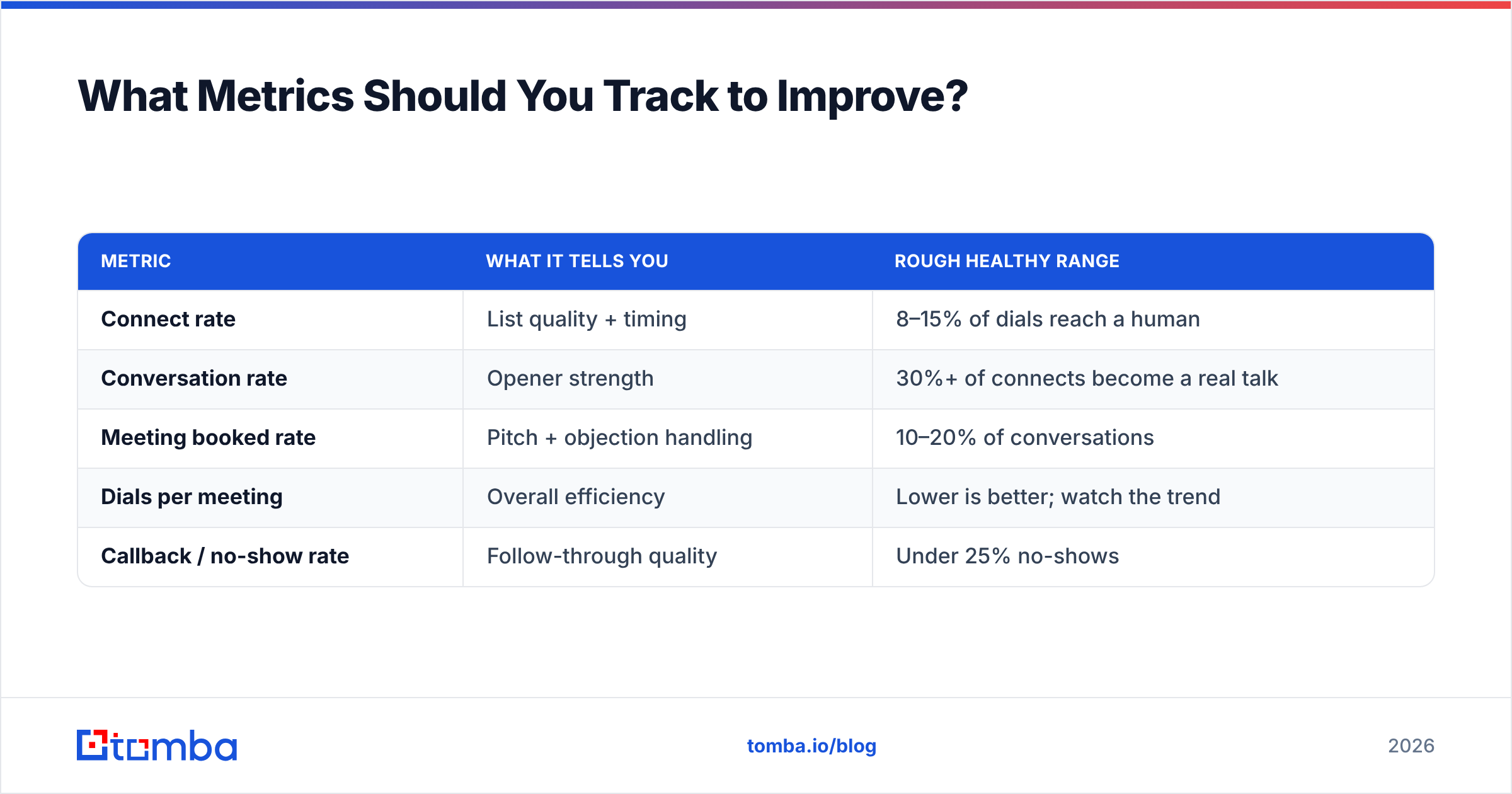
If you only count dials, you'll optimize for the wrong thing — mindless volume. Track the funnel instead, so you know which tip actually helped.
| Metric | What it tells you | Rough healthy range |
|---|---|---|
| Connect rate | List quality + timing | 8–15% of dials reach a human |
| Conversation rate | Opener strength | 30%+ of connects become a real talk |
| Meeting booked rate | Pitch + objection handling | 10–20% of conversations |
| Dials per meeting | Overall efficiency | Lower is better; watch the trend |
| Callback / no-show rate | Follow-through quality | Under 25% no-shows |
Review these weekly. If your connect rate is low, fix the list and timing (tips 11, 12, and the timing table). If connects are high but conversations are low, your opener is the problem. If conversations are high but meetings are low, drill your objection handling and your ask. The metric tells you which fix to run — you stop guessing.
Tools like Salesforce or your dialer can log most of this automatically. What matters is that you look at it and let it direct your practice.
How Do You Build a Repeatable Cold Calling Routine?#
Consistency beats intensity. A rep who runs the same clean process every day outperforms the one who sprints once a week.
A simple daily loop:
- Prep (15 min): Pull and verify 20–30 contacts. Note one trigger event per account.
- Block 1 (75 min): Dial in the prospect's morning window. No email, no Slack.
- Debrief (10 min): Log outcomes, send promised follow-ups within five minutes.
- Block 2 (75 min): Dial the afternoon window, different accounts or second attempts.
- Weekly review (30 min): Listen to two calls, update your objection scripts, check the funnel metrics.
The prep step is non-negotiable. Reps who skip list-building end up improvising numbers mid-block, which is how you burn an hour on dead lines. Batch the boring data work up front so your calling time stays pure calling time. If you're pulling contacts at scale, the same accuracy standards apply whether you're on a free plan or a paid one — see Tomba pricing for where verified phone and email lookups fit your volume.
The Bottom Line#
Cold calling in 2026 rewards preparation, not hustle theater. Nail the first eight seconds, call at the right time, rehearse your five objections, and — most importantly — dial numbers that actually reach the right person. Do those four things and your connect rate, your conversation rate, and your calendar all move in the same direction.
Everything upstream of the call is where quotas are won or lost. Before your next block, aim every dial at a verified, reachable contact: use the Tomba Email Finder to confirm the decision-maker and pair it with Tomba's phone finder so you're never wasting a dial on a dead line. Clean data in, booked meetings out. Start with the free tier and see how much of your call block you get back.
Related guides#
Ready to find emails that actually work?
Join 150,000+ professionals who stopped guessing and started sending. Free credits on signup — no credit card required.
Get the Tomba newsletter
Practical outbound tactics and product updates — once every two weeks.
About the author