Cold Calling to Book Meetings: A 2026 Playbook That Works
Cold calling still books meetings in 2026 — if you have accurate numbers, a tight opener, and a system for handling objections. Here's the full playbook.
Cold calling is not dead — bad cold calling is. Every quarter someone declares the phone obsolete, and every quarter a rep somewhere books a full pipeline off 40 dials a day. The difference is never luck. It's list quality, a disciplined opener, and a repeatable way to turn "not interested" into a calendar hold.
This is the playbook for cold calling to book meetings in 2026: what to say in the first ten seconds, how to handle the four objections you'll hear on every call, and the numbers that tell you whether your process is working before your quota does.
TL;DR#
- Cold calling still books meetings — connect-to-meeting rates of 3–8% are realistic when your data is clean and your opener earns the next 30 seconds.
- Bad numbers kill more calls than bad scripts. Verify direct-dial and mobile data before you dial; a wrong number is a guaranteed zero.
- The opener is a permission play, not a pitch. Name the reason for the call, ask for a slice of time, and get to the point.
- Objections are patterns, not surprises. Four of them cover ~80% of what you'll hear — script them once.
- Track leading metrics (dials, connects, conversations, meetings booked) so you can fix the right link in the chain.
Does cold calling still work in 2026?#
Yes — for the teams that treat it as a data problem first and a talk-track second. The phone remains one of the few channels where you get a real-time, two-way conversation with a buyer. Email gets filtered; LinkedIn requests get ignored; a live human answering "Hello?" gives you a chance no automated sequence can match.
But the bar has risen. Buyers are busier, direct dials churn faster, and gatekeepers are sharper. According to sales research aggregated by HubSpot, it takes an average of several touch attempts to reach a prospect — and most reps quit long before that. The reps who win aren't more charming. They dial more of the right numbers and stay consistent.
The single biggest lever is your list. A polished script dialed into a disconnected number books exactly zero meetings. Before you obsess over your opener, make sure the person on the other end is real, reachable, and roughly the right fit.
What makes a cold call actually book a meeting?#
Three things, in order: the right person, the right opener, and the right ask. Miss any one and the call collapses.
- The right person. Job title, seniority, and a plausible reason they'd care. Calling the wrong persona wastes the connect you worked hard to earn.
- A reachable, verified number. Direct dials and mobiles beat switchboards by a wide margin. A number that rings the target's desk (or pocket) is worth ten switchboard transfers.
- A permission-based opener. You have about ten seconds before the prospect decides whether to hang up. Use them to earn the next thirty.
- A specific, low-friction ask. "Do you have 15 minutes Thursday?" beats "Would you be open to learning more?" every time. Name a length and a day.
- A reason to care right now. Tie your call to a trigger — a hire, a funding round, a tech-stack change — so it doesn't feel random.
Notice that two of the five are about data, not delivery. That's the part most "cold calling tips" articles skip, and it's exactly where deals are won or lost. Feeding your dialer with accurate contacts from a real B2B database is the unglamorous work that makes the glamorous part — the conversation — possible.
How do you open a cold call without getting hung up on?#
Lead with a pattern interrupt and a permission ask. The worst openers pretend the call isn't cold ("How are you today?"). Buyers see through it instantly. The best openers are honest, brief, and hand a little control back to the prospect.
A reliable structure:
"Hi [Name], it's [You] from [Company]. I know I'm an interruption — can I take 30 seconds to tell you why I called, and then you decide if it's worth continuing?"
This works because it does three things at once: it's transparent (buyers relax when you name the elephant), it's short (30 seconds is a low commitment), and it gives them agency (they get to decide). Roughly seven in ten prospects will say "go ahead." That yes is the meeting-in-miniature — you've already gotten them to agree to something.
Then earn it. In your 30 seconds, name a specific problem you solve for people in their exact role, not a feature list. End with a soft question that invites a reaction rather than a yes/no wall.
Cold calling vs. cold email vs. LinkedIn: which books more meetings?#
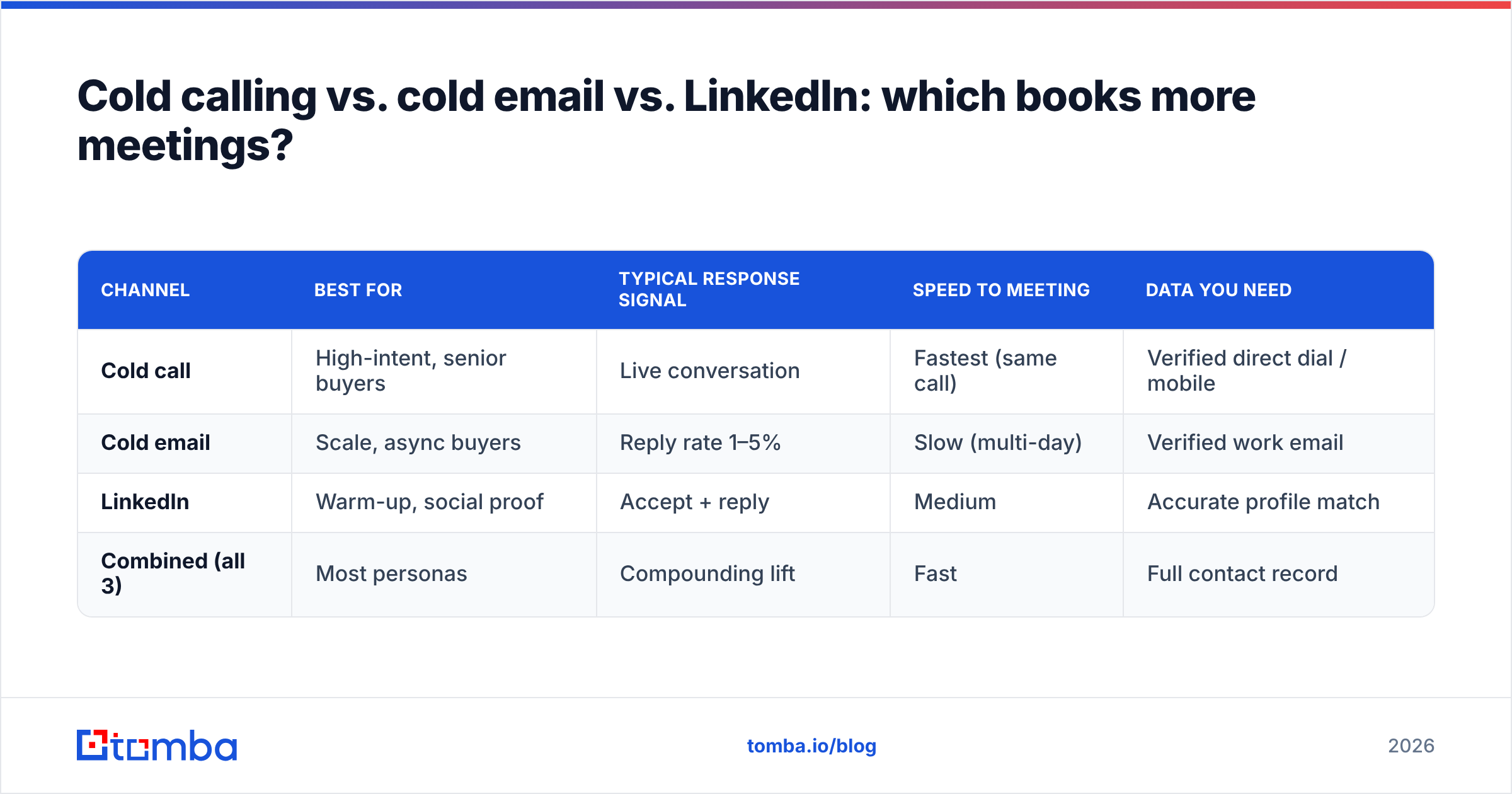
None of them wins alone. The highest-performing outbound motion in 2026 is multi-threaded — the call is amplified by an email and a LinkedIn touch, not replaced by them. But each channel has a distinct job, and knowing which does what stops you from over-investing in the wrong one.
| Channel | Best for | Typical response signal | Speed to meeting | Data you need |
|---|---|---|---|---|
| Cold call | High-intent, senior buyers | Live conversation | Fastest (same call) | Verified direct dial / mobile |
| Cold email | Scale, async buyers | Reply rate 1–5% | Slow (multi-day) | Verified work email |
| Warm-up, social proof | Accept + reply | Medium | Accurate profile match | |
| Combined (all 3) | Most personas | Compounding lift | Fast | Full contact record |
The takeaway: the call closes the loop fastest, but it depends most heavily on data quality. A cold email bounces quietly; a cold call to a dead number burns a dial slot and your morale. That's why the strongest teams pair a phone finder for direct dials with an email verifier for the follow-up — so every channel fires at a real, reachable contact.
If you want to reach the buyer at all, you first need their coordinates. Pulling verified emails and numbers straight from a company domain with domain search means your reps spend their day dialing, not googling.
How do you handle the four objections you'll hear every day?#
Script them once and stop improvising. Objections in cold calling are remarkably predictable — the same four cover the vast majority of pushback. Treating each as a known branch, not a fresh crisis, keeps you calm and keeps the call alive.
- "I'm not interested." You expected this — it's a reflex, not a decision. Respond: "Totally fair, you don't know me yet. Most folks I talk to said the same until they saw [specific outcome]. Can I take 20 seconds?"
- "Now's not a good time." Take it at face value and pin a slot: "No problem — I'd rather not catch you mid-fire-drill. Is Thursday at 2, or Friday morning better for 15 minutes?"
- "Just send me an email." Half brush-off, half opening. Agree, then narrow: "Happy to. So I send something useful and not generic — are you more focused on [X] or [Y] right now?" You've turned a dodge into discovery.
- "We already use [competitor]." Great — they've got budget and a use case. "That's exactly why I called — a lot of [competitor] users I speak with hit [limitation]. Worth a quick compare?"
The pattern across all four: acknowledge, reframe, re-ask for the small commitment. You are not arguing. You are lowering the cost of saying yes to the next step.
What's the ideal cold call script structure?#
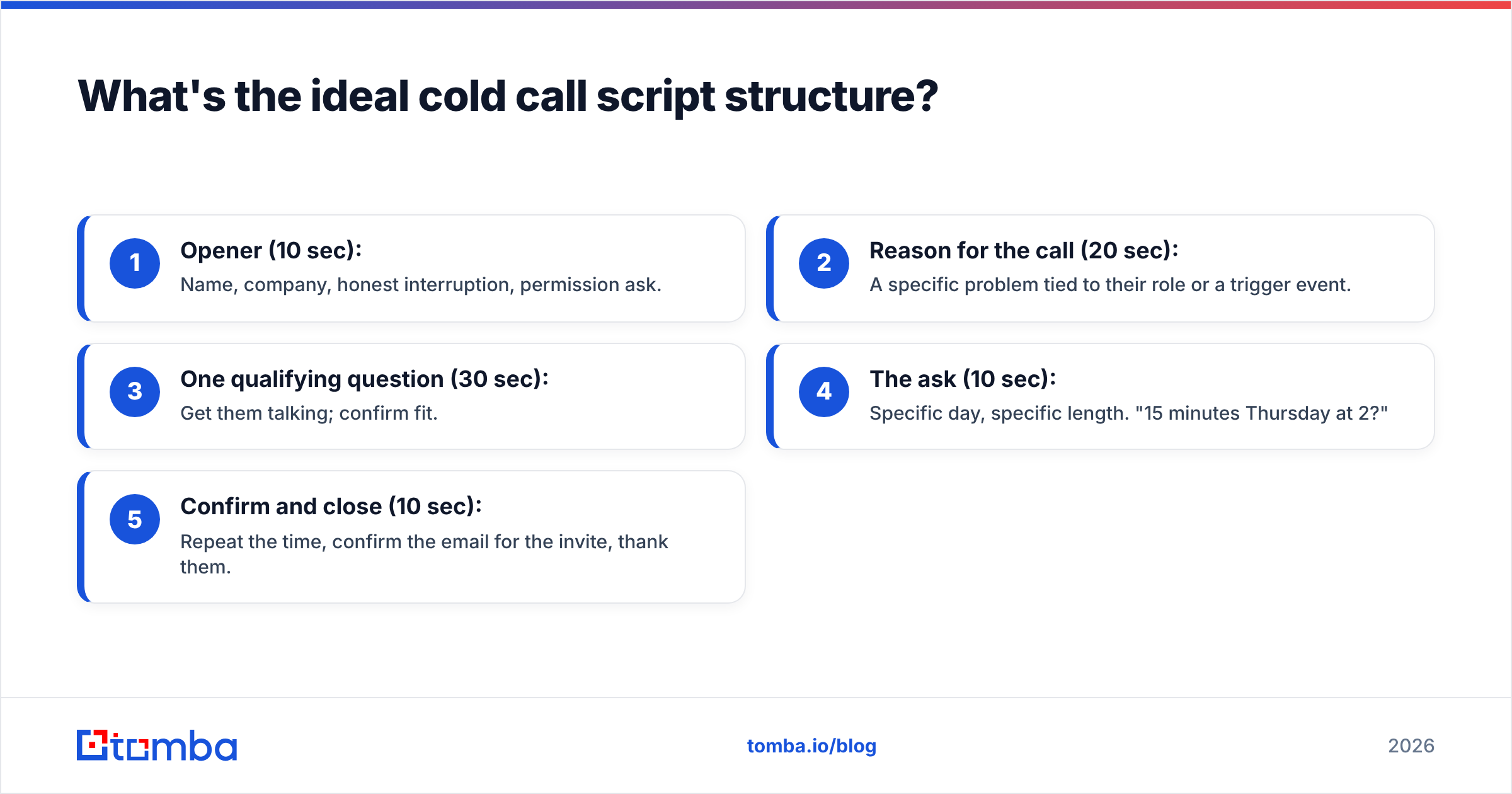
A repeatable five-part frame, timed to under two minutes. Scripts aren't cages — they're guardrails that free your brain to actually listen. Here's the skeleton that consistently books meetings:
- Opener (10 sec): Name, company, honest interruption, permission ask.
- Reason for the call (20 sec): A specific problem tied to their role or a trigger event.
- One qualifying question (30 sec): Get them talking; confirm fit.
- The ask (10 sec): Specific day, specific length. "15 minutes Thursday at 2?"
- Confirm and close (10 sec): Repeat the time, confirm the email for the invite, thank them.
The confirm step matters more than reps think. Restating the time out loud and getting the buyer to say "yes, Thursday works" locks in the commitment psychologically. And confirming their email address on the call gives you a clean, verified contact for the calendar invite — no bounce, no no-show from a mistyped address.
For the follow-up cadence around the call, most teams lean on a proven set of touches. A library of tested cold email templates keeps the written half of your outreach as sharp as your talk track, so the call and the inbox reinforce each other instead of competing.
What metrics tell you if your cold calling is working?#
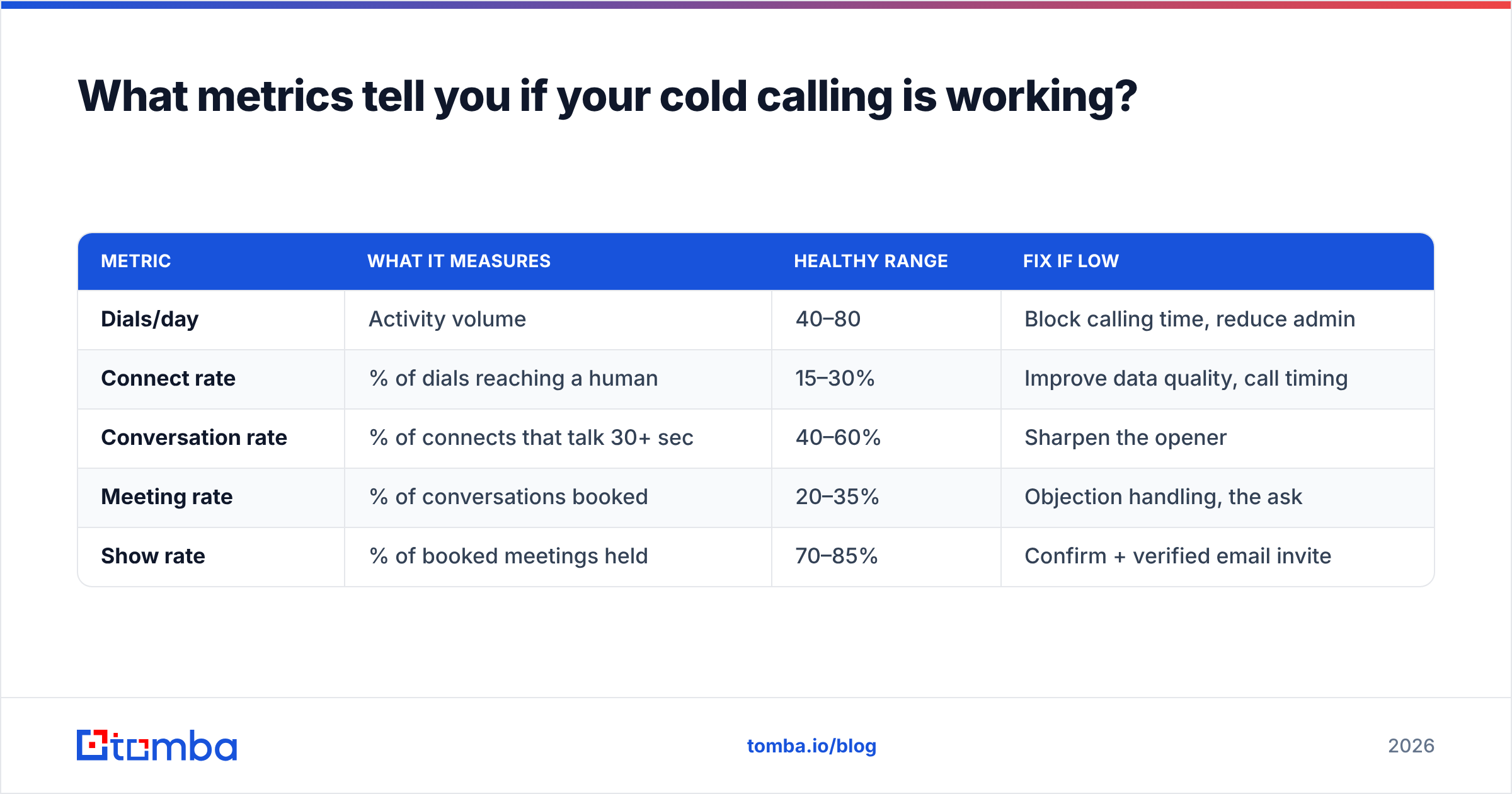
Track the whole chain, not just booked meetings. Meetings booked is a lagging number — by the time it dips, the problem started days earlier somewhere upstream. Watch the leading indicators so you can fix the right link.
| Metric | What it measures | Healthy range | Fix if low |
|---|---|---|---|
| Dials/day | Activity volume | 40–80 | Block calling time, reduce admin |
| Connect rate | % of dials reaching a human | 15–30% | Improve data quality, call timing |
| Conversation rate | % of connects that talk 30+ sec | 40–60% | Sharpen the opener |
| Meeting rate | % of conversations booked | 20–35% | Objection handling, the ask |
| Show rate | % of booked meetings held | 70–85% | Confirm + verified email invite |
Read the table like a diagnosis. Low connect rate almost always means bad numbers — the cure is upstream data, not a new script. Low conversation rate points at your opener. Low meeting rate is an objection-handling or ask problem. A dropping show rate usually traces back to wrong emails on invites or a weak confirm step. Each symptom has one primary cause; don't rewrite your whole process when one link is broken.
This is why data quality shows up twice in the funnel — at connect (right number) and at show (right email). Enriching your contact records with data enrichment before a campaign means both ends of the chain fire correctly, and your leading metrics stop lying to you.
How much dialing does it actually take to book a meeting?#
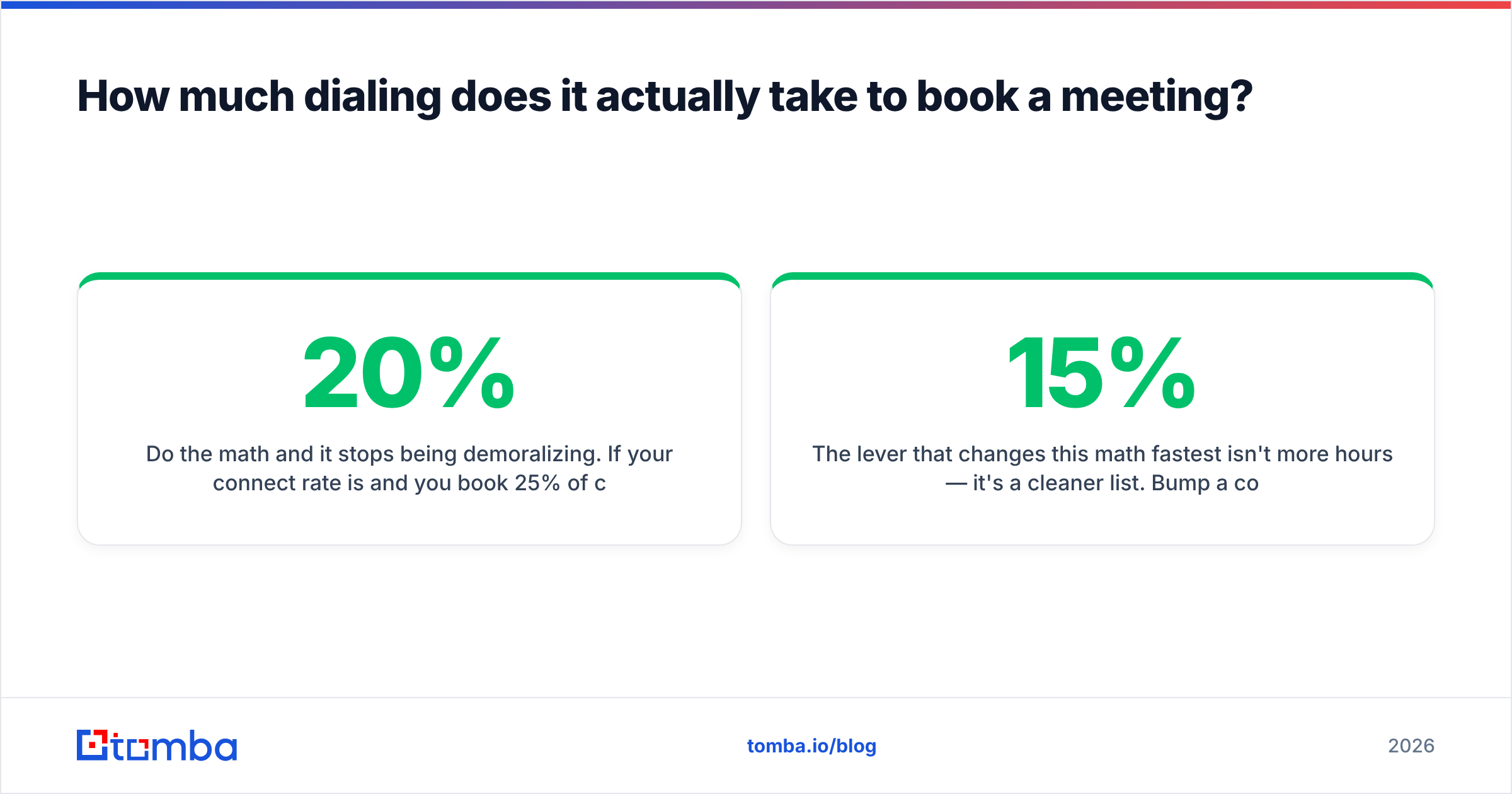
Do the math and it stops being demoralizing. If your connect rate is 20% and you book 25% of conversations, then 40 dials yields ~8 connects, and ~2 booked meetings — every single day. Over a 20-day month that's roughly 40 meetings from one rep. The phone isn't slow; impatience is.
The lever that changes this math fastest isn't more hours — it's a cleaner list. Bump a 15% connect rate to 25% by verifying numbers first, and you've added 50% more conversations without dialing once more. That's the entire argument for treating cold calling as a data discipline: the same effort, aimed at real contacts, compounds.
You can check Tomba pricing to see how per-search or bulk lookups map to your dialing volume — the Free tier (25 searches/mo) is enough to test whether verified numbers move your connect rate before you commit to a plan. For broader tool context, review sites like G2 and Capterra let you compare data providers on real user feedback.
Common cold calling mistakes that kill meeting rates#
- Dialing unverified numbers. The #1 silent killer. Every dead number is a zero you can't win back.
- Pitching before permission. Launching into features earns a hang-up. Ask for the 30 seconds first.
- Vague asks. "Open to a chat sometime?" invites a stall. Name a day and a length.
- Quitting after two attempts. Most meetings come from touch three onward. Persistence, not perfection.
- No trigger, no relevance. A call with no reason to be happening today feels like spam — because it is.
The bottom line: put verified data behind every dial#
Cold calling to book meetings works in 2026 for one reason: it's the only channel that turns a stranger into a conversation in real time. But that conversation only happens if the number connects and the follow-up email lands. Everything upstream of your talk track — the person, the direct dial, the verified email — determines whether your script ever gets a chance.
Start there. Use the Tomba Email Finder to build clean, verified contact lists from any company domain, pair it with direct dials, and feed your dialer only numbers worth calling. Your opener will land more often, your connect rate will climb, and the math that felt impossible will start booking meetings on its own. Dial with confidence — because the data behind the call is real.
Related guides#
Ready to find emails that actually work?
Join 150,000+ professionals who stopped guessing and started sending. Free credits on signup — no credit card required.
Get the Tomba newsletter
Practical outbound tactics and product updates — once every two weeks.
About the author