Cold Calling Training in 2026: The Complete Rep Playbook
Most cold calling training teaches scripts and hangs reps out to dry on the phones. Here's a 2026 framework that actually builds pickup-to-meeting reps — openers, objection handling, call blocks, and the metrics that matter.
Cold calling isn't dead — bad cold calling training is. Reps still book pipeline on the phone every day, but most of them learned in spite of their onboarding, not because of it. If your "training" is a script PDF and a headset, you're setting people up to burn through good leads and quit in month three.
This guide gives you a training system you can actually run: what to teach, in what order, how to practice it, and how to measure whether it's working.
TL;DR#
- Scripts are the smallest part. The reps who win drill openers, tone, and objection reflexes — not word-for-word monologues.
- Practice beats theory. Role-play and live-call review move the needle far more than slide decks. Aim for reps making real dials in week one.
- Bad data kills good training. A perfectly trained rep dialing wrong numbers still fails. Clean, verified contact data is a training prerequisite, not an afterthought.
- Measure connect-to-meeting, not dials. Activity metrics hide skill gaps. Conversion metrics expose them.
- Ramp is a program, not an event. The best teams run continuous coaching cycles — weekly call reviews, monthly recalibration — not a one-week bootcamp.
Why does most cold calling training fail?#
Because it teaches the wrong thing first. Think of learning to cold call like learning to drive: nobody gets good by memorizing the owner's manual. They get good with a licensed instructor in the passenger seat, on a real road, correcting small mistakes in real time.
Most programs invert this. They front-load theory — the company pitch, the product spec sheet, a 40-line script — and then throw reps onto the phones alone. The rep freezes on the first objection, sounds robotic, gets hung up on, and concludes they're "just not a phone person."
The three failure patterns show up again and again:
- Script worship. Reps read instead of talk. Prospects can hear it instantly and disengage.
- No live practice. Trainees "understand" objection handling in theory but have never said the words out loud under pressure.
- Garbage lists. New reps are handed the oldest, most-dialed, least-verified data in the CRM and told to "get some reps in." They spend the day reaching disconnected numbers and voicemails.
That third one is the silent killer. You can run a flawless coaching program and still watch ramp times balloon because the underlying B2B phone numbers are stale. Fix the data before you blame the rep.
What should a cold calling training program actually cover?#
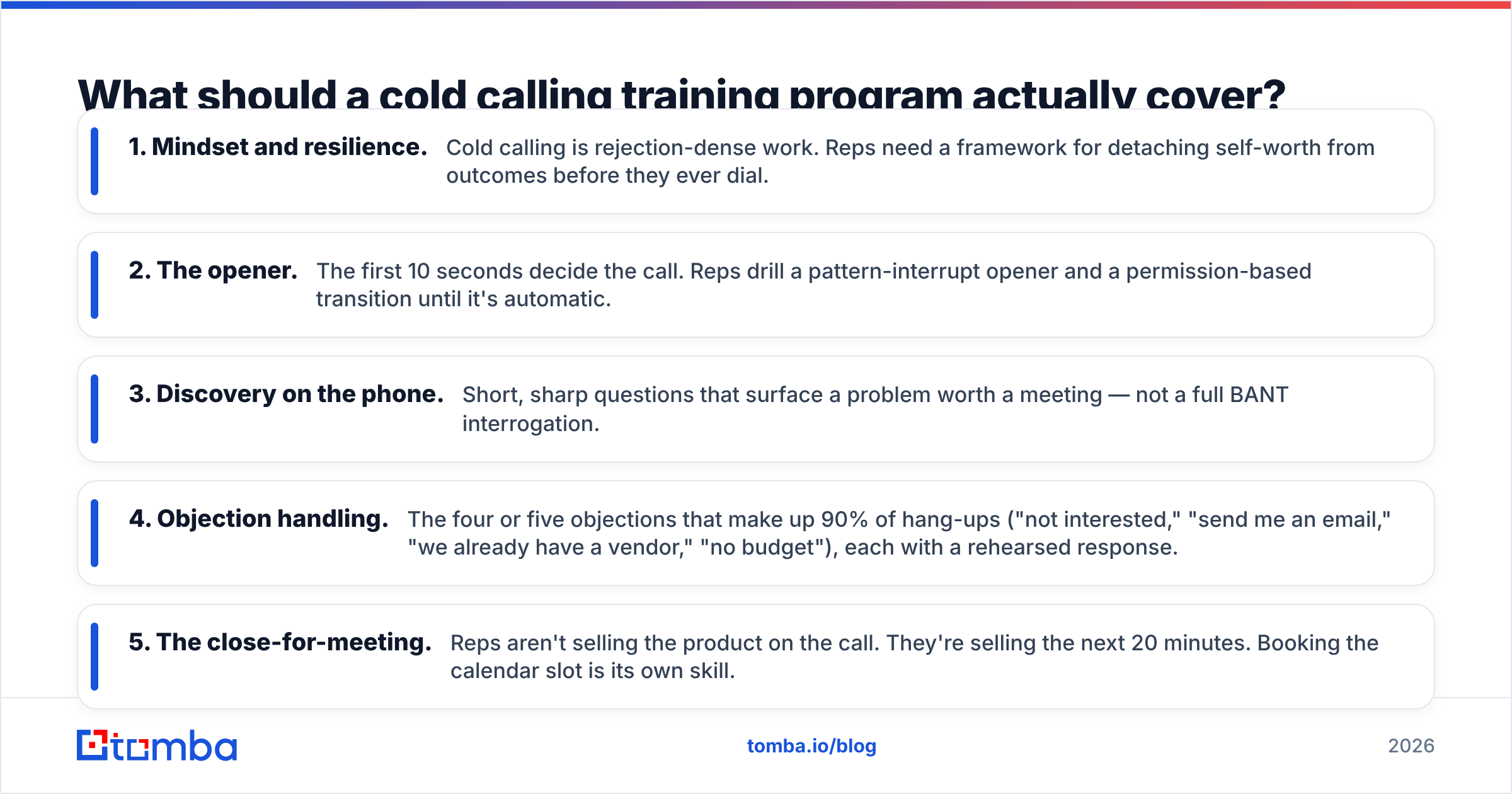
A complete program has five modules, taught roughly in this order. Each one is a skill you drill, not a concept you read.
- 1. Mindset and resilience. Cold calling is rejection-dense work. Reps need a framework for detaching self-worth from outcomes before they ever dial.
- 2. The opener. The first 10 seconds decide the call. Reps drill a pattern-interrupt opener and a permission-based transition until it's automatic.
- 3. Discovery on the phone. Short, sharp questions that surface a problem worth a meeting — not a full BANT interrogation.
- 4. Objection handling. The four or five objections that make up 90% of hang-ups ("not interested," "send me an email," "we already have a vendor," "no budget"), each with a rehearsed response.
- 5. The close-for-meeting. Reps aren't selling the product on the call. They're selling the next 20 minutes. Booking the calendar slot is its own skill.
Notice what's not first: product knowledge. It matters, but a rep who knows every feature and can't survive an opener books zero meetings. Product depth is layered in after the conversational reflexes exist.
What's the fastest way to build calling skills — theory or practice?#
Practice, and it isn't close. The teams that ramp reps fastest treat classroom time as the appetizer and live practice as the meal.
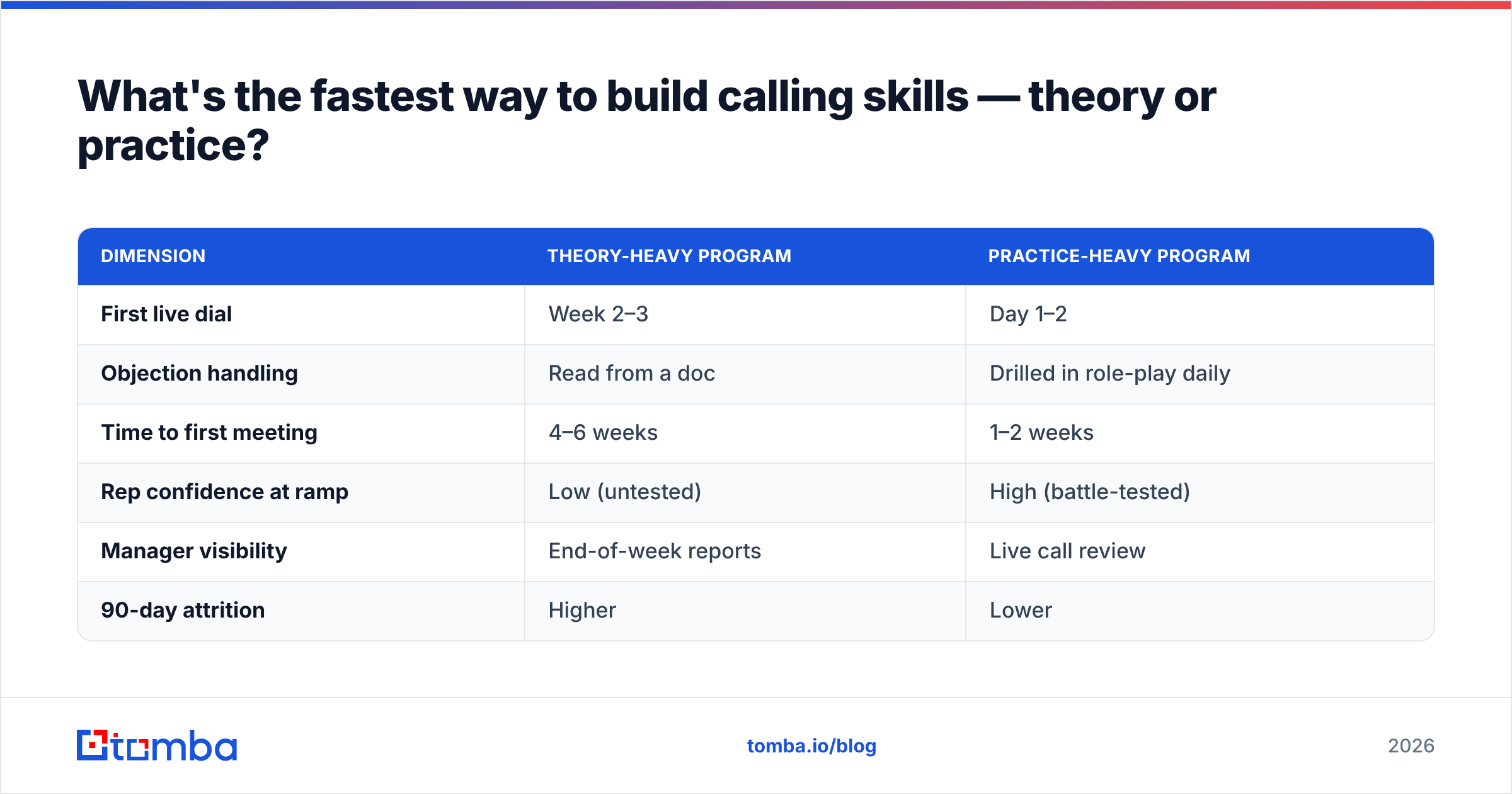
Here's how the two approaches compare in the wild:
| Dimension | Theory-heavy program | Practice-heavy program |
|---|---|---|
| First live dial | Week 2–3 | Day 1–2 |
| Objection handling | Read from a doc | Drilled in role-play daily |
| Time to first meeting | 4–6 weeks | 1–2 weeks |
| Rep confidence at ramp | Low (untested) | High (battle-tested) |
| Manager visibility | End-of-week reports | Live call review |
| 90-day attrition | Higher | Lower |
The mechanics of a practice-heavy program are simple but require discipline:
- Daily role-play, 15 minutes. Manager or peer plays a hostile prospect. Reps drill the opener and one objection. No slides.
- Call recording and review. Record every call (where legally permitted), then review two or three per rep per week. Score the opener, the tone, the transition to the ask.
- Live listening. A new rep listens to a top performer's live block, then the top performer listens to theirs. Real-time correction beats delayed feedback.
- Rip-and-read is banned. The script becomes a map, not a teleprompter, by week one.
For guidance on structuring the classroom portion that does matter, sales-education libraries from vendors like HubSpot and peer reviews on G2 are useful references — but they supplement live reps, they don't replace them.
How do you train objection handling that actually holds up?#
Treat objections like a firefighter treats a fire drill: rehearse the response so many times that the reaction is muscle memory, not improvisation. When a prospect says "I'm not interested" and the rep has said their comeback 200 times, there's no panic — just the next move.
Build an objection bank of your five most common stalls, and drill a response for each. A simple, effective structure is acknowledge → reframe → re-ask:
- "Not interested." Acknowledge ("Totally fair, you don't know me yet"), reframe ("most folks I talk to weren't looking either"), re-ask ("can I take 30 seconds to say why I called?").
- "Send me an email." Acknowledge, then trade ("happy to — so I send the right thing, are you the person handling X?").
- "We already use a vendor." Acknowledge, differentiate, re-ask for a low-stakes comparison call.
- "No budget." Acknowledge, decouple ("this isn't a buying conversation"), re-ask for a discovery slot next quarter.
The reps who master this don't sound scripted — they sound calm, because they've removed the surprise. That calm is the entire skill.
Which metrics tell you the training is working?#
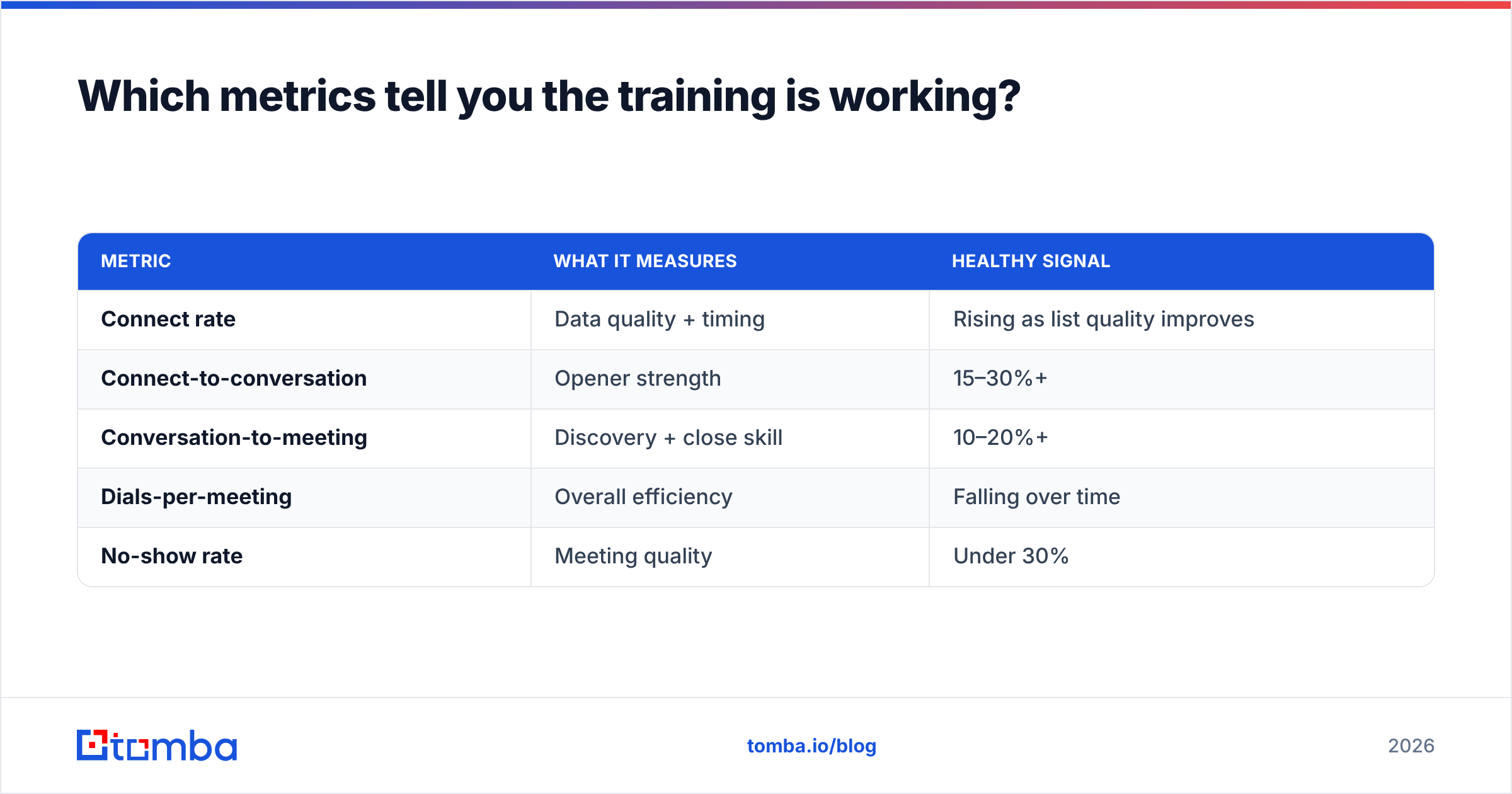
Stop celebrating dial counts. A rep making 150 dials a day into bad data is producing noise, not progress. The metrics that expose real skill are conversion ratios along the call funnel.
| Metric | What it measures | Healthy signal |
|---|---|---|
| Connect rate | Data quality + timing | Rising as list quality improves |
| Connect-to-conversation | Opener strength | 15–30%+ |
| Conversation-to-meeting | Discovery + close skill | 10–20%+ |
| Dials-per-meeting | Overall efficiency | Falling over time |
| No-show rate | Meeting quality | Under 30% |
If connect rate is low, that's a data problem, not a skill problem — no amount of coaching fixes a disconnected number. If connects are healthy but conversations don't convert, the opener needs work. If conversations happen but meetings don't book, drill the close. The funnel tells you exactly which module to re-teach. Track these alongside your broader response rate benchmarks so phone and email outreach are measured on the same terms.
How does data quality change everything?#
Here's the truth most training vendors won't tell you, because they sell coaching, not data: the single biggest lever on a new rep's success is the quality of the list they dial. It has always been this way.

A rep with a mediocre script and a clean, verified list of the right decision-makers will outbook a rep with a perfect script and a stale export every time. Connect rate — the top of your entire funnel — is almost entirely a function of whether the number is current and belongs to the right person.
This is where your training stack and your data stack meet:
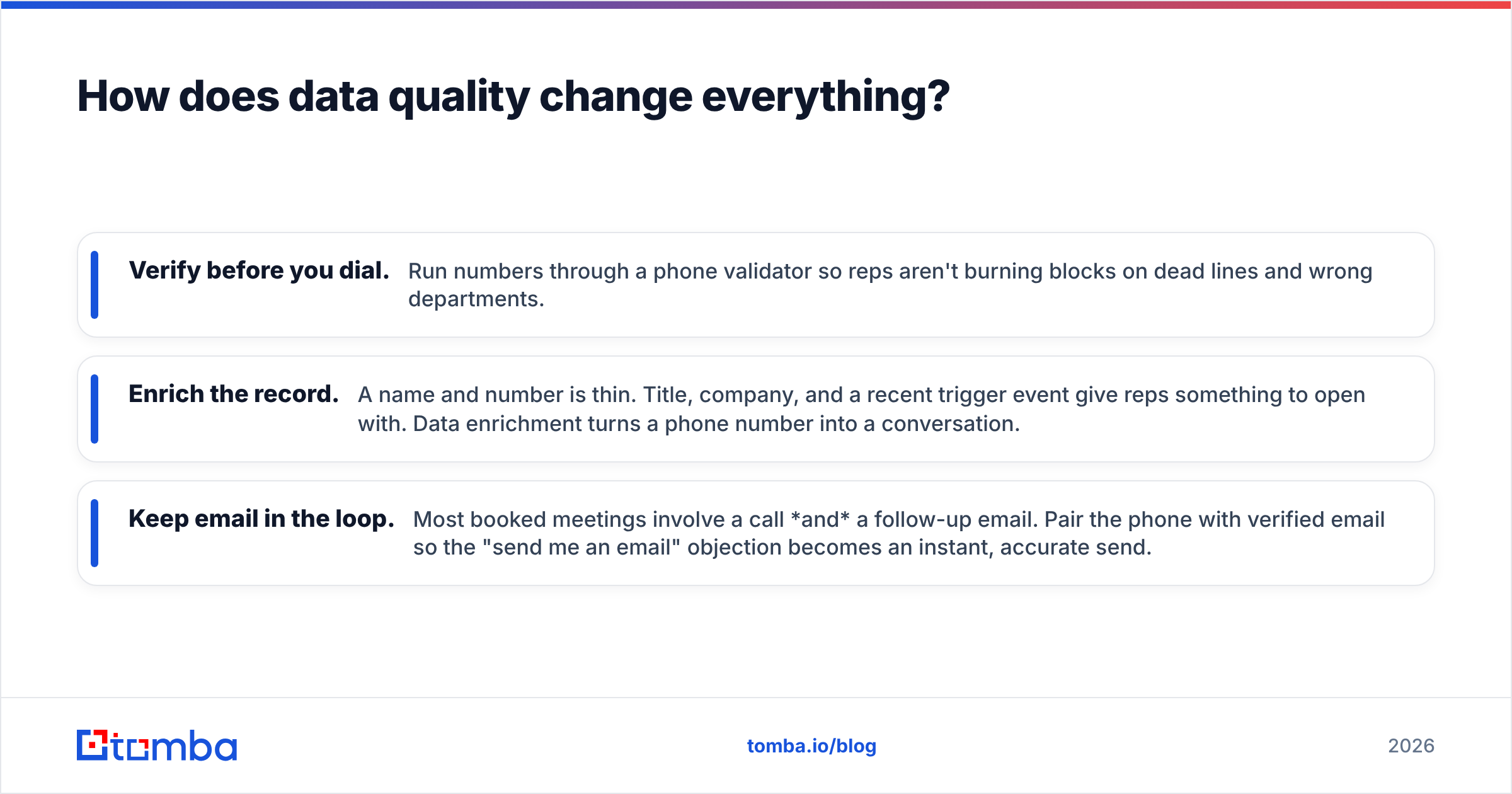
- Verify before you dial. Run numbers through a phone validator so reps aren't burning blocks on dead lines and wrong departments.
- Enrich the record. A name and number is thin. Title, company, and a recent trigger event give reps something to open with. Data enrichment turns a phone number into a conversation.
- Keep email in the loop. Most booked meetings involve a call and a follow-up email. Pair the phone with verified email so the "send me an email" objection becomes an instant, accurate send.
Salesforce's research on sales productivity has long pointed to the same conclusion — reps spend a punishing share of their week on non-selling tasks like fixing bad data (see Salesforce's State of Sales). Every hour a trainee spends dialing garbage is an hour they're not building the skill you're paying to develop.
What does a 30-day cold calling ramp look like?#
A concrete plan beats good intentions. Here's a battle-tested 30-day structure you can adapt:
- Week 1 — Foundations + first dials. Mindset, opener drills, and live calls by day two on a low-stakes segment. Volume is secondary; getting over the fear is the goal.
- Week 2 — Objections + discovery. Daily role-play on the objection bank. Reps start reviewing their own recordings.
- Week 3 — Close and calendar. Drill booking the meeting. Introduce paired listening with a top performer.
- Week 4 — Full funnel ownership. Rep runs real blocks on real data, with weekly one-on-one call reviews. Metrics start driving coaching.
After day 30, the program doesn't stop — it shifts to a maintenance rhythm: weekly call reviews, a monthly objection-bank refresh as the market shifts, and quarterly recalibration. Skill decays without reinforcement, exactly like any other trained reflex.
Common cold calling training mistakes to avoid#
- Overloading week one with product. Teach the conversation first, the catalog second.
- Scoring activity over outcomes. Dial quotas reward busywork and punish thoughtful reps.
- Skipping the recording review. Reps can't fix what they can't hear.
- Training once and walking away. One bootcamp doesn't create a lasting skill.
- Ignoring the list. The most common and most expensive mistake of all — coaching a rep to perfection while feeding them data that guarantees failure.
The bottom line#
Great cold calling training is a system, not a script: practice-first, objection-drilled, funnel-measured, and built on data your reps can actually trust. Get the coaching rhythm right and pair it with verified, enriched contact data, and ramp times fall while attrition follows.
Start by fixing the input. Before your next training block, feed your reps a clean list of the right people — Tomba's Email Finder surfaces verified professional contacts by name, domain, or company, so your newest reps spend their practice reps on real conversations instead of dead ends. Check the Tomba pricing plans to size it to your team, and let your training do what it's supposed to: build reps who book meetings.
Related guides#
// get started
Find, verify and enrich your first contacts today
Start on the free plan with 25 searches a month, then scale when your team is ready.
Free plan · No credit card required · GDPR & CCPA
// about the author