Cold Calling Voicemail Scripts That Actually Get Callbacks in 2026
Most sales voicemails get deleted in under three seconds. Here are 12 cold calling voicemail scripts, the 8-second structure behind them, and the timing rules that turn ignored messages into callbacks.
Cold voicemail is the most-skipped, least-planned 20 seconds in outbound sales. Reps who script every line of the live call still improvise the voicemail — then wonder why nobody calls back. This guide fixes that with structure, timing, and 12 scripts you can steal today.
TL;DR#
- Callback rates for cold voicemails sit around 4-6% — but a tight, specific message beats a rambling one by a wide margin. Structure matters more than charm.
- Keep it to 20-30 seconds. The first 8 seconds decide whether the rest gets heard or deleted.
- Pair every voicemail with a follow-up email or text. Voicemail alone is a dead end; the "double-tap" is what actually generates callbacks.
- Use the 5-part structure below (identity → reason → relevance → soft ask → callback trigger) and swap in one of the 12 scripts.
- Accurate contact data is the multiplier. A perfect script left on the wrong number or paired with a bounced email wastes the whole sequence.
Why do most cold calling voicemail scripts get ignored?#
Because they sound like every other voicemail: a nervous name-drop, a 45-second company pitch, and a phone number mumbled so fast nobody writes it down. The prospect deletes it before you reach your value prop.
Think of a cold voicemail like a movie trailer. The trailer's only job is to make you buy a ticket — not to tell the whole story. Most reps try to cram the entire film into 60 seconds and lose the audience in the first scene.
Three failure patterns show up again and again:
- Too long. Anything past 30 seconds feels like work to listen to. Prospects triage voicemail the same way they triage email — length is a delete signal.
- Too vague. "I wanted to talk about how we help companies like yours" tells the prospect nothing. No specific reason means no reason to call back.
- No reason to respond now. If there's no hook tied to their world — a trigger event, a peer result, a relevant number — the message goes to the bottom of an infinite list.

The fix isn't a better voice or more confidence. It's a repeatable structure that front-loads relevance and makes the callback effortless.
What is the ideal cold voicemail structure?#
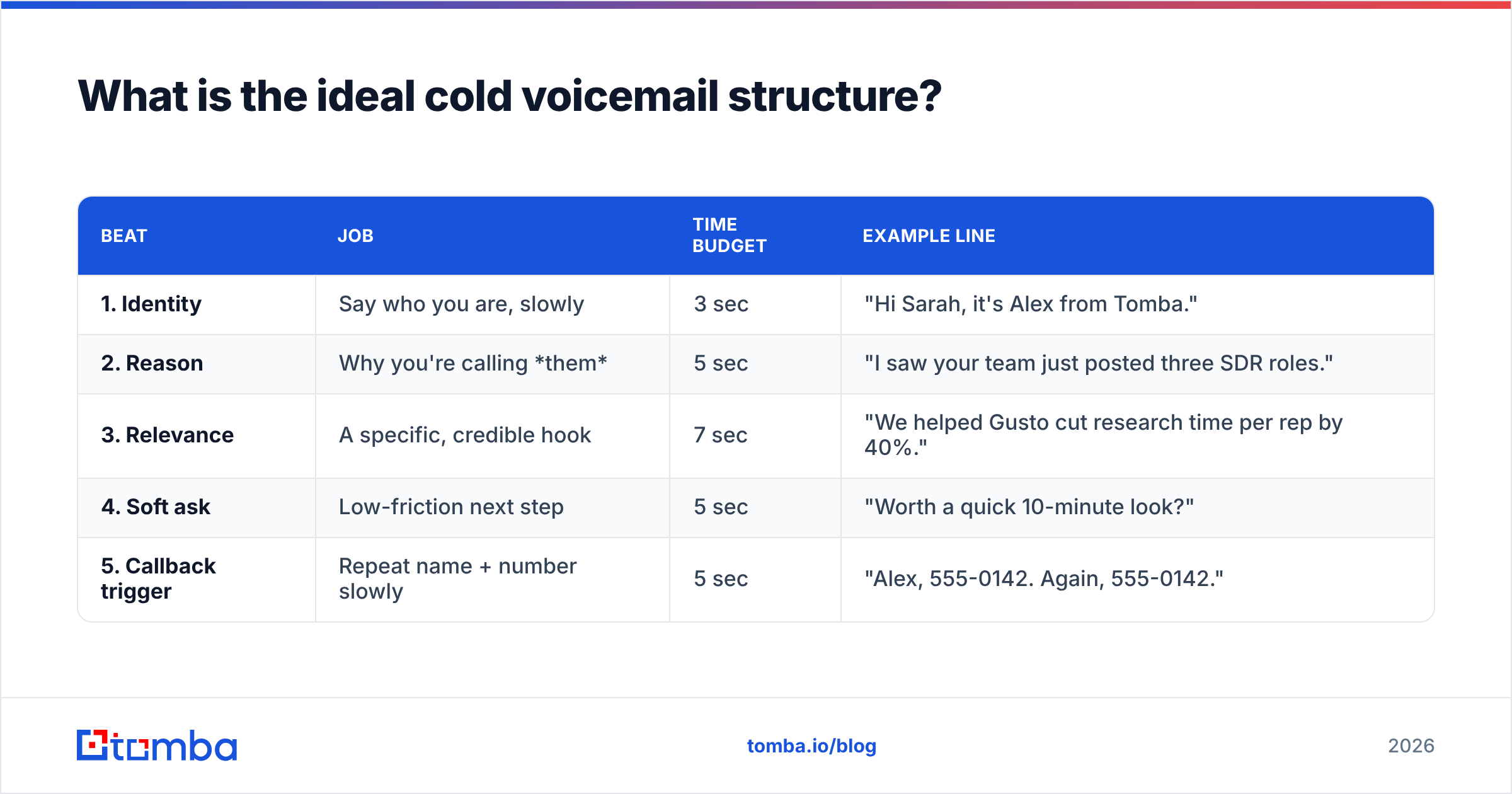
The best-performing cold calling voicemail scripts follow the same five beats, in order. Each beat has a job, and each has a time budget.
| Beat | Job | Time budget | Example line |
|---|---|---|---|
| 1. Identity | Say who you are, slowly | 3 sec | "Hi Sarah, it's Alex from Tomba." |
| 2. Reason | Why you're calling them | 5 sec | "I saw your team just posted three SDR roles." |
| 3. Relevance | A specific, credible hook | 7 sec | "We helped Gusto cut research time per rep by 40%." |
| 4. Soft ask | Low-friction next step | 5 sec | "Worth a quick 10-minute look?" |
| 5. Callback trigger | Repeat name + number slowly | 5 sec | "Alex, 555-0142. Again, 555-0142." |
That's roughly 25 seconds. Notice what's missing: no feature list, no "hope you're doing well," no three-paragraph backstory. Every second earns its place.
Two rules make this structure work:
- Repeat your number twice, slowly, at the end. This single habit is the difference between a prospect who can call back and one who'd have to replay your message. Most reps skip it.
- Match the voicemail to the email you send 60 seconds later. Reference the same hook in both. When your name hits their inbox right after your voice hits their phone, recognition doubles. This is where clean data earns its keep — a voicemail paired with a bounced email is half a message.
12 cold calling voicemail scripts you can steal#
Swap in your details. Each is written to land in 20-30 seconds.
1. The trigger-event script "Hi Marcus, it's Dana from Tomba. I saw you just opened a second office in Austin — congrats. That kind of growth usually means your reps are scrambling for good contact data. We fixed exactly that for two other logistics teams last quarter. Worth a quick chat? Dana, 555-0198. Again, 555-0198."
2. The peer-result script "Hey Priya, Sam here from Tomba. We just helped a team about your size double their connect rate without adding headcount. Thought it was worth 10 minutes to see if the same play fits your setup. Sam, 555-0121. That's 555-0121."
3. The referral-name-drop script "Hi Tom, this is Lena from Tomba. Jordan on your marketing team suggested I reach out — they mentioned the SDRs are stretched on prospecting. I've got a specific idea. Lena, 555-0177, 555-0177."
4. The one-question script "Hey Nina, it's Chris from Tomba. Quick question about how your team sources direct dials right now — I think we can cut that time in half. Call me back when you have two minutes. Chris, 555-0165. Again, 555-0165."
5. The pattern-interrupt script "Hi Raj, Casey from Tomba. I'll keep this to 15 seconds because I know voicemails are the worst. One idea that could add ten meetings a month to your pipeline. Casey, 555-0133, 555-0133."
6. The value-first (no ask) script "Hey Dana, it's Ori from Tomba. Not asking for a meeting — just sending you a benchmark report on connect rates in fintech. Watch for my email in a minute. If it's useful, you know where to find me. Ori, 555-0154."
7. The second-attempt script "Hi Sarah, Alex from Tomba again. I know you're slammed, so I'll make the callback easy: just text me a yes or no on whether pipeline is a priority this quarter. Alex, 555-0142, 555-0142."
8. The competitor-mention script "Hey Leo, this is Mia from Tomba. Teams switching from manual list-building usually tell us the same thing — they were paying for data that bounced. We fixed that. Two minutes? Mia, 555-0188, 555-0188."
9. The event-follow-up script "Hi Priya, Sam from Tomba — we didn't get to connect at SaaStr but I saw your talk on outbound. One idea that ties directly to what you covered. Sam, 555-0121, again 555-0121."
10. The straight-shooter script "Hey Marcus, Dana from Tomba. Honest pitch: we find verified emails and direct dials so your reps stop guessing. That's it. If that's a problem you have, call me — Dana, 555-0198, 555-0198."
11. The curiosity-gap script "Hi Tom, it's Lena from Tomba. There's one number in your industry's outbound data that surprises every VP I show it to. Happy to share it. Lena, 555-0177, 555-0177."
12. The breakup script "Hey Nina, Chris from Tomba, last message from me. I don't want to be the rep who won't stop calling. If prospecting data ever becomes a priority, I'm here. Chris, 555-0165. All the best."
How many times should you leave a voicemail?#
Three to four times across a 2-3 week sequence — never back-to-back, and never the same script twice.
A cold voicemail is one touch in a multi-channel cadence, not a standalone play. Data from HubSpot and other sales-benchmark sources consistently shows that connect and callback rates climb when calls are paired with email and social touches rather than fired in isolation. Left alone, voicemails almost never convert; woven into a sequence, they lift the whole thing.
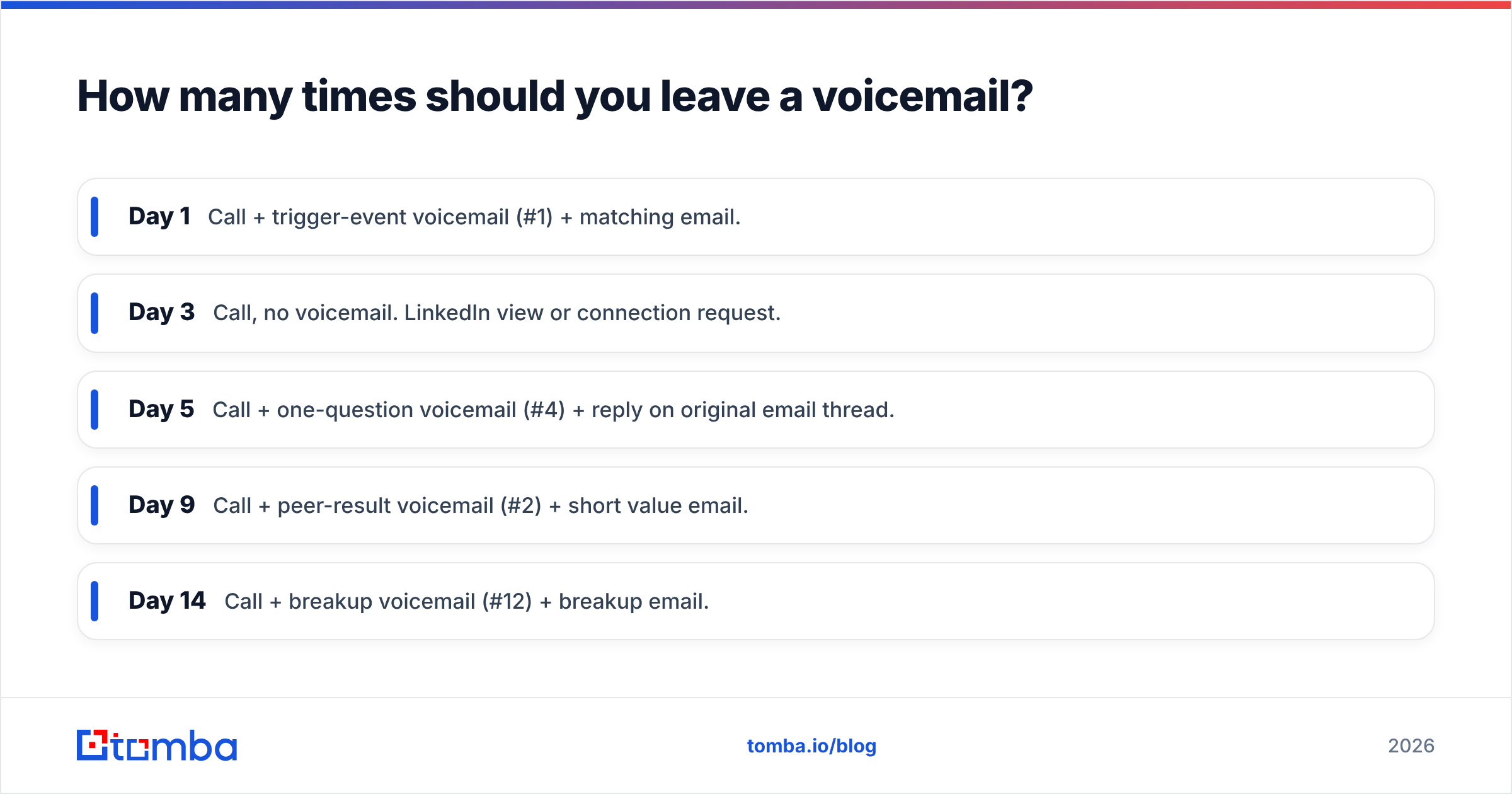
A workable 14-day cadence looks like this:
- Day 1 — Call + trigger-event voicemail (#1) + matching email.
- Day 3 — Call, no voicemail. LinkedIn view or connection request.
- Day 5 — Call + one-question voicemail (#4) + reply on original email thread.
- Day 9 — Call + peer-result voicemail (#2) + short value email.
- Day 14 — Call + breakup voicemail (#12) + breakup email.
Notice you don't leave a message every time. Two to three well-placed voicemails across the sequence outperform a message on every attempt — which just reads as pestering. If you want to tighten the copy that rides alongside each call, our cold email templates library maps cleanly onto this cadence.
What separates a callback from a delete?#
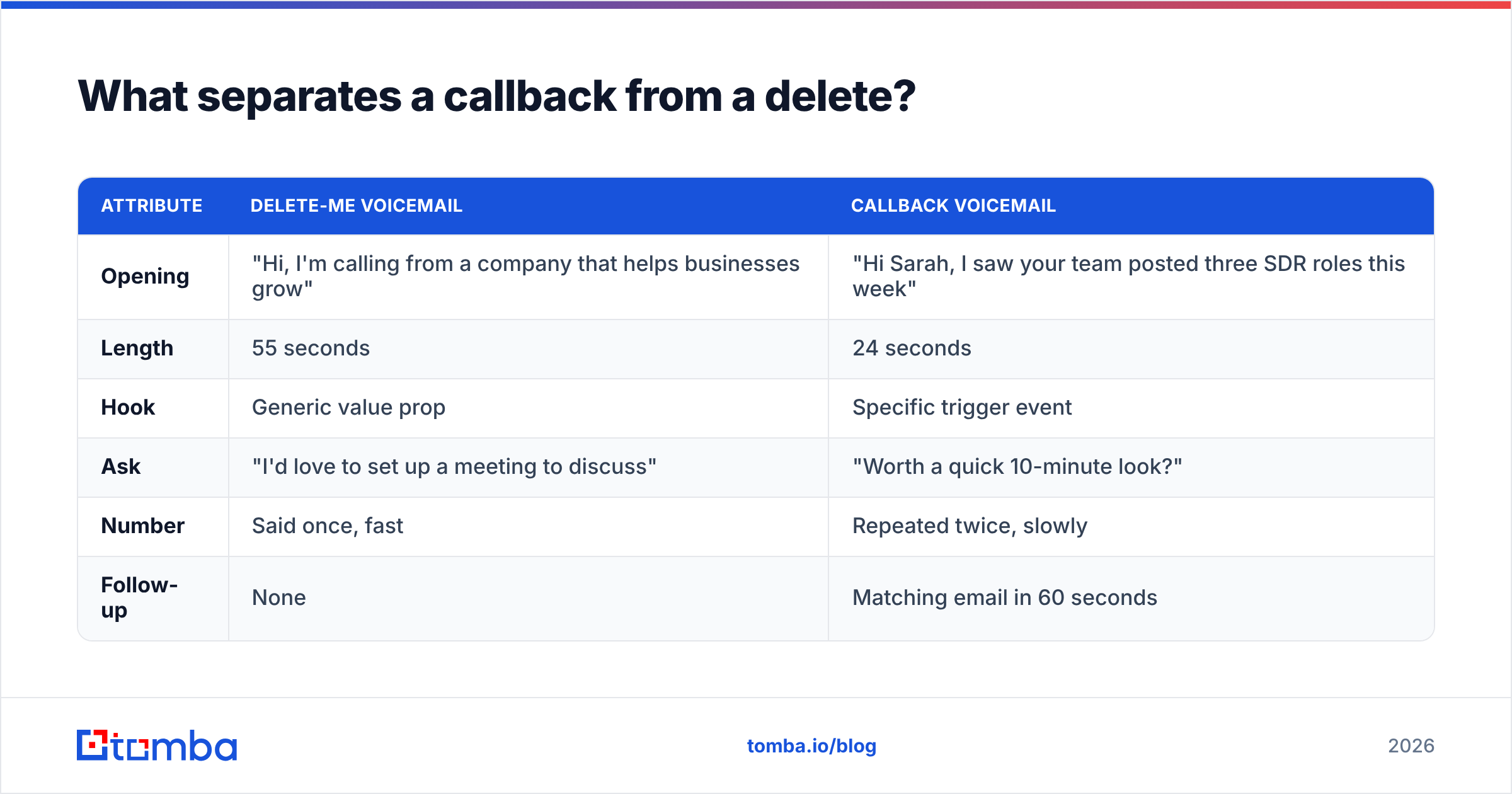
Specificity and effort — both yours and theirs. Compare these two openings for the same prospect:
| Attribute | Delete-me voicemail | Callback voicemail |
|---|---|---|
| Opening | "Hi, I'm calling from a company that helps businesses grow" | "Hi Sarah, I saw your team posted three SDR roles this week" |
| Length | 55 seconds | 24 seconds |
| Hook | Generic value prop | Specific trigger event |
| Ask | "I'd love to set up a meeting to discuss" | "Worth a quick 10-minute look?" |
| Number | Said once, fast | Repeated twice, slowly |
| Follow-up | None | Matching email in 60 seconds |
The right-hand column isn't harder to say — it's harder to prepare. The trigger event, the peer result, the correct spelling of the prospect's name, the working direct dial: all of that is research done before you dial. That's the real work of cold voicemail, and it's why generic messages lose.
It also explains why so many good scripts still fail. If the number is wrong, the best voicemail in the world never gets heard. If the paired email bounces, your double-tap collapses to a single touch. Reliable B2B phone numbers and verified emails are the foundation the script sits on — you can measure the payoff directly in your team's response rate.
How do you make the callback effortless?#
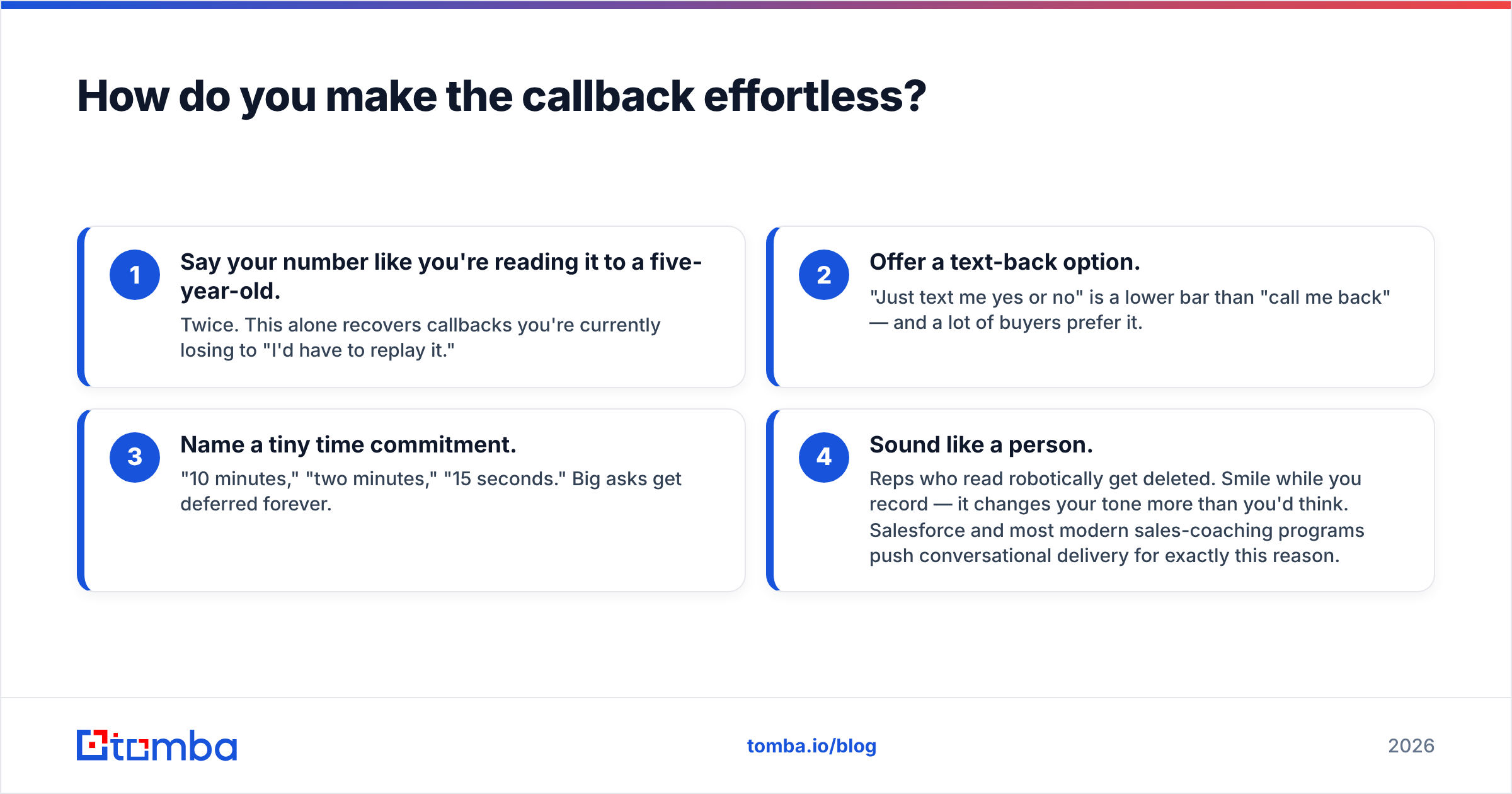
Remove every reason for the prospect to hesitate. Callbacks die on friction — a number said too fast, an unclear reason, an ask that sounds like a 45-minute demo.
Four fast upgrades:
- Say your number like you're reading it to a five-year-old. Twice. This alone recovers callbacks you're currently losing to "I'd have to replay it."
- Offer a text-back option. "Just text me yes or no" is a lower bar than "call me back" — and a lot of buyers prefer it.
- Name a tiny time commitment. "10 minutes," "two minutes," "15 seconds." Big asks get deferred forever.
- Sound like a person. Reps who read robotically get deleted. Smile while you record — it changes your tone more than you'd think. Salesforce and most modern sales-coaching programs push conversational delivery for exactly this reason.
You can pressure-test your own scripts against peer benchmarks on G2 before rolling them out to the team — reading real buyer reviews of the tools you mention keeps your claims honest and your hooks credible.
Put the scripts to work with data that connects#
Scripts are the easy part. The hard part — the part that actually moves callback rates — is landing the right message on the right number, backed by an email that lands in the inbox instead of the bounce folder.
That's where Tomba's Email Finder fits into your cold-calling motion: it surfaces verified professional emails by name, domain, or company so every voicemail you leave is backed by a matching, deliverable email touch. Pair it with the phone finder for direct dials, start free with 25 searches a month, and scale up through Tomba pricing tiers ($49/mo Starter, $99/mo Growth) as your sequences grow. Get the data right, run the 5-part structure, and the callbacks follow.
Related guides#
// get started
Find, verify and enrich your first contacts today
Start on the free plan with 25 searches a month, then scale when your team is ready.
Free plan · No credit card required · GDPR & CCPA
// about the author