Cold Calls vs Warm Calls: Which Converts Better in 2026?
Cold calls hit roughly 2% connect rates while warm calls can clear 30%. Here's exactly when each one wins, the metrics that matter, and how to warm up more of your list before you dial.
TL;DR
- Cold calls reach prospects with no prior relationship; warm calls reach people who already know your brand, engaged with content, or were referred. The difference shows up hard in the numbers.
- Cold call connect rates hover around 2–5%, with roughly 1–2% booking a meeting. Warm calls routinely triple or quadruple that, because the prospect already recognizes you.
- Cold calling still works for net-new markets, event follow-up, and territories with no inbound. It's a volume game with a thick skin requirement.
- Warm calling wins on efficiency and rep morale, but it depends on a steady supply of intent signals, referrals, and engaged leads to fuel it.
- The best teams don't pick one — they run a pipeline that converts cold contacts into warm ones before the dial, using accurate phone data, enrichment, and multi-touch sequencing.
Most "cold vs warm" debates are framed as a moral question — as if warm calling is enlightened and cold calling is a relic. That's the wrong frame. Both are tools. The real question is which one fits the lead in front of you, and how you move more leads from the cold column to the warm one. Let's break it down with numbers, not vibes.
What is the difference between a cold call and a warm call?#
A cold call targets someone with zero prior relationship to you or your company. A warm call targets someone who already has some connection — they downloaded a whitepaper, replied to an email, attended a webinar, were referred by a mutual contact, or visited your pricing page. That connection is the entire difference, and it changes everything about how the conversation opens.
On a cold call, your first job is to earn 30 seconds of attention from a stranger who didn't ask to hear from you. On a warm call, you're picking up a thread the prospect already started. The pitch, the objection handling, and the success rates all diverge from there.
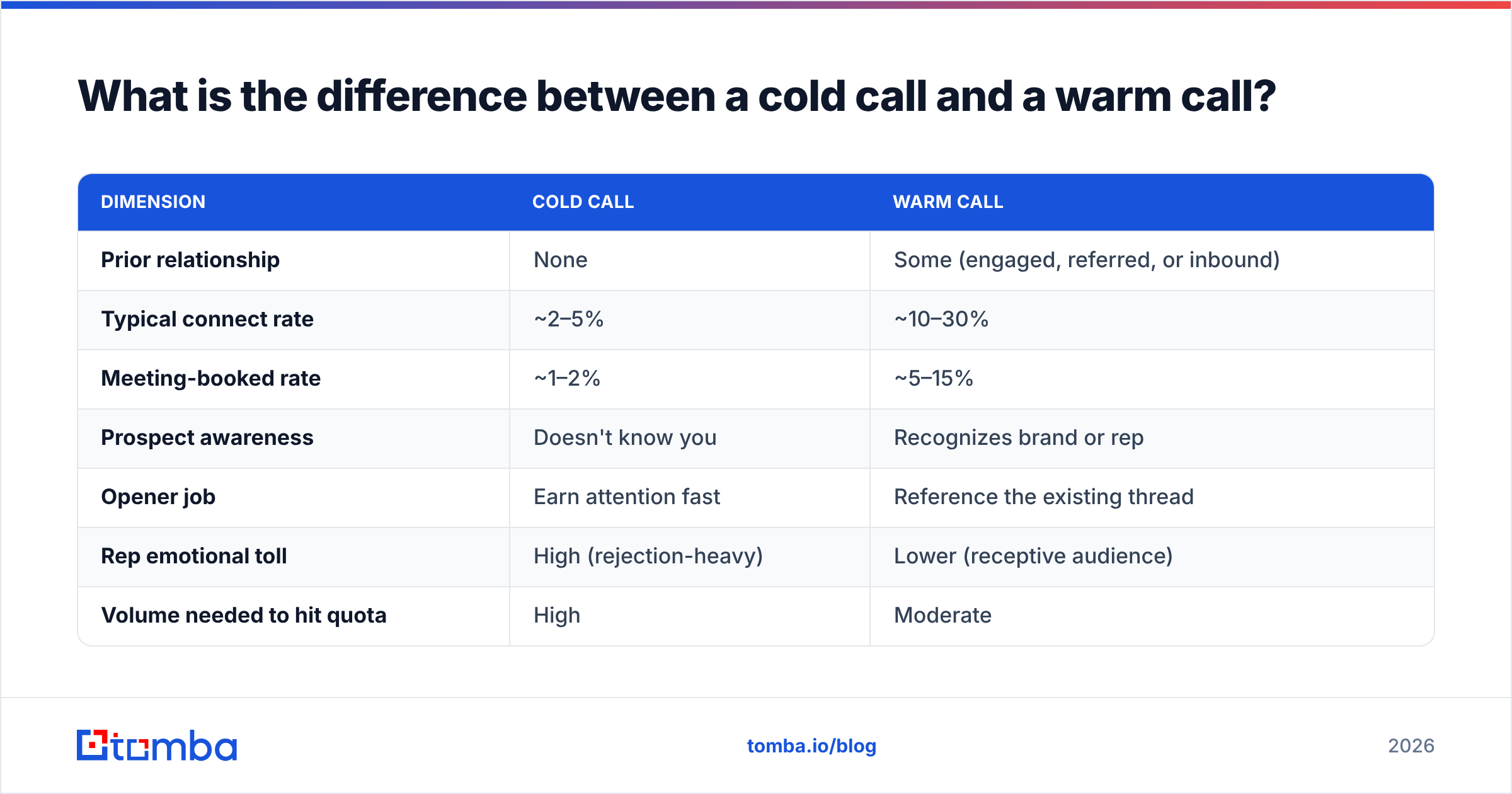
Here's the core distinction laid out:
| Dimension | Cold Call | Warm Call |
|---|---|---|
| Prior relationship | None | Some (engaged, referred, or inbound) |
| Typical connect rate | ~2–5% | ~10–30% |
| Meeting-booked rate | ~1–2% | ~5–15% |
| Prospect awareness | Doesn't know you | Recognizes brand or rep |
| Opener job | Earn attention fast | Reference the existing thread |
| Rep emotional toll | High (rejection-heavy) | Lower (receptive audience) |
| Volume needed to hit quota | High | Moderate |
| Best data requirement | Accurate direct-dial numbers | Intent signals + enriched context |
Numbers vary by industry, seniority, and offer — treat these as directional ranges, not guarantees. But the shape holds across almost every B2B motion: warm calls convert several times better per dial, and cold calls make up for lower rates with sheer volume and reach into markets you can't touch any other way.

Why do warm calls convert so much better?#
Warm calls convert better because you skip the two hardest parts of a cold call: proving you're worth listening to, and establishing relevance. When a prospect already engaged with your content or came through a referral, both of those are pre-solved. According to HubSpot's sales research, referrals and warm introductions consistently outperform cold outreach on both connect and close rates — buyers are simply more receptive when there's an existing thread of trust.
There are three mechanics behind the lift:
- Recognition lowers the guard. A prospect who recognizes your brand doesn't reflexively reach for "not interested." You've cleared the pattern-match that kills most cold openers.
- Context sharpens relevance. If you know they downloaded a guide on SOC 2 compliance, your opener can speak to that exact pain instead of guessing.
- Timing rides intent. Warm leads often call in near a buying trigger — a website visit, a demo request, a competitor's contract renewal. You're catching them in-market, not interrupting.
That said, "warm" is a spectrum. A referral from a trusted peer is scalding hot. A lead who opened one email six weeks ago is barely lukewarm. Grading your warm leads by recency and depth of engagement keeps you from treating a cold lead like a warm one and blowing the opener.
When is cold calling still the right move?#
Cold calling is the right move when you have no warm supply — new territories, brand-new products, or account lists where nobody has engaged yet. You can't warm-call your way into a market you've never touched. Cold calling is how you generate the first data point.
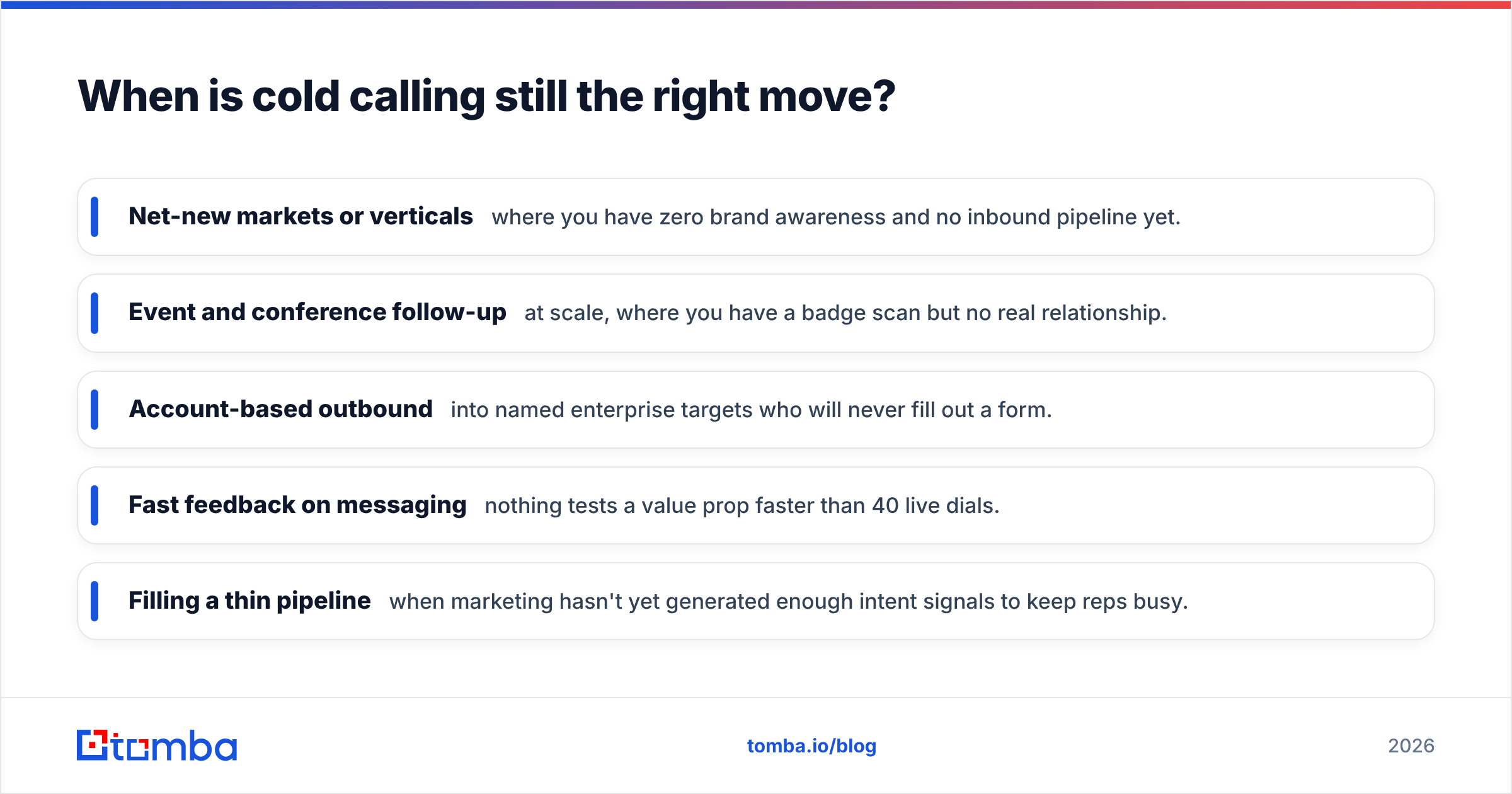
Cold calling earns its keep in these situations:
- Net-new markets or verticals where you have zero brand awareness and no inbound pipeline yet.
- Event and conference follow-up at scale, where you have a badge scan but no real relationship.
- Account-based outbound into named enterprise targets who will never fill out a form.
- Fast feedback on messaging — nothing tests a value prop faster than 40 live dials.
- Filling a thin pipeline when marketing hasn't yet generated enough intent signals to keep reps busy.
The catch is that cold calling is a volume-and-resilience game. Connect rates in the low single digits mean reps burn through a lot of dials and a lot of rejection to book a meeting. That's manageable when your data is clean and your list is well-targeted — and brutal when half your numbers are wrong. This is exactly where a reliable phone finder and a phone validator pay for themselves: every dead number you filter out is a rejection your rep never has to absorb. Gartner's B2B buying research also shows buyers now run most of their journey independently, which means your cold list quality matters more than ever — you're often calling people mid-research, and hitting the right person at the right number is the whole game.
Cold calls vs warm calls: which should your team prioritize?#
Prioritize warm calls for efficiency and cold calls for reach — then build a system that manufactures more warm calls over time. The framing that actually helps a sales leader isn't "which is better," it's "what's my ratio, and how do I improve it?"
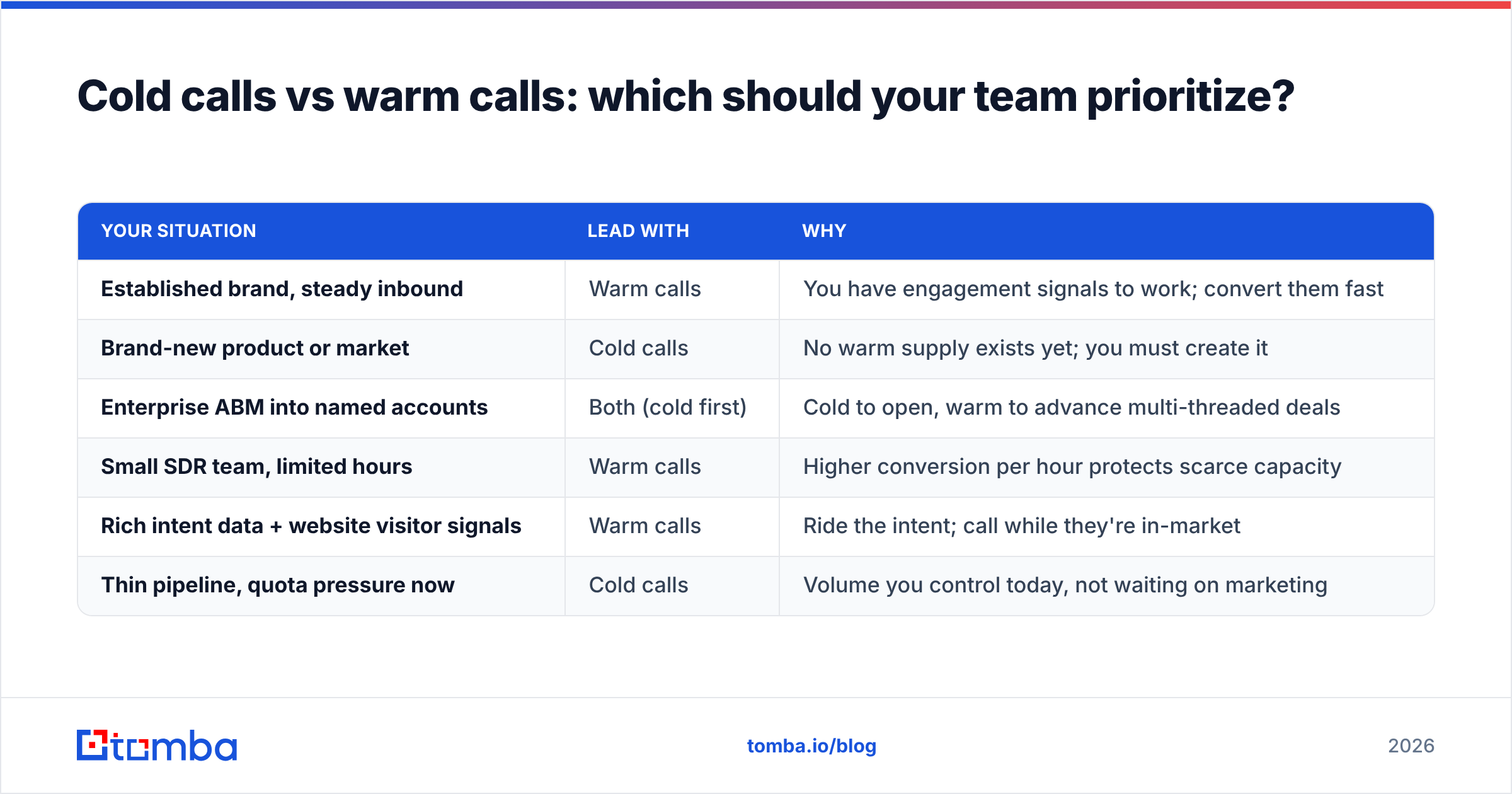
Here's a decision guide by scenario:
| Your situation | Lead with | Why |
|---|---|---|
| Established brand, steady inbound | Warm calls | You have engagement signals to work; convert them fast |
| Brand-new product or market | Cold calls | No warm supply exists yet; you must create it |
| Enterprise ABM into named accounts | Both (cold first) | Cold to open, warm to advance multi-threaded deals |
| Small SDR team, limited hours | Warm calls | Higher conversion per hour protects scarce capacity |
| Rich intent data + website visitor signals | Warm calls | Ride the intent; call while they're in-market |
| Thin pipeline, quota pressure now | Cold calls | Volume you control today, not waiting on marketing |
Notice that most rows aren't purely one or the other. A mature motion cold-calls into a fresh account list, gets a few conversations, nurtures the rest with email and LinkedIn, and then warm-calls the ones who engaged. The cold call is often just the first touch that eventually produces a warm one.
How do you turn cold calls into warm calls?#
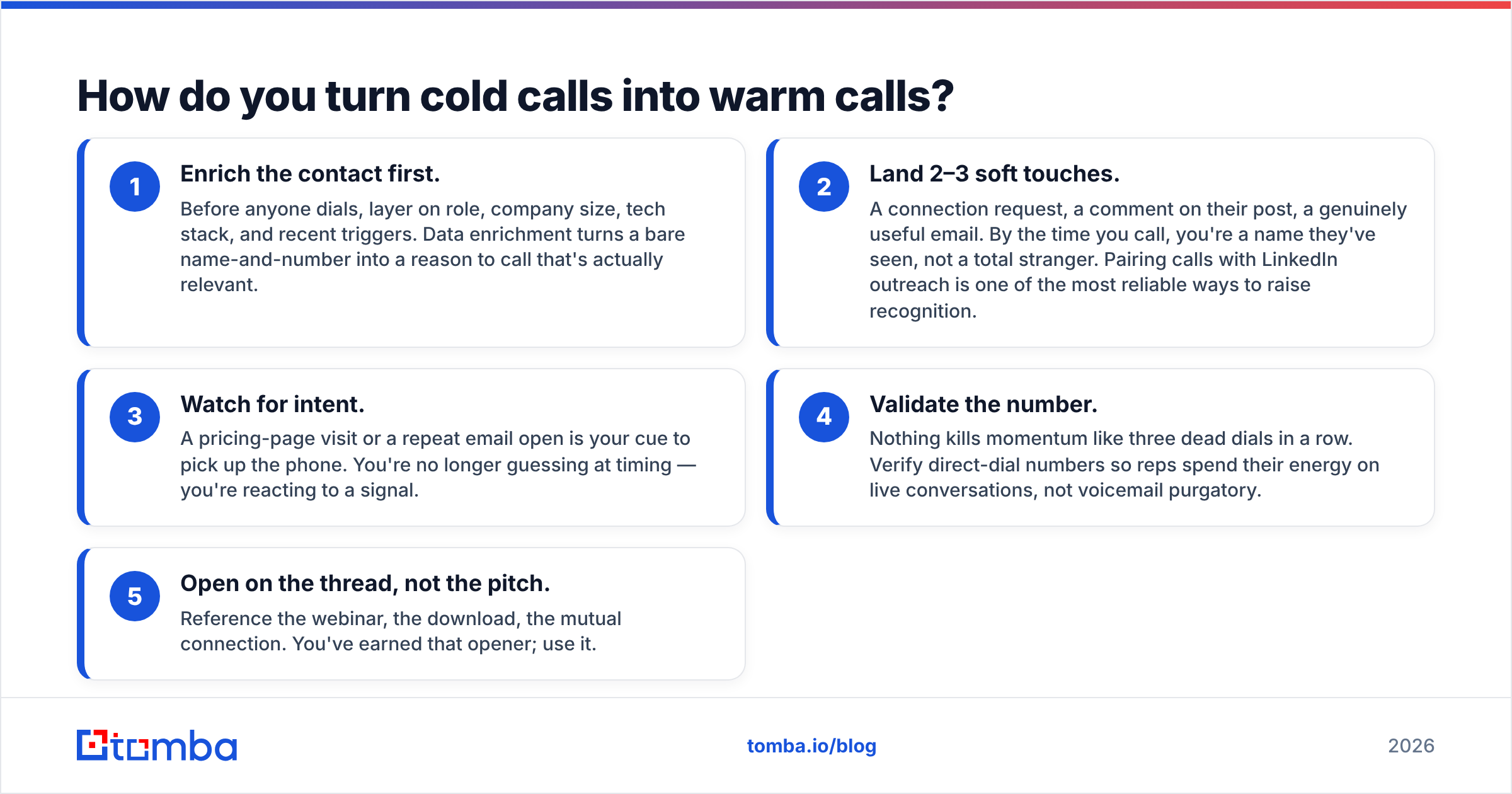
You warm up a cold list by adding context and touches before the dial — enrichment, multi-channel engagement, and intent tracking — so the prospect recognizes you when you finally call. This is the highest-leverage move in the whole debate, because it lets you keep cold calling's reach while capturing warm calling's conversion rates.
A practical warm-up sequence looks like this:
- Enrich the contact first. Before anyone dials, layer on role, company size, tech stack, and recent triggers. Data enrichment turns a bare name-and-number into a reason to call that's actually relevant.
- Land 2–3 soft touches. A connection request, a comment on their post, a genuinely useful email. By the time you call, you're a name they've seen, not a total stranger. Pairing calls with LinkedIn outreach is one of the most reliable ways to raise recognition.
- Watch for intent. A pricing-page visit or a repeat email open is your cue to pick up the phone. You're no longer guessing at timing — you're reacting to a signal.
- Validate the number. Nothing kills momentum like three dead dials in a row. Verify direct-dial numbers so reps spend their energy on live conversations, not voicemail purgatory.
- Open on the thread, not the pitch. Reference the webinar, the download, the mutual connection. You've earned that opener; use it.
Run this consistently and your "cold" calls start behaving like warm ones — connect rates climb, openers land, and rep morale recovers because they're talking to people who half-expect the call. The response rate lift compounds across the whole sequence, not just the phone.
What metrics should you track for cold vs warm calling?#
Track connect rate, conversation rate, meeting-booked rate, and cost per meeting separately for cold and warm dials — because blending them hides where your pipeline actually comes from. If you only look at aggregate numbers, a strong warm-call motion will mask a broken cold one, or vice versa.
The metrics that matter:
- Connect rate — dials that reach a live person. Your first signal of data quality. Low here usually means bad numbers, not bad reps.
- Conversation rate — connects that turn into a real discussion (not an instant hang-up). Your opener and targeting live here.
- Meeting-booked rate — conversations that convert to a next step. The number your quota actually cares about.
- Cost per meeting — fully loaded rep time plus data cost, divided by meetings. This is where warm calling's efficiency shows up starkly, and where cold calling justifies itself only at scale.
- Speed-to-lead on warm calls — how fast you dial an inbound or intent signal. Minutes matter; the curve drops sharply after the first hour.
Segment every one of these by cold vs warm and you'll see exactly where to invest. Most teams discover their warm calls are wildly under-resourced relative to how well they convert — and that the fix isn't "call more," it's "warm more leads before calling." Sites like G2 are full of sales engagement tools that automate the tracking, but the input that determines all of it is still the accuracy of your contact data going in.
Cold calls vs warm calls: the honest verdict#
Neither wins outright, and any post that tells you otherwise is selling something. Warm calls convert several times better per dial and are kinder to your reps — but they can't reach markets you haven't warmed. Cold calls reach anyone and generate first contact — but they demand volume, resilience, and clean data to work. The teams that win treat these as two ends of one pipeline, and spend their real effort on the machinery that moves cold contacts toward warm.
That machinery runs on data. A warm-up sequence is only as good as the contact record feeding it, and a cold call is only as good as the number you dial. If half your list is stale or wrong, no amount of clever opener writing saves you.
That's where Tomba's Email Finder fits into a phone-first motion: it's the front door to building accurate, enriched contact records you can then warm up across email, LinkedIn, and the phone. Find the verified professional email, layer on enrichment and a validated direct dial, run your multi-touch warm-up, and then pick up the phone. Start free with 25 searches a month, and check the full Tomba pricing — Starter is $49/mo — when you're ready to scale the list that feeds every cold and warm call your team makes. Warm the lead first. Dial second. Convert more of both.
Related guides#
// get started
Find, verify and enrich your first contacts today
Start on the free plan with 25 searches a month, then scale when your team is ready.
Free plan · No credit card required · GDPR & CCPA
Get the Tomba newsletter
Product and data updates
// about the author