Cold Email in 2026: The Complete Guide to Booking Meetings
Cold email still books meetings in 2026 — if you get deliverability, targeting, copy, and follow-ups right. Here's the honest, no-fluff playbook that keeps you out of spam and in the inbox.
Cold email is not dead in 2026 — but the lazy version of it finally is. Google and Microsoft tightened bulk-sender rules, buyers got faster at ignoring templates, and "spray and pray" now torches your domain reputation in days. What still works is the disciplined version: clean data, warm infrastructure, tight targeting, and copy that sounds like a human who did their homework.
This guide walks through the whole system — from why messages land in spam to how to write a first line someone actually reads — with a comparison of the sending stack you'll need.
TL;DR#
- Deliverability is the whole game. SPF, DKIM, DMARC, warmup, and low volume-per-inbox matter more than clever copy in 2026.
- Bad data kills good campaigns. Sending to invalid or catch-all addresses spikes bounces and destroys sender reputation — verify before you send.
- Relevance beats volume. A tightly targeted list of 200 with a specific reason to reach out beats a blast of 5,000 every time.
- Follow-ups drive most replies. The majority of positive responses come from message two through four, not the first email.
- One clear CTA per email. Ask for a small, specific next step — not "a quick 30-minute call to explore synergies."
What is cold email, really?#
Cold email is a one-to-one business message sent to someone who has not opted in, with a specific, relevant reason for reaching out. That definition matters because it draws the line between legitimate outbound and spam.
Think of it like knocking on a specific office door because you know what that team is working on — versus wallpapering an entire building with flyers. The first is prospecting. The second gets your domain blocked. In 2026, mailbox providers are very good at telling the two apart, and they punish the flyer approach automatically.
Cold email is legal in most markets when done correctly. Under CAN-SPAM in the US you need accurate headers, a real physical address, and a working unsubscribe path. Under GDPR in the EU you need a lawful basis (legitimate interest, documented) and easy opt-out. Compliance isn't optional garnish — providers read the same signals regulators do.
Why do cold emails land in spam?#
Because the inbox is scored on trust, and most senders never earn any. Filters weigh three buckets: infrastructure (is your domain authenticated?), reputation (do people engage or complain?), and content (does this look like a template blast?).
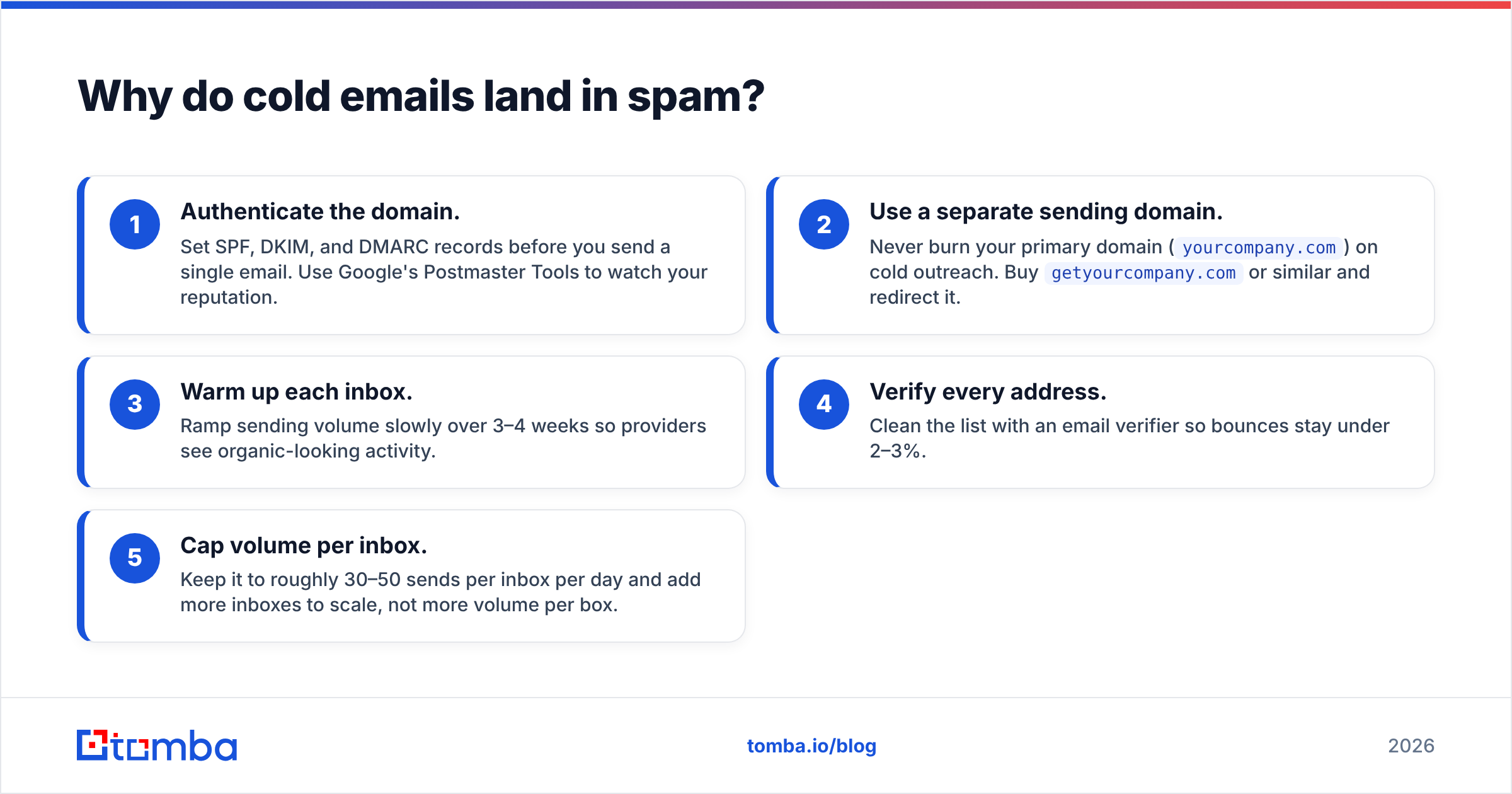
Here's the order operations should happen in — most people skip straight to step 5 and wonder why nothing works:
- Authenticate the domain. Set SPF, DKIM, and DMARC records before you send a single email. Use Google's Postmaster Tools to watch your reputation.
- Use a separate sending domain. Never burn your primary domain (
yourcompany.com) on cold outreach. Buygetyourcompany.comor similar and redirect it. - Warm up each inbox. Ramp sending volume slowly over 3–4 weeks so providers see organic-looking activity.
- Verify every address. Clean the list with an email verifier so bounces stay under 2–3%.
- Cap volume per inbox. Keep it to roughly 30–50 sends per inbox per day and add more inboxes to scale, not more volume per box.
Skip authentication and you're invisible. Skip verification and a 15% bounce rate tells Gmail you're a spammer within a day. This is why email deliverability — not copywriting — is where you should spend your first week.
What does a cold email sending stack cost in 2026?#
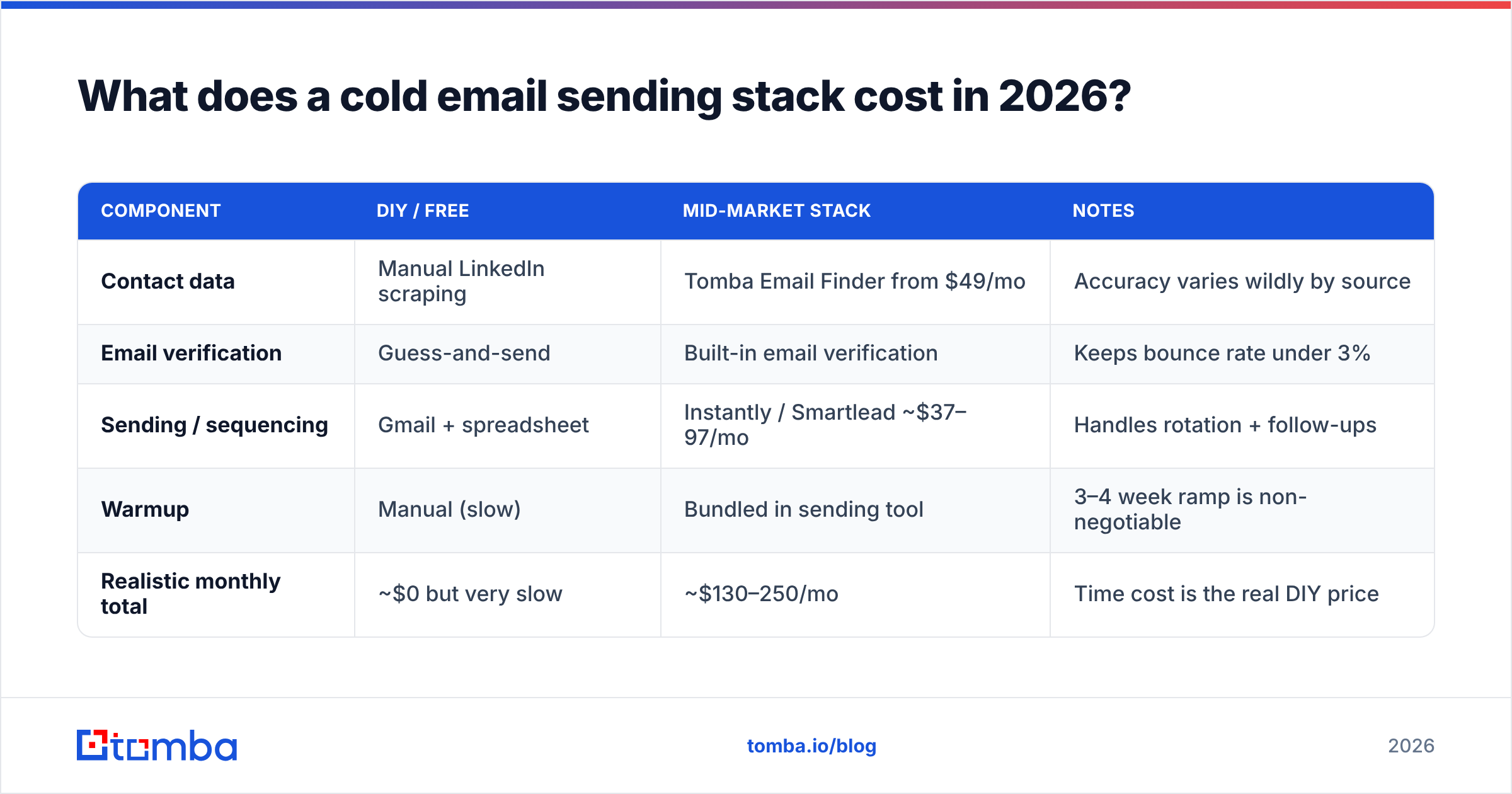
You need four moving parts: a source of accurate contact data, verification, a sending/sequencing tool, and warmup. Here's how the common approaches compare on what actually matters.
| Component | DIY / Free | Mid-Market Stack | Notes |
|---|---|---|---|
| Contact data | Manual LinkedIn scraping | Tomba Email Finder from $49/mo | Accuracy varies wildly by source |
| Email verification | Guess-and-send | Built-in email verification | Keeps bounce rate under 3% |
| Sending / sequencing | Gmail + spreadsheet | Instantly / Smartlead ~$37–97/mo | Handles rotation + follow-ups |
| Warmup | Manual (slow) | Bundled in sending tool | 3–4 week ramp is non-negotiable |
| Realistic monthly total | ~$0 but very slow | ~$130–250/mo | Time cost is the real DIY price |
The free path works if you're sending 20 emails a week by hand. The moment you want repeatable pipeline, the mid-market stack pays for itself in saved hours and protected domain reputation. Tomba's pricing starts at a Free tier (25 searches/mo) so you can validate the workflow before committing.
How do you build a targeting list that converts?#
Start narrow. The single biggest lever in cold email is not the copy — it's who receives it. A relevant message to the wrong-fit person still fails.
Define your ICP in one sentence: "Heads of RevOps at Series A–C B2B SaaS companies using HubSpot, 50–500 employees, US-based." Every filter in that sentence removes people who will never buy, which raises your reply rate and protects your reputation from indifferent recipients who mark you as spam.
Once the ICP is set, sourcing has three steps:
- Find the companies that match firmographics (industry, size, tech stack, funding).
- Find the right person at each — title and seniority, not just any inbox.
- Get a verified email using a domain search or name-based lookup, then confirm it's deliverable.
Resist the urge to buy a giant list. Purchased lists are stale, shared across dozens of senders, and packed with spam traps. Building 200 verified, ICP-matched contacts beats renting 20,000 unknowns — and it keeps you off blocklists. If you already have a B2B database or CRM export, run it through verification first; contacts decay at roughly 2–3% per month as people change jobs.
What makes cold email copy actually get replies?#
Relevance you can prove in the first line, a single clear ask, and brevity. If your email is longer than a phone screen, it won't get read.
A reliable structure:
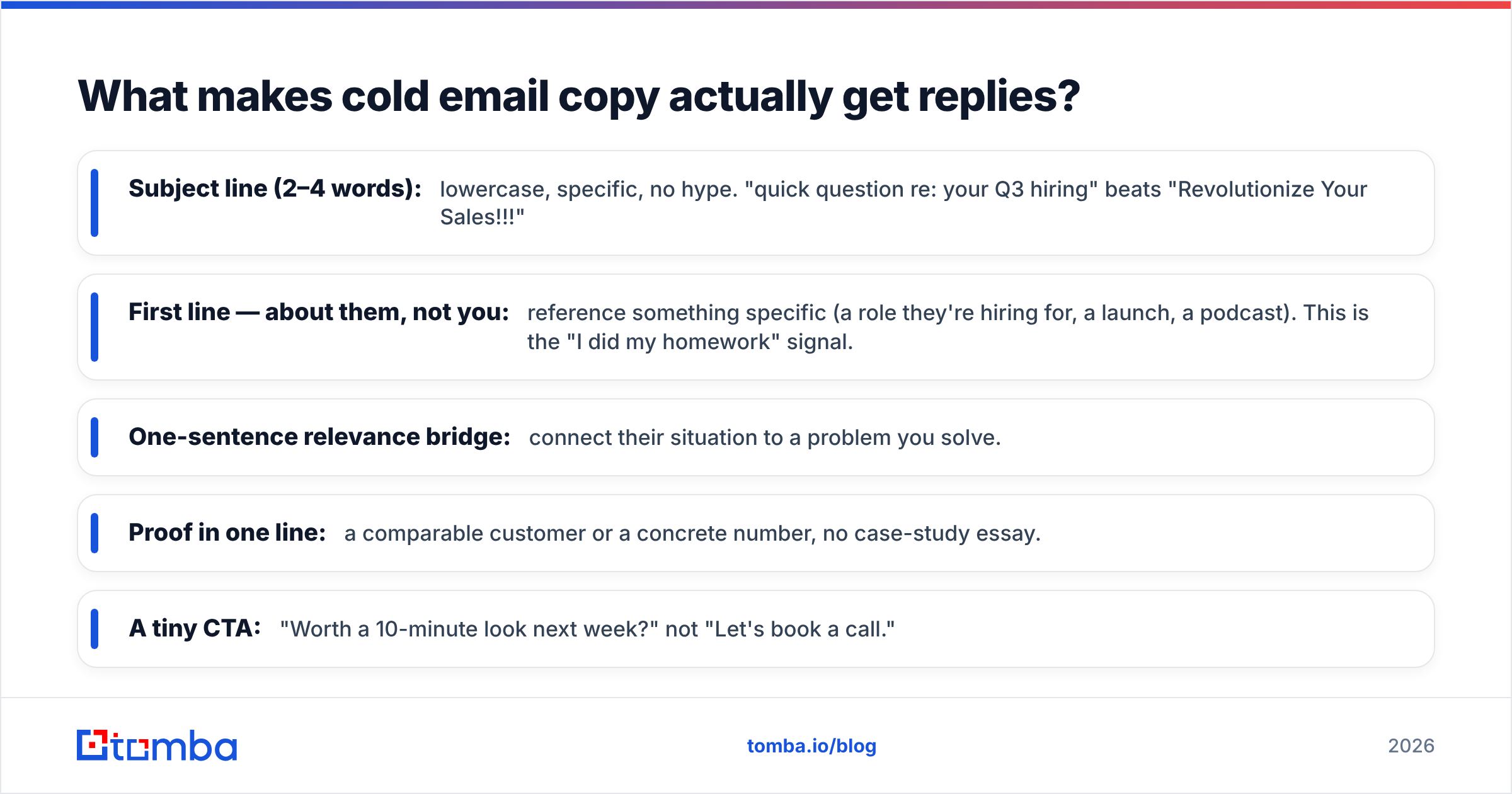
- Subject line (2–4 words): lowercase, specific, no hype. "quick question re: your Q3 hiring" beats "Revolutionize Your Sales!!!"
- First line — about them, not you: reference something specific (a role they're hiring for, a launch, a podcast). This is the "I did my homework" signal.
- One-sentence relevance bridge: connect their situation to a problem you solve.
- Proof in one line: a comparable customer or a concrete number, no case-study essay.
- A tiny CTA: "Worth a 10-minute look next week?" not "Let's book a call."
Match sentence length to how a busy person skims — short. Passive, jargon-stuffed paragraphs read as automated, and both humans and filters penalize them. If you want a starting point, grab proven cold email templates and rewrite the specifics in your own voice; don't send them verbatim, because so has everyone else.
Personalization at scale is the trick most people fudge. You don't need a hand-written novel per prospect — you need one genuinely researched variable (the first line) and a solid, relevant body. That's the 80/20.
How many follow-ups should a cold email sequence have?#
Three to five messages over two to three weeks. Most positive replies arrive after the first email, so stopping at one send throws away the majority of your pipeline.
A sequence that respects the recipient looks like this:
- Email 1 (day 0): the researched, personalized opener.
- Email 2 (day 3): a short bump with a new angle or a relevant resource — never "just following up."
- Email 3 (day 7): social proof or a specific result a similar company got.
- Email 4 (day 12): a soft breakup — "should I close the loop?" This often outperforms every prior email.
Each follow-up must add something. Reply in the same thread, keep it shorter than the last, and always leave a clean exit. Someone who opts out politely is protecting your sender reputation — treat unsubscribes as a feature, not a loss.
How do you measure a cold email campaign?#
Track the metrics that predict pipeline, not vanity opens. Apple Mail Privacy Protection made open rates unreliable years ago; in 2026, treat opens as a rough directional signal at best.
The numbers that matter:
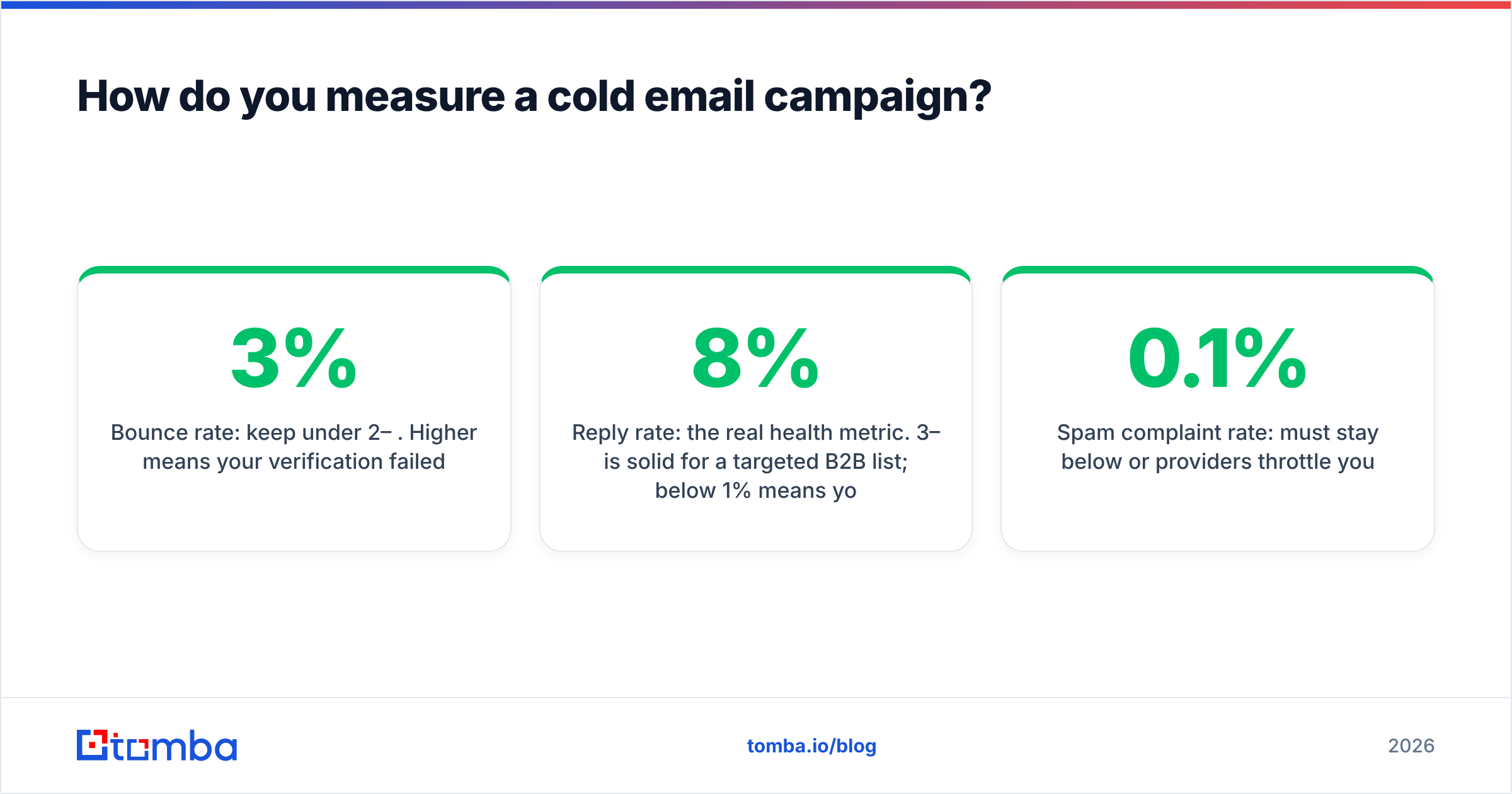
- Bounce rate: keep under 2–3%. Higher means your verification failed.
- Reply rate: the real health metric. 3–8% is solid for a targeted B2B list; below 1% means your targeting or copy is off.
- Positive reply rate: replies that want to talk, not "unsubscribe."
- Meetings booked: the only number your revenue team cares about.
- Spam complaint rate: must stay below 0.1% or providers throttle you.
If reply rate is low but bounces are fine, fix targeting and the first line. If bounces are high, your data pipeline is the problem — go back and verify. Diagnosing in that order saves weeks. For teams running outbound at scale, pairing this with a broader sales automation workflow keeps the measurement consistent across reps.
Cold email in 2026: what changed and what didn't#
What changed: bulk-sender enforcement is stricter, one-click unsubscribe is effectively mandatory, and AI-generated filler is easy for both filters and humans to spot. What didn't change: a specific, relevant, human message to a well-chosen person still books meetings — arguably more now, because so many senders got lazy and the bar to stand out dropped.
The winning move in 2026 is boring discipline. Verify your data. Authenticate and warm your domains. Send less, but to better-fit people. Write like a person. Follow up with substance. Measure replies, not opens. Do those six things and cold email remains one of the highest-ROI channels in B2B — no gimmicks required.
Start with clean, verified data#
Every point above collapses without accurate contact data, because a beautiful campaign sent to invalid addresses still tanks your reputation on day one. That's the foundation, and it's where to start.
Use the Tomba Email Finder to source verified, ICP-matched business emails by domain, name, or company — then confirm deliverability before your first send. Start on the free tier, prove the workflow on a small list, and scale only once your bounce rate holds under 3%. Get the data right, and everything downstream — copy, sequencing, follow-ups — finally has a chance to work.
Related guides#
// get started
Find, verify and enrich your first contacts today
Start on the free plan with 25 searches a month, then scale when your team is ready.
Free plan · No credit card required · GDPR & CCPA
// about the author