Cold Email Closing Lines That Get Replies: 2026 Playbook
Your closing line decides whether a prospect replies or archives your email. Here are the cold email closing lines that book meetings in 2026 — with templates, a comparison table, and the mistakes killing your reply rate.
Your closing line is the last thing a prospect reads before they either reply or hit archive. You can nail the subject line, personalize the opener, and prove value in the body — then torch the whole thing with a vague "Let me know your thoughts!" that asks for nothing and gets nothing back.
This guide breaks down the cold email closing lines that actually move deals in 2026: what to write, why it works, and the specific phrasing to steal. No fluff, just closers you can paste into your next sequence today.
TL;DR: What makes a cold email closing line work?#
- One ask, not three. The best closing lines request a single, low-friction next step — a reply, a yes/no, or a specific time.
- Interest-based CTAs beat meeting-based CTAs for first-touch emails. "Worth a look?" outperforms "Can we book 30 minutes Tuesday?"
- Specificity converts. "Open to a 12-min call Thursday at 10am ET?" gets more replies than "Let me know if you're interested."
- Your sign-off is part of the close. A clean signature with a real name, title, and one link beats a wall of social icons.
- Reply rate starts with reaching the inbox — a great closer on a bounced email books zero meetings, so verify before you send.
Why does the closing line matter more than the rest of the email?#
Think of a cold email like a sales call that ends with a handshake. You can have a brilliant conversation, but if you mumble at the door and never actually ask for the next meeting, the prospect walks away and forgets you. The closing line is the handshake — it's where you convert attention into action.
Most reps spend 90% of their editing time on the opener and subject line, then slap a generic CTA on the end. That's backwards. The body creates interest; the closing line captures it. A weak close leaks every bit of momentum you built.
There's also a psychological reason. The final sentence carries disproportionate weight in what's called the recency effect — people remember the last thing they read. If your last line is confident and easy to act on, that's the impression that lingers in the prospect's mind when they decide whether to reply.
What are the different types of cold email closing lines?#
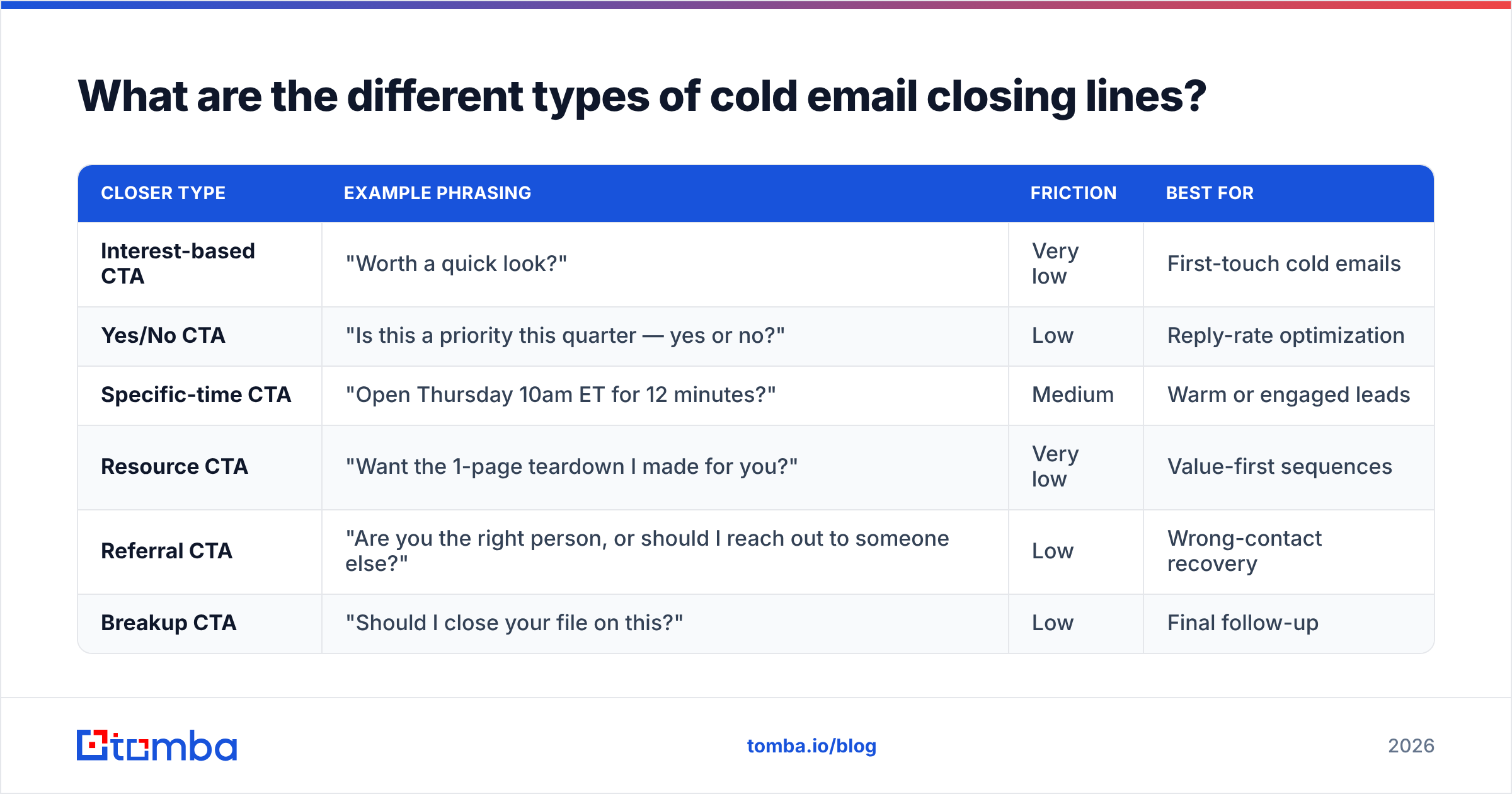
Not every close does the same job. Match the type to where the prospect sits in your sequence and how much friction they'll tolerate.
Here's how the main categories stack up:
| Closer type | Example phrasing | Friction | Best for |
|---|---|---|---|
| Interest-based CTA | "Worth a quick look?" | Very low | First-touch cold emails |
| Yes/No CTA | "Is this a priority this quarter — yes or no?" | Low | Reply-rate optimization |
| Specific-time CTA | "Open Thursday 10am ET for 12 minutes?" | Medium | Warm or engaged leads |
| Resource CTA | "Want the 1-page teardown I made for you?" | Very low | Value-first sequences |
| Referral CTA | "Are you the right person, or should I reach out to someone else?" | Low | Wrong-contact recovery |
| Breakup CTA | "Should I close your file on this?" | Low | Final follow-up |
The pattern to notice: the lower the friction, the earlier in the sequence it belongs. You earn the right to ask for 30 minutes only after you've earned a reply.
What are the best interest-based closing lines for first-touch emails?#
For a first cold email, your only real goal is to start a conversation — not to close a deal. Interest-based closers ask for a signal, not a calendar commitment. They convert because saying "yes, tell me more" costs the prospect almost nothing.
Steal these:
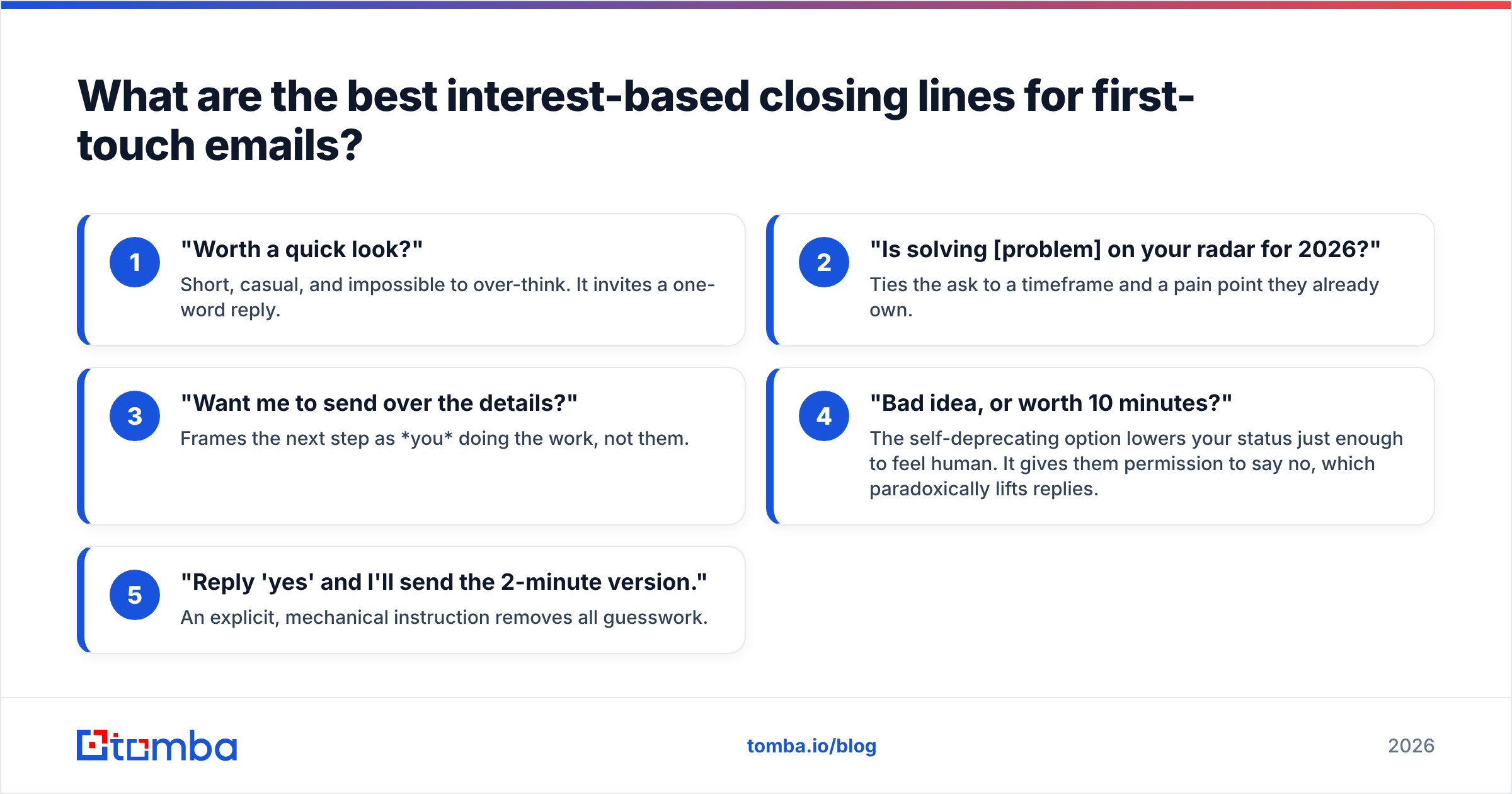
- "Worth a quick look?" — Short, casual, and impossible to over-think. It invites a one-word reply.
- "Is solving [problem] on your radar for 2026?" — Ties the ask to a timeframe and a pain point they already own.
- "Want me to send over the details?" — Frames the next step as you doing the work, not them.
- "Bad idea, or worth 10 minutes?" — The self-deprecating option lowers your status just enough to feel human. It gives them permission to say no, which paradoxically lifts replies.
- "Reply 'yes' and I'll send the 2-minute version." — An explicit, mechanical instruction removes all guesswork.
Notice none of them mention a demo, a meeting, or a signature deck. First-touch closers sell the conversation, and the conversation sells everything else.
How do you write a strong call-to-action closing line?#
A strong CTA closing line does three things: it's singular, specific, and low-effort. Break any one of those and your reply rate drops.
Singular means one ask. When you write "Let me know if you'd like a demo, or I can send a case study, or we could hop on a call," you've handed the prospect a decision tree. Decisions create friction, and friction creates silence. Give them one door to walk through.
Specific means concrete. "Sometime next week?" forces the prospect to do the scheduling labor. "Does Thursday at 10am ET work, or is Friday better?" hands them a near-finished decision — they just pick A or B.
Low-effort means the yes should be cheap. Early in a sequence, "reply with a thumbs up" beats "book time on my calendar," because clicking into a scheduling link is a bigger commitment than typing one line.
For a deeper look at how the whole message flows into that final ask, our guide on cold email templates shows full-message structure you can adapt. And if you want the AI to draft variations for you, the cold email AI writer generates closers you can A/B test.
Which cold email closing lines should you avoid?#
Some closers are so common that prospects' eyes glide right past them. Others actively signal "mass blast." Cut these:
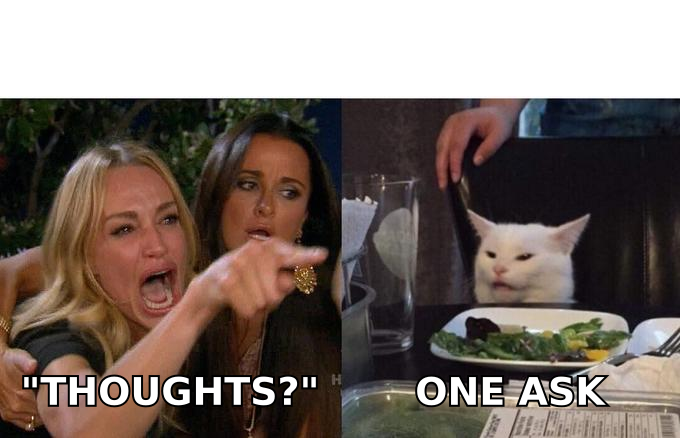
- "Let me know your thoughts!" — Asks for nothing concrete. Thoughts on what? By when? It's the closing-line equivalent of trailing off mid-sentence.
- "Looking forward to hearing from you." — Passive, expectant, and it puts the burden entirely on them with no next step.
- "I'll follow up if I don't hear back." — A threat disguised as politeness. It adds zero value and telegraphs that you're running a sequence.
- "Please don't hesitate to reach out." — Corporate filler. Nobody was hesitating; you just wasted a line.
- "Circling back / just bumping this to the top of your inbox." — Transparent filler that admits you have nothing new to say.
The common thread: each one shifts all the work onto the prospect while offering no reason to act now. Replace vagueness with a single, dated, low-friction ask every time.
What are good follow-up and breakup closing lines?#
Follow-ups fail when they just repeat the first email louder. A good follow-up close adds a new angle or lowers the ask.
Follow-up closers that work:
- "Did this get buried, or is it just not a fit right now?" — Gives them an easy out while re-surfacing the offer. The "not a fit" option feels honest, so people actually answer it.
- "Should I keep this on your radar for Q3, or park it?" — Respects their timeline instead of nagging.
- "One quick question: are you the right person for [initiative]?" — Pivots to a routing ask, which is easy to answer even when they can't buy.
Breakup closers are your last email in a sequence, and counterintuitively they often get the highest reply rate because they trigger loss aversion:
- "I'll assume the timing's off and close your file — fair?"
- "Last note from me: worth revisiting, or should I stop reaching out?"
- "Closing the loop on this. If [problem] becomes urgent, you know where to find me."
The breakup works because it removes pressure. You're not asking for a meeting anymore — you're asking for permission to leave. That reversal often prompts the "wait, actually…" reply you've been chasing. HubSpot's research on sales follow-up cadence backs this up: persistence paired with a clean exit outperforms endless bumping.
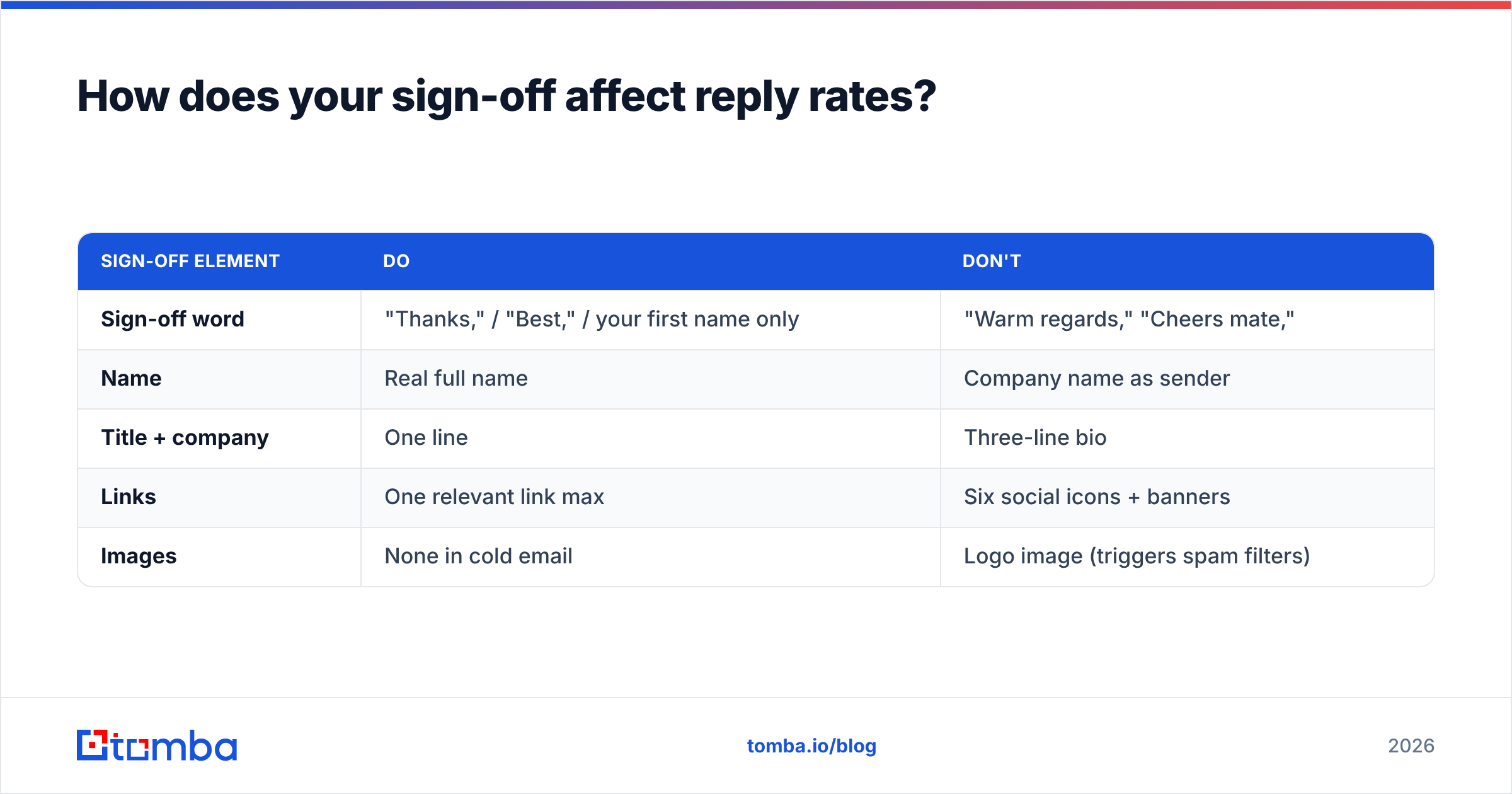
How does your sign-off affect reply rates?#
The sign-off is the closing line's silent partner. A messy signature undercuts even a great CTA. Keep it human and scannable.
| Sign-off element | Do | Don't |
|---|---|---|
| Sign-off word | "Thanks," / "Best," / your first name only | "Warm regards," "Cheers mate," |
| Name | Real full name | Company name as sender |
| Title + company | One line | Three-line bio |
| Links | One relevant link max | Six social icons + banners |
| Images | None in cold email | Logo image (triggers spam filters) |
Image-heavy HTML signatures are a well-known deliverability risk — they raise your spam score and can land you in Promotions. Plain text keeps you in the primary inbox. If you want to build a clean one, the email signature generator produces text-first signatures that render everywhere.
Speaking of deliverability: the single fastest way to protect reply rates isn't a better closer, it's a valid recipient. Even the sharpest closing line earns nothing if the email bounces or hits a spam trap. Run your list through an email verifier before you send so your closers actually reach a human. You can read more about why this matters in the field of email deliverability.
How do you test which closing lines work best?#
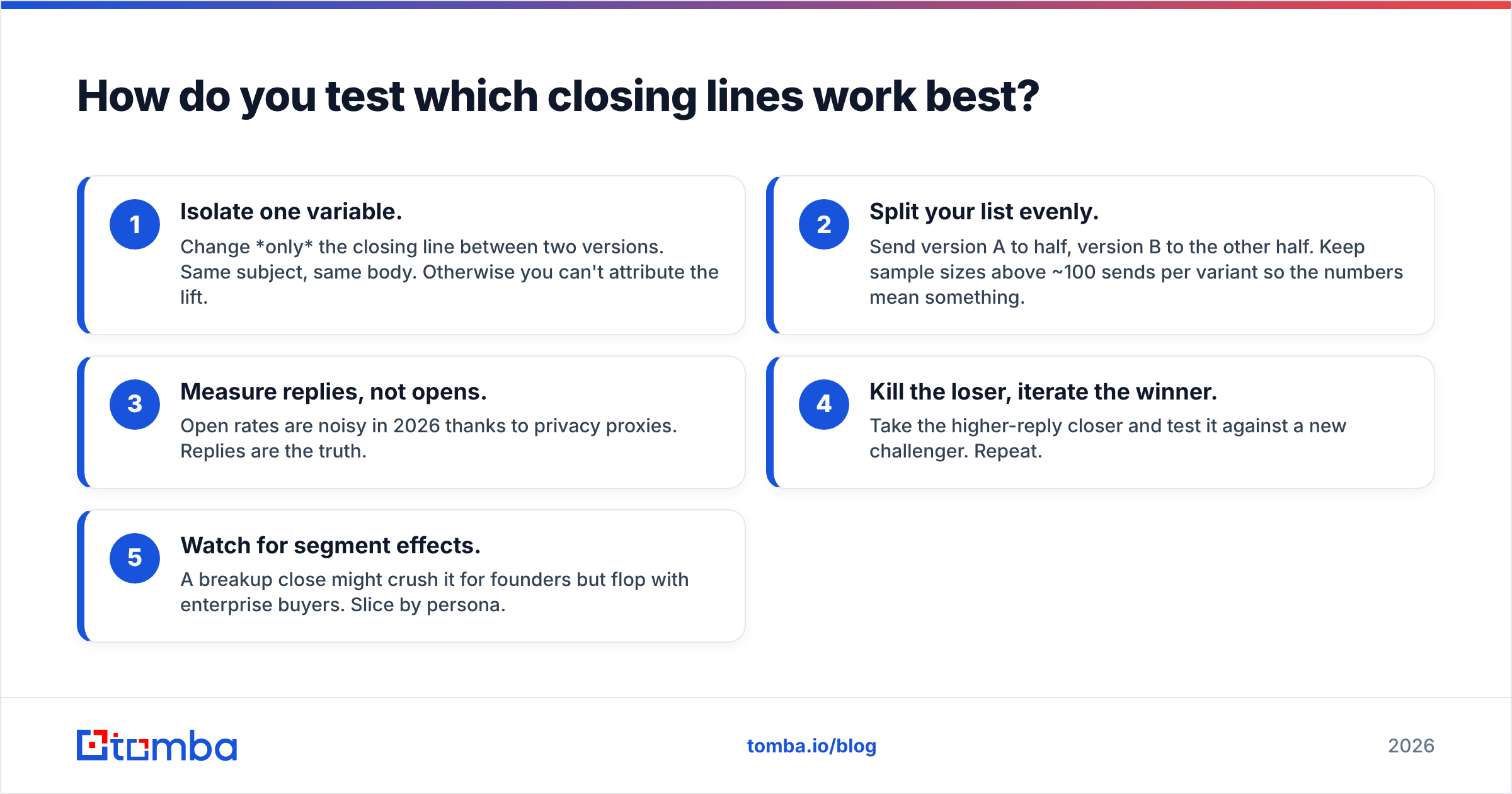
Don't guess — measure. Reply rate is the only metric that tells you whether a closer earns its place. Here's a simple testing loop:
- Isolate one variable. Change only the closing line between two versions. Same subject, same body. Otherwise you can't attribute the lift.
- Split your list evenly. Send version A to half, version B to the other half. Keep sample sizes above ~100 sends per variant so the numbers mean something.
- Measure replies, not opens. Open rates are noisy in 2026 thanks to privacy proxies. Replies are the truth.
- Kill the loser, iterate the winner. Take the higher-reply closer and test it against a new challenger. Repeat.
- Watch for segment effects. A breakup close might crush it for founders but flop with enterprise buyers. Slice by persona.
Industry benchmarks from Salesforce's State of Sales consistently show that reps who systematically test messaging outperform those who "set and forget." Your closing line is the highest-leverage sentence to test first, because it's short, isolated, and directly tied to the action you want.
One practical note: testing only works at volume, and volume only works with clean data. If a chunk of your sends bounce, your reply-rate math is garbage. Building your list with a reliable email finder keeps your denominator honest so your test results are trustworthy.
Quick-reference: 5 closers by scenario#
- Cold first-touch: "Worth a quick look?"
- Value-first: "Want the 1-page teardown I made for your team?"
- Engaged lead: "Open Thursday 10am ET for 12 minutes — or does Friday suit you better?"
- Wrong contact: "Are you the right person for this, or should I reach out to someone else?"
- Breakup: "Should I close your file on this — fair to assume the timing's off?"
Print those, tape them to your monitor, and stop writing "Let me know your thoughts!" forever.
Start booking more replies#
Great cold email closing lines are only half the equation — the other half is making sure they land in a real inbox. The strongest CTA in the world converts nobody if the address bounces.
Build your outreach on verified, accurate contact data with the Tomba Email Finder. Find professional emails by name, domain, or company, then verify them before you send so every one of your carefully crafted closers reaches a human who can reply. Start on the free tier (25 searches a month), and when you're ready to scale, Tomba pricing starts at $49/mo. Write a better close, reach the right inbox, and watch your reply rate climb.
Related guides#
// get started
Find, verify and enrich your first contacts today
Start on the free plan with 25 searches a month, then scale when your team is ready.
Free plan · No credit card required · GDPR & CCPA
// about the author