Cold Email Copywriter: The 2026 Guide to Hire or Become One
What a cold email copywriter really does, what fair rates look like in 2026, and whether hiring one beats writing your own outbound. A no-fluff guide with a rate table, a hiring checklist, and copy examples.
A cold email copywriter is the person who turns a cold list into booked meetings — or the person you become when your outbound stops working. Before you post a job or quote a client, here is what the role actually involves, what it costs in 2026, and how to tell a good one from someone who just writes clever subject lines.
TL;DR#
- A cold email copywriter writes and structures outbound sequences designed to get replies from strangers — not opens, not "engagement," replies and meetings.
- Rates in 2026 range from ~$40/hour freelance to $3,000+ per multi-step sequence, with retainers of $2,000–$8,000/mo for ongoing outbound.
- Great copy on a bad list still fails. Deliverability and accurate contact data do more for reply rates than any headline swap.
- Hire one when outbound is a real revenue channel and you lack time or skill; write your own when you're still finding product-market fit and need to hear objections firsthand.
- The best setup pairs a skilled writer with clean data — an email verifier and accurate targeting beat "genius" copy every time.
What does a cold email copywriter actually do?#
Think of a cold email copywriter as an architect, not a decorator. The decorator picks nice words. The architect designs the whole structure so the reader moves from "who is this?" to "tell me more" without friction.
In practice, the job covers five things:
- Audience and offer research — reading your ICP, past deals, and objections so the message lands on a real pain, not a guessed one.
- Sequence design — the full arc of 3–6 touches, including timing, angle rotation, and the break-up email, not a single message.
- Copy — subject lines, opening lines, the value proposition, the ask, and the P.S. — each doing one job.
- Deliverability-aware writing — avoiding spam triggers, heavy HTML, link-stuffing, and the tone that gets flagged. Copy and email deliverability are inseparable.
- Testing and iteration — A/B tests on subject and first line, reading reply sentiment, and rewriting the losers.
If a writer only hands you words and never asks about your list, your sending domain, or your ICP, you've hired a decorator.

Why does copy matter less than most people think?#
Here's the uncomfortable truth: the reply rate on a cold campaign is decided before the first word is written. Targeting and data quality set the ceiling; copy just determines how close you get to it.
Picture two identical emails. One goes to 500 verified decision-makers who genuinely fit the offer. The other goes to 500 scraped addresses, 30% of which bounce and half of which are the wrong role. Same copy. The first campaign books meetings; the second lands in spam and torches your sender reputation.
That's why experienced copywriters obsess over inputs. A bounce rate above 3–5% signals mailbox providers that you're a spammer, and once your sender reputation drops, even perfect copy sits in the junk folder. Cleaning the list with an email verifier and sourcing accurate contacts with a reliable email finder does more for results than any headline rewrite.
The best copywriters know this and refuse to write against a dirty list — because their results depend on it.
What separates a great cold email copywriter from an average one?#
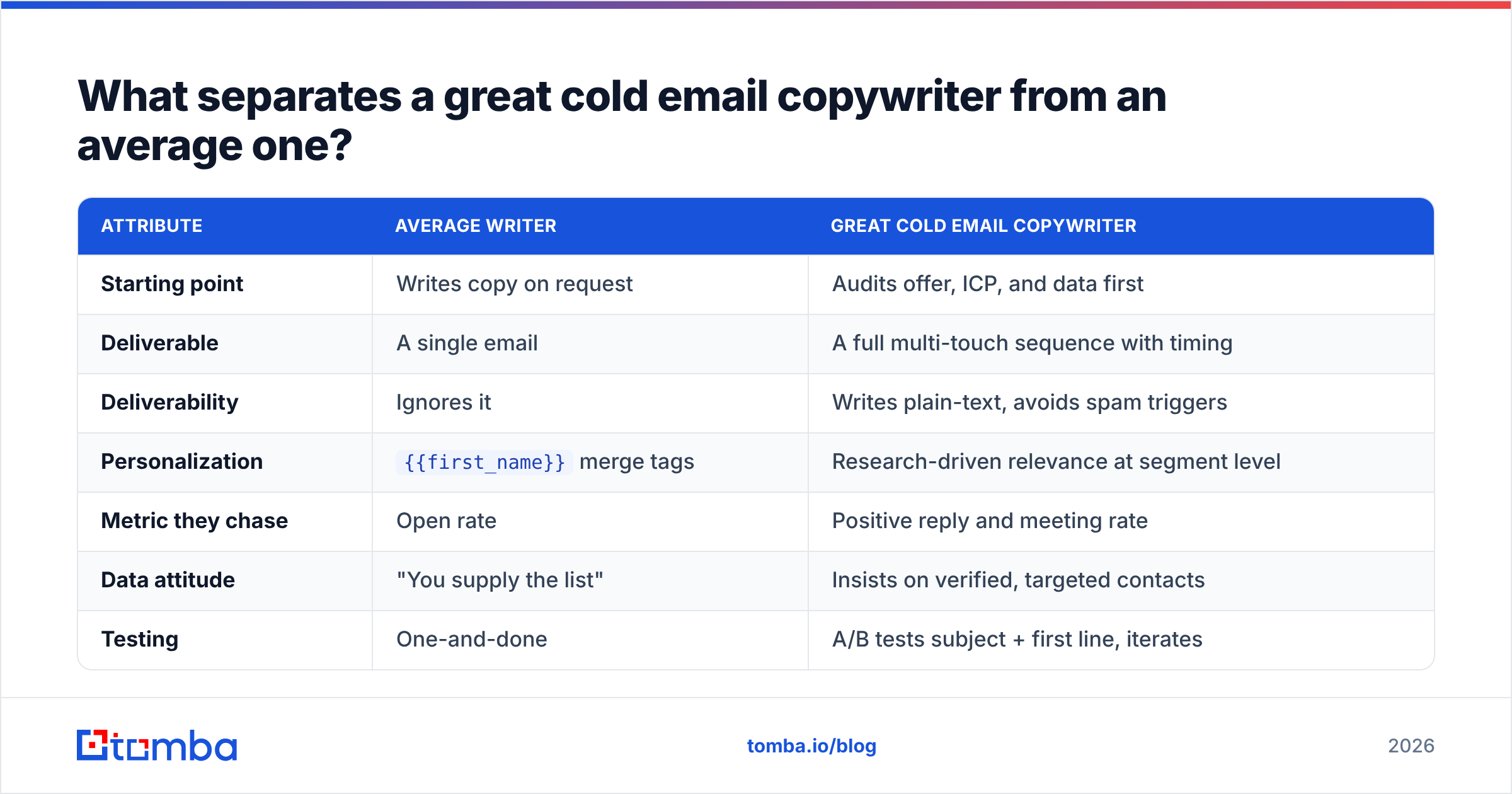
| Attribute | Average writer | Great cold email copywriter |
|---|---|---|
| Starting point | Writes copy on request | Audits offer, ICP, and data first |
| Deliverable | A single email | A full multi-touch sequence with timing |
| Deliverability | Ignores it | Writes plain-text, avoids spam triggers |
| Personalization | {{first_name}} merge tags |
Research-driven relevance at segment level |
| Metric they chase | Open rate | Positive reply and meeting rate |
| Data attitude | "You supply the list" | Insists on verified, targeted contacts |
| Testing | One-and-done | A/B tests subject + first line, iterates |
The pattern is clear: average writers optimize the wrong thing (opens), while strong ones optimize replies and treat data as part of their job.
How much does a cold email copywriter cost in 2026?#
Pricing varies by engagement model more than by skill. Here's the current landscape.
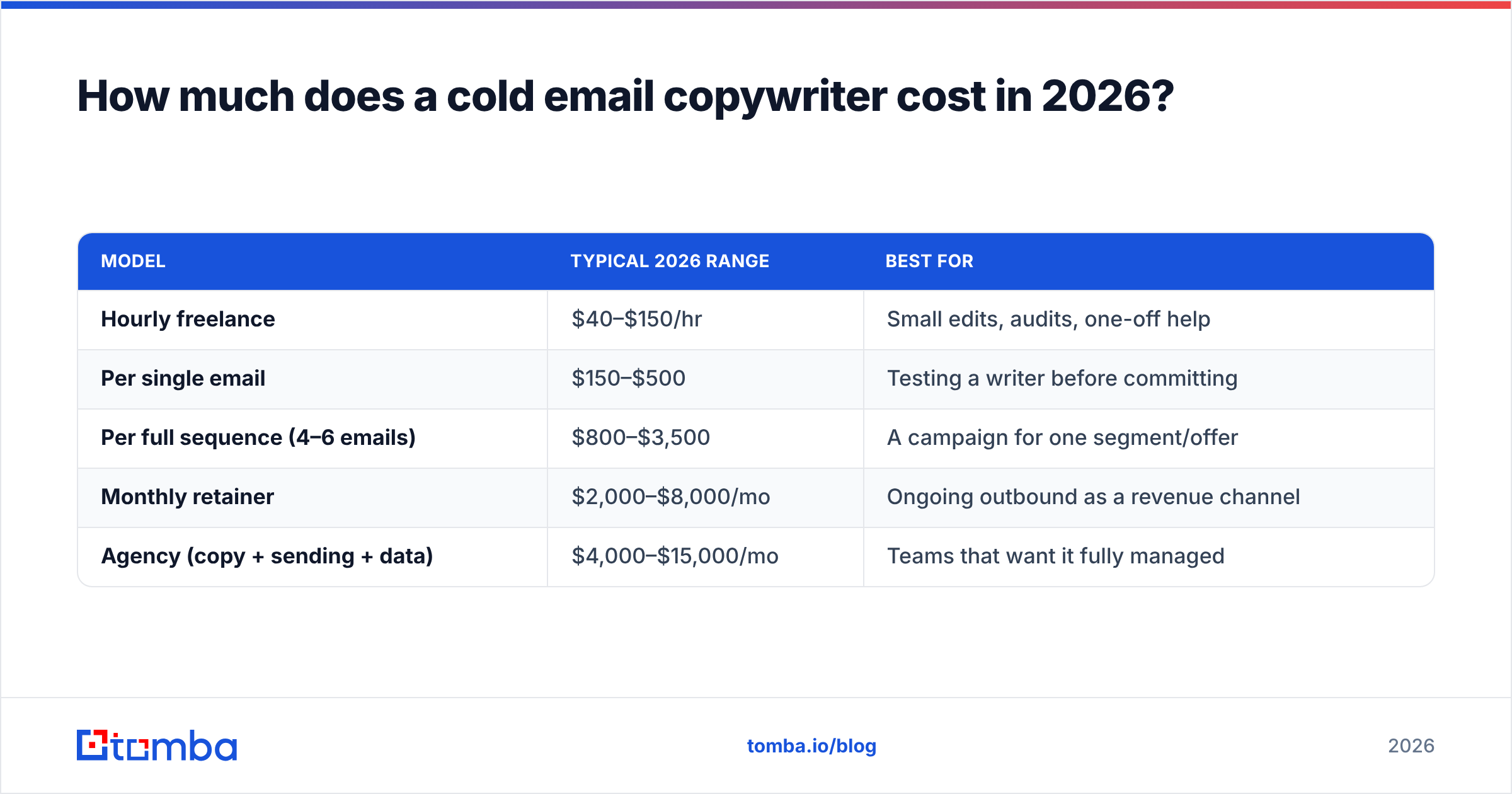
| Model | Typical 2026 range | Best for |
|---|---|---|
| Hourly freelance | $40–$150/hr | Small edits, audits, one-off help |
| Per single email | $150–$500 | Testing a writer before committing |
| Per full sequence (4–6 emails) | $800–$3,500 | A campaign for one segment/offer |
| Monthly retainer | $2,000–$8,000/mo | Ongoing outbound as a revenue channel |
| Agency (copy + sending + data) | $4,000–$15,000/mo | Teams that want it fully managed |
A few notes on reading this table. A $2,000 sequence from someone who researches your ICP and designs the full arc is usually cheaper per meeting than a $300 "email" from a generalist. And retainers only make sense once outbound is a proven channel — paying $5,000/mo to test whether cold email works at all is a fast way to conclude it doesn't.
For context on what tools cost alongside a writer, Tomba pricing starts with a free tier (25 searches/mo), then Starter at $49/mo and Growth at $99/mo — so the data layer is a small fraction of what you'll pay for the copy itself.
Should you hire a cold email copywriter or write it yourself?#
Conclusion first: hire when outbound is a validated channel and your time is worth more than the writer's fee; write your own while you're still learning what your buyers object to.
Hire a cold email copywriter when:
- Cold email already produces revenue and you want to scale it.
- You've validated your offer and ICP and just need volume and consistency.
- Your calendar can't absorb 10+ hours a week of writing and iterating.
- You need a fresh outside angle because your own copy has gone stale.
Write it yourself when:
- You're pre-product-market-fit and need to hear objections in your own inbox.
- Budget is tight and your time is the cheaper resource.
- Your offer changes weekly — a writer can't keep up with a moving target.
- You want to build the skill in-house before outsourcing it.
A practical middle path: write your first campaigns yourself to learn the objections, then hand a copywriter your winning angles and reply data. They'll scale what already works instead of guessing from zero.
How do you evaluate a cold email copywriter before hiring?#
Use this checklist. Strong candidates clear most of it; weak ones stumble on the first two.
- Do they ask about your data and deliverability? If the first question isn't about your list, domain, or warmup, pass. This is the single biggest tell.
- Can they show reply rates, not open rates? Opens are unreliable in 2026 with privacy protections; ask for booked-meeting or positive-reply numbers with context.
- Do they write plain, human copy? Read a sample aloud. If it sounds like a brochure, it'll read like spam.
- Do they design sequences, not emails? Ask to see a full 4–6 touch arc, including the break-up email.
- Do they test? Ask how they'd A/B test your first campaign and what they'd measure.
- Do they understand your buyer? A short research call reveals whether they can speak your ICP's language or are winging it.
What does good cold email copy actually look like?#
Good cold copy is short, specific, and about the reader. Here's a skeleton that consistently performs, with the job of each part:
- Subject line — 2–5 words, curiosity or relevance, never salesy. "Question about {{company}}'s onboarding" beats "Boost your revenue 300%."
- Opening line — a genuine, specific observation about them, not "I hope this email finds you well." This line decides whether they keep reading.
- The problem — one sentence naming a pain your ICP actually feels.
- The proof — one concrete result, ideally with a number and a comparable company.
- The ask — a single, low-friction question. "Worth a 15-minute look?" outperforms "Book a demo here."
- The P.S. — optional, but a good place for social proof or a soft second angle.
Notice what's missing: no giant intro paragraph, no five links, no attached deck. Every added element lowers reply rate and raises spam risk. If you want a head start, browse ready-made cold email templates and adapt the structure to your offer rather than copying it word for word.
The other half of good copy is the machinery behind it. Even the best sequence needs the right addresses, so writers often lean on a bulk email finder to build targeted, verified lists before a single word is written.
How does a copywriter fit into the rest of your outbound stack?#
A cold email copywriter is one link in a chain. The chain, roughly in order:
- Targeting — define the ICP and pull matching companies and roles.
- Data — find and verify contact emails so the list is real. Tools like Tomba's domain search build role-specific lists by company.
- Infrastructure — warmed-up sending domains, SPF/DKIM/DMARC configured.
- Copy — where the copywriter lives.
- Sending platform — sequencing, scheduling, and reply routing.
- Measurement — reply sentiment, meetings booked, pipeline created.
A writer who ignores steps 1–3 is optimizing a link while the chain snaps elsewhere. This is why the strongest copywriters either handle data themselves or insist you fix it first. For a deeper look at where accurate contact data comes from, see Tomba's data sources.
If you're comparing full-service outbound platforms and considering alternatives to the bundled suites, it's worth reading how tools stack up — G2's sales engagement category and HubSpot's own cold email guide are useful neutral references before you commit budget.
What mistakes do first-time hirers make?#
Three recurring ones, in order of how much they cost:
- Buying copy for a broken list. No writer can save a 40%-bounce list. Fix data first, then hire.
- Judging on opens. A campaign can show 60% opens and 0% replies. Meetings are the only metric that pays rent.
- Expecting instant results. Cold email is iterative. The first sequence is a hypothesis; the third is usually the winner. Budget for iteration, not a magic one-shot.
Avoid these and a good copywriter pays for themselves within a quarter. Fall into them and you'll blame the writer for a data and expectations problem.
Cold email copywriter vs. AI copy tools: which should you use?#
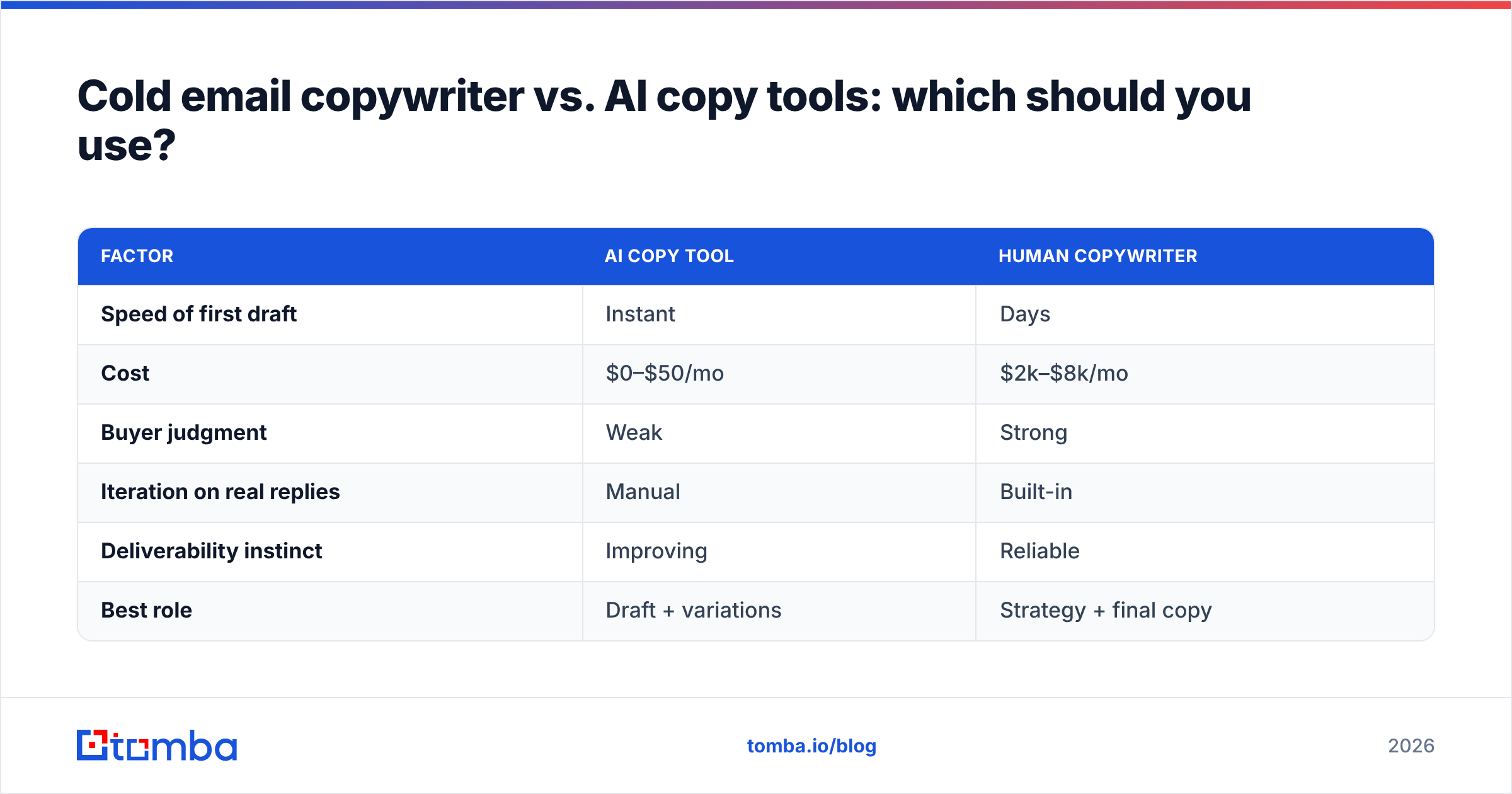
Not either/or — both, in the right order. AI is excellent for first drafts, subject-line variations, and beating the blank page. It's weak at judgment: knowing which angle fits your specific buyer, reading reply sentiment, and deciding when to kill a losing sequence.
| Factor | AI copy tool | Human copywriter |
|---|---|---|
| Speed of first draft | Instant | Days |
| Cost | $0–$50/mo | $2k–$8k/mo |
| Buyer judgment | Weak | Strong |
| Iteration on real replies | Manual | Built-in |
| Deliverability instinct | Improving | Reliable |
| Best role | Draft + variations | Strategy + final copy |
A pragmatic 2026 workflow: use an AI cold email writer to generate drafts and variations fast, then have a human (you or a hired writer) apply judgment, personalize at the segment level, and iterate on replies. The AI handles volume; the human handles the decisions that move reply rates.
The bottom line#
A cold email copywriter can be one of the highest-ROI hires in your go-to-market motion — but only when the foundation is solid. Copy is the last 20% that turns a good list into meetings; it can't rescue a bad one. Get your targeting and data right first, then bring in a writer to maximize the ceiling those inputs create.
Whether you write your own sequences or hire a pro, every reply starts with reaching a real person at the right company. Build that list with the Tomba Email Finder — find accurate, verified professional emails by domain, name, or company, starting free with 25 searches a month. Give your copy a list worth writing to, and let the words do what they're actually good at.
Related guides#
// get started
Find, verify and enrich your first contacts today
Start on the free plan with 25 searches a month, then scale when your team is ready.
Free plan · No credit card required · GDPR & CCPA
// about the author