Cold Email Copywriting Examples: 7 Templates That Get Replies
Seven cold email copywriting examples that actually book meetings, broken down line by line — plus the frameworks, subject lines, and mistakes that quietly kill your reply rate.
Most cold emails fail before the prospect reads the second line. Not because the offer is bad, but because the copy sounds like a template that was blasted to 4,000 people — which it was. This guide gives you seven cold email copywriting examples you can steal today, each dissected so you understand why it works, not just what to paste.
TL;DR#
- Copy is 80% of your cold email's outcome — a great list with weak copy still flops, and these seven examples show the patterns that flip that.
- Every winning email does three things: earns the open (subject line), earns the read (relevant first line), and earns the reply (one clear, low-friction ask).
- Short beats clever. The best-performing examples below are 50–125 words with a single call to action.
- Personalization is not
{{first_name}}— it's one specific, researched detail that proves you're not mass-mailing. - Frameworks scale, not scripts. Learn AIDA, PAS, and BAB so you can write 100 variations instead of reusing one dead template.
What makes a cold email actually get a reply?#
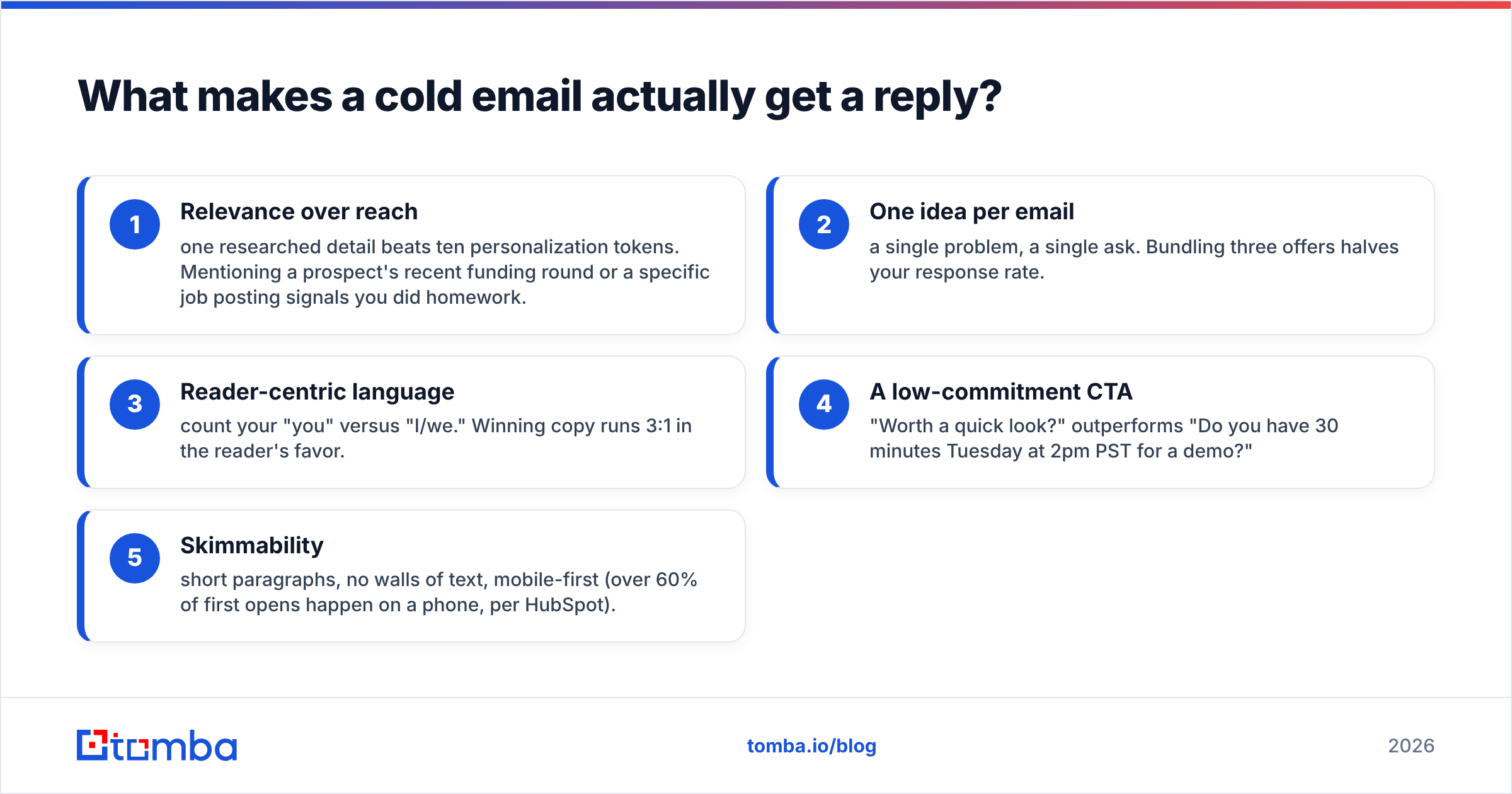
A reply-worthy cold email clears three gates in order: the open, the read, and the response. Miss any gate and the rest never happens.
Think of it like a nightclub with three doors. The subject line is the bouncer — get past it or the night's over. The opening line is the coat check — a quick friction point where you either belong or you don't. The call to action is the bar, where the actual transaction happens. Most reps obsess over the bar (their pitch) while getting turned away at the door.
Here's what separates the emails that get replies from the ones that get archived:
- Relevance over reach — one researched detail beats ten personalization tokens. Mentioning a prospect's recent funding round or a specific job posting signals you did homework.
- One idea per email — a single problem, a single ask. Bundling three offers halves your response rate.
- Reader-centric language — count your "you" versus "I/we." Winning copy runs 3:1 in the reader's favor.
- A low-commitment CTA — "Worth a quick look?" outperforms "Do you have 30 minutes Tuesday at 2pm PST for a demo?"
- Skimmability — short paragraphs, no walls of text, mobile-first (over 60% of first opens happen on a phone, per HubSpot).
Which cold email copywriting frameworks should you use?#
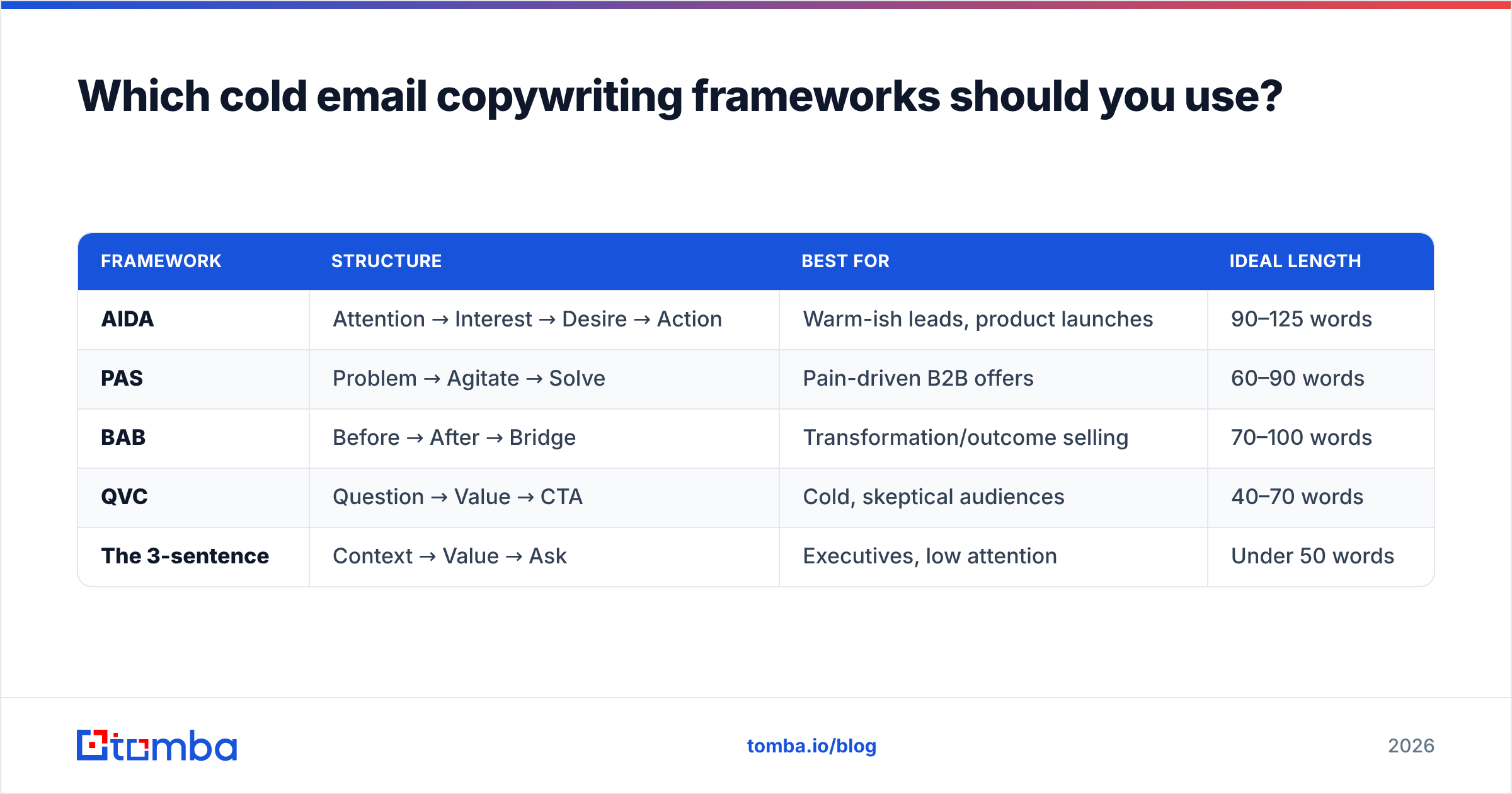
Before the examples, learn the three frameworks they're built on. Scripts break the moment your use case changes; frameworks bend to fit any audience.
| Framework | Structure | Best for | Ideal length |
|---|---|---|---|
| AIDA | Attention → Interest → Desire → Action | Warm-ish leads, product launches | 90–125 words |
| PAS | Problem → Agitate → Solve | Pain-driven B2B offers | 60–90 words |
| BAB | Before → After → Bridge | Transformation/outcome selling | 70–100 words |
| QVC | Question → Value → CTA | Cold, skeptical audiences | 40–70 words |
| The 3-sentence | Context → Value → Ask | Executives, low attention | Under 50 words |
The rule of thumb: the colder and more senior the prospect, the shorter the email. A VP of Sales does not read paragraph four.
What are 7 cold email copywriting examples that work?#
Below are seven examples across common B2B scenarios. Each includes the copy, the framework it uses, and the specific mechanic that earns the reply. Swap the bracketed details for your own research.
Example 1 — The pain-point opener (PAS)#
Subject: quick question about [Company]'s onboarding
Hi [Name],
Noticed [Company] doubled headcount last quarter — congrats. Fast-growing teams usually hit the same wall: new reps take 60+ days to ramp because onboarding lives in five different docs.
We cut that to 21 days for [Similar Company] by centralizing it. Curious whether ramp time is on your radar right now?
[Signature]
Why it works: The problem is tied to a specific observed trigger (headcount growth). The agitation ("five different docs") is concrete. The ask is a yes/no question, not a meeting request.
Example 2 — The transformation pitch (BAB)#
Subject: [Competitor] → 3 hours back per rep
Hi [Name],
Most RevOps teams I talk to spend ~3 hours a week manually cleaning CRM data. That's a full workday per rep every month.
Teams that automate enrichment get that time back and see cleaner pipeline forecasting. Would it be useful to see how [Similar Company] did it in under a week?
[Signature]
Why it works: It paints the "before" (manual cleanup) and "after" (time back, cleaner forecasting), then bridges with a proof point. The math ("a full workday per rep") makes the pain tangible.
Example 3 — The three-sentence executive email#
Subject: idea for [Company]'s Q3 pipeline
Hi [Name],
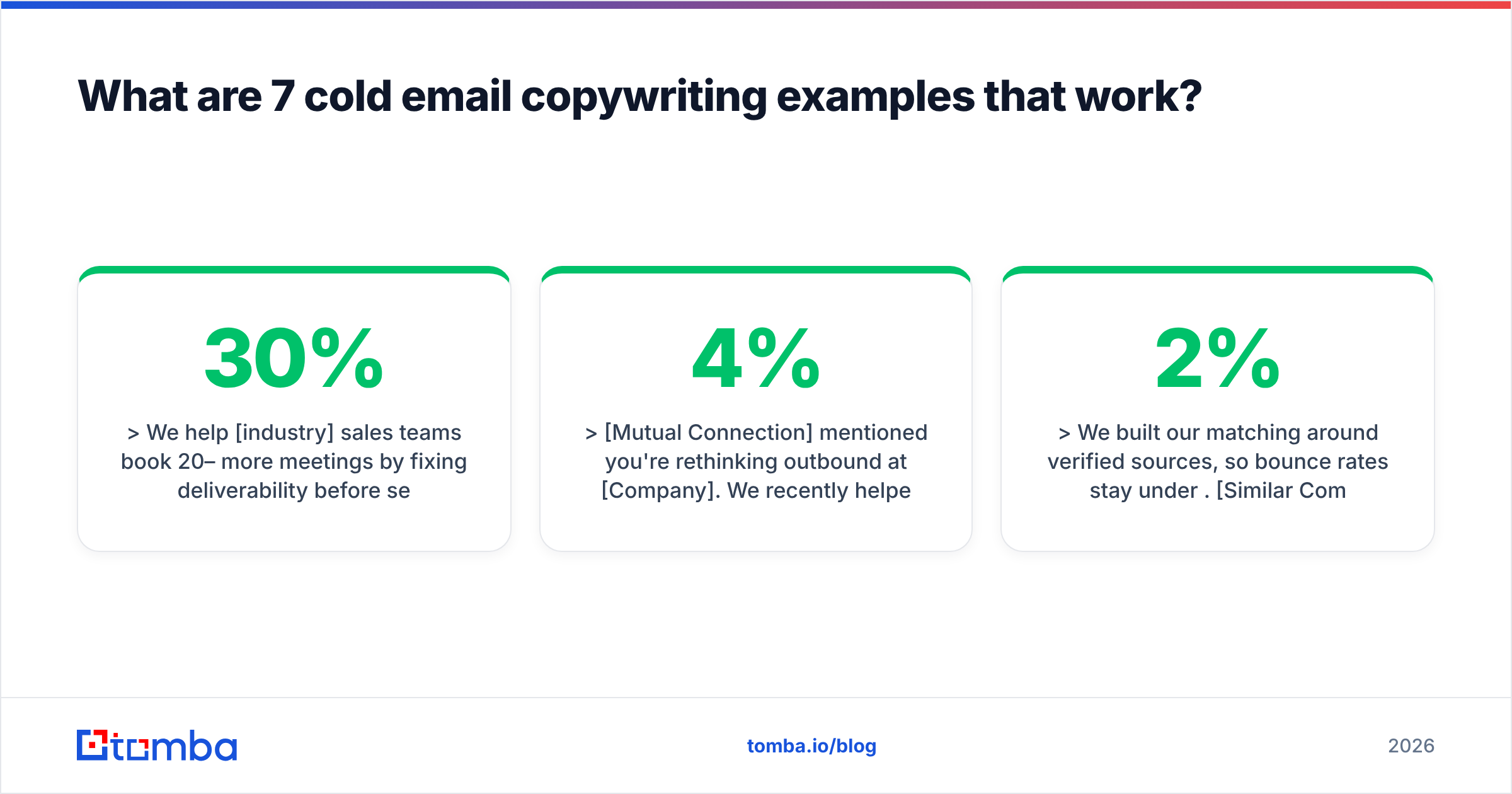
We help [industry] sales teams book 20–30% more meetings by fixing deliverability before send. [Similar Company] added 41 meetings last quarter this way. Worth a 10-minute look?
[Signature]
Why it works: An executive can read it in five seconds. One outcome, one proof point, one soft ask. If you want templates like this ready to adapt, our cold email templates library has variants by role.
Example 4 — The referral/social-proof angle#
Subject: [Mutual Connection] suggested I reach out
Hi [Name],
[Mutual Connection] mentioned you're rethinking outbound at [Company]. We recently helped their team lift reply rates from 4% to 11% by tightening targeting and copy.
Happy to share the exact playbook — open to a quick swap of notes?
[Signature]
Why it works: Borrowed trust. A real mutual connection front-loads credibility that a cold sender otherwise has to earn over several lines. Never fake this — it's checkable.
Example 5 — The competitor-switch email (AIDA)#
Subject: why [Similar Company] left [Competitor]
Hi [Name],
Attention: teams on [Competitor] tell us the same thing — great UI, painful data accuracy.
We built our matching around verified sources, so bounce rates stay under 2%. [Similar Company] switched and cut wasted sends by a third.
If accuracy is a sore spot, I'd love to show you a side-by-side. Open to it this week?
[Signature]
Why it works: It names a real objection ("painful data accuracy") that switchers actually feel, then answers it with a metric. Verify any competitor claim before you send it.
Example 6 — The trigger-event email#
Subject: congrats on the [Series B]
Hi [Name],
Saw the [Series B] news — exciting time to scale the sales org.
Most teams at this stage struggle to keep contact data fresh while hiring fast. We keep enrichment automatic so your new reps start with clean lists on day one.
Worth a chat as you build out the team?
[Signature]
Why it works: Timeliness. A funding announcement, a new hire, or a product launch gives you a legitimate reason to write now. Trigger-based outreach consistently outperforms static lists on G2.
Example 7 — The value-first, no-ask email#
Subject: teardown of [Company]'s signup flow
Hi [Name],
I ran through [Company]'s free trial signup and spotted three friction points costing you conversions (screenshot attached). No pitch — just thought it'd be useful.
If you ever want the other seven I found, happy to send them over.
[Signature]
Why it works: It gives before it takes. The "no pitch" line disarms skepticism, and the open loop ("the other seven") invites the reply on the prospect's terms.
How should you write cold email subject lines?#
Your subject line has one job: get the open without triggering the spam filter or the delete reflex. The examples above lean on five proven patterns.
- Curiosity gap: "why [Similar Company] left [Competitor]"
- Personal/observed: "quick question about [Company]'s onboarding"
- Trigger event: "congrats on the [Series B]"
- Value tease: "teardown of [Company]'s signup flow"
- Mutual connection: "[Name] suggested I reach out"
Keep subject lines under 50 characters so they don't truncate on mobile, avoid ALL CAPS and spammy words ("free," "guarantee," "act now"), and never use misleading bait — a fake "Re:" kills trust the instant they open. If you want to A/B test variants fast, a subject line generator can spin up options to test against your control.
What are the most common cold email copywriting mistakes?#
Most underperforming emails share the same handful of errors. Fix these before you write another word.
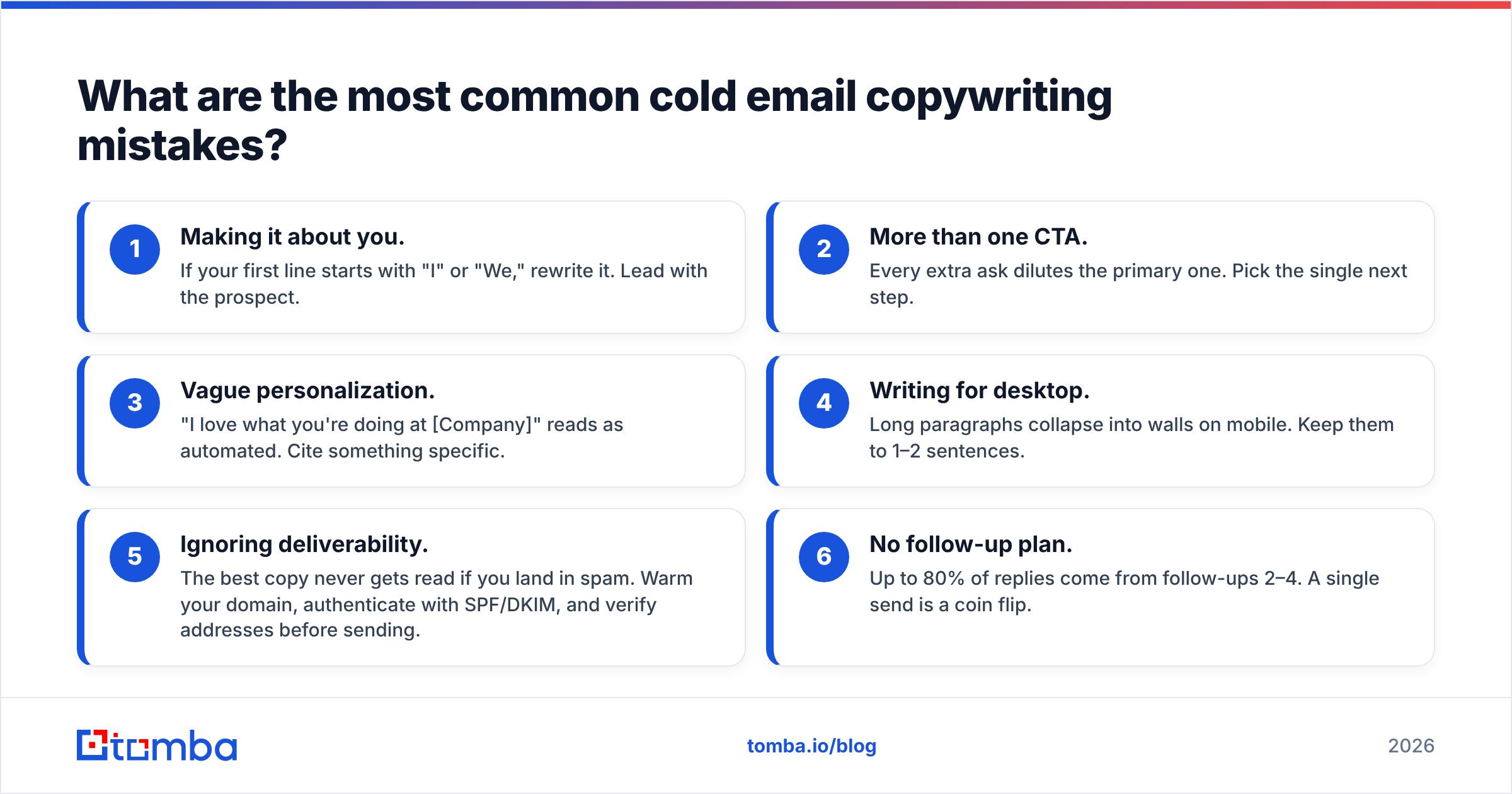
- Making it about you. If your first line starts with "I" or "We," rewrite it. Lead with the prospect.
- More than one CTA. Every extra ask dilutes the primary one. Pick the single next step.
- Vague personalization. "I love what you're doing at [Company]" reads as automated. Cite something specific.
- Writing for desktop. Long paragraphs collapse into walls on mobile. Keep them to 1–2 sentences.
- Ignoring deliverability. The best copy never gets read if you land in spam. Warm your domain, authenticate with SPF/DKIM, and verify addresses before sending.
- No follow-up plan. Up to 80% of replies come from follow-ups 2–4. A single send is a coin flip.
On point five — deliverability quietly caps your results. Even flawless copy loses if half your list bounces, which spikes your spam rate and tanks sender reputation. Running your list through an email verifier before send keeps bounces low and your primary-inbox placement high.
How do you personalize cold emails at scale?#
Personalization at scale is a research problem, not a writing problem. The copy frameworks above stay fixed; only the researched variable changes per prospect.
The workflow that makes this repeatable:
- Build a tight, ICP-matched list. Narrow beats broad — 200 perfect-fit contacts outperform 5,000 sprayed ones.
- Find verified contact data. You can't personalize what you can't reach. A reliable email finder gets you accurate addresses tied to the right person.
- Attach one research snippet per contact — a funding event, a job post, a LinkedIn comment, a product change.
- Merge the snippet into a framework template, keeping the structure identical and swapping only the personal line.
- Verify, then send in small warmed batches and iterate on subject line and CTA based on reply data.
For AI-assisted drafting that still respects these frameworks, a cold email AI tool can generate first drafts you then tighten by hand — treat it as a co-writer, not autopilot. Fully automated copy reads exactly as automated, and prospects can tell.
How long should a cold email be?#
Aim for 50–125 words. The colder the prospect and the more senior their role, the shorter you go. Data from sales-engagement studies consistently shows emails under 125 words outperform longer ones on reply rate, and the three-sentence executive format wins with time-poor buyers.
Length is a proxy for respect. A short email says "I value your time and I know exactly what I want." A long one says "I'm hoping something in here sticks." Cut every sentence that doesn't move the prospect toward the single ask.
Put these cold email examples to work#
Great copy and great data are two halves of the same result — one without the other stalls. The seven examples above give you frameworks that flex to any audience; the missing piece is reaching the right person with a verified address so your personalization actually lands. Start free with the Tomba Email Finder to pull accurate, verified contact data by name, domain, or company, then plug those contacts into the templates above. The free plan covers 25 searches a month so you can test the workflow before scaling — see full Tomba pricing when you're ready to ramp your outbound.
Related guides#
Ready to find emails that actually work?
Join 150,000+ professionals who stopped guessing and started sending. Free credits on signup — no credit card required.
Get the Tomba newsletter
Practical outbound tactics and product updates — once every two weeks.
About the author