Cold Email Etiquette in 2026: The Complete, No-Fluff Guide
Cold email etiquette is the difference between a booked meeting and a spam complaint. Learn the rules, the mistakes to avoid, and a pre-send checklist that keeps you out of the junk folder.
Cold email still works in 2026 — but only if you treat the inbox like someone else's house, not a billboard you rented. Etiquette is not about being polite for its own sake. It is the set of habits that keep your messages out of spam, protect your sending domain, and earn replies from people who never asked to hear from you.
TL;DR#
- Cold email etiquette is the practical code of conduct that keeps your outreach legal, deliverable, and respectful — permission-aware sending, honest subject lines, easy opt-outs, and relevance over volume.
- The biggest etiquette failures are technical, not tonal: unverified lists, no unsubscribe, spoofed "Re:" subject lines, and blasting 500 people from a cold domain.
- Personalization is table stakes. A generic "I came across your profile" now reads as automation, not effort.
- Follow-ups are allowed — but 2 to 4 spaced touches, not a daily drip until they block you.
- Verify every address before you send. Bounces wreck your sender reputation faster than any bad line of copy.
What is cold email etiquette?#
Cold email etiquette is the unwritten (and partly legal) rulebook for emailing someone who has no prior relationship with you. Think of it like knocking on a stranger's door to talk business: you introduce yourself clearly, you keep it short, you explain why you specifically knocked on their door, and you leave the moment they say no.
The difference between cold email and spam is not the tool — it is the behavior. Spam is unsolicited, irrelevant, sent at scale, and hard to escape. A well-mannered cold email is unsolicited but relevant, targeted, and trivially easy to opt out of. Regulators draw the same line: the US CAN-SPAM Act and the EU's GDPR both permit business outreach, provided you identify yourself, tell the truth, and honor opt-outs.
Good etiquette also protects you selfishly. Every spam complaint, hard bounce, and "who is this?" reply chips away at your sender reputation, and once mailbox providers distrust your domain, even your warm emails start landing in Promotions or Spam.
Why does cold email etiquette matter more in 2026?#
Because the inbox got smarter and buyers got tired. Three shifts made manners a ranking factor:
- Provider filtering is behavioral. Gmail and Outlook weight engagement — opens, replies, "not spam" clicks — over keyword filters. Low-relevance blasts train the filter against you.
- Bulk-sender rules are enforced. Since 2024, Google and Yahoo require authenticated domains (SPF, DKIM, DMARC), one-click unsubscribe, and spam-complaint rates under 0.3%. Sloppy senders get throttled automatically.
- Buyers pattern-match spam instantly. A decade of bad outreach trained your prospects to delete on sight. Etiquette — brevity, relevance, a real human tone — is now the signal that you are worth two seconds of attention.
The teams winning at cold outreach treat email deliverability and etiquette as the same discipline. You cannot copy your way out of a reputation problem.
What are the core rules of cold email etiquette?#
Here is the short version you can tape to your monitor. Each rule maps to either a deliverability risk or a trust risk — usually both.
- Get to relevance in the first line. Skip "I hope this email finds you well." Open with why you are emailing this person.
- Tell the truth in the subject line. No fake "Re:", no "RE: our call" when there was no call. Deceptive headers are both illegal and reputation suicide.
- Keep it under 125 words. Long cold emails read as demands on the reader's time.
- One ask, one link. Multiple CTAs signal a spray-and-pray sequence.
- Make opting out effortless. A visible unsubscribe or a plain "reply 'no' and I'll stop" line is non-negotiable.
- Verify before you send. Bounces are the fastest way to get flagged. Use an email verifier on every address.
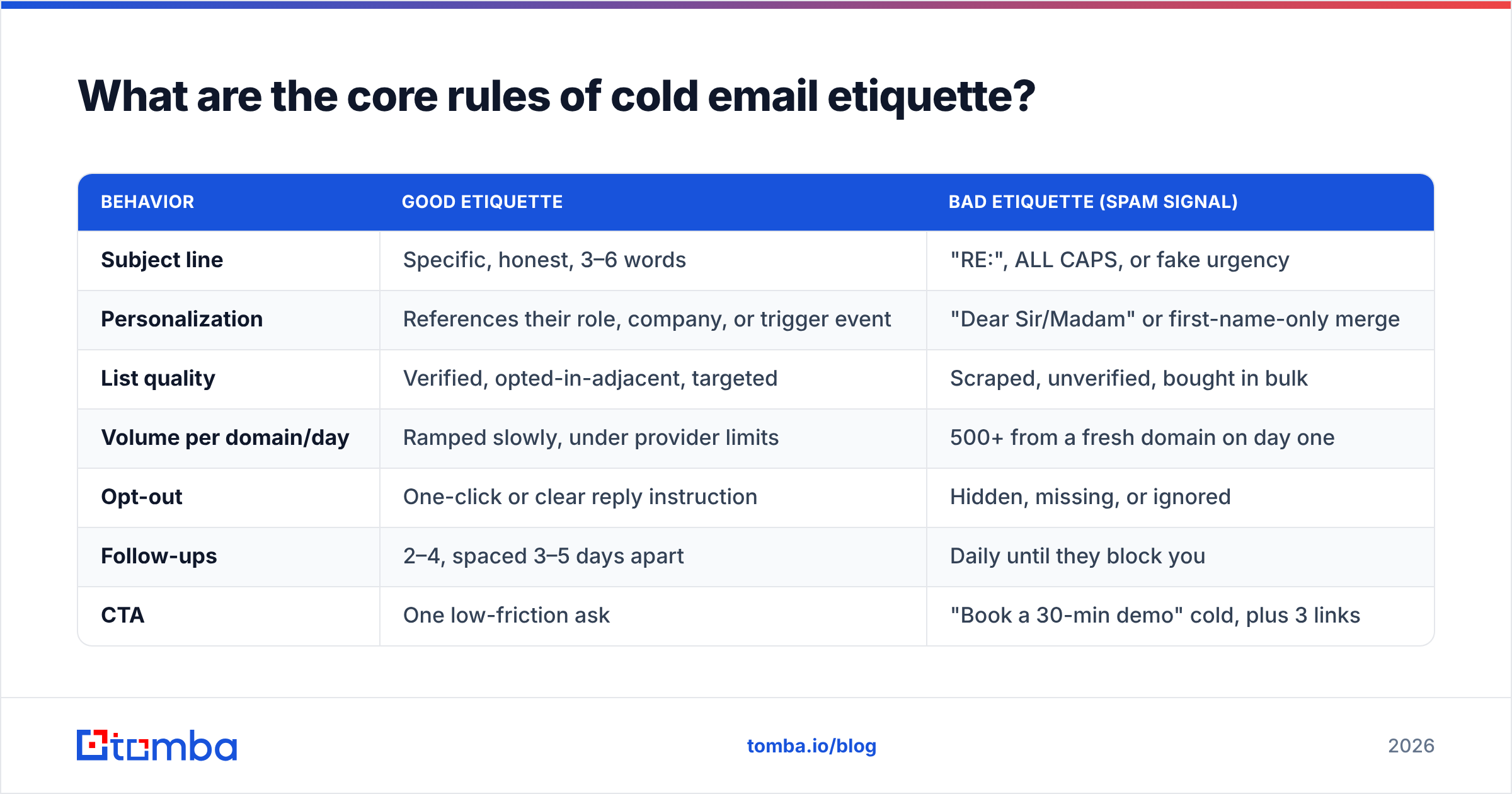
Good etiquette vs. bad etiquette at a glance#
| Behavior | Good etiquette | Bad etiquette (spam signal) |
|---|---|---|
| Subject line | Specific, honest, 3–6 words | "RE:", ALL CAPS, or fake urgency |
| Personalization | References their role, company, or trigger event | "Dear Sir/Madam" or first-name-only merge |
| List quality | Verified, opted-in-adjacent, targeted | Scraped, unverified, bought in bulk |
| Volume per domain/day | Ramped slowly, under provider limits | 500+ from a fresh domain on day one |
| Opt-out | One-click or clear reply instruction | Hidden, missing, or ignored |
| Follow-ups | 2–4, spaced 3–5 days apart | Daily until they block you |
| CTA | One low-friction ask | "Book a 30-min demo" cold, plus 3 links |
What are the most common cold email etiquette mistakes?#
Most failures fall into four buckets. Fix these before you touch your copywriting.
1. Sending to unverified addresses. A 5% bounce rate tells Gmail you are working a dirty list, and that is a classic spammer fingerprint. Run every contact through verification and quarantine risky or catch-all domains. Tomba's catch-all verifier helps you decide which accept-all domains are safe to risk.
2. Faking familiarity. "Re: following up" on a first-ever email, or "As we discussed…" when you never spoke, torches trust the instant they notice. It also violates CAN-SPAM's header-honesty rule.
3. Over-automating personalization. Merge tags that misfire ("Hi {FirstName}") are worse than no personalization. If your "custom" first line could be pasted into 10,000 emails unchanged, it is not personalization — it is decoration.
4. Not knowing when to stop. Etiquette includes graceful exits. No reply after your final follow-up means stop. A "not interested" means stop immediately and suppress the contact. Ignoring either is how you earn complaints.
How do you personalize a cold email without being creepy?#
Aim for relevant, not surveillance. There is a bright line between "I saw your team is hiring three SDRs" (public, business-relevant) and "I saw you were at the coffee shop on 5th" (invasive). Stay on the public, professional side of it.
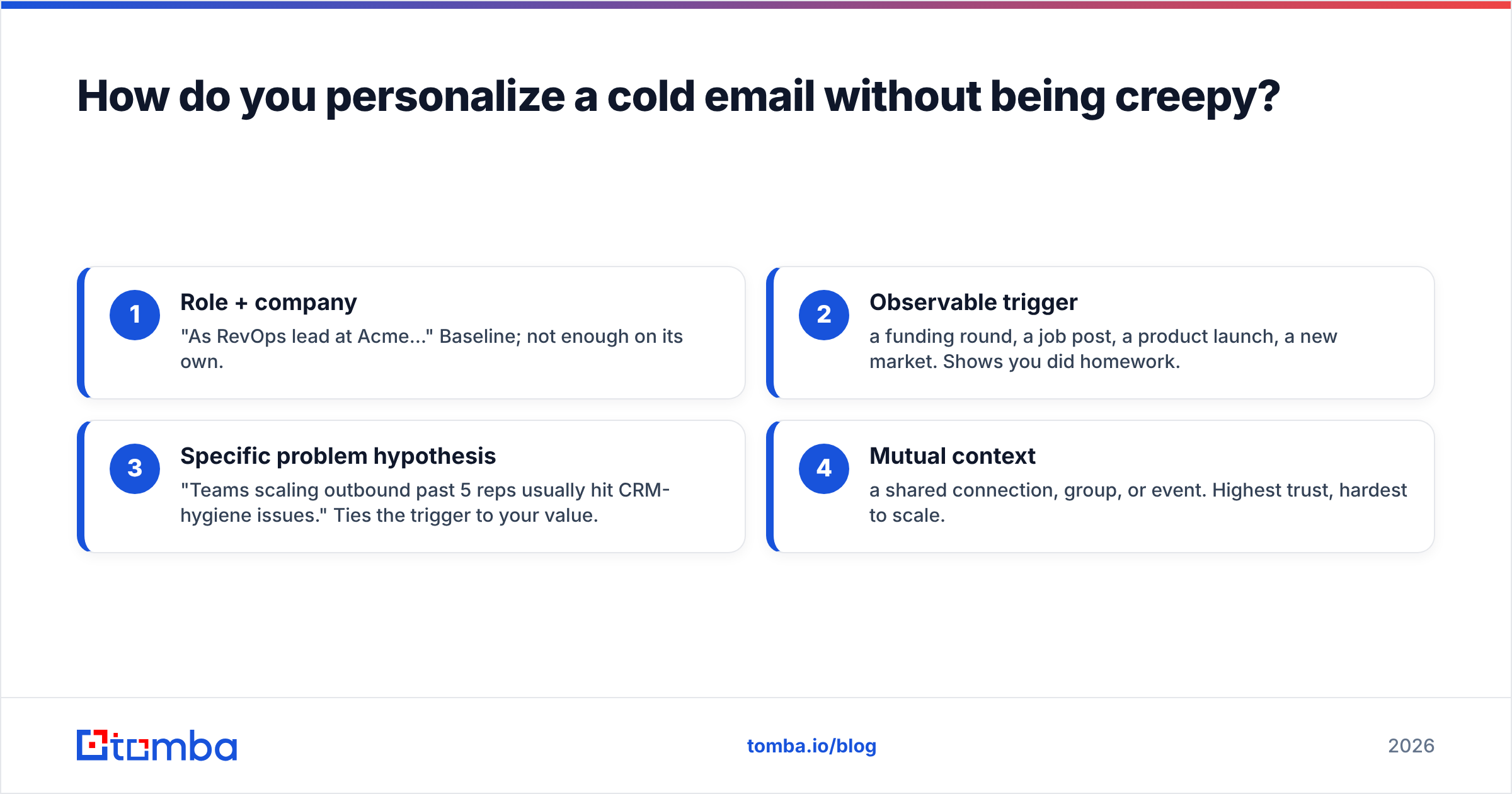
A useful personalization ladder, cheapest to most valuable:
- Role + company — "As RevOps lead at Acme…" Baseline; not enough on its own.
- Observable trigger — a funding round, a job post, a product launch, a new market. Shows you did homework.
- Specific problem hypothesis — "Teams scaling outbound past 5 reps usually hit CRM-hygiene issues." Ties the trigger to your value.
- Mutual context — a shared connection, group, or event. Highest trust, hardest to scale.
You need accurate data to do any of this at volume. Pulling verified contacts and firmographics with a tool like the Tomba Email Finder or enriching a list through data enrichment beats guessing formats and hoping they land. The etiquette point: personalization built on correct data respects the reader; personalization built on bad guesses insults them.
What are the rules for cold email follow-ups?#
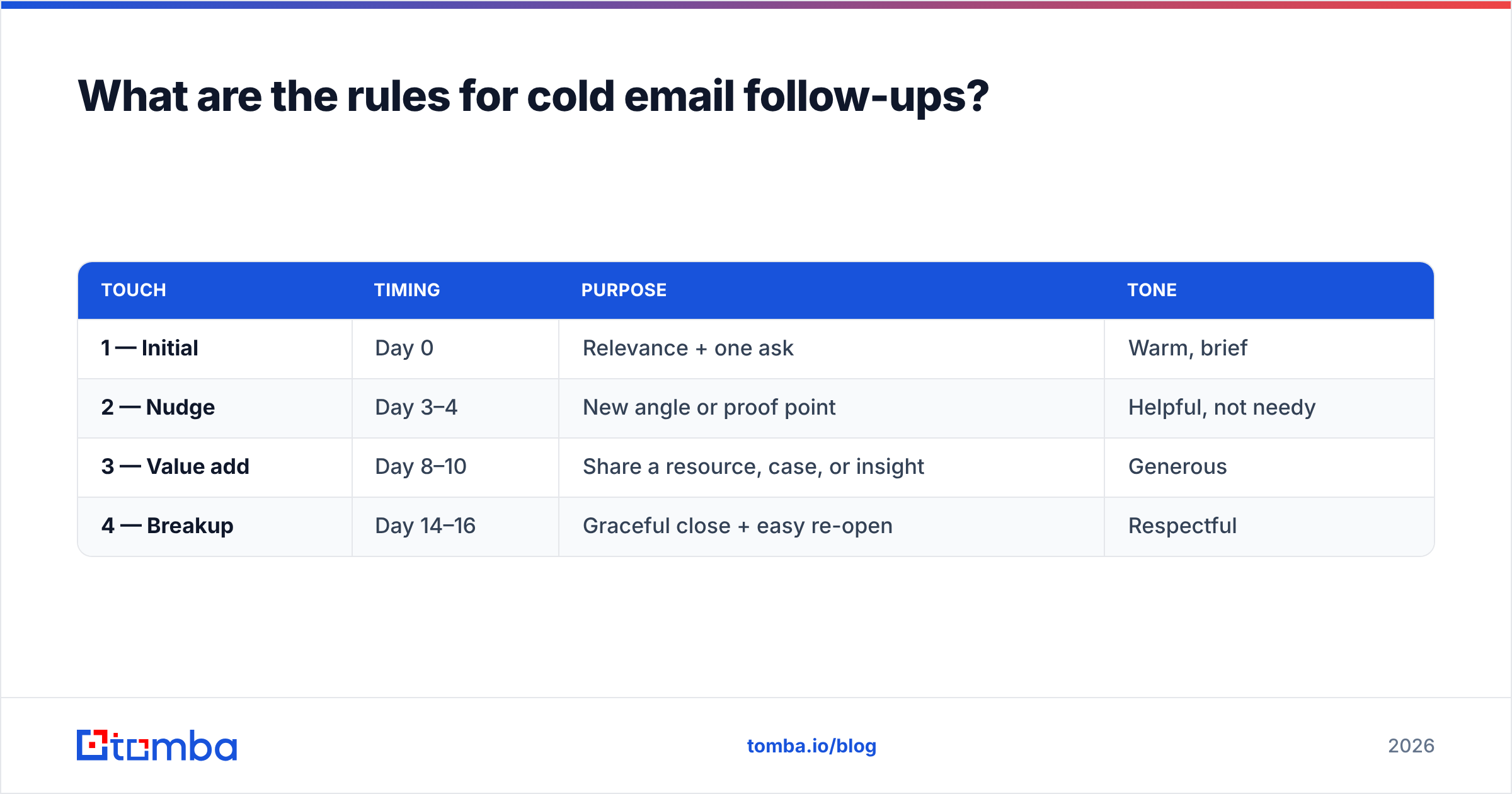
Follow-ups are where good intentions turn into harassment. The etiquette is about spacing, count, and adding value each time — not repeating "just bumping this."
| Touch | Timing | Purpose | Tone |
|---|---|---|---|
| 1 — Initial | Day 0 | Relevance + one ask | Warm, brief |
| 2 — Nudge | Day 3–4 | New angle or proof point | Helpful, not needy |
| 3 — Value add | Day 8–10 | Share a resource, case, or insight | Generous |
| 4 — Breakup | Day 14–16 | Graceful close + easy re-open | Respectful |
Four touches over roughly two weeks is a defensible cadence. Each message should stand on its own — if you deleted the previous emails, this one should still make sense and still offer something. When the sequence ends, it ends. Suppress the contact and move on. Persistence past a clear no is not "sales grit," it is a complaint waiting to happen.
If you send at any real volume, protect the domain too: warm it up gradually, keep daily sends conservative, and run a periodic check with a spam checker so a broken template doesn't quietly tank an entire campaign.
How do you stay legal and compliant?#
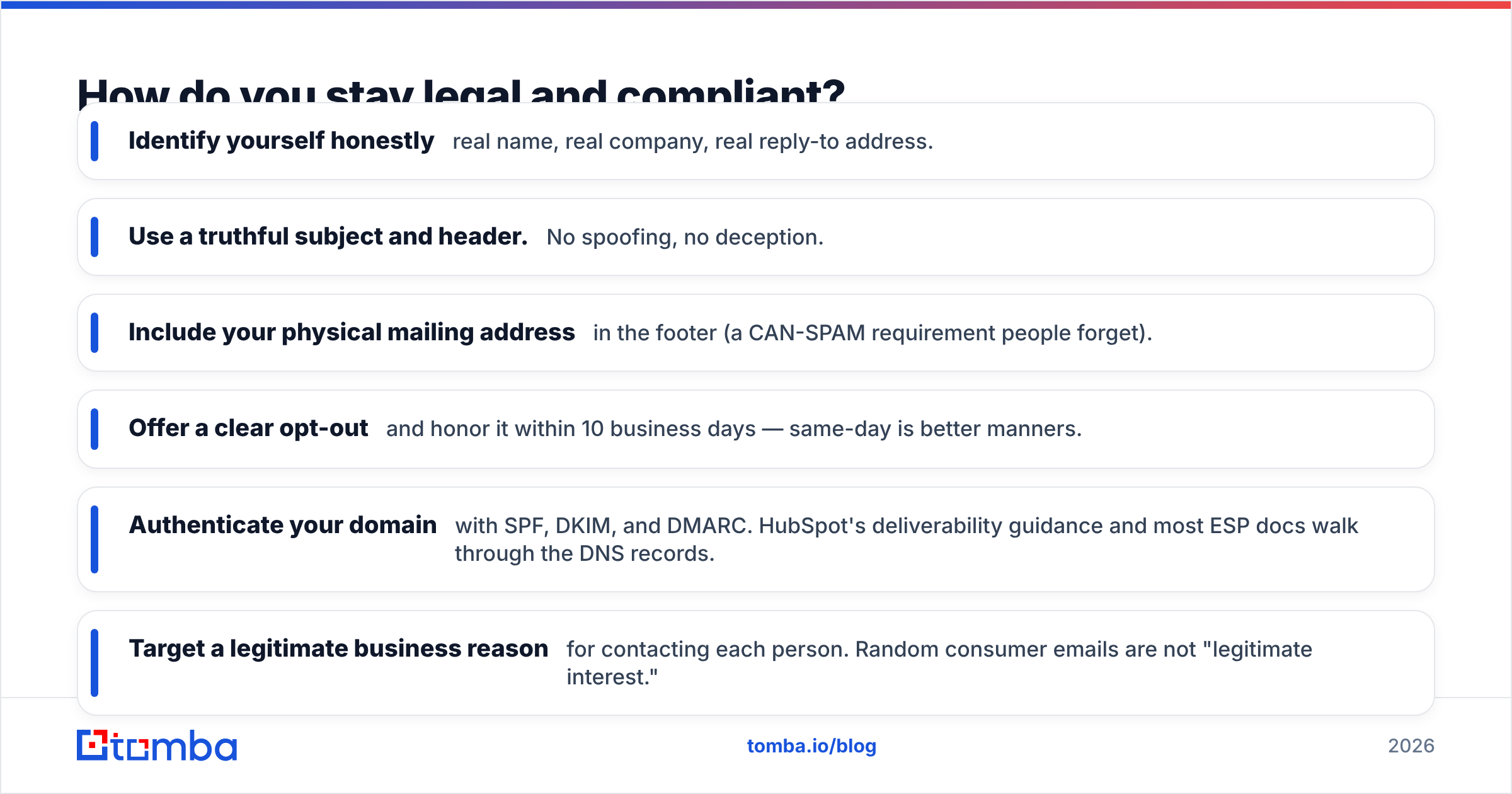
Etiquette and law overlap almost completely here. Hit these and you satisfy CAN-SPAM, most of GDPR's legitimate-interest basis, and the Google/Yahoo bulk-sender rules at once:
- Identify yourself honestly — real name, real company, real reply-to address.
- Use a truthful subject and header. No spoofing, no deception.
- Include your physical mailing address in the footer (a CAN-SPAM requirement people forget).
- Offer a clear opt-out and honor it within 10 business days — same-day is better manners.
- Authenticate your domain with SPF, DKIM, and DMARC. HubSpot's deliverability guidance and most ESP docs walk through the DNS records.
- Target a legitimate business reason for contacting each person. Random consumer emails are not "legitimate interest."
Rules vary by region — Canada's CASL and parts of the EU lean stricter toward prior consent, so check the jurisdiction of your recipients rather than assuming US rules apply everywhere. When in doubt, the etiquette default (relevant, honest, easy to escape) keeps you defensible almost anywhere.
What does a well-mannered cold email look like?#
Here is a compact example that respects every rule above:
Subject: Question about Acme's SDR ramp
Hi Jordan,
Saw Acme posted three SDR roles this month — usually a sign outbound is scaling faster than your data hygiene can keep up.
We help RevOps teams keep CRM contacts verified so reps stop burning sends on dead addresses. One team cut bounce rate from 9% to under 2% in a month.
Worth a 15-minute look? If not, just reply "no" and I'll stop here.
— Sam, Tomba · [mailing address] · unsubscribe
Notice what it does: honest subject, trigger-based opening, one proof point, one low-friction ask, and a built-in exit. Under 80 words. That is etiquette in practice. For more ready-to-adapt structures, browse a library of cold email templates and rewrite them in your own voice — never send a template unedited.
Cold email etiquette: the pre-send checklist#
Run this before every campaign:
- Is every address verified? No unverified sends, ever.
- Is the subject line honest and specific?
- Does the first line prove relevance to this person?
- Is there exactly one clear ask?
- Can they opt out in one step?
- Is my domain authenticated and warmed?
- Is my follow-up cadence capped and spaced?
- Would I be annoyed to receive this? If yes, rewrite it.
That last question is the whole discipline in one line. Cold email etiquette is just empathy plus deliverability hygiene, applied consistently.
Start with clean, accurate data#
Every etiquette rule collapses if your list is wrong. You cannot personalize around a name you guessed, and you cannot stay out of spam while sending to addresses that bounce. Clean data is the foundation everything else stands on.
Start there. Use the Tomba Email Finder to source verified, correctly-formatted professional emails, run them through verification, and build campaigns on contacts that actually exist. The free tier gives you 25 searches a month to test the workflow, and paid plans start at $49/mo — see full Tomba pricing for details. Good manners get you the reply; good data gets you to the inbox in the first place. Get both right, and cold email still works in 2026.
Related guides#
Ready to find emails that actually work?
Join 150,000+ professionals who stopped guessing and started sending. Free credits on signup — no credit card required.
Get the Tomba newsletter
Practical outbound tactics and product updates — once every two weeks.
About the author