Cold Email Examples That Get Replies: 7 Templates for 2026
Seven cold email examples that actually book meetings — with the exact structure, subject lines, personalization, and follow-ups you can copy, adapt, and send this week.
Cold email still works in 2026 — but only when the message reads like it was written for one person, not blasted to ten thousand. The difference between a 1% reply rate and a 15% reply rate is rarely the tool. It's the structure, the research, and the restraint.
This guide gives you seven cold email examples you can copy, the reasoning behind each one, and a framework for writing your own. Every template here follows the same skeleton that consistently outperforms "spray and pray" outreach.
TL;DR#
- Short wins. The best cold emails are 50–125 words with one clear ask. Longer emails bury the point.
- One CTA only. Ask for a single, low-friction next step ("worth a quick look?") instead of demanding a 30-minute call up front.
- Personalization beats volume. A relevant first line tied to the prospect's role, company, or trigger event lifts reply rates more than any subject-line trick.
- Follow-ups drive most replies. 40–60% of positive responses come from follow-up #2 and #3, not the first send.
- Deliverability is the foundation. Verified addresses, warmed domains, and clean lists keep you out of spam so your examples actually get seen.
What makes a cold email actually work?#
A cold email works when it respects the reader's time and gives them an obvious reason to reply. That's it. Every high-performing cold email answers three silent questions in the reader's head: Why me? Why you? Why now?
Think of it like knocking on a stranger's door. If you open with a five-minute monologue about your company's mission, the door closes. If you say, "I noticed the fence you're building — I install the exact bracket you're missing, and I'm two houses down," you get a conversation. Cold email is the same: lead with their context, not your pitch.
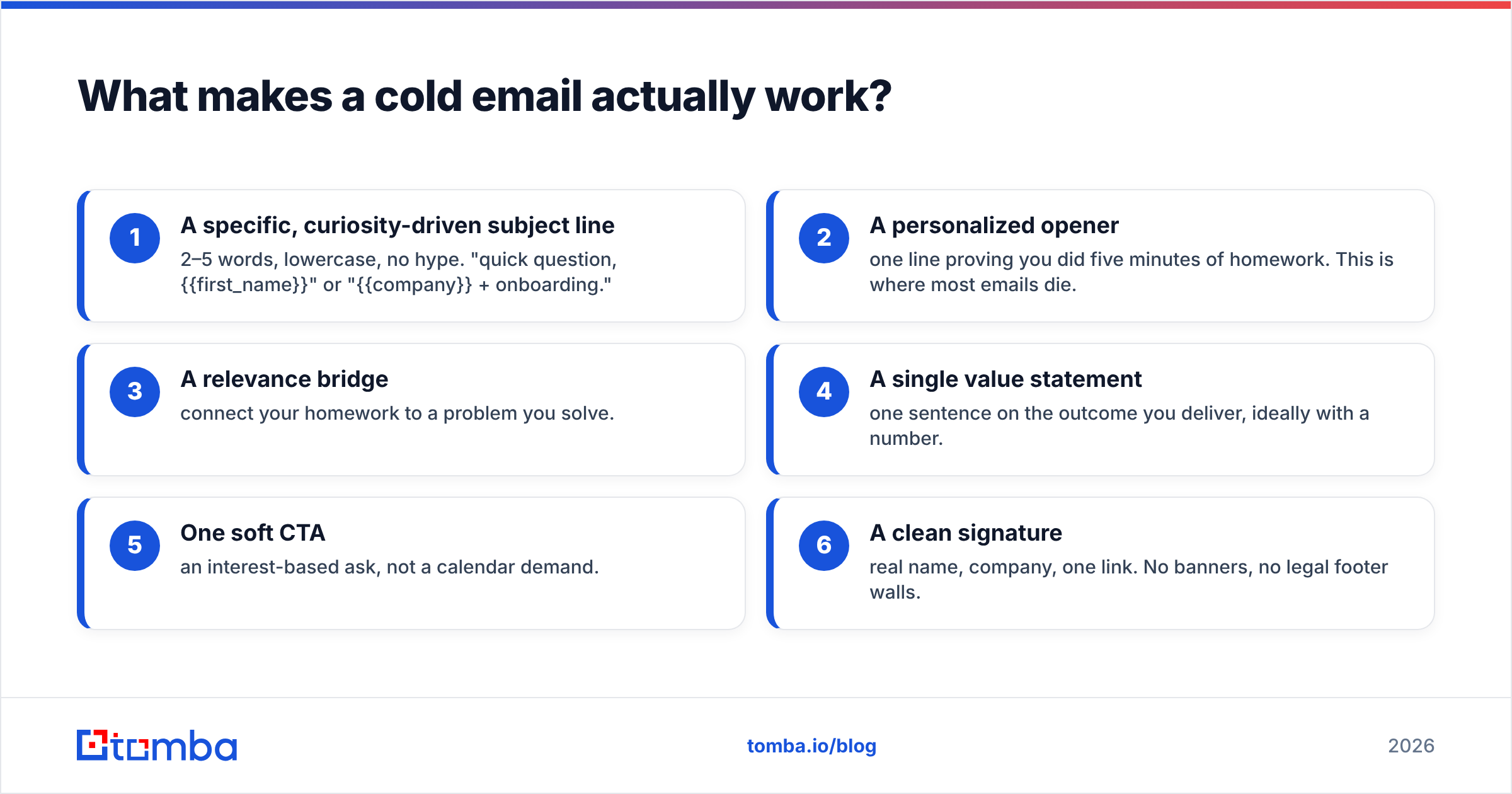
Here are the six components every strong cold email shares:
- A specific, curiosity-driven subject line — 2–5 words, lowercase, no hype. "quick question, {{first_name}}" or "{{company}} + onboarding."
- A personalized opener — one line proving you did five minutes of homework. This is where most emails die.
- A relevance bridge — connect your homework to a problem you solve.
- A single value statement — one sentence on the outcome you deliver, ideally with a number.
- One soft CTA — an interest-based ask, not a calendar demand.
- A clean signature — real name, company, one link. No banners, no legal footer walls.
If any of those six pieces is missing, the email underperforms. If you add a seventh thing — a second CTA, a second link, a second paragraph of pitch — it also underperforms. Restraint is the skill.
7 cold email examples you can copy#
Below are seven templates covering the most common B2B scenarios. Swap the bracketed variables, keep the structure, and test one variable at a time.
1. The trigger-event email (best reply rate)#
Subject: congrats on the {{round}} raise
Hi {{first_name}},
Saw {{company}} closed your Series B last week — congrats. New funding usually means the SDR team doubles in a quarter, and clean contact data becomes the bottleneck fast.
We help teams like {{competitor_customer}} feed verified prospect emails straight into their sequences, so reps spend time selling instead of guessing addresses.
Worth a quick look before you scale the team?
{{your_name}}
Why it works: the trigger event (funding) makes the outreach timely and relevant. "Why now?" is answered in the first sentence.
2. The problem-agitate-solve email#
Subject: bounced emails at {{company}}?
Hi {{first_name}},
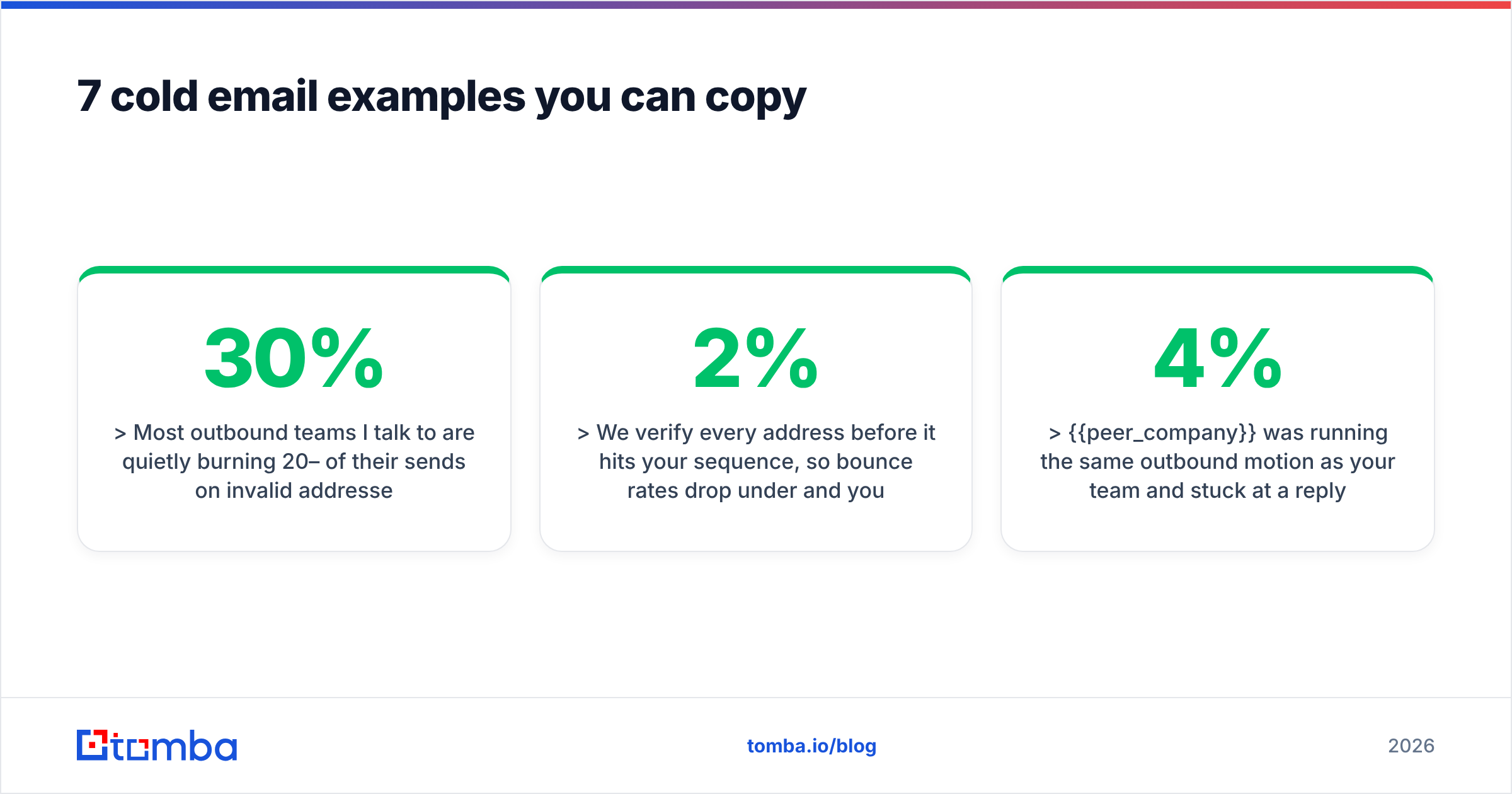
Most outbound teams I talk to are quietly burning 20–30% of their sends on invalid addresses — which tanks domain reputation and lands the good emails in spam too.
We verify every address before it hits your sequence, so bounce rates drop under 2% and your sender score recovers.
Open to seeing how it'd work on your current list?
{{your_name}}
3. The peer-proof email#
Subject: how {{peer_company}} 3x'd replies
Hi {{first_name}},
{{peer_company}} was running the same outbound motion as your team and stuck at a 4% reply rate. After cleaning their list and fixing personalization, they hit 12% in six weeks.
Happy to share the exact playbook — no pitch. Interested?
{{your_name}}
4. The question-only email#
Subject: who owns outbound at {{company}}?
Hi {{first_name}},
Quick one — are you the right person to talk to about how {{company}} sources prospect contact data, or should I reach out to someone on your RevOps team?
Thanks,
{{your_name}}
Why it works: it's a 30-second reply for the reader and often gets forwarded to the right person internally.
5. The referral / name-drop email#
Subject: {{mutual_contact}} suggested I reach out
Hi {{first_name}},
{{mutual_contact}} mentioned you're rebuilding the SDR stack at {{company}} this quarter. We handle the contact-data layer — verified emails and direct dials — for a few teams in your space.
Would a 10-minute intro be useful, or is now the wrong time?
{{your_name}}
6. The "break-up" follow-up#
Subject: should I close the loop?
Hi {{first_name}},
I've reached out a couple of times about tightening up {{company}}'s outbound data — no reply, which usually means one of three things: not a priority, wrong person, or bad timing.
Just let me know which and I'll act accordingly. No hard feelings either way.
{{your_name}}
7. The value-first (no ask) email#
Subject: teardown of your outbound flow
Hi {{first_name}},
I mapped how {{company}}'s current sign-up-to-outreach flow looks from the outside and spotted two gaps costing you replies. Wrote it up in a short doc — want me to send it over?
{{your_name}}
Use the cold email templates library if you want a running head start, and generate variations fast with the cold email AI writer when you're testing angles at scale.
Which cold email format performs best?#
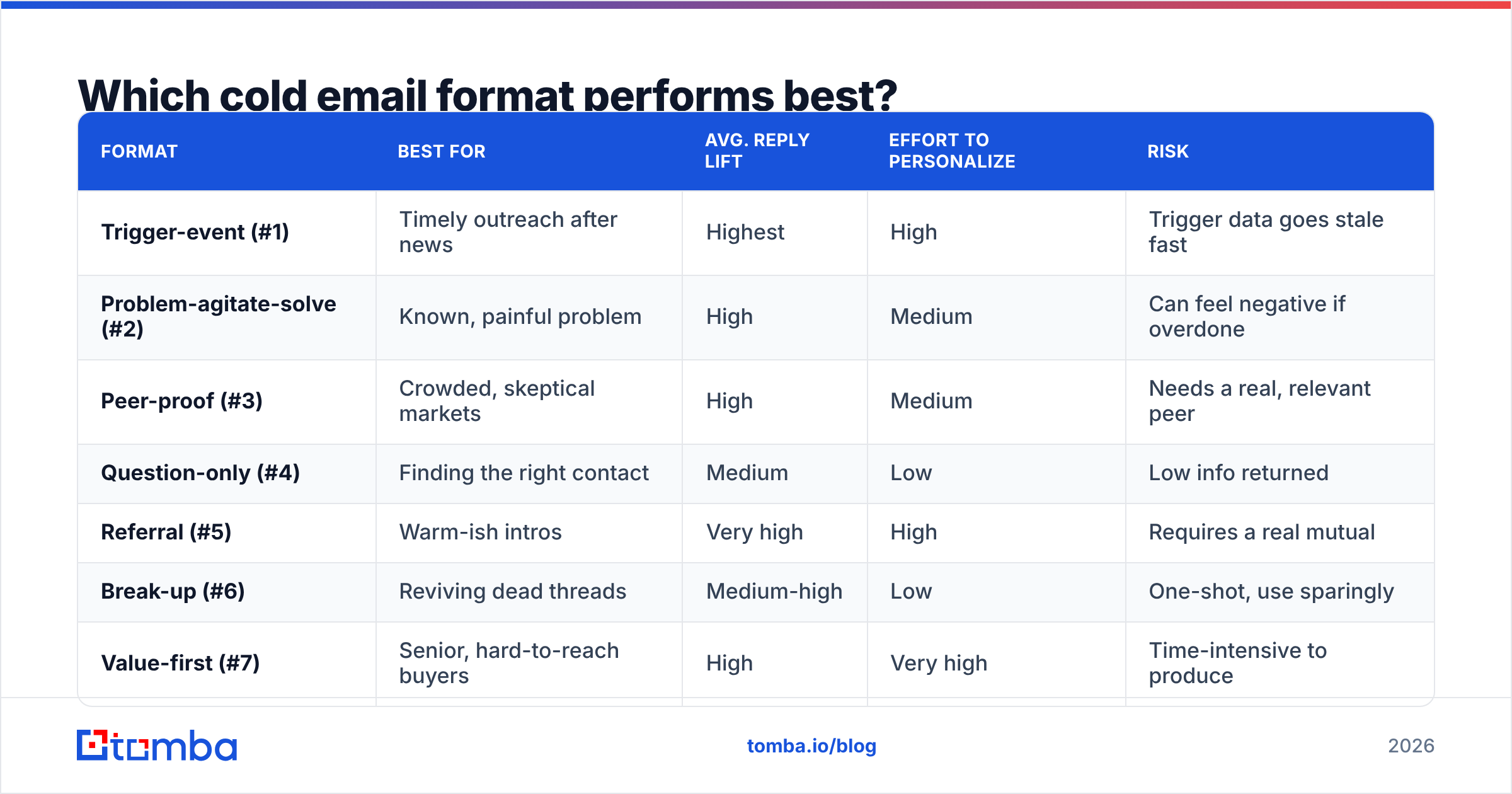
No single format wins every time — it depends on your list quality, your offer, and where the prospect sits in the buying cycle. Here's how the seven examples compare on the dimensions that matter.
| Format | Best for | Avg. reply lift | Effort to personalize | Risk |
|---|---|---|---|---|
| Trigger-event (#1) | Timely outreach after news | Highest | High | Trigger data goes stale fast |
| Problem-agitate-solve (#2) | Known, painful problem | High | Medium | Can feel negative if overdone |
| Peer-proof (#3) | Crowded, skeptical markets | High | Medium | Needs a real, relevant peer |
| Question-only (#4) | Finding the right contact | Medium | Low | Low info returned |
| Referral (#5) | Warm-ish intros | Very high | High | Requires a real mutual |
| Break-up (#6) | Reviving dead threads | Medium-high | Low | One-shot, use sparingly |
| Value-first (#7) | Senior, hard-to-reach buyers | High | Very high | Time-intensive to produce |
The pattern across all of them: the more specific the personalization, the higher the reply rate — and the harder it is to scale. Your job is to find the highest level of relevance you can sustain across your volume, not the most clever line you can write once.
How long should a cold email be?#
Keep it between 50 and 125 words. Boomerang's analysis of over 40 million emails found that messages of 50–125 words consistently earned the best response rates, and readability at a third-grade level outperformed more complex writing. Nobody on a phone reads a wall of text from a stranger.
A simple length test: if your email doesn't fit on a phone screen without scrolling, cut it. Remove every sentence that talks about you until only the reader's context and one ask remain. The subject line tester helps you keep the first impression tight too — subject lines under 30 characters tend to travel better on mobile.
Why do most cold emails end up in spam?#
Because the sender skipped the unglamorous work: list hygiene, domain warmup, and authentication. You can write the best cold email examples in the world and still get zero replies if the message never reaches the inbox.
Three things quietly kill deliverability before your copy ever gets a chance:
- Invalid addresses. Every hard bounce signals to mailbox providers that you're not a careful sender. Keep bounce rates under 2% by running your list through an email verifier before you send.
- Cold domains. A brand-new sending domain with no reputation gets throttled. Warm it gradually over 2–4 weeks before scaling volume. Google's own Postmaster Tools documentation is the source of truth for how Gmail judges senders.
- Missing authentication. No SPF, DKIM, or DMARC records means providers can't trust you. Check your SPF record setup and fix gaps before your first campaign.
Deliverability is the floor your copy stands on. Get it right once and every future example you send benefits.
How many follow-ups should you send?#
Send three to four total touches, spaced 3–4 days apart, then stop. Most positive replies don't come from the first email — they come from follow-ups #2 and #3, when the prospect finally has a free minute and your name is familiar.
The rules for follow-ups that don't annoy people:
- Add value each time. Never just "bumping this to the top of your inbox." Bring a new angle, a resource, or a shorter ask.
- Keep them shorter than the original. By follow-up #3, three sentences is plenty.
- Change the subject line thread sparingly. Staying in the same thread keeps context; a fresh subject can re-trigger curiosity on the last touch.
- End with the break-up. Example #6 gives the prospect an easy out — and often pulls a reply from people who meant to respond but forgot.
How do you find verified emails to send to?#
You find them by starting from the company domain or the person's name and verifying the result before you hit send. Guessing formats like first.last@company.com and hoping is how you rack up bounces.
A reliable workflow looks like this:
- Use a domain search to pull every discoverable address pattern at a target company.
- Narrow to the specific decision-maker with an email finder using their name plus the domain.
- Verify each address so your bounce rate stays low and your sender reputation stays intact.
- For volume, run a bulk email finder against your target account list and enrich the rest.
Clean input is what makes every template above actually land. The best-written cold email example is worthless if it bounces. If you're weighing tools, compare Tomba pricing — the free tier gives you 25 searches a month to test the workflow before committing.
Common cold email mistakes to avoid#
- Two CTAs. "Book a call or reply or check out our site" splits attention and kills action. One ask.
- The "I" opener. Starting with "I'm reaching out because I…" signals a template. Lead with them.
- Fake personalization. "I love what you're doing at {{company}}!" fools no one. Reference something specific and verifiable.
- Pitching features. Prospects buy outcomes, not feature lists. Translate every feature into a result.
- No follow-up. Sending once and giving up wastes 60% of your potential replies.
- Sending to unverified lists. The fastest way to land in spam and torch your domain reputation.
Cold email FAQ#
Are cold emails legal? Yes, when you comply with CAN-SPAM (US) and GDPR (EU): use accurate sender info, offer a clear opt-out, and have a legitimate business reason to contact B2B recipients. Review HubSpot's cold email guidance for the compliance basics.
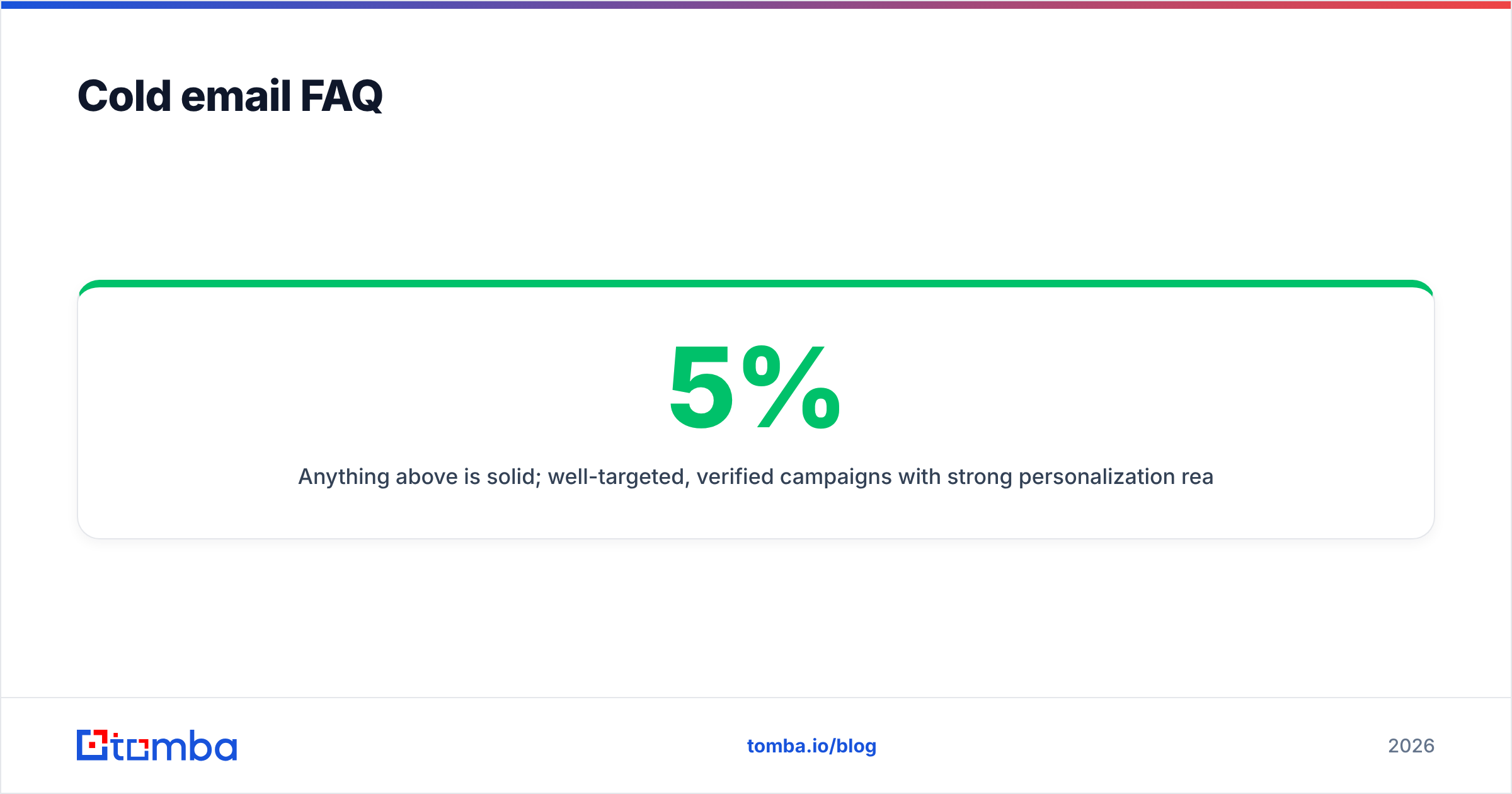
What's a good cold email reply rate? Anything above 5% is solid; well-targeted, verified campaigns with strong personalization reach 10–15%. If you're under 2%, the problem is usually list quality or deliverability, not copy.
Should I use AI to write cold emails? Use AI to draft variations and beat writer's block, then edit for specificity. AI-generated emails that go out unedited all sound the same — and prospects can tell.
Start with data that actually delivers#
The best cold email example in this guide won't get a single reply if it bounces or lands in spam. Great outreach starts one step earlier — with a verified, accurate contact.
Use the Tomba Email Finder to find professional email addresses by domain, name, or company, and verify them before they ever enter your sequence. Start free with 25 searches a month, then scale on the Starter plan at $49/mo when your reply rates prove the model. Write the email like it's for one person — and make sure it reaches them.
Related guides#
Ready to find emails that actually work?
Join 150,000+ professionals who stopped guessing and started sending. Free credits on signup — no credit card required.
Get the Tomba newsletter
Practical outbound tactics and product updates — once every two weeks.
About the author