Cold Email for Collaboration: How to Write One That Gets Replies
A practical guide to writing a cold email for collaboration that lands partnerships, guest posts, and co-marketing deals — with templates, subject lines, and a step-by-step outreach process.
Collaboration deals — guest posts, co-marketing, podcast swaps, affiliate partnerships, influencer campaigns — rarely start with a warm intro. They start with a stranger who decided your work was worth an email. The problem is that most of those emails read like a template someone forgot to finish, and they die in the archive.
This guide breaks down how to write a cold email for collaboration that a busy founder, editor, or creator actually replies to. You'll get the structure, the psychology, subject lines, a comparison of outreach angles, and copy-paste templates you can adapt today.
TL;DR#
- A collaboration email is a value pitch, not a favor request. Lead with what the other person gains, not what you need.
- Personalization beats volume. One researched, specific email outperforms 100 generic blasts on reply rate every time.
- Structure wins: relevant hook → clear value → specific ask → zero-friction next step. Keep it under 150 words.
- Get the right address first. A perfect pitch sent to
info@or a guessed inbox never gets read — use a real, verified contact. - Follow up 2–3 times. Most collaboration replies come on the second or third touch, not the first.
What is a cold email for collaboration?#
A cold email for collaboration is an unsolicited message proposing a mutually beneficial partnership to someone you have no prior relationship with. Think of it like asking a neighbor you've never met to co-host a block party: you can't lead with "do me a favor" — you have to show up with a plan, a reason it helps them, and a low-effort way to say yes.
Unlike a cold sales email, you're not trying to close a transaction. You're proposing to build something together: content, an audience swap, a bundle, an event, a backlink exchange, a joint webinar. Because both sides invest effort, the bar for trust is higher — and that changes how you write.
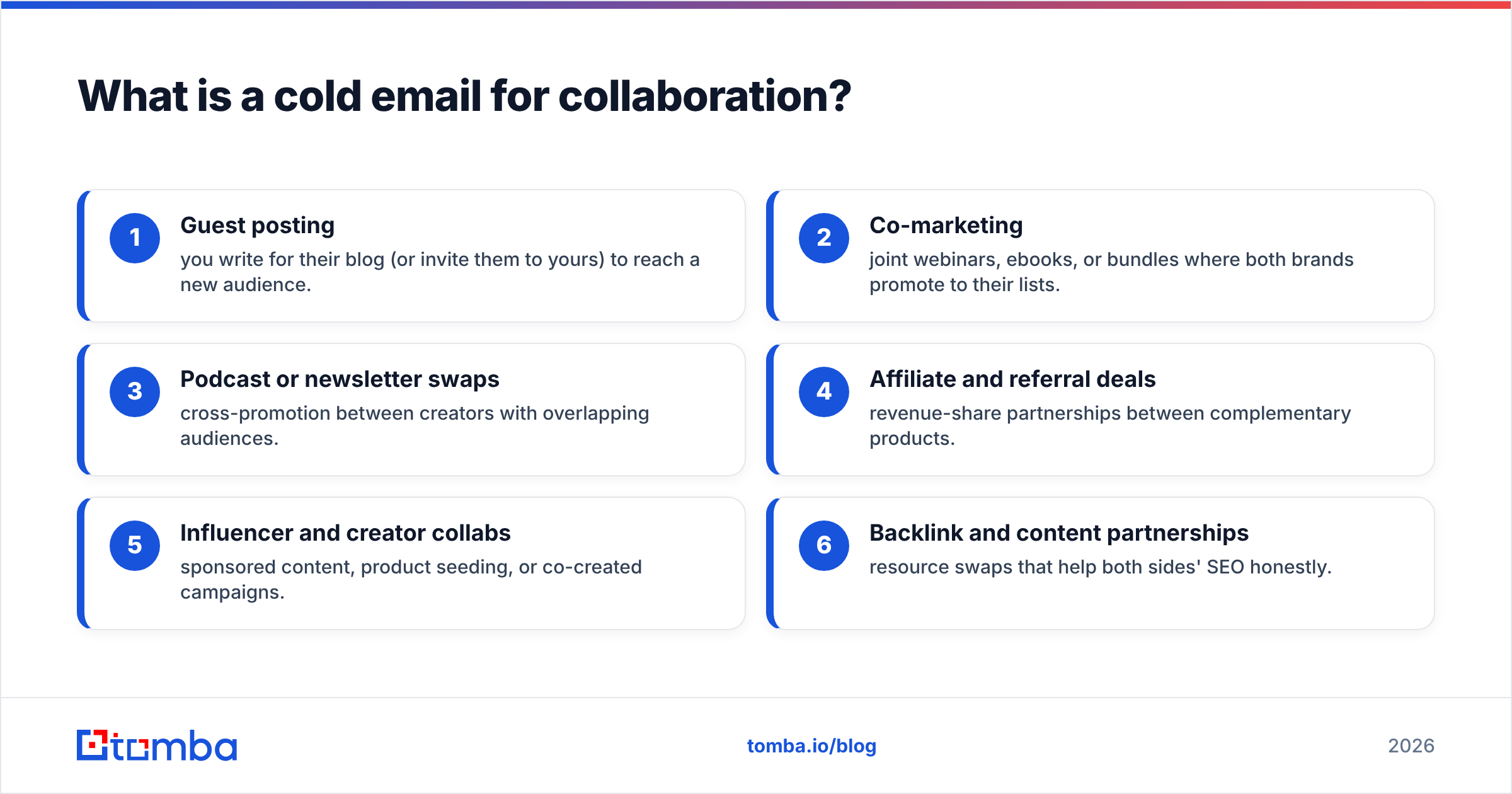
The most common collaboration types you'll pitch:
- Guest posting — you write for their blog (or invite them to yours) to reach a new audience.
- Co-marketing — joint webinars, ebooks, or bundles where both brands promote to their lists.
- Podcast or newsletter swaps — cross-promotion between creators with overlapping audiences.
- Affiliate and referral deals — revenue-share partnerships between complementary products.
- Influencer and creator collabs — sponsored content, product seeding, or co-created campaigns.
- Backlink and content partnerships — resource swaps that help both sides' SEO honestly.
Why do most collaboration emails get ignored?#
Because they're written from the sender's point of view. The average pitch opens with "I'm reaching out because I'm a huge fan of your work" — a line so overused it now signals nothing was researched. Then it pivots straight to the ask, and the reader closes the tab.
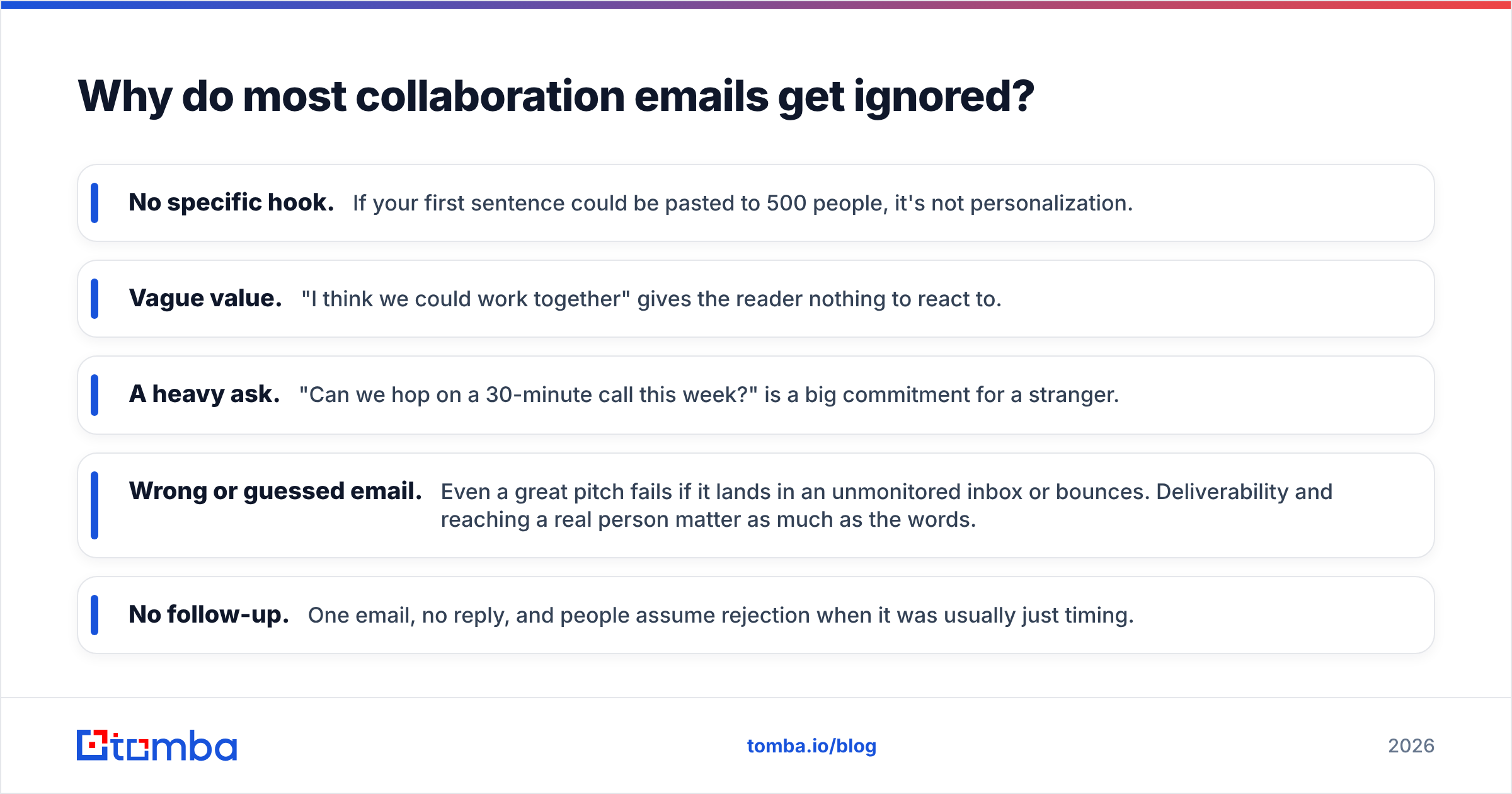
Here's what kills a collaboration pitch:
- No specific hook. If your first sentence could be pasted to 500 people, it's not personalization.
- Vague value. "I think we could work together" gives the reader nothing to react to.
- A heavy ask. "Can we hop on a 30-minute call this week?" is a big commitment for a stranger.
- Wrong or guessed email. Even a great pitch fails if it lands in an unmonitored inbox or bounces. Deliverability and reaching a real person matter as much as the words.
- No follow-up. One email, no reply, and people assume rejection when it was usually just timing.
The fix is not a cleverer template. It's shifting the whole email so the recipient's upside is obvious in the first two lines.
What makes a collaboration email actually work?#
A reply-worthy cold email for collaboration does four things, in order:
1. Opens with proof you did the homework. Reference a specific post, product launch, episode, or number. "Your teardown of the Notion pricing page" beats "your content."
2. States the value to them, fast. Name the audience, reach, or asset you bring. "My newsletter has 12,000 RevOps subscribers who match your ICP" is concrete and checkable.
3. Makes one specific, small ask. Propose a concrete format, not an open-ended "let's chat." "Would you be open to a guest post on X?" is easier to answer than "want to collaborate?"
4. Removes friction from yes. Offer to do the heavy lifting — draft the outline, send the first idea, handle scheduling. Give them a one-word-reply exit.
Keep the entire email under 150 words. Editors and founders skim; a wall of text is an instant delete. For more on why brevity and personalization drive replies, HubSpot's research on email personalization is a solid, data-backed reference.
Which collaboration angle should you lead with?#
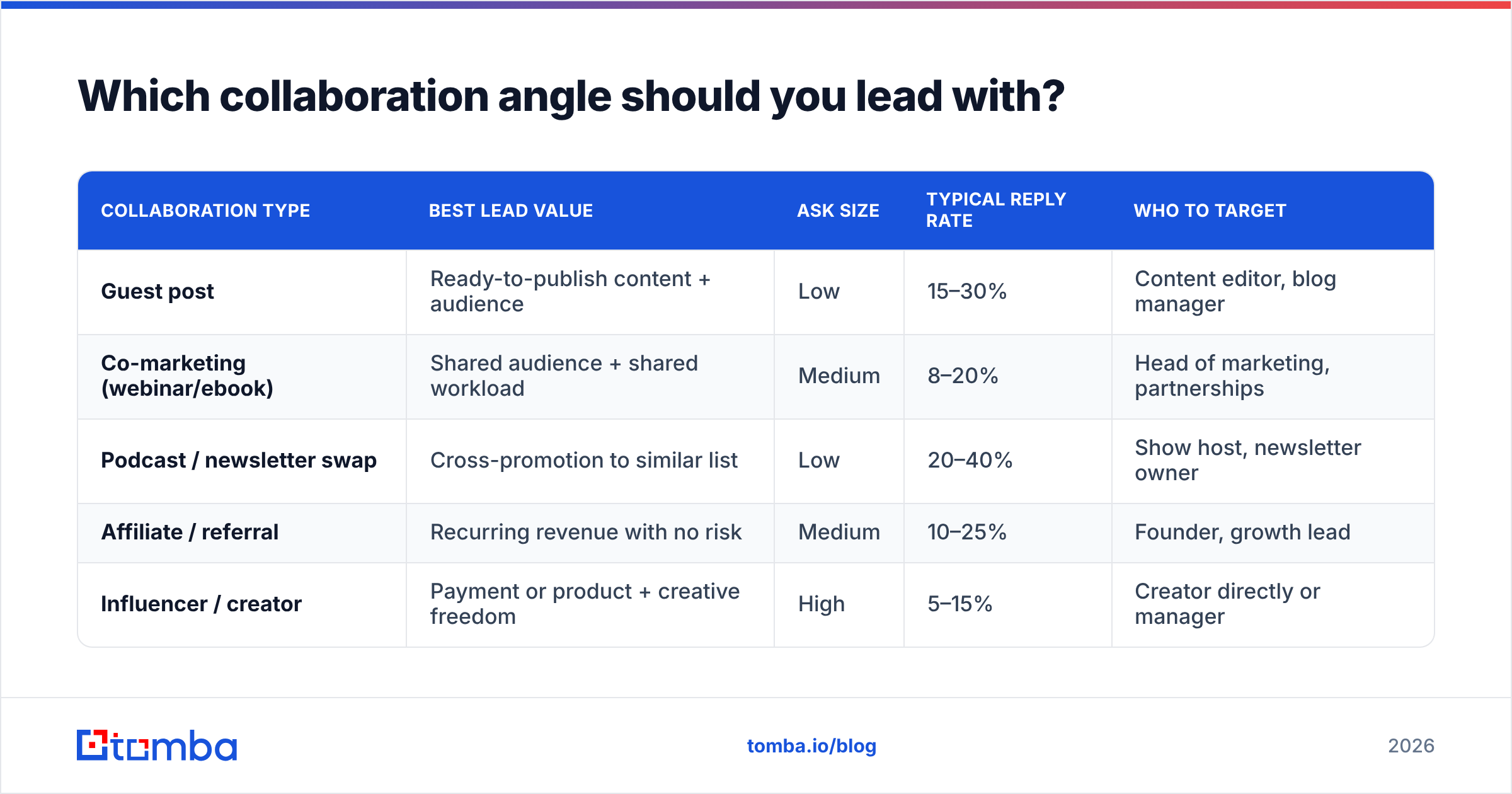
Different partnerships call for different pitches. Use this table to match your angle to the outcome and effort involved.
| Collaboration type | Best lead value | Ask size | Typical reply rate | Who to target |
|---|---|---|---|---|
| Guest post | Ready-to-publish content + audience | Low | 15–30% | Content editor, blog manager |
| Co-marketing (webinar/ebook) | Shared audience + shared workload | Medium | 8–20% | Head of marketing, partnerships |
| Podcast / newsletter swap | Cross-promotion to similar list | Low | 20–40% | Show host, newsletter owner |
| Affiliate / referral | Recurring revenue with no risk | Medium | 10–25% | Founder, growth lead |
| Influencer / creator | Payment or product + creative freedom | High | 5–15% | Creator directly or manager |
The pattern: the lower the ask and the clearer the mutual audience, the higher your reply rate. Start collaborations with the low-ask formats (guest posts, swaps) to build a relationship, then propose bigger co-marketing plays once there's trust.
How do you write a cold email for collaboration, step by step?#
Follow this sequence and you'll avoid the mistakes above.
Step 1 — Build a tight target list. Twenty-five well-matched prospects beat a list of 500 random ones. Filter for audience overlap, comparable size, and complementary (not competing) offerings.
Step 2 — Find the right person and a verified email. Pitch the actual decision-maker, not a shared inbox. Use a domain search to see who works there, then confirm the address with an email verifier so your pitch doesn't bounce or hurt your sender reputation. A guessed address is the single most common reason a good pitch never gets read.
Step 3 — Research one specific hook per prospect. Read a recent post, note a product update, or find a shared connection. This one line is what separates a collaboration email from spam.
Step 4 — Write the four-part structure. Hook → value → specific ask → frictionless next step. One idea per email.
Step 5 — Nail the subject line. It decides whether step 4 is ever seen (more below).
Step 6 — Follow up on a schedule. Two to three spaced follow-ups, each adding a new angle or a small new value, not just "bumping this."
Step 7 — Track and iterate. Log opens, replies, and wins. Kill the templates that don't perform and double down on the ones that do.

What subject lines get collaboration emails opened?#
Your subject line is the pitch for your pitch. It should signal relevance and mutual benefit without sounding like marketing spam. Keep it under ~45 characters so it isn't cut off on mobile, and avoid anything that reads like a promotion.
High-performing patterns for a cold email for collaboration:
- Specific + curious: "Idea for [their brand] + [your brand]"
- Reference-based: "Loved your [specific post] — quick idea"
- Audience-led: "12k RevOps readers ↔ your audience?"
- Format-first: "Guest post pitch for [blog name]"
- Peer-to-peer: "Podcast swap? Our audiences overlap"
Avoid "Partnership opportunity," "Collaboration request," and "Quick question" — they're the exact phrases mass-blasters use, so they trigger skepticism. If you want to sanity-check tone and spam risk before sending, a free subject line tester helps you compare variants.
Cold email templates for collaboration you can steal#
Adapt these — don't paste them verbatim. The specifics (the bracketed parts) are the whole point.
Template 1 — Guest post pitch
Subject: Guest post idea for [Blog]
Hi [Name],
Your recent piece on [specific topic] was the clearest breakdown I've read — especially the part about [detail].
I write for [your audience/publication] and I'd love to contribute a piece your readers would use: "[proposed title]." I'll deliver a fully edited draft with original data, so it's zero work on your end until review.
Want me to send a short outline?
[Your name]
Template 2 — Co-marketing / webinar
Subject: Idea for [Their brand] + [Your brand]
Hi [Name],
We both serve [shared audience], and I think a joint [webinar/ebook] on [topic] would be a win for both lists. My side brings [X subscribers / Y reach]; you'd bring the [their strength].
I'm happy to handle the [logistics/design/promotion draft]. Open to a quick idea doc I can send over?
[Your name]
Template 3 — Podcast / newsletter swap
Subject: Audience swap? We overlap a lot
Hi [Name],
I run [your show/newsletter] for [audience], and our readers overlap heavily with yours. Would you be open to a cross-promo swap — I feature you, you feature me — no cost either way?
If yes, I'll send two ready-to-use blurbs so it takes you five minutes.
[Your name]
Notice the pattern in all three: specific hook, concrete value, one small ask, and an offer to do the work. For more angle variations, our cold email templates library has additional structures you can adapt.
How many follow-ups should you send?#
Two to three, spaced three to five business days apart. Most collaboration replies arrive on the second or third touch — not because the first was ignored on purpose, but because it landed on a busy day.
Rules for follow-ups that don't annoy:
- Add value each time. A new content idea, a relevant stat, a fresh example — never just "just bumping this."
- Stay short. Two or three sentences max on follow-ups.
- Change the angle. If the guest-post ask stalled, try a swap or a smaller collaboration.
- Know when to stop. After the third unanswered email, move on and revisit in a quarter.
A clean, verified list keeps your follow-up cadence from hurting deliverability. If you're sending at any volume, protect your sender reputation by verifying addresses before the first send and pruning bounces after.
What tools help you run collaboration outreach at scale?#
You need three things: a way to find the right contacts, a way to verify them, and a way to keep pitches organized. Vendor-neutral resources like G2's outreach software category are useful for comparing sending platforms, while Gmail's bulk-sender guidelines explain the deliverability rules you have to respect.
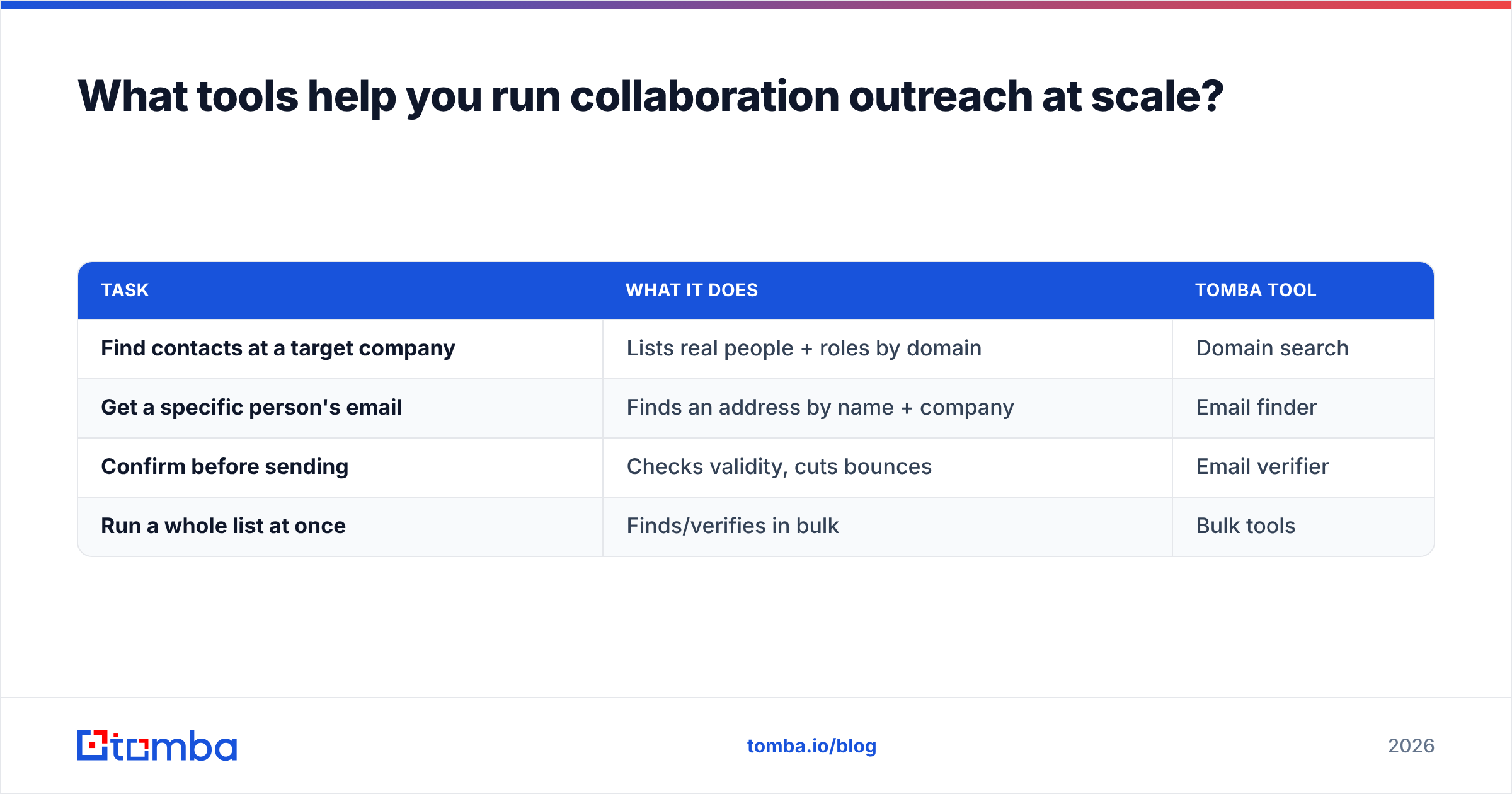
For the contact-data layer — finding and confirming who to actually email — here's how the core pieces fit together:
| Task | What it does | Tomba tool |
|---|---|---|
| Find contacts at a target company | Lists real people + roles by domain | Domain search |
| Get a specific person's email | Finds an address by name + company | Email finder |
| Confirm before sending | Checks validity, cuts bounces | Email verifier |
| Run a whole list at once | Finds/verifies in bulk | Bulk tools |
Tomba's pricing scales with your outreach volume: a Free tier with 25 searches/month to test the workflow, then Starter at $49/mo and Growth at $99/mo as your partnership pipeline grows. You can see the full breakdown on the Tomba pricing page.
Common mistakes that sink collaboration pitches#
- Pitching competitors. Collaboration needs complementary, not overlapping, offers. A direct rival has no reason to help you.
- Making it all about you. If the reader can't find their benefit in the first two lines, they won't hunt for it.
- Sending to the wrong inbox.
hello@andinfo@are graveyards. Reach a named person. - Over-formatting. Heavy HTML, images, and multiple links read as marketing, not a peer reaching out.
- No clear yes-path. "Let me know your thoughts" is weaker than "Want the outline? Just reply 'yes.'"
- Giving up after one email. The single-send-and-quit approach leaves most of your wins on the table.
Wrap-up: your collaboration outreach checklist#
A cold email for collaboration works when it reads like a peer offering a genuine win — researched, specific, low-friction, and sent to a real person who can say yes. Build a tight list, lead with their upside, keep it under 150 words, nail the subject line, and follow up with new value two or three times.
The one thing that quietly makes or breaks every campaign is reaching the right inbox. Before you send your next partnership pitch, find and confirm the decision-maker's address with the Tomba Email Finder — start free with 25 searches, verify your list, and make sure your best pitch actually gets read instead of bouncing. Great collaborations don't start with volume. They start with one good email that lands.
Related guides#
Ready to find emails that actually work?
Join 150,000+ professionals who stopped guessing and started sending. Free credits on signup — no credit card required.
Get the Tomba newsletter
Practical outbound tactics and product updates — once every two weeks.
About the author